
Key Takeaways
- Rankings predict impressions, not pipeline. Treat position as an input variable alongside crawl health and content velocity, with qualified leads measured through CRM-stage progression as the real output.
- Instrument five linked stages—impression, click, engaged visit, trusted page, and qualified lead—so each failure mode gets assigned to a specific owner rather than lumped into a vanity rank-tracking dashboard.
- In YMYL categories, trust is produced on the page, not inherited from position 1. Named authors, dated expert review, and source transparency differentiate against a weak editorial baseline 5.
- Compliance now shapes rankings and measurement directly: FTC fake-review rules 2, 3reshape testimonial workflows, and HIPAA tracking guidance 10forces server-side forwarding, BAAs, and identifier redaction.
Rankings Are an Input Variable, Not a Business Outcome
Position tracking still dominates most SEO reports delivered to in-house marketing leaders. A ranking number, on its own, does not predict a single qualified consult, intake call, tour request, or booked appointment. It predicts the probability of an impression, which is only the first link in a longer chain.
This distinction matters because research on search behavior has quietly decoupled visibility from credibility. A peer-reviewed experiment with 3,196 participants across three studies found that higher-ranked accurate results were clicked more often but were not trusted more by searchers, and warnings attached to results reduced trust in accurate information as well as misinformation 1. The study used COVID-19 queries with controlled result ordering; the directional finding still holds: rank buys attention, not belief.
For a VP defending organic investment to a CFO, that reframes the entire reporting conversation. Rankings belong on the input side of the model, next to crawl health, index coverage, and content velocity. The output side is qualified pipeline, measured through first-party conversion data and CRM-stage progression. Everything between those two sides, including click-through rate, engaged visit depth, trust signals on the landing page, and completion of the intended task, is a stage that can be instrumented and improved independently.
The sections that follow treat ranking as one variable in that chain rather than the headline metric. Each stage carries its own failure mode, its own data source, and its own governance requirement, particularly for behavioral health intake, senior living tour requests, legal consultations, and other categories where regulators and search quality raters apply stricter scrutiny.
The Pipeline Chain That Replaces the Rank-Tracking Dashboard
From Impression to Qualified Lead: Five Stages, Five Failure Modes
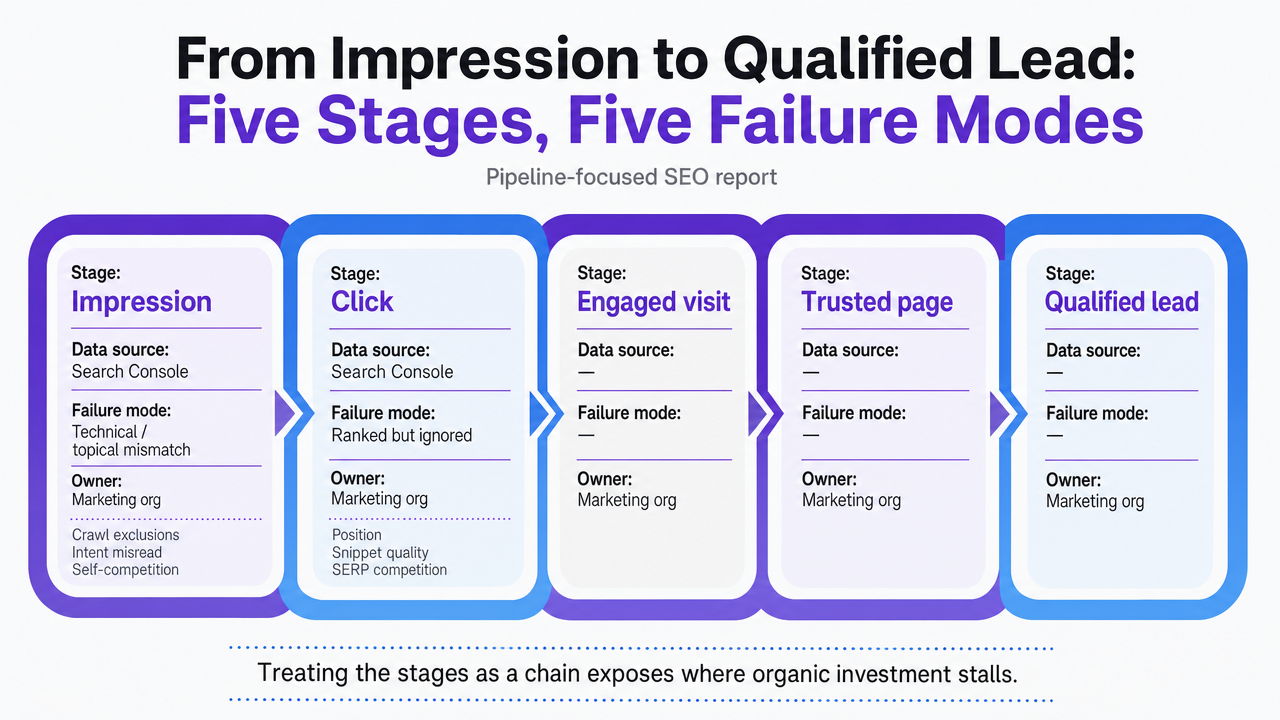
A pipeline-focused SEO report tracks five linked stages: impression, click, engaged visit, trusted page, and qualified lead. Each stage has its own data source, its own failure mode, and its own owner inside the marketing organization. Treating them as a chain rather than a scorecard exposes exactly where organic investment stalls.
Impression is a Search Console metric and reflects whether the ranking system considers a page eligible for the query. Failure here is usually a technical or topical mismatch problem—crawl exclusions, intent misread, or a page that competes with itself across clusters. The click stage layers on position, snippet quality, and SERP feature competition. Its failure mode is the classic ranked-but-ignored page: visible, but not persuasive at the title and description level.
The engaged visit stage is where analytics should carry the weight. A dental DSO landing page that pulls traffic but produces three-second sessions is a loading, layout, or relevance failure, not a ranking failure. The trusted page stage is the one most SEO dashboards omit entirely. It covers whether the visitor finds the author, the organization, the sourcing, the credentials, and the proof points credible enough to continue—a judgment that moves independently from rank. The decoupling of position and trust is a useful finding: position earns the click, the page has to earn the belief.
The qualified lead stage closes the chain in the CRM, not the analytics tool. Its failure mode is a volume of form fills or calls that intake teams disqualify. Instrumenting all five stages gives a VP a diagnostic map rather than a vanity dashboard, and lets each failure be assigned to a specific owner—technical SEO, content, UX, editorial governance, or intake operations.
 Visualize the five-stage pipeline chain the section explicitly describes, pairing each stage with its data source, failure mode, and owner
What Ranking Quality Actually Does to Clicks
Position is the variable most SEO reports fixate on, but the better predictor of click behavior is ranking quality—whether the results surfaced for a query are the ones the searcher actually wanted. The distinction is not academic. It changes which investments earn pipeline.
A Stanford working paper on web-search market power measured user response to deliberately degraded organic rankings and found that overall organic click-through rate fell 7.51% after ranking quality dropped, while the top-link click-through rate fell 15.3% 8. The experimental context was general web search; the structural point still carries: when the top result is a poorer match for intent, searchers click less at the top and redistribute attention down the page or off it entirely.
For a VP evaluating organic performance, that reframes a familiar pattern. A page that moved from position four to position two but lost click-through rate is not necessarily a title-tag problem. It is often a quality-of-match problem—the page ranks for a query it only partially answers, and the SERP now surfaces competitors who answer it more directly. The remedy is topical, not cosmetic.
For behavioral health intake queries, personal injury consult requests, and senior living tour searches, the implication is sharper. These queries carry high intent and high ambiguity. A page that ranks for "outpatient treatment near me" without specifying levels of care, insurance accepted, or admissions process is competing on position while losing the quality-of-match contest. Click-through rate becomes the earliest signal that ranking position has outrun ranking relevance. The operational response is to pair Search Console query data with intent audits on the top ten landing pages each quarter, and to treat a declining CTR at a stable position as a content problem rather than a snippet problem.
Test live ranking improvements on your domain
Validate organic pipeline impact with real content published and tracked on your own site during the trial.
Why Visibility Does Not Equal Trust in YMYL Verticals
The Editorial Quality Baseline on Health, Legal, and Care Content
The editorial baseline on YMYL websites is weaker than most marketing leaders assume, and that weakness sets the ceiling on what a top ranking can produce. A systematic review of online health information quality found that none of the assessed websites reached the "excellent" quality category, with 37 to 79 percent rated good depending on the evaluation context and the remainder rated poor 5. The review aggregated studies that used established quality instruments, so the exact percentages shift across samples and should not be read as a universal grade for every health SERP. The pattern is still the pattern: excellence is rare, and mediocrity is the default competitive set a well-governed page is measured against.
A 2025 study of patients with high cardiovascular risk in Malaysia pushed the analysis one step further by measuring whether readers actually trusted information according to its quality. Misinformation appeared in 23.3 percent of information entries, and only 51.5 percent of entries were appropriately trusted—meaning the reader's confidence matched the material's accuracy 6. The study population and condition scope are narrow, so the figures should not be projected onto senior living inquiries or dental new-patient research. The structural signal is portable: nearly half of the trust judgments readers make on health content are miscalibrated in one direction or the other.
For a behavioral health intake page, a DSO procedure explainer, or a personal injury practice-area page, those numbers reframe editorial governance as a ranking and conversion input rather than a brand sidebar. Pages that name authors with verifiable credentials, cite primary sources, carry visible medical or legal review dates, and separate marketing claims from clinical or legal statements are competing against a baseline where most of the SERP cannot do the same. That gap is the lever. The team that treats expert review, source transparency, and update cadence as production requirements, rather than optional polish, moves the trusted-page stage of the pipeline chain in a way that no title-tag revision will match.
What Readers Actually Judge: Navigability, Clarity, and Source Transparency
A meta-analysis of 147 empirical studies on web-based health information quality identified the strongest antecedents of perceived quality as navigability, aesthetics, and ease of understanding, with perceived quality in turn linked to intentions to use the information and satisfaction with it 4. The studies span varied populations and site types, so the finding is directional rather than a universal weighting. The implication for a VP running intake pages is specific: readers form quality judgments from signals that production teams often treat as cosmetic.
Navigability means a visitor on a senior living community page can locate pricing bands, care levels, visitation policy, and tour-request paths without hunting. Ease of understanding means a behavioral health admissions page explains levels of care, insurance verification, and intake timing in language a family member in crisis can parse on the first read. Aesthetics is not decoration—it is the visual hierarchy that makes the preceding two possible.
Source transparency sits alongside those three as the signal that most directly addresses the trust gap the YMYL evidence base documents. Named authors with verifiable credentials, dated reviews by licensed clinicians or attorneys, and citations to primary research or statute convert a page from a marketing asset into a reference the visitor can defend to a spouse, a referring physician, or a corporate counsel. The operational move is to audit the top ten converting landing pages against those four criteria each quarter and route failures to editorial rather than to the SEO backlog. Trust is produced on the page, not inherited from the rank above it.
Compliance as a First-Order Ranking Input
The FTC Fake Reviews Rule and the Testimonial Workflow It Breaks
Review velocity, star-average lift, and testimonial carousels have been standard local-SEO tactics for a decade. The FTC's final rule on fake reviews and testimonials, announced in August 2024 and effective October 21, 2024, retired most of the shortcuts that made those tactics cheap 2. The rule prohibits creating, selling, purchasing, or disseminating fake reviews and testimonials, including AI-generated reviews representing nonexistent people or experiences, and it reaches undisclosed insider reviews, deceptive company-controlled review websites, and certain review suppression practices 2. The Federal Register text adds the authoritative detail on buying positive or negative reviews, conditioning compensation on sentiment, and misrepresenting independence 3.
For a DSO coordinating new-patient reviews across forty locations, a personal injury firm running client-story landing pages, or a senior living operator soliciting family testimonials after a tour, the operational consequences are specific. Incentives that condition any payment, discount, or gift card on the sentiment of a review are off the table. Employee reviews posted without a clear disclosure of the employment relationship are off the table. Takedown workflows that lean on intimidation rather than genuine content-policy violations expose the operator to enforcement risk. The accompanying FTC guidance on endorsements reinforces that endorsements must be truthful and non-misleading, and that material connections between an endorser and the business generally must be clearly disclosed 7.
The workflow that survives looks different from the one most agencies built. Review requests go to every eligible patient, client, or resident family, not only the ones intake flagged as happy. Compensation, if any, is tied to the act of leaving a review, not to its content or star rating. Clinician, attorney, and staff testimonials carry an on-page disclosure of the employment relationship. Review-platform takedown requests are filed on documented policy grounds and logged for audit. Legal review sits inside the publishing path, not alongside it. The reputation signal that feeds local pack rankings still gets built—it just gets built from honest volume rather than curated volume, and it holds up when a regulator or plaintiff's counsel asks to see the collection records.
HIPAA Tracking Obligations and the Conversion Measurement Stack
The analytics stack most marketing teams inherited assumes a single trade-off between measurement depth and page performance. For healthcare and behavioral health operators, HHS Office for Civil Rights added a second trade-off that outranks the first. The OCR bulletin on online tracking technologies explains that HIPAA-covered entities and business associates must configure tracking so that uses and disclosures of protected health information comply with the Privacy Rule and that electronic PHI is protected under the Security Rule 10. The guidance acknowledges that not every unauthenticated page interaction involves PHI, but it requires regulated entities to assess context, data flows, vendors, and whether the information can identify or relate to an individual's health condition or care 10.
That assessment changes which conversion events a behavioral health intake page, an oncology service line, or a cardiology appointment-request flow can send to a standard analytics or ad platform. Form submissions that transmit a treatment interest alongside an IP address or device identifier can qualify as PHI disclosures when the receiving vendor is not under a business associate agreement. Call tracking that records the number dialed, the service line page it came from, and the caller's phone number raises the same question. Remarketing audiences built from visits to a specific condition page carry the same risk.
The measurement stack that holds up pairs server-side event forwarding with vendor contracts that cover PHI, strips or hashes identifiers before anything leaves the covered entity's boundary, and segments conversion events by whether the originating page is condition-specific or general. Call intelligence platforms used in these verticals need a signed BAA and configurable redaction on recordings and transcripts. The pipeline-chain report still closes in the CRM, but the path from engaged visit to qualified lead runs through infrastructure that assumes a regulator will eventually ask how each identifier moved. Teams that defer this work tend to discover it during a breach notification or an OCR inquiry, not during a quarterly SEO review.
See How Enterprise Teams Achieve Top Google Rankings Without Expanding Headcount
Request a data-driven assessment of your current ranking signals and learn how AI-powered execution can streamline pipeline growth across content, SEO, and conversion—no additional team or agency required.
Reporting That Survives a CFO Review
A CFO does not reject organic marketing reports because they lack rankings. CFOs reject them because they cannot trace a dollar from spend to a line on the pipeline report. The reporting layer that holds up swaps rank-tracking screenshots for a task-completion view that lines up with how finance already thinks about customer acquisition.
The U.S. government's Digital Analytics Program recommends measuring traffic, engagement, task completion, return likelihood, top referring search terms, low-CTR queries, page load time, and user experience, with completion rate of the intended task sitting among the baseline metrics 9. The guidance was built for public-sector digital services rather than private-sector lead generation; the structural recommendation does: report on whether visitors finished the thing they came to do, and surface the queries where visibility exists but the click is not happening.
Translated into a marketing report a CFO will read, that produces four blocks. First, qualified visibility—impressions and clicks segmented by query intent, not aggregated across the whole domain. Second, task completion rate on the pages that matter, defined by the specific action each page is built to produce: a tour request on a senior living community page, a consult form on a personal injury practice-area page, an admissions call on a behavioral health intake page, a new-patient booking on a DSO location page. Third, a low-CTR query register that names the pages ranking without earning clicks, with an owner and a remediation date beside each entry. Fourth, CRM-stage progression that attributes qualified leads back to the originating page and query, with lead-to-consult and consult-to-close rates visible on the same page.
That report structure retires three artifacts marketing leaders should stop sending to finance: the keyword-count summary, the undifferentiated organic sessions chart, and the "page one" celebration slide. None of them map to a line on the pipeline report. The replacement runs on data the team already collects—Search Console, GA4 or server-side equivalent, and CRM—assembled against the stages of the chain the earlier sections laid out.
The Operating Model Question for Multi-Location Programs
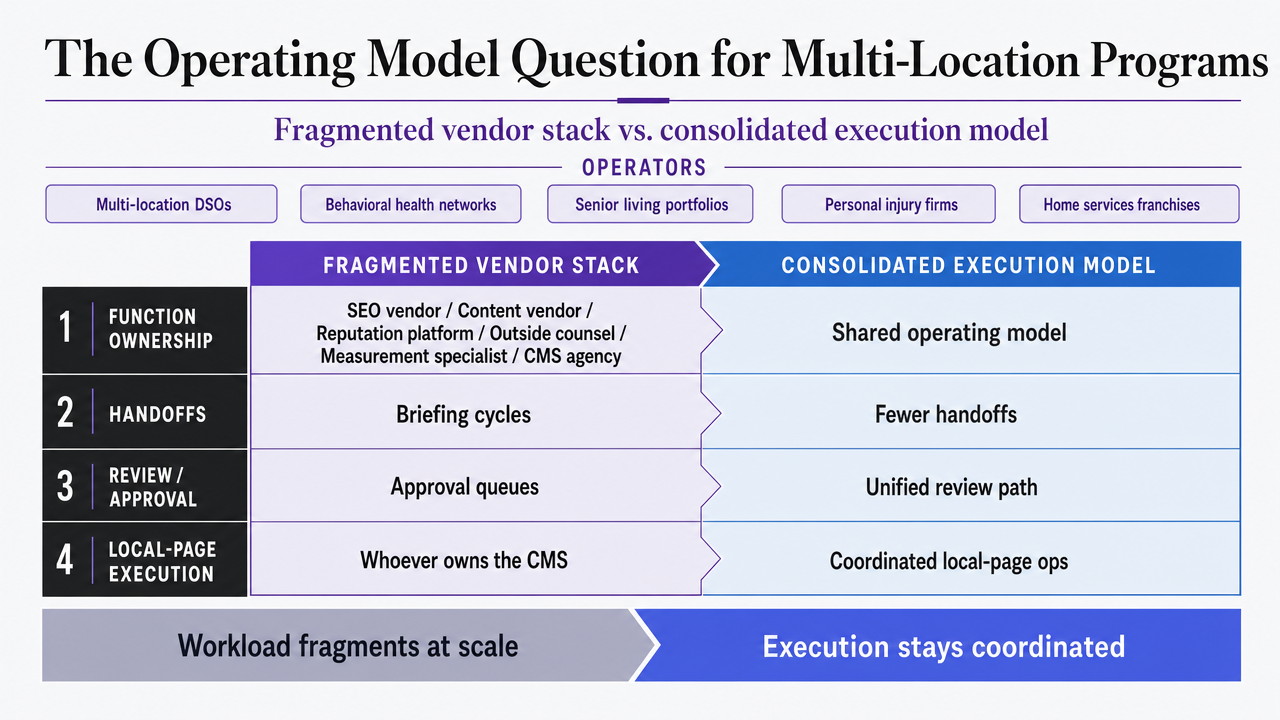
The preceding sections apply to any in-house marketing team running an organic program. This one narrows to the operators who feel the pipeline chain's coordination tax most acutely—multi-location DSOs, behavioral health networks, senior living portfolios, personal injury firms with multiple office locations, and home services franchises managing dozens of local pages at once.
The functional workload the earlier sections described does not shrink at scale. It fragments. Technical SEO sits with one vendor, content production with another, review management with a reputation platform, FTC and HIPAA review with outside counsel or a compliance consultant, analytics instrumentation with a measurement specialist, and local-page operations with whichever agency owns the website CMS. Each handoff adds a briefing cycle, an approval queue, and a reconciliation meeting. The pipeline-chain report the CFO wants depends on all of them producing consistent data against the same stage definitions, which rarely happens on the first attempt.
The variables that actually move the operating cost of this model are not line-item retainers. They are vendor count, approval cycle length, briefing hours per asset, and the number of handoffs between strategy and publish. A VP evaluating consolidation should model those four before modeling price.
| Variable | Fragmented vendor stack | Consolidated execution model |
|---|---|---|
| Vendor relationships to manage | 5–7 (SEO, content, reviews, compliance, analytics, local pages, call tracking) | 1 platform plus retained counsel for sign-off |
| Approval cycle per asset | Multiple queues, often 7–21 days end-to-end | Single approval workflow, measured in days not weeks |
| Briefing hours per asset | Repeated per vendor, re-explained per handoff | Entered once, inherited across functions |
| Pipeline-chain reporting | Reconciled manually across tools | Assembled against one data model |
The question for a VP is not whether a consolidated model is theoretically better. It is whether the team can hold editorial governance, FTC-compliant review workflows, HIPAA-aware instrumentation, and quarterly intent audits across every location without adding headcount. Platforms built around approval-first automation—Vectoron offers a two-week trial at $599 per month—exist to compress those handoffs while keeping sign-off with the in-house team. The decision is an operating-model decision, not a tooling decision, and it is the one that determines whether the pipeline chain the earlier sections described can actually be run.
 Render the section's explicit comparison table of a fragmented vendor stack versus a consolidated execution model across four operating variables
Frequently Asked Questions
References
- 1.Misinformation does not reduce trust in accurate search results, but warnings reduce trust in accurate search results.
- 2.Federal Trade Commission Announces Final Rule Banning Fake Reviews and Testimonials.
- 3.Federal Register, Volume 89 Issue 163 (Thursday, August 22, 2024).
- 4.Consumers' Evaluation of Web-Based Health Information Quality.
- 5.Can Patients Trust Online Health Information? A Meta-Analysis.
- 6.Appropriate trust in online health information is associated with information characteristics among patients with high cardiovascular risk.
- 7.Endorsements, Influencers, and Reviews.
- 8.Sources of Market Power in Web Search.
- 9.DAP: Digital Metrics Guidance and Best Practices.
- 10.Use of Online Tracking Technologies by HIPAA Covered Entities and Business Associates.