
Key Takeaways
- Treat the patient portal as a primary content channel with plain-language result explainers, pre-visit prep, and post-visit next-step cards reviewed by clinicians.
- Write service pages and explainers for 6th-grade comprehension with teach-back recaps, since AHRQ and HHS put the burden of clarity on the organization 5, 8.
- Run AI-assisted drafting behind a hard review gate with claim-level evidence binding and named clinical reviewers, since users cannot reliably spot AI-generated health misinformation 10.
- Segment social content by patient demographics and language, because health-information use on social splits sharply across racial and ethnic groups 12.
- Build a virtual care content track matched to the visit types that actually convert virtually at your organization, using modality guides, prep checklists, and post-visit follow-through.
- Design accessibility into the production spec with captions, author-written alt text, screen-reader-tested forms, and template-level contrast, referencing WCAG and Section 508 14, 15.
- Centralize claims governance and tracking inventory under one owner, covering FTC substantiation before publication 3, 4and HHS OCR tracking rules by page context 2.
- Consolidate the multi-location content stack into a single approval workflow so costs stop scaling per site and claims, evidence, and tracking governance live in one auditable log.
- Execute in 30-day gates: register and inventory first, then ship pilot assets for one service line, then measure completion and follow-ups before scaling.
What Changes for Healthcare Marketers in 2026
Two forces are squeezing your content program from opposite sides. On one side, patient portals and app-based access are shortening the distance between a patient query and a clinical action. On the other, HHS, the FTC, and the DOJ guidance continues to constrain what you can claim, how you can measure, and who you have to serve. The old playbook of top-of-funnel blog posts graded by sessions does not survive contact with either force.
You already have the reach. In 2024, 65% of U.S. individuals accessed an online medical record or patient portal 1. The problem is what happens after the click: only 66% of patients who viewed early test results through a portal said they understood what those results meant for their care 16. That gap is where your 2026 content work either earns an appointment or loses one.
The seven trends below are framed as production decisions, not predictions. Each one tells you what to build, who signs off on it, and how to tell if it moved a patient. Compliance is folded into the trends that need it, then consolidated once so you can brief the whole thing into a team this quarter.
Treat the Patient Portal as a Content Channel
Your portal is not just an IT system owned by the EHR team. It is now the most reliable distribution channel you have for reaching patients at the exact moment a clinical decision is in play. In 2024, 65% of U.S. individuals accessed an online medical record or patient portal, and app-based access climbed from 38% in 2020 to 57% in 2024 1. Your website might get a visitor once a year. The portal gets them every time a result lands, a refill is due, or a message pings.
The gap you are solving sits one layer deeper. Most patients now view test results through a web or app portal before speaking with a provider, but only 66% of those who reviewed results early said they understood what the results meant for their care 16. That means roughly a third of patients did not report understanding what the results meant, which is a content problem, not a software problem.
Treat the portal like any other channel with an editorial calendar. Build a small library of assets that live where the patient actually is:
- Plain-language result explainers. One short page per common lab or imaging study, written at a 6th-grade level, linked from the portal result view. Explain what the test measures, what a normal range means for that patient's visit reason, and what questions to bring to follow-up.
- Pre-visit prep notes. A portal message sent 48 hours before the appointment with a two-minute read on what to bring, what the clinician will ask, and what the visit will not cover.
- Post-visit next-step cards. A short recap tied to the visit type, with the two or three actions the patient actually needs to take.
Staffing matters. A clinician or clinical educator reviews each asset, marketing owns the plain-language edit, and the portal admin maps the trigger. Measure comprehension and action, not opens: did the patient schedule the follow-up, complete the pre-op form, or send a clarifying message instead of a confused one? That is the KPI your CMO can defend and your medical director will sign off on.
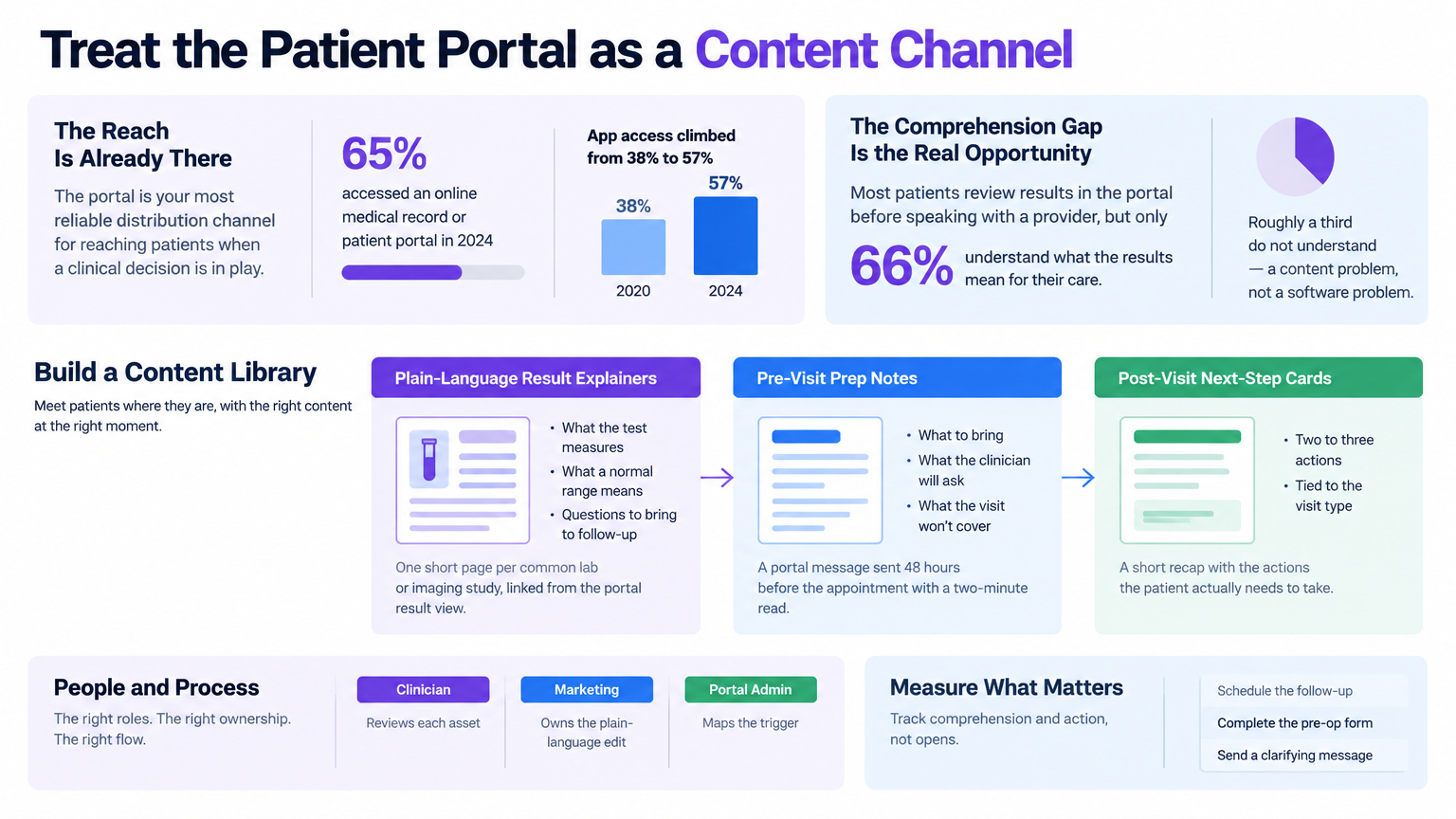 Infographic on patient portal content strategy showing healthcare marketing reach, comprehension gap, and content library.
Anchors the section's argument that reach into the portal is already there, but the comprehension gap is what content can actually close.
Write for Plain-Language Comprehension, Not Just Rankings
Ranking a service page for a condition name is the easy part. The harder question in 2026 is whether the person who lands there can actually explain, in their own words, what you want them to do next. HHS is explicit: plain language helps people understand health information because the writing is clear, concise, organized, and jargon-free, and it matters most for readers with limited health literacy 5. AHRQ pushes the same frame further and puts the burden on the organization, not the patient, to reduce complexity so people understand their conditions and make real decisions about care 6.
That reframes what a healthcare content brief looks like. Reading level is a design spec, not a style preference. Target a 6th-grade reading level, short sentences, one idea per paragraph, and section headings that answer the question the patient actually typed. Replace clinical shorthand with the word a patient would use when calling the front desk. Keep risk, uncertainty, and contraindications in the copy; stripping them out is not plain language, it is a liability.
Borrow teach-back from the clinical side and build it into the asset itself. AHRQ describes teach-back as a comprehension check where the patient or caregiver explains the information back in their own words, which supports engagement, safety, and adherence 8. In content, that looks like a short "what you'll tell your doctor" recap at the bottom of a treatment explainer, a three-question self-check before a pre-op form, or a one-line summary a caregiver can read out loud. AHRQ's Communicate Clearly tool is blunt about the payoff: clear communication helps patients understand and act on health information, feel more involved, and follow through on treatment plans 7.
Operationally, set three gates before anything publishes. A clinical reviewer confirms accuracy. A plain-language editor rewrites to the target reading level without dropping safety information. A patient-facing proofreader, ideally someone outside the specialty, flags any sentence they cannot restate. Measure the output on comprehension signals you can actually see: fewer clarifying calls on the topic, higher completion rates on linked forms, more scheduled follow-ups from the page. Rankings are a side effect of writing something a human can use.
Produce AI-Assisted Content Behind a Human Review Gate
AI will write faster than your team can review. That is the operational problem, not the technology problem. A 2026 systematic review of 15 empirical studies found that generative AI increases the volume, speed, and perceived credibility of health disinformation, and that users often cannot distinguish AI-generated misinformation from human-authored misinformation 10. The same review flagged that current detection systems have limited performance and that labeling effects are context-dependent. If your workflow lets a model publish directly to a service page, a social caption, or a portal message, you are shipping an untested claim into a channel where patients act on it.
The fix is a review gate, not a review step. A step is a checkbox someone clicks at 4:55 p.m. A gate is a workflow state where nothing moves until a named reviewer signs off, and the reviewer sees the evidence behind every factual claim before approving. A 2025 viewpoint on AI and health information argues that oversight has to be built into policy and workflow because AI complicates accountability, authorship, verification, and professional responsibility 11. Translate that into three concrete controls:
- Claim-level evidence binding. Every factual sentence an AI drafts gets paired with the source it came from. If the drafter cannot produce a source, the sentence does not ship. This is the single highest-leverage control you can add.
- Named clinical reviewer per content type. Service pages, condition explainers, and procedure prep get a clinician reviewer by name, not "the medical team." Social captions and FAQ updates can route to a clinical educator. Ad copy routes to compliance.
- Uncertainty preserved, not smoothed. AI drafts tend to flatten hedges into confident prose. Reviewers restore the "may," "depends on," and "ask your provider" language the model stripped out. The viewpoint authors call this explicit handling of uncertainty 11; your editors call it not getting sued.
Approval-first content operations platforms exist for exactly this reason, and Vectoron is one of them in the healthcare category. Pick tooling that treats the approval gate as the default, logs who approved what against which evidence, and refuses to publish anything that bypasses the gate. Speed is only an asset if the thing you shipped is defensible the next morning.
{{5-8 word headline for someone ready to 7-day free trial with full access to Professional plan features, allowing users to publish real content during the trial period — direct, no company names}}
{{One sentence under 20 words: what the reader gets by doing 7-day free trial with full access to Professional plan features, allowing users to publish real content during the trial period — concrete, no feature lists}}
Segment Social Content by Who Actually Uses It for Health Info
"Be on TikTok" is not a social strategy. The actual question is whose health decisions move because of social, and the answer is not evenly distributed. Pew's 2025 surveys found that 36% of U.S. adults get health information from social media at least sometimes, but that number hides a wide split: 49% of Hispanic adults, 47% of Asian adults, 45% of Black adults, and 30% of White adults 12. If your social calendar treats the audience as one block, you are underserving the groups most likely to act on what you post and overserving the group least likely to.
Start by mapping your actual patient population against those numbers. A multi-location dental group in South Texas and a cardiology practice in suburban Minnesota do not have the same social opportunity, and they should not share a content calendar. Pull your patient-mix data by location, overlay the Pew splits, and rank each location by expected social lift before you allocate production hours.
Then build to the format and language your highest-opportunity segments actually use. That means Spanish-first captions and voiceovers where the data supports it, not translated afterthoughts. It means short vertical video with on-screen captions for sound-off viewing, and it means featuring clinicians who reflect the patient population on camera when you can. A 2024 umbrella review of 15 reviews concluded that health professionals can use platforms like YouTube, Instagram, Facebook, and X to share scientific evidence in accessible, clear ways that help counter misinformation, provided the sourcing is explicit 9. Treat every post as a piece of patient education with a visible source, not as a brand impression.
Three production rules keep this honest:
- One clinician reviewer per topic. A named reviewer approves the medical substance before the caption is written, not after the Reel is edited.
- Source on screen. If a post states a statistic, risk, or recommendation, the source appears in the frame or the first comment. No source, no post.
- Platform-native, not cross-posted. A 60-second Reel is not a 60-second YouTube Short with the logo moved. Script, pacing, and hook change per platform.
Measure the lift at the location level, not the brand level. Track calls, appointment requests, and portal signups from the ZIP codes your highest-opportunity segments live in, not aggregate follower growth. If the Pew split predicts a 15-point gap in social health-info use between two of your markets, your KPI dashboard should show that gap closing in the one you invested in.
Build a Virtual Care Content Track Matched to Real Utilization
Virtual care is not the growth story it was in 2020, and your content calendar should stop pretending otherwise. Among eligible Medicare Fee-for-Service users, 25% received at least one telehealth service in 2024, down from 48% in 2020 and 34% in 2021 13. That is a specific population, not the whole U.S. market, but the shape of the curve is instructive: virtual care has settled into a steady channel for specific visit types, not a replacement for in-person work. Content that still treats telehealth as a novelty is talking past the patient.
What you build next depends on which visit types actually convert to virtual at your organization. Pull your own utilization data by service line before you write anything. Behavioral health follow-ups, medication management, dermatology triage, and post-op check-ins tend to hold virtual share. New-patient orthopedic consults and anything requiring a hands-on exam do not. Match the content to the visits that are really happening.
Three asset types do the heaviest lifting:
- Modality decision guides. One short page per service line that tells the patient when a virtual visit is appropriate, when it is not, and what the clinician will do if the visit needs to convert to in-person. This cuts no-shows and reduces the "wrong visit type" calls your front desk fields all day.
- Pre-visit tech and prep checklists. A plain-language walkthrough of the camera test, the login path, what the patient should have within reach, and how a caregiver can join. Delivered by portal message 24 hours out, not buried on a help page.
- Post-visit follow-through assets. The recap, the prescription instructions, the next appointment trigger. Virtual visits lose continuity faster than in-person ones; content closes that gap.
Measure the track on completion and conversion, not production volume. Did the virtual visit happen without a tech failure? Did the patient complete the follow-up action? Did the modality guide reduce misrouted bookings in the service line you targeted? Those are the numbers that justify the content hours, and they are the numbers your operations director already tracks.
Design for Accessibility Before Legal Forces the Issue
Accessibility is the trend most healthcare marketers underfund until a complaint lands. The DOJ points to the Web Content Accessibility Guidelines and Section 508 Standards as the technical references for making web content accessible 14. For state and local government entities, DOJ rulemaking identifies WCAG 2.1 Level AA as the required technical standard 15. If you run marketing for a county hospital, a state university health system, or a government-affiliated clinic, that rule reaches you directly. If you run a private provider group, it does not automatically bind you, but it is the standard plaintiffs' attorneys cite and the one your general counsel will ask about. Analyze your own obligations with legal; do not assume the government deadline is your deadline.
Build accessibility into the production spec instead of auditing it in later. Four controls catch most of the real-world failures:
- Captions and transcripts on every clinician video. No exceptions for Reels or portal explainers. Sound-off viewing is the default on social, and transcripts double as indexable text.
- Alt text written by the content author, not the uploader. Describe what the image communicates clinically, not just what it depicts.
- Forms, portal messages, and PDFs tested with a screen reader. Appointment request forms are the most common failure point and the highest-conversion asset you own.
- Color contrast and keyboard navigation checked at template level. Fix it once in the design system, not page by page.
DOJ is clear that technical conformance alone does not guarantee information is usable 14. Pair the engineering checks with plain-language editing and, where your patient mix supports it, Spanish-language versions of the same assets.
See How Leading Healthcare Brands Streamline Content Production for 2026
Connect to get a walkthrough of autonomous marketing workflows designed for healthcare compliance, multi-channel campaigns, and rapid scaling—no headcount increase required.
Centralize Claims Governance and Measurement Compliance
You can fold compliance into every section, or you can give it one owner, one workflow, and one dashboard. The second option is cheaper, faster, and the only one that survives an audit. Two federal rulebooks dominate 2026 planning: FTC substantiation for anything that looks like a claim, and HHS Office for Civil Rights guidance on tracking technologies for anything that looks like measurement. Treat them as one governance workstream, not two.
On the claims side, the FTC's standard is direct: health-related advertising claims must be supported by solid proof, and that substantiation must exist before the ad runs 3. The compliance guidance extends that to implied claims, qualifying language, and the net impression a reader actually takes away, and it rules out using a disclaimer to rescue an unsupported claim 4. Build one claims register that lists every outcome statement, testimonial pattern, before-and-after, and quantified promise in current use, maps each to the evidence that supports it, and flags the ones that cannot be sourced. Those get rewritten or pulled. New drafts route through the same register before publishing.
On the measurement side, HHS OCR says regulated entities may not use tracking technologies in ways that cause impermissible disclosures of protected health information, and that tracking on authenticated portal pages generally touches PHI and requires permitted disclosures, safeguards, and business associate agreements 2. A June 2024 federal court order vacated part of the bulletin covering certain unauthenticated public pages, and HHS is still evaluating next steps 2. The practical read: do not assume analytics on your public marketing pages are automatically prohibited, and do not assume they are automatically safe. Run a page-by-page inventory of pixels, cookies, session-replay scripts, call tracking, and chat widgets, split by authenticated vs. unauthenticated context, and confirm BAAs where vendors handle anything that could relate to a person's care.
One governance owner runs both registers. Legal, compliance, and the medical director sign the policy; marketing operates it. Review the claims register quarterly and the tracking inventory any time a new tag, vendor, or landing page ships. That cadence is the difference between a program that scales and one that gets paused the week before open enrollment.
Consolidate the Content Stack for Multi-Location Operators
Scope shift: this section is for operators running content across more than one site — a DSO with 40 offices, a behavioral health group with a dozen clinics, a senior living portfolio, a multi-state telehealth brand. If you run a single location, skip ahead. The economics below only matter when per-location overhead compounds.
The typical multi-location stack is a content agency on retainer, a separate SEO agency, a compliance reviewer contracted hourly, an analytics or pixel-audit vendor pulled in after each HHS OCR update 2, and an internal coordinator who spends most of their week moving files between those parties. Every new location adds a brief cycle, a review queue, and a reconciliation call. Costs scale per location; approval latency scales worse.
Consolidating the stack means collapsing those vendor seams into one approval workflow where strategy, drafting, clinical and legal review, plain-language editing, and publishing all route through the same gate. The comparison below uses variables, not invented dollar figures, because supplied research does not include benchmark agency pricing.
| Cost or control dimension | Traditional vendor stack | Consolidated AI content operations |
|---|---|---|
| Monthly cost structure | Content retainer + SEO retainer + hourly compliance review + analytics audit, each scaling per location | Platform fee with unlimited locations, plus internal reviewer hours |
| Approval path | Email + shared drive + separate legal queue | Single gate with named reviewer, evidence bound to each claim |
| Claims register ownership | Split across agency and in-house | One register, one owner, auditable log |
| Tracking governance | Reactive, after each OCR update | Page-level inventory maintained in workflow |
Approval-first platforms exist in this category, and Vectoron is one of them. Pick tooling that logs who approved what against which evidence, scales across locations without per-site fees, and refuses to publish anything that skips the gate. That is the control you need before the next audit, not after it.
A 90-Day Plan to Put These Trends Into Production
Seven trends is a planning doc. Here is the ship schedule. Treat each 30-day block as a gate with named owners and a deliverable your CMO can see.
- Days 1-30: Register and inventory. Stand up the claims register and route every current outcome statement, testimonial, and quantified promise through it against FTC substantiation 3, 4. In parallel, inventory every pixel, cookie, session-replay script, call tracker, and chat widget by page, split by authenticated and unauthenticated context 2. Pick one service line as the pilot. Name a clinical reviewer and a plain-language editor by role, not department.
- Days 31-60: Build the pilot assets. For the pilot service line, ship three plain-language result or procedure explainers written to a 6th-grade target 5, one portal pre-visit message, and one post-visit recap. Add teach-back recaps to each 8. Launch one segmented social track in the language and format your highest-opportunity patient segment actually uses 12. Every asset routes through the review gate; nothing publishes without a named approver and bound evidence.
- Days 61-90: Measure, then scale. Report on completion, scheduled follow-ups, and clarifying-call volume for the pilot. If the numbers hold, replicate the pattern across the next two service lines and roll the governance workflow to additional locations.
Frequently Asked Questions
References
- 1.Individuals’ Access and Use of Patient Portals and Smartphone Health Apps, 2024.
- 2.Use of Online Tracking Technologies by HIPAA Covered Entities and Business Associates.
- 3.Health Claims.
- 4.Health Products Compliance Guidance.
- 5.U.S. Department of Health and Human Services 2025 Plain Writing Compliance Report.
- 6.Patient Education and Engagement - Health Literacy.
- 7.Communicate Clearly: Tool 4 - Health Literacy.
- 8.Tool: Teach-Back.
- 9.Social Networks as a Tool for Evidence-Based Health Education: Umbrella Review.
- 10.Generative AI and health misinformation: production, propagation, and mitigation-a systematic review.
- 11.Viewpoint on the Intersection Among Health Information, Misinformation, and Generative AI Technologies.
- 12.Americans' use of social media for health information differs by race and ethnicity.
- 13.Medicare Telehealth Trends Report.
- 14.Guidance on Web Accessibility and the ADA.
- 15.Accessibility of Web Content and Mobile Apps Provided by State and Local Government Entities.
- 16.A Patient-Centered Approach to Delivering Test Results.