
Key Takeaways
- Patient acquisition costs rose 22% between 2021-2023, but content-led organizations absorbed roughly 15% less of that inflation, exposing why fixed retainers break unit economics at renewal 7.
- Documented growth strategies drive 2.6x higher patient acquisition rates and 3.8:1 content ROI, making written production capacity, paid support, and conversion paths the core operating decision 8.
- Specialty CAC ranges from $155 to $610, and Medicare patients run 5-7 searches before booking, so service-line coverage depth should match search behavior rather than a blended target 10.
- Compliance functions as a routing layer, not a checkpoint: classify briefs at intake into clinical-education, plan-touching, or PHI-adjacent queues to protect clinician time and publication cadence 4.
Why the Old Retainer Math Stopped Working
Healthcare marketing teams inherited an operating model built for a cheaper acquisition environment. Between 2021 and 2023, that environment changed enough to break the unit economics that retainer relationships were sized against. The shift is measurable, the cause is structural, and the response requires more than a new agency RFP.
The 22% Acquisition Cost Shift and What It Measures
Patient acquisition cost across the healthcare sector rose 22% between 2021 and 2023. Organizations running content-led acquisition saw costs roughly 15% lower than the broader cohort over the same window 7. This figure tracks marketing-driven acquisition cost across studied U.S. healthcare organizations, specifically for new patient acquisition, not retention or referral capture.
Two forces contributed to this increase: paid search and paid social inventory became more expensive as more health systems, specialty rollups, and DSO-backed platforms entered the same auctions. Simultaneously, organic visibility consolidated around publishers and brands with sustained content production, reducing the unscheduled-traffic smaller practices once relied on.
The 15% delta for content-led organizations indicates that continuous owned-asset production helped absorb auction inflation better than reliance on paid channels alone. For a regional system spending $8M annually on patient acquisition, this structural advantage translates to roughly $1.2M in reallocatable budget.
The retainer model, often established with a flatter cost curve in mind, struggles with this shift. A fixed monthly fee tied to a deliverable count, priced against a CAC that has increased by 22%, results in a worse cost per acquired patient with each contract renewal. This necessitates a review of the operating model.
Why Digital Channels Structurally Undercut the Direct-Mail Cost Base
Digital channels offer a lower per-contact cost basis than direct mail and traditional outbound methods. This is primarily because production and distribution scale at near-zero marginal cost once the digital asset exists 6. Unlike a printed mailer that incurs costs per piece and per send, a service-line landing page is a one-time investment that generates impressions for years.
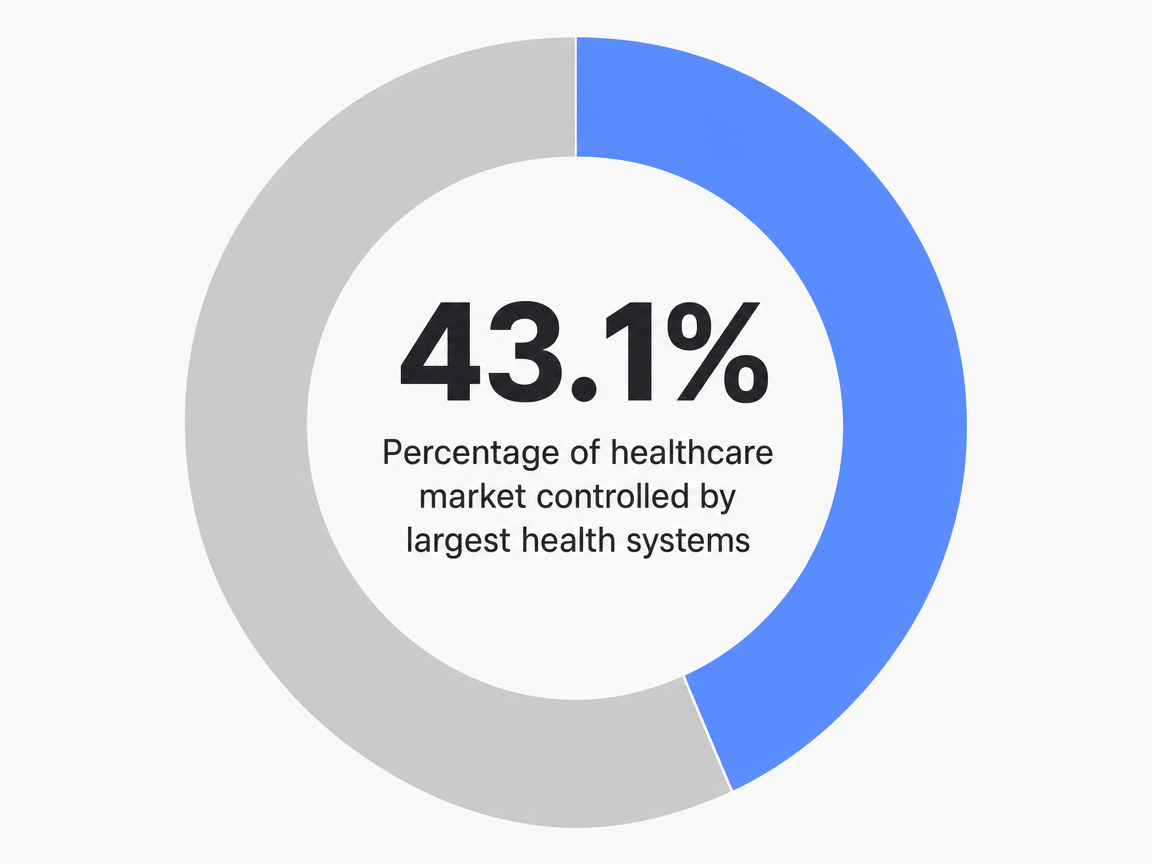 Percentage of healthcare market controlled by largest health systems: 43.1%
For multi-location operators, this asymmetry is amplified. A direct-mail campaign for 60 locations multiplies print, list, and postage costs by the number of locations. In contrast, a content asset published at the account level serves patients in every market, with localization handled through templating rather than reprinting. Direct channels scale linearly with footprint, while digital channels scale with publishing throughput.
The retainer model's limitations become apparent here. Agency retainers are priced against deliverable counts, not throughput. A six-article-per-month retainer provides the same output for a 10-location group as it does for a 150-location group. However, the larger operator requires significantly more service-line, location, and condition-level coverage to meet search demand. The cost per published asset remains flat, but the cost per location served rises.
Digital channels reward operators who can produce, review, and publish at a rate that traditional agency throughput models cannot match without proportional fee increases. This is why marketing leaders managing numerous locations are exploring operating models that decouple cost from headcount and scale output based on the actual service footprint.
The Operating Model: Strategy, Production, and Review as One System
To maintain unit economics, healthcare marketing teams must integrate strategy, production, and compliance review into a continuous system rather than sequential handoffs. This approach impacts documented strategy effectiveness, content investment ROI, and cost-per-published-asset.
Documented Strategy as the 2.6x Multiplier
Medical practices with a documented growth strategy acquire new patients at 2.6 times the rate of those without one 8. This highlights the importance of a clear, actionable plan. The average return on content-based marketing investment in the MGMA cohort is 3.8:1 8, demonstrating the financial efficacy of this approach.
A documented strategy specifies production capacity for service lines, paid support for markets, conversion paths for each location, and weekly review queue handling. This structured approach allows for continuous production, preventing delays caused by frequent re-scoping meetings. Organizations without such documentation can lose weeks per quarter to alignment exercises that yield no published assets.
The 3.8:1 ROI figure further supports the value of content-based marketing, making it a defensible line item for CFOs. It also explains why the 15% acquisition-cost advantage is achievable: documented strategy in content marketing effectively mitigates auction inflation.
Marketing leaders who lack a documented strategy that can withstand executive changes are not realizing the full potential suggested by these benchmarks.
Cost Structure: Agency Retainer vs. In-House Build vs. Platform Model
Multi-location operators have three primary options for funding their marketing strategy: agency retainers, in-house teams, or a platform model. The MGMA benchmark cohort typically allocates 1-5% of revenue to marketing 8. ACHE research indicates that organizations with formal marketing strategies report 34% higher profitability 9. The goal is to choose the structure that maximizes outcomes within budget, specifically focusing on the lowest cost per published asset.
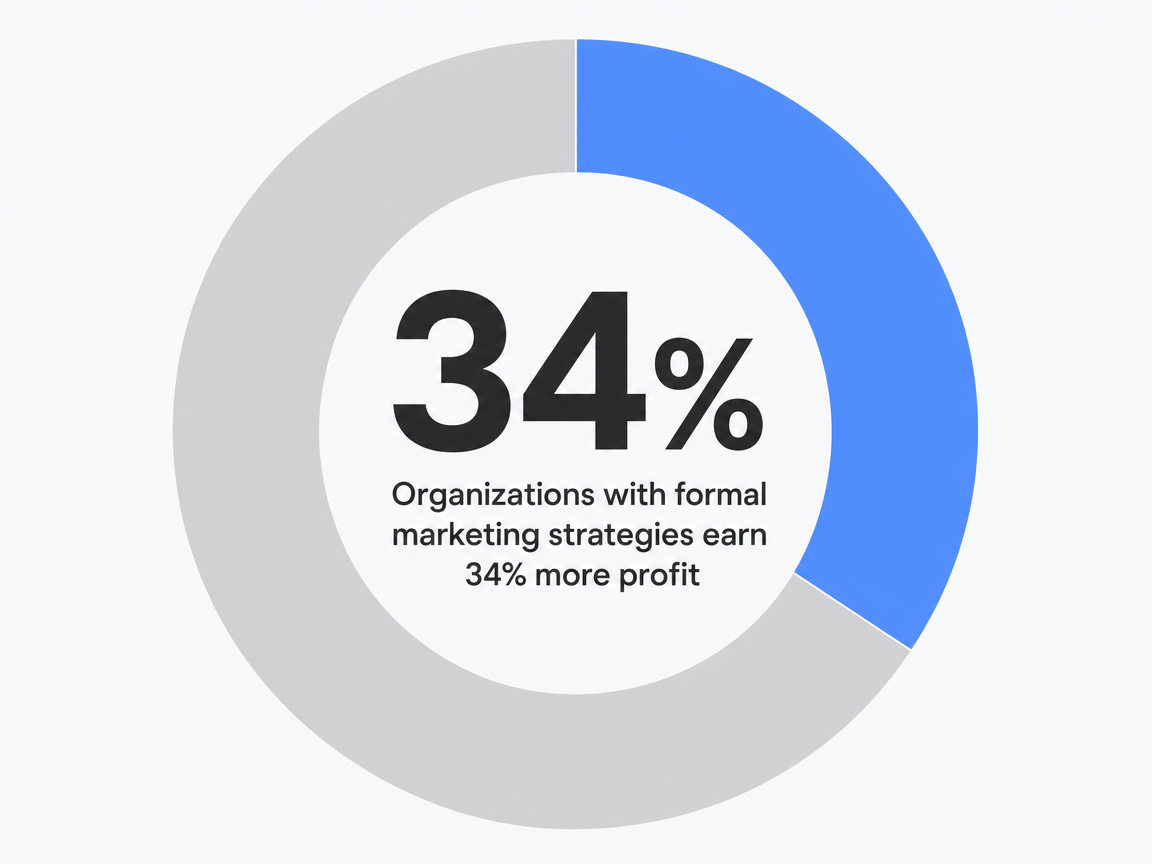 Organizations with formal marketing strategies earn 34% more profit: 34%
| Dimension | Agency Retainer | In-House Build | Platform Model |
|---|---|---|---|
| Cost basis | Fixed monthly retainer + per-deliverable surcharges | Salary load (strategist, writers, editors, medical reviewer, SEO) + tooling | Subscription fee, decoupled from headcount and deliverable count |
| Throughput | Capped by deliverable count in scope | Scales with hires; constrained by hiring cycle and management overhead | Scales with workflow capacity rather than headcount |
| Cost per published asset | Rises as scope additions price per piece | Falls once team is staffed; high until then | Falls as throughput rises within the subscription |
| Locations covered per unit cost | Flat output across footprint; per-location work billed separately | Whatever the team can produce; coverage gaps in early quarters | Account-level coverage across all locations and service lines |
| Compliance review | Vendor-side review or client-side review after delivery | In-house medical reviewer in the workflow | Review layer integrated into the production pipeline |
| Time-to-publish | Brief, draft, revision, client review, vendor revision, publish | Faster once team is mature; slower during ramp | Continuous publication with review checkpoints inline |
| Budget fit (1-5% of revenue, 8) | Concentrates spend on fees over output | Concentrates spend on payroll | Concentrates spend on throughput |
The retainer model is straightforward to budget but challenging to scale. A contract for six articles per month provides the same output for both a 12-location group and a 120-location group, meaning the cost per location served increases with footprint without a change in invoice. The in-house model reverses this: cost per asset decreases once the team is productive, but the initial three to four quarters involve full payroll against partial output, and medical accuracy review becomes a hiring challenge.
The platform model, such as Vectoron, decouples cost from headcount. Production, SEO, and review operate as a single workflow at the account level, covering all locations and service lines under one growth program. For marketing leaders aiming for the 34% profitability increase 9 within the 1-5% revenue budget 8, the critical variable is the cost per published asset across the entire service footprint, which the platform structure is designed to optimize.
Test AI-Driven Content for Multi-Site Patient Growth
Experience measurable patient acquisition impact by publishing live campaigns during your no-risk trial.
Search Behavior, CAC Spread, and the Specialty Reality
Generic marketing funnel advice often fails in healthcare because the patient journey varies significantly by service line. A bunion consultation, a vasectomy reversal, and a cardiology second opinion differ in search depth, decision timelines, and willingness to travel. Ignoring these differences can lead to underpricing some service lines and overspending on others.
The 5-7 Pre-Decision Search Pattern and Specialty CAC Ranges
Patient acquisition costs range from approximately $155 to $610 depending on the specialty. This wide spread means a single blended CAC target for a multi-specialty group can be misleading. Primary care visits and orthopedic surgical consults, for example, represent opposite ends of this range, requiring distinct marketing strategies for profitability.
The underlying behavior explains this spread. Medicare beneficiaries conduct 4.2 times more healthcare-related searches than the general population, and 78% of their healthcare decisions are influenced by online research 10. This demographic, often seeking higher-acuity services like cardiology, orthopedics, oncology, and ophthalmology, engages in a search-intensive process, comparing five to seven options before booking.
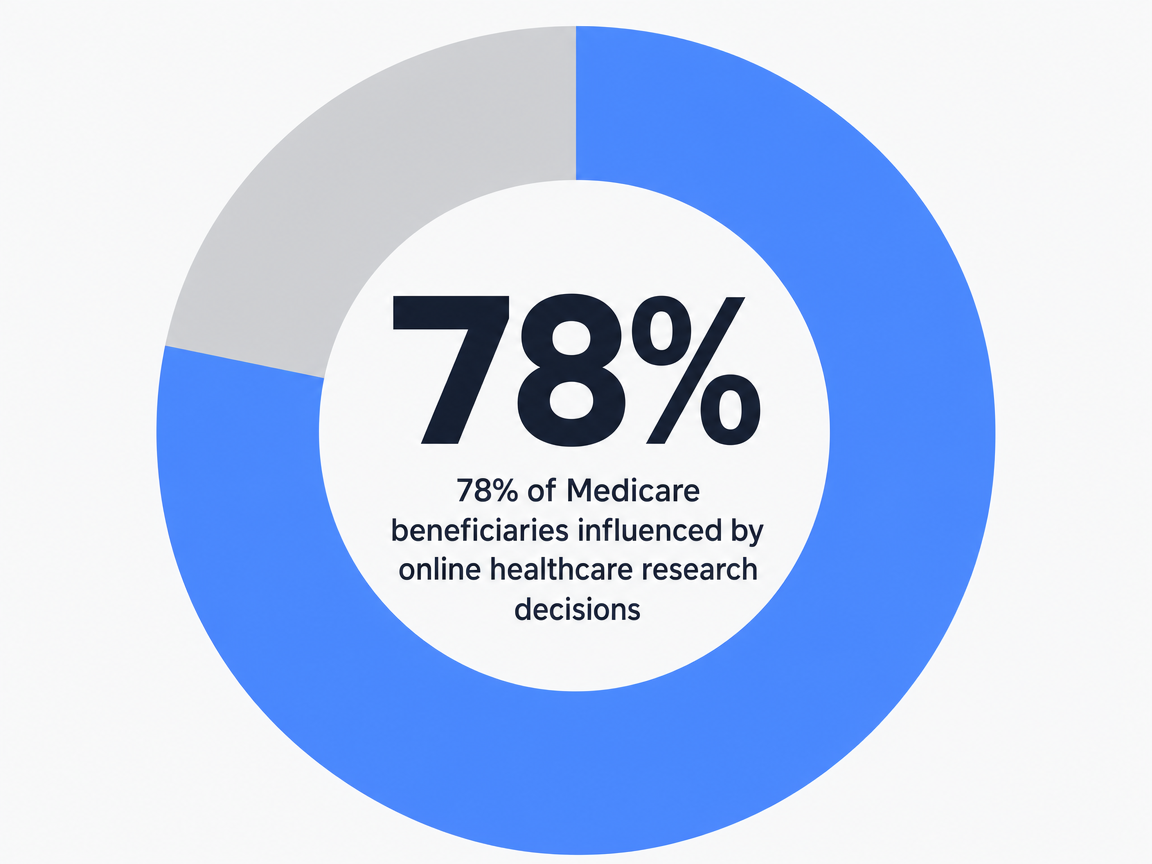 78% of Medicare beneficiaries influenced by online healthcare research decisions: 78%
This five-to-seven-search pattern dictates the necessary content footprint for a service line. Initial searches are symptom-led, followed by comparisons of treatment approaches, then provider identification, and finally evaluation of credentials, reviews, insurance acceptance, and location convenience. A practice that only ranks for one part of this sequence risks entering the consideration set too late or not at all.
For a VP of Marketing managing a 60-location specialty group, this means service lines with CACs between $400-$610 require comprehensive coverage across the entire search sequence, not just high-intent transactional queries. Service lines under $200 CAC can manage with a thinner footprint, leveraging local pack visibility and paid support. Applying a uniform strategy to both will cause blended CAC to increase over time.
Local Reputation Operations Across Locations
Local reputation becomes critical during the fifth-to-seventh search, when prospective patients examine review pages, Google Business Profiles, and insurance acceptance. At this stage, the marketing focus shifts from visibility to ensuring each location's operational signal aligns with the brand promise conveyed by the organization's content.
For multi-location operators, this signal is often fragmented. Review velocity, average rating, response cadence, hours accuracy, photo freshness, and provider-page completeness can vary significantly by location. A regional system with 40 locations might see a half-point or greater star-rating disparity between its best and worst markets, impacting conversion rates before affecting revenue.
Account-level reputation operations manage each location's profile as an asset. This includes a standing review-response SLA, templated provider-bio refreshes tied to credentialing changes, and monitoring to flag rating drift before it negatively impacts paid traffic conversion.
Without this approach, paid spend might drive prospects to a location page with a 3.7-star average and an outdated response, leading to a 30-40% higher cost-per-acquired-patient for that location. Addressing profile issues is more cost-effective than increasing ad spend. However, this work often falls between marketing and operations, requiring dedicated ownership at the account level.
Compliance Architecture for Continuous Production
Compliance can either hinder or protect marketing throughput in healthcare. Two key regulatory frameworks for multi-location operators are CMS rules on influencing beneficiary decision-making and HIPAA-driven medical accuracy review. Both are workflow challenges before they are legal ones.
CMS Influence-Activity Boundaries in Production Workflows
CMS defines marketing under the Medicare Communications and Marketing Guidelines (MCMG) as activities intended to influence beneficiary decision-making regarding plan enrollment or retention 4. This definition is broader than many marketing teams realize. A blog post explaining how a Medicare Advantage benefit interacts with a specialty service line can shift from communication to marketing based on its framing of plan choice, with differing documentation, disclaimer, and submission requirements 1.
For multi-location operators with content touching Medicare-eligible patients across various service lines, this has direct workflow consequences. Any asset mentioning a plan, its benefits, or comparing coverage requires a different review queue than a generic clinical-education piece. Routing all content through the same legal review creates a bottleneck for the majority of content that doesn't need such scrutiny.
The architectural solution is classification at intake. Briefs for plan-touching content are routed to an MCMG-aware reviewer, while clinical-education content goes solely to medical accuracy review. These queues run in parallel, preventing production delays caused by waiting for the wrong reviewer to clear an asset outside their scope.
The alternative leads to slow publication calendars. If every asset enters a single queue and every reviewer examines every piece, the median time-to-publish can extend significantly. The CMS framework requires specific standards for plan-influencing content, which is a routing problem that a well-designed production system can solve without slowing the entire pipeline.
HIPAA, Medical Accuracy, and the Review Layer
Medical accuracy review often slows healthcare marketing operations. While clinician-led review is essential and costly, it's frequently understaffed relative to publishing volume. The structural solution is to design the review layer so clinicians only focus on work requiring their specific judgment.
Three categories of edits—source verification, terminology consistency, and disclaimer placement—consume significant reviewer time without needing clinical input. Handling these upstream, before the asset reaches the clinician, can halve review time per piece. Clinicians can then focus on claims about treatment efficacy, contraindication framing, and outcome language, which are tasks no upstream layer can replace.
HIPAA impacts the production workflow at two points: assets using patient testimonials, case studies, or before-and-after content require consent, de-identification, and authorization documentation in the brief. Secondly, any analytics or retargeting setup capturing protected health information via form fields, chat tools, or pixel-based tracking on condition-specific landing pages introduces HIPAA exposure. The review architecture must account for both content and marketing technology layers.
Marketing leaders who view compliance as a mere checkpoint will experience throughput issues. Those who integrate it as a routing layer can keep clinicians and legal reviewers focused, maintaining the production calendar's cadence as dictated by the documented strategy.
See How Top Healthcare Marketers Automate Patient Acquisition at Scale
Request a walkthrough of the latest data-driven platform built for multi-location healthcare growth—streamline strategy, content, and compliance without agency overhead or operational drag.
Implementation Roadmap: First 90 Days
A 90-day period is sufficient to transition a multi-location operator from a retainer-dependent model to a documented, continuously producing operating model. This roadmap is designed for marketing leaders managing 25 to 200 locations, balancing budget constraints with brand objectives.
Days 1-30: Audit and document. Analyze the last four quarters of marketing spend against the MGMA benchmark of 1-5% of revenue for medical groups 8, identifying expenditures on retainer fees, paid media, tooling, headcount, and per-location surcharges. Concurrently, document the growth strategy that yields the 2.6x acquisition multiplier 8. This includes specifying quarterly production capacity for service lines, paid support for markets, and conversion paths for each location. The outcome of this month is a spend ledger and a strategy document that an incoming executive could implement immediately.
Days 31-60: Route the work. Implement an intake classification system for all briefs: clinical-education, plan-touching, or testimonial/PHI-adjacent, enabling parallel review queues. Establish a reputation operations layer, including a standing review-response SLA, templated provider-bio refreshes, and rating-drift monitoring across all locations. Integrate front-end revenue capture into the marketing dashboard; a drop in time-of-service copay collection, for instance, signals intake and conversion issues that marketing leaders can address proactively.
Days 61-90: Cut over and measure. Transition production to the chosen operating model (in-house or platform). Establish the cost-per-published-asset baseline at the account level, not the location level. Monitor trailing profitability against the 34% delta ACHE attributes to organizations with formal marketing strategies 9. While the full multiplier may not be evident in the first quarter, this period will confirm production cadence, clear review queues, and converging location-level reputation signals, which are leading indicators of the operating model's success. Platforms like Vectoron are designed for this pattern, integrating strategy, production, and review into a continuous workflow at the account level.
Frequently Asked Questions
References
- 1.Medicare Marketing Guidelines - CMS.
- 2.Foundational benchmarks and KPIs for medical practice operations in 2023.
- 3.Patient balance collection: What's moving the numbers and how to improve.
- 4.Medicare Communications and Marketing Guidelines (MCMG) - CMS.
- 5.Marketing Health Services, Fifth Edition.
- 6.The adaptation of health care marketing to the digital era - PMC.
- 7.Health Affairs - Healthcare Policy & Economics Journal.
- 8.Medical Group Management Association - Practice Operations & Growth.
- 9.American College of Healthcare Executives - Healthcare Leadership Research.
- 10.Centers for Medicare & Medicaid Services - Healthcare Data & Research.