
Key Takeaways
- A five-person team's capacity math rarely balances against SERP demands, since ranking gains compound across technical health, content depth, authority, and engagement work that outpaces manual output.
- Empirical research points to a clear factor hierarchy: backlinks, technical trust signals like SSL, and content depth carry the most weight, with engagement metrics forming a strong second tier 1, 11.
- Marketing automation delivers a roughly 20 percent baseline productivity lift, while redesigning workflows around AI produces 2 to 3x gains and campaign cycles compressing toward same-day execution 5, 14, 17.
- A signal, recommend, approve, execute, measure loop places automation on mechanical steps and human judgment on brand and ranking risk, preserving E-E-A-T through credentialed bylines, SME interviews, and first-party data 7, 8.
- Compared with agency retainers and headcount expansion, AI-augmented in-house execution shifts 70 to 80 percent of mechanical workload to automated cycles while keeping approval gates with senior marketers 14.
- Portfolio and multi-location programs benefit disproportionately, since parallel crawl monitoring, schema deployment, and location-specific briefs replace per-market specialists without linear hiring 14.
- A 90-day sequence fixes technical trust and instrumentation first, moves mechanical work to gated automation in month two, then compounds authority through interviews, first-party data, and outreach 11, 14, 7.
The capacity math behind a frozen headcount
A five-person in-house marketing team operates with finite hours. After accounting for standing meetings, executive reporting, paid media QA, and design queues, the remaining capacity for organic growth typically amounts to one to two full-time equivalents. This limited capacity must cover technical audits, brief creation, drafting, editing, internal linking, outreach, and measurement across potentially hundreds of website pages. This arithmetic rarely balances.
Ranking gains are cumulative. Google's algorithm considers over 200 signals, including keyword usage, site structure, bounce rate, and time on site 9. Moving a domain from page three to page one for a competitive commercial query often demands in-depth content across dozens of supporting pages, sustained link acquisition, and continuous engagement optimization. A team producing four articles a month cannot compete with a competitor publishing forty, and manual technical fixes on a large site often lag behind the crawl issues that generate them.
The natural inclination is to request more headcount or a larger agency retainer. However, neither option is feasible when budgets are capped, and both introduce coordination overhead that diminishes the marginal output they promise.
An alternative is to redesign the workflow. Peer-reviewed research and analyst benchmarks now indicate that critical ranking factors—such as technical health, content depth, authority signals, and engagement—are systematizable. AI-enabled execution can bridge the gap between what a lean team can achieve and what the SERP demands 13. This article addresses this redesign as an operational challenge, not merely a tooling problem.
Which ranking factors actually move the needle
The empirical factor hierarchy
The belief that more content automatically leads to higher search engine rankings persists because content output is easy to measure, while its impact is not. Empirical research contradicts this notion. Studies that analyze live SERPs, rather than relying on practitioner opinions, consistently identify a smaller set of factors as most influential.
A 2024 analysis of SEO ranking factors found that the quantity and quality of backlinks, bounce rate, and SSL certificate presence were the most significant contributors to Google performance 1. Another empirical study of 24 site characteristics highlighted SSL certificate presence, keywords in the URL, backlink quantity, text length, and domain age as key drivers of higher rankings 11. The convergence of these studies is telling: backlinks and technical trust signals are paramount, with content depth closely following.
Engagement metrics form the second tier. Research linking Google Analytics signals to SERP outcomes shows that page length, pages per visit, mobile traffic, bounce rate, and return visits all correlate with ranking improvements 9. Practitioner surveys further support this, with respondents ranking page content, CTR from SERPs, and page load speed as the highest-impact internal factors they can influence 6.
For a VP managing a program under a headcount cap, this hierarchy is clear: backlink authority, technical trust, and content depth carry disproportionate weight. A team that publishes fifty superficial pages while neglecting HTTPS misconfigurations, orphaned URLs, or consistent outreach for link acquisition is generating activity, not ranking gains 11.
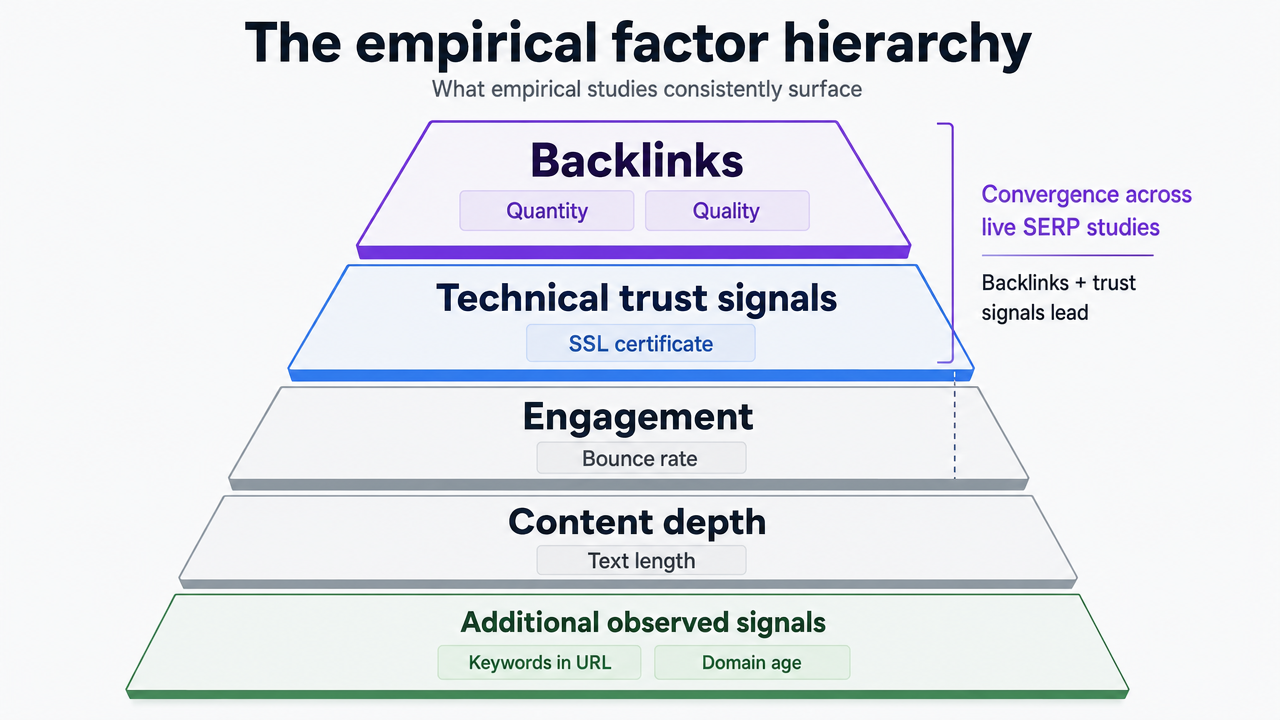 Visualize the empirical ranking factor hierarchy cited from peer-reviewed research in this section, giving readers a clear tier structure of what actually moves rankings
Labor-bound vs. automatable levers
Given the factor hierarchy, the next step is to determine which levers a small team can systematize and which still require human effort. This distinction is crucial for allocating reclaimed capacity.
Technical health is largely automatable. Tasks such as crawl monitoring, HTTPS validation, redirect audits, schema deployment, internal link mapping, page speed regression tracking, and on-page keyword coverage can operate on continuous cycles, requiring human review only for anomalies. Research on ranking factors treats these as engineering problems, benefiting from the continuous monitoring approach used by DevOps teams for infrastructure 1, 11. Content drafting, on-page optimization, meta generation, and structured data markup also fall into this automatable category when combined with a review step.
Engagement optimization is semi-automatable. Bounce rate, pages per visit, and return visits improve through systematic testing of page layouts, headings, and internal linking. Generative AI can optimize marketing strategies by A/B testing page layouts, ad copy, and SEO elements using predictive analytics 15. However, the judgment call regarding which variant best reflects the brand voice or addresses the customer's actual question remains a human task.
Labor-bound work is narrower than many teams assume. Relationship-driven link acquisition, subject-matter expert interviews, first-party research, executive bylines, and editorial decisions related to E-E-A-T signals still require human input. Strategic decisions about which query clusters align with revenue also fall into this category.
The goal of redesign is not to automate everything, but to shift 70 to 80 percent of the mechanical workload away from the team, allowing human effort to concentrate on the 20 to 30 percent that machines cannot replicate.
The productivity delta AI actually delivers
What the marketing productivity research shows
The productivity figures VPs need for planning are not aspirational; they are derived from studies measuring the impact of marketing departments deploying automation and generative AI. The observed range is often narrower than vendor claims suggest.
Nucleus Research found that companies implementing marketing automation for the first time experienced an average 20 percent productivity increase across their marketing departments. This gain was more pronounced for junior staff, with lower and mid-tier marketers seeing a 22 percent lift, while senior marketers saw 18 percent 5. This distinction is important for VPs allocating reclaimed capacity. The majority of recovered hours come from individuals who typically spend their time on formatting, meta descriptions, internal link mapping, and QA. Redirecting these hours toward briefs, SME interviews, and outreach is where SEO output truly compounds.
Research on generative AI indicates even higher potential. McKinsey estimates that generative AI could boost marketing function productivity by 5 to 15 percent of total marketing spend. This benchmark is based on analysis of how language models displace mechanical work in content, insights, and personalization 13. Organizations that redesigned their operating models around AI, rather than simply adding tools to existing briefing cycles, reported 2 to 3x productivity gains and up to 30 percent higher marketing ROI 14.
The difference between the 20 percent baseline and the 2-3x ceiling represents the redesign premium. Simply adding automation yields modest, roughly linear gains. Workflow redesign, where AI handles detection, drafting, and monitoring while humans provide judgment, produces the step change necessary to make ranking programs viable under a headcount cap.
From weeks to same-day: execution speed as a ranking lever
Ranking programs are essentially experiments conducted against an evolving algorithm. The team that can ship, measure, and revise faster acquires more information per quarter, leading to compounding position gains. Speed, not headcount, is often the primary constraint for in-house programs.
McKinsey's agentic AI research quantifies this potential. Some Fortune 250 companies using agentic AI report campaign creation and execution speeds increasing up to 15-fold, driven by faster innovation cycles and end-to-end process redesign 17. Related research documents organizations compressing campaign development cycles from six to ten weeks down to same-day execution, alongside two- to five-fold increases in creative productivity 14.
In SEO, the implications are direct. A team that previously shipped one topic cluster per quarter, conducted a single technical audit annually, and pursued backlink outreach in sporadic bursts can transition to continuous cycles. Technical monitoring can run daily. Content drafts can move from brief to publish-ready in hours instead of weeks. On-page optimization tests can run in parallel rather than sequentially. The number of ranking hypotheses a five-person team can test per quarter multiplies, and the feedback loop from publication to measured SERP movement tightens from months to weeks.
Two important caveats apply. The 15x figure represents early leaders at scale, not median outcomes. Furthermore, speed without proper approval gates can lead to thin, unhelpful output, which Google's helpful content systems are designed to demote. The next section addresses the placement of these gates.
Test AI-powered ranking strategies in real time
See measurable impact on search rankings by publishing live content during your trial—no commitment required.
Approval-gated execution: where judgment lives and where automation lives
The workflow: signal, recommend, approve, execute, measure
Speed without gates results in superficial content that Google's helpful content systems actively demote 7. Conversely, gates without speed create the briefing-cycle bottleneck that initially led to headcount caps. An effective design places automation on mechanical steps and human review on decisions involving brand and ranking risk.
A functional loop involves five stages.
- Signal detection runs continuously: crawl monitors flag broken canonicals, rank trackers identify position drops on commercial queries, analytics detect bounce rate spikes on templated pages, and outreach systems log link acquisition velocity.
- Recommendation ranks these signals by expected revenue impact, not by volume, ensuring that a technical fix on a top-ten commercial page takes precedence over a new draft for a low-intent query.
- Approval is central: a person, typically a senior marketer or VP, reviews the ranked queue, rejects work that deviates from brand voice or customer intent, and releases the rest.
- Execution then proceeds automatically: drafts become publish-ready, schema deploys, redirects fire, and meta descriptions update.
- Measurement closes the loop, with SERP movement, engagement deltas, and pipeline attribution feeding the next signal cycle.
This design is crucial because it concentrates human judgment on the 20 to 30 percent of work that machines cannot replicate—editorial calls, strategic priorities, and SME quotes—while the mechanical 70 to 80 percent runs on automated rails. This allocation generates the 2 to 3x productivity gain observed in AI-redesigned marketing organizations, rather than the modest linear lift from simply adding automation 14. It also allows generative A/B testing of page layouts, meta variations, and internal link patterns to run in parallel, eliminating the need for manual configuration of each experiment 15.
Within this loop, the VP's role is not to approve every asset, but to set thresholds: which query clusters require senior review, which technical changes can auto-deploy, and which outreach templates need a signature. Once these thresholds are calibrated, the queue moves efficiently without constant meetings.
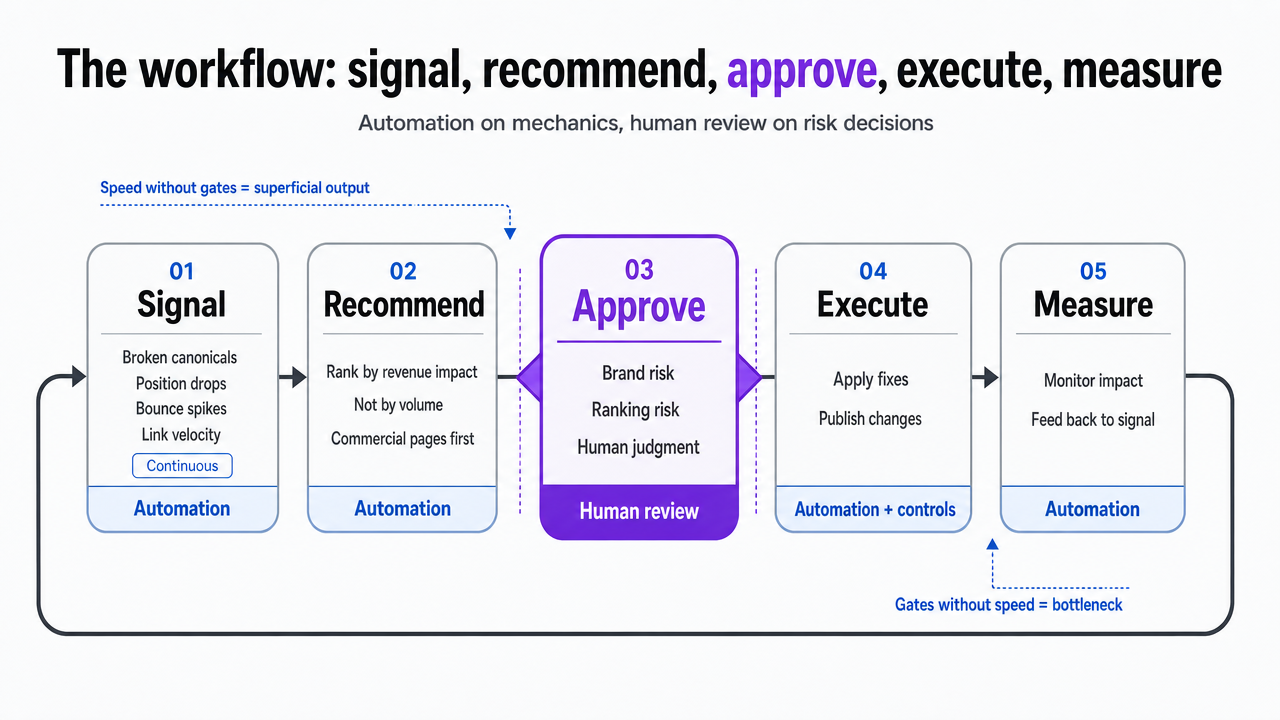 Illustrate the five-stage approval-gated execution loop described in this section, showing where automation runs and where human judgment intervenes
Preserving E-E-A-T under AI-scaled output
A common concern with AI-scaled SEO is that increased volume might dilute the experience and expertise signals valued by Google's quality systems. This concern is valid but often misinterprets Google's guidance.
Google's documentation on helpful content explicitly states that AI usage is acceptable when the output is people-first. The key assessment is not whether a machine drafted the text, but who created the content, how it was produced, and why it exists 7. E-E-A-T itself is framed not as a distinct ranking factor, but as a philosophy for creating helpful, people-centric content, evaluated at the document, domain, and source-entity levels 8. This framework provides a clear operating standard for an AI-augmented program: automation can draft, optimize, and monitor, but experience and expertise signals must originate from real people whose judgment is evident on the page.
In practice, this means certain gates remain non-negotiable:
- Author bylines should belong to practitioners with verifiable credentials, not generic content personas.
- Subject-matter expert interviews with clinicians, attorneys, or operators provide primary-source quotes and case details that a language model cannot invent.
- First-party data, whether from call transcripts, booking patterns, or client outcome samples, gives content the specificity that thin AI output lacks.
- Editorial review by a senior marketer identifies areas where a draft accurately summarizes but offers no unique experience the reader couldn't find elsewhere.
It's important to compare an AI-scaled program with these gates against a fully manual program without them. A team publishing four manually drafted articles a month, lacking SME involvement, first-party data, and editorial review, is not necessarily producing stronger E-E-A-T signals than an AI-augmented program with structured interviews, credentialed bylines, and human approval. Instead, it is producing less content with a similar quality gap. The design of the gates, rather than the drafting method, determines whether the output demonstrates expertise.
Comparing three operating models for organic pipeline
A VP facing a headcount cap has three realistic operating models for organic pipeline: a traditional agency retainer, in-house headcount expansion, and AI-augmented in-house execution. The primary differences lie not in the work performed, but in the allocation of speed, oversight, and reclaimed capacity.
| Model | Monthly cost profile | Output capacity | Speed to execution | Oversight model |
|---|---|---|---|---|
| Traditional agency retainer | Fixed retainer plus scope-change fees; coordination overhead absorbed internally | Roughly 4–8 articles per month, quarterly technical audit, batch link outreach | 6- to 10-week campaign cycles typical of pre-AI marketing operations 14 | Client review at brief, draft, and publish stages; agency owns production |
| In-house headcount expansion | Fully loaded FTE cost per added role; recruiting and ramp time before productivity | Linear with hires; a marketing automation baseline adds roughly 20 percent department productivity 5 | Bounded by team size and standing meeting load; no inherent cycle compression | VP and senior marketers review inside existing briefing cycles |
| AI-augmented in-house execution | Platform cost plus existing team; no added FTEs required | 2 to 3x productivity gains and 5–15 percent marketing spend efficiency in redesigned organizations 14, 13 | Campaign development cycles compressing from six to ten weeks toward same-day execution; up to 15x execution speed for early leaders 14, 17 | Approval gates on ranked recommendations; humans review priorities and editorial, automation executes |
The comparison isn't about whether one model produces content and another doesn't; all three generate content, technical fixes, and link outreach. The key difference is where the coordination burden falls. Agency retainers outsource production but maintain the existing briefing cycle, limiting cycle speed to six to ten weeks 14. Headcount expansion yields modest linear productivity, with marketing automation contributing an average 20 percent lift when first deployed, primarily benefiting junior staff on mechanical tasks 5. AI-augmented execution shifts 70 to 80 percent of mechanical workload to automated cycles governed by approval gates, enabling the 2 to 3x productivity multiple observed in organizations that redesigned their workflows rather than simply layering on tools 14.
Speed is critical because ranking programs compound through the volume of experiments. A team that compresses its cycle from ten weeks to days can test an order of magnitude more ranking hypotheses per quarter without adding a single hire.
See How Leading Teams Achieve Top Search Rankings Without Expanding Staff
Request a walkthrough of unified AI-driven workflows designed for agencies and enterprises to scale SEO execution, track every ranking gain, and retain full oversight—without additional headcount or complex vendor management.
If a VP manages multiple locations or a portfolio
For marketing leaders overseeing multi-location service businesses or a portfolio of brands, the capacity math becomes more complex. A single-site program has one technical stack, one content voice, and one link profile. A twenty-location operator faces twenty local SERPs, twenty citation profiles, and twenty sets of review signals, all feeding the same organic pipeline. Headcount rarely scales linearly with locations, often leading to per-location output collapsing to the lowest-effort template.
Workflow redesign alters this arithmetic. Continuous crawl monitoring, schema deployment, and on-page optimization can run across every location URL in parallel, rather than as a queued backlog. Location-specific content briefs can be drafted using local intent data, then routed to a regional marketer for approval before publishing. The mechanical work that would typically require a dedicated local SEO specialist per market shifts to automated cycles, freeing up human hours to concentrate on tasks that resist automation: interviews with location managers, first-party operational data, and outreach for locally relevant links.
The productivity research holds true at a portfolio scale. Organizations that redesigned marketing around AI reported 2 to 3x productivity gains across the entire function, not just at headquarters 14. For a VP managing ten or more locations, this multiplier transforms a hiring-frozen program into a per-location cadence that can effectively compete on local SERPs.
A 90-day sequence to compound ranking gains without hiring
Presenting a workflow redesign to a CEO is more effective when it's framed within a clear timeline. A 90-day sequence provides a defensible plan, measurable milestones at 30-day intervals, and a decision point for expanding the program before the next budget cycle.
- Days 1–30: Fix the base and instrument the loop. The first month focuses on resolving technical and measurement gaps that introduce noise into downstream experiments. Conduct a full crawl audit, validate HTTPS across all subdomains, resolve redirect chains, deploy schema on top revenue templates, and map internal links across the twenty to thirty pages with commercial intent. SSL presence, backlink volume, text length, and domain age are high in the empirical factor hierarchy, so technical trust signals take precedence over new content 11. Instrument bounce rate, pages per visit, and return visits on the same page set to make engagement deltas visible in week five rather than month six 9.
- Days 31–60: Move mechanical work to automated cycles with approval gates. The second month demonstrates the productivity multiplier. Route on-page optimization, meta generation, and first-draft content through an approval queue ranked by expected revenue impact. Senior marketers review priorities and editorial voice; automation handles execution once approved. This represents a true redesign, not just adding tools, and it yields the 2 to 3x productivity gains observed in AI-restructured marketing organizations, rather than modest linear lifts 14. Simultaneously, launch A/B tests on page layouts and meta variations against the instrumented pages to enable continuous predictive optimization 15.
- Days 61–90: Compound with authority and measure the delta. The final month shifts capacity toward tasks that resist automation: SME interviews, first-party data, credentialed bylines, and relationship-driven outreach. Google's guidance explicitly states that AI-assisted content is acceptable when it is people-first, meaning experience and expertise signals must come from named practitioners whose judgment is evident on the page 7. Conclude the 90 days with a reporting pass that links SERP movement, engagement deltas, and pipeline contribution back to the ranked queue, then present the executive team with the compounding curve rather than a task list.
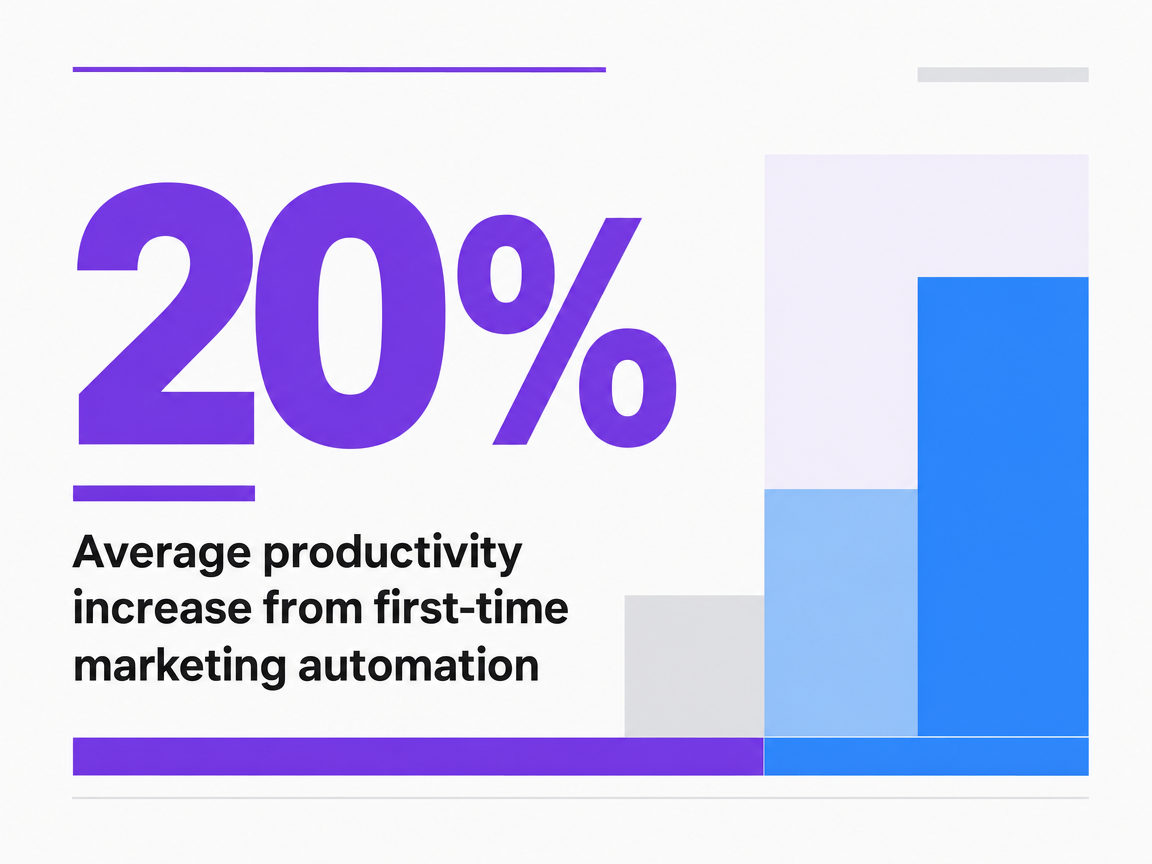 Average productivity increase from first-time marketing automation
Average productivity increase from first-time marketing automation
Frequently Asked Questions
References
- 1.Exploring the impact of SEO-based ranking factors for website performance.
- 2.Important Factors for Improving Google Search Rank.
- 3.Ranking factors to increase your position on the search engine results page.
- 4.Identification of Positioning Factors in Academic SEO (ASEO).
- 5.Marketing Automation Increases Productivity.
- 6.Search Engine Optimization: Factors Influencing Website Ranking.
- 7.Creating Helpful, Reliable, People-First Content.
- 8.Google E-E-A-T Guidelines.
- 9.Search Engine Optimization Factors and Blog Performance.
- 10.Search Engine Optimization based on Effective Factors of Ranking in Web Sites: A Review.
- 11.Important Factors for Improving Google Search Rank.
- 12.From anxiety to advantage: A marketing organization that thrives with AI.
- 13.The economic potential of generative AI: The next productivity frontier.
- 14.McKinsey says AI could transform marketing but firms lag.
- 15.AI-powered marketing and sales reach new heights with generative AI.
- 16.How generative AI can boost consumer marketing.
- 17.Agents for growth: Turning AI promise into impact.
- 18.The Ultimate Guide to Google's E-E-A-T and Quality Assessment.