
Key Takeaways
- Predictable organic growth depends on running five interdependent decisions—indexation, evidence quality, page experience, authority, and measurement—as one governed workflow rather than five separate vendor projects.
- Priority pages must be crawlable, renderable, and canonically consistent before anything else compounds, since click distribution heavily favors first-page results and second-page rankings are effectively invisible 1.
- Named authorship, primary-source citations, disclosed scope, and visible review dates decide whether pages earn durable placement and citation inside AI Overviews, using the same signals that DISCERN and JAMA scoring reward 3.
- For multi-location operators, measure PM hours per week, days from signal to published change, and percent of conversions attributed to a page and query before renegotiating any vendor contract—those numbers reveal whether the current stack can support predictable growth.
The Five Decisions That Determine Whether SEO Compounds or Stalls
Most organic programs do not fail because a keyword was missed or a title tag was too long. They fail because the team is running five different decisions as five different projects, often across three to five vendors, with no shared measurement and no shared approval loop.
Predictable growth from search is a system question. Peer-reviewed work on SEO strategy treats it as a multi-dimensional determinant of brand positioning rather than a single-variable keyword game, spanning technical, content, authority, and experience signals 2. The teams that compound organic pipeline tend to operate five decisions as one governed workflow:
- Indexation. What Google is allowed and encouraged to crawl, render, and rank.
- Evidence quality. What ships on the page, who authored it, and what substantiates the claims.
- Page experience. How the page converts a click into an intake form, a booked call, or a scheduled appointment.
- Authority and local relevance. How the domain and each location earn trust without importing review-program risk.
- Measurement. How queries, pages, calls, and bookings are joined so a VP can defend the channel to a CFO in revenue terms.
Each decision is analyzed in the sections that follow, along with a consolidated governance layer for regulated verticals and a coordination-cost view for multi-location operators. The order matters. Skip the first decision and the fourth cannot compound. Skip the fifth and none of them can be defended in a budget review.
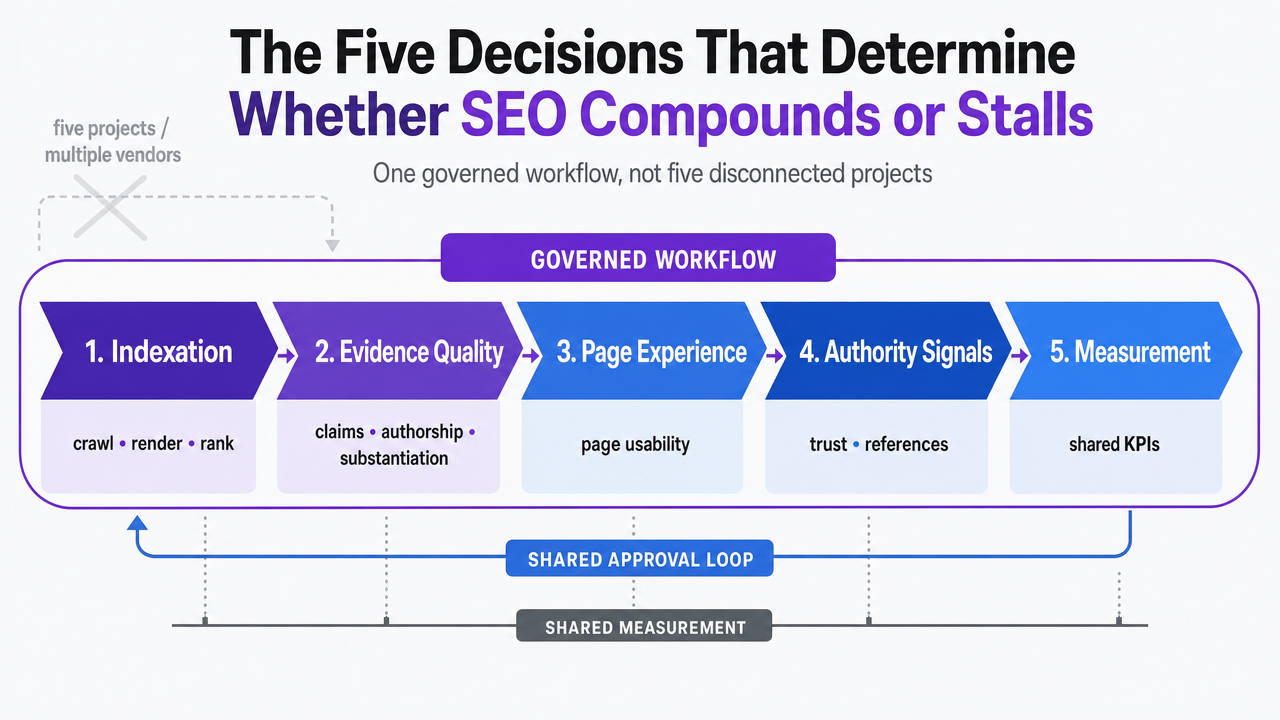 Visualize the five interdependent decisions framework introduced in this section as a sequenced operating model
Decision One: What Gets Crawled and Indexed
Ranking cannot compound on pages Google will not crawl, cannot render, or has been told to ignore. The indexation decision comes first because the click economics of search leave no room for pages that land on page two.
A 2023 comparative study of Google and Bing clicking behavior found that 97.11% of Google clicks in the sample went to first-page results, and more than 86% went to positions one through five 1. The study observed a specific set of queries in a specific market, and click distribution shifts with query intent, device, and SERP features, so the number should not be treated as a universal constant. It is directionally decisive anyway: a page that indexes on the second page of results is, for planning purposes, invisible.
That reality changes what the technical layer is actually for. Its job is not to chase every crawl budget optimization on the internet. Its job is to make sure the pages the business needs to rank are the pages Google can efficiently discover, render, and understand.
Five checks decide the outcome for most programs:
- Discoverability. XML sitemaps reflect only canonical, indexable URLs. Internal links reach every priority page within three clicks of the homepage or a hub.
- Render integrity. Critical content and primary calls to action appear in the rendered HTML, not only after client-side JavaScript execution.
- Signal consistency. Canonical tags, hreflang, robots directives, and internal anchors point at the same preferred URL. Conflicting signals get resolved, not layered on.
- Duplication control. Location pages, service pages, and programmatic templates carry enough unique substance to avoid being folded together by Google's own consolidation.
- Coverage monitoring. Search Console Index Coverage reports are triaged weekly, not quarterly. Pages that flip from Indexed to Crawled - currently not indexed get diagnosed before the query data disappears.
The operational takeaway is narrow. Before any content, authority, or measurement work compounds, the priority URLs need to be crawlable, renderable, canonical, and monitored. Everything downstream assumes those four conditions hold.
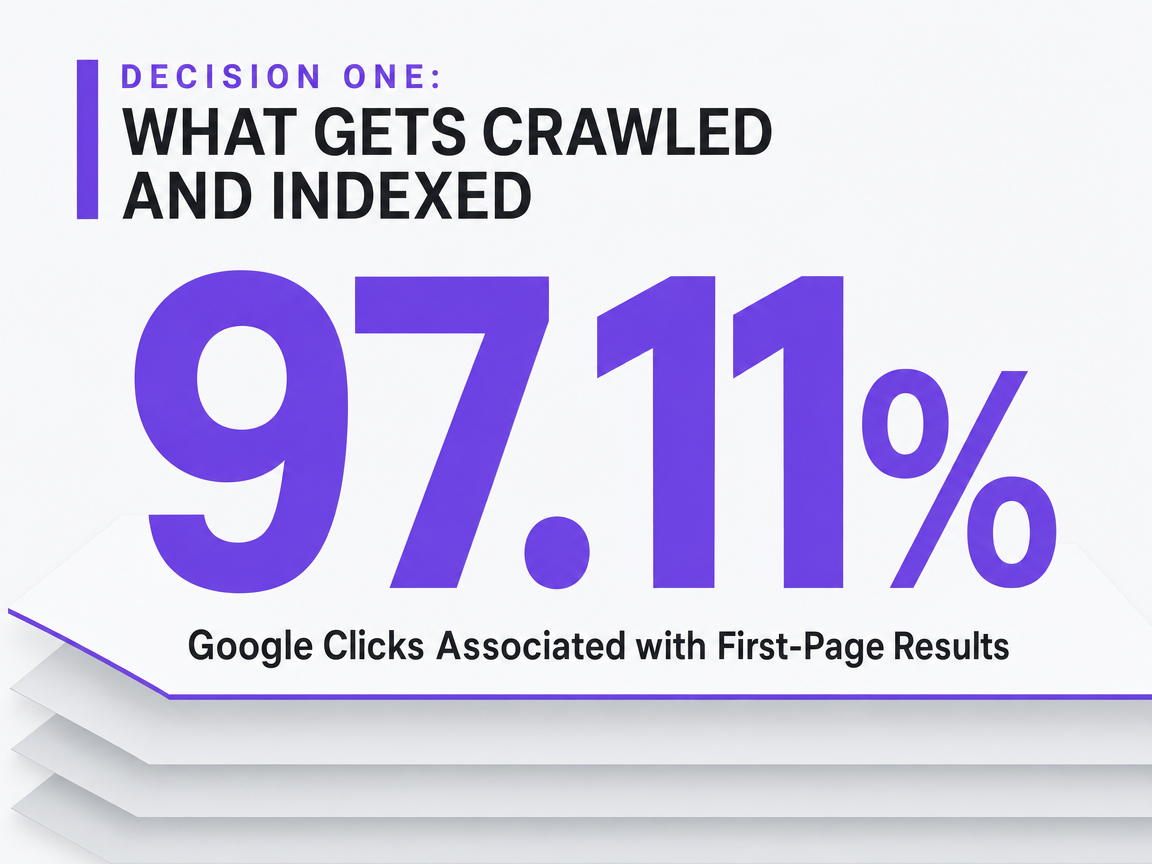 Google Clicks Associated with First-Page Results
Google Clicks Associated with First-Page Results
Decision Two: The Quality of Evidence That Ships
Once the priority URLs are crawlable, the question shifts to what actually lives on them. Not word count. Not keyword density. The specific evidence a page offers, who authored it, and what substantiates the claims inside it.
This decision has become sharper as generative search surfaces have entered the mix. A 2025 comparative study of consumer health information across Google, Bing, and generative AI platforms used DISCERN and JAMA Benchmark Criteria to score quality, credibility, and readability. Google achieved the highest reported mean DISCERN and JAMA scores among the evaluated platforms, and every platform in the sample produced content that exceeded recommended public-health reading levels 3. The study covered selected queries at one point in time, so the rankings are directional rather than permanent, but the underlying framework is what matters for a VP designing a content operation: named authors, disclosed sources, currency of information, balance of benefits and limits, and clear scope of applicability are the signals that separate content that ranks and gets cited from content that gets summarized past.
Four attributes tend to decide whether a page earns durable placement:
- Named authorship and reviewer credentials. Bylines that map to a real person with a verifiable background, plus a medical, legal, or subject-matter reviewer where the topic warrants it.
- Primary evidence, not paraphrase. Direct links to studies, regulator guidance, primary datasets, and dated sources. Citations should let a reader verify the claim in one click.
- Scope disclosure. Statistics presented with the population studied, the time frame, and the limits of generalization inside the same paragraph as the number.
- Review dates and update logs. A visible last-reviewed date and a change history for content that touches health, legal, financial, or safety-adjacent decisions.
Two operational habits protect this decision at scale. First, an editorial checklist that a page cannot pass without a named author, at least one primary source per non-obvious claim, and a review date. Second, a quarterly content audit that surfaces pages whose claims have aged out of their source. Pages that fail either check either get updated or get consolidated. Publishing volume without this discipline produces the ranking pattern most VPs recognize: a spike, a plateau, and a slow decline as competing pages ship better-substantiated versions of the same answer.
Decision Three: Page Experience That Converts a Visit into a Booking
A first-page ranking that lands on a slow, confusing, or inaccessible page is a wasted acquisition cost. Page experience is where organic visibility becomes booked revenue, and it is the decision most often outsourced to a developer with no visibility into the query behind the visit.
Three layers determine whether a click converts.
Speed and stability. Core Web Vitals data is available in Search Console at both the page and template level. The operational move is to triage by template, not by URL. A slow location page template is a slow location page template across every market; fixing the template compounds across the portfolio.
Accessibility as a conversion lever. Department of Justice guidance identifies form labels, keyboard access, sufficient color contrast, headings, and alternative text as core practices for public-facing business websites, and it is directly relevant to sites that rely on online intake or appointment forms 6. Every one of those items is also a conversion variable. An intake form that fails keyboard navigation loses submissions from users who never left a support ticket. Contrast failures on a primary call-to-action button suppress taps on mobile in bright light.
Intent match at the fold. The page that ranks for a service query should present the service, the location, the qualifying details, and the next step above the fold. A generic hero image and a nine-field contact form is a design decision that costs bookings on every visit.
The operational takeaway: instrument the intake form the same way the search team instruments queries. Field-level drop-off, time-to-first-interaction, and submission success by device belong in the same weekly review as impressions and clicks. Page experience stops being a developer ticket and starts being a pipeline input the moment those two data sets sit in one report.
Test Predictable SEO Growth Strategies in Real Time
See the impact of data-driven SEO improvements on your live pipeline before making a commitment.
Decision Four: Authority and Local Relevance Without Review Risk
Authority is the compounding layer. A domain that earns durable citations, mentions, and reviews outranks a domain that publishes twice as often but is talked about half as much. For multi-location operators, that authority has to be built at both the brand and the location level without importing the review-program risk that has quietly become one of the most expensive compliance exposures in local marketing.
Three moves carry most of the weight at the brand level: earned mentions from publications and associations the target buyer already reads, contributed research or datasets that give other sites a reason to cite the domain, and consistent named authorship that connects individual expertise to the organization. Directory link buying and reciprocal exchanges do not compound; they add risk without moving qualified impressions.
At the location level, the operational surface is narrower and higher-stakes. Google Business Profile completeness, category accuracy, service-area precision, and structured location pages with unique on-the-ground detail — staff, hours, insurance accepted, service scope, photos of the actual site — are what let a single location rank against national aggregators. Reviews sit on top of that layer, and this is where the risk lives.
The FTC's Consumer Reviews and Testimonials Rule took effect on October 21, 2024 and directly targets fabricated reviews, undisclosed insider reviews, review suppression, and misrepresentations that a site provides independent feedback 10. Endorsement guidance separately requires that testimonials be truthful, that material connections be disclosed, and that implied claims inside a review be substantiated the same way a direct claim would be 8. The operational consequence for a local program: solicitation cannot be selective by expected sentiment, incentives must be disclosed, employee and family reviews are off-limits without clear disclosure, and any process that filters negative feedback before it reaches a public page is now a rule violation, not a gray area. Detailed regulator-mapped guidance is consolidated in the governance section that follows.
The Governance Layer: One Section for Compliance, Substantiation, and Privacy
Regulated verticals do not need compliance mentioned in every section. They need one map that shows which regulator applies at which point in the SEO workflow, and what the operational consequence is when the rule is missed. The five decisions above generate compliance touchpoints in four places: the pages themselves, the review and testimonial layer, the intake experience, and the measurement stack.
Accessibility at the page and intake layer. Department of Justice guidance under the ADA identifies inaccessible websites as a barrier to services and applies to state and local governments and businesses open to the public 4. The companion ADA.gov guidance names the practical items that most often fail on service-business sites: form labels, keyboard access, sufficient color contrast, headings, alternative text, and clear instructions 6. The operational consequence is that intake forms, appointment scheduling, and service-page navigation are simultaneously a conversion asset and a legal exposure. A single template audit for keyboard, contrast, labels, and headings covers both surfaces.
Substantiation for health-adjacent claims. The FTC's Health Products Compliance Guidance requires that health-related advertising claims be truthful, not misleading, and supported by competent and reliable scientific evidence, including claims that are only implied through testimonials or expert endorsements 5. The companion PDF is explicit that an honest opinion in a testimonial does not substitute for evidence when the testimonial communicates an implied effectiveness claim, and that expert endorsers must have appropriate qualifications with material connections disclosed 9. For SEO copy, the operational consequence is that outcome language on service pages, before-and-after references, and success-story pages carry the same evidentiary weight as a headline claim. Legal review sits inside the content workflow, not after publication.
The review and testimonial rule. The FTC Consumer Reviews and Testimonials Rule took effect October 21, 2024 and directly addresses fake reviews, false testimonials, review suppression, undisclosed insider reviews, and misrepresentation that a site provides independent feedback 10. Endorsement guidance separately requires disclosure of material connections and truthful representation 8. Operationally: solicitation cannot be selective by expected sentiment, employee and family reviews require clear disclosure, and any filter that suppresses negative feedback before it reaches a public page is now prohibited conduct rather than a gray area.
Analytics and call intelligence in healthcare. HHS guidance on online tracking technologies states that HIPAA Rules apply when information collected through tracking scripts or disclosed to tracking vendors includes protected health information, with distinct requirements for user-authenticated pages 7. HHS marketing guidance separately defines when communications encouraging use of a product or service require prior authorization 11. The operational consequence for a covered entity: aggregate Search Console and query-level reporting sit on one side of a wall, and any pixel, tag, form field, call recording, or vendor integration that could carry PHI sits on the other, with a business associate agreement and a configured data flow.
These four regulatory surfaces map cleanly to the five decisions and belong on a single reviewed checklist rather than embedded piecemeal in every content brief.
Decision Five: Measurement Architecture That Ties Queries to Revenue
An organic program that cannot be defended in revenue terms will lose budget to a paid channel that can. Measurement is the decision that turns the previous four into a line item a CFO recognizes.
The architecture has three layers, and each one exists to answer a different question.
The visibility layer answers what queries the domain is competing for. Search Console query, page, country, device, impression, click, and Core Web Vitals data at the template level is the primary input. The operational move is to join the query report to the page report weekly, not monthly, and to flag any priority page whose impression trend flattens while average position drifts past five. That drift is where forecastable pipeline quietly leaks.
The conversion layer answers what a click did after it landed. Form submissions, scheduled appointments, chat starts, and calls need to be attributed to the landing page and the entry query, not to a generic organic bucket. Call tracking with dynamic number insertion at the page-template level is the piece most programs skip; without it, the phone conversions that dominate high-stakes verticals stay invisible to the search team.
The revenue layer answers what those conversions became. Booked appointments, qualified opportunities, closed matters, and contract value need to travel back from the CRM or practice management system and rejoin the page and query record. This is where organic stops being a traffic report and becomes a pipeline report.
For healthcare and behavioral-health operators, this architecture has a hard constraint. HHS guidance on online tracking technologies makes clear that HIPAA Rules apply when information collected through tracking scripts or disclosed to tracking vendors includes protected health information, with distinct requirements for user-authenticated pages 7. Aggregate Search Console reporting and template-level performance sit on one side of a configured wall; any pixel, form field, call recording, or CRM sync that could carry PHI sits on the other with a business associate agreement in place.
The concrete deliverable is a single weekly report with three columns per priority page: entry queries and position trend, conversions by type, and revenue attributed. When that report exists, budget conversations stop being about rankings and start being about cost per booked appointment by page. That is the number a VP defends.
See How Leading Teams Build Predictable SEO Pipeline—Without Adding Headcount
Request a data-driven analysis of your current SEO process and receive actionable benchmarks on scaling organic growth efficiently across multiple channels.
If You Operate Multiple Locations: The Coordination Math of a Vendor Stack
This section is written for multi-location operators and portfolio marketing leaders. A single-location program can survive with a decent agency and a spreadsheet. A twenty-location dental group, a regional behavioral-health network, or a home-services franchise cannot, and the reason is not tactical. It is coordination cost.
Most portfolio SEO programs assemble somewhere between three and five vendors: a national SEO agency, a content shop, a technical SEO consultant on retainer, a local listings and reputation vendor, and an analytics contractor stitching reports together. Each vendor optimizes for the deliverable in its own contract. None of them own the pipeline number. The peer-reviewed framing of SEO as a multi-dimensional determinant of brand positioning rather than a single-variable exercise is exactly why fragmentation hurts here: the five decisions covered above are interdependent, and interdependence does not survive being split across five statements of work 2.
Three variables isolate the actual cost. Operators can fill them in with their own numbers rather than borrow invented benchmarks.
| Variable | Fragmented Vendor Stack | Single Governed Workflow |
|---|---|---|
| Coordination overhead (internal PM hours per week) | Weekly status calls with each vendor, brief translation between shops, and manual reconciliation of conflicting recommendations. Scales roughly linearly with vendor count and location count. | One approval queue, one prioritized backlog, one review cadence. PM hours track work volume, not vendor count. |
| Decision latency (days from Search Console signal to published change) | Signal surfaces in one vendor's report, gets escalated in the next standing meeting, waits for a brief, waits for content, waits for technical implementation, waits for QA. Two to six weeks is common. | Signal to prioritization to approval to publish inside one governed loop. Measured in days, not weeks. |
| Attribution completeness (percent of organic conversions tied to a specific page and entry query) | Analytics contractor sees conversions. Local vendor sees calls. SEO agency sees rankings. Joining them back to a page and query per conversion is a manual quarterly exercise, if it happens at all. | Query, page, conversion type, and revenue live in one record per priority page. Weekly reporting is a query, not a project. |
The economic argument is not that fragmentation is always more expensive in retainer dollars. It often is not. The argument is that fragmentation taxes the three variables that actually determine whether the five decisions compound. A program with high coordination overhead and slow decision latency cannot act on the visibility layer fast enough to protect priority pages when average position drifts past five. A program with incomplete attribution cannot defend budget in revenue terms, which returns the operator to the problem the fifth decision was designed to solve.
The operational takeaway for a portfolio operator is narrow: before renegotiating any vendor contract, measure the current values of PM hours per week, days from signal to published change, and percent of organic conversions with a page-and-query attribution. Those three numbers decide whether the current stack can support predictable growth, or whether the coordination math already answers the question.
Why AI Overviews Reward the Same Fundamentals
The arrival of AI Overviews and AI Mode has generated more strategic anxiety than the underlying mechanics warrant. Google's own position is that generative surfaces do not require a parallel optimization playbook: the signals that qualify a page for a traditional ranking are the signals that qualify it for citation inside a generated answer.
The 2025 comparative study of consumer health information across Google, Bing, and generative AI platforms found that Google achieved the highest reported mean DISCERN and JAMA scores among the evaluated platforms, with all evaluated content exceeding recommended public-health reading levels 3. The study covered selected queries at one point in time, so the specific rankings will shift. The evaluation framework will not. Named authorship, cited primary evidence, currency, balance, and clear scope are what the scoring instruments reward, and those are the same attributes that decision two of this framework already treats as non-negotiable.
The operational consequence is narrow. A page built to satisfy the evidence-quality decision is already built to be surfaced inside a generated answer. Pages that fail to name an author, cite primary sources, or disclose review dates lose ground on both surfaces at once.
The teams treating AI Overviews as a new discipline are usually the teams that skipped the evidence-quality decision the first time.
A 90-Day Sequence for Turning the Five Decisions Into One Workflow
The five decisions do not have to be adopted at once. They have to be sequenced so each week's work makes the next week's work possible. A 90-day cadence is enough to move a fragmented program into one governed loop without pausing publishing.
Days 1–30: Instrument before optimizing. Pull Search Console query and page data at the template level. Map every priority URL to its indexation status, canonical target, and Core Web Vitals bucket. Deploy dynamic number insertion on service and location templates so calls carry a landing-page and entry-query record. In regulated verticals, run the analytics stack through a privacy review before adding new tags, per HHS guidance on tracking technologies and PHI 7. The deliverable is a single baseline report: priority page, entry queries, position trend, conversion type, and revenue where the CRM connection is live.
Days 31–60: Fix the templates, not the URLs. Triage indexation and page-experience issues at the template level. Retire or consolidate pages that fail the evidence-quality checklist — no named author, no primary source, no review date. Audit intake forms for keyboard access, labels, and contrast against DOJ web guidance 6. Publish a governance checklist that a page cannot pass without editorial, accessibility, and (where applicable) legal review.
Days 61–90: Operate the loop weekly. One approval queue. One prioritized backlog fed by Search Console drift and conversion gaps. One weekly report joining query, page, conversion, and revenue. By day 90, the question stops being which vendor owns which tactic and starts being which page is closest to moving from position seven to position four. That is the loop platforms like Vectoron are built to run.
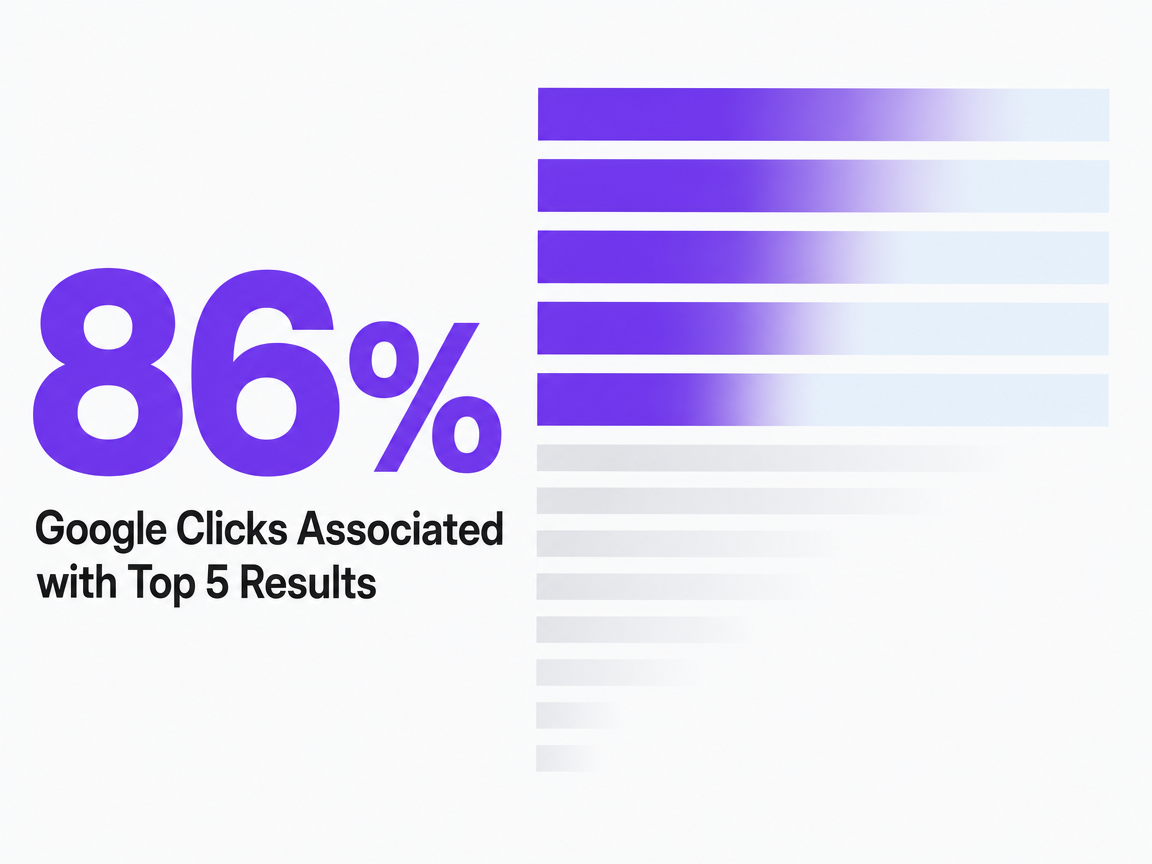 Google Clicks Associated with Top 5 Results
Google Clicks Associated with Top 5 Results
Frequently Asked Questions
References
- 1.You are how (and where) you search? Comparative analysis of search engines and clicking behavior.
- 2.Search engine optimisation (SEO) strategy as determinants to enhance the online brand positioning.
- 3.The Reliability Gap: How Traditional Search Engines and Generative AI Platforms Compare in Consumer Health Information.
- 4.Justice Department Issues Web Accessibility Guidance Under the Americans with Disabilities Act.
- 5.Health Products Compliance Guidance.
- 6.Guidance on Web Accessibility and the ADA.
- 7.Use of Online Tracking Technologies by HIPAA Covered Entities and Business Associates.
- 8.Endorsements, Influencers, and Reviews.
- 9.Health Products Compliance Guidance.
- 10.The Consumer Reviews and Testimonials Rule: Questions and Answers.
- 11.Marketing.