
Key Takeaways
- Treat organic search as four coupled loops under governance: demand identification, content production, conversion engineering, and closed-loop measurement from impression to retained revenue.
- Replace rankings and sessions with a six-stage funnel ending in retained revenue, so each drop-off has a named owner and ties organic landing pages to closed deals through CRM integration.
- Apply FTC advertising standards to landing-page claims, testimonials, and review programs from the first draft, including the Consumer Reviews and Testimonials Rule effective October 21, 2024 5.
- Multi-location operators should centralize research, technical work, compliance, and measurement while keeping content, reviews, and GBP updates local, and healthcare operators must inventory tracking tags against HHS guidance 9.
Reframing the Question: From Rankings to a Pipeline Operating System
The question "how do I SEO my website" sounds tactical, but a VP of marketing who inherits it from a CFO is being asked something different: can organic search produce pipeline on a schedule, reported in the same cadence as paid media and sales. That answer does not live in a keyword tool or a title-tag audit. It lives in an operating system that connects demand to revenue and runs under governance.
Rankings are a diagnostic. Pipeline is the output. A site can rank for high-intent terms and still fail to produce booked appointments if intake is slow, if landing-page claims cannot be substantiated, or if measurement stops at session counts. Google's own guidance has moved in this direction, emphasizing people-first content, crawlability, policy compliance, and accurate structured data rather than any single ranking trick.
The reframing matters because it changes what gets staffed, what gets measured, and what gets approved. SEO pages are advertising surfaces when they promote services, which brings them under FTC standards for truthful, substantiated, non-deceptive claims 1. That constraint is not a tax on growth. It is the design discipline that separates compounding programs from episodic traffic spikes.
The rest of this analysis treats SEO as four coupled loops wrapped by a governance layer, then shows how a lean team runs it against revenue targets rather than vanity dashboards.
The Four Loops That Produce Predictable Organic Revenue
Loop One: Demand Identification Beyond Keyword Lists
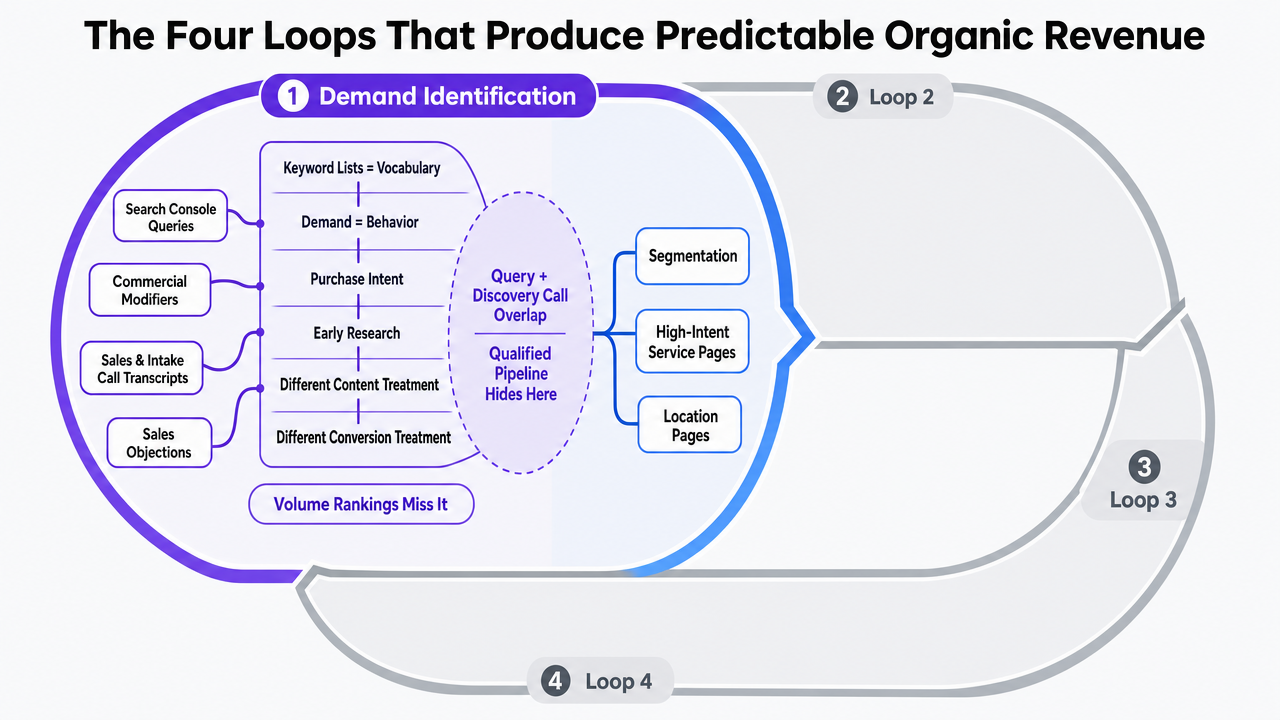
Keyword lists describe vocabulary. Demand describes behavior. A VP running organic for pipeline needs to see both, then separate the queries that signal purchase intent from those that signal early research, and route each to a different content and conversion treatment.
The practical starting point is a demand map built from three inputs:
- search console query data filtered by commercial modifiers (near me, cost, reviews, best, consultation),
- transcripts and tags from inbound sales and intake calls, and
- the objections sales teams close against most often.
The overlap between what people type and what they say on a discovery call is where qualified pipeline hides. Pure volume rankings miss it.
Segmentation then determines content economics. High-intent service pages, location pages, and comparison pages carry the booking burden. Mid-funnel explanations, condition guides, and process pages carry the trust burden. Each segment gets its own conversion target, its own refresh cadence, and its own measurement line. Treating a 300-visit comparison page the same as a 30,000-visit glossary entry is how teams waste production budget.
Demand identification is also a legal filter. Queries that imply health, safety, or outcome claims pull the matching pages into FTC substantiation territory before the first draft is written 1. Flagging those terms at the research stage, not at legal review, keeps production velocity intact.
Loop Two: Useful Content Production Under Governance
Production is where most SEO programs lose predictability. Output surges when a vendor is onboarded, then collapses when a key writer leaves or when legal review becomes a bottleneck. The teams that compound revenue treat production as a governed workflow with defined inputs, review gates, and accountable owners for every artifact.
The NIST AI Risk Management Framework Generative AI Profile, published July 26, 2024, identifies 12 categories of generative AI risk and more than 200 suggested actions across design, development, use, and evaluation of generative systems 3. The profile reads like a specification for the exact failure modes a scaled SEO program hits: unverified claims, source confusion, privacy leakage, and loss of human accountability for what gets published. Applied to content operations, it argues for reviewable workflows, documented source controls, factual verification steps, and a named human approver before anything ships.
In practice this means every piece moves through a fixed sequence:
- brief with intent and claims surfaced,
- draft with inline source attribution,
- subject-matter review for accuracy,
- compliance review for regulated claims, and
- final approval logged by name and date.
AI assistance accelerates the draft and research stages, but the approval record stays with a person.
Production governance also protects pipeline continuity. When a claim is challenged, when a page needs a correction, or when a vertical regulator updates its guidance, the team can trace what was published, who approved it, and what source supported each statement. Content without that paper trail is a liability, not an asset.
Loop Three: Conversion Engineering From Click to Booked Appointment
A click is not a conversion event worth reporting to a CFO. A booked appointment, a qualified call, or a signed intake form is. The gap between the two is where conversion engineering lives, and it is the loop where response time and intake capacity matter as much as page design.
Local-search behavior sets the clock. A peer-reviewed article on review recency cites findings that 76% of consumers who performed a local search visited a related business within a day, and 88% did so within a week 4. The study develops research propositions rather than reporting a new field experiment, and the figures are drawn from prior work on local-search behavior, so they should not be read as a universal benchmark for every vertical. The directional signal still matters: intent decays in hours, not weeks.
That decay dictates the conversion stack. Click-to-call buttons need to route to staffed phones during the hours the search traffic actually arrives, not a 9-to-5 window set years ago. Form submissions need an automated acknowledgment and a human follow-up measured in minutes. Call recordings and dispositions need to feed back to the SEO team so page copy can be adjusted when callers repeatedly ask the same unanswered question.
Landing-page design belongs to the same loop. Headlines, offer framing, and testimonial placement all affect conversion rate, and every one of those elements is advertising subject to FTC rules on truthfulness, substantiation, and testimonial representativeness 1. A page that converts well but cannot defend its claims is a pipeline risk disguised as a win. Conversion engineering, done honestly, treats the compliance layer as a design constraint from the first wireframe.
Loop Four: Closed-Loop Measurement From Impression to Retained Revenue
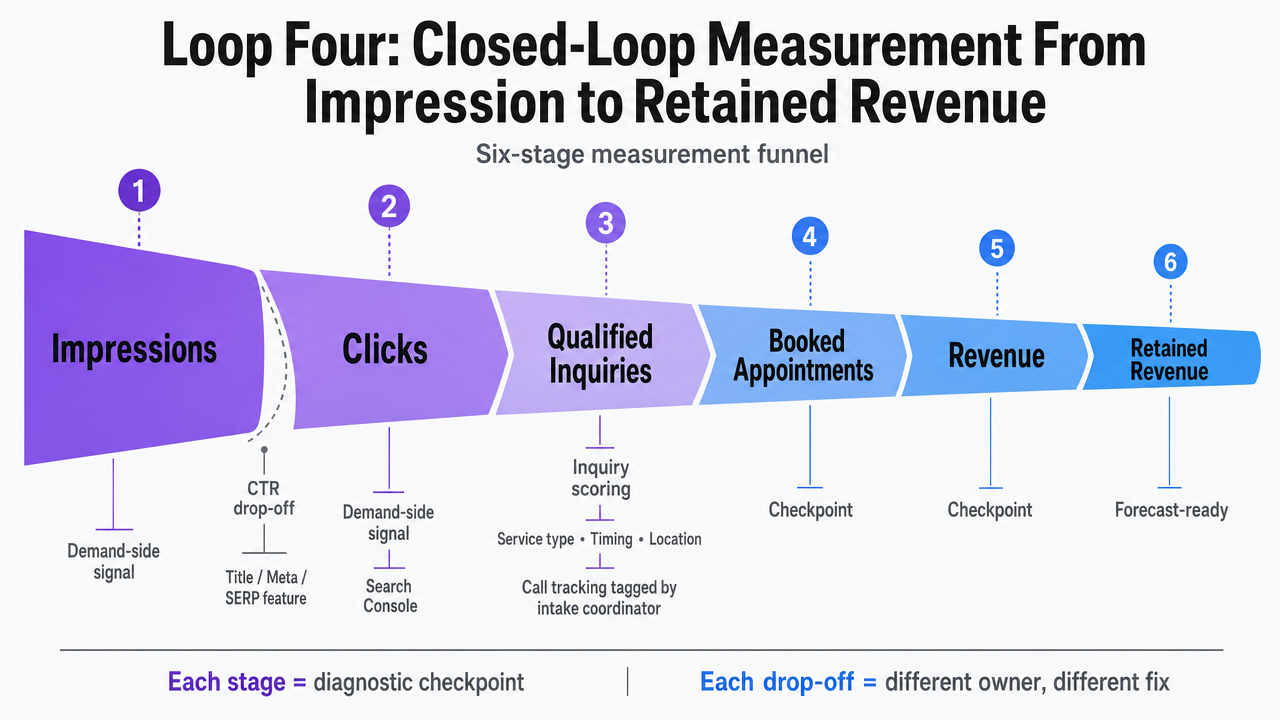
Measurement is where SEO earns a seat in the forecast meeting or loses it. Session counts and keyword rankings do not survive scrutiny from a CFO because they do not connect to revenue. The measurement spine that does survive runs through six stages:
- Impressions,
- Clicks,
- Qualified Inquiries,
- Booked Appointments,
- Revenue, and
- Retained Revenue.
Each stage is a diagnostic checkpoint, and each drop-off has a different owner and a different fix.
Impressions and clicks come from search console and are the demand-side signal. A click-through rate collapse on a page that still ranks points to a title, meta description, or SERP-feature problem. Qualified inquiries, the next stage, require inquiry scoring: a form that asks for service type, timing, and location, or a call tracking recording tagged by an intake coordinator. Unqualified inquiries get counted separately, because flooding the pipeline with wrong-fit leads inflates conversion rates and corrodes sales confidence.
Booked appointments and revenue require CRM integration. The SEO team needs a view of which organic landing pages produced which booked consultations and, downstream, which closed deals. Retained revenue, the sixth stage, matters because the pages and queries that produce the longest-tenured customers are not always the ones that produce the most volume. Prioritizing production against lifetime value changes the keyword list.
Every claim made along this funnel is advertising when it promotes a service, which means substantiation standards apply to the headlines, comparison statements, and expected-result language that drive each conversion step 1. Measurement without that constraint produces optimization loops that improve a page's conversion rate by making promises the business cannot defend. Measurement with it produces compounding pipeline that holds up in a quarterly review.
 Visualize the six-stage measurement funnel explicitly described in the section prose, with each stage named in the article
 Visualize the four coupled loops described in the section as a connected operating model, reinforcing the article's central framework
See SEO-driven pipeline impact in one week
Experience how streamlined SEO execution generates measurable, real-world results for your pipeline—before you commit.
The Governance Layer: Treating SEO Pages as Regulated Advertising Surfaces
Landing-Page Claims, Testimonials, and Substantiation
A service landing page is advertising the moment it promotes a service, and the FTC applies the same truthfulness, substantiation, and non-deception standards to it that apply to a television spot or a paid search ad 1. Most SEO teams treat page copy as editorial. Regulators do not. That gap is where enforcement risk and quiet pipeline attrition both live, because pages that overpromise convert in the short term and generate complaints, refunds, and reputational damage in the medium term.
Three claim categories need a documented substantiation file before publication:
- Performance claims (success rates, timelines, outcomes) require evidence proportional to the specificity of the number.
- Comparative claims against named or implied competitors require data the business can actually produce if challenged.
- Health, safety, and expected-result claims require competent and reliable scientific evidence, a bar the FTC applies tightly to health-adjacent services 6.
A page that says a treatment "typically resolves symptoms in two weeks" is making a quantitative outcome claim and needs the underlying study, chart review, or dataset on file.
Testimonials carry a parallel standard. Quoted patient or client results must reflect what consumers can generally expect, not the exceptional case; a disclaimer that "results may vary" is not sufficient on its own 2. The practical fix is a testimonial inventory tied to the page it appears on, with the substantiation document, consent record, and any material connection noted in a single row. When a reviewer asks why a quote is on a page, the answer takes thirty seconds to produce.
Pages written under this discipline convert slightly lower on first draft and considerably higher after six months, because the claims that survive review are the ones the business can keep making.
Review Programs After the FTC Rule Took Effect
Review generation is now a regulated workstream. The FTC's Consumer Reviews and Testimonials Rule took effect October 21, 2024 and authorizes civil penalties for knowing violations involving fake reviews, undisclosed incentives, and conditioning incentives on a particular sentiment 5. Local SEO programs that lean on review velocity for map-pack prominence inherit that exposure directly.
Three mechanics in common review playbooks need to change:
- Incentives, if offered at all, cannot be tied to leaving a positive review and must be disclosed as a material connection 10.
- Review-gating workflows that route unhappy customers to a private channel while sending happy ones to Google create a distorted public record and are exactly the pattern the rule targets.
- Employee or vendor reviews, including those written by marketing contractors, require clear disclosure of the relationship or should not be posted at all.
The operational response is a review policy document that lives next to the SEO playbook: who can request reviews, what language the request uses, what disclosures accompany any incentive, how negative reviews are handled, and who approves responses. The Consumer Review Fairness Act also protects honest consumer opinions, which means contract clauses or form language that penalize negative reviews create their own liability 10. A clean review program still produces the recency and volume signals that help local prominence; it just does so on a record the business can defend if the FTC or a state AG asks.
Site Security and Healthcare Measurement as Pipeline Controls
Two controls that rarely appear in an SEO plan belong in the governance layer because they interrupt pipeline directly when they fail: website security and healthcare-specific measurement.
NIST released Cybersecurity Framework 2.0 in February 2024 as outcome-based guidance for managing cybersecurity risk across industry and government 7. For a marketing site, the relevant failure modes are concrete:
- injected spam that triggers manual actions and tanks rankings,
- compromised forms that leak lead data,
- DNS or hosting outages that drop the site during peak search hours, and
- plugin vulnerabilities that redirect traffic.
Assigning a named owner for the identify, protect, detect, respond, and recover functions around the marketing stack keeps these from being treated as someone else's problem until the pipeline drops and the forensic bill arrives.
Healthcare and behavioral health operators carry an additional measurement constraint. HHS guidance issued June 26, 2024 on online tracking technologies defines tracking broadly as any code or script that gathers user actions on a website or app, and applies HIPAA obligations whenever the collected or disclosed information includes protected health information 9. Analytics tags on an appointment confirmation page, pixels on a condition-specific landing page, chat tools, call intelligence, and remarketing lists can all cross into PHI depending on the data flow. Related HIPAA marketing rules require written authorization before most uses of PHI for marketing communications 8.
The operational implication is a tracking inventory reviewed by compliance before new tags ship, business associate agreements with every analytics and call-tracking vendor, and consent configuration that assumes PHI exposure rather than hoping it does not occur. Measurement built this way survives an audit and keeps the pipeline running.
If You Operate Multiple Locations: Consolidating SEO Execution Without Losing Local Signal
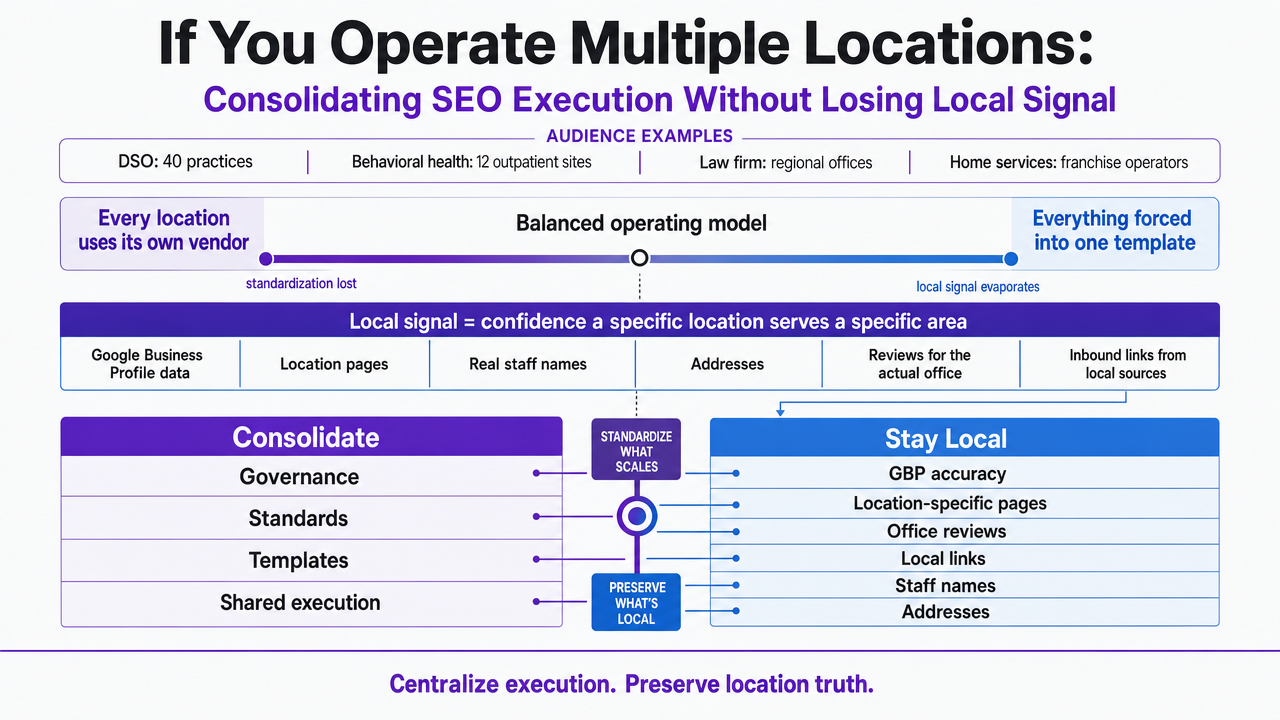
This section shifts audience. The reader here runs SEO across a portfolio of locations: a DSO with 40 practices, a behavioral health group with a dozen outpatient sites, a law firm with regional offices, a home services brand with franchise operators. The economics and governance questions are different from a single-site operator, and the common failure pattern is the same: either every location gets its own vendor and the brand loses standardization, or everything collapses into a central template and local signal evaporates.
Local signal is the search engine's confidence that a specific location serves a specific area. It comes from accurate Google Business Profile data, location-specific pages with real staff names and addresses, reviews that mention the actual office, and inbound links from local sources. None of that scales by cloning a template across 40 URLs and swapping the city name. Search engines detect doorway patterns, and users detect them faster.
The consolidation that works separates the function from the facility. Keyword research, technical audits, schema deployment, review policy, compliance review, and measurement infrastructure centralize cleanly. Location-specific content, review responses, Google Business Profile updates, and local link development stay close to the location, with the central team providing templates, guardrails, and approval workflows rather than finished copy.
The table below frames the tradeoff. Dollar figures are intentionally left as variables because retainers and FTE loaded costs vary by market; operators should substitute their own numbers.
| Function | Per-Location Agency or FTE Model | Consolidated Operating Model | Governing Standard |
|---|---|---|---|
| Keyword research | Repeated per location at retainer rate R | Centralized once, segmented by market | FTC claim scoping 1 |
| On-page production | Local writer time at hourly H × pages | Central draft, local review, approval logged | NIST AI RMF reviewable workflow 3 |
| Local listings and GBP | Per-location coordinator time | Central tooling, local approval of changes | FTC truthfulness in listings 1 |
| Review operations | Varies by location, often informal | One policy, one request script, central monitoring | FTC Reviews Rule 5, Endorsements 10 |
| Technical audits | Duplicated or skipped | Single crawl across portfolio, prioritized backlog | NIST CSF 2.0 7 |
| Measurement | Fragmented analytics per site | Unified funnel, location-level attribution | HHS tracking guidance where PHI applies 9 |
The governance consequence matters more than the cost column. When the FTC Reviews Rule took effect, a portfolio operator with 40 locations each running their own review playbook faced 40 compliance surfaces 5. The consolidated model collapses that to one policy, one approval record, and one audit trail, which is why the model survives both a regulator inquiry and a quarterly board review.
 Visualize the centralize-vs-local operating model comparison from the section's table, showing which functions consolidate and which stay close to the location
See How Leading Brands Build Predictable SEO Pipeline—Without Expanding Headcount
Request a data-backed assessment of your current SEO execution workflow and discover proven methods to systematize organic lead generation at scale—tailored for teams managing multi-channel campaigns.
Staffing the Operating Model Lean
A VP who runs the four loops under governance does not need a 15-person SEO department. The predictable model fits five accountable roles, several of which can be fractional or shared with adjacent functions.
The roles are:
- a demand analyst who owns the keyword-to-call-transcript overlap and the content backlog;
- a managing editor who owns the production workflow, source attribution, and approval log aligned to the NIST generative AI profile 3;
- a conversion owner responsible for landing-page copy, intake response time, and the CRM integration that lets booked appointments trace back to pages;
- a compliance reviewer, often shared with legal or clinical leadership, who clears claims against FTC substantiation and testimonial standards 1 and the Reviews Rule 5; and
- a technical owner for crawl health, schema, and the security controls that keep the site from becoming a pipeline outage 7.
AI assistance compresses the drafting, research, and audit stages inside those roles. It does not replace the approver. The headcount that gets saved is the second and third generalist marketer hired to keep up with volume; the headcount that stays is the named person who signs off before anything ships.
A 90-Day Instrumentation Sequence for the First Loop Cycle
The first 90 days should instrument the system, not chase rankings. The output of this quarter is a measurable funnel the VP can defend in a forecast meeting, with named owners for each stage and a documented approval record for anything that ships.
- Days 1 to 30 belong to measurement and governance scaffolding. Connect search console, CRM, and call recordings into a single reporting view with the six-stage funnel defined from impressions to retained revenue. Publish the claims substantiation standard, the review request script, and the approval log template in one shared document aligned to FTC advertising standards 1 and the Consumer Reviews and Testimonials Rule 5. Healthcare and behavioral health operators complete a tracking inventory and vendor BAA review before any new tag ships 9.
- Days 31 to 60 build the demand map and the production workflow. Overlay commercial queries with call transcripts, rank pages by booking contribution, and route the top 10 through the full brief-draft-review-approve sequence under the generative AI governance frame 3.
- Days 61 to 90 run the first conversion experiments: intake response time, headline substantiation, and local page refreshes. The quarter closes with a funnel the next quarter can compound against.
Frequently Asked Questions
References
- 1.Advertising and Marketing on the Internet: Rules of the Road.
- 2.Advertising FAQ's: A Guide for Small Business.
- 3.Artificial Intelligence Risk Management Framework: Generative Artificial Intelligence Profile.
- 4.Contextual Effects of Online Review Recency: Three Research Propositions.
- 5.The Consumer Reviews and Testimonials Rule: Questions and Answers.
- 6.Health Products Compliance Guidance.
- 7.NIST Releases Version 2.0 of Landmark Cybersecurity Framework.
- 8.Marketing.
- 9.Use of Online Tracking Technologies by HIPAA Covered Entities and Business Associates.
- 10.Endorsements, Influencers, and Reviews - Federal Trade Commission.