
Key Takeaways
- SEO works as a five-stage operating loop—eligibility, usefulness, accessibility, trust, and measurement—rather than a tactics checklist, with every published asset passing through each gate before shipping.
- Writing to the decision behind a query, not the keyword itself, and treating readability as a conversion variable determines whether ranked pages actually produce qualified leads 1, 9.
- Trust and compliance gates carry real exposure in regulated verticals, spanning the six-criteria editorial rubric, FTC rules on reviews and testimonials, and HIPAA limits on marketing data 3, 4, 6, 10.
- VPs should spend the first 90 days running an eligibility and privacy sweep on the top 20 revenue URLs, installing the editorial rubric, and rebuilding measurement around qualified leads and blended CAC.
The Operating Loop That Replaces the Tactics Checklist
Most pages that answer "how do you do SEO" hand back a tactics list: meta tags, header hierarchy, internal links, backlinks, schema. That list is accurate and nearly useless for a marketing VP who owns a pipeline number. Tactics describe parts. They do not describe the system that produces qualified organic revenue month after month.
The more defensible frame is an operating loop with five jobs. A site has to be eligible to compete, meaning search engines can crawl, render, and understand what each page is for. Its content has to be useful to a specific audience making a specific decision. The experience has to be accessible, both technically and across reading levels and languages. The organization has to prove trust through authorship, substantiation, and clean handling of reviews, testimonials, and patient or client data. And the program has to measure revenue contribution, not vanity rankings, so the loop can be tuned on evidence instead of opinion.
These five jobs are not sequential steps. They run in parallel on a cadence, with every published asset passing through each gate before it ships. In regulated service verticals — law, behavioral health, dental and DSO groups, home services, senior living, healthcare — the gates carry real consequences. Readability failures suppress conversion even when a page ranks. Credibility gaps undermine trust in categories where buyers are already skeptical. Endorsement and privacy missteps create legal exposure, not just marketing underperformance.
The rest of this guide walks through each stage of the loop, what it looks like when it runs well, and how VPs can audit whether their current program is actually operating a system or just working a backlog.
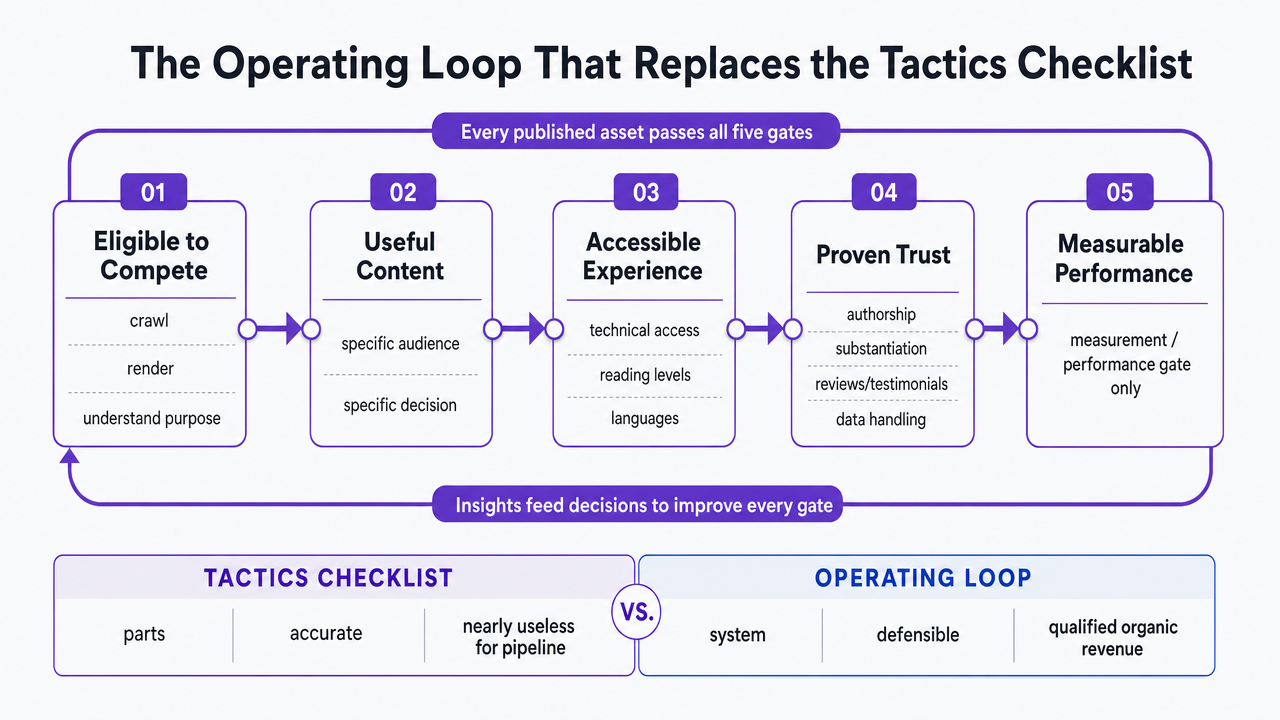 Visualize the five-stage SEO operating loop introduced in this section as a framework diagram showing the parallel gates every published asset must pass through
Stage One: Making the Site Eligible to Compete
Eligibility is the floor, not a differentiator. A page cannot earn qualified traffic if search engines cannot crawl it, render its primary content, understand what entity owns it, or match it to a clear query intent. VPs who skip an eligibility audit often fund content programs that produce drafts a crawler never fully indexes.
The eligibility layer answers four technical questions about every URL that matters to pipeline:
- Can it be crawled on the device profile that drives most of its traffic, usually mobile?
- Does the server respond with a stable status code and reasonable time-to-first-byte under real load?
- When the page renders, is the primary content present in the initial HTML or dependent on client-side scripts the crawler may not execute?
- Is the page's purpose declared cleanly through title, headings, canonical, hreflang where applicable, and structured data that matches the on-page claims?
Site architecture sits on top of those questions. Service pages should resolve to one canonical URL per service per location, not three near-duplicates created by filter parameters or legacy campaign landing pages. Internal links should move authority from high-traffic educational pages toward the conversion URLs that actually book revenue. Orphaned pages — URLs with no internal link path — should be identified and either linked, redirected, or removed.
For regulated service verticals, eligibility also includes governance plumbing: a published authorship model with reviewer credentials, a privacy posture that keeps protected health information out of analytics and tag containers 6, and a template system that lets legal and compliance review changes before they ship. Eligibility is boring. It is also the stage where most underperforming programs are quietly losing before any content judgment is made.
Stage Two: Making Content Useful to a Specific Audience
Writing to the Decision, Not the Keyword
A keyword is a signal. The decision behind it is the asset. When a user searches "outpatient alcohol treatment near me," the keyword routes the query, but the content has to serve the decision underneath: a family member comparing programs, worried about cost, scheduling, confidentiality, and whether the facility will treat a specific co-occurring condition. Writing to the keyword produces a page stuffed with the phrase. Writing to the decision produces a page that answers the five or six questions a buyer actually asks before picking up the phone.
The practical shift is in the brief. Instead of a target keyword and a word count, each page is briefed with the audience segment, the decision stage, the objections being handled, the proof the page must display, and the next action the page is designed to produce. A service page for a DSO parent brand aimed at insurance-anxious patients looks nothing like a service page aimed at referring general dentists, even when both target the same procedure keyword.
Pages built this way tend to rank for broader clusters of related queries because they cover the decision rather than one phrase. More importantly, they convert, because the reader finds the answer to the question that brought them, not a thin restatement of the query.
Readability as a Pipeline Variable
Readability is treated as an editorial preference. It behaves like a conversion variable. If a page is written three grade levels above the audience's comprehension, the reader either leaves or absorbs less of what the page says, and the next action — call, form fill, chat — becomes less likely regardless of ranking position.
The evidence from regulated verticals is pointed. A peer-reviewed evaluation of 36 online heart-failure patient-education resources found that median readability sat at approximately a ninth- to tenth-grade level or higher by one measure, well above the sixth- to eighth-grade range that health-literacy guidance recommends for general patient audiences 1. That study examined one clinical topic on a small sample of patient-facing sites, so the number is not a universal benchmark. The operational point generalizes: content teams routinely publish at a reading level that outruns the audience they are trying to convert.
The AHRQ Health Literacy Universal Precautions Toolkit treats this as a system problem, not a writing-style problem 9. It recommends assuming any reader may struggle with dense material and designing page templates, service explanations, FAQs, and intake flows around comprehension by default. For an SEO program, that translates to concrete editorial gates: short sentences, defined terms the first time they appear, a measured reading grade on every published page, and a review step that catches jargon the subject-matter expert did not notice they used. Readability stops being a copyediting preference and starts being a line item in the conversion math.
 Heart failure education websites offering non-English languages
Heart failure education websites offering non-English languages
Test Automated SEO Execution On Live Campaigns
Experience real-time SEO improvements and measure impact on actual search traffic before making a long-term commitment.
Stage Three: Accessibility as Reach, Not Charity
Accessibility is often filed under compliance, which is why it stays underfunded. Treated correctly, it is a reach decision: every language barrier, screen-reader failure, and contrast problem narrows the addressable market a ranking page can actually convert.
The same peer-reviewed evaluation of 36 online heart-failure patient-education resources found that only 10 sites — 28% — offered information in languages other than English, and none provided comprehensive accessibility features 1. The sample is narrow (one clinical topic, patient-facing sites), so the figure is not a universal benchmark. The pattern it describes is familiar in every regulated service vertical this guide addresses: content is produced in English, built for sighted desktop users, and shipped without a serious audit of who cannot use it. A ranking position in a market where a meaningful share of searchers prefer Spanish, Vietnamese, or Mandarin returns a conversion rate that reflects only the English-reading, fully-sighted slice of demand.
The legal perimeter is narrower than most compliance decks suggest. The DOJ's 2024 Title II rule sets WCAG 2.1 Level AA as the technical standard for state and local government web content and mobile apps, with larger covered entities generally obligated by April 24, 2026 and smaller entities by April 26, 2027 7, 8. That rule binds covered public entities directly. Private-sector obligations depend on other laws, contracts, and facts and should be scoped with counsel rather than assumed from the Title II rule alone.
Operationally, VPs can treat accessibility as three concrete gates on the publishing workflow:
- A language-access decision for every service line, informed by the actual language distribution of the service area rather than a corporate default.
- A WCAG 2.1 AA baseline on templates — semantic headings, alt text, keyboard navigation, color contrast, visible focus states — audited at the template level so individual page authors are not reinventing it.
- A rendering check that confirms the primary content and conversion elements work without JavaScript assists that screen readers or older devices mishandle.
Running those three gates expands the pool of users a top-ranked page can convert, which is the only reason the stage exists in the loop.
Stage Four: Proving Trust Under Regulatory Scrutiny
A Six-Criteria Editorial Review Rubric
Trust is not an aura. It is a set of attributes a page either displays or does not, and most published content fails them. A peer-reviewed study of 77 Spanish-language online patient-education websites found that only 7.8% met all JAMA benchmark criteria for quality and credibility, and no site reached the recommended sixth-grade reading level 2. The sample is a specific language group and topic set, so the figure is not a universal benchmark, but it describes what review teams tend to find whenever they audit live inventory against a formal rubric: pages rank, pages get traffic, pages fail credibility gates.
A qualitative study of how patients and the public actually judge online health information identified six criteria they use: authorship, reliability, usefulness, accessibility, readability, and privacy and confidentiality 3. Those six are a workable editorial gate for any regulated service vertical, not only healthcare.
Operationalized, the rubric runs as a pre-publish checklist attached to the CMS workflow:
Authorship : A named author and a named reviewer with disclosed credentials appear on the page.
Reliability : Factual claims are sourced to primary references, and the publish date and last-review date are visible.
Usefulness : The page answers the decision the reader arrived with, not an adjacent one.
Accessibility : The page meets the template-level WCAG baseline and offers language access where the service area demands it.
Readability : Measured reading grade sits within the target range for the audience, not the author.
Privacy : Forms, chat widgets, and analytics on the page do not collect protected or sensitive information outside the organization's documented consent and retention model.
Pages that cannot clear all six do not ship.
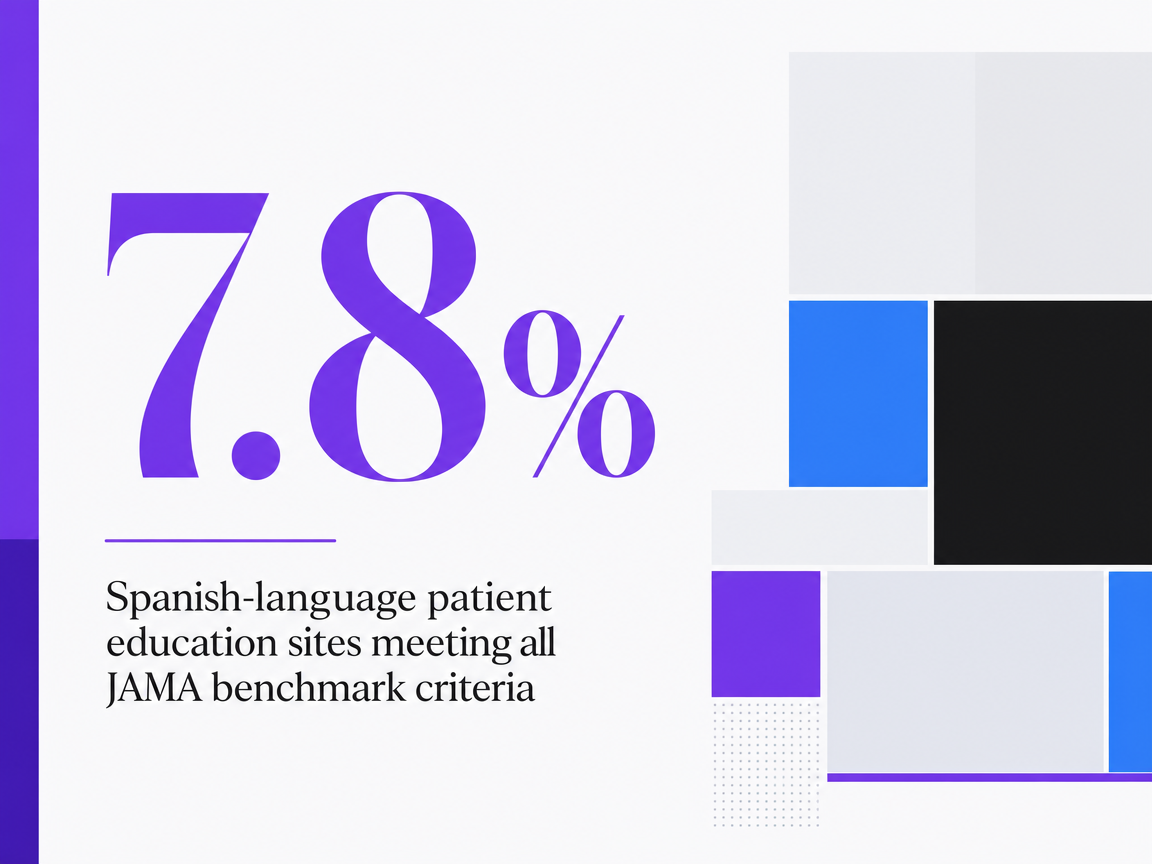 Spanish-language patient education sites meeting all JAMA benchmark criteria
Spanish-language patient education sites meeting all JAMA benchmark criteria
Reviews, Testimonials, and the FTC Perimeter
Reviews and testimonials are where SEO programs most often cross from marketing judgment into legal exposure. The FTC's 2023 revisions to its Endorsement Guides addressed fake reviews, incentivized reviews, employee reviews, fake negative reviews, undisclosed material connections, virtual influencers, and intermediary liability 4. The Consumer Reviews and Testimonials Rule took effect October 21, 2024 and targets deceptive conduct involving reviews and testimonials, including procurement, suppression, insider reviews, and misleading claims of independence 10. Separate FTC guidance makes clear that testimonials must not mislead, endorsers must have actual experience with the product or service, outcome claims require appropriate substantiation, and unrepresentative testimonials may require context about what consumers can generally expect 5.
Three implementation rules follow for any local SEO or reputation program:
- Review solicitation can offer incentives only when the incentive does not require a particular sentiment; a request that implies a positive review in exchange for a discount is the pattern regulators flag 10.
- Suppression of authentic negative reviews — removing them, burying them, or responding in ways designed to pressure retraction — is treated as deceptive conduct, not reputation management.
- Employee and insider reviews require clear disclosure of the material connection, and that disclosure has to be visible on the review itself, not buried in a site footer.
Case studies and client stories carry the same perimeter. A testimonial from an unrepresentative outcome needs context stating what a typical result looks like, and that context has to accompany the claim rather than live on a separate disclosures page 5. Review governance belongs in the same approval workflow as content, not in a parallel one owned by operations.
Stage Five: Measuring Revenue Contribution, Not Rankings
Rankings are a leading indicator. They are not a KPI a CFO will fund against. The measurement layer of the loop reports what the program produced in qualified pipeline, not where a page sat in a results set on a given Tuesday.
A VP-level SEO dashboard carries four lines:
- Qualified organic leads — calls, forms, chats, and bookings — attributed to organic entry, filtered by a definition of "qualified" the sales or intake team actually agrees with.
- Conversion rate by template and service line, so a readability or trust fix can be tied to the lift it produced.
- Blended customer acquisition cost for organic, including the fully loaded cost of content production, review, and technical maintenance, so the channel is compared on the same basis as paid.
- Pipeline contribution over a rolling window long enough to absorb publishing cadence — typically a trailing 90 days — so a single slow month does not trigger a strategy change.
Rankings, impressions, and click-through rate sit one layer down as diagnostic metrics. They explain why a KPI moved. They are not the KPI.
The measurement layer is also where privacy quietly determines what a team is allowed to collect. Under the HIPAA Privacy Rule, uses or disclosures of protected health information for marketing generally require written authorization, with limited exceptions 6. HHS guidance makes clear that marketing communications that encourage recipients to purchase or use a product or service fall inside that perimeter 11. For healthcare operators, that constrains how call tracking, chat transcripts, form submissions, and remarketing audiences are configured: identifiable patient information cannot flow into analytics, tag containers, or audience platforms outside the organization's documented consent and business-associate structure. The practical effect on measurement is that attribution has to be built on aggregated, de-identified signals and first-party conversion events the organization controls, not on third-party pixels fed with raw intake data.
A dashboard that cannot survive a privacy review is not a measurement system. It is a liability. VPs auditing an existing program should ask two questions in the same sitting: what is this channel contributing to pipeline, and what data is powering the answer. If the second question has no clean answer, the first one is not trustworthy either.
See How Leading Brands Streamline SEO Execution for Predictable Pipeline
Request a walkthrough of unified workflows that integrate content, technical SEO, and analytics—enabling marketing teams to improve rankings and conversion rates without increasing headcount or agency overhead.
Running the Loop: Who Owns What
Staffing the Five Jobs Across Three Operating Models
The loop runs the same way regardless of who executes it. What changes is where the labor sits, how fast the cadence can move, and how much oversight burden lands on the VP. Three staffing models dominate in regulated service verticals:
- An in-house team only
- A traditional agency plus in-house oversight
- AI-assisted execution with in-house approval
The table below maps the five loop jobs against each model on four dimensions a VP actually negotiates against — owner, cadence, oversight burden, and compliance risk surface.
| Loop Job | In-House Only | Agency + Oversight | AI-Assisted + Approval |
|---|---|---|---|
| Eligibility (technical, architecture) | Dev + SEO lead; quarterly audits; low external risk | Agency tech team; monthly cadence; coordination overhead on dev handoffs | Automated audit + in-house dev fix; continuous cadence; approval gate before deploys |
| Usefulness (briefs, drafting, readability) | Internal writers + SME review; cadence capped by headcount; low drift risk | Agency writers + internal SME review; weekly cadence; brief-cycle overhead | AI drafting + SME and editorial review; weekly or faster; drift risk if approval is skipped |
| Accessibility (WCAG, language access) | Shared across dev and content; often underfunded | Agency rarely owns; usually a separate vendor; gap risk at the seams | Template-level checks automated; language decisions still require operator input |
| Trust (authorship, reviews, endorsements) | Legal + marketing jointly; slow but defensible 4, 10 | Agency drafts; internal legal approves; disclosure gaps common at scale 5 | Rubric enforced pre-publish; legal reviews exceptions, not every page |
| Measurement (pipeline, CAC, privacy) | Analytics owner; PHI boundaries respected by default 6, 11 | Agency reports rankings; internal team rebuilds pipeline view | First-party dashboard; privacy posture configured once, enforced on every event |
No model eliminates the VP's oversight obligation. The difference is where approval happens — inside a briefing cycle, at the end of a monthly report, or on each recommendation before it ships.
If You Manage Multiple Locations
For operators running 20 or more locations — DSO parent brands, multi-state behavioral health networks, regional home-services groups, senior living portfolios — the loop does not scale by multiplication. Running it five times at five sites is manageable. Running it fifty times with the same team is where most programs break.
Three structural decisions determine whether multi-location SEO holds together:
- Template centralization. Service pages, location pages, and FAQ structures should be built once at the brand level, with location-specific variables (address, hours, named clinicians or attorneys, service availability, insurance accepted) populated from a single source of truth. Local teams get authority over the variables, not the template. That protects the eligibility, accessibility, and trust gates from drifting across the portfolio.
- Review governance at scale. FTC obligations around incentive conditioning, suppression, and insider disclosures apply identically at every location 10. A single rogue location running a "leave us five stars for a discount" campaign exposes the parent brand. Review policy, solicitation language, and response protocols belong at the brand level, with location managers trained against them rather than inventing their own.
- Measurement rollup. A VP overseeing fifty locations needs qualified-lead and CAC views at the portfolio, region, and location level in the same dashboard, with the same qualified-lead definition applied everywhere. Without that, underperforming locations hide inside blended averages and strong locations get credit for lifts they did not produce.
Where to Start This Quarter
A quarter is enough time to install the loop, not enough time to rebuild the backlog. VPs auditing an existing program should spend the first 90 days proving the gates work on a small inventory, then widen the aperture.
Three moves fit inside one quarter:
- Run an eligibility and privacy sweep on the top 20 revenue URLs: crawl, render, canonical, structured data, and a check that no form, chat widget, or tag on those pages is collecting protected or sensitive information outside a documented consent model 6.
- Stand up the six-criteria editorial rubric — authorship, reliability, usefulness, accessibility, readability, privacy — as a pre-publish gate in the CMS, and reprocess the same 20 URLs against it 3.
- Rebuild the measurement view around qualified leads, conversion rate by template, blended CAC, and 90-day pipeline contribution, with rankings demoted to a diagnostic tab.
Teams that want the loop running at full cadence without adding headcount can evaluate Vectoron's approval-first execution model on a two-week trial at $599 per month.
Frequently Asked Questions
References
- 1.Readability and Accessibility of Patient-Education Materials on Heart Failure Websites.
- 2.Implications for Patient Education and Health Disparities.
- 3.Assessing Credibility: Quality Criteria for Patients, Caregivers, and the Public in Online Health Information-A Qualitative Study.
- 4.Federal Trade Commission Announces Updated Advertising Guides to Combat Deceptive Reviews and Endorsements.
- 5.Advertisement Endorsements.
- 6.Standards for Privacy of Individually Identifiable Health Information.
- 7.Nondiscrimination on the Basis of Disability; Accessibility of Web Information and Services of State and Local Government Entities.
- 8.Fact Sheet: New Rule on the Accessibility of Web Content and Mobile Apps.
- 9.AHRQ Health Literacy Universal Precautions Toolkit.
- 10.The Consumer Reviews and Testimonials Rule: Questions and Answers.
- 11.Marketing.