
Key Takeaways
- Google publishes no character limit for meta descriptions; the widely repeated 155-character figure is a display heuristic tied to SERP pixel width, not policy 1.
- Meta descriptions are candidates competing against passages Google extracts from the page, so uniqueness, query relevance, and on-page accuracy determine whether the authored text appears 1, 2.
- Because Google indexes with the smartphone agent, the value proposition and query-relevant terms belong in the first 105 to 120 characters to survive mobile truncation 5.
- At portfolio scale, replace character-count audits with a rubric tracking uniqueness above 95 percent, front-loading discipline, title overlap, and rewrite rate segmented by URL class 3.
The Character-Count Rule Google Never Wrote
Ask ten SEO leads how long a meta description should be, and most will answer "155 characters" without hesitation. Google's own documentation contradicts that answer directly:
"There's no limit on how long a meta description can be"
1. The 155 figure is a display heuristic derived from SERP pixel width on a specific device class, not a policy anyone at Google has published.
For agency teams responsible for metadata across hundreds or thousands of client URLs, the distinction matters. A character-count rule treats meta descriptions as a formatting problem. Google treats them as a source of candidate summary text, weighed against passages the crawler can extract from the page itself and displayed only when judged more accurate than those alternatives 1, 2. Snippets are truncated to fit the querying device, which means the same description renders differently on mobile and desktop results.
The right operational question is not how many characters to write. It is what portion of the description survives truncation on the dominant device, whether Google will use it at all, and how to enforce that standard across a portfolio without a specialist auditing every URL. The rest of this article replaces the 155-character rule with a production standard built for that reality.
What Google Actually Says About Length
No Fixed Limit, Only Display Truncation
Google's public documentation is unambiguous:
"There's no limit on how long a meta description can be"
1. The 155- and 160-character figures repeated across SEO tools and audit templates are not policy. They are display heuristics derived from the pixel width of a snippet on a specific device class, and they change whenever Google adjusts SERP typography, layout, or result density.
What Google does say is that snippets are truncated as needed, typically to fit the querying device 1. This creates two different truncation zones an agency team needs to plan for. Mobile SERPs, rendered on narrower viewports, cut visible snippet text roughly in the low-to-mid 100s of characters. Desktop SERPs extend that window into the 150s or 160s before the ellipsis appears. The same description, written once and pushed to production, will render as two different previews depending on where the query lands.
The operational consequence is straightforward. A description written to exactly 155 characters is not "correct." It is a description that happens to fit one truncation zone on one device class on the day the audit was run. Front-loading the value proposition before mobile truncation matters more than the total count, because what appears above the fold on a phone determines whether the click happens at all.
What the HTML Standard Requires (And What It Does Not)
The WHATWG HTML Standard defines the description metadata name as a free-form string that describes the page and must be appropriate for use in a directory of pages, such as a search engine 4. The standard also specifies that a document should not contain more than one description meta element 4. That is the full extent of the technical requirement.
No character ceiling exists at the standard level. No preferred sentence structure, no keyword density guidance, no format for programmatic output. The specification cares about two things: that the string describes the page, and that only one such element appears per document. Every other rule agency teams enforce, including the 155-character convention, sits above the standard as convention or tooling default.
For portfolio audits, this means duplicate-description warnings are the only spec-level violation worth flagging as a defect. Everything else is a quality judgment.
When Google Rewrites Your Description
Google's snippets are generated primarily from page content, and the meta description is used when Google judges it a more accurate summary than what the crawler can extract 1, 2. That inverts how most agency QA workflows treat the field. The description is not a guaranteed output. It is a candidate, competing against passages Google can pull directly from the body copy.
Three signals tend to push Google toward using the authored description rather than rewriting it:
- The first is uniqueness. Duplicated or templated descriptions across many URLs weaken the candidate, because Google's earlier guidance explicitly warns against duplicate descriptions and recommends page-specific summaries 3.
- The second is query relevance. When a search query contains terms the description addresses directly, the description competes better against an extracted passage.
- The third is accuracy against on-page content. A description that promises information the page does not deliver is a weak candidate by definition 2.
For agency teams, this reframes the metric that matters. The question is not whether a description hits 155 characters. It is what percentage of a client's indexed URLs display the authored description in live SERPs versus a Google-generated alternative. That rewrite rate is the closest available proxy for description quality at scale, and it is measurable in Search Console query-level snippet data.
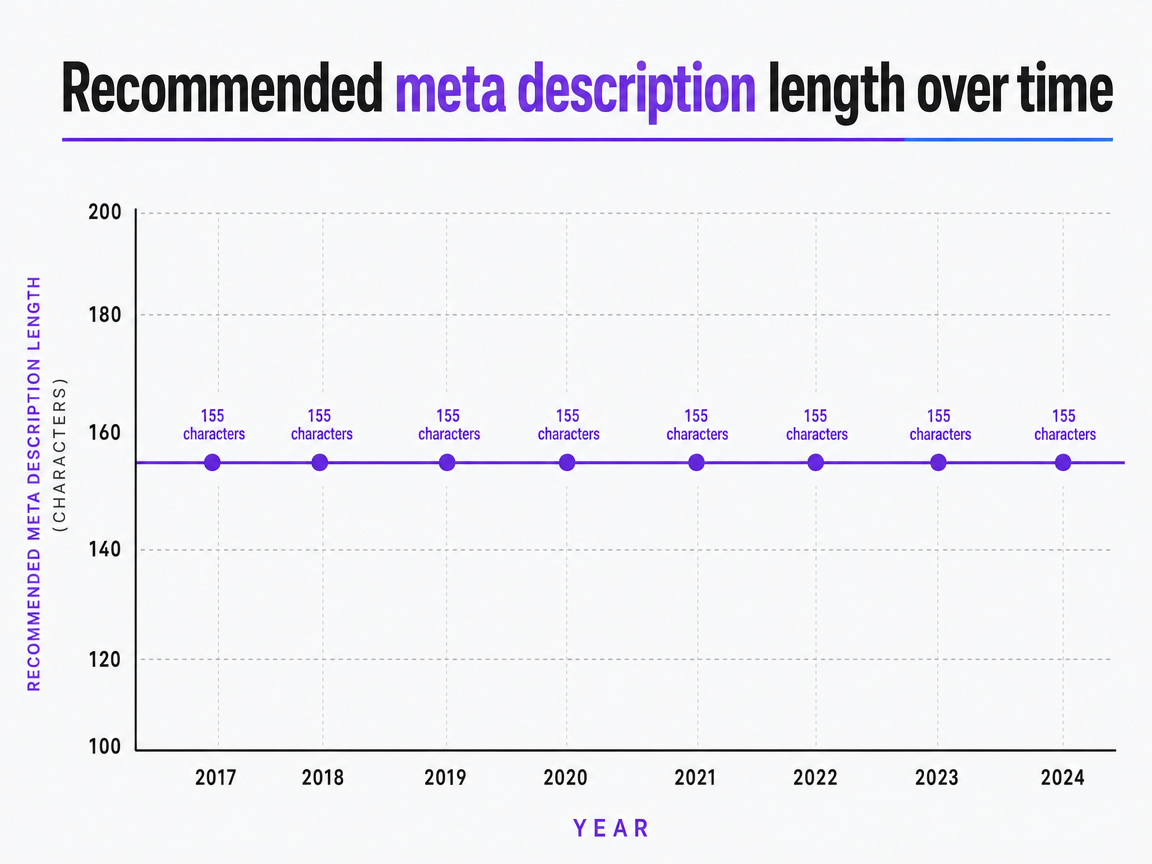 Recommended meta description length over time
Source: Google Search Central - How to Write Meta Descriptions
The Real Operational Question: What Survives Truncation
Front-Loading for Mobile-First Indexing
Google uses the mobile version of a site's content for indexing and ranking, crawled with the smartphone agent 5. That has a direct consequence for meta description production that most character-count rules ignore: the mobile SERP is the primary rendering surface, and mobile viewports truncate visible snippet text earlier than desktop.
The practical rule that follows is front-loading. The first roughly 105 to 120 characters carry the load because that is the portion likely to render before an ellipsis on a phone. That opening span needs the value proposition, the differentiating detail, and the query-relevant terms a searcher scanned for. Anything after that point is supplemental context Google may or may not display, and cannot be relied on to influence the click decision on a mobile result.
For agency QA at portfolio scale, this reframes the writing standard. A description that buries the specific offer, service line, or location behind a generic opening clause fails on mobile even when it passes a 155-character audit. A description that leads with the specific and adds context afterward passes both truncation zones. Front-loading is not a stylistic preference. It is what the dominant indexing surface requires.
The Working Length Ranges by Device
Google publishes no character ceiling 1, but production teams still need working ranges to audit against. Three zones are useful, each tied to what typically renders before truncation on the querying device rather than to any policy.
Mobile-safe zone (up to ~105 to 120 characters) : This is the text most likely to appear above the ellipsis on a phone. Every description should treat this zone as mandatory ground and place the core message inside it.
Desktop-visible zone (~155 to 160 characters) : This is the desktop-visible window under standard SERP typography, and it is where secondary context, a supporting detail, or a call-to-value clause belongs.
Overflow zone (beyond 160 characters) : Google will accept it because there is no fixed limit 1, but visible display is unreliable and the extra text should carry no critical information.
Descriptions written to these zones survive both truncation surfaces. Descriptions written to a single 155-character target routinely fail the mobile zone because the important content sits in the back half.
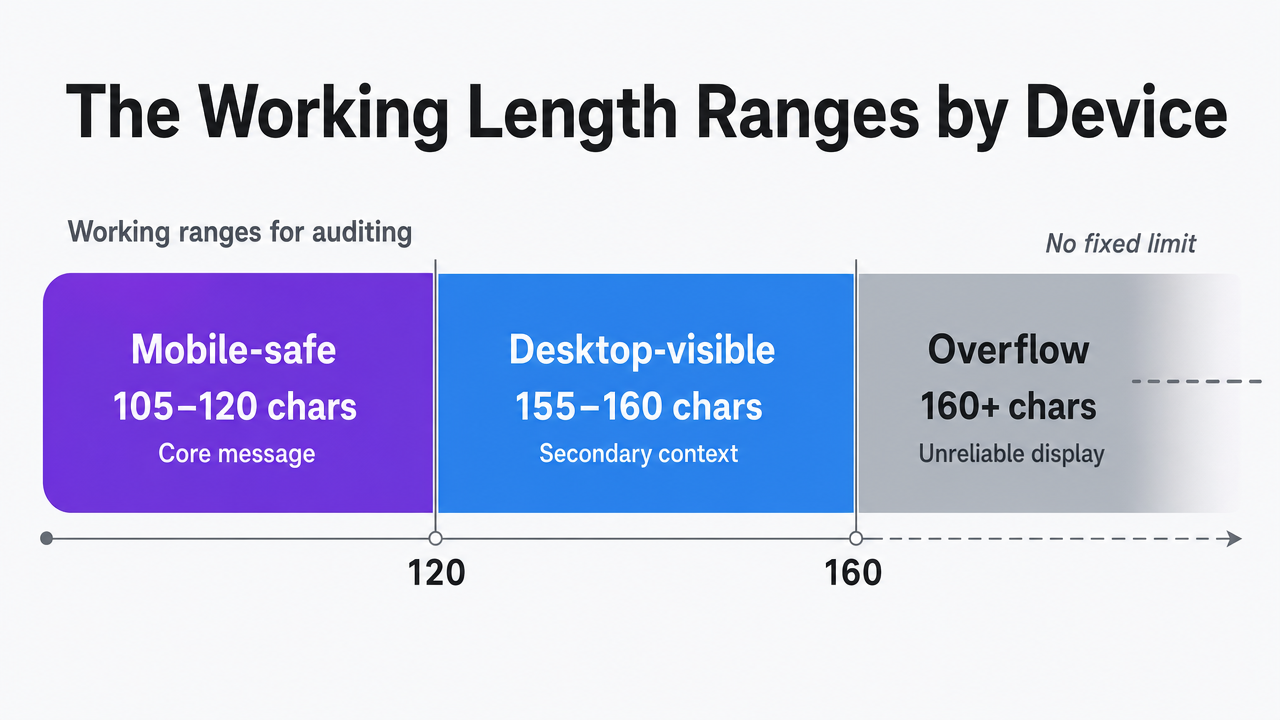 Visualize the three truncation zones (mobile-safe, desktop-visible, overflow) as a labeled character-range diagram that directly supports the section's cited length ranges
Complementing, Not Duplicating, the Title Link
Google constructs title links from multiple signals, including the title element, visible page title, headings, og:title, page text, anchor text, inbound link text, and WebSite structured data 6. The title link and the meta description occupy adjacent space in the SERP, and the description that repeats the title wastes half of the available real estate.
A production standard for portfolios should treat the two fields as complementary. The title link carries the primary keyword, the entity, and the page identity. The meta description should extend that promise with information the title does not already convey: the specific benefit, the differentiator, the qualifying detail, or the format of what the user will find. Audit rubrics catch title-description duplication easily by comparing token overlap between the two fields across a URL inventory.
Test live meta descriptions in real searches
Experience actual search snippet performance before finalizing your optimized meta descriptions.
How Rich Results Compress the Visible Description
Length rules assume the description occupies a predictable slice of the SERP. On rich results, it does not. When a page qualifies for product, review, or offer enhancements through structured data, Google can insert ratings, review counts, price, and availability into the result 8. Review markup can add a short excerpt or an aggregate rating, often averaged across multiple reviewers 9. Each of those elements consumes vertical and horizontal space that would otherwise render the meta description.
The compression is not uniform. A product result with a five-star rating widget, review count, price, and stock status can push the visible description down to a single truncated line, sometimes fewer than 80 characters before the ellipsis. A plain organic result on the same query might show the full desktop-visible zone. The same description, written to the same 155-character target, appears as two different previews depending on whether structured data qualified the URL for a richer layout on that query.
Structured data itself does not replace the description and does not guarantee a rich result on any given query 7. Google decides result formatting per query, per device, and per moment. That variability breaks the assumption behind any single character-count rule for portfolios with product catalogs, review-eligible pages, or event and recipe inventory.
The operational adjustment for agency teams is scope-specific. For URL classes eligible for rich results, front-loading the description into the mobile-safe window becomes more important, not less, because the truncation point on a rich result sits earlier than on a plain organic listing. The description also needs to add information the structured data does not already convey. Repeating the star rating or price in prose wastes the compressed space Google leaves behind after inserting the rich elements above it.
A Production QA Rubric for Portfolio-Scale Metadata
Uniqueness Across Thousands of URLs
Google's guidance on duplicate descriptions predates most current SEO tooling and has not softened. Descriptions should be unique and page-specific, and duplicated summaries across many URLs weaken the candidate Google evaluates against extracted page content 3. At portfolio scale, that principle becomes a measurable defect class rather than a writing preference.
The audit is mechanical. Pull every indexed URL's description into a single dataset, hash the strings, and count collisions. Two categories tend to surface:
- Exact duplicates, common on paginated archives, filtered category pages, and CMS templates that fall back to a site-wide default when the field is empty.
- Near-duplicates that differ only by a location token or product name, a pattern typical of programmatic pages for multi-location businesses.
Both categories weaken the candidate signal even when the character count passes.
The remediation target is a uniqueness rate above 95 percent across the indexed inventory, with the remainder documented as intentional exceptions rather than tolerated defects.
Query Alignment and Truncation Safety Checks
Two automated checks catch the majority of description defects that character-count audits miss. The first is query alignment. For each indexed URL, pull the top three to five queries driving impressions from Search Console and check whether the description contains at least one term or close variant from that query set. Descriptions that address no ranking query underperform as candidates, because Google weighs query relevance when deciding whether to use the authored text or extract a passage from the page 1, 2.
The second is truncation safety. Split each description into two spans: the first 105 to 120 characters, treated as the mobile-safe zone, and the remainder up to roughly 155 to 160 characters, treated as the desktop extension. Score whether the mobile-safe span contains the value proposition and the query-relevant token. A description where the important content sits in the back half passes a length audit and fails a truncation audit at the same time.
Both checks run as scheduled jobs against the URL inventory. Neither requires a specialist writer to review each output. What the specialist reviews is the exception list, not the corpus.
Diagnosing and Reducing Rewrite Rate
Rewrite rate is the closest available proxy for description quality at portfolio scale. When Google judges an extracted passage more accurate than the authored description, it substitutes that passage in the snippet 1, 2. The rate at which that substitution occurs, measured across a client's indexed URLs, is a diagnostic no character-count audit produces.
The measurement method uses Search Console's query-level snippet data. For a sampled set of ranking URLs, compare the live SERP snippet against the authored description. String-similarity scoring at roughly 70 percent overlap separates "description in use" from "description rewritten." Track the ratio monthly and segment by URL class, because rewrite rates for product pages, editorial content, and location pages typically differ.
The extraction behavior driving those rewrites has been documented in academic work as well. A 2019 study of 163,412 keywords in Polish Google results found that 48 percent of featured snippets were sourced from the top-ranking organic result, scoped to featured snippets rather than standard description snippets 11. This confirms that Google independently extracts content from the highest-authority page on the query. Reducing rewrite rate means writing descriptions that beat that extraction on uniqueness, query relevance, and accuracy against on-page content.
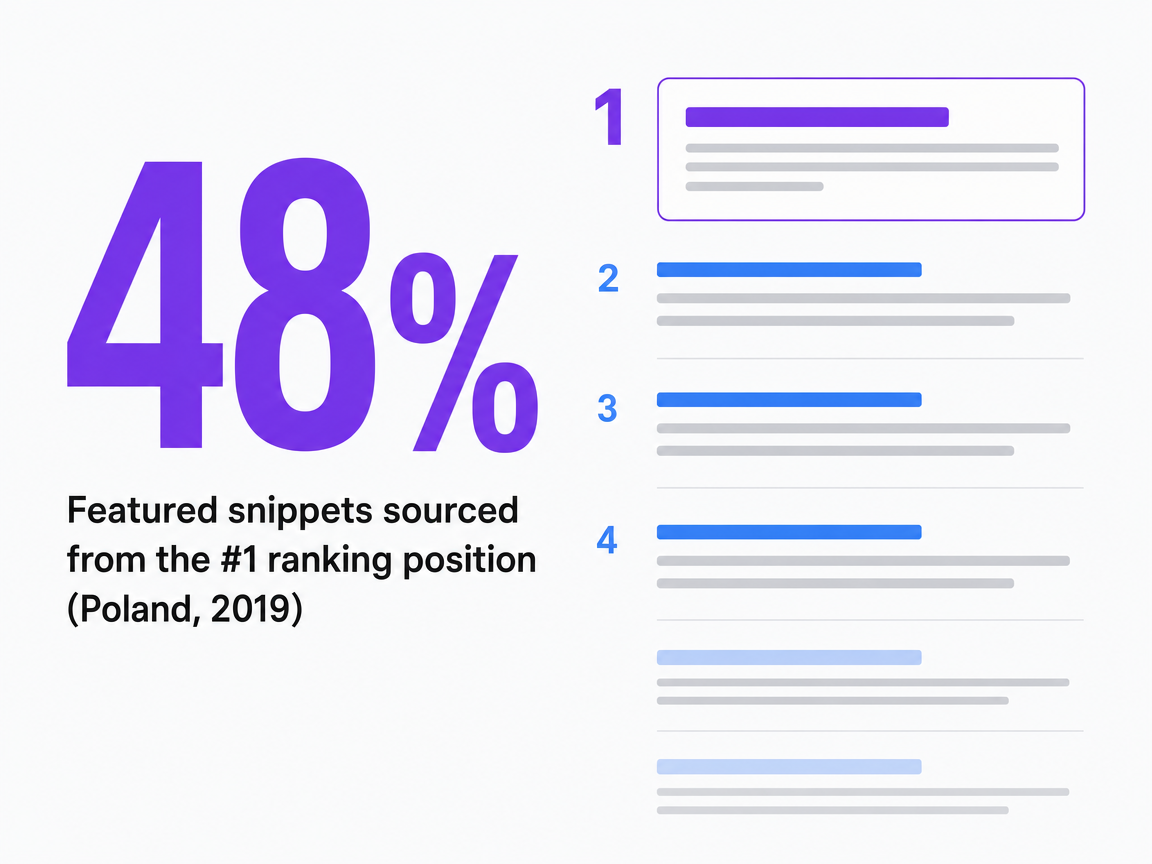 Featured snippets sourced from the #1 ranking position (Poland, 2019)
Featured snippets sourced from the #1 ranking position (Poland, 2019)
If You Manage Multiple Client Portfolios: Production Model Economics
This section shifts scope. The reader here is not writing descriptions for one site. They are choosing a production model for an agency handling 20 or more client portfolios, where a single account can carry 500 to 5,000 URLs and metadata quality has to hold across all of them without a senior specialist reviewing each output.
Three production models dominate agency workflows:
- Senior SEO hand-writing, where an experienced specialist authors every description.
- Templated production, where junior writers or systems fill patterned structures against product, location, or category variables, with QA review on a sample.
- AI-assisted generation with human approval, where a model drafts against a page-content prompt and a reviewer approves or edits before publish.
Each model produces different uniqueness rates, different front-loading discipline, and different rewrite rates in live SERPs.
The comparison below uses observable operational variables rather than invented dollar figures, because agency labor rates and tooling costs vary too widely to publish as benchmarks. The variables that matter across all three models are the same ones the QA rubric already measures: minutes per description, review time per description, uniqueness rate across the corpus, and rewrite rate in Search Console.
| Production Model | Minutes per Description | Review Time | Uniqueness Rate | Front-Loading Discipline |
|---|---|---|---|---|
| Senior SEO hand-writing | High | None (author is reviewer) | High | High but inconsistent at volume |
| Templated with junior writer | Low | Sampled QA | Low on programmatic pages | Depends on template design |
| AI-assisted with human approval | Low | Per-description approval | High when prompted per-URL | Enforceable in the prompt |
The model choice is not about writing quality per description. It is about which variable dominates at portfolio scale. Hand-writing loses on throughput. Templating loses on uniqueness, because Google's duplicate-description guidance treats near-identical outputs as weak candidates 3. AI-assisted generation with human approval holds uniqueness and front-loading if the prompt encodes the QA rubric and the reviewer clears the exception list rather than editing every draft. That is the production shape most agencies land on once the URL count crosses a few thousand.
Benchmark Meta Description Lengths for Consistent SEO Performance
Connect with our team to see data-backed workflows for optimizing meta descriptions at scale—without manual bottlenecks or risking content quality for client portfolios.
Snippet Controls for Regulated and Paywalled Inventory
A narrower operator case sits outside the general length discussion: clients in healthcare, legal, financial services, and subscription publishing whose URLs carry content that cannot appear in a snippet without review. For that inventory, Google exposes two controls agency teams should encode into the audit rubric rather than handle case by case.
The max-snippet directive limits the character count Google can extract into a snippet, and data-nosnippet excludes specific HTML spans from being pulled into the preview at all 10. Both operate on Google's extraction behavior, not on the authored meta description. A page can carry a 160-character description written to the standard front-loading rules and still ship data-nosnippet wrappers around protected clinical detail, case outcomes, or paywalled body copy that legal or compliance flagged.
Neither control forces Google to display the authored description, and neither guarantees a specific visible length 10. What they do is remove the risk that an extracted passage from a protected section overrides the description in the SERP.
What to Replace the 155-Character Rule With
The replacement is not another number. It is a four-part production standard that survives both truncation zones and holds up across a portfolio audit: uniqueness above 95 percent, the value proposition and query-relevant token inside the first 105 to 120 characters, no token overlap with the title link 6, and a monitored rewrite rate segmented by URL class 1, 2. Character count becomes a soft guardrail, roughly 155 to 160 for desktop context, with anything beyond treated as optional 1.
Agency teams that adopt this standard stop defending a number to clients and start reporting a rate. That is the shift Vectoron's content workflows are built around: encode the rubric into the prompt, clear the exception list, and let the corpus hold.
Frequently Asked Questions
References
- 1.How to Write Meta Descriptions | Google Search Central.
- 2.Better Snippets for your Users.
- 3.Improve snippets with a meta description makeover.
- 4.HTML Standard, Edition for Web Developers - WHATWG.
- 5.Mobile-first Indexing Best Practices | Google Search Central | Documentation | Google for Developers.
- 6.Influencing Title Links in Google Search | Google Search Central | Documentation | Google for Developers.
- 7.Structured Data Markup that Google Search Supports.
- 8.Product Snippet Structured Data.
- 9.Review Snippet Structured Data.
- 10.Subscription and Paywalled Content.
- 11.Featured Snippets Results in Google Web Search: An Exploratory Study.