
Key Takeaways
- Google specifies only a floor for internal linking, that every important page needs at least one inbound internal link, and names no maximum count 1.
- Internal links redistribute authority rather than create it, so editorial decisions determine which pages receive the share that external links have already brought in 6.
- Rearranging existing links to point at higher-priority destinations moves PageRank more effectively than adding new ones, since each additional outbound link dilutes every existing share 5, 10.
- Assigning links to defined roles and page types, paired with descriptive anchors and two-click reachability, scales editorial consistency better than any per-page numeric quota 1, 11.
Why the Link-Count Question Is the Wrong One
The question "how many internal links per page" arrives in editorial standups almost weekly, usually because a writer wants a threshold and a manager wants a rule. Neither Google nor the peer-reviewed link-analysis literature supplies one. Google's own linking documentation names a floor, not a ceiling: every page a site cares about should have a link from at least one other page on the site 1. Beyond that, the guidance shifts from counting to describing behavior, anchor text, and site architecture.
The reason a fixed number never appears in the primary sources is mechanical. Internal links do not add authority to a site; they redistribute what external links have already brought in, a distinction formalized in the decomposition of PageRank into internal and external components 6. A page with fourteen internal links is not automatically stronger than one with four. The variable that moves ranking signals is where those links point and from which pages they originate, not the raw count on any single URL.
Content operations leaders who chase a target number spend editorial cycles on the wrong lever. The more useful reframing is a role-based one: which links serve discovery, which distribute authority to priority pages, and which exist for navigation. That taxonomy scales across twenty writers in a way a numeric quota never will.
What Google and Bing Actually Say About Internal Links
The One Rule Google Commits To
Across Google's public documentation on links, one directive stands out for what it does not say. The Search Central guidance on crawlable links states that every page a site cares about should have a link from at least one other page on that site 1. That is a floor. There is no companion sentence naming a maximum, a target range, or a per-page quota.
The same document frames links as a discovery and relevance signal: Google uses links to find new pages and to judge how pages relate to each other 1. What follows in the guidance is behavioral, not numeric. Anchor text should be descriptive. Links should be crawlable `` elements. Important destinations should not depend on JavaScript that fails to render.
The absence of a numeric ceiling is not an oversight. Third-party coverage of Google's more recent public statements reaches the same conclusion: no fixed count exists, and teams are advised against overwhelming users with too many links 7. Content teams asking "how many" are asking a question the primary source has declined to answer for two decades.
Structure as a Signal: Sitelinks and Site Importance
Google's sitelinks documentation raises the stakes on internal linking without ever mentioning a count. The company states that its systems analyze the link structure of a site to find shortcuts that save users time 2. Those shortcuts, the indented links that appear under a brand's main search result, are generated algorithmically from patterns Google reads in the graph of internal connections.
Two things follow from that mechanic. First, internal link structure is not a UX detail siloed from search performance; it is an input Google reads to infer which pages inside a site deserve prominence. Second, the pages that surface as sitelinks are the pages the internal graph elevates, which means editorial decisions about which URLs receive contextual links, hub links, and cross-cluster references shape what a brand's own search result looks like.
The same Google guidance emphasizes logical site structure and concise anchor text as conditions that improve the odds of useful sitelinks appearing 2. Structure and language, not volume. A page with thirty poorly labeled internal links is a worse candidate for sitelink generation than a page with eight descriptive ones pointing to a coherent set of related URLs.
Bing's Consistency Requirement
Bing adds a dimension Google spends less time on: URL consistency inside the link graph. Bing's Webmaster guidance recommends using the canonicalized version of a URL religiously in internal linking and using absolute URLs rather than relative ones for internal references 3. The reasoning is mechanical. Crawlers interpret each URL variant as a candidate for the same page, and inconsistency across internal links splits signals across duplicates.
For content teams running CMS environments where trailing slashes, protocol variants, or tracking parameters can leak into published links, that guidance is operational. It says less about how many internal links belong on a page and more about the discipline required to keep the count meaningful. A template that emits inconsistent internal URL formats is diluting its own linking effort before any editor argues about link count.
The PageRank Mechanics Content Teams Rarely Read
Internal Links Redistribute Authority, They Do Not Create It
The clearest way to understand what internal links actually do is to read them as a distribution problem. A formal decomposition by Viennot and collaborators splits PageRank into two components: an external portion that flows into a site from other domains, and an internal portion that circulates through the site's own link graph 6. External links deposit authority at the front door. Internal links determine which rooms it reaches.
That framing matters because the vast majority of hyperlinks on the web point from a page on a host to another page on the same host, a structural fact documented in the BlockRank analysis of the web graph 4. Sites are dense internally and sparse externally. Whatever a domain has earned from outside sources gets moved around by decisions writers and editors make inside their own CMS.
One consequence is that adding an internal link on page A pointing to page B does not summon new authority from Google's index. It reroutes a share of what page A already holds. Content teams asking how many links to place per page are asking a question about allocation, not accumulation. The right editorial question is which pages should receive that redistributed share, and from where.
Block Structure: Why Clusters Behave Like Sub-Sites
The web link graph is not flat. The BlockRank research shows it has a nested block structure, with hosts forming tight interior clusters and comparatively few edges crossing between them 4. The same pattern repeats inside a single domain. A pillar page and its supporting cluster function as a densely connected subgraph, weakly linked to other clusters through hub pages, category templates, or occasional contextual references.
That block behavior gives content managers a tractable unit to reason about. Rather than auditing every page's link count in isolation, editorial ops can treat a topic cluster as the operational object. Inside the cluster, cross-links between siblings tend to reinforce topical coherence and keep authority circulating among related URLs. Between clusters, only a few carefully placed bridges are needed to move signal across the site.
The practical read for a content marketing manager running a resource hub with hundreds of pages: assign linking rules at the cluster level, not the page level. A cluster with fifteen siblings has different linking behavior than a cluster with three. Writers producing new pages within a cluster inherit the rule set for that block rather than negotiating link counts one URL at a time.
Rearrangement Beats Addition
The most useful finding for editors comes from a 2011 paper on link rearrangement, which studies changes in internal link placement for the purpose of improving the valuation of a page or group of pages under PageRank 5. The paper's mechanism is not adding more links. It is moving existing ones. Removing a link from a low-priority destination and pointing it at a priority destination shifts the distribution of internal PageRank without changing the total count of links on the page.
Deeper Inside PageRank reinforces the arithmetic behind that result: link flow at any node is a function of where inbound links originate and how outbound links divide that node's share among its targets 10. Adding a fifteenth link to a page that already has fourteen dilutes each existing link's share by roughly seven percent. Redirecting one of the fourteen to a more valuable target changes the distribution without diluting anything.
For a content team that has spent months publishing new pages, this reframes the audit priority. The higher-leverage exercise is often reviewing where existing internal links point, not stacking new ones onto every published URL.
Test optimal internal link strategies on live pages
Experiment with internal link volumes and measure direct SEO impact in your own environment.
A Link-Role Taxonomy That Scales Across Writers
The output of the mechanics section is a shift from counting links to labeling them. Once editors stop asking how many, they can start asking what each link is for. Five roles cover the vast majority of internal links a content team publishes, and each role behaves differently under the block-structure and link-rearrangement models discussed earlier 4, 5.
Hub links : Point from a high-authority page, usually a pillar or category index, down to supporting URLs inside its cluster. These are the highest-leverage links a site publishes because they sit on pages that typically hold the most redistributable internal PageRank. Rearranging hub links is where the link-rearrangement literature finds the largest movement in per-page valuation 5.
Cluster sibling links : Connect pages within the same topical block. Their function is topical reinforcement and lateral discovery. The BlockRank finding that the vast majority of hyperlinks connect pages on the same host applies with even more force inside a cluster: sibling density is what makes a cluster read as a coherent unit to a crawler 4.
Contextual body links : Are the in-prose references writers add while drafting. They carry the most anchor-text signal because the surrounding sentence supplies semantic context. They are also the role most vulnerable to editorial drift, since twenty writers left unsupervised will point contextual links at different destinations for the same phrase.
Navigational links : Live in headers, breadcrumbs, and menus. They appear on nearly every page, which means they distribute authority broadly but thinly. Their editorial value is consistency, not selection.
Footer links : Function similarly to navigational links but with lower click-through and lower editorial weight. Stacking priority pages into the footer rarely moves the needle the way a hub-link change does.
Assigning every internal link to one of these five roles gives content managers a shared vocabulary. A writer no longer asks whether a page has "enough" links. The editor asks whether the hub links point to the right cluster members, whether sibling density is adequate within the block, and whether contextual anchors describe their destinations.
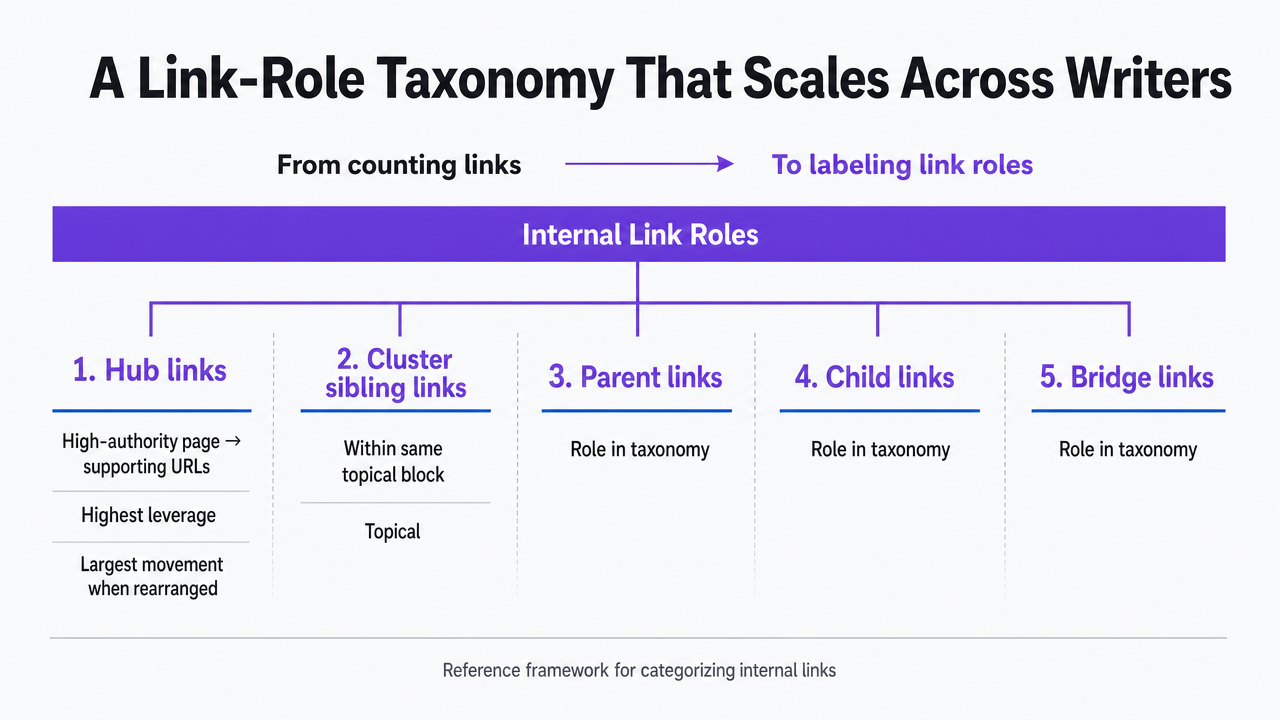 Visualize the five internal link roles described in the section as a reference framework editors can use to categorize links
A Decision Matrix by Page Type
The role taxonomy answers what a link is for. The next question is which links belong where, and that depends on the page doing the linking. Five page types cover most content operations: pillar, cluster member, product or service, comparison, and glossary. Each carries a different profile of inbound sources, outbound targets, and anchor-text patterns, and each maps directly to Google's guidance on link architecture and sitelink generation 1, 2, 11.
Pillar pages : Should draw inbound links from the home page, the primary navigation, and every cluster member they anchor. Outbound, they distribute hub links to each supporting URL in their cluster with descriptive anchors that name the sub-topic. Pillars are the pages Google is most likely to promote through sitelinks, which is why link structure into and out of them warrants the most editorial attention 2. A pillar with sparse inbound links is a pillar the algorithm has no reason to treat as central.
Cluster members : Receive inbound links from their pillar and from sibling pages inside the same block, and they link laterally to two or three siblings plus back to the pillar. Anchor text on sibling links should describe the destination topic, not restate the source page's own title.
Product or service pages : Sit at the commercial floor of the site and should be reachable from the home page within two clicks, consistent with Google's long-standing guidance that important pages be easy for Googlebot to find 11. Inbound sources include category indexes, comparison pages, and contextual references from relevant blog content. Outbound links stay minimal and point to supporting resources rather than competing offerings.
Comparison pages : Function as bridges between commercial URLs and educational content. They link outbound to each option they evaluate and to the pillar for the broader topic. Inbound links come from cluster members that mention alternatives and from contextual references in decision-stage content.
Glossary entries : Operate as terminal nodes. They collect inbound contextual links from across the site whenever a term appears in-prose, and their outbound links point to a small set of related terms plus the relevant pillar. Anchor text pointing into glossary entries should match the term being defined, which reinforces the topical association Google reads from the link graph 1.
Codifying these five rows into a shared matrix gives editors a page-type test that replaces per-URL negotiation over link counts.
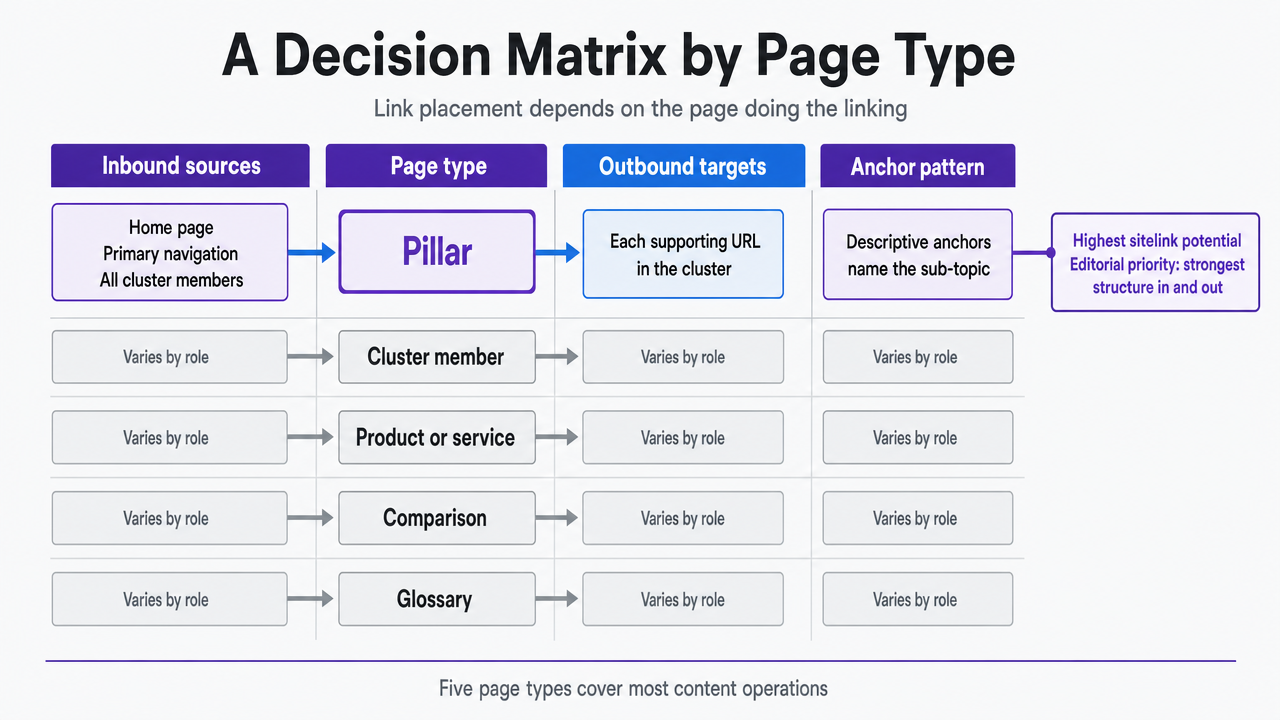 Present the five page types and their inbound/outbound linking profile as a comparison matrix that codifies the section's editorial rules
Anchor Text, Crawl Depth, and Click Distance
Descriptive Anchors Over Volume
Anchor text is the second variable Google names explicitly in its linking guidance, and it does more work than most editors credit. The Search Central documentation frames anchors as a relevance signal: the words inside the `` tell crawlers what the destination is about, which is why generic labels like "click here" or "learn more" waste the semantic slot they occupy 1. A page with twelve descriptive anchors carries more topical signal than the same page with twenty ambiguous ones.
The practical rule for writing teams is straightforward. Anchor text should describe the destination page's subject in a phrase a reader could recognize out of context. Third-party coverage of Google's more recent statements reaches the same conclusion, adding that stuffing near-duplicate anchors across a page reads as manipulation rather than clarity 7. Editors reviewing drafts should treat vague anchors as defects on par with broken links, not stylistic preferences.
Reachability From the Home Page
Click distance is the other architectural variable content operations can control. Google's link architecture guidance, though dating to 2008, still holds: important pages should be clickable from the home page and easy for Googlebot to find throughout the site 11. The mechanism is discovery efficiency. Crawlers allocate bounded attention to any given domain, and pages buried five or six clicks deep receive less of it than pages reachable in two.
The editorial implication is that click distance is a property of the site's link graph, not any individual page. A product page four clicks from the home page is not fixed by adding more links to the product page itself. It is fixed by giving the product page an inbound link from a page one click closer to the home, which is exactly the rearrangement mechanism the PageRank literature identifies as the higher-leverage move 5. URL structure reinforces the same principle: clean, shallow paths help crawlers and users read site organization consistently 12. Reachability is engineered upstream, not patched at the destination.
See How Data-Driven Internal Linking Impacts Your SEO Performance
Request a tailored analysis of your site’s internal linking structure and get actionable recommendations, benchmarked against leading enterprise and agency standards.
When Additional Links Stop Helping
The ceiling question is where most link-count debates land, and the mathematics gives a cleaner answer than the folklore does. PageRank flows out of a page divided among its outbound links, which means each additional link reduces the share every existing link carries 10. A page with ten outbound internal links sends roughly ten percent of its distributable share to each destination. The eleventh link drops every existing share to about nine percent. The twentieth cuts it in half.
That dilution is not a reason to publish sparse pages. It is a reason to spend outbound links on destinations that earn them. The link-rearrangement research demonstrates the point in reverse: moving a link from a low-priority target to a high-priority one raises the valuation of the priority page without changing the total link count 5. The failure mode is not too many links in the abstract. It is too many links pointing at destinations that do not warrant the share they receive.
A second ceiling shows up in reader behavior. Google's public guidance, echoed in third-party coverage, warns against overwhelming users with too many links on a page 7. Once contextual density passes the point where a reader can distinguish primary from incidental references, anchor-text signal degrades as well, because crawlers read the same ambiguity human readers do. The operational read for editors: audit outbound link priority before adding new ones, and treat any page pushing past roughly one link per fifty words of body copy as a candidate for pruning rather than expansion.
Encoding the Rules Into Editorial Workflow
The gap between knowing what good internal linking looks like and getting twenty writers to execute it consistently is where most content operations lose the plot. Rules that live in a senior editor's head do not scale. Rules encoded into templates, briefs, and review checklists do.
Three artifacts carry most of the weight.
- A page-type template that ships every brief with pre-declared hub and sibling link slots, so writers inherit inbound-and-outbound assignments rather than negotiating them mid-draft.
- An anchor-text rule embedded in the style guide: destination-descriptive phrases only, no generic labels, no near-duplicate stacking across the same page 1, 7.
- A URL hygiene standard that names the canonical format for every internal reference and forbids relative paths in body copy, matching Bing's guidance on consistent canonical URLs and absolute internal links 3.
Quarterly link audits then shift focus from adding links to rearranging existing ones, which the PageRank literature identifies as the higher-leverage move 5. Editors review where hub links point, whether cluster siblings still reference each other after new pages ship, and which pages have drifted deeper than two clicks from the home page 11. The output is a rearrangement queue, not a link-count spreadsheet. Content teams that codify these rules once stop relitigating them per URL.
If Content Teams Manage Location or Branch Page Networks
A quick scope shift for managers whose sites include location, branch, practice, or franchise pages: the same block-structure mechanics apply, with the location set functioning as its own cluster inside the domain. The BlockRank finding that the vast majority of hyperlinks connect pages on the same host holds inside a location network too, where individual city or branch pages sit as siblings under a state or regional hub 4.
Three rules do most of the work.
- Each location page should be reachable from the home page within two clicks through a directory or regional index, consistent with Google's link architecture guidance 11.
- Sibling links between locations belong on the regional hub, not stacked as a footer of every city page, where they would dilute outbound share across dozens of destinations 10.
- Contextual body links from service or resource pages should reference the relevant location using the location name as the anchor, not a generic label 1.
Location networks fail the same way any cluster fails: sparse inbound links to individual branches, ambiguous anchors, and click depth that pushes cities four or five levels deep.
Frequently Asked Questions
References
- 1.SEO Link Best Practices for Google | Google Search Central.
- 2.Learn About What Sitelinks Are | Google Search Central.
- 3.Making links work for you (SEM 101) | Bing Webmaster Blog.
- 4.Exploiting the Block Structure of the Web for Computing PageRank.
- 5.On the rearrangement of links to improve page rank.
- 6.Internal and external PageRank.
- 7.Google Shares Tips To Improve SEO Through Internal Links.
- 8.auth.dvi.
- 9.Link Analysis Ranking: Algorithms, Theory, and Experiments.
- 10.Deeper Inside PageRank.
- 11.Importance of link architecture | Google Search Central Blog.
- 12.URL structure best practices for Google Search.