
Key Takeaways
- AI search has split visibility into two surfaces: classic ranking position and citation presence inside synthesized answers, and both need to be audited on the same cadence.
- Technical eligibility—crawlable URLs, server-rendered content, valid schema, fast response times—remains the price of admission for retrieval into Google, ChatGPT, Perplexity, and Gemini.
- Being cited is not the same as being represented accurately; audit every citation on URL validity, source relevance, and statement-level support, since fluent synthesis frequently breaks the third check 1.
- Prioritize distinctive first-party evidence and authoritative third-party references, then report qualified pipeline, citation accuracy, assisted conversions, and share of answer rather than session volume.
The Shift from Ranking to Retrieval and Citation
Peer-reviewed research out of Princeton, presented at KDD 2024, found that content modifications aligned with generative engine optimization can shift visibility inside generative-engine answers by up to 40 percent, measured across the GEO-bench benchmark of diverse queries and web sources 10. This reframes the question most marketing leaders are actually being asked by their executives. The surface that decides whether a brand appears is no longer only a ranked list of blue links. It is a retrieval layer that pulls passages into AI Overviews, ChatGPT answers, Perplexity citations, and Gemini responses, then decides which sources to name.
Rankings still exist; they are now one input into a larger retrieval-and-citation system.
The practical consequence for an in-house VP is a change in what gets optimized. A page that ranks third but is never cited inside an AI answer loses the click to the summary above it. A page that ranks eighth but is quoted verbatim by three generative engines earns pipeline the ranking report will not show. Visibility has split into two measurable surfaces: classic SERP position and citation presence inside synthesized answers. Both can be audited. Both respond to deliberate content choices.
Treating AI search as a tunable retrieval surface, rather than a black box, is what the GEO work established. The authors reported that effectiveness varies by domain and by model, so the 40 percent figure is a ceiling observed in controlled testing on an academic benchmark, not a guarantee for any single commercial vertical 10. Legal services, dental networks, behavioral health groups, and home services operators will see different lift curves. The method, however, transfers: define the queries that matter, publish passages engineered to be retrieved and cited, and measure both ranking and citation outcomes on the same cadence.
The sections that follow build out that operating model, starting with what technical SEO still earns before any AI layer gets involved.
What Technical Eligibility Still Buys You
Before any generative engine can cite a page, a retrieval system has to find it. That base layer has not changed. Crawlable URLs, clean canonicals, server-rendered content, valid structured data, and fast response times remain the price of admission for both Google's index and the retrieval pipelines feeding ChatGPT, Perplexity, and Gemini. Scholars reviewing the transition to generative interfaces have made the same point directly: generative answers sit on top of information retrieval, not in place of it, and source inspection remains part of how both systems and users evaluate output 6.
Technical eligibility does not win the citation. It makes the citation possible.
The useful way to frame the work for an executive is as a qualifying round. A page that cannot be rendered without JavaScript execution, returns a soft 404 to a crawler, or hides its primary evidence behind a gated form is invisible to the retrieval layer regardless of how authoritative the underlying expertise may be. The same page, once indexable, becomes eligible for both ranking and citation. From that point, distinctive content and third-party references determine which surfaces actually surface it.
Marketing VPs auditing this layer should expect a short, boring checklist: crawl logs reviewed quarterly, Core Web Vitals in the green for the templates that carry pipeline, schema that matches the visible content rather than decorating it, and internal linking that reflects topical structure rather than navigation convenience. None of this will move an AI Overview on its own. All of it has to be true before anything else does.
Being Cited Is Not the Same as Being Represented Accurately
A 2025 evaluation of a retrieval-augmented system built on FDA guidance documents found that the system cited the correct source document 89.2 percent of the time, yet generated a response that was fully correct, helpful, and free of errors only 33.9 percent of the time 5. The study was scoped to regulatory questions answered against a curated corpus, which is a cleaner retrieval environment than the open web. The gap still matters for any marketing team watching its content get named inside AI answers.
Citation is a routing decision. Accuracy is a synthesis decision. The two do not move together.
What this means in practice: a page can be pulled into an AI Overview, named as a source, and still be paraphrased in a way that softens a disclaimer, omits a qualifier, or merges two separate claims into one. The reader sees the brand name attached to a statement the brand did not quite make. In regulated verticals, that distinction has legal weight. In unregulated ones, it still shapes whether the citation drives qualified pipeline or sends a confused prospect into a sales conversation that opens with a correction.
Other research reinforces the pattern. An audit of generative AI responses to North American Spine Society guideline questions found that 76 percent of the 254 generated references were authentic and 24 percent were fabricated, with the authors concluding that the output did not meet standards for clinical implementation 3. A separate JMIR AI study of AI-powered search for dietary-supplement questions reported that 72.7 percent of the 3,081 citations drawn into responses came from unverified or nonauthoritative sources 2. Both findings sit in health-adjacent domains, which is where this failure mode has been studied most rigorously. The mechanism is not domain-specific: generative systems optimize for a fluent answer, and the citation layer is assembled around that answer rather than constraining it.
For a marketing VP, this reframes what a citation report actually proves. A dashboard showing that a brand was cited forty-two times across Perplexity and ChatGPT last month answers only the routing question. It does not answer whether those forty-two mentions represented the brand's claims correctly, linked to a live and relevant URL, or attached the citation to the specific statement the source supported. Those are three separate checks, and they map directly onto the SourceCheckup framework's distinction between URL validity, source relevance, and statement-level support 1. The next section turns that distinction into a running audit discipline.
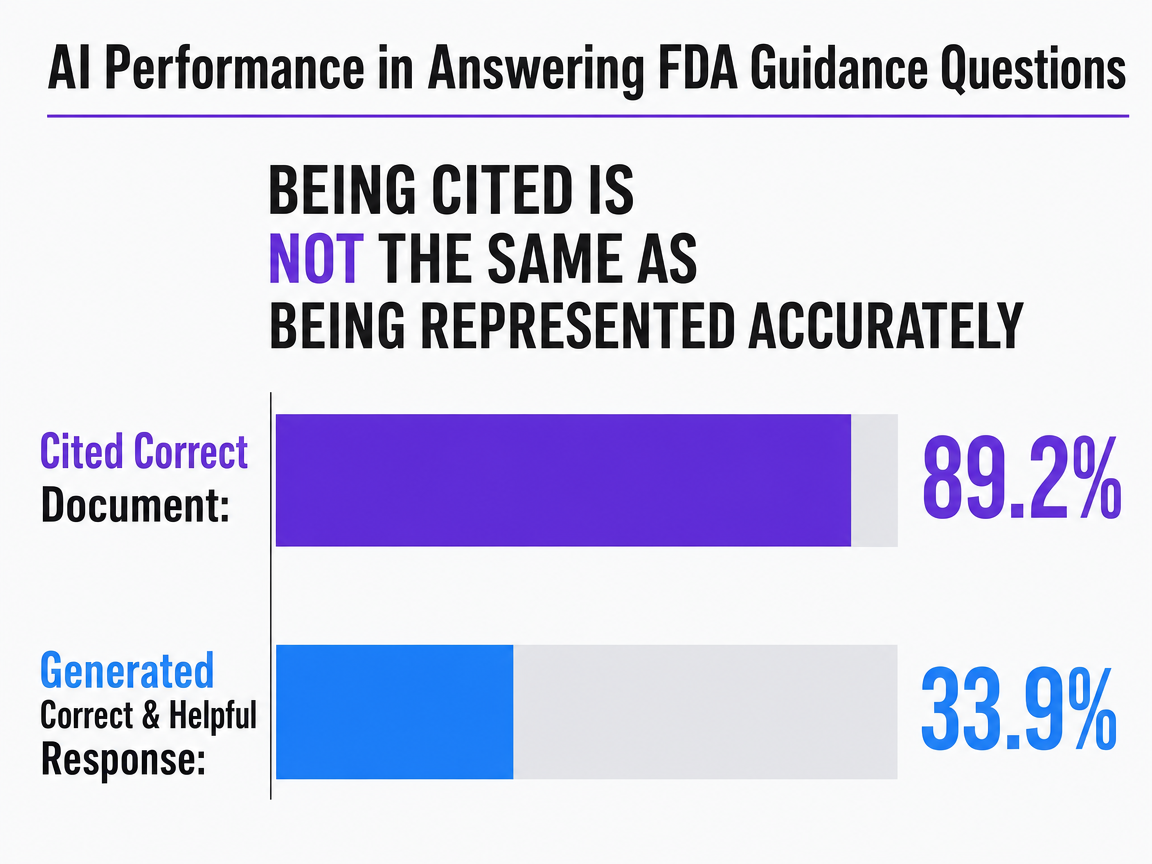 AI Performance in Answering FDA Guidance Questions
A retrieval-augmented system for FDA documents cited the correct source 89.2% of the time, but provided a fully correct, helpful response with no errors only 33.9% of the time.
Test AI-driven SEO execution on live pages today
Experience measurable SEO impact by publishing real, optimized content during your free trial—no delays or commitments required.
Running a Citation Audit Alongside the Rank Audit
The SourceCheckup study, which evaluated seven large language models across 800 medical questions, found that even GPT-4o with web search access produced individual statements that were unsupported by the cited sources roughly 30 percent of the time 1. The scope matters: the dataset was medical, the evaluation was done by trained reviewers, and the framework separated three distinct checks that a marketing team can borrow directly. Those checks are URL validity, source relevance, and statement-level support. Each one answers a different question, and a monthly audit should treat them as three separate columns, not one score.
URL validity : Asks whether the citation points to a live, reachable page that resolves to the content being referenced. Fabricated or hallucinated links fail here. So does a citation that points to a parent category page when the original claim lived on a child article that has since been redirected or deprecated.
Source relevance : Asks whether the cited page is actually about the topic the AI answer is discussing. A brand's homepage pulled in to support a claim about pricing fails this check even if the URL resolves. The citation routes a user to a page that does not back the statement.
Statement-level support : The strictest test. Given a specific sentence inside the AI answer, does the cited source contain language that supports that specific sentence? This is where fluent synthesis most often breaks. A page that discusses outpatient recovery timelines in general terms can be cited to support a very particular claim the page never made.
A workable monthly cadence looks like this. Pull every AI citation to the brand captured by whichever monitoring tool the team runs. Sample ten to twenty citations per generative surface. Score each on the three columns. Flag any failure for one of two responses: correct the underlying page so the next retrieval cycle has better material to work with, or publish a dedicated passage that answers the misrepresented query directly and cleanly, giving the retrieval layer a cleaner target.
Two operational notes keep this discipline from becoming busywork. First, pair the citation audit with the existing rank audit on the same reporting cycle, so leadership sees ranking position and citation quality on one page rather than two. Second, record the specific sentence that was misrepresented, not just the fact of misrepresentation. Patterns emerge quickly: certain claim types, certain product categories, and certain page templates fail statement-level support more often than others, and those patterns tell the content team where to rewrite first.
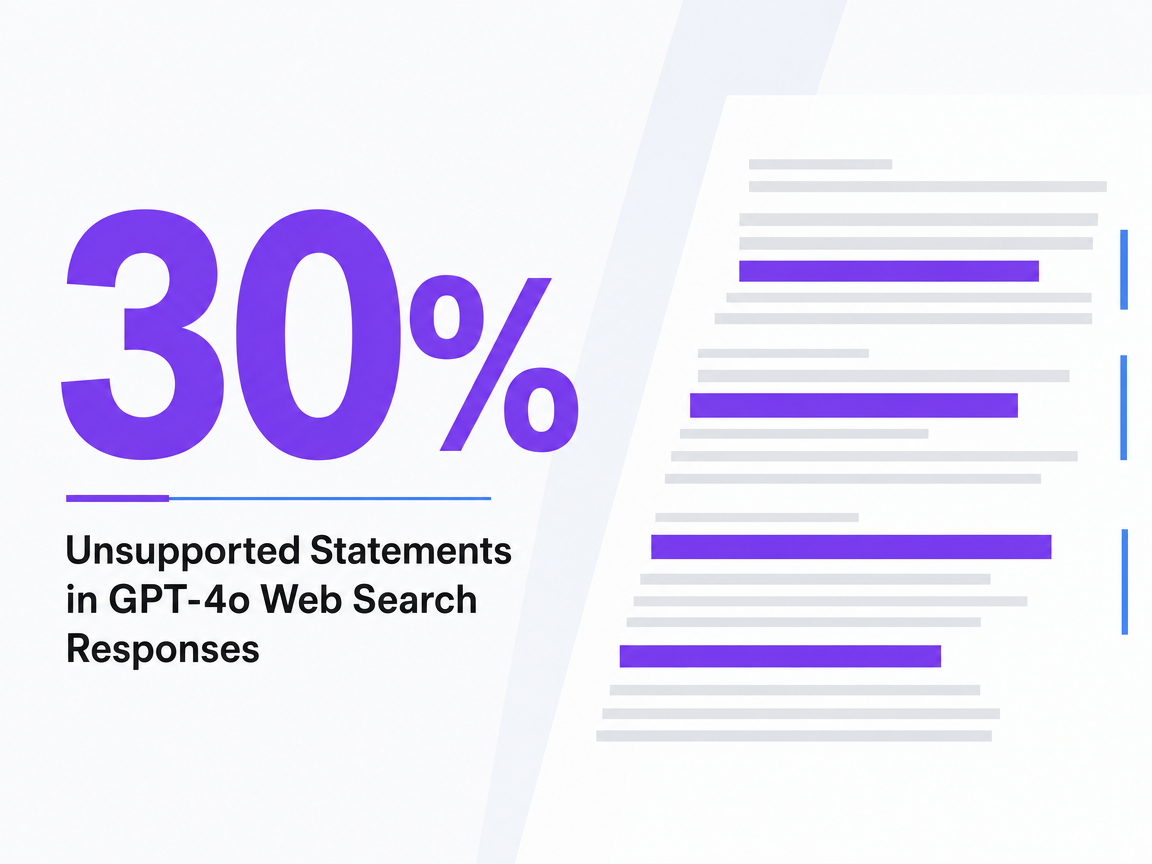 Unsupported Statements in GPT-4o Web Search Responses
Unsupported Statements in GPT-4o Web Search Responses
First-Party Evidence and Third-Party Authority as Retrieval Inputs
A 2025 neurology study tested what happens when a web-grounded language model is forced to retrieve only from authoritative domains rather than the open web. Correctness improved by 8 to 18 percentage points depending on the model, and output variability was cut roughly in half 4. The research was scoped to neurology questions and a defined set of trusted sources, so the specific numbers belong to that domain. The mechanism generalizes: when the retrieval layer has better material to pull from, the synthesized answer gets measurably better and more consistent.
That finding reframes what content and PR teams are actually doing when they place expert commentary in a trade publication, contribute data to an industry report, or earn a reference in a government or academic resource. Those placements are not just reputation signals for a human reader. They are inputs to the retrieval layer that generative engines sample when assembling an answer about the brand's category.
Two kinds of evidence do the heaviest lifting.
The first is distinctive first-party evidence: proprietary data, named practitioners, clinical outcomes, case documentation, methodology descriptions, and specific operational numbers that no competitor can replicate. Generative systems trained to prefer sources that add new information will cite a page that reports original intake data over a page that paraphrases three competitors. A consumer-health comparison of Google, Bing, ChatGPT, and Gemini scored outputs on DISCERN and JAMA benchmark criteria and found that credibility, transparency about sources, and content quality drove the reliability gap rather than surface fluency 12. The same signals that scored well in that evaluation—named authors, disclosed methods, traceable claims—are what distinguish a citable passage from a generic one.
The second is third-party authority: references in publications, directories, and institutional resources that retrieval systems already treat as credible. The spine-guideline audit cited earlier found that 24 percent of AI-generated references were fabricated, meaning retrieval systems will invent authority where none exists if the real web does not supply it 3. Earning placements in sources the retrieval layer actually trusts is the counter-move. It gives the system a real citation to use instead of a hallucinated one.
For an in-house VP, the operational translation is a shift in how editorial calendars and PR targets are set. Every quarter, the content team should ship at least one asset built on proprietary data the brand owns outright, and the PR function should earn at least one placement in a source that already appears in competitor AI citations. Both inputs feed the same retrieval surface. Both are measurable against the citation audit described in the previous section.
Measuring Qualified Pipeline, Not Sessions
Sessions have become an unreliable proxy for SEO performance because the surfaces now intercepting intent do not always generate a click. An AI Overview that answers a comparison query, a Perplexity response that names three vendors with inline citations, or a ChatGPT reply that recommends a specific procedure all shape pipeline without registering in a standard analytics report. A dashboard built on session volume will show decline even in quarters where qualified demand is holding or growing.
The replacement metric set is narrower and more honest about what SEO is now producing.
Four measures carry the reporting load.
- Qualified pipeline attributed to organic and AI-referred traffic, defined by the same lead-scoring criteria sales already uses, not by raw form fills.
- Citation presence across the generative surfaces that matter in the category, tracked as both frequency and accuracy using the three SourceCheckup columns described earlier: URL validity, source relevance, and statement-level support 1.
- Assisted conversions where organic or AI-cited content touched the deal path even when a branded search closed it.
- Share of answer on the twenty to fifty queries that produce the brand's highest-value pipeline, measured as the percentage of generative responses that name the brand or cite its content.
A peer-reviewed comparison across 150 TREC health-misinformation questions found that traditional search engines answered correctly 50 to 70 percent of the time while language models reached roughly 80 percent, and retrieval-augmented variants lifted smaller models by up to 30 percentage points 11. The study was scoped to health queries, but the implication for measurement is general: different surfaces produce different accuracy profiles for the same question, which means pipeline attribution must distinguish them. Collapsing all organic traffic into one bucket hides which surface is actually converting.
Reporting to executives should name the four measures on one page, with the citation audit sitting next to the ranking report rather than in a separate deck. That single view is what lets a VP answer the question executives are actually asking, which is whether organic investment is still producing qualified demand, not whether sessions went up.
See How Leading Teams Are Adapting SEO for AI-Driven Search Results
Connect with our specialists to review data-backed workflows for scaling SEO execution across channels—without adding team members or managing fragmented vendor handoffs.
Governance That Lets Legal Sign Off Without Slowing Production
Legal review becomes the bottleneck in most AI-assisted content operations because the review happens after a draft exists, not during the workflow that produced it. The fix is to move the controls upstream and make them visible as named gates rather than informal checks. Three published frameworks give an in-house VP enough structure to defend that posture to a general counsel without inventing policy from scratch.
The NIST Generative AI Profile, released in July 2024 as a companion to the broader AI Risk Management Framework, identifies confabulation, information integrity failures, privacy loss, and harmful bias as the core risk categories that AI-assisted content workflows need to address through design, monitoring, and incident response 13. Translated into a content operation, that means every published asset should pass through named gates:
- source verification against an approved library,
- human editorial contribution recorded in the revision history,
- approval sign-off by a named reviewer, and
- a monitoring step that catches post-publication drift when the underlying claims age or regulations change.
The U.S. Copyright Office's Part 2 report, published January 29, 2025, settled a question that had been sitting in legal review queues for two years. AI-assisted work remains copyrightable where a human author determines sufficient expressive elements; merely supplying prompts does not qualify 7. The operational consequence is specific. Content workflows need to capture evidence of human editorial judgment—selection, arrangement, revision, and rejection of model output—inside the production record itself, not reconstructed later from memory.
Substantiation duty under FTC authority is the third anchor. The Operation AI Comply announcement in September 2024 confirmed that AI-related marketing claims receive the same consumer-protection scrutiny as any other claim, and that using a model to generate the language does not shift liability 14. Claims about outcomes, reviews, lead quality, performance, or capability still need the receipts that would satisfy a traditional substantiation review.
What this looks like on a single approval screen: the reviewer sees the draft, the sources the retrieval layer pulled from, the specific statements that cite each source, a flag for any claim that lacks substantiation, and a required sign-off field tied to a named editor. Legal reviews the gate design once, not every asset. Production speed increases because the controls are structural rather than ad hoc, and because the audit trail is generated as a byproduct of the workflow rather than assembled under deadline when an inquiry arrives.
If You Manage Multiple Locations: Consolidating the Stack
This section narrows the audience. The reader shifts from the single-site marketing VP to the operator running SEO across a dental support organization, a multi-market law firm, a home-services franchise, a senior living portfolio, or a behavioral health network with ten to several hundred locations. The economics change because every retrieval, citation, and governance control described earlier has to run at location scale, not asset scale.
The common stack is familiar: an SEO agency for technical and content, a separate content studio, a PR or digital-PR vendor earning the third-party references that the domain-restricted retrieval research identified as a correctness lever 4, a PPC agency, a social agency, and a call-tracking tool stitched into reporting. Each vendor files its own brief, runs its own approval cycle, and reports on its own metric. The seams between them are where citation audits fail, where substantiation evidence goes missing when the FTC posture described earlier is tested 14, and where location-level pipeline data stops being traceable back to the asset that produced it.
The qualitative comparison that matters to a portfolio operator looks like this.
| Dimension | Fragmented vendor stack | Consolidated approval-first workflow |
|---|---|---|
| Coordination overhead | Separate briefs, status calls, and reporting decks per vendor per location | One brief, one approval queue, one reporting view across channels and locations |
| Time-to-publish | Multiple handoff cycles between strategy, draft, legal, and publishing per asset | Named gates inside a single workflow; approval and publishing on the same screen |
| Citation and evidence governance | Source libraries and substantiation records live in each vendor's system | Shared source library, per-statement citations, and audit trail generated as a byproduct of approval, consistent with NIST GenAI Profile controls 13and Copyright Office authorship evidence requirements 7 |
| Attribution to qualified pipeline | Channel-siloed reporting; location-level qualified pipeline reconstructed manually | Qualified calls, bookings, and pipeline tied to the specific asset and location that produced them |
Two operational variables decide whether consolidation pays off at a given portfolio size. The first is briefing cycles per asset, counted across vendors; stacks that require three or more cycles before a draft moves to legal lose most of their production speed to coordination rather than writing. The second is approval gates per channel; when each vendor runs its own gate, the governance posture that legal signed off on cannot be enforced uniformly, and the citation audit discipline described earlier breaks at the location level because no single system owns the record.
The portfolio question is not whether to run SEO. It is whether the current stack can run the retrieval-and-citation operation described in the preceding sections at location scale without adding headcount. If the honest answer is no, consolidation moves from a cost conversation to an execution one.
An Operating Model for the Next Two Years
The operating model that holds up under AI search is narrower than most marketing plans assume. Four functions have to run on the same cadence, against the same source library, through the same approval queue:
- technical eligibility,
- distinctive content production,
- third-party reference building, and
- citation measurement.
When those four live in separate systems or separate vendors, the seams produce exactly the failure modes the preceding sections documented—fabricated references, unsupported statements, misrepresented citations, and pipeline that cannot be traced back to the asset that earned it.
A workable two-year plan sequences the work rather than attempting it all at once. In the first two quarters, the base layer gets fixed: crawl eligibility, structured data, and a consolidated source library that both human editors and retrieval-assisted drafting pull from. Quarters three and four add the citation audit as a monthly discipline reported alongside rankings, and shift at least one editorial slot per quarter to proprietary data assets the retrieval layer will prefer. Year two moves the governance posture from documented to automated, with NIST-aligned gates 13, Copyright Office authorship evidence 7, and FTC-grade substantiation 14captured as byproducts of the approval workflow rather than reconstructed under deadline.
For teams considering a consolidated platform to run this loop, Vectoron offers a two-week trial at $599 per month after trial.
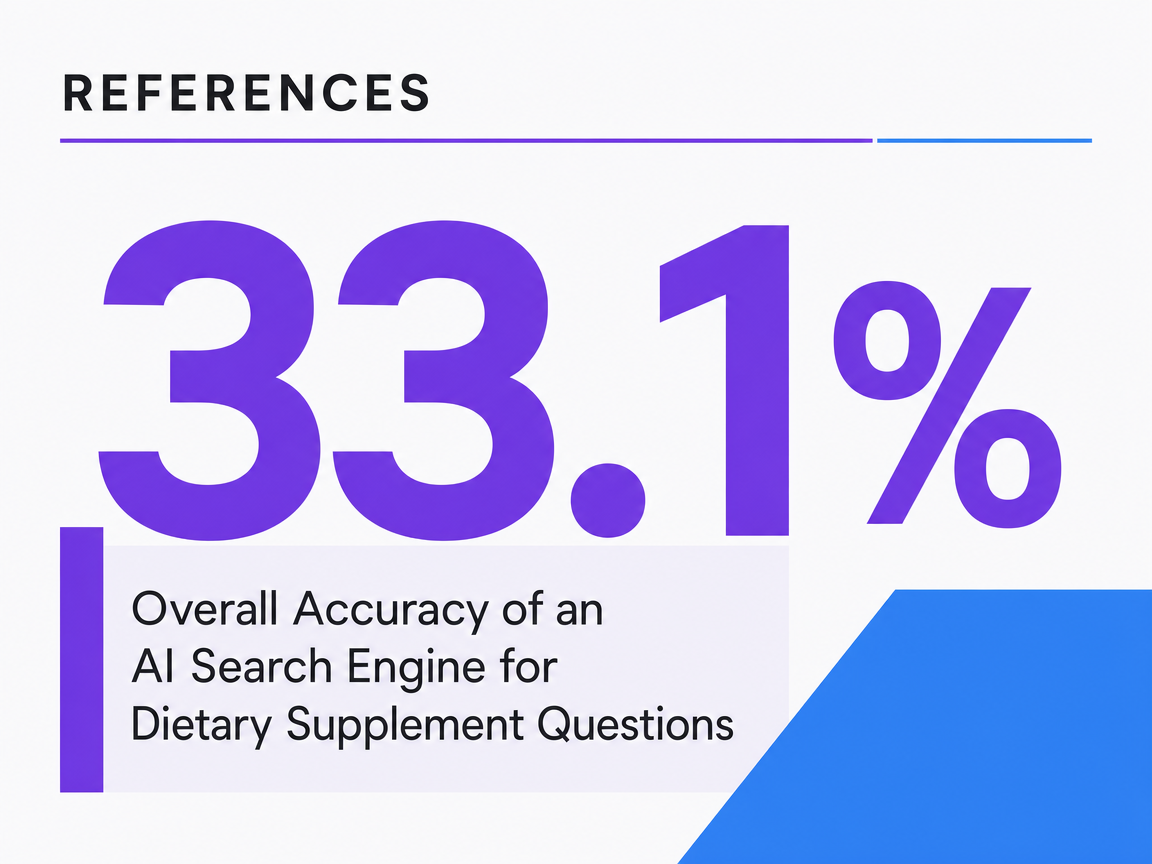 Overall Accuracy of an AI Search Engine for Dietary Supplement Questions
Overall Accuracy of an AI Search Engine for Dietary Supplement Questions
Frequently Asked Questions
References
- 1.An automated framework for assessing how well LLMs cite relevant medical sources.
- 2.Evaluating the Reliability and Accuracy of an AI-Powered Search Engine in Providing Responses on Dietary Supplements: Quantitative and Qualitative Evaluation.
- 3.The double-edged sword of generative AI: surpassing an expert or a danger for medical practice?.
- 4.Evaluating Web Retrieval–Assisted Large Language Models With Domain-Restricted Search.
- 5.Semantic Search of FDA Guidance Documents Using Large Language Models.
- 6.Search still matters: information retrieval in the era of generative AI.
- 7.Copyright Office Releases Part 2 of Artificial Intelligence Report.
- 8.Artificial Intelligence: Generative AI Technologies and Their Commercial Applications.
- 9.Artificial Intelligence: Generative AI Training, Development, and Deployment Considerations.
- 10.GEO: Generative Engine Optimization.
- 11.Evaluating search engines and large language models in answering health-related questions.
- 12.The Reliability Gap: How Traditional Search Engines and Generative AI Compare in Consumer Health Information.
- 13.Artificial Intelligence Risk Management Framework: Generative Artificial Intelligence Profile.
- 14.FTC Announces Crackdown on Deceptive AI Claims and Schemes.