
Key Takeaways
- Keyword prioritization, not discovery, is where agency quality collapses at scale, so a six-factor scoring model replaces individual strategist judgment and keeps decisions consistent across accounts.
- Weighting shifts by funnel stage: content relevance drives purchase-stage queries while authority drives awareness-stage queries, so authority-constrained clients should over-index on specificity and bottom-funnel intent 1.
- Specificity frequently beats raw volume because narrower queries attract more involved searchers who click and convert at higher rates, especially against entrenched head-term incumbents 11.
- Close the loop by feeding call-tracking qualification tags back to the cluster level, retiring rows where strong rank fails to produce qualified pipeline rather than defending the ranking.
Why Keyword Prioritization, Not Discovery, Is the Real Agency Bottleneck
Agency SEO leaders running 15 to 80 accounts rarely struggle to find keywords. Any specialist with a Search Console login and a competitor crawl can produce a list of 4,000 candidates for a mid-sized client inside an afternoon. The constraint sits one step later: deciding which 60 of those 4,000 deserve a page given the client's current authority, competitive position, and the stage of the buyer the query represents.
That decision is where quality collapses at scale. When each specialist applies personal judgment, output drifts. One strategist chases volume. Another chases rank difficulty scores. A third builds around whatever the client's founder mentioned on the last call. The portfolio ends up with pages that rank but do not generate qualified calls, and reporting cycles get consumed defending traffic charts that do not tie to pipeline.
Peer-reviewed work on keyword selection frames the problem precisely. Query popularity, competition, specificity, intent, content relevance, and online authority interact to determine whether a chosen term produces organic clicks and rank, and the weighting shifts by customer journey stage 1. That interaction is what a scoring model has to encode. Treating keyword selection as a prioritization system, rather than a research exercise, is what lets an agency ship consistent decisions across accounts without a senior strategist signing off on every list.
The Six-Factor Scoring Model That Replaces Strategist Judgment Calls
Popularity, Competition, and Specificity: The Demand-Side Inputs
The demand side of the scoring model asks a single question: is anyone actually looking for this, and if so, who else is standing in the way. Popularity measures raw query volume. Competition measures how crowded the organic SERP is for that query, including SERP features that compress the organic click space. Specificity measures how narrowly the query defines the searcher's problem. The peer-reviewed framework from the Journal of Retailing treats these three as the demand-side predictors of expected clicks and rank, with each operating through a different mechanism 1.
Popularity is the input most agencies over-weight. A keyword with 12,000 monthly searches looks like a prize until the strategist checks what sits above the fold. If the SERP is dominated by a knowledge panel, four ad slots, a map pack, and a People Also Ask carousel, the organic click share available to any ranking page may be smaller than for a term pulling 400 searches a month with a clean ten-blue-link layout.
Specificity does the opposite work. A longer, more defined query carries fewer searches but a sharper signal of what the searcher wants, which affects both ranking difficulty and downstream conversion. The scoring sheet should capture specificity as a positive weight, not treat it as a volume penalty.
Treating the three demand-side inputs as a single score, rather than three separate columns a specialist eyeballs, is what forces consistent decisions. The specialist stops arguing for a term because the volume is impressive and starts defending the composite number.
Intent, Relevance, and Authority: The Site-Side Inputs
The other three factors in the Journal of Retailing framework describe the client, not the query 1. Intent captures what the searcher is trying to do: learn, compare, locate, or buy. Content relevance captures how closely the destination page matches that intent at the text, structural, and entity level. Online authority captures the site's accumulated signals of credibility, including link profile, domain history, and the strength of the parent brand.
Intent is a classification task before it is a scoring task. A query like "invisalign cost" sits mid-funnel. "Invisalign vs braces" sits earlier. "Invisalign provider near me" sits at the bottom. The scoring sheet should carry an intent tag that drives how the next two factors are weighted, not just a numeric score.
Content relevance is where most agencies have the most control. A junior specialist can improve a relevance score inside a sprint by rewriting a page, adding supporting entities, or correcting an intent mismatch. Authority is the slowest-moving factor and the one least responsive to a single quarter of effort. A dental startup with a six-month-old domain cannot out-authority a 20-year-old DSO on a head term, no matter how good the content is.
The practical consequence: the scoring model should penalize keywords where the authority gap to the top-ranking competitors exceeds what the client can realistically close inside the engagement horizon. That one filter removes the majority of pages that would otherwise ship, rank nowhere, and burn production capacity.
The Authority-vs-Stage Tradeoff Most Agencies Miss
The six factors do not operate independently. The Journal of Retailing analysis finds that the weighting shifts by customer journey stage: content relevance exerts stronger influence on expected clicks and rank for purchase-stage queries, while online authority exerts stronger influence for awareness-stage queries 1. This interaction is the single most actionable finding in the paper and the one most keyword-selection workflows ignore.
The operational translation is direct. For a client with modest domain authority, the scoring model should over-weight purchase-stage queries where sharp, well-structured content can win against stronger domains that have not built pages matching the specific intent. For a client with strong authority, the model can tolerate awareness-stage targets because the authority signal does part of the work the content would otherwise have to do alone.
A chart comparing the two weightings makes the point visible. For purchase-stage queries, the content relevance factor carries the heavier bar; for awareness-stage queries, online authority carries it 1. Agencies that apply a flat weighting across both ends of the funnel systematically mis-prioritize: they chase awareness terms for low-authority clients who cannot win them, and they under-invest in bottom-funnel content for high-authority clients who could compound rankings quickly.
Encoding the interaction in the scoring sheet is straightforward. Two weighting profiles sit behind the same six-column input: one for authority-constrained clients that boosts relevance and specificity, and one for authority-rich clients that boosts authority leverage against competitive head terms. The strategist no longer argues the tradeoff. The model expresses it.
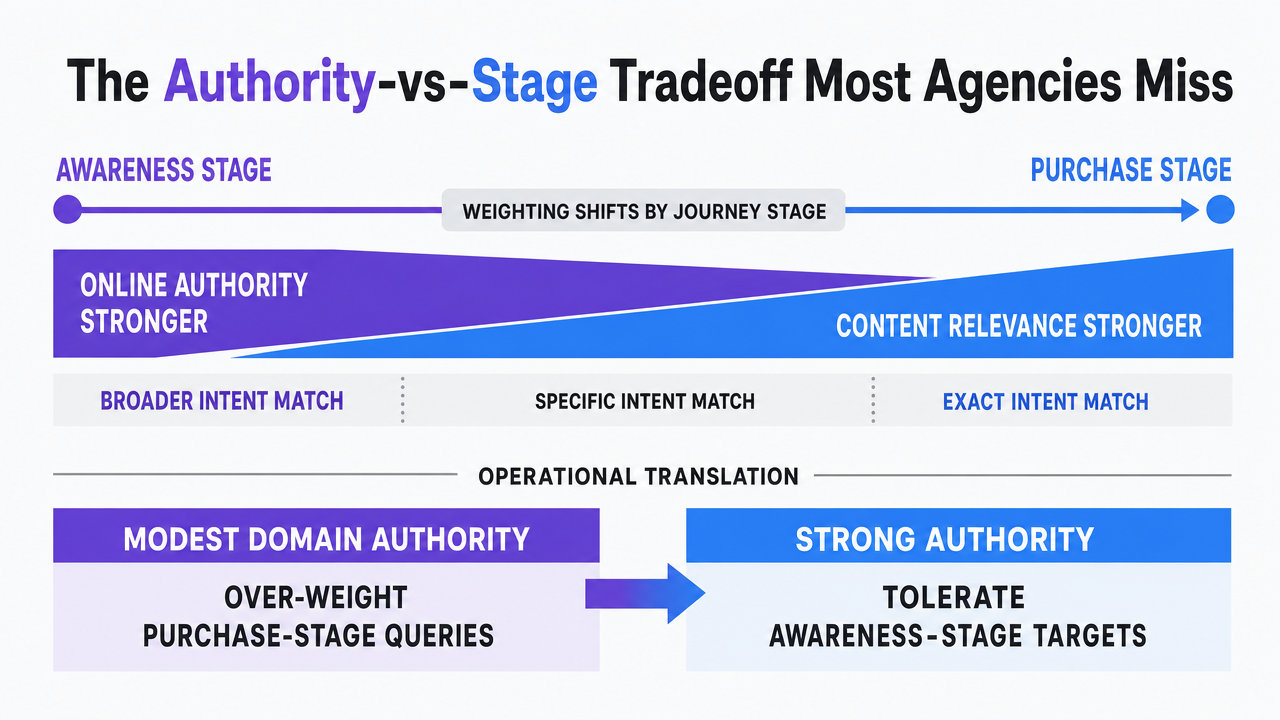 Visualize the two weighting profiles from the Journal of Retailing framework, showing how content relevance dominates for purchase-stage queries while online authority dominates for awareness-stage queries
Translating the Model Into a Scoring Sheet That Runs Across Accounts
The scoring sheet is the artifact that turns the six-factor framework 1into something a junior specialist can run without a senior strategist in the room. Each candidate keyword gets one row. The columns capture the six inputs, the intent tag, the two weighting profiles that depend on client authority tier, and a composite score the sheet calculates automatically.
The column structure matters more than the exact formula. Popularity, competition, and specificity sit in the first block as the demand-side score. Intent sits as a classification field with four allowed values: informational, comparative, local, and transactional. Content relevance and online authority sit in the site-side block, each scored against the current top three organic results for the query. A final column holds the authority-gap flag that marks any row where closing the gap to the ranking competitors would take longer than the engagement horizon.
Two weighting profiles live on a separate tab. The authority-constrained profile boosts specificity and relevance; the authority-rich profile boosts the leverage of existing domain signals against competitive head terms 1. The specialist selects a profile when onboarding the client, not when scoring individual keywords. That single choice removes the most common source of drift across accounts.
Governance sits in the review step. The senior strategist does not re-score rows. The strategist audits a sample, confirms the authority tier and weighting profile were set correctly, and signs off on the top-scored cluster the sheet surfaces. Specialists ship from the ranked output. Disagreements get resolved by adjusting the weighting profile at the account level, not by overriding individual rows, which keeps the model's logic intact as the portfolio grows.
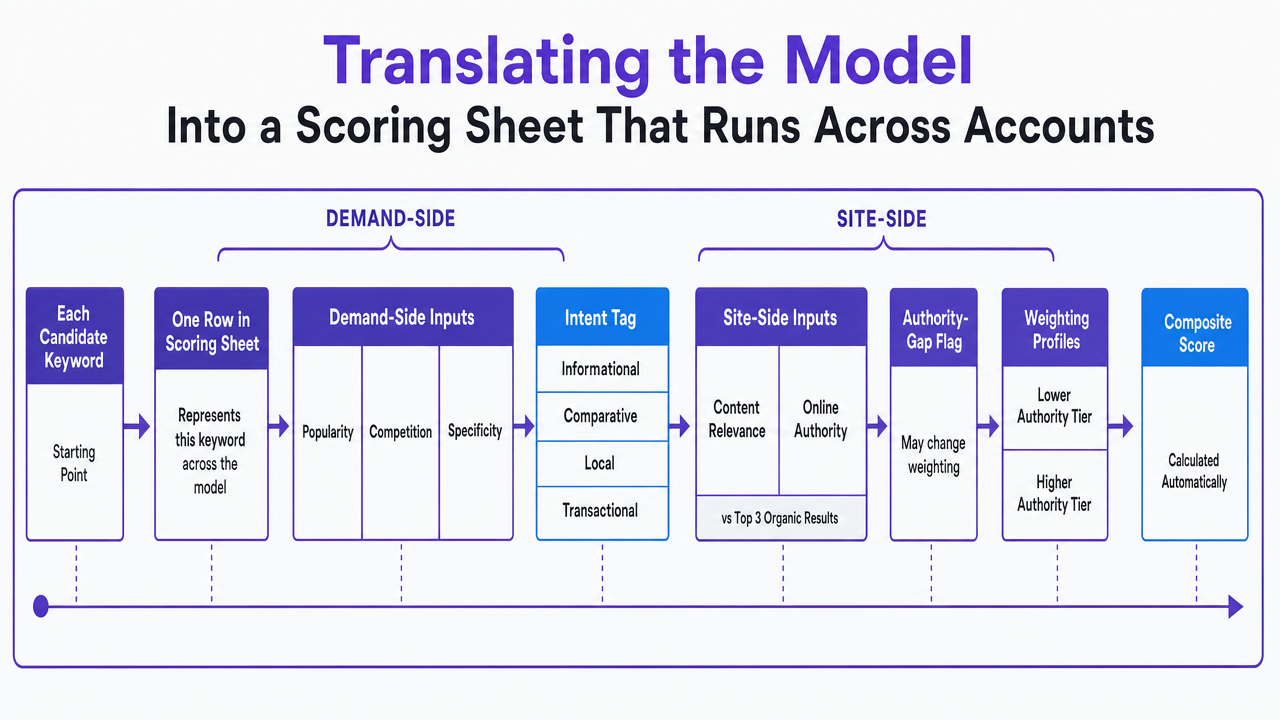 Show the structure of the six-factor keyword scoring sheet described in the section, including demand-side inputs, intent classification, site-side inputs, the authority-gap flag, and composite output
Test real-time keyword strategies with live data
Validate and refine your client keyword approach using actual published content and measurable results during your trial.
Specificity Beats Volume: The Click Behavior Evidence
Agencies that rank keyword lists by monthly volume systematically overweight the terms least likely to produce qualified calls. Individual-level click research from a leading search engine shows that searches for less popular keywords were associated with more clicks per search and a larger share of sponsored clicks than searches for popular keywords 11. The behavioral read is straightforward: a narrower query reflects a more involved searcher, and involved searchers click more and convert more.
The scope of the finding matters. The data comes from a South Korean search engine, so the absolute magnitudes do not transfer cleanly to U.S. SERPs across every vertical 11. The directional signal does. A dental client ranking for "same-day crown appointment [city]" will typically produce more booked consultations per hundred sessions than a top-three ranking for "dental crown," even when the head term pulls thirty times the traffic.
For the scoring sheet, this evidence hardens the specificity weight. Specificity is not a tiebreaker applied after popularity has been maximized. It is a primary input that frequently outranks volume in composite scoring, especially for authority-constrained clients competing against entrenched head-term incumbents.
The operational discipline follows: when a specialist defends a high-volume head term, the senior reviewer should ask what the specificity score is and what the composite looks like. If a cluster of three narrower queries scores higher together than the head term scores alone, the three ship first.
Forecasting Demand When Search Volume Itself Is Moving
Keyword tools report last quarter's demand, not next quarter's. That gap has always existed, but it is widening as a share of information-seeking shifts from search boxes into conversational interfaces. FTC staff research on large language model adoption documented a 31.5% decrease in Google searches in the studied adoption context 5. The number is specific to that research setting, not a market-wide decline, and should be triangulated against each client's Search Console trend, call volume, and booked-appointment data before any list is re-weighted 5.
The operational response is not to abandon volume estimates. It is to stop treating them as the primary input. Head-term volume forecasts carry the most uncertainty because informational queries are the ones most easily absorbed by chat interfaces. Transactional and local queries, where the searcher needs a provider, a price, or a location, remain anchored to a click because the conversion lives on a website or a phone line.
That asymmetry maps cleanly onto the scoring sheet. The authority-constrained weighting profile already boosts specificity and purchase-stage relevance 1. A demand environment where upper-funnel volume is softening makes that bias correct for a wider slice of the portfolio, not just the smaller clients.
Two practical adjustments follow. The scoring sheet should apply a volatility discount to popularity scores for purely informational queries, pulling their composite down relative to transactional terms with equivalent raw volume. And the quarterly review should compare the agency's own Search Console impression trends across intent tiers rather than trusting third-party volume estimates alone. Clients whose informational impressions are falling faster than their transactional impressions are early signals the broader forecast is drifting.
Compliance as a Keyword-Selection Filter, Not an Afterthought
Certain keyword clusters carry regulatory exposure that changes whether an agency should pursue them at all. For legal, healthcare, behavioral health, dental, and senior living clients, the scoring sheet needs a compliance column that sits upstream of the composite score, not downstream in a legal review that happens after pages are drafted. The column flags three categories of risk that FTC guidance treats as actionable areas of enforcement.
The first category covers review, testimonial, and comparison queries. The FTC's Consumer Reviews and Testimonials Rule took effect October 21, 2024 and authorizes civil penalties for knowing violations involving fake, false, or manipulated reviews 10, 7. "Best [service] [city]," "top-rated [provider]," and "[competitor] vs [competitor]" clusters are not off-limits, but any page targeting them has to be built against substantiation requirements the specialist cannot waive. Material connections between endorsers and the client must be disclosed when they could affect how consumers evaluate the endorsement 8.
The second category covers outcome, service, and comparative claims on landing pages built for transactional queries. Testimonials cannot carry claims the advertiser could not legally substantiate, and disclosures must be clear and conspicuous 9, 13. A "guaranteed settlement" or "pain-free procedure" query drives a page whose copy exposure outweighs the traffic value for most clients in regulated verticals.
The third category covers the organic-paid boundary. When keyword research feeds both SEO and PPC calendars, the FTC requires that advertising be clearly and prominently distinguished from natural search results 12. Blended reporting that obscures which clicks came from which channel creates a governance problem the scoring sheet should preempt by tagging dual-use clusters.
The compliance column has three allowed values: clear, substantiation-required, and avoid. Terms flagged substantiation-required proceed only when the client supplies evidence the page can cite. Terms flagged avoid are removed before the composite score is calculated. The filter runs once, at the account level, and prevents the recurring pattern of ranking pages that have to be pulled down after a legal review that should have happened before production started.
Streamline Keyword Selection Across Clients With AI-Driven Precision
Connect with our team to see how advanced call intelligence and automated workflows enable agencies to identify, prioritize, and implement high-impact SEO keywords at scale—without increasing manual oversight.
Measuring Keywords by Qualified Pipeline, Not Rank
Ranking reports flatter the scoring model. They do not validate it. A keyword that reaches position two and generates no booked consultations has failed the only test that matters for client retention. The measurement layer has to be built around qualified pipeline from the start, not bolted on after a quarterly business review exposes the gap.
The sequence that holds up across accounts begins with defining success metrics and KPIs before any dashboard gets built, then segmenting results by location, technology, and acquisition source 3. Keyword performance belongs in that segmentation, not as a standalone rank chart. The reporting unit is the cluster-to-outcome pair: this set of queries drove this volume of qualified calls, this count of booked appointments, this slice of pipeline, over this window.
Translating that into an operational system means tracking a short list of signals per cluster. Impressions and clicks come from Search Console. Low-CTR queries, changing search terms, and top clicked URLs sit alongside them as early indicators that a cluster's intent match is drifting 6. The downstream signals, qualified call volume and booked outcomes, come from call tracking and CRM data joined back to the landing page the session touched.
Rank still appears on the dashboard. It sits as a diagnostic, not a KPI. When a cluster shows strong rank and weak qualified-call volume, the scoring sheet's intent tag or relevance score was wrong, and the cluster gets retired or rebuilt rather than defended. That is the governance discipline rank-first reporting cannot produce.
If the Portfolio Includes Multi-Location Clients: Governance Economics
The scope shifts here. The reader managing a book that includes dental groups with 40 practices, home-services franchisors with 120 territories, or senior-living operators with 25 communities faces a different scoring problem than the one that governs single-location accounts. Keyword selection has to run per location, roll up to a brand parent, and still produce defensible decisions a specialist can execute without a senior strategist re-scoring every row.
Segmenting performance by geography rather than aggregate rankings is the baseline discipline, and the operational reason is that intent, competitive density, and conversion behavior vary meaningfully by market even when the service catalog does not 4. A "same-day crown" cluster that scores well in a mid-density suburb may fail the authority-gap filter in a dense urban market where three incumbent DSOs hold the top ranks. The scoring sheet needs a location dimension on every row, not a brand-level composite that averages away the markets where the page should never ship.
Governance cost is the variable that decides whether multi-location keyword work scales. Three staffing models produce very different throughput against the same scoring discipline.
| Staffing model | Hours per location per month | Pages shipped per cycle | Senior approval-gate time ||---|---|---|---|| Senior-strategist-per-client | High | Low | Low (strategist is author) || Junior-executed with senior review | Moderate | Moderate | High (row-by-row review) || AI-assisted with approval workflow | Low | High | Low (sample audit + profile sign-off) |
The third model only works when the scoring sheet is doing the prioritization. Without it, AI-assisted output ships at volume and the senior strategist spends the saved hours cleaning up pages that never should have entered production. With the scoring model in place, the approval gate moves from individual rows to the weighting profile and the authority-gap flag at the account level, which is where governance scales cleanly across 40 locations instead of collapsing under row-level review.
Closing the Loop: Call-Signal Feedback Into the Scoring Model
The scoring model decides which keywords deserve a page. Only downstream signal tells the agency whether the decision was right. Form fills and session data do not resolve the question for most high-stakes verticals, because the booked consultation, the intake call, and the qualified inquiry happen on the phone. Without a feedback channel from the call back into the scoring sheet, the model keeps producing the same prioritization errors across accounts.
The loop has four stops. A keyword cluster ships as a page. The page captures a session. The session produces a call. The call gets tagged for qualification, intent, and the service requested, and that tag flows back to the cluster it came from. When a cluster accumulates sessions and calls but the qualification rate sits well below the account baseline, the intent tag or relevance score on that row was wrong. The row gets retired or rebuilt against a different intent profile.
AI-powered call analysis that reads recorded calls, tags qualified inquiries, flags missed opportunities, and surfaces intake patterns is what makes the loop operable across a portfolio. Vectoron's Call Intelligence sits in that position for agency teams running the scoring discipline described here. The next quarter's keyword list is only as good as the signal the current quarter's calls feed back into the model.
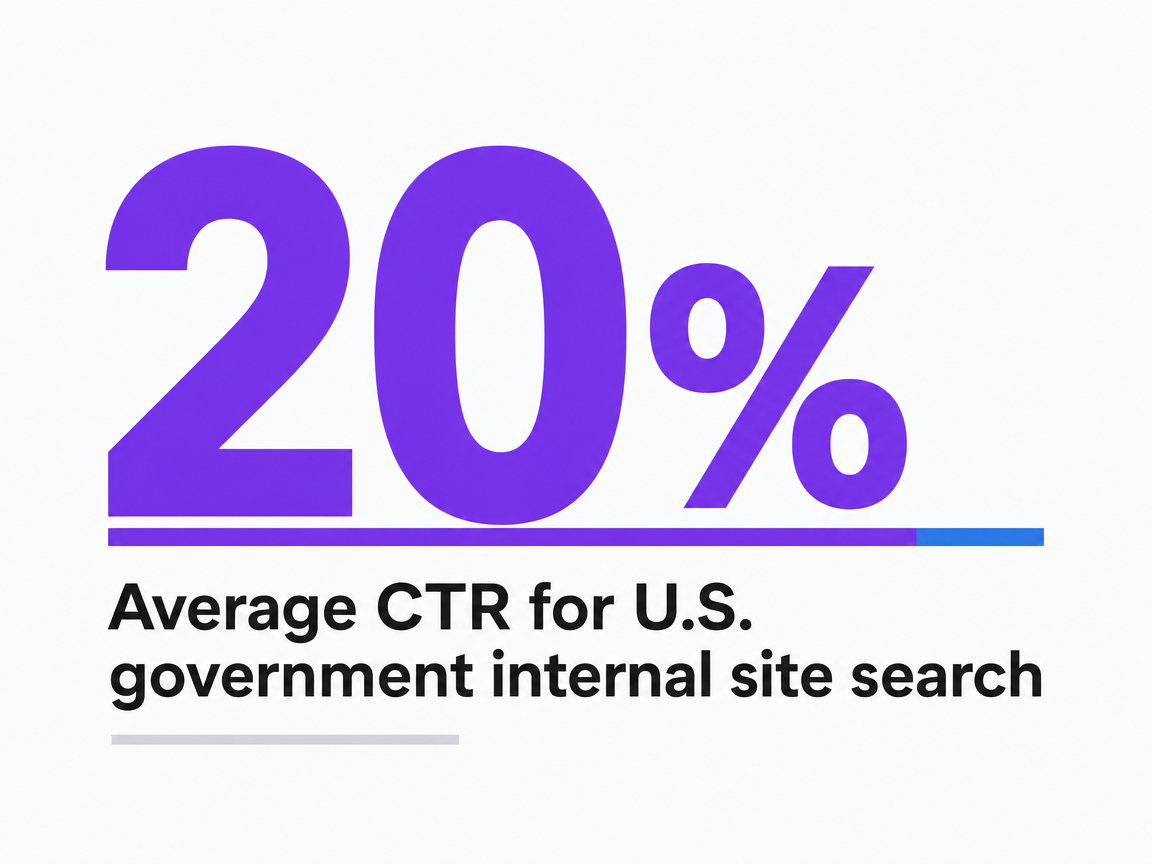 Average CTR for U.S. government internal site search
Average CTR for U.S. government internal site search
Frequently Asked Questions
References
- 1.Keyword Selection Strategies in Search Engine Optimization.
- 2.How to analyze your search analytics.
- 3.Know what you're looking for.
- 4.Understanding International SEO.
- 5.The Impact of LLM Adoption on Online User Behavior.
- 6.DAP: Digital Metrics Guidance and Best Practices.
- 7.Rulemaking: Use of Consumer Reviews and Testimonials.
- 8.Endorsements, Influencers, and Reviews.
- 9.Advertising and Marketing on the Internet: Rules of the Road.
- 10.The Consumer Reviews and Testimonials Rule: Questions and Answers.
- 11.Consumer Click Behavior at a Search Engine.
- 12.FTC Consumer Protection Staff Updates Agency’s Guidance to Search Engine Industry on the Need to Distinguish Between Advertisements and Natural Search Results.
- 13.Online Advertising and Marketing.