
Key Takeaways
- A pipeline-grade SEO strategy runs as a four-layer operating loop: intent mapped to commercial actions, evidence gates at publication, a signal-to-approval execution cadence, and closed-loop attribution to CRM opportunities.
- Query clusters earn roadmap slots only when the searcher's problem matches a current offer, the searcher can advance a purchase, and the on-page conversion maps to a CRM stage — volume is secondary.
- Compliance is a publication checklist, not an audit: FTC truth-in-advertising and substantiation rules 2, 10, the 2024 reviews rule 15, and HHS tracking guidance 8each attach to specific artifacts and owners.
- VPs should approve or reject ranked recommendations weekly, read attribution and retire underperforming clusters monthly, and audit the reviewer log and measurement stack quarterly against NIST's Privacy Framework 1.
Why organic search misses pipeline targets even when rankings improve
A marketing team can lift non-branded impressions 40% in a quarter, watch position-one placements accumulate, and still miss the pipeline number. The gap is rarely a ranking problem. It is a wiring problem between what search engines reward, what buyers actually do on the page, and what the CRM can prove happened next.
Three failure patterns show up repeatedly in organic programs that hit traffic goals but not revenue goals:
- Intent map built around search volume rather than commercial action, so the site attracts readers who were never going to convert on this quarter's offer.
- Conversion assets — service pages, comparison pages, testimonial widgets, call-tracking scripts — produced without evidence and compliance gates, which introduces silent risk that surfaces as legal review holds, retracted claims, or worse. The FTC's baseline is unambiguous: advertising must be truthful, substantiated, and non-deceptive, and that standard applies to organic service pages and case studies, not only paid campaigns 2.
- Measurement stops at form fill or phone connect, so no one can attribute a closed opportunity back to the query, the page, or the asset that earned it.
Each pattern is fixable, but not by adding more content. It requires treating the SEO program as an instrumented operating loop with defined layers: an intent map tied to commercial actions, evidence gates at publication, a signal-to-approval execution cadence, and closed-loop attribution from impression to opportunity. The rest of this article describes that operating model and the governance controls that keep it defensible to a CFO, general counsel, and the board.
The four-layer operating model for a pipeline-grade SEO strategy
Layer one: an intent map tied to commercial actions, not keyword volume
An intent map is a spreadsheet that most organic programs never build. It lists every query cluster the business will pursue, then binds each cluster to a specific commercial action — a booked consultation, a qualified inbound call, a demo request, a pricing inquiry, a contract sent. Volume is a secondary column, not the sorting logic.
The sorting logic is commercial fit. A query cluster earns a slot in the roadmap when three conditions hold:
- The searcher's stated problem matches an offer the company sells this quarter.
- The searcher has the authority or influence to advance a purchase.
- The conversion action on the destination page maps to a stage the CRM can recognize.
Clusters that fail any of the three become editorial candidates, not pipeline candidates, and they get scheduled against a different budget line.
Each row on the map carries a designated artifact type — service page, comparison page, use-case page, diagnostic tool, calculator, case study, or educational article. Artifact type dictates the conversion instrument attached to it. A comparison page carries a scoped-quote form. A diagnostic tool captures qualification variables the sales team already asks for. An educational article carries a soft ask that feeds nurture, not a demo request the reader is not ready to make.
Two disciplines keep the map honest. First, every cluster names the objection it resolves — pricing opacity, credentialing doubt, timeline uncertainty, integration risk — so the copy has a job beyond ranking. Second, clusters are retired when the conversion instrument underperforms for two consecutive review cycles, regardless of impression growth. Traffic that does not convert is not a hedge; it is a cost center dressed as a leading indicator.
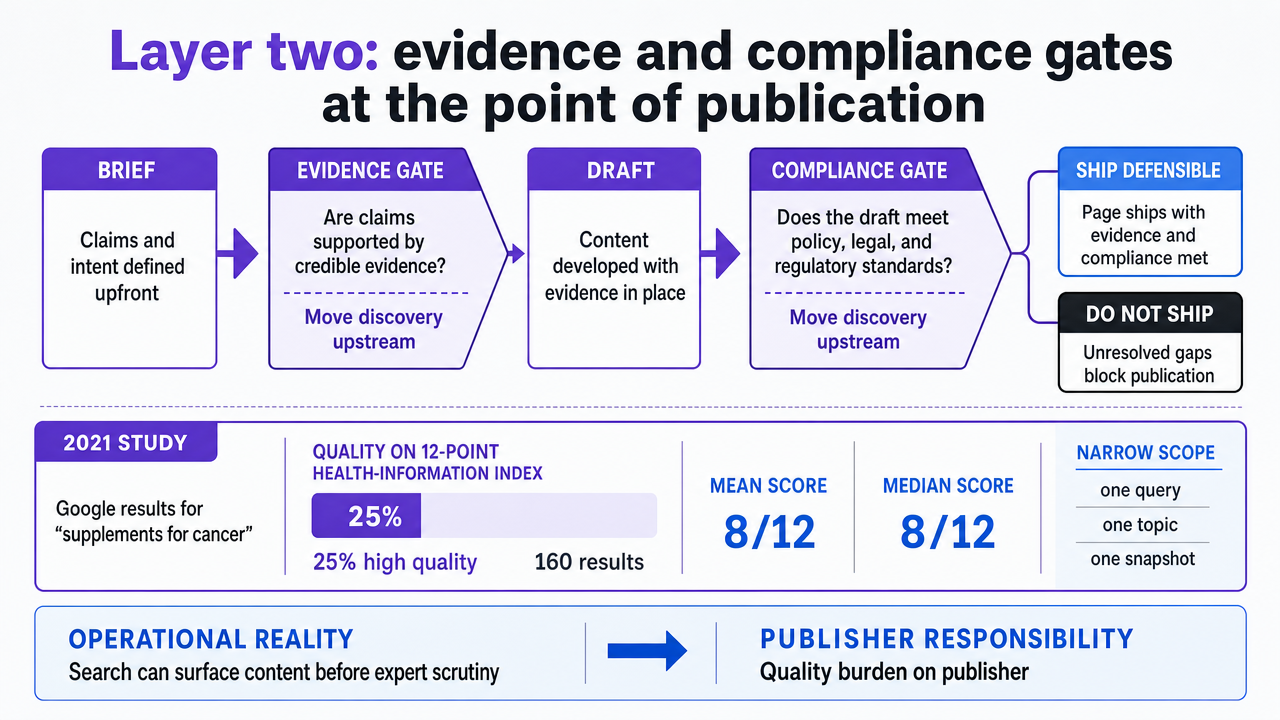
Layer two: evidence and compliance gates at the point of publication
Publication is the wrong place to discover a claim is unsupportable. Evidence and compliance gates move that discovery upstream, into the brief and the draft, so the page ships defensible or does not ship.
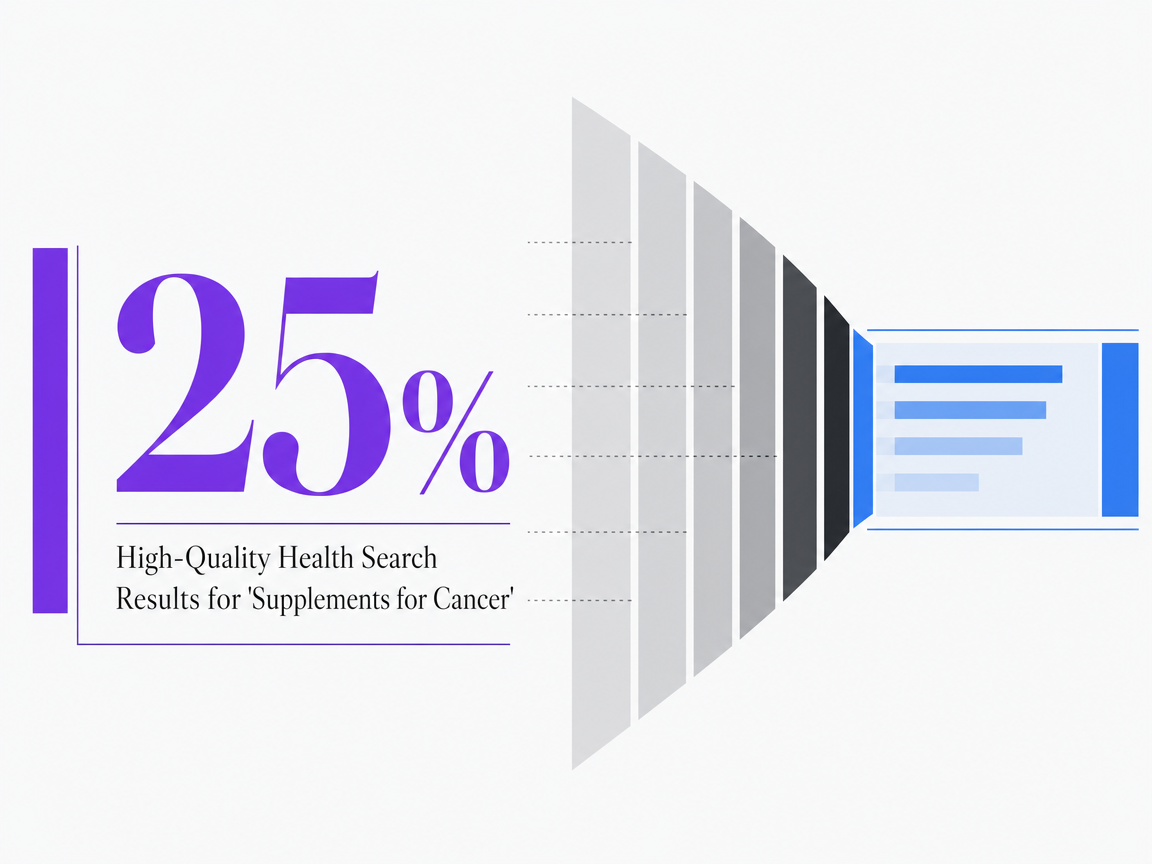
The rhetorical hinge for why these gates matter comes from a 2021 peer-reviewed study of Google results for the narrow query "supplements for cancer." Only about 25% of the 160 results were rated high quality and objective on a 12-point health-information quality index, with a median and mean score of 8/12 4. The study is narrow — one query, one health topic, one snapshot — and should not be generalized to the entire medical search landscape. It does, however, illustrate a durable operational point: search systems will surface content whether or not it holds up under expert scrutiny, and the burden of quality falls on the publisher, not the algorithm.
A workable gate has three checkpoints:
- Brief checkpoint — requires every factual claim, statistic, and outcome assertion to name its source before a writer begins.
- Draft checkpoint — runs the copy against the applicable regulatory baseline: the FTC's requirement that advertising be truthful, non-deceptive, and evidence-supported, which governs service pages, comparison pages, case studies, and testimonials 2; and, for health-adjacent services, the FTC's substantiation standard requiring competent and reliable scientific evidence for objective health claims, with testimonials treated as inadequate substitutes for that evidence 10, 11.
- The publication checkpoint routes any page carrying a health, financial, legal, or safety claim through a qualified reviewer whose sign-off is logged and versioned.
Structured review is not optional theater. Research validating multidimensional quality assessment of health-search results across usefulness, supportiveness, and credibility used 6,030 human-annotated query-document pairs across 32 health-related inquiries to demonstrate that quality can be evaluated systematically at scale 5. The operational translation for a marketing organization is a rubric, not a vibe check — each reviewer scores a page against defined dimensions and the score, reviewer, and date are stored with the asset.
The compounding benefit is defensibility. When a claim is challenged, the reviewer log shows who approved what, when, and against which evidence. That record is what lets a program keep publishing at velocity without asking legal to re-read the site every quarter.
 Support the cited 2021 study statistic that only 25% of Google results for 'supplements for cancer' were rated high quality, reinforcing why evidence gates matter
Layer three: the signal-to-approval execution loop
The execution layer is where most SEO programs collapse into a ticket queue. A signal-to-approval loop replaces the queue with a cadence: signals in, ranked recommendations out, human approval before anything ships, KPI feedback routed back to the ranker.
Signals are the raw inputs a strategist reads on a defined interval. They include:
- Search Console impression and click data at the query and page level
- Qualified call outcomes from call intelligence
- Form-fill quality scores from CRM enrichment
- Ranking movement against tracked clusters
- Competitive page changes on the top three results for priority queries
A well-run program consolidates these into one review surface rather than five dashboards, because the analytical question is comparative — which cluster is moving, which asset is decaying, which page is drawing the wrong reader.
Ranked recommendations are the strategist's output. Each recommendation names the asset to create, refresh, or retire; the cluster it serves; the conversion instrument attached; the evidence required for the claims involved; and the expected pipeline effect stated as a hypothesis, not a promise. Ranking is by expected marginal contribution to the quarter's pipeline number, adjusted for compliance risk and production cost.
The approval gate is the non-negotiable step. Nothing publishes without a named human accepting the recommendation, the evidence, and the conversion instrument as a package. This is the control that makes AI-assisted production defensible, and it aligns with the governance posture NIST's AI Risk Management Framework and its Generative AI Profile prescribe for organizations using AI in customer-facing work 13. The Generative AI Profile, released July 26, 2024 as NIST-AI-600-1, centers on twelve risks and just over 200 actions organizations can take to manage them 7.
Feedback closes the loop. Each shipped asset is tagged with the recommendation ID that produced it, so the ranker can learn which recommendation types converted, which decayed, and which drew traffic that never became pipeline. The strategist tunes the next week's ranking against that data, not against intuition.
Layer four: closed-loop attribution from impression to opportunity
Attribution is the layer that decides whether the first three layers earn their budget. Without it, the program can prove traffic and rankings but not revenue, and the CFO's question — what did we get for the spend — has no defensible answer.
Closed-loop attribution requires four connected records for every conversion:
- The query or entry page that produced the session
- The on-page action that captured the lead
- The CRM record that stored qualification and stage
- The opportunity outcome — won, lost, disqualified, or nurturing
The instrumentation stitches these together with persistent identifiers on forms, dynamic number insertion on call-tracking scripts, and CRM fields that carry source data through stage transitions rather than dropping it at lead-to-opportunity handoff.
The instrumentation itself is the compliance surface most VPs underestimate. HHS guidance is explicit that HIPAA obligations apply when tracking technologies on healthcare websites or apps collect or disclose information that includes protected health information, and covered entities must ensure permitted disclosures, minimum necessary use, and appropriate business associate agreements with vendors 8. A behavioral health program cannot fire a standard remarketing pixel on a service page describing a specific condition without evaluating whether that fires PHI to a third party.
Beyond healthcare, the broader governance discipline sits inside NIST's Privacy Framework 1.1, which structures identification, governance, control, communication, and continuous improvement of privacy practices — including call tracking, form analytics, CRM enrichment, and remarketing 1. The framework treats measurement as an evolving risk surface rather than a fixed setup.
The reporting output the program owes the executive team is a single view: pipeline sourced, pipeline influenced, cost per qualified opportunity by cluster, and forecast contribution for the next two quarters. When those numbers are legible weekly, organic search stops being a faith-based line item and starts behaving like every other measured channel.
 High-Quality Health Search Results for 'Supplements for Cancer'
High-Quality Health Search Results for 'Supplements for Cancer'
Test a Data-Driven SEO Workflow in Practice
Validate your SEO strategy by publishing live content and measuring pipeline impact before making a commitment.
Regulatory pillars that govern every SEO conversion asset
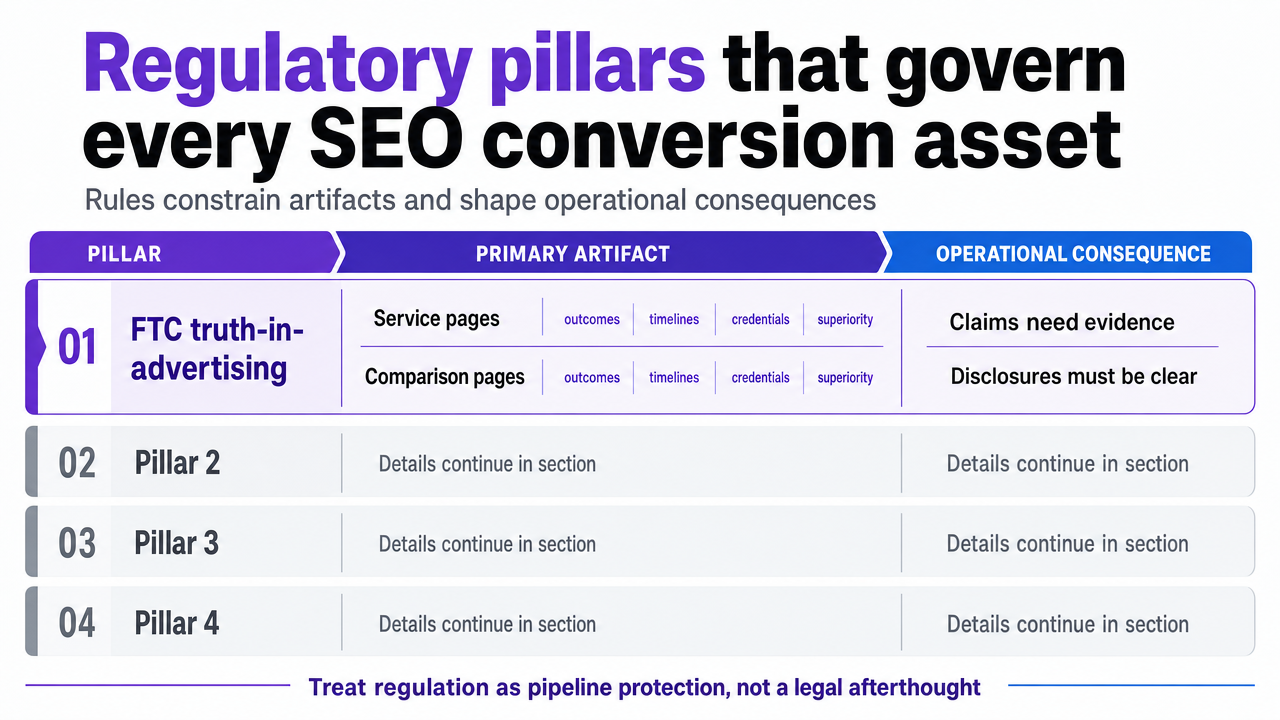
Four regulatory pillars govern the pages, widgets, and instrumentation a pipeline-grade SEO program touches every week. Each pillar constrains a specific artifact, and each artifact carries a specific operational consequence when the rule is ignored. Treating these as pipeline-protection mechanisms rather than legal afterthoughts is what keeps a program shippable at velocity.
Pillar one: FTC truth-in-advertising, applied to service and comparison pages. The baseline is that advertising must be truthful, non-deceptive, and supported by evidence, and that online disclosures must be clear and conspicuous 2. The artifact this rule governs most directly is the service page and the comparison page, where headline claims about outcomes, timelines, credentials, or superiority accumulate faster than substantiation. The operational consequence: any page carrying a comparative or outcome claim needs a substantiation record filed with the page ID before publication, and a generic footer disclaimer will not cure an unsupported headline.
Pillar two: FTC health-claim substantiation, applied to landing pages and case studies. Health-related claims generally require competent and reliable scientific evidence, and consumer experiences or testimonials do not, by themselves, substitute for that evidence 10, 11. The artifacts are conversion landing pages for health-adjacent services and case-study pages that translate outcomes into implied claims. The operational consequence: a case-study page describing a single patient outcome cannot be structured as a broader efficacy claim, and testimonial pages need material-connection disclosures placed close to the endorsement, not buried in a policy link.
Pillar three: the FTC 2024 final rule on consumer reviews and testimonials, applied to review widgets and testimonial pages. The rule, effective October 21, 2024, prohibits the sale or purchase of fake reviews, undisclosed insider testimonials, company-controlled review sites presented as independent, review suppression, and fake indicators of social-media influence, and it allows the FTC to seek civil penalties for knowing violations 15, 12. The artifacts are the review widget on the homepage, the aggregated testimonial page, and any reputation-program workflow that solicits, filters, or displays customer feedback. The operational consequence: solicitation scripts, moderation rules, and employee-review disclosures need documented policy, and any AI-assisted generation of review-adjacent copy needs an authenticity check before it ships.
Pillar four: HHS guidance on online tracking technologies, applied to the measurement stack itself. HIPAA obligations apply when tracking technologies collect or disclose information that includes protected health information, and covered entities must ensure permitted disclosures, minimum necessary use, and appropriate business associate agreements with vendors 8. The artifacts are the analytics tag, the remarketing pixel, the call-tracking script, and the form-capture instrumentation on any page that reveals a condition, treatment, or care context. The operational consequence: standard third-party pixels cannot fire indiscriminately on condition-specific service pages, and vendor selection for call intelligence, CRM enrichment, and analytics has to include a BAA review, not just a procurement review.
The through-line across the four pillars is that each one attaches to a concrete artifact a marketing team already owns. A program that maps pillar to artifact to owner turns compliance from a periodic audit into a publication checklist — and a publication checklist is what lets organic search keep producing pipeline without stopping the presses every quarter for legal review.
 Visualize the four regulatory pillars mapped to specific artifacts and operational consequences described in this section
Governing AI-assisted execution without ceding editorial control
AI-assisted production changes the throughput math for an SEO program, but it does not change who is accountable when a claim is wrong, a review is fabricated, or a testimonial implies more than the evidence supports. The governance question is not whether to use generative systems in the workflow. It is where the human sign-off sits, what the reviewer is scoring against, and what record survives after the page ships.
NIST's Generative AI Profile, NIST-AI-600-1, released July 26, 2024, organizes the answer around twelve risks and just over 200 actions organizations can take to manage them 7, 13. Translated into an SEO operating context, three controls carry most of the operational weight.
The first is source-bound generation. Drafts produced by a model are constrained to cited sources supplied in the brief, and any claim without a mapped source is flagged for the reviewer before the draft is accepted. This is the control that keeps the FTC's substantiation standard intact when velocity increases — advertising claims still need evidence, and the model does not get to invent it 2, 10.
The second is review-adjacent authenticity checks. The 2024 FTC final rule specifically addresses AI-generated reviews that misrepresent real consumer experience, and knowing violations carry civil penalties 15. Any AI-assisted copy that touches testimonials, review summaries, or reputation widgets needs a documented authenticity check before it ships.
The third is a versioned approval log. Every AI-assisted asset records the prompt, the source set, the reviewer, and the sign-off timestamp. That log is what makes the program auditable — and what lets the marketing team keep the presses running when legal or the CFO asks who approved what.
See How Leading Brands Build Predictable SEO Pipelines at Scale
Request a walkthrough of coordinated, AI-driven SEO strategy execution—without adding headcount or managing multiple vendors. Learn how enterprise teams streamline organic pipeline creation and maintain full oversight.
If you manage multiple locations: the operator economics of consolidation
The reader shifts here. A VP running organic search for a single brand at one location optimizes for asset quality and conversion depth. A VP running organic for ten, fifty, or two hundred locations — a DSO, a behavioral health group, a multi-state law firm, a home-services franchisor, a senior-living portfolio — is running a coordination problem that dwarfs the content problem. The pipeline math changes because the coordination load compounds with every location and every channel.
The traditional stack expresses that compound load as separate vendor relationships: one content agency, one SEO agency, one PPC vendor, one link-building vendor, one social team, one call-intelligence provider. Each relationship carries a retainer, a briefing cycle, an approval queue, and its own reporting cadence. The coordination cost is not the sum of the retainers. It is the sum of the retainers plus the loaded hours the internal team spends translating between them.
A defensible way to model the delta is a variable formula the VP populates with the organization's own numbers, not fabricated benchmarks. Total monthly coordination load can be expressed as (channels × per-channel retainer) + (coordination hours per cycle × approval cycles per month × loaded hourly cost). Applied across locations, the coordination term dominates the retainer term faster than most operators expect.
| Model | Vendor count | Briefing hours per cycle | Approval cycles per month | Monthly coordination load |
|---|---|---|---|---|
| Traditional multi-vendor stack | 6 (content, SEO, PPC, backlinks, social, call intelligence) | Populate: hours per channel per cycle | Populate: cycles per channel per month | (6 × retainer) + (hours × cycles × loaded hourly cost) |
| Consolidated approval-first platform | 1 | Populate: hours per unified cycle | Populate: unified cycles per month | Platform fee + (hours × cycles × loaded hourly cost), with platform pricing disclosed at $599/mo post-trial |
The formula is the point, not the number. Two structural effects tend to show up when a portfolio operator runs its own inputs:
- The coordination term shrinks non-linearly when the six vendor relationships collapse into one approval surface, because briefing hours per cycle are the variable most sensitive to consolidation.
- Cycle time compresses — the interval between a signal appearing and an approved asset shipping — which matters more than retainer arithmetic when a location's competitive set changes weekly.
The output an operator should demand from the exercise is not a promised percentage saving. It is a defensible answer to two questions a CFO will ask: how many hours of internal coordination does each channel consume this month, and what does the answer look like if the six queues become one governed queue with human sign-off preserved at every publication point. Consolidation is worth pursuing when those two answers move together.
What a VP should review weekly, monthly, and quarterly
The cadence question is not what to look at. It is what to escalate, what to accept, and what to retire. A workable rhythm splits the VP's attention across three intervals, each with a different decision output.
Weekly. The VP reviews the ranked recommendation queue produced by the strategist layer, not the underlying dashboards. The decisions are three: approve, revise, or reject. The inputs supporting each recommendation include the cluster it serves, the conversion instrument attached, the evidence log for any factual claim, and the expected pipeline contribution stated as a hypothesis. Anything touching a health, financial, legal, or safety claim, or a review or testimonial widget, arrives with the reviewer sign-off already attached — the VP is checking that the gate ran, not re-running it 10, 15.
Monthly. The VP reads the closed-loop attribution report: pipeline sourced and influenced by cluster, cost per qualified opportunity, and asset decay. The decision output is a retirement list. Clusters that failed the conversion instrument for two consecutive cycles come off the roadmap regardless of impression trend.
Quarterly. The VP audits the governance surface — the reviewer log, the AI-assisted approval records, and the measurement stack against the applicable privacy posture 1. The decision output is a documented sign-off that the operating loop is still defensible to the CFO and general counsel. That signature is what keeps organic search a forecastable line item rather than a quarterly surprise.
Frequently Asked Questions
References
- 1.Using Privacy Framework 1.1.
- 2.Advertising FAQ's: A Guide for Small Business.
- 3.Federal Trade Commission Announces Updated Advertising Guides to Combat Deceptive Reviews and Endorsements.
- 4.Using the Google™ Search Engine for Health Information.
- 5.Online Health Search Via Multidimensional Information Quality Assessment Based on Deep Language Models: Algorithm Development and Validation.
- 6.Civil Rights Division | Disability Rights Section.
- 7.Department of Commerce Announces New Guidance, Tools 270 Days Following President Biden’s Executive Order on Artificial Intelligence.
- 8.Use of Online Tracking Technologies by HIPAA Covered Entities and Business Associates.
- 9.Native Advertising: A Guide for Businesses.
- 10.Health Claims.
- 11.Health Products Compliance Guidance.
- 12.16 CFR Part 465: Trade Regulation Rule on the Use of Consumer Reviews and Testimonials: Final Rule.
- 13.AI Risk Management Framework.
- 14.Guidance on Web Accessibility and the ADA.
- 15.Federal Trade Commission Announces Final Rule Banning Fake Reviews and Testimonials.