
Key Takeaways
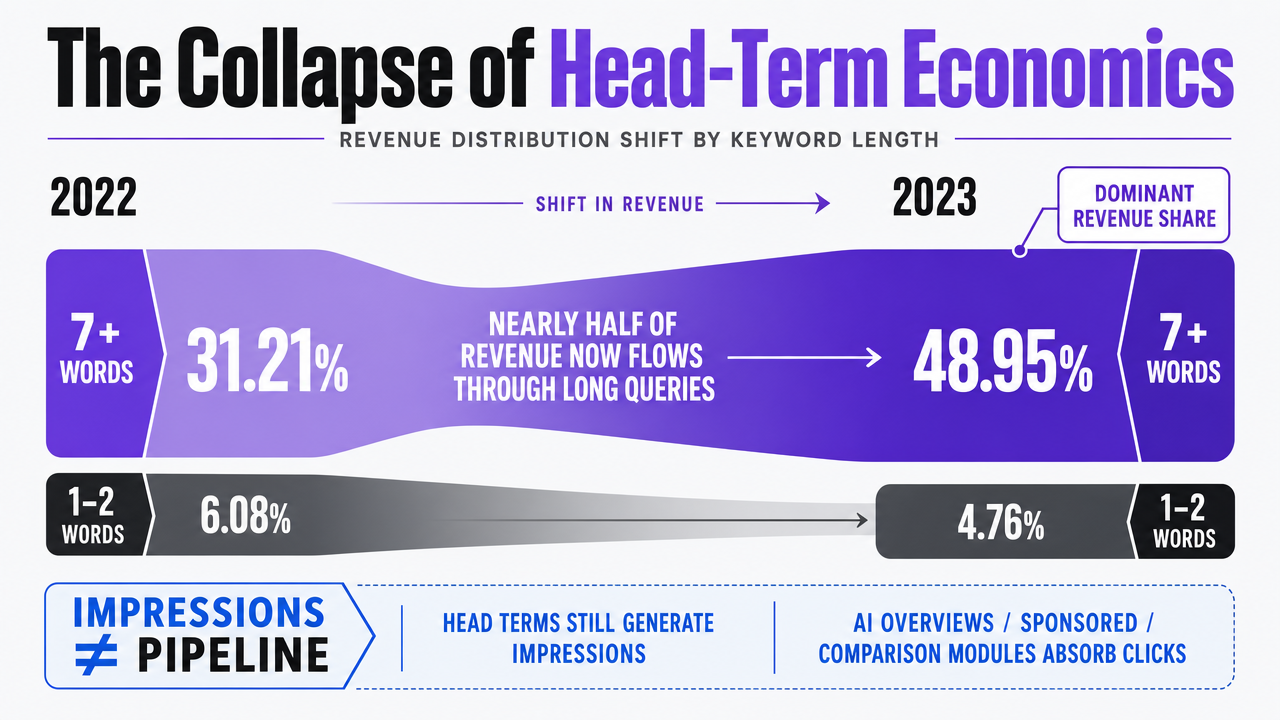
- Revenue has shifted decisively toward long queries, with 7+ word keywords growing to 48.95% of tracked revenue in 2023, making head-term-weighted calendars a losing portfolio design 1.
- Treat keyword creation as a portfolio problem across three linked disciplines—intent classification, journey mapping, and production velocity—since any one failing collapses the other two.
- Apply a five-tier intent schema (informational, associated, commercial, transactional, branded) that a junior writer or AI workflow can execute without a strategy call for each brief.
- Build query sets that mirror roughly five days of buyer behavior, since incorporating that history improves conversion-intent prediction by 8 to 15 percentage points over single-query models 2.
- Weight production capacity by expected conversion contribution per tier rather than by search volume, since long-tail terms are roughly 66% more profitable than head terms in paid data 9.
- For multi-location operators, replicate commercial and transactional pages per location while producing informational and associated content once in a shared library to avoid fragmenting authority.
- Design briefs against the full conversational query form, since average AI Mode queries run roughly three times the length of traditional searches and carry stated context and constraints 8.
- Wire each intent tier to a matching landing template so transactional queries hit conversion-first pages and informational queries route returning visitors deeper into the query sequence 12.
The Collapse of Head-Term Economics
The economics of short, high-volume keywords have quietly inverted. Between 2022 and 2023, keywords of seven or more words grew from 31.21% to 48.95% of tracked revenue, while one-to-two-word queries fell from 6.08% to 4.76% 1. Nearly half of revenue now flows through queries that most keyword tools still bury on page four of the export.
That shift is not a rounding error. It reflects a change in how buyers phrase their problems before they buy, and it exposes a portfolio design that most content teams have not updated. Head terms still generate impressions, but impressions have decoupled from pipeline. A ranking for a two-word category term now sits above AI overviews, sponsored placements, and comparison modules that absorb the click before a visitor reaches the page.
For content marketing managers reporting on organic pipeline contribution, the operational consequence is direct. A calendar weighted toward broad, competitive terms produces traffic charts that look healthy and revenue charts that do not move. The teams pulling measurable pipeline from search are rebalancing toward longer, more specific queries where intent is legible and the click still resolves to a page rather than an answer box.
The rest of this piece treats keyword creation as a portfolio problem rather than a research task. The framework covers three linked disciplines: classifying intent with a schema writers can actually apply, mapping queries to multi-day buyer journeys, and building enough production velocity to keep the portfolio staffed.
Keyword Creation as a Portfolio Problem
Why Research Frameworks Underperform Portfolio Frameworks
Most keyword workflows still resemble stock picking: identify individual terms with attractive volume-to-difficulty ratios, brief a writer, publish, repeat. The output is a list of standalone pages, each optimized against a single query. That model was defensible when search behavior was linear and one page could reasonably terminate a decision. It no longer holds.
Search now behaves as a repeat-visit hub. APAC field research using passive monitoring found that consumers return to search throughout the buying process, from initial curiosity through pre-purchase validation, rather than searching once and converting 14. A single-query, single-page model cannot capture a buyer who runs six related queries across four days before booking a consultation.
Portfolio frameworks treat keywords as a weighted set with dependencies. A commercial-intent query is worth targeting only if the informational queries that typically precede it are also covered by pages the same visitor will find later. Coverage gaps in the middle of the journey leak conversions to competitors who mapped the full sequence. The framing shift is from ranking individual terms to owning connected query paths across a buyer's decision window.
The Three Linked Disciplines: Intent, Journey, Production
A conversion-weighted portfolio rests on three disciplines that fail together when any one is neglected. Intent classification determines which queries deserve production budget. Journey mapping determines the order and adjacency of those queries. Production velocity determines whether the plan ever reaches published pages before the query landscape shifts again.
Intent classification without journey mapping produces a stack of commercial and transactional pages with nothing feeding them. Journey mapping without intent classification produces coverage for its own sake, including informational pages that rank but never hand off to a converting experience. Both disciplines fail without production velocity, since a portfolio design that requires 60 pages against a team shipping four per month is a spreadsheet, not a strategy.
McKinsey's growth research finds that companies systematically using customer behavioral data outperform peers on growth and returns 15. The relevant behavioral data for content teams is the query stream itself. The sections that follow treat each discipline in turn, starting with a classification schema built to survive being handed to a junior writer or an AI production workflow.
An Intent Classification Schema That Survives Contact With Writers
Five Intent Tiers, With Query Examples From a Real Vertical
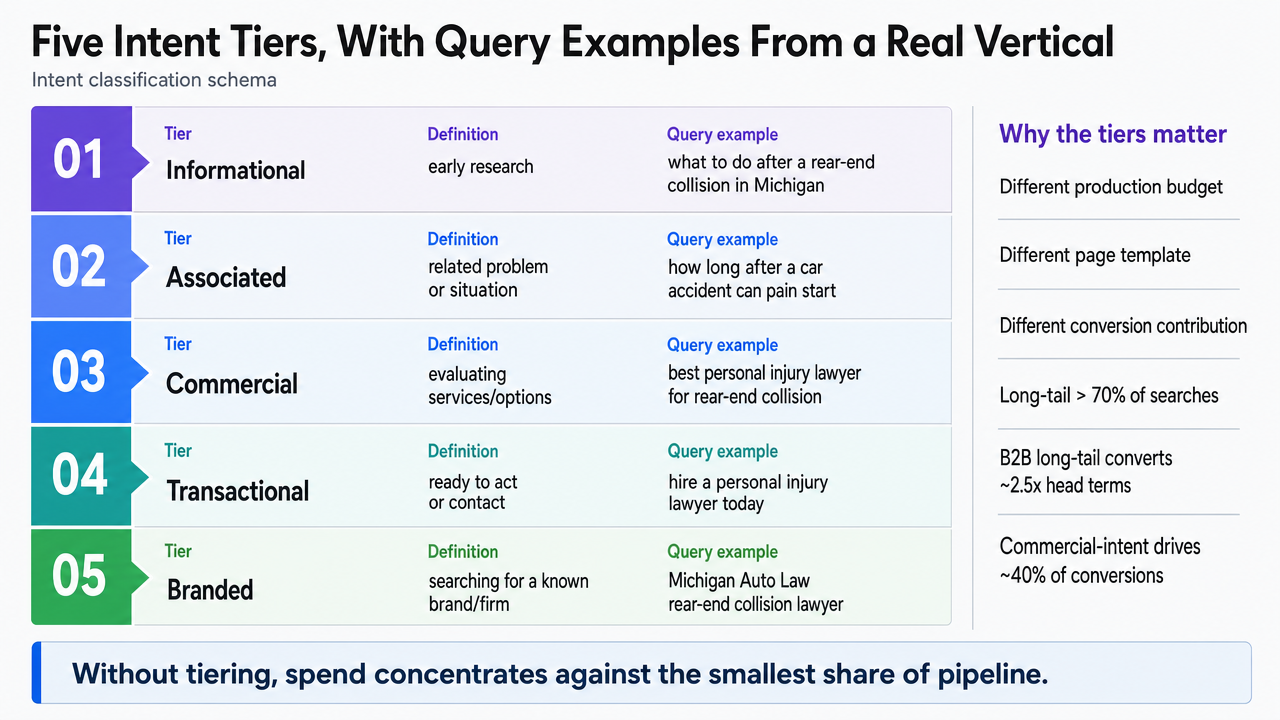
A classification schema earns its place when a junior writer or an automated production step can apply it without a strategy call. Five tiers cover the observed spectrum: informational, associated, commercial, transactional, and branded. Each carries a different production budget, page template, and expected conversion contribution.
The economics behind this structure are consistent. Long-tail queries account for over 70% of all searches 7, and in a B2B setting, long-tail terms convert roughly 2.5x better than head terms while commercial-intent keywords generate around 40% of conversions 10. A schema that ignores these tiers concentrates spend against the smallest share of pipeline.
Applied to personal injury law, the tiers separate cleanly. Informational: what to do after a rear-end collision in Michigan. Associated: how long does a car insurance investigation take, a query that names no attorney service but signals a claimant stuck in an adjacent problem. Commercial: best personal injury attorney for uninsured motorist claims. Transactional: free consultation personal injury attorney Traverse City. Branded: [firm name] settlement results.
The same structure holds for dental DSOs (informational: signs of a cracked molar; transactional: emergency dentist open Saturday near me) and home services (associated: why is my AC blowing warm air but running; transactional: same day HVAC repair 24 hour). Writers receiving a brief tagged with tier assignments know which template to pull, which internal links to include, and what conversion action the page must offer.
Associated Keywords: The Category Most Portfolios Skip
The associated tier is the one most keyword tools do not surface, and it is the one that separates conversion-weighted portfolios from ranking-weighted ones. Associated keywords are queries about adjacent problems, symptoms, or contexts that signal buying intent without naming the product or service category directly.
A peer-reviewed 2025 analysis of search conversion journeys found that incorporating roughly five days of user search history, including these adjacent queries, improved the accuracy of predicting conversion intent by 8 to 15 percentage points compared with modeling only the immediate query 2. The finding reframes associated queries from noise to signal.
For a dental DSO, bleeding gums when brushing is associated with periodontal service demand even though no clinical or commercial term appears. For a personal injury firm, how to read a settlement offer letter sits upstream of representation intent. For an HVAC operator, freon smell in house maps to emergency service demand more reliably than the head term hvac repair.
Building the associated tier requires interviewing intake staff and sales reps, mining call transcripts for the phrases prospects actually used before they identified their problem in category terms, and running those phrases back through query research tools. Most competing portfolios miss this tier entirely because standard research workflows start from the service noun, not the problem the buyer is still trying to name.
The Specificity Trap: When Longer Queries Convert Worse
Blanket advice to favor longer queries breaks in one specific case. An empirical study of branded and category keywords found that as branded queries became more specific, conversion rate per visit increased, while more specific category queries showed decreasing traffic, orders, and conversion rates 3. Specificity compounds intent when a buyer already knows the brand and is narrowing toward a decision. It fragments intent when a buyer is still exploring the category and adds modifiers that describe a use case the operator does not serve.
The operational implication is that tier 3 (commercial) and tier 4 (transactional) queries should be filtered for service-market fit before entering the portfolio. A dental DSO that does not offer sedation should not build against sedation dentistry for children with autism near me simply because it is long-tail and low-competition. The specificity that would boost conversion for an actual sedation provider actively reduces it for a mismatched one.
Writers applying the schema need a simple gate: does the operator deliver the exact service specified in the query? If not, the query belongs in the informational tier as reference content, not in the commercial tier as a conversion target.
Accelerate SEO-driven content production this week
Test-drive real-world keyword workflows and publish live SEO content before making a commitment.
Mapping Queries to Multi-Day Decision Journeys
Search as a Loop, Not a Funnel
The funnel metaphor implies a single downward pass: a buyer enters at the top, narrows through consideration, and exits at purchase. Behavioral data does not support that shape. Think with Google's EMEA research on the path to purchase notes that a single search can spark an entirely new want, sending the buyer sideways rather than forward 13. Curiosity, comparison, and validation happen in overlapping cycles, not tidy stages.
APAC field research using passive monitoring reinforces the point. When consumers begin researching something, they return to search repeatedly, comparing options and re-validating information all the way through to the decision 14. The same person may query the same product category on Monday for feature comparisons, Wednesday for pricing, and Friday for reviews before contacting a provider.
Portfolios built for a funnel deliver one page per stage and assume linear progression. Portfolios built for a loop deliver a set of interconnected pages that a returning searcher can enter at any point and still find the next relevant answer. The design question shifts from what does this keyword rank for to which four or five queries does this buyer run in sequence, and does the site show up for all of them.
Building Query Sets That Mirror Five Days of Buyer Behavior
The five-day window is not arbitrary. The Frontiers 2025 analysis of search conversion journeys found that incorporating approximately five days of user search history improved conversion-intent prediction by 8 to 15 percentage points over models using only the current query 2. Five days is roughly how long the associated, informational, and commercial queries cluster before a decision resolves.
Query set construction begins by picking a target conversion query and working backward. For a dental DSO targeting dental implant consultation [city], the preceding five-day set might include: day one, can you replace one tooth without a bridge; day two, dental implant vs bridge cost difference; day three, how long does dental implant surgery take; day four, dental implant reviews [city]; day five, the transactional query itself. Each is a separate page with a distinct template, but internal navigation and related-content modules connect them.
Two operational rules apply. First, the set must include at least one associated query, since those are the entries that most competitors miss. Second, every page in the set must reference the next likely question, either through content structure or through visible links to the adjacent pages. Query sets that fail this second rule rank in isolation and lose the returning searcher to the competitor who mapped the full sequence.
Portfolio Economics: Where Conversion Value Actually Sits
Keyword length correlates with profit in a way that reshapes portfolio budgeting. A large paid-search dataset analyzing head and long-tail terms across impressions, clicks, and conversions found a nearly monotonic increase in click-through rate, conversion rate, and conversions per 1,000 impressions as keyword length grew, with long-tail terms estimated to be roughly 66% more profitable than head terms 9. The study is PPC-based, so the absolute deltas should be treated as directional for organic work, but the shape of the curve holds across the intent tiers a content portfolio targets.
That curve has budgeting consequences. If a team allocates production capacity proportional to search volume, the calendar concentrates on head and mid-tail terms where CTR and conversion rate are lowest. Allocating proportional to expected conversion contribution flips the mix toward longer, more specific queries, even though each individual page earns fewer impressions. The trade is fewer visitors per page against a materially higher share of those visitors converting.
The B2B pipeline evidence points the same direction. Aggregated benchmarks report that SEO drives roughly 57% of B2B leads, long-tail queries convert about 2.5x better than head terms, and commercial-intent keywords generate around 40% of B2B conversions 10. These figures come from a compilation of underlying studies with varied definitions of conversion, so they read as trend-level evidence rather than precise targets. The directional signal is consistent: conversion value sits in the specific and commercial bands, not the broad and informational ones.
The practical rule for portfolio design is to weight production capacity by expected conversion contribution per tier, not by keyword volume. Head terms retain a role as topical anchors and internal-link destinations, but they should not consume the majority of writer hours in a portfolio that reports on pipeline.
If a Team Manages Multiple Locations or Practices
How Intent-Weighted Portfolios Distribute Across Location and Service Modifiers
The framework so far assumes a single-location operator. Multi-location businesses—dental DSOs with 40 practices, HVAC operators covering six metros, personal injury firms with regional offices—face a different problem. Every intent tier multiplies against every location, and every service line multiplies again on top of that. A portfolio that reads as 60 pages for one location expands to several hundred once modifiers are applied, and the production math breaks unless the team weights those modifiers deliberately.
The distribution question is where to concentrate location modifiers versus service modifiers. Transactional queries almost always carry a location modifier: emergency dentist open Saturday [city] outperforms the unmodified version because the intent is inseparable from proximity. Informational and associated queries usually do not: signs of a cracked molar reads the same in Detroit and Denver, and duplicating that page 40 times fragments authority rather than compounds it. Commercial queries sit in the middle, with location modifiers useful when service delivery is location-bound and unnecessary when it is not.
The table below shows structural distribution ratios for three multi-location verticals. It uses variables, not dollar figures, since actual page counts depend on service breadth and local competition.
| Operator Type | Locations (L) | Core Services (S) | Location-Modified Pages | Service-Only Pages |
|---|---|---|---|---|
| Dental DSO | L | S | L × (transactional + commercial subset) | Informational + associated (shared) |
| HVAC Multi-Location | L | S | L × S (transactional) | Associated symptom queries (shared) |
| Personal Injury Firm | L | S | L × S (commercial + transactional) | Informational case-type content (shared) |
The operational takeaway: informational and associated tiers should be produced once and served across locations through a shared library, while commercial and transactional tiers get replicated per location. Portfolios that invert this ratio—localizing informational content and centralizing transactional pages—waste production capacity on the tier with the lowest conversion contribution.
See How Top Brands Accelerate SEO Keyword Strategy with AI Coordination
Connect with experts to learn how enterprise teams use AI-driven workflows to generate conversion-focused SEO keywords and streamline multi-channel execution—without expanding headcount or sacrificing control.
Adapting Keyword Creation to Conversational AI Search
Query Length Is Now the Independent Variable
Think with Google APAC reports that the average AI Mode query runs roughly three times the length of a traditional search query, with users typing or speaking full sentences that include context, constraints, and preferences 8. The BCG-partnered analysis of AI-enabled search reaches the same conclusion from a different angle: buyers are no longer typing keywords but sharing situations, and search captures those situations across an ongoing loop of research and evaluation 4.
That shift changes what a keyword list is supposed to represent. A portfolio built on two-to-four-word terms cannot map to a query stream where the median entry is 12 to 18 words and contains multiple modifiers, a stated goal, and an implicit constraint. Writers briefed against short seeds produce pages that answer a phrase no one is actually searching. The correction is to model the full conversational form of each target query in the brief itself.
For a personal injury firm, the seed car accident lawyer expands to what happens if the other driver's insurance denies my claim after a rear-end accident in Michigan. The seed still guides research and page structure, but the H2s, subheads, and answer blocks are written against the conversational form. Query length has moved from a filter to apply after research to a variable to design against from the start of the brief.
Auditing Existing Pages Against Natural-Language Prompts
Search Engine Journal's synthesis of Google's AI search data recommends a direct exercise: take the top 10 pages on the site, identify each page's primary keyword, and rewrite that keyword as the natural-language prompt a person would actually use in a conversation with an AI assistant 6. The gap between the two versions is the audit finding.
The exercise produces three outcomes per page:
- Pages where the conversational rewrite matches the existing H1 and opening paragraph need no work.
- Pages where the rewrite reveals missing context—unstated location, unstated use case, unstated constraint—get a content expansion brief.
- Pages where the rewrite exposes a mismatch between the query and the service offered get downgraded from commercial to informational or removed from the portfolio entirely.
Running this audit against 10 pages a week gives a mid-sized content team a quarterly refresh cycle without displacing new production. The output is a page inventory sorted by how well each URL answers the conversational form of its target query, which is the shape of the query volume shifting into AI-mediated results.
Wiring the Portfolio to Landing Experiences
A well-classified keyword portfolio still fails at the last mile if the landing page does not answer the exact question the query implies. Google's Quality Rater Guidelines treat this alignment directly through the Needs Met scale, which evaluates how well a result satisfies the searcher's intent rather than how thoroughly it covers the topic 12. A page that ranks for a transactional query but opens with a 400-word history of the service fails Needs Met even when every keyword variant is present.
The wiring rule is one-to-one at the intent level:
- Transactional queries land on pages with the conversion action above the fold, a visible service-area confirmation, and a single primary CTA.
- Commercial queries land on comparison-structured pages that resolve the buyer's evaluation criteria before offering the CTA.
- Informational and associated queries land on educational pages whose only conversion job is to route the returning visitor toward the commercial or transactional page later in the sequence.
Google's people-first guidance reinforces the same point from the content-quality angle: pages must be built to help the specific person who asked, not to accumulate keyword coverage 11. Portfolios that share landing templates across intent tiers collapse the conversion gains the classification schema was built to produce.
Production Velocity: The Constraint That Kills Portfolio Strategies
A portfolio designed against five-day query sets across five intent tiers and three service lines generates page counts that quickly outrun a two-writer team. Classification and journey mapping are the visible disciplines. Production velocity is the one that decides whether either of them shows up in the pipeline report.
The math is unforgiving. A dental DSO with 20 locations, six service lines, and a query set of five pages per commercial target produces a backlog measured in the low thousands of URLs. A team shipping eight pages a month against that backlog finishes the initial build in roughly 20 years, by which point the query landscape has turned over several times. McKinsey's growth research finds that companies systematically using customer behavioral data outperform peers on growth and returns 15, but behavioral data only compounds when the content it informs actually ships.
Three levers move velocity without adding writers:
- Shared informational and associated libraries eliminate duplicate work across locations.
- Tier-tagged briefs let AI production workflows draft the transactional and commercial pages that follow repeatable templates, leaving human writers on the query sets where judgment matters.
- A weekly audit cadence, applied to 10 pages at a time against conversational query forms 6, keeps the existing inventory aligned with how buyers now phrase their searches.
The portfolio strategy that ships is the one that survives.
 Increase in Conversions from Google's AI Max in Search Campaigns
Increase in Conversions from Google's AI Max in Search Campaigns
Frequently Asked Questions
References
- 1.Which Keyword Types Drive Revenue?.
- 2.Search conversion journeys and the missed opportunity of associated keywords.
- 3.The effect of search query characteristics and consumer decision journey on conversion rate.
- 4.The customer-decision journey and AI search.
- 5.How AI is changing consumer search behavior – Think with Google.
- 6.Google Data Shows AI Search Users Moved Past Keywords – Your Content Hasn’t.
- 7.2024 Keyword Strategy: 2.5x Higher Conversions.
- 8.How AI Search reshapes consumer behaviour.
- 9.Head vs. Long Tail Keywords Analyzed: Impressions, Clicks, Conversions, Profitability.
- 10.130+ B2B SEO Stats | Verified & Sourced 2026.
- 11.Creating Helpful, Reliable, People-First Content.
- 12.Google's Search Quality Raters Guidelines: A Guide for SEO.
- 13.7 Ways to Win Consumers on Their Path to Purchase.
- 14.Innovative new research sheds light on Search’s role in consumer journey.
- 15.The new battleground for marketing-led growth.