
Key Takeaways
- Quality drift in portfolio keyword research stems from inconsistent scoring logic across analysts, not from missing data or tools, so agencies need a shared model that produces the same shortlist from the same inputs.
- Replace the volume-difficulty-intent triad with six inputs: popularity, competition, and specificity as pass-fail filters, then intent, content relevance, and online authority as weighted business-value scores that shift by search stage 9.
- Route every query through six gates—Discover, Score, Cluster, Brief, Publish, Measure—concentrating human approval at Score, Brief, and Publish where mistakes cannot be corrected downstream 6.
- Add a compliance gate before clustering for YMYL verticals to reject or reframe queries whose answers imply claims the client cannot substantiate under FTC health guidance 11, and block AI-generated testimonial content under the FTC reviews rule 1.
- Model the economics across traditional, hybrid, and approval-first delivery to see that FTE reduction comes from fewer briefing cycles and coordination overhead, not from removing specialist judgment.
- Enforce a seven-item publish-gate checklist covering intent match, natural query placement, citation of sourced claims, substantiation status, verified testimonials, accessibility 4, and a stamped review and retirement date.
The Quality Drift Problem in Portfolio Keyword Research
Keyword research often suffers from "quality drift" in agencies managing multiple accounts. A successful template used by a senior specialist for one client can lead to inconsistent results when applied by junior analysts across many accounts. This happens because scoring logic diverges, with some accounts overemphasizing volume while others neglect intent. This inconsistency can lead to targeting irrelevant queries.
The core issue for SEO managers overseeing numerous accounts isn't a lack of tools or data, but rather the absence of a consistent scoring system. Such a system would ensure that any specialist, or even an AI strategist operating under human supervision, produces the same prioritized keyword list from identical inputs.
Academic research supports this. A Journal of Retailing study analyzing search-query and organic-click data found that the relative importance of factors like popularity, competition, specificity, intent, content relevance, and online authority changes depending on the search stage 9. Portfolio research that uniformly prioritizes volume across all keywords and accounts overlooks this crucial finding.
This article outlines a revised workflow based on six weighted inputs, a six-gate approval process, a compliance gate for regulated industries, and the economic considerations of implementing this system across a client portfolio.
Six Scoring Inputs That Replace the Volume-Difficulty-Intent Triad
Popularity, Competition, and Specificity as Baseline Filters
Popularity, competition, and specificity are commonly tracked inputs, often referred to as volume, difficulty, and long-tail length. The first step in refining the process is to treat these as filters rather than as a primary ranking model.
Popularity measures demand over a specific period. Its role is to eliminate terms with insufficient demand. For example, a dental client's query falling below a set monthly search volume threshold would be removed before further scoring, regardless of its perceived attractiveness.
Competition assesses the difficulty of outranking existing results and acts as a feasibility check. A query dominated by national publishers with deep topical authority would be unsuitable for a local home services account, even if it has high volume. This filter prevents briefs from being written for unachievable keywords.
Specificity indicates how precisely a query defines the searcher's need. The Journal of Retailing analysis highlighted that specificity, popularity, and competition collectively influence organic outcomes 9. Therefore, all three serve as gates: a query must meet a demand floor, a feasibility ceiling, and a specificity threshold relevant to the client's existing content before advancing to business-value weighting.
Intent, Relevance, and Authority as Business-Value Weights
After clearing the baseline filters, three business-value inputs determine a query's priority: intent, content relevance, and online authority. These function as weights, not gates.
Intent categorizes queries by search stage (awareness, consideration, comparison, or purchase) and conversion path. For instance, a behavioral health query like "what is [condition]" requires different content than "admissions near me," and the scoring model should reflect this distinction.
Content relevance evaluates how well a client's existing content, products, and services align with the query's underlying need. A dental practice specializing in implants would have high relevance for implant-related queries but low relevance for orthodontic queries if they don't offer those services. Relevance is client-specific, not universal.
Online authority reflects the strength of the domain and its topical clusters around the query. This determines the client's plausible ranking ability against competitors, within the feasibility limits set by the competition filter.
The empirical basis for weighting these three by search stage comes from the Journal of Retailing study, which found that content relevance is crucial for purchase-oriented searches, while online authority is key for awareness-stage informational searches 9. This implies that a scoring model applying uniform relevance and authority weights across all queries will misallocate resources, under-investing in relevance for bottom-funnel terms and over-investing in authority for converting pages.
Agencies can address this by defining two weight profiles within the scoring model: one for awareness queries and one for purchase-intent queries. The intent classification automatically directs each shortlisted keyword to the appropriate profile. The same six inputs are used, but their coefficients differ. This allows specialists to see not just a score, but also the profile that generated it, making discrepancies between AI-generated rankings and human judgment transparent.
This approach ensures that different analysts scoring the same list will arrive at the same top twenty keywords, with clear justifications for each ranking.
Turning the Six Inputs Into a Weighted Score
A scoring model is effective only if it yields consistent results regardless of who operates it. The six inputs—popularity, competition, specificity, intent, relevance, authority—are combined into a single numeric score per query using a documented, version-controlled formula.
The process involves normalizing each input to a 0-to-1 scale using client-specific benchmarks like demand floors, feasibility ceilings, page-inventory depth, and domain authority bands. The three baseline filters (popularity, competition, specificity) result in a pass or fail. The three business-value inputs (intent, relevance, authority) are assigned weights that vary by intent profile, which are established during account setup rather than negotiated per keyword.
Two rules maintain the model's integrity. First, every scored keyword retains its input values, allowing specialists to audit rankings and challenge incorrect inputs. Second, the model version is stamped on all exports, ensuring that any ranking shifts are traceable to coefficient changes, not analyst inconsistencies.
This structure shifts the SEO manager's role from mediating individual keyword disputes to approving weight profiles at the account level, making the research process scalable and defensible across numerous clients.
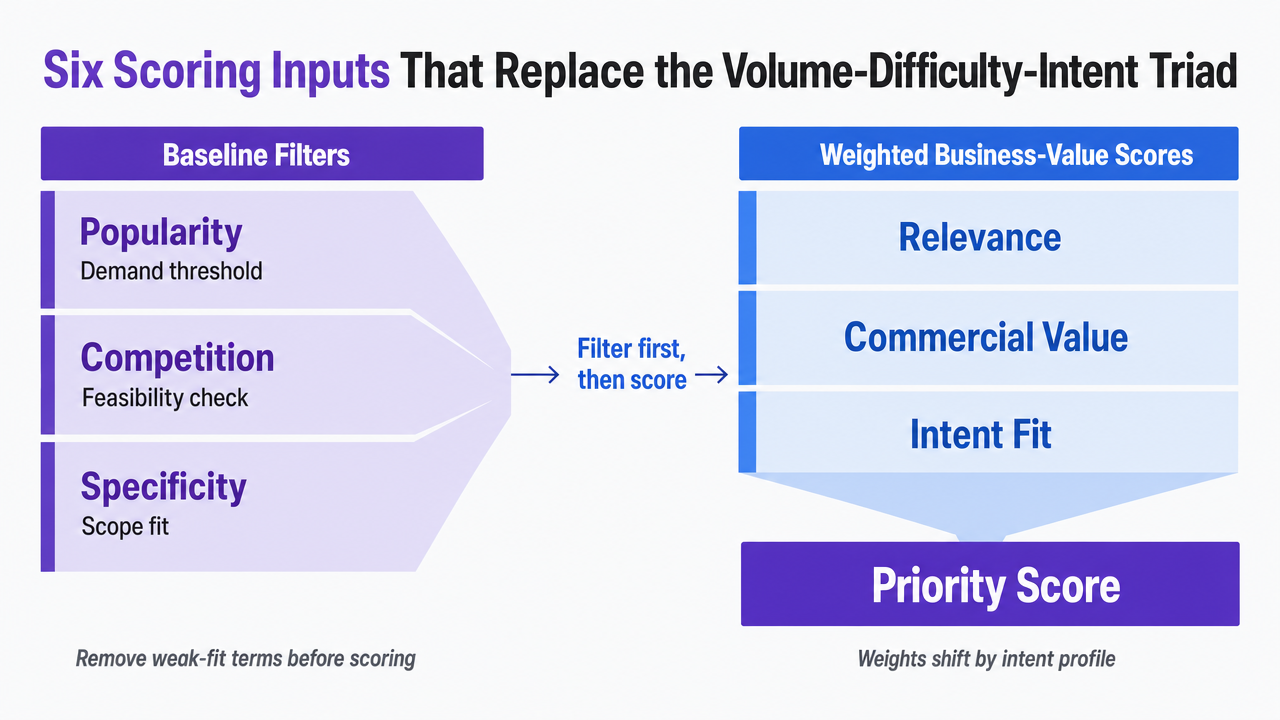 Visualize the six-input scoring framework, distinguishing baseline filters from weighted business-value scores that shift by intent profile, directly supporting the section's core framework
Test scalable keyword research workflows in real time
Run live keyword projects end-to-end and measure the impact before committing long term.
The Six-Gate Research Loop From Discovery to Retirement
Discover and Score: Where AI Drafts and a Specialist Approves
The scoring model's output is reliable only when integrated into a workflow with defined checkpoints. A query progresses through six gates: Discover, Score, Cluster, Brief, Publish, and Measure. Human approval is concentrated at three critical points—Score, Brief, and Publish—where errors cannot be easily rectified later.
NIST's AI Risk Management Framework and its Generative AI Profile (July 2024) emphasize human oversight, provenance, and documented review as essential controls for generative-AI workflows in high-stakes environments 6. This framework dictates checkpoint placement, especially for clients in regulated sectors like healthcare or legal.
The Discover phase runs autonomously. An AI strategist gathers seed queries from client data, call transcripts, competitor SERPs, and adjacency expansions, generating thousands of raw candidates weekly per account. No human review occurs at this stage due to the sheer volume.
Score is the first checkpoint. The scoring model applies the six inputs, evaluates each candidate against the client's demand floor and feasibility ceiling, and produces a ranked shortlist with visible input values. A specialist reviews the top portion, challenges any questionable inputs, and approves the shortlist for clustering.
Cluster and Brief: Preserving Intent Across Grouped Queries
Clustering consolidates the approved shortlist into groups of queries that share a common searcher need and can be addressed by a single page. A common pitfall is AI grouping based on lexical similarity, merging awareness and purchase queries that share a head term, resulting in ineffective content briefs.
The correction is to cluster based on the intent classification already assigned by the scoring model, rather than string overlap. Awareness-profile queries cluster together, and purchase-intent queries cluster separately, even if they use similar vocabulary. For example, "what are dental implants" and "dental implants near me" for a dental group belong on different pages, and the cluster gate enforces this separation before a brief is written.
Brief is the second human checkpoint. Each cluster generates a draft brief detailing the target intent, primary and supporting queries, relevant client content, and the scoring rationale. A specialist reviews the brief for intent alignment, potential internal cannibalization, and page-type suitability. Approval releases the brief for production; rejection sends it back to clustering with a specific reason to prevent recurrence.
Publish and Measure: Review Cadence and Retirement Rules
Publish is the final human checkpoint before content goes live. The specialist at this stage confirms three things: the draft matches the approved intent, all sourced claims are cited, and the page meets the QA checklist. Any failure sends the page back to production with specific flags.
Measure is where many agency workflows falter. Pages go live, rankings are tracked, but the underlying keyword decisions are rarely revisited until a client complaint. A portfolio system addresses this by assigning every published asset a review date and a retirement rule at the time of publication.
HHS content lifecycle guidance recommends annual review and evaluation for public health content, warning against the risks of outdated information 10. While this applies to federal sites, an annual review is a defensible baseline for any YMYL (Your Money Your Life) account and a useful benchmark for others. Higher-risk pages, such as those detailing medication or legal procedures, are assigned shorter review cycles at the brief gate.
Each review categorizes the asset as retain, revise, or retire. Retirement, often avoided by agencies, is crucial for portfolios. A page targeting an irrelevant query or one whose scoring inputs have fallen below threshold is removed. This protects the topical authority of remaining, relevant pages.
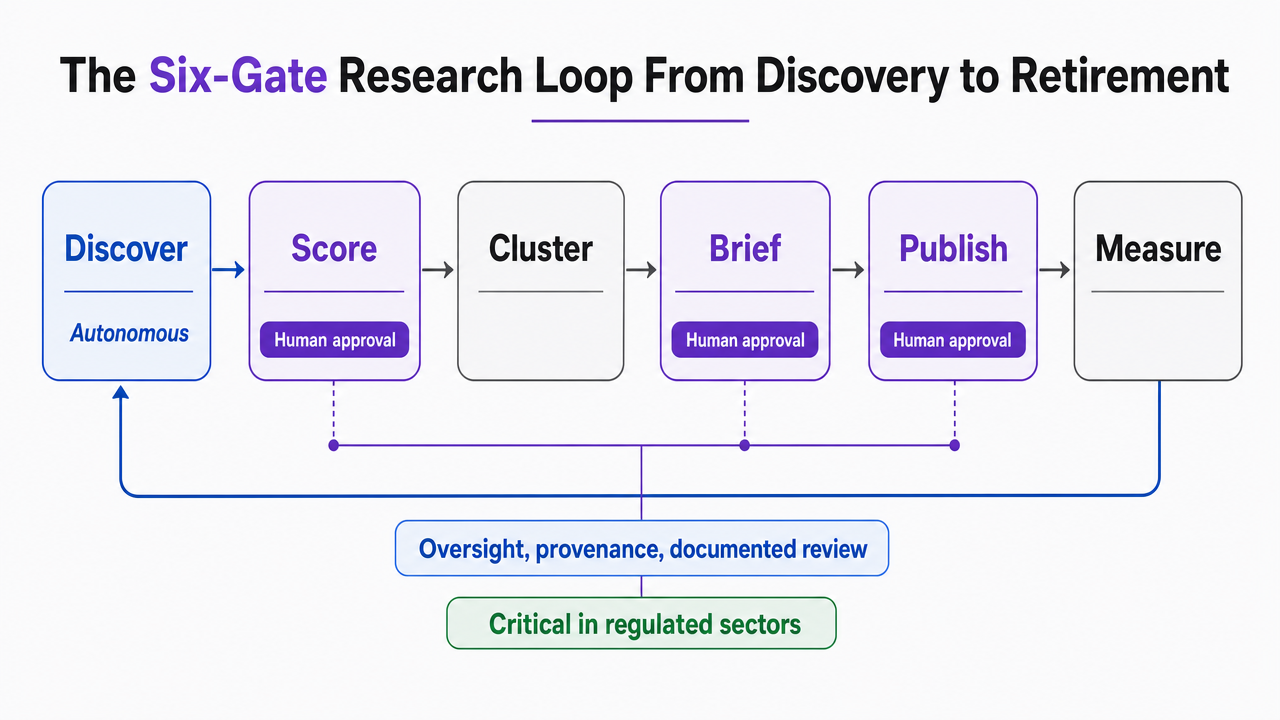 Diagram the six-gate workflow (Discover, Score, Cluster, Brief, Publish, Measure) and mark the three human approval checkpoints, mirroring the section's operating model
The Compliance Gate for YMYL Verticals
Rejecting High-Volume Queries That Trigger Substantiation Obligations
Some keywords must be rejected on legal grounds, irrespective of their scoring. Queries promising specific recovery outcomes in behavioral health, treatment effects for supplements, or procedure results in dentistry can score highly but create liability if a page attempts to fulfill the searcher's intent.
The compliance gate operates between the scoring shortlist and the clustering stage. Its function is to identify queries whose plain-language answers would require substantiation the client cannot provide, routing them for rewriting or rejection before a brief is drafted. The FTC's Health Products Compliance Guidance explicitly states that health-related claims generally require competent and reliable scientific evidence, that both express and implied messages count, and that anecdotal evidence is insufficient 11. High search volume does not grant permission to make unsubstantiated claims.
Operationally, the specialist at this gate performs three actions per candidate:
- Interprets the implied claim a satisfying page would make.
- Verifies if the client possesses or can obtain evidence meeting regulatory standards.
- If not, either reframes the target (e.g., from an efficacy claim to a service description) or rejects the query.
Rejections are logged with reasons to prevent recurrence.
This is where a portfolio system differs from single-site workflows: rejection must be as swift and defensible as approval, given the high volume of candidates.
Expert Review in Healthcare: What the DISCERN Evidence Requires
While the substantiation gate addresses what a page can claim, expert review ensures the drafted content withstands clinical scrutiny, particularly in healthcare. These are distinct checkpoints.
Evidence for a dedicated expert-review layer is compelling. A systematic review of 153 studies covering 11,785 websites found that no websites achieved an "excellent" DISCERN quality rating, with ratings ranging from good to poor 12. This indicates that, without a review layer, content published at portfolio scale in categories where independent evaluators rarely find excellent quality will likely be mediocre or poor.
The solution is to have a clinician or credentialed reviewer sign off on drafts before they reach the publish gate. This reviewer focuses on three aspects:
- Ensuring clinical claims align with current standards.
- Verifying transparent and current sourcing.
- Confirming that any implied outcome language is supported or removed.
Turnaround times and compensation are set at the account level to maintain throughput. Agencies without in-house clinical expertise should outsource this review, as the efficiency gains of the scoring model are negated by the need to retract a page due to clinical inaccuracies.
Reputation and Local Queries Under the FTC Reviews Rule
Reputation and local queries often present a direct conflict between compliance and AI-assisted content production. Terms like "[service] reviews near me" or "best [practice] in [city]" are high-converting but prone to generating content that violates FTC regulations.
The FTC's August 2024 final rule prohibits creating, selling, buying, procuring, or disseminating fake reviews, including AI-generated reviews that misrepresent nonexistent people 1. The Endorsement Guides further clarify that endorsers must have actual experience, and claims requiring proof not possessed by the advertiser are impermissible 2.
For review-intent keywords, the account playbook includes a strict rule: no AI-generated testimonial content, synthesized customer quotes, or composite reviewer voices. Pages targeting these queries must be built from verified first-party reviews with disclosed material connections, or the query should be addressed through service descriptions and comparison content that doesn't rely on testimonials.
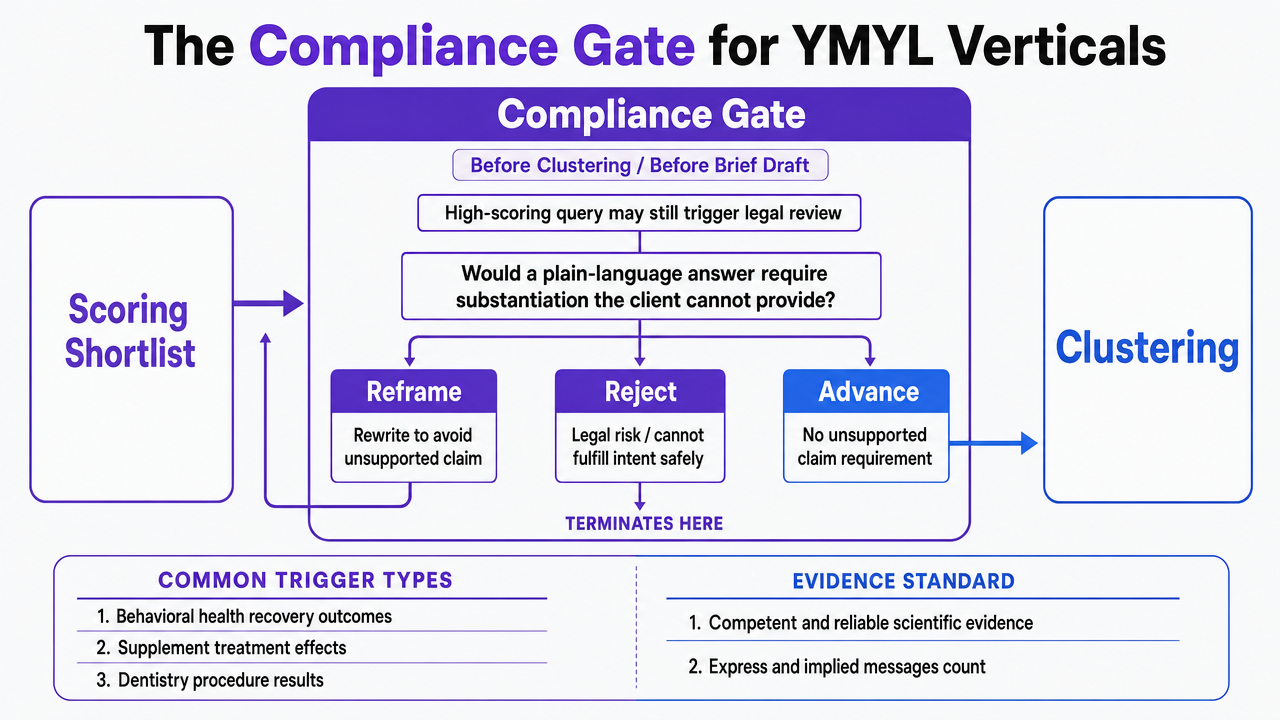 Show the decision flow at the compliance gate between scoring and clustering, illustrating the three specialist actions and outcomes (reframe, reject, advance) referenced in the section
See the Workflow Behind Scalable, Data-Driven Keyword Research
Request a walkthrough of the approval-first, AI-powered approach used by leading agencies to streamline keyword discovery, automate prioritization, and ensure strategic oversight across high-volume client portfolios.
Operator Economics: Throughput and Cost Across Three Delivery Models
The scoring model and six-gate system aim to improve throughput per specialist and reduce cost per published asset across client portfolios. These figures assume a mid-size agency with 20 clients and an SEO manager overseeing 2 to 10 specialists. Ranges are illustrative, except for platform costs which reflect publicly stated trial pricing.
Client AI readiness varies. Census BTOS data indicated that overall business AI usage remained between 17% and 20% from December 2025 to May 2026, with 20% to 23% expecting adoption in the next six months 8. This suggests a portfolio will include clients with differing AI adoption levels, requiring a flexible delivery model.
| Metric (per account, per week) | Traditional specialist-led | Hybrid AI-assisted | Approval-first AI platform |
|---|---|---|---|
| Keywords researched and scored | 50–150 | 300–800 | 1,000–000+ (unattended discovery) |
| Briefs produced | 1–3 | 3–8 | 8–15 |
| Human approval touchpoints per asset | 1–2 (informal) | 2–3 (partial) | 3 (Score, Brief, Publish) |
| Specialist FTEs per 20 accounts | 4–6 | 2–3 | 1–2 + platform |
| Platform anchor cost | n/a | Reader-supplied tool stack | $599/month after 2-week trial |
Two key economic observations emerge. First, throughput increases with discovery volume, but published asset quality depends on approval discipline, not just automation. The "approval-first" model adds touchpoints, emphasizing quality. Second, FTE reduction comes from streamlining briefing cycles and coordination, not replacing human judgment. An SEO manager who approves weight profiles and reviews shortlists at the Score gate spends less time on individual keyword debates and more on retention economics.
Cost per published asset decreases when specialists can produce more approved briefs weekly without the quality drift described earlier. This is the core efficiency target of the portfolio system.
The Publish-Gate QA Checklist Specialists Actually Run
The publish gate involves a precise, line-by-line checklist, not a general re-read. Specialists can complete this in under fifteen minutes per asset, ensuring quality and consistency. Improvisation, conversely, takes longer and often leads to missed issues.
The checklist covers seven items:
- The draft must match the approved intent profile from the Brief gate, preventing shifts in framing.
- Primary and supporting queries must appear in headings and body copy using natural language, avoiding keyword stuffing.
- All sourced claims must have citations; uncited claims are either re-sourced or removed.
- YMYL substantiation status is confirmed against the compliance-gate log, with expert-reviewer sign-off where required.
- No testimonial content is present unless derived from verified first-party reviews with disclosed material connections 2.
- Accessibility requirements, such as alternative text for images, descriptive headings, accessible forms and tables, and media captions, must be met 4.
- The review date and retirement rule are stamped on the asset before publication.
Any failure on this checklist sends the page back to production with the specific line flagged. The checklist is versioned, ensuring that any quality drift is identified through reason codes rather than appearing in traffic reports months later.
Frequently Asked Questions
References
- 1.Federal Trade Commission Announces Final Rule Banning Fake Reviews and Testimonials.
- 2.Endorsements, Influencers, and Reviews.
- 3.Guidance on Web Accessibility and the ADA.
- 4.Resources For Web Developers.
- 5.Advertising FAQ’s: A Guide for Small Business.
- 6.AI Risk Management Framework.
- 7.Health Products Compliance Guidance.
- 8.Large Firms With at Least 20 Employees Biggest AI Users.
- 9.Keyword Selection Strategies in Search Engine Optimization.
- 10.HHS Website Content Lifecycle Management and Archive Guidance.
- 11.Health Products Compliance Guidance.
- 12.Can Patients Trust Online Health Information? A Meta-Analysis of the Quality of Health Information on the Internet.