
Key Takeaways
- Roughly 70% of SEO delivery is identical across accounts, so standardize technical pipelines, schema libraries, and reporting while protecting the 30% client-specific judgment layer with approval gates.
- Audit where delivery hours actually go, then assign templated stages to a shared production layer and route expertise, substantiation, and compliance work to named account-team owners.
- Treat technical SEO and accessibility QA as automated monitoring functions with pre-publish gates covering structured data, Core Web Vitals, WCAG 2.1 AA, and internal link integrity 2.
- Standardize content briefs as production scaffolding but require named authors, cited sources, and a per-client claims register before drafting, which the FTC expects for health-related substantiation 12.
- Run local review generation through logged approval gates covering solicitation templates, incentives, insider disclosures, and AI-assisted responses to stay inside the FTC Reviews Rule 4.
- Score every link candidate on topical relevance and network position, maintain a shared prospecting database, and log acquired placements with substantiation so authority programs compound across accounts 6.
- Build one canonical event model for calls, forms, bookings, and revenue, then fork measurement for healthcare clients with server-side tagging and signed BAAs to keep PHI contained 3.
- Place AI assistance only at named stages with documented use cases, source verification, human review, and logged accountability, matching the control pattern NIST defines for generative workflows 1.
The 70/30 Split That Separates Scalable SEO from Bespoke Delivery
Agencies that cross 40 or 50 accounts without a proportional specialist count share one trait: they stop treating each engagement as a custom build. Roughly 70% of the work on any SEO account is identical to the work on every other account in the book. Crawl diagnostics, schema libraries, internal link audits, Google Business Profile hygiene, reporting pipelines, and QA checklists do not change meaningfully between a 14-location dental group and a regional personal injury firm. The remaining 30% is what actually distinguishes clients from each other: author expertise, claims substantiation, review authenticity, vertical compliance, and the specific evidence that supports a page's credibility.
Delivery teams that confuse these two layers end up rebuilding templates for every client or, worse, flattening the client-specific layer into generic output that fails under scrutiny. Both failure modes compress margin.
The operating premise of this piece is simple. Standardize the 70% ruthlessly. Isolate the 30% and protect it with approval gates, source verification, and documented accountability, which NIST frames as core controls for any AI-assisted production workflow 1. Everything that follows, from technical pipelines to review systems to measurement, maps back to that split.
Designing the Production Line: Stages, Templates, and QA Gates
Mapping Standardizable vs. Client-Specific Work Across the Portfolio
The first exercise for any delivery lead is a line-item audit of where the hours actually go. Pull three months of time entries across a representative sample of accounts, tag each entry as standardizable or client-specific, and the distribution usually resolves into a predictable shape. Technical audits, schema libraries, local profile hygiene, reporting dashboards, and QA checklists cluster on one side. Author expertise sourcing, claims substantiation, review authenticity verification, and vertical compliance review cluster on the other.
A useful way to visualize the split is a horizontal comparison of monthly delivery hours by category. Call the total monthly hours per client H. In most mid-market agency books, standardizable stages absorb roughly 0.65H to 0.75H when templated properly:
- technical crawl diagnostics (~0.15H)
- schema deployment from a maintained library (~0.08H)
- local profile management (~0.12H)
- reporting pipeline maintenance (~0.10H)
- QA gate execution (~0.15H to 0.20H)
Client-specific stages take the remaining 0.25H to 0.35H:
- expertise and byline sourcing (~0.08H)
- claims substantiation and evidence collection (~0.10H)
- review authenticity verification (~0.07H)
- vertical compliance review (~0.05H to 0.10H)
The chart matters because it reframes the staffing conversation. The question stops being "how many SEO specialists per client" and starts being "which stages belong to the shared production layer and which belong to the account team." NIST's generative AI profile reinforces this separation by requiring documented use cases, risk classification, and clear accountability for any AI-assisted output, which is exactly the boundary where templated work hands off to human-reviewed, client-specific judgment 1. Standardize the template layer. Protect the judgment layer with named owners and approval gates. The ratio is the operating model.
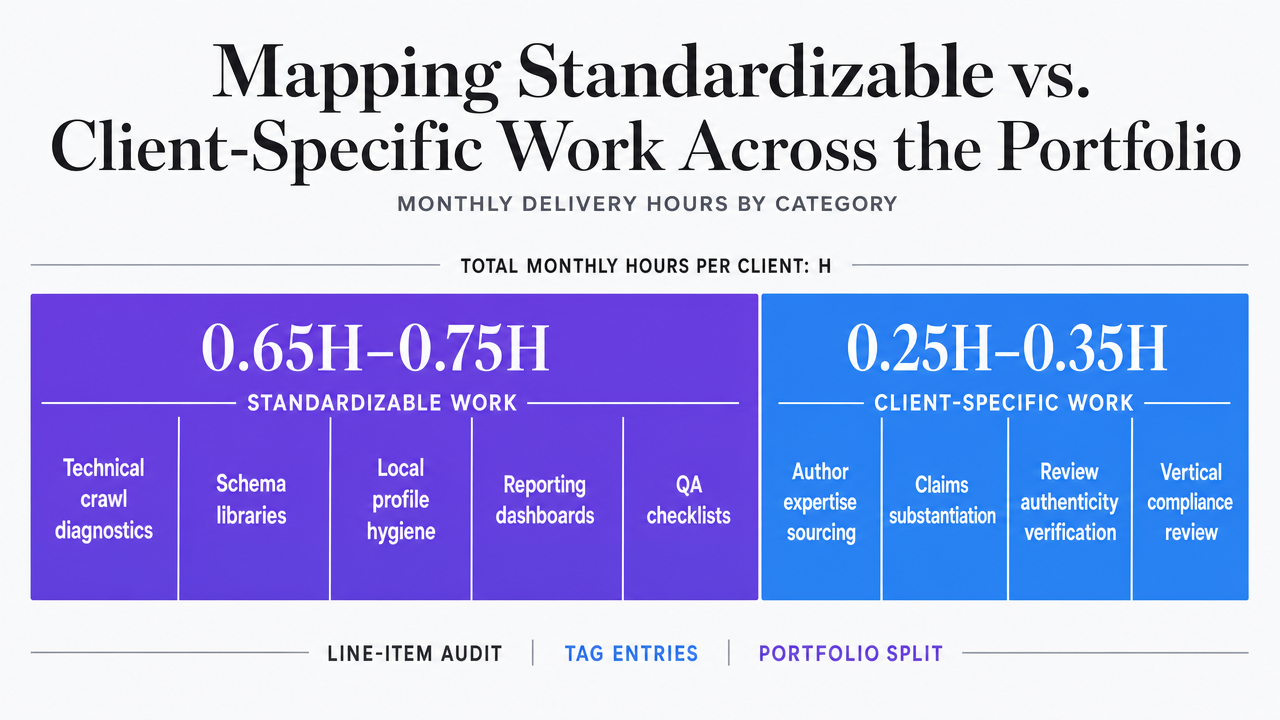 Visualize the 70/30 split of monthly delivery hours between standardizable and client-specific SEO stages, matching the hour allocations cited in the section
Technical Foundations as a Templated Layer
Technical SEO is the easiest stage to industrialize and the most expensive to leave bespoke. A single crawl configuration, a maintained schema library covering Organization, LocalBusiness, Service, FAQ, Article, and Physician or Attorney entity types, and a standardized internal linking audit should cover 90% of what any client in a service vertical needs. The crawler runs on a schedule. Diffs route into a ticket queue. A specialist reviews exceptions, not every output.
The architecture that supports this is older than most delivery leads realize. The original Stanford description of large-scale search explains why site-wide link structure and anchor text behavior have to be managed as portfolio concerns, not page-level concerns 7. Internal link graphs, orphan page detection, and redirect chain cleanup belong in an automated monitoring layer that flags deviations against a baseline, not in a quarterly manual audit that scales linearly with account count.
Three templates do most of the work:
- A crawl profile per site archetype (multi-location, single-location professional service, lead-gen funnel, content publisher) with pre-set thresholds for crawl depth, response time, and canonical consistency.
- A schema deployment library versioned in source control, with vertical-specific extensions bolted on at the account level.
- A QA checklist that runs before any publish event: canonical, hreflang if applicable, structured data validation, Core Web Vitals delta, indexability, and internal link integrity.
When these three artifacts are maintained centrally and consumed by every account team, the technical stage becomes a monitoring function instead of a labor function.
Where Accessibility QA Enters the Technical Pipeline
Accessibility belongs in the same automated QA gate as structured data and Core Web Vitals, not as a separate quarterly engagement. The DOJ's 2024 Title II rule set WCAG 2.1 Level AA as the technical standard for state and local government web content and mobile apps, with implementation deadlines tied to entity population 2. That ruling matters directly for agencies with public-sector or government-adjacent clients, and it establishes WCAG 2.1 AA as the practical reference point most legal teams now use when evaluating private-sector exposure under Title III as well 8.
Operationally, this means two additions to the pre-publish gate. An automated accessibility scan covering color contrast, text alternatives, form labeling, heading structure, and keyboard navigability runs on every new template and every content update. Failures block publish until a specialist resolves them or documents a legitimate exception. The second addition is a quarterly manual audit on a sampled page set per client, since automated tools catch roughly 30% to 40% of real WCAG failures and miss most content-level issues like ambiguous link text or inaccessible media. Build both into the standard delivery scope. Treating accessibility as an upsell is how it gets skipped on the accounts most likely to generate complaints.
Content Production at Portfolio Scale Without Flattening Expertise
Standardizing the Brief, Isolating the Evidence
The brief is where portfolio content production either scales or collapses. A shared brief template, versioned centrally, carries the structural elements every page needs regardless of client: target query cluster, search intent classification, entity coverage requirements, internal link targets, schema type, word-count band, metadata pattern, and the pre-publish QA checklist reference. These fields do not vary between a dental implant service page and a wrongful death practice page. They are production scaffolding.
What must vary, and what the brief must explicitly request from the account team, is the evidence layer:
- Named author with verifiable credentials.
- Primary sources for every factual claim.
- Jurisdiction-specific statutes or treatment protocols where relevant.
- Client-supplied case data, outcome numbers, or clinical references with substantiation attached.
The brief treats these as required inputs, not optional enrichment. A draft that arrives at the QA gate without them gets routed back before a reviewer reads a sentence.
This separation is also what makes AI-assisted drafting defensible at scale. NIST's generative AI profile frames the controls that have to wrap any assisted output: documented use cases, source verification, human review, and clear accountability 1. The standardized brief encodes the use case. The evidence layer forces source verification before drafting. The approval gate assigns accountability to a named reviewer. The template scales. The judgment does not.
YMYL Claims Substantiation Inside the Production Loop
For healthcare, behavioral health, dental, legal, and financial accounts, claims substantiation has to live inside the production workflow, not after it. The FTC requires that health-related advertising claims be supported by competent and reliable scientific evidence before dissemination, and evaluates the net impression of a page rather than individual disclaimers 12. Review processes that catch unsupported claims post-publish are already late.
The operational fix is a claims register maintained per client. Every efficacy statement, outcome figure, success rate, comparative claim, and credential reference gets logged with its supporting source, the date of substantiation, and the reviewer who approved it. Drafters pull from the register. New claims trigger a substantiation request before the draft advances. The register becomes the single source of truth that content, local profiles, FAQs, and metadata all reference, which prevents the common failure mode of a substantiated claim on the service page drifting into an unsupported variant in a GBP post or schema description.
The FTC's health claims guidance reinforces that websites and review surfaces must reflect genuine customer feedback and that substantiation applies across the full presentation, not just the headline 11. Build the register, require the citation, and the YMYL layer stops being the account that keeps the delivery lead awake.
Local SEO and Review Systems Under the FTC Rule
Local SEO at portfolio scale means running review generation, response, and syndication across dozens or hundreds of locations simultaneously. That scale is exactly what the FTC's Trade Regulation Rule on Consumer Reviews and Testimonials now regulates. The final rule took effect October 21, 2024, and prohibits creating, selling, purchasing, or disseminating fake or false reviews when the business knew or should have known they were false. AI-generated fake reviews fall squarely inside its scope, as do:
- undisclosed insider reviews
- purchased positive or negative reviews
- review suppression
- fake indicators of social-media influence 4
Knowing violations carry civil penalty exposure 5.
The operational translation is a review workflow with approval gates mapped to the prohibited practices. Solicitation templates get reviewed for incentive language that could taint authenticity. Insider reviews from employees, family, or affiliated parties require disclosed material connections before they publish, consistent with the FTC's endorsement guidance 9. Response templates get a compliance pass to confirm the agency is not suppressing negative feedback through legal threats or platform manipulation. Any AI-assisted response drafting routes through a human reviewer who confirms the response reflects actual client knowledge of the interaction.
Build the register. Log every review source, every solicitation campaign, every incentive offered, and every response approver. When a regulator or a client's general counsel asks how the agency ensures authenticity across 60 locations, the answer is the log, not a policy document.
Test AI-driven SEO execution at real scale
Experience end-to-end, publish-ready SEO workflows on your actual client accounts for one week, risk-free.
Link Acquisition as a Repeatable Authority Program
Link acquisition breaks under scale when it stays artisanal. The agencies that run authority programs across 40 or more accounts treat links as a classification problem, not a prospecting problem. Every candidate link gets scored against two axes before outreach begins: topical relevance to the client's entity graph, and the network position of the linking domain. The original PageRank work framed authority as an eigenvector of the link graph, which is a technical way of saying that a few well-connected, topically adjacent domains outweigh hundreds of unrelated ones 6. Anchor text behavior and site-wide link structure compound that effect 7.
The repeatable program has three fixed components:
- A shared prospecting database tagged by vertical, geography, and domain classification, maintained centrally and queried by account teams.
- A standardized outreach pipeline with templated angles (data assets, expert commentary, local sponsorships, resource page placements) matched to client-supplied evidence and author credentials.
- A monthly link register logging acquired placements, the substantiation behind any claims in the linked asset, and the approver who signed off.
Links that cannot be classified or substantiated do not ship. The program compounds because the database improves with every account; it does not reset per client.
Measurement Standardization on Live Business Data
A Shared Reporting Spine Across the Book of Business
Rankings and traffic are not outcomes. Qualified calls, booked appointments, submitted intake forms, and closed matters are. The reporting spine that scales across a book of business starts from a shared data model: a canonical set of events (call connected, call qualified, form submitted, appointment booked, matter opened, revenue recognized) that every account instruments the same way, regardless of vertical. Dashboards consume from that model. Account teams do not rebuild metrics per client; they map client-specific sources into the shared schema.
Three artifacts hold the spine together:
- A tagging specification that defines each event, its parameters, and its consent requirements.
- A warehouse layer where call tracking, CRM, booking systems, and site analytics land in a unified schema.
- A reporting template that renders the same executive view for every client, with vertical overlays bolted on where needed.
When these are centrally maintained, the monthly reporting cycle collapses from a per-client authoring task into a review-and-annotate task. Delivery leads see pipeline impact across the portfolio in one view, and account managers spend their time on narrative and next-month priorities rather than screenshot assembly. The spine is also what makes AI-assisted insight summaries defensible: the model reads from the same vetted data every reviewer does.
HIPAA-Safe Tracking for Healthcare and Behavioral Health Accounts
Measurement in healthcare and behavioral health is a different instrumentation problem. HHS has made clear that tracking technologies deployed on the websites and apps of covered entities and business associates can expose protected health information, and regulated entities must configure those technologies so PHI is used and disclosed only as permitted. Tracking vendors that receive PHI generally need an applicable business associate agreement 3.
Operationally, that means the shared spine forks for healthcare clients. Appointment booking flows, symptom-tagged service pages, and authenticated portal interactions get instrumented through server-side tagging with PHI stripped before any third-party vendor sees the event. Conversion events pass through a controlled proxy that logs the business outcome (booking occurred) without transmitting the clinical context that caused it. Any analytics, call tracking, or ads vendor touching the event stream must sit under a signed BAA, and the vendor inventory per client is reviewed quarterly. Remarketing audiences built from condition-adjacent page visits are turned off by default. The measurement model still rolls up into the portfolio dashboard; the raw event capture simply obeys a stricter contract before it gets there.
AI Assistance Inside a Governed Approval Loop
Adoption numbers for generative AI run far ahead of outcome numbers. Stanford's 2025 AI Index reports that 78% of surveyed organizations used AI in at least one business function in 2024, up from 55% in 2023, and that 71% of respondents using AI in marketing and sales reported revenue gains, most commonly below 5% 10. The scope matters: these are self-reported survey responses, not audited revenue attribution. The takeaway for a delivery lead is that tool adoption and client outcomes are two different variables, and the gap between them is where governance earns its keep.
Inside a scaled SEO production system, AI assistance belongs at specific stages with named controls, not sprinkled across the workflow as a general productivity layer. NIST's generative AI profile names the controls that have to wrap any assisted output: documented use cases, risk classification, source verification, human review, monitoring, incident handling, and clear accountability 1. Each of those maps to a concrete gate.
Documented use cases : The agency defines, in writing, where AI assists: first-draft outlines against the shared brief, schema generation from a maintained library, internal link candidate suggestions, QA diff summaries, reporting narrative drafts. Use cases outside the list require a change request, not a Slack message.
Source verification : Every factual claim in an assisted draft arrives with a cited source the human reviewer can open. Unsourced claims get stripped before review, not during it.
Human review : A named approver signs off on the output, with the sign-off logged against the asset.
Monitoring : Post-publish checks for drift, hallucinated citations, and claims that survived review but fail substantiation on a second pass.
Incident handling : A defined rollback path when a published asset is found to contain fabricated data.
The pattern is the same across every stage: AI drafts, humans verify, approvers sign, systems log. Adoption is the easy part. The 5% revenue outcome is what the governed loop is designed to protect.
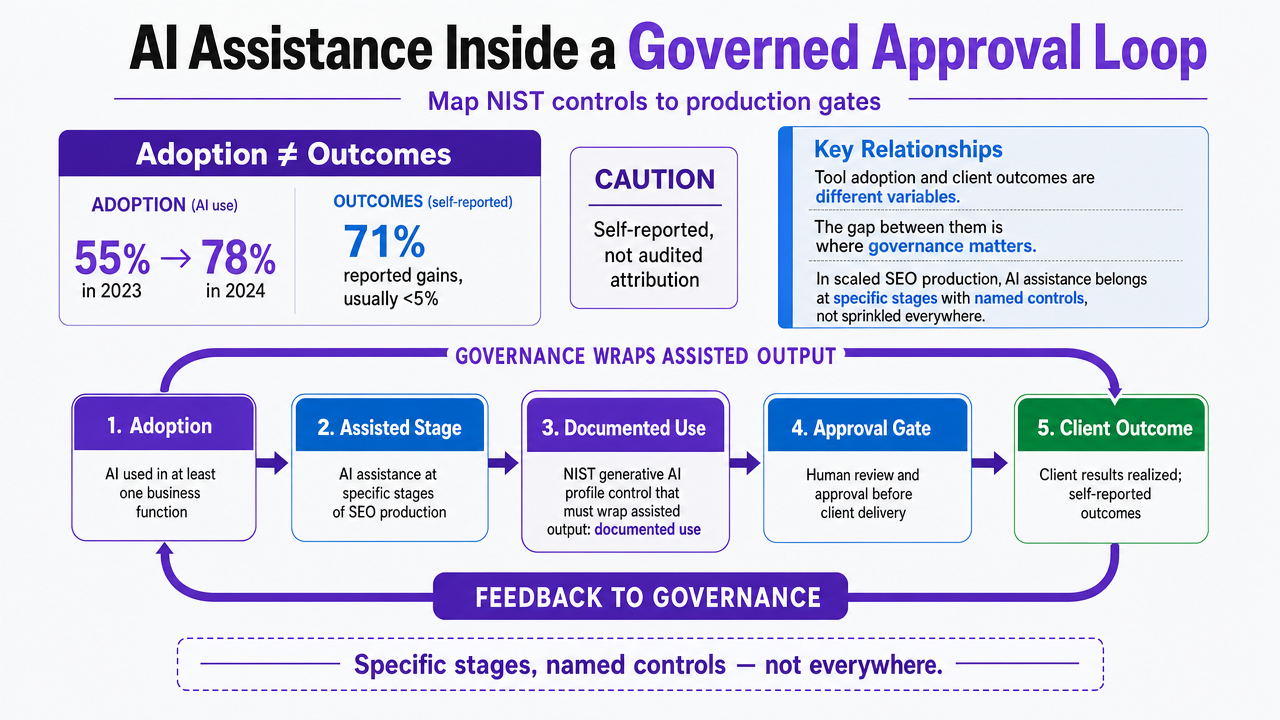 Visualize the governed AI approval loop as a process diagram mapping NIST controls to concrete production gates described in the section
See How Leading Agencies Scale SEO Execution Without Adding Headcount
Connect with our team to review proven workflows for automating multi-client SEO production—while maintaining granular approval controls and measurable quality at scale.
Two Scaling Models: Hire More Specialists or Systematize and Approve
There are two ways past the 40-account ceiling.
- Hire. Every incremental 8 to 12 accounts gets a technical SEO, a content lead, a local specialist, and a share of a measurement engineer. Headcount scales roughly linearly with revenue, utilization targets drive the staffing model, and margin compresses whenever a vertical shift forces a new hire ahead of the revenue that justifies it. Quality holds because expertise is local to the account team. The ceiling is cash, recruiting pipeline, and the manager-of-managers layer that appears around 60 to 80 heads.
- Industrialize the 70% and route the 30% through approval. Technical pipelines, schema libraries, local profile hygiene, reporting spines, and QA gates run as shared infrastructure. Account teams own evidence, substantiation, and vertical judgment. AI assists at named stages under documented use cases, source verification, human review, and logged accountability, which is the control pattern NIST describes for any generative workflow 1. Headcount decouples from account count. The ceiling moves to the quality of the approval layer and the discipline of the register.
Neither model is free. Hiring buys predictability and absorbs vertical complexity through people. Systematization buys leverage and absorbs it through controls. Delivery leads who try to run both without choosing end up paying for infrastructure and specialists simultaneously, which is the worst margin position of the three.
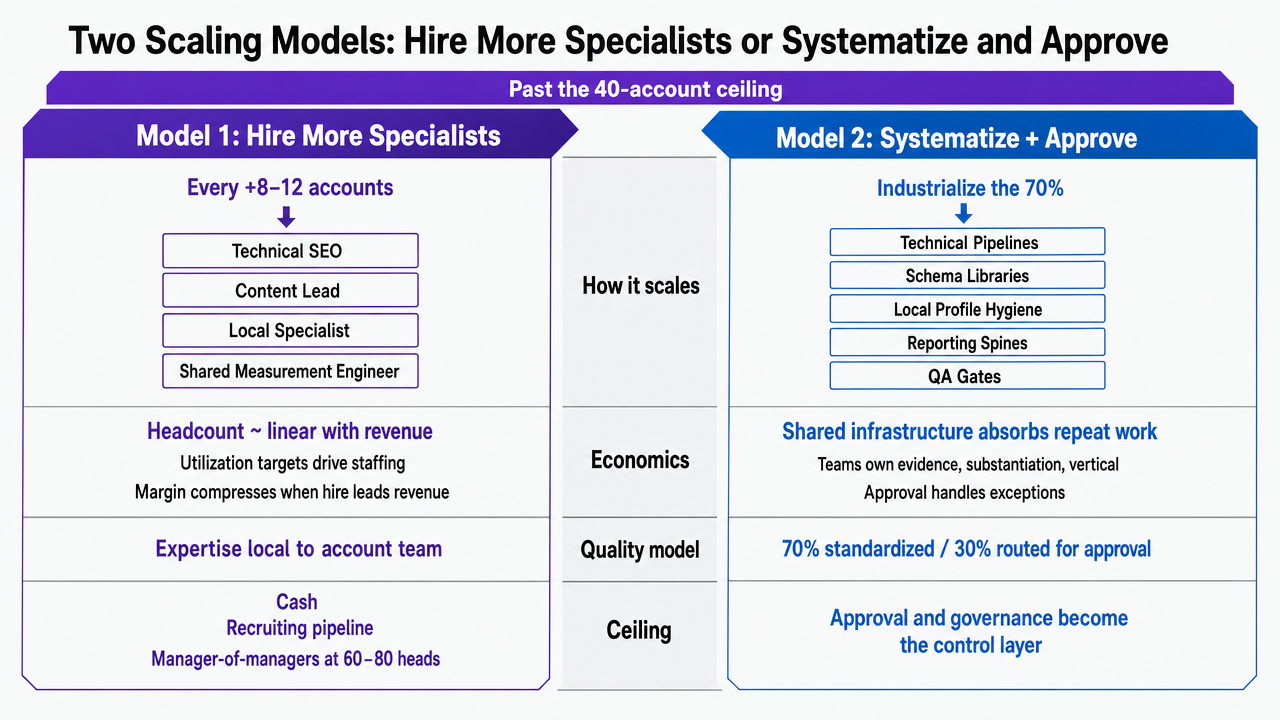 Side-by-side comparison framework contrasting the two scaling models described in the section
If You Manage a Multi-Location or Franchise Book
A quick scope marker: this section is for delivery leads whose book skews toward multi-location brands, franchise systems, DSOs, MSOs, and branch networks, where one client contract covers 20, 200, or 2,000 locations under a shared brand.
The 70/30 split tightens here. Technical templates, schema libraries, and reporting spines apply across every location without modification. What changes is the review and local-profile layer, which multiplies by location count and compounds regulatory exposure. A 180-location dental group running review solicitation across every operatory is 180 chances for an incentive template, an insider testimonial, or an AI-assisted response to drift outside the FTC Reviews Rule, which carries civil penalty exposure for knowing violations 5. The register approach is not optional at this scale. Every solicitation campaign, incentive, insider relationship, and approved response template logs centrally, with location-level sign-off attached.
Measurement forks the same way. Franchise reporting rolls up to the brand and down to the unit, which means the shared data model needs a location dimension on every event before the first dashboard renders. Build it in day one, or rebuild it at location 50.
What Changes When the Production System Works
Three things change when the 70/30 split, the registers, and the approval loop are actually running:
- Delivery capacity decouples from headcount, so adding a 50th or 70th account stops triggering a hiring cycle.
- Compliance exposure drops into a logged, auditable surface instead of living in individual specialists' heads.
- Reporting conversations move from screenshot assembly to pipeline impact, because the shared data model already renders the same view across the book.
The quieter change matters more. The approval layer becomes the product. When every published asset carries a named reviewer, a cited source, and a logged sign-off, the agency sells governance, not hours. That is the model Vectoron is built around, and it is the one that holds past 40 accounts without compressing margin.
Frequently Asked Questions
References
- 1.Artificial Intelligence Risk Management Framework: Generative Artificial Intelligence Profile.
- 2.Fact Sheet: New Rule on the Accessibility of Web Content and Mobile Apps Provided by State and Local Governments.
- 3.Use of Online Tracking Technologies by HIPAA Covered Entities and Business Associates.
- 4.16 CFR Part 465: Trade Regulation Rule on the Use of Consumer Reviews and Testimonials (Final Rule).
- 5.The Consumer Reviews and Testimonials Rule: Questions and Answers.
- 6.Link Analysis, Eigenvectors and Stability.
- 7.The Anatomy of a Large-Scale Hypertextual Web Search Engine.
- 8.Guidance on Web Accessibility and the ADA.
- 9.Advertisement Endorsements.
- 10.Economy | The 2025 AI Index Report | Stanford HAI.
- 11.Health Claims - Federal Trade Commission.
- 12.Health Products Compliance Guidance.