
Key Takeaways
- Treat Google Search Console as a weekly intelligence feed, exporting 28-day query data at positions 5-20 and cross-referencing the CRM to build refresh, new-page, and metadata-fix lists.
- Enforce retrieval discipline on every page by placing primary keywords within the first 65 characters of the title and the opening two sentences, avoiding stuffing that degrades indexing 2, 4.
- Run a monthly technical audit against Google's published Core Web Vitals thresholds—LCP under 2.5s, INP under 200ms, CLS under 0.1—using field data from Search Console and CrUX, not synthetic scores 6.
- Defend the program above the marketing line with weekly dashboards, monthly revenue attribution mapped to CRM pipeline stages, and annual reviews that place organic cost per lead beside paid 8.
- Score each of the four loops against agency, in-house, and hybrid models rather than picking a column, since ROI varies by company size, vertical, and internal team maturity 13.
- For multi-location operators, retainer and pure-hire math both break at scale; internal ownership of strategy and reporting paired with automated capacity for volume loops fits the portfolio 13.
- Use AI assistively, not autonomously: let it draft shortlists, retrieval-aligned page artifacts, engineering tickets, and reports, while humans hold approval and prioritization judgment.
SEO Has Become an Operating System, Not a Vendor Line Item
The retainer model is losing its grip on how organic growth actually gets produced. Search engine optimization is no longer a deliverable a vendor ships each month; it is a set of continuous internal loops that a marketing team runs against live signals from Search Console, its content management system, and its revenue data. Marketing leaders who still frame the question as "which agency should own SEO" are asking a 2018 question in a 2026 market.
Recent comparison research on agency, in-house, and hybrid models finds that many organizations are moving toward hybrid structures that combine internal strategic ownership with selective external support, and that returns vary sharply by company size, vertical, and the maturity of the internal team 13. Translation for the VP of marketing: the retainer is no longer the default, and the ROI case for any resourcing model depends on what the internal operating rhythm looks like.
That operating rhythm has four moving parts. Demand sensing reads what buyers actually search. Content production converts intent into pages that retrieve well. Technical health protects the pages from being throttled by performance issues Google publicly measures. Stakeholder reporting keeps the program funded and visible above the marketing line 8. Each loop has measurable thresholds, named tools, and a cadence a small team can hold without adding headcount. The rest of this piece describes how to run them.
The Four Internal Loops That Replace Agency Deliverables
Agency retainers bundle four distinct workstreams into one invoice, which is why they feel indispensable until a marketing team decomposes them. Once separated, each becomes a loop with its own inputs, tools, cadence, and success signal. A small in-house team can run all four in parallel when the loops feed a single prioritization queue rather than four disconnected backlogs.
- Demand sensing pulls query and impression data from Search Console and revenue signals from the CRM to identify which intents deserve pages this quarter.
- Content production converts those ranked intents into published assets, governed by discoverability rules on titles, opening copy, and keyword placement.
- Technical health monitors crawl coverage, indexing, structured data, and Core Web Vitals so publishing effort is not throttled by performance debt.
- Stakeholder reporting translates loop output into revenue language the CFO and CEO already use.
The 2026 comparison research on resourcing models finds that many organizations now combine internal strategic ownership with selective external support, and that ROI varies by company size, vertical, and internal team maturity 13. That finding matters here because the four loops are what internal ownership actually consists of. External help, when used, plugs into a specific loop, such as a specialist audit for technical health, rather than replacing the operating system. The next four sections take each loop in turn.
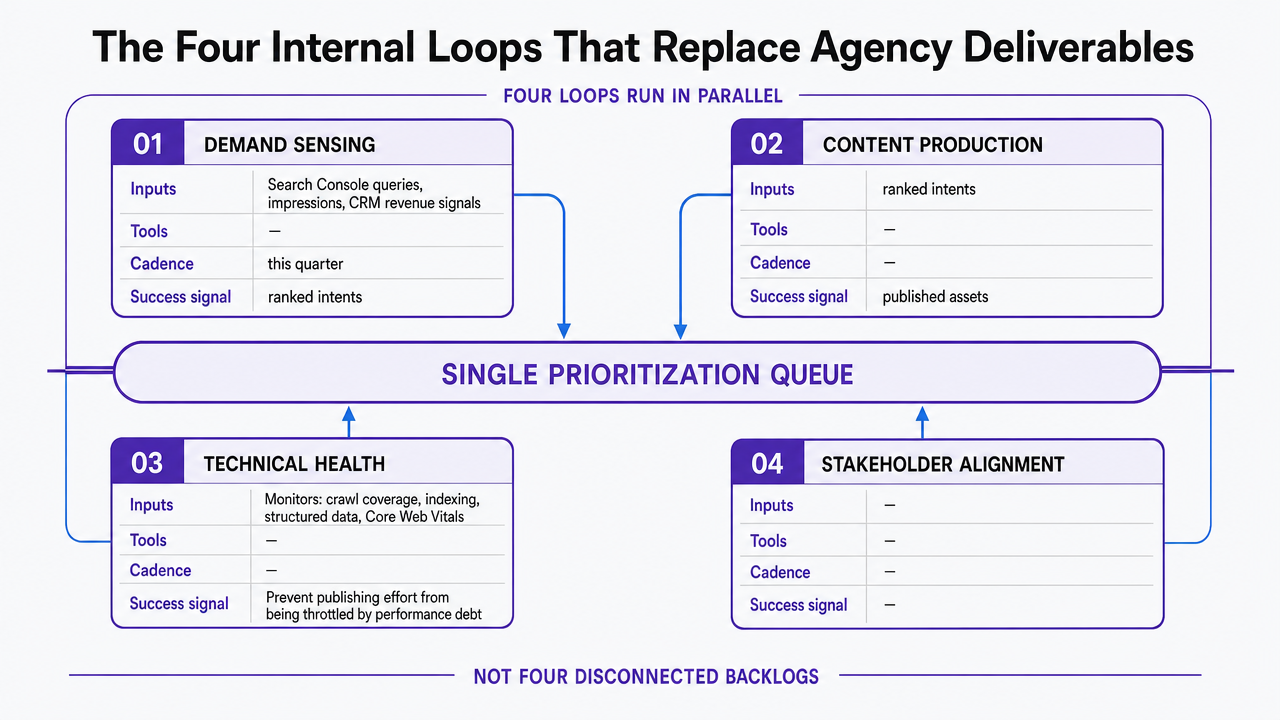 Visualize the four internal loops framework that structures the entire article as an operating model
Demand Sensing: Turning Search Console Into a Weekly Intelligence Feed
Demand sensing starts by treating Google Search Console as a weekly intelligence feed rather than a quarterly reporting tool. The Performance report already contains the queries a site earns impressions against, the pages those queries land on, and the click-through gap between the two. Marketing leaders who set a recurring thirty-minute review on the same day each week convert that raw feed into a ranked list of intents worth publishing against.
The mechanics are straightforward. Export the last 28 days of queries filtered to positions 5 through 20. Those are the intents Google already associates with the domain but does not yet reward with top placement. Cross-reference the list with the CRM to flag which queries touch pages that produced qualified leads, demos, or booked calls in the same window. The intersection is the shortlist: intents with existing authority and demonstrated revenue proximity.
Two additional filters sharpen the queue. First, queries with high impressions but click-through rates below the domain average signal a title or meta description problem, not a content gap, and belong in a separate optimization backlog. Second, queries returning pages older than twelve months should be tagged for refresh rather than net-new production, because refreshing an existing URL typically compounds authority faster than launching a competing one.
Practitioner guidance on in-house programs emphasizes drawing a visible line from organic traffic to revenue and running weekly, monthly, and annual reporting cadences that keep the function aligned with company strategy 8. The weekly demand-sensing review is where that line gets drawn at the query level. It produces three artifacts every seven days:
- a refresh list,
- a new-page list, and
- a metadata-fix list.
Those three lists become the input for content production, which is what the next loop consumes. Without this feed, an in-house team ends up publishing on instinct and defending the program on vibes—both of which agencies happily sell against.
Test AI-driven SEO execution hands-on this week
See your content published and tracked live in your own channels before making a commitment.
Content Production Built Around Retrieval, Not Word Counts
Title and Opening Discipline Against Measured Thresholds
Content production breaks down when teams optimize for length instead of retrieval. Word counts do not determine whether a page ranks; the placement of primary terms in the title, the opening copy, and the metadata does. Two thresholds should govern every published asset before anyone debates the body.
The first threshold is title length. Guidance on writing for search retrieval recommends placing the most important one to two keywords within the first 65 characters of the title 2. That character budget is not arbitrary. Practitioner-facing guidance on title construction notes that some search engines display only the first six to seven words of a title in results snippets, which means primary terms placed after the seventh word are effectively invisible to a scanning searcher 3. An in-house team that adopts this rule can strip the guesswork out of headline drafting: the primary intent term lives in words one through four, the qualifier lives in words five through seven, and any brand or modifier sits after the visible cutoff.
The second threshold governs the opening. The same retrieval framework advises using the first two sentences of the abstract, or in a landing-page context, the first two sentences of the page introduction, to carry the target keywords in readable phrasing 2. Those two sentences are what appears in featured-snippet extractions and what algorithms weight most heavily when scoring topical relevance against a query.
Both thresholds come with a guardrail. Practitioner SEO guidance explicitly warns that keyword stuffing produces poorer indexing outcomes, not better ones, because search engines discount pages that repeat terms without contextual variation 4. The discipline is placement, not density. A marketing team that enforces these two rules on every published page removes the most common reason in-house content underperforms agency output: not effort, but structural inattention to where terms sit.
The Title-Abstract-Keyword Triangle Applied to Landing Pages
The title-abstract-keyword triangle originates in scientific publishing but transfers directly to commercial landing pages. Research on discoverability describes the title, abstract, and keyword list as a compact, miniaturized representation of the underlying content, and argues that retrieval performance depends on how coherently those three elements represent the same intent 5. Applied to a landing page, that means the H1, the opening two sentences, and the metadata must describe the same page to the same audience using the same terms.
Most in-house content fails this test not because writers are careless but because the three elements are drafted by different people at different times. The H1 comes from a content brief. The opening paragraph comes from a subject matter expert. The meta title and description come from whoever publishes the page in the CMS. Three drafts, three vocabularies, one page that reads inconsistently to a crawler.
The fix is a single production template that forces the three elements to be written together and reviewed as a unit. Guidance on maximizing discoverability recommends placing the most common and important key terms at the beginning of the abstract in readable phrases likely to match how searchers actually query 1. For a landing page, that translates to a template row that shows the H1, the first two sentences, and the meta title side by side, with the primary term highlighted in each. Any draft where the three elements do not share the primary term gets rejected before it reaches development review.
This template does two things a content agency retainer typically does not. It compresses the QA cycle to a single artifact, and it makes retrieval alignment a visible pass/fail check rather than a subjective editorial judgment. Small teams can enforce it without adding headcount because the check takes under two minutes per page.
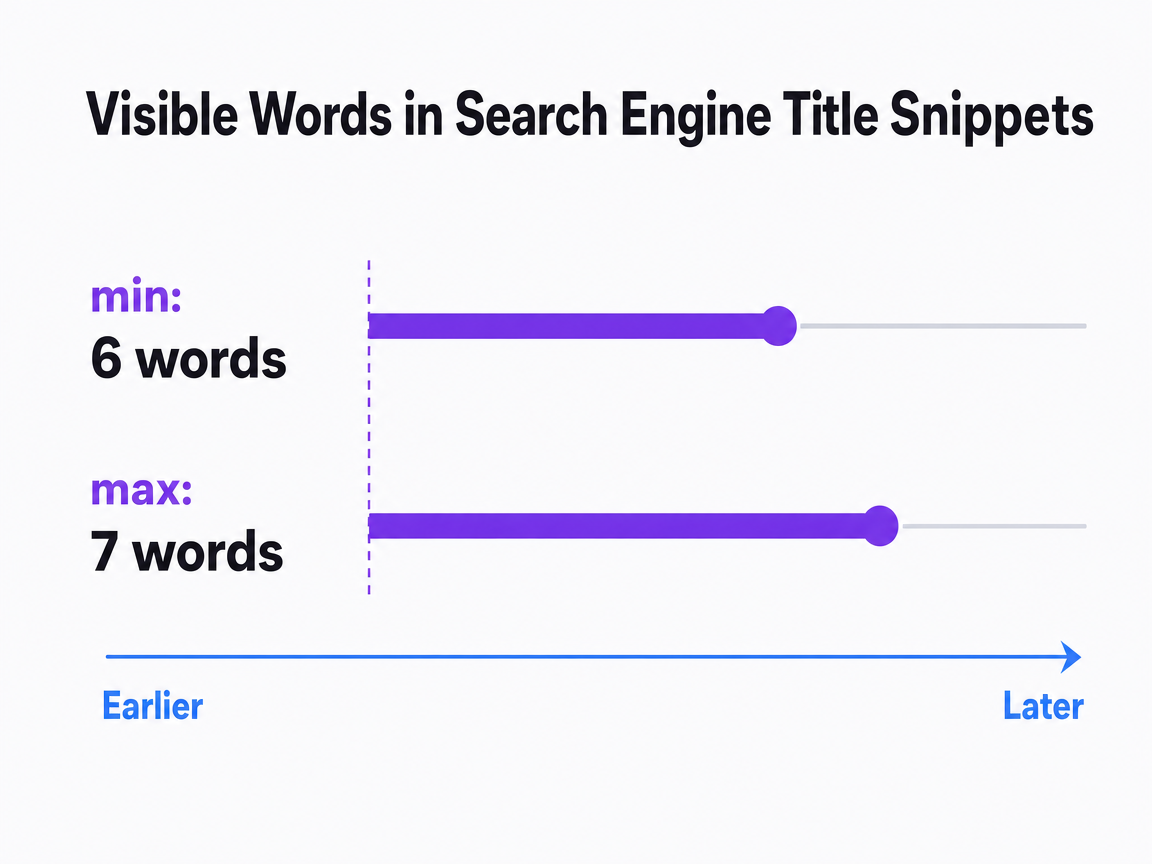 Visible Words in Search Engine Title Snippets
Some search engines may only display the first 6 to 7 words of a title in search results, highlighting the importance of placing key terms at the beginning.
Technical Health: The In-House Audit Cadence
Technical health is where in-house programs most often stall, because the work sits between marketing and engineering and belongs fully to neither. A monthly audit cadence, owned by marketing but executed with a named developer partner, closes that gap without an agency in the middle.
Google Search Central defines three field-measured user experience benchmarks that the audit should treat as non-negotiable:
- Largest Contentful Paint under 2.5 seconds,
- Interaction to Next Paint under 200 milliseconds, and
- Cumulative Layout Shift under 0.1 6.
Those are the "Good" bands. Anything above triggers "Needs Improvement" or "Poor" categorization, and the field data that Google itself uses to rank the site's user experience comes from the Chrome User Experience Report, not from synthetic Lighthouse scores run in a browser tab.
The monthly workflow has four checkpoints:
- Pull the Core Web Vitals report in Search Console and segment by mobile and desktop, because mobile field data drives most rankings and typically fails first.
- Take the URLs flagged "Needs Improvement" or "Poor" into PageSpeed Insights to see field data alongside lab diagnostics, then use Chrome DevTools to isolate the render-blocking resources, unoptimized images, or layout shifts producing the score 9.
- Review the Index Coverage report for crawl errors, soft 404s, and canonical conflicts, which throttle the same publishing effort that content production is generating each week.
- Validate structured data on high-value templates so review, FAQ, and product schema still parse cleanly after any CMS release.
The published checklists agree on the field-data emphasis and the tooling stack. Practitioner audits recommend memorizing the LCP, INP, and CLS thresholds and letting Search Console and CrUX drive the priority list rather than synthetic scores 10. Consolidated 2026 checklists reinforce the same tooling combination—Search Console, PageSpeed Insights, real-user monitoring, and Lighthouse—for teams collaborating without an agency intermediary 12. Vendor-neutral references add the standard remediation menu: image optimization, code minification, CDN routing, and script deferment, most of which developers can ship inside a normal sprint once marketing files the ticket with the offending URL and the specific metric attached 11.
The output of the monthly audit is a single artifact: a ranked ticket list with URL, failing metric, field-data score, and suggested fix, handed to engineering with the next release window attached. That artifact is what a technical SEO retainer typically produces on a quarterly cadence at a much higher price point. An in-house team producing it monthly, against the same public thresholds Google publishes, is doing the same work with a tighter feedback loop.
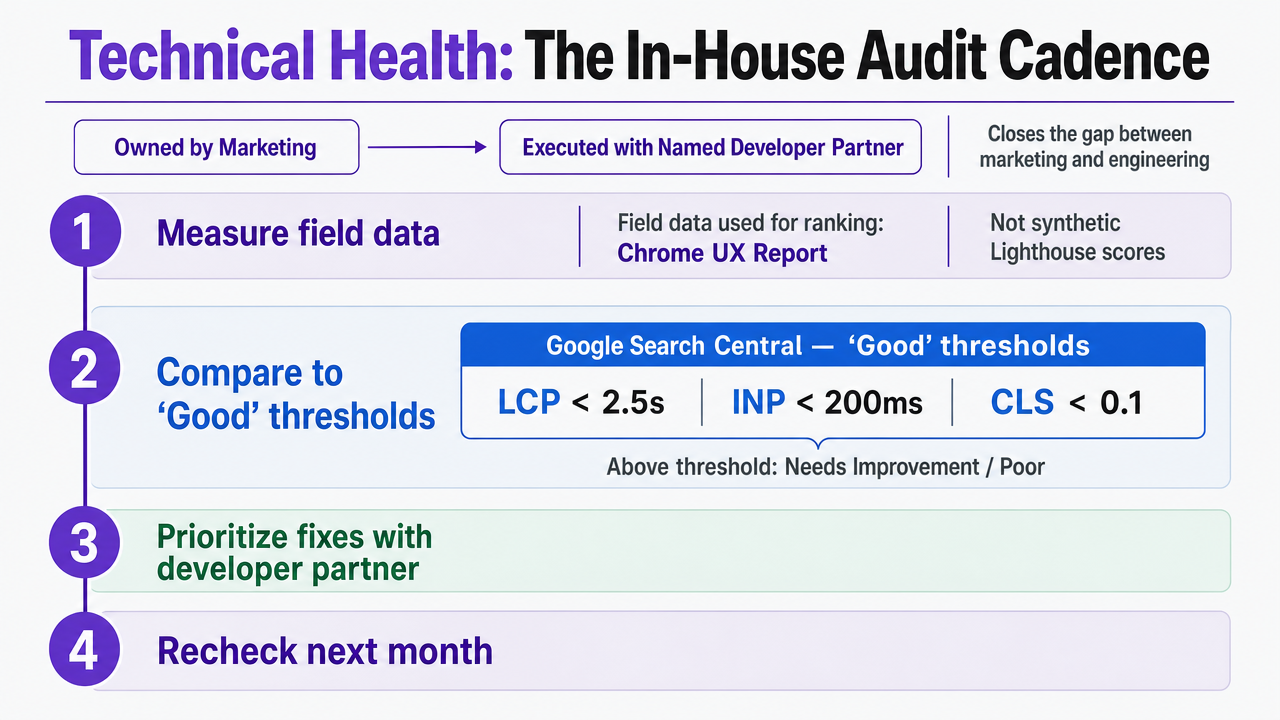 Show the four monthly audit checkpoints with Google's published Core Web Vitals thresholds cited in the prose
Stakeholder Reporting: Defending the Program Above the Marketing Line
Organic programs die in budget reviews, not in Search Console. A VP of marketing who cannot show a visible line from organic sessions to booked revenue will lose the line item the first time the CFO looks for savings, regardless of how well the first three loops are running.
Practitioner guidance on in-house programs defines a strong SEO business case as one that draws a direct line from organic traffic to revenue, with clear success criteria and named resourcing needs, delivered on a weekly, monthly, and annual cadence that matches how the rest of the company already plans 8. The cadence matters as much as the numbers. Weekly reports keep the content and technical loops accountable inside marketing. Monthly reports land in the leadership meeting where budget decisions get made. Annual reports set the resourcing baseline for the next planning cycle.
Three artifacts do most of the work:
- A weekly one-page dashboard tracks published pages, refreshed pages, technical tickets shipped, and query-level movement on the demand-sensing shortlist.
- A monthly revenue attribution view maps organic sessions to pipeline stages already tracked in the CRM, using the same source and medium definitions finance uses for paid channels.
- An annual review compares the year's investment against sourced pipeline and closed revenue, with cost per organic lead sitting next to cost per paid lead in the same table.
Internal advocacy is the other half of the job. Guidance from experienced in-house SEO leaders emphasizes securing key stakeholders early and teaching adjacent teams enough SEO to defend the work when marketing is not in the room 7. That means the product manager understands why a canonical tag matters before a release, the sales director can name the top five commercial queries the site ranks for, and the CEO sees organic revenue in the same slide as paid revenue every month. Programs that stay invisible to executives get cut when budgets tighten. Programs the CFO can trace to pipeline get funded through downturns.
Achieve Scalable SEO Performance Without Traditional Agency Overhead
See how enterprise marketing teams and agencies use AI-driven workflows to deliver measurable SEO results—reducing manual oversight, eliminating vendor coordination, and accelerating pipeline impact. Request a data-backed walkthrough tailored to high-stakes, multi-location needs.
Resourcing the Function: Retainer, Hire, or Hybrid
A Comparison Table Marketing Leaders Can Fill In
The retainer-versus-hire debate collapses once the four loops are named. Each resourcing model handles the loops differently, and the choice is less about ideology than about which loops a marketing team can already staff internally and which ones need help.
The 2026 comparison research on resourcing models reports that many organizations are moving toward hybrid structures that combine in-house strategic ownership with selective external support, and that ROI varies by company size, vertical, and the maturity of the internal team 13. The implication is that no single model wins on paper. What wins is a resourcing choice that maps to the specific loop capacity a marketing team already has.
The table below gives marketing leaders a structure to fill in with their own figures. It leaves cost as a variable because sourced benchmarks for retainer pricing, in-house salary loads, and platform fees vary too widely to reproduce responsibly here.
| Variable | Agency Retainer | In-House Hire | Hybrid / AI-Augmented |
|---|---|---|---|
| Monthly cost | $___ retainer | $_ loaded salary | $___ platform + selective spend |
| Execution speed | Briefing cycle bound | Sprint-bound | Approval-queue bound |
| Oversight and control | Vendor SLA | Direct management | Human approval per action |
| Channel coverage | Scoped to contract | Scoped to headcount | Scoped to configured loops |
The exercise a VP of marketing should run is not picking a column. It is scoring each of the four loops—demand sensing, content production, technical health, stakeholder reporting—against the three models and letting the pattern emerge. Most mid-market teams find that stakeholder reporting and demand sensing must stay internal to protect institutional context, while technical health and production volume are the loops where external or automated capacity earns its keep.
If a Marketing Leader Runs Multiple Locations
The calculus shifts for VPs overseeing multi-location operators—DSOs, law firm networks, home services franchises, senior living portfolios. Location count multiplies every loop. Fifty pages of local content become five hundred. One Core Web Vitals audit becomes one per template across dozens of subdomains or location directories. One monthly stakeholder report becomes one per regional operator plus a rollup for corporate.
At that scale, the retainer math breaks first. Agencies typically price by scope, and location-multiplied scope crosses the point where retainers exceed the loaded cost of a small internal team plus tooling. The hire math breaks second, because a two-person in-house team cannot manually run the content and technical loops across fifty locations without a production system underneath them.
The hybrid pattern in the 2026 comparison research fits multi-location operators most cleanly: internal ownership of strategy, demand sensing, and stakeholder reporting, paired with automated or externally augmented capacity for the volume loops 13. The operational test is whether each location gets the same title-and-opening discipline, the same monthly technical audit, and the same query-level demand review that a single-location site would receive. If the answer is no at any location, the resourcing model is not yet correct for the portfolio.
Running the Four Loops With a Small Team and AI Assistance
A two- to six-person marketing team cannot manually run demand sensing every week, ship title-disciplined content at volume, execute a monthly technical audit, and produce three tiers of stakeholder reporting without one of two things happening: something gets dropped, or someone gets outsourced. AI assistance is what makes the fourth option—keeping all four loops live at current headcount—arithmetically possible.
The pattern that holds up is assistive, not autonomous. AI drafts the demand-sensing shortlist from Search Console exports, flags the queries where click-through rate lags position, and pre-fills the refresh-versus-new-page tag. A marketing manager reviews the ranked list in minutes rather than hours. On the content loop, AI generates the H1, opening two sentences, and meta title as a single artifact against the title-abstract-keyword template already described, which forces retrieval alignment before a human editor touches the draft. On technical health, AI parses the Core Web Vitals report, correlates failing URLs with the templates that produced them, and drafts the engineering ticket with metric, field-data score, and suggested remediation attached. On reporting, AI compiles the weekly one-pager and the monthly revenue attribution view from CRM and Search Console data on a fixed cadence.
The human role is approval and judgment: which intents to publish against, which technical tickets to prioritize against the release calendar, and how to frame monthly numbers for the leadership meeting. Practitioner guidance on scaling in-house programs stresses that impact grows when SEO extends beyond the SEO team itself, which is what an approval-first execution layer produces in practice 8. Platforms in this category, including Vectoron, package the four loops behind a single approval queue so a small team keeps oversight while the volume work runs underneath.
Frequently Asked Questions
References
- 1.Title, abstract and keywords: a practical guide to maximize the visibility and impact of your research article.
- 2.Search engine optimization for scientific publications.
- 3.Writing the title and abstract for a research paper.
- 4.Search engine optimization: What is it and why should we care?.
- 5.Keywords, discoverability, and impact.
- 6.Understanding Core Web Vitals and Google search results.
- 7.Mastering In-House SEO – 2020 Edition.
- 8.The ultimate guide to effective inhouse SEO.
- 9.Advanced Core Web Vitals: A Technical SEO Guide.
- 10.Technical SEO Audit: Crawl, Indexing, Architecture, Core Web Vitals.
- 11.Understand Core Web Vitals.
- 12.The Ultimate Core Web Vitals Checklist (2026).
- 13.SEO Agency vs In-House SEO Team: A Data-Driven Comparison 2026.