
Key Takeaways
- Agency SEO capacity is now constrained by the operating system, not headcount; standardizing work units and routing them through AI drafts with mandatory human approval is what unlocks strategist hours.
- Reserve AI-assisted gains for structured work like audits, briefs, metadata, internal linking, and reporting, where sourced productivity ranges of 10% to 45% realistically apply 4, 7.
- Keep strategy, YMYL review, and claim substantiation with senior humans, since NIST frames oversight as a built-in control and the FTC places substantiation duty on the agency itself 8, 3.
- For regulated and multi-location portfolios, add HIPAA tracking review and expert YMYL gates, price on reviewer hours per location, and treat provenance records as reusable SEO assets 2, 1.
The capacity ceiling has moved from headcount to operating system
Most agency SEO leaders are not short on tactics; they are short on strategist hours. A Head of SEO managing numerous accounts across diverse industries like legal, healthcare, dental, and home-services frequently encounters the same quarterly challenges: audits fall behind, briefs accumulate, metadata reviews are rushed, and reporting consumes significant time. Historically, the solution has been hiring more staff, but this approach is no longer sustainable given the narrow margins most agencies operate on.
The fundamental constraint has shifted. The output of an SEO strategist is now determined by how effectively an agency standardizes its work units and routes them through reviewable, AI-assisted production processes. The U.S. Bureau of Labor Statistics projects a 6% growth in advertising, promotions, and marketing manager roles from 2025 to 2035, with approximately 36,300 annual openings. This projection explicitly notes that AI tools are expected to help marketing staff generate, test, and modify work more quickly 5. For an agency's profit and loss, this means the hiring market remains tight, and the productivity lever that regulators and labor economists already anticipate agencies pulling is AI-assisted execution with human oversight.
This reframes the core question. "How to improve my SEO" is no longer a tactical question for a Head of SEO; it is an operating-system question. Agencies must identify which work units can be standardized, measured, and routed through AI drafts with mandatory approval, and which require a senior strategist due to high risk, deep reasoning, or significant substantiation burdens. Agencies that explicitly answer these questions are the ones consistently increasing their margins while competitors struggle with staffing.
The remainder of this article provides an answer, structured as an operating model rather than a simple checklist.
What AI-assisted productivity actually buys an SEO team
The capacity benefits of AI-assisted SEO are more precise and defensible than many vendor claims suggest. Stanford's 2025 AI Index, which synthesized five major academic studies involving over 200,000 professionals across various industries and task types, reported productivity gains ranging from 10% to 45% 4. The 2026 AI Index further extends this upper bound for structured marketing work, indicating output gains of up to 50% in cited studies. However, it explicitly cautions that gains diminish for tasks requiring deeper reasoning and that over-reliance can hinder the learning of junior staff 7. These figures establish a realistic ceiling for agencies to plan against and are the only productivity metrics cited in this article.
The operational interpretation of these figures is more crucial than the headline numbers. A 10% to 45% range does not translate directly into a staffing reduction multiplier. Instead, it represents a per-task improvement that compounds only on work that was already standardized, measurable, and repeatable before AI integration. Examples include technical audits, keyword and intent mapping, metadata drafting, internal-link recommendations, QA checklists, and monthly reporting. Conversely, strategy calls, YMYL (Your Money or Your Life) substantiation, root-cause analysis of traffic drops, and senior review of regulated client drafts do not fit this profile. The 2026 AI Index clearly states that measurable, structured tasks are where the most significant gains are concentrated 7.
For a Head of SEO, this means AI-assisted productivity frees up strategist hours on structured core tasks. These reclaimed hours should be reinvested in work that data indicates AI handles less effectively. This allows for more audits per strategist per week, faster brief turnaround, tighter QA cycles, and reserving senior judgment for strategic decisions and high-stakes reviews. This allocation of resources is supported by research. Any approach beyond this—such as replacing senior strategists with prompts or scaling publication volume without proper review—exceeds what the evidence can defend.
The SEO work units worth standardizing first
The sequence of standardization is critical. An SEO leader attempting to systematize everything simultaneously risks creating rigid templates that junior strategists will bypass. A more efficient approach is to prioritize work units that already possess measurable inputs, measurable outputs, and a reviewable artifact. These units should then be routed through AI-assisted drafts with mandatory approval before moving to the next layer. The 2026 AI Index explicitly identifies structured, measurable tasks as the primary areas for productivity gains 7. This serves as the guiding principle for sequencing.
Three categories consistently meet these criteria:
- audits, briefs, and metadata;
- internal linking and on-page decisions; and
- the QA checklists that oversee both.
Each category has a clearly defined input (e.g., a crawl, a keyword set, a draft), a distinct output (e.g., a prioritized issue list, a brief document, a metadata set, a link recommendation), and a reviewer capable of approving or rejecting in minutes rather than hours. Standardizing these first frees up strategist hours, which can then be allocated to the senior review required for subsequent, more complex work.
Audits, briefs, and metadata: the structured core
Technical audits offer the most straightforward starting point. Inputs include a crawl, a log sample, and a Search Console export. The output is a ranked list of issues, complete with severity, affected URLs, and recommended fixes. An AI-assisted process can generate a first draft of this list significantly faster than a strategist can manually compile it. The strategist's role then shifts to approving, reprioritizing based on client context, and providing final sign-off. A similar pattern applies to keyword and intent mapping: AI clusters the terms, and the strategist addresses edge cases and commercial priorities.
Briefs represent the next unit for standardization. A standardized brief template, requiring specific fields such as primary intent, secondary intents, entities to cover, required citations, internal link candidates, and substantiation notes, transforms brief writing into a structured task. AI can effectively draft against this structure, allowing strategists to review quickly. Metadata follows the same logic. Title tags, meta descriptions, and schema markup are high-volume, pattern-driven tasks with clear review gates. These three units typically consume the largest portion of a junior strategist's week, making them prime candidates for initial capacity improvements.
Internal linking and on-page decisions as repeatable units
Internal linking is often treated as a judgment-based task in most agencies and rarely standardized. This approach should be reversed. A link recommendation has defined inputs: the target URL, its primary intent, the existing anchor distribution, candidate source pages, and topical proximity. An AI pass can generate a ranked list of recommended links with proposed anchors, which a strategist can then approve, reject, or edit within a reviewable queue. The resulting artifact is a changelog, which also serves as a provenance record for future audits.
On-page decisions follow a similar pattern. H1 and H2 structure, FAQ selection, schema type choice, image alt text, and canonical calls are all repeatable units with a limited decision space. By standardizing the decision tree and allowing AI to draft against it, strategist time can be reserved for pages where the decision tree does not apply—typically high-value pages, regulated topics, and those directly tied to a client's conversion path.
Trial AI-powered SEO execution across real campaigns
Experience automated, approval-first SEO workflows and publish live content before making any commitment.
A work-unit view of capacity: traditional staffing vs. AI-assisted with approval
To understand the true source of capacity, it's helpful to compare SEO work units under traditional staffing models versus AI-assisted models with human approval. Stanford's 2025 AI Index indicates a realistic per-task productivity gain of 10% to 45% across over 200,000 professionals in five studies 4. The 2026 AI Index reports gains of up to 50% for structured marketing work, with the important caveat that returns decrease for tasks requiring deeper reasoning 7. These two figures provide the only reliable inputs for this comparison.
| SEO work unit | Traditional staffing assumption | AI-assisted + human-approval model | Capacity delta (planning variable) |
|---|---|---|---|
| Technical audit | Strategist assembles crawl, logs, Search Console export, and ranks issues manually | AI drafts ranked issue list; strategist reprioritizes against client context and signs off | Within the 10%–45% structured-task range 4 |
| Keyword and intent mapping | Strategist clusters terms, assigns intent, and resolves edge cases by hand | AI clusters and tags intent; strategist adjudicates commercial priorities and ambiguous terms | Within the 10%–45% structured-task range 4 |
| Content brief | Strategist writes brief fields from scratch per asset | AI fills standardized brief template; strategist approves entities, citations, substantiation notes | Toward the upper bound of structured marketing gains, up to 50% 7 |
| Draft production | Writer drafts from brief; editor revises | AI drafts to brief; strategist edits for argument, accuracy, and voice before approval | Within the 10%–45% range; smaller gains on deeper-reasoning drafts 7 |
| On-page and metadata | Strategist writes titles, descriptions, and schema per URL | AI generates metadata and schema against pattern library; strategist approves in reviewable queue | Toward the upper bound of structured marketing gains, up to 50% 7 |
| Internal linking | Judgment work handled ad hoc per page | AI surfaces ranked link and anchor candidates; strategist approves changelog | Within the 10%–45% structured-task range 4 |
| QA and substantiation review | Editor or senior strategist checks claims, links, and schema manually | AI runs checklist pass; senior strategist reviews flagged items and YMYL claims | Modest; strategist hours shift from catching errors to approving edge cases |
| Publishing | Coordinator schedules, pushes, and spot-checks live URLs | Approved assets ship through automated publishing with provenance log attached | Within the 10%–45% structured-task range 4 |
| Monthly reporting | Analyst assembles data pulls, writes narrative, and formats deck | AI compiles data and drafts narrative; strategist edits insights and client-specific calls | Toward the upper bound of structured marketing gains, up to 50% 7 |
Capacity deltas are planning variables, not guarantees. The 2026 AI Index notes that gains concentrate on structured, measurable work and shrink on deeper-reasoning tasks 7.
This table should be viewed as a budgeting tool, not a justification for staffing cuts. The productivity deltas only apply to work units that were already standardized before AI integration, which underscores the importance of the sequencing discussed earlier. An SEO leader who applies the upper-bound figure to draft production or QA will likely overestimate capacity and underestimate the required review load. Applying the lower bound to the structured core—audits, briefs, metadata, internal linking, and reporting—provides a more defensible calculation, one that can significantly alter hiring discussions for most agencies.
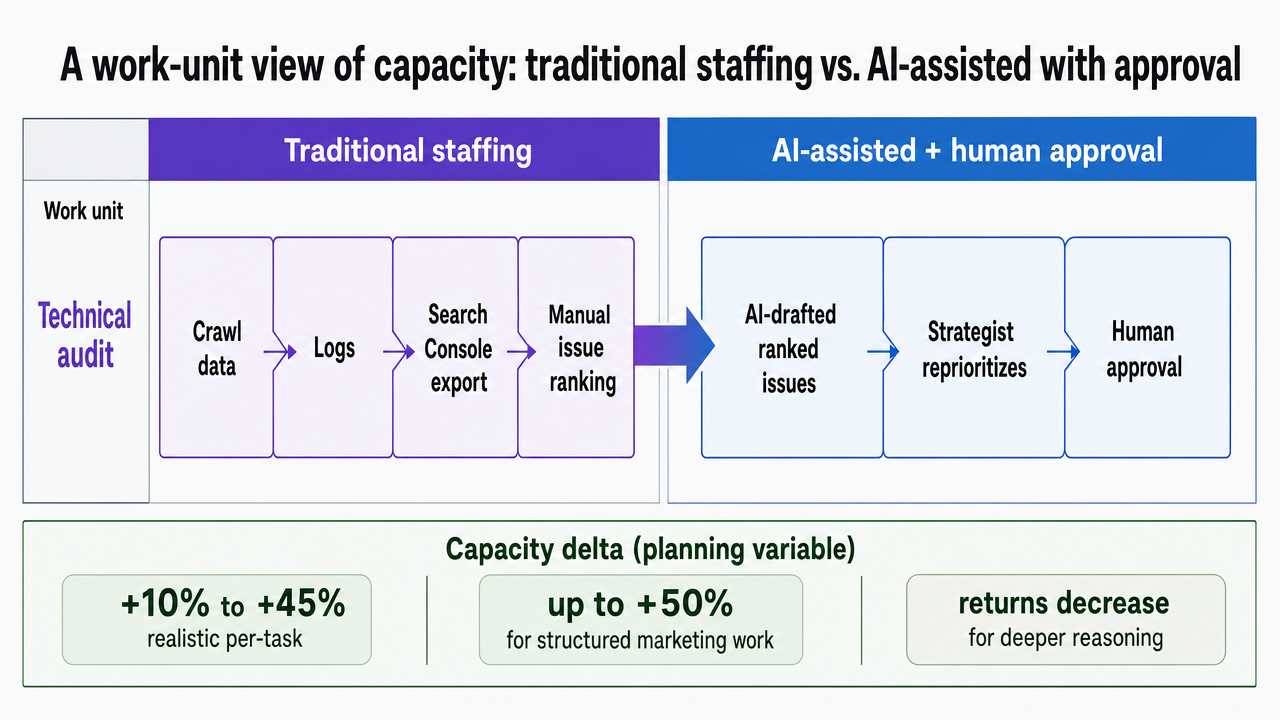 Visualize the section's comparison table as a two-column process infographic showing how each SEO work unit moves from traditional staffing to AI-assisted with human approval, reinforcing the operating-model shift
Human-only work: strategy, YMYL review, and claim substantiation
The scope of work that AI should not handle unsupervised is smaller than most agencies acknowledge but larger than most vendors admit. Three categories firmly remain on the human side:
- strategic decisions influenced by client context that AI cannot perceive,
- review of Your-Money-Your-Life (YMYL) topics where errors could lead to patient or client harm, and
- substantiation of claims for which the agency itself bears responsibility.
Each category requires human involvement for distinct reasons, and conflating them can result in either overly cautious workflows that stifle productivity or dangerously incautious ones that expose the agency to risk.
Strategy remains a human domain because its inputs are inherently incomplete. A senior strategist evaluating whether to invest in topical authority for a dental DSO's implant line versus local pages for new acquisitions considers signals not present in any crawl: the client's acquisition pipeline, the operations team's capacity for onboarding new locations, the dynamics of referring dentists in each market, and the client's tolerance for a two-quarter payoff. While AI can rank options based on stated criteria, it cannot establish those criteria for a client it has never interacted with.
YMYL review and claim substantiation require human oversight for a different reason: they are subject to regulation. The following two subsections delve into each of these aspects.
Where NIST AI RMF draws the oversight line
NIST's Generative AI Profile positions human oversight as a cross-sector control that organizations are expected to integrate into AI workflows from the outset, rather than as an afterthought. It explicitly states that this framework complements the broader AI Risk Management Framework, aiming to help organizations incorporate trustworthiness considerations into the design, development, use, and evaluation of AI 8. For an agency, this translates into a practical rule: every AI-assisted SEO output intended for a regulated client requires a named reviewer, a recorded approval, and an evaluation step performed by someone other than the individual who prompted the model.
The profile addresses governance, evaluation, provenance, privacy, bias, misinformation, security, and human oversight 8. A Head of SEO does not need to operationalize all eight simultaneously. The two most directly impacting daily workflow are human oversight for YMYL drafts and provenance tracking for every published asset.
FTC substantiation duty sits on the agency, not just the client
The FTC's internet advertising guidance is remarkably clear about where responsibility lies. Claims, particularly those concerning health, safety, or performance, must be substantiated. The guidance specifies that agencies and website designers should review the information used to support claims, rather than solely relying on the advertiser's assurances 3. For an SEO leader, this means a client's medical director signing off on a treatment page does not absolve the agency of its duty to verify supporting evidence before the page goes live.
The operational consequence is a mandatory review gate, not merely a disclaimer. Any draft containing a health, safety, efficacy, outcome, or performance claim—whether generated by a junior strategist or an AI pass against a brief—must have a substantiation record attached before approval. This record should include the source supporting the claim, the reviewer who verified it, and the date of verification. This record serves as the agency's defense if the claim is ever challenged. Without it, the AI-assisted productivity gains discussed in this article become a liability the moment a regulator or opposing counsel requests backup.
Regulated verticals change the operating model
For agencies with a significant client base in healthcare, behavioral health, legal, or financial sectors, the operating model described thus far requires an additional layer before any capacity gains can be safely realized. Regulated verticals simultaneously alter two key aspects: the type of data the SEO stack is permitted to collect and the evidence required for a published page to go live. Both constraints converge on the same reviewer queue, compelling the Head of SEO to redesign the production line rather than merely attaching controls at the end.
The baseline quality in these sectors is often lower than agencies assume. A meta-narrative systematic review of 153 cross-sectional studies, evaluating 11,785 health websites using the DISCERN instrument, found that none were rated excellent, 37% to 79% were rated good (depending on the study), and the remainder scored poorly; only 18% had HON Code certification 9. This is the environment a healthcare SEO team operates within. A page that passes a generic brand-voice check and a technical QA still enters a landscape where credible, well-sourced content is not the norm. The implication for an agency's operating model is not increased volume, but rather the integration of a clinical or legal reviewer into the approval queue, with their sign-off recorded as part of the asset's provenance.
The following two subsections address the data and content aspects separately, as they present distinct failure points and involve different reviewers.
HIPAA tracking review before analytics, pixels, or call tracking ships
HHS has explicitly stated that HIPAA-covered entities and their business associates must evaluate online tracking technologies whenever collected or disclosed data could include protected health information (PHI). Regulated entities are prohibited from using tracking in ways that cause impermissible PHI disclosures, and vendor relationships involving PHI generally require business associate agreements (BAAs) where applicable 2. For an SEO team, this encompasses the standard stack: analytics tags, remarketing pixels, session recording, heatmaps, call tracking, chat widgets, and form handlers.
The operational change required is a privacy review gate before any tracking script is deployed to a covered-entity client's site. The reviewer is a privacy or compliance lead, not the SEO strategist who requested the tag. The artifact of this review is a concise record detailing the vendor, the data elements captured, the pages where the tag fires, the authentication state of those pages, and whether a BAA is in place. Without this record, the AI-assisted productivity gains in reporting and attribution become untenable the moment a client's compliance team questions what is firing on an appointment-request page.
Expert review gates for health, legal, and financial drafts
Draft review in YMYL verticals constitutes a distinct gate with a different reviewer. The FTC's internet advertising guidance mandates that claims, especially those related to health, safety, or performance, must be substantiated. It also specifies that agencies and website designers share responsibility for reviewing the information supporting these claims, rather than solely relying on the advertiser's word 3. A 2025 comparison of Google, Bing, ChatGPT, and Gemini on consumer health information, using DISCERN, JAMA Benchmark, and readability measures, found that ChatGPT scored lowest across evaluated measures, while Google scored highest 10. An AI-drafted paragraph on a treatment page is therefore not a finished asset; it is a starting point that requires adjudication by a clinician, attorney, or licensed financial reviewer before approval.
This gate is structural, not merely advisory. Every YMYL draft must be routed to a named expert reviewer, accompanied by the brief, source list, and substantiation notes. The reviewer approves, edits, or rejects the draft, and their decision is recorded against the asset. This record serves as the agency's defense if a claim is later challenged and is the operational reason why this review layer cannot be merged with a standard editorial pass.
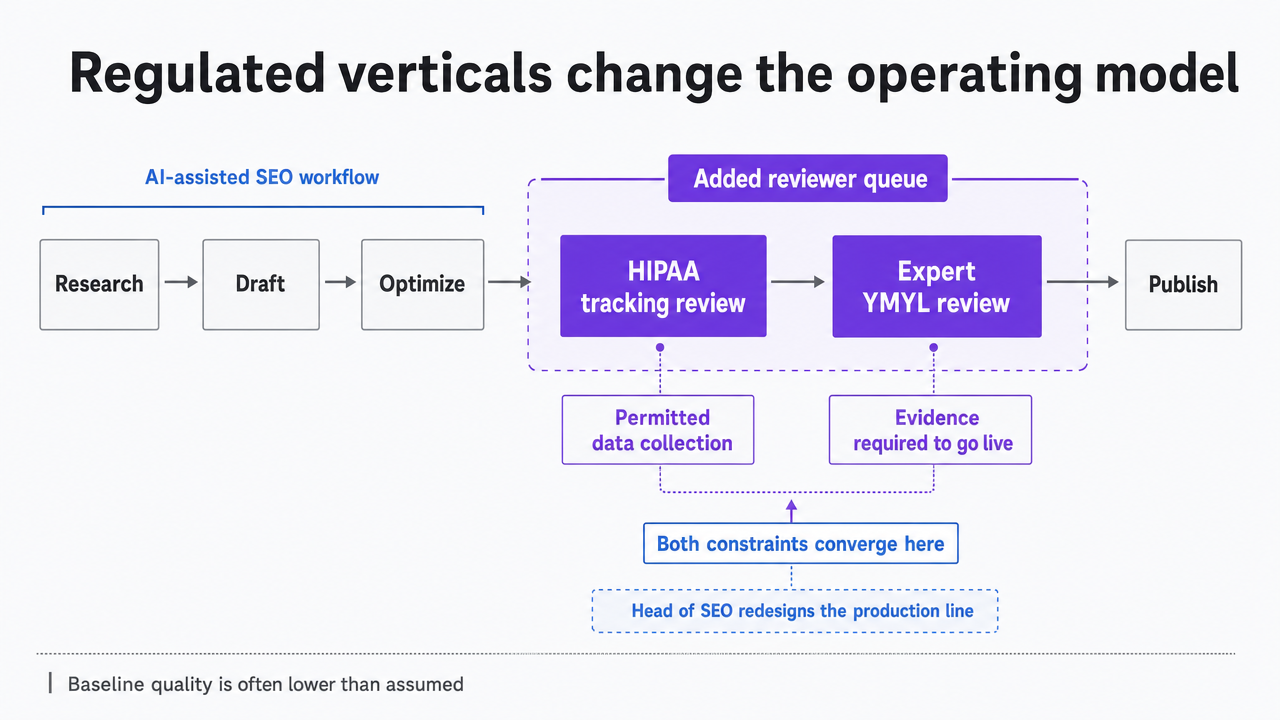 Show the two added approval gates (HIPAA tracking review and expert YMYL review) that regulated verticals insert into the standard AI-assisted SEO workflow, directly visualizing the section's described governance layer
Scale SEO Impact—No Additional Headcount Required
See how leading agencies are leveraging AI-powered workflows to streamline multi-client SEO, maintain quality, and deliver measurable outcomes—without expanding internal teams.
Provenance and approval records as SEO assets
Most agencies view approval logs as mere compliance paperwork. This perspective undervalues their utility. A meticulously maintained provenance record functions as an SEO asset, providing benefits across three timelines: it defends claims when challenged, accelerates subsequent audits of the same URL, and preserves the reasoning behind page decisions even through staff turnover. NIST describes provenance tracking as recording a digital asset's origins and history to support authenticity judgments, noting that provenance and detection are complementary 1. For an SEO operation routing AI-assisted drafts through human approval, this is precisely the function such records fulfill.
A useful record is concise. For each published or materially updated asset, it should log:
- the source URLs the content relies on,
- the AI model or tool used in drafting,
- the brief it was written against,
- the named reviewer,
- the approval timestamp,
- substantiation notes for any health, safety, efficacy, or performance claims, and
- a changelog for subsequent edits.
The FTC's internet advertising guidance makes the substantiation aspect non-negotiable for agencies, which share responsibility for reviewing evidence behind claims 3. The reviewer and source fields are what the agency presents if a claim is questioned.
Treat the log as a lookup tool, not an archive. When a quarterly audit flags a page, the strategist can access the provenance record to understand why the current title, internal links, and schema exist, who approved them, and what evidence supports the on-page claims. This streamlines the audit process and prevents inadvertent rewrites that undo previous decisions. This record also ensures the durability of capacity gains elsewhere in the operating model; without it, context is lost with each handoff, leading to wasted strategist hours on rework.
If you manage multi-location or DSO portfolios, the math breaks differently
This section is specifically for Heads of SEO whose client portfolios are heavily weighted towards multi-location operators—such as DSOs (Dental Service Organizations), behavioral-health networks, home-services franchisees, senior-living portfolios, or multi-office law firms. The per-location multiplier is where traditional staffing models become unsustainable, and it is also where the AI-assisted operating model demonstrates its value most clearly.
A single-location client typically requires one set of each structured work unit: one technical audit, one keyword map, one metadata pass, one internal-link review, and one monthly report. In contrast, a 40-location DSO adds 40 location pages, 40 local keyword clusters, 40 schema sets, 40 citation profiles, and 40 reporting slices on top of the brand-level work. Under a traditional staffing model, this workload grows roughly linearly with the number of locations. However, when routed through standardized templates with AI drafts and strategist approval, each per-location unit becomes a reviewable queue item rather than a from-scratch build. The capacity window, offering a 10% to 45% gain on structured tasks, applies almost entirely to this multiplier 4.
The constraint that does not scale is review. Each new location necessitates substantiation review for any clinical, legal, or safety claim on its page. For healthcare portfolios, it also requires a HIPAA tracking review for any analytics, call tracking, or form handlers on appointment pages 2. The operating model should be designed so that AI handles the per-location production load, while senior reviewers focus only on per-location decisions that genuinely require judgment. Accounts should be priced based on reviewer hours per location, not on page count.
Monitoring and reporting without adding a reporting analyst
Reporting is a common area where agency hours are quietly consumed. A strategist spending six hours per month per account pulling data from Search Console, GA4, rank tracking, and call data into a client deck is time not spent on audits or brief approvals. The structured components of reporting—data pulls, chart assembly, period-over-period comparisons, anomaly flags, and initial narrative drafting—are ideal candidates for AI-driven gains. The 2026 AI Index indicates that structured marketing output can achieve the higher end of productivity ranges for precisely these types of tasks 7. The monthly report should be treated as a reviewable artifact, not a document built from scratch.
The operational setup involves scheduled data pulls into a standardized template, an AI-drafted narrative identifying movements and probable causes, and a strategist's pass to edit for client-specific context and add forward-looking calls to action. Monitoring between reports follows a similar pattern: anomaly detection for rankings, traffic, and conversion events routes alerts to a strategist's queue rather than an inbox. Each alert includes affected URLs, the suspected driver, and a recommended next action. The strategist then decides whether to act, defer, or escalate. This transforms the need for a new reporting analyst into a reviewer role that an existing strategist can absorb.
Frequently Asked Questions
References
- 1.Reducing Risks Posed by Synthetic Content.
- 2.Use of Online Tracking Technologies by HIPAA Covered Entities and Business Associates.
- 3.Advertising and Marketing on the Internet: Rules of the Road.
- 4.CHAPTER 4: Economy.
- 5.Advertising, Promotions, and Marketing Managers.
- 6.Economy | The 2025 AI Index Report.
- 7.Economy | The 2026 AI Index Report.
- 8.Artificial Intelligence Risk Management Framework: Generative Artificial Intelligence Profile.
- 9.Can Patients Trust Online Health Information? A Meta-narrative Systematic Review Addressing the Quality of Health Information on the Internet.
- 10.The Reliability Gap: How Traditional Search Engines and Generative AI Platforms Compare in Consumer Health Information.