
Key Takeaways
- Traffic-first SEO stalls because it optimizes for sessions and rankings while ignoring the CRM stages, comparison pages, and preference-formation surfaces that actually shape B2B revenue outcomes.
- Diagnose the program by mapping every organic URL to journey stages and CRM touch history, revealing that fewer than twenty pages typically drive most sourced pipeline.
- Rebuild around preference formation, since 68% of B2B buyers enter evaluation with a front-runner in mind and that vendor wins 80% of deals 9.
- Defend visibility on AI answer surfaces, which appear on 51.5% of real-user queries and draw from a different source ecosystem than classic search 15.
- Reallocate existing budget by cutting top-of-funnel informational spend, roughly doubling investment in commercial and preference-formation pages, and elevating AEO to a defensible line item.
- Measure against four CRM-linked KPIs: sourced pipeline, influenced pipeline, cost per SQL, and assisted revenue from top-quartile URLs, each traceable to opportunity records finance will accept.
Why traffic-first SEO stalls before it reaches the CRM
Most in-house SEO programs still get graded on the wrong scoreboard. Sessions climb, keyword counts expand, and dashboards look healthy, but the CRM tells a different story: flat sourced pipeline, rising cost per SQL, and a sales team that treats organic leads as second-tier. The gap is not effort. It is that traffic-first SEO optimizes for a stage of the buyer journey that no longer exists in isolation.
B2B purchasing has become a distributed decision process. McKinsey reports that buyers now use an average of ten interaction channels across the journey, up from five in 2016 7. Organic search is one node in that network, not a funnel unto itself. When an SEO program is measured by session volume, it tends to over-index on informational queries that never touch a revenue-bearing page, while the URLs that actually influence deals, comparison pages, pricing logic, technical proof, get treated as afterthoughts.
The disconnect compounds at the point of preference formation. Forrester finds that 68% of B2B buyers already have a front-runner vendor in mind when they enter formal evaluation, and that front-runner wins 80% of the time 9. If the organic program is not shaping consideration well before an RFP or demo request, it is producing traffic for deals that were already decided elsewhere.
Improving SEO for a sales pipeline, then, is not a tactics upgrade. It is a reallocation problem: which pages, which intent stages, and which measurement surfaces actually move CRM outcomes, and which ones are consuming budget without earning it.
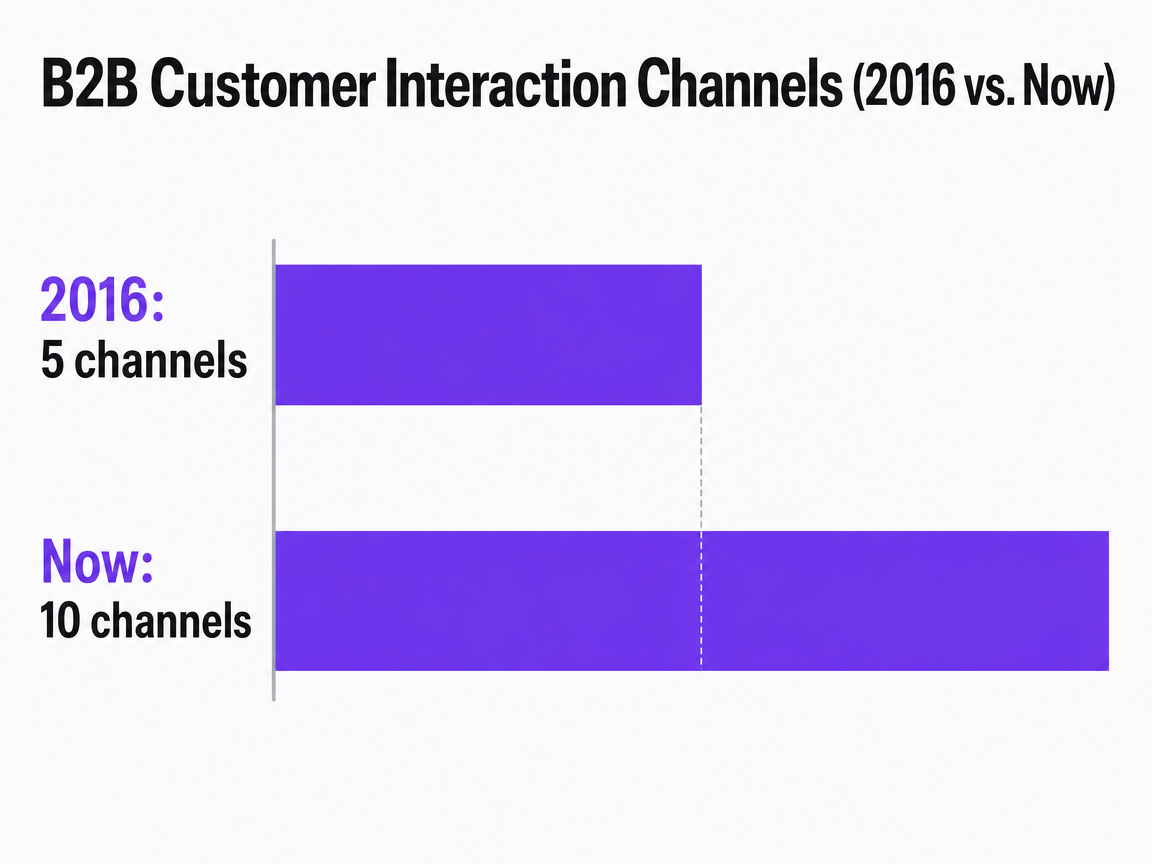 B2B Customer Interaction Channels (2016 vs. Now)
Compares the average number of channels B2B buyers used in their journey in 2016 versus the present day, according to McKinsey research.
Diagnose the program you actually have
Audit URLs against pipeline stages, not rankings
Before any reallocation decision makes sense, a demand gen manager needs an inventory that maps organic URLs to the pipeline stages they influence. Ranking reports and traffic dashboards do not answer that question. They rank pages by attention, not by contribution.
A useful audit starts by pulling every indexable URL that has generated at least one organic session in the last twelve months, then tagging each one against the stages of the B2B decision journey: identifying needs, evaluating suppliers, customizing or specifying, and reordering or expanding 8. Most in-house catalogs skew heavily toward the first stage. Blog posts answering "what is," "how to," and "vs." queries dominate, while pages that support supplier selection, technical fit, and post-purchase expansion are thin or missing.
The next pass overlays CRM data. For each URL, pull the count of first-touch conversions, last-touch conversions, and assisted opportunities from the last two full quarters. Cross-reference with closed-won revenue where attribution allows. The output is uncomfortable for most programs: a small cluster of URLs, often fewer than twenty, will be tied to the majority of sourced pipeline, while hundreds of pages produce sessions without touching a deal.
That distribution is the diagnosis. The problem is not that the program lacks content. It is that content production has drifted away from the stages where organic search actually shapes revenue. Google's own guidance reinforces the underlying quality bar, that pages should be original, complete, and useful to a defined audience 2, but quality alone does not fix a misallocated portfolio.
The Pipeline-Weighted Page Score
Once URLs are mapped to journey stages and CRM outcomes, the next step is a single score that ranks pages by their contribution to pipeline rather than by rank position or session count. Call it the Pipeline-Weighted Page Score. It combines four inputs, each drawn from data the team already collects.
The first input is intent stage, weighted higher for pages tied to supplier evaluation, specification, and reorder decisions than for early-stage informational queries. McKinsey's decision-journey framework provides the stage taxonomy: needs identification, supplier selection, customization, exception handling, use, and reorder 8. Assigning a stage weight forces the team to state, in writing, which pages exist to shape consideration versus which pages exist to catch curiosity.
The second input is CRM-stage influence, calculated as the share of opportunities in the last two quarters where the URL appears in the touch history before the opportunity was created. A page that consistently appears before SQL conversion earns a higher weight than one that appears only in post-close research sessions.
The third input is on-page conversion rate to a pipeline-relevant action: demo request, pricing inquiry, technical download tied to a scoring model, or a sales-accepted contact form. Sessions that never convert to a scored action count as noise, regardless of volume.
The fourth input is assisted pipeline value, the dollar amount of opportunities the URL has touched, weighted by stage confidence. This is the number that survives a finance conversation, because it ties a specific asset to revenue in motion.
The four inputs multiply into a single priority score used to sort every URL in the catalog. Pages in the top quartile receive investment: refreshes, internal links, structured data, and paid amplification where appropriate. Pages in the bottom quartile are candidates for consolidation, redirection, or deprecation. The score is not a permanent verdict. It is a quarterly ranking that reflects how the portfolio is actually performing against pipeline goals.
What to stop funding
A pipeline-weighted view usually surfaces three categories of spend that no longer earn their keep.
The first is top-of-funnel keyword expansion for terms with no demonstrated path to a scored action. Programs often keep publishing against high-volume informational queries because ranking data rewards it, but if the CRM touch history shows those URLs never appear before opportunity creation, additional posts in that cluster produce sessions without pipeline. Cutting the publishing cadence in that cluster by half rarely moves sourced revenue and frees budget for higher-intent work.
The second is thin comparison and alternatives content that exists only to capture branded competitor queries without substantive product, pricing, or fit information. Google's guidance is explicit that content should demonstrate originality, expertise, and value to the reader rather than exist for ranking purposes 2. Comparison pages that fail that bar tend to underperform in both classic search and AI answer surfaces, because neither system rewards derivative summaries.
The third is reporting infrastructure built around domain authority scores, keyword count totals, and session growth as headline metrics. These numbers do not survive a CFO review, and continuing to fund dashboards, tools, and internal reporting cycles around them consumes analyst time that would produce more value tied to CRM stages. Reallocating that measurement effort toward pipeline-linked KPIs is the cheapest win in most audits, because the data already exists in the CRM and marketing automation platform. It just is not being reported yet.
Test SEO pipeline improvements with real content
Evaluate live SEO and pipeline impact using your own published campaigns during the trial period.
Rebuild around preference formation, not first-touch capture
The front-runner problem
The moment a B2B buyer opens a formal evaluation, most of the decision is already made. Forrester's buyer research shows that 68% of B2B buyers enter the purchasing process with a front-runner vendor already in mind, and that front-runner goes on to win the deal 80% of the time 9. The implication for organic search is direct: the URLs that matter most are the ones the buyer encountered months before an RFP existed, not the pages that captured the demo request at the end.
Traffic-first SEO programs miss this window entirely. They measure conversion at the point of form fill, which is downstream of the decision that actually determined the outcome. A page that ranks well for "enterprise [category] platform" and generates a demo request from a buyer who already picked a competitor is not producing pipeline. It is producing a lost opportunity with a nicely attributed first touch.
Preference forms across a longer surface than the demo funnel. It gets built during technical research, peer conversations, analyst reading, and the incidental encounters buyers have with a company's point of view on the problem they are trying to solve. Organic search is one of the few channels that reaches buyers at every stage of that formation process, because the same person who reads a technical explainer in month one runs a comparison query in month four and a pricing search in month six.
The reallocation question becomes concrete: how much of the current program is aimed at buyers whose preferences are still open, versus buyers who are just executing a decision they already made?
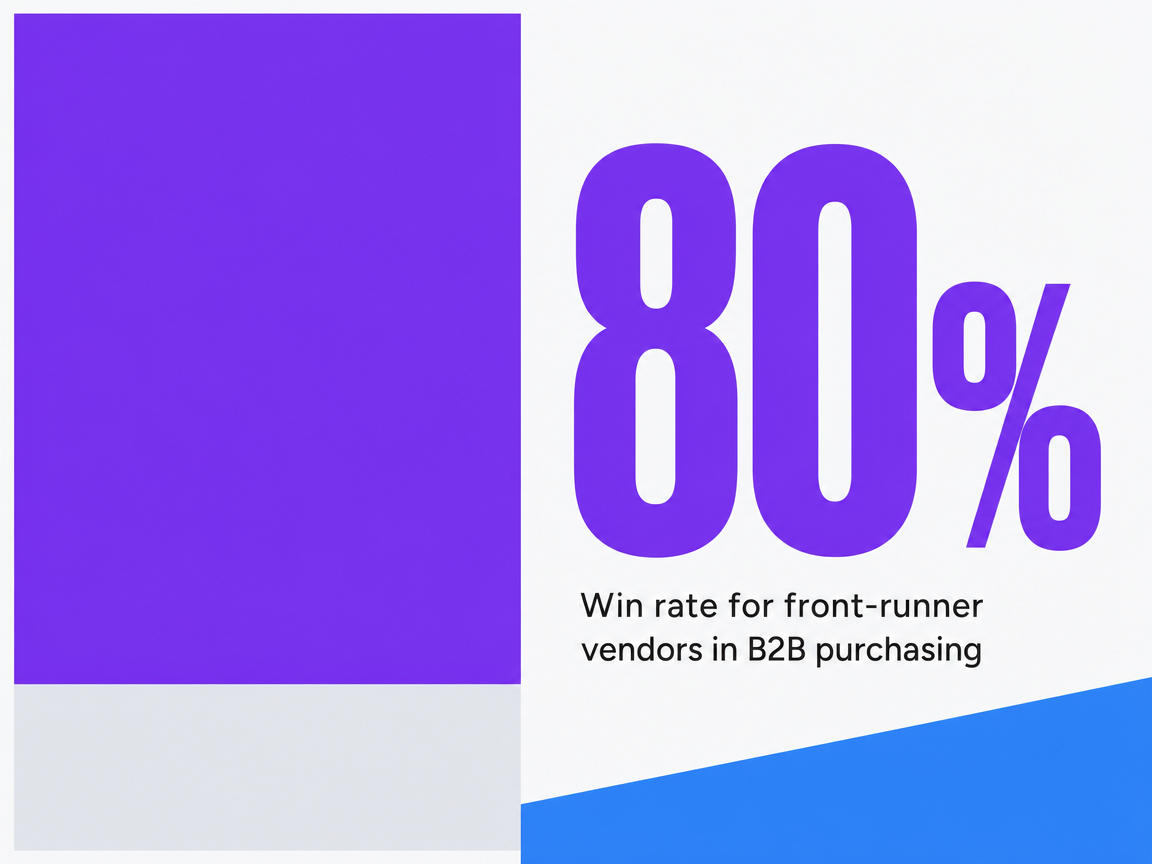 Win rate for front-runner vendors in B2B purchasing
Win rate for front-runner vendors in B2B purchasing
Content that earns consideration before evaluation
Content that shapes preference does specific work. It defines the problem in language the buyer will later use to describe it internally, establishes criteria the buyer will apply when comparing options, and provides technical or operational proof the buyer can forward to colleagues without editing. None of that reads like a product page.
Three formats do this reliably:
- Diagnostic frameworks let a buyer self-assess where they stand on the problem, which creates a mental model the vendor's category owns.
- Reference architectures and implementation blueprints give technical evaluators something to bring to internal stakeholders, moving the conversation from "should we look at this" to "how would we deploy it."
- Point-of-view analyses on category tradeoffs establish the criteria the buyer will use in later comparisons, which is where preference actually gets set.
Google's people-first guidance describes the underlying bar: content should demonstrate originality, expertise, and clear value to a defined audience rather than exist to capture rankings 2. For preference-formation content, that bar is not a compliance exercise. Buyers forward what they trust, and the front-runner advantage compounds when a company's frameworks show up in internal memos and vendor evaluation docs written by the buyer themselves.
The measurement shift follows the content shift. Success at this stage is not the form fill. It is whether the URL appears in the touch history of opportunities that eventually convert, and whether it appears early enough to have influenced the criteria those opportunities were evaluated against.
Defend visibility on the second search surface
How AI answer surfaces reshape discovery
Classic search results are no longer the only place a buyer forms a first impression. An empirical study of Google Search, Gemini, and AI Overviews found that AI Overviews appear on 51.5% of representative real-user queries, and the sources retrieved by AI systems differ substantially from the sources ranked in traditional results 15. The figure comes from a preprint using a real-user query sample rather than a curated keyword list, so it should be read as a directional read on where AI answers now surface, not a final industry benchmark.
The behavioral evidence complicates the picture in a useful way. Microsoft Research's eye-tracking work reports that generative AI content changes how people scan a results page while the golden triangle of attention on classic listings remains valid 12. Nielsen Norman Group's field research reaches a compatible conclusion: users often move between AI summaries and traditional results on the same query, using each to explore and fact-check the other 13. Neither surface is winning outright. Buyers are consulting both.
For a demand gen program, that means visibility is now a two-surface problem. A page can rank in position three on classic SERPs and still be absent from the AI Overview a buyer reads first, or the reverse. Forrester frames answer engine optimization as significantly, but not fundamentally, different from SEO 10, which is the right calibration. The technical foundations carry over. The retrieval logic and the source ecosystems do not.
The strategic consequence is defensive. If more than half of real-user queries produce an AI answer, and the front-runner advantage is set well before formal evaluation, a program that ignores AI surfaces cedes preference formation to whichever sources the answer engine chose to cite.
Structured data and source signals that both engines read
The tactical overlap between classic SEO and AEO sits in the machine-readable layer of a site. Structured data, entity clarity, and source authority feed both retrieval systems from the same underlying content. Google's structured data policy requires supported formats, required properties, original content, and no blocking of pages that carry the markup 3. The rich-result gallery covers product, FAQ, organization, article, and video markup that classic search can display as enhanced listings 5. The same properties help AI systems parse what a page is actually about.
Three markup priorities carry the most weight for a pipeline program:
- Product and offer markup on commercial pages clarifies category, capability, and pricing structure in a way both engines can extract.
- Organization markup with consistent name, sameAs, and identifier properties strengthens entity resolution across the web, which improves the odds of being cited as an authoritative source.
- FAQ and article markup on preference-formation content increases eligibility for rich results while giving answer engines cleanly delimited question-answer pairs to summarize.
Source signals matter beyond markup. Forrester's AEO guidance notes that answer engines increasingly ingest pricing information, proof assets, and trustworthy third-party citations when deciding what to surface 17. Pages that hide pricing behind gated forms or bury proof points in PDFs tend to underperform in AI answers regardless of how well they rank in classic search.
The operational takeaway is narrow: audit the top-quartile Pipeline-Weighted pages first, apply supported markup with valid required properties, and expose the proof and pricing signals that both engines need to cite the page confidently.
See How Streamlined SEO Execution Fuels Higher-Quality Pipeline Results
Request a walkthrough of coordinated, AI-powered SEO workflows that connect organic performance directly to sales pipeline metrics—purpose-built for agencies and enterprise teams managing high-volume lead generation.
Reallocate the budget you already have
Most in-house SEO programs do not need more money. They need a different distribution of the money they already have. The reallocation logic follows directly from the Pipeline-Weighted Page Score: budget flows toward the URLs and surfaces that touch pipeline, and away from the buckets that produce sessions without CRM contribution.
The table below shows how a fixed annual SEO budget typically shifts when a program moves from traffic-first to pipeline-weighted. The percentages are illustrative allocation logic, not benchmark data.
| Budget bucket | Traffic-first program | Pipeline-weighted program |
|---|---|---|
| Top-of-funnel informational content | 50% | 20% |
| High-intent commercial and preference-formation pages | 25% | 40% |
| Technical SEO and structured data | 20% | 20% |
| AEO and answer-surface visibility | 5% | 20% |
Three shifts do the work. Informational content drops because the audit already showed most of those URLs never appear in opportunity touch histories. Commercial and preference-formation pages nearly double because the front-runner advantage is set on those surfaces, and the top-quartile URLs deserve the refresh, internal linking, and proof-asset investment they rarely get. AEO rises from a rounding error to a defensible line item because more than half of real-user queries now surface an AI Overview, and the source ecosystem those systems draw from differs from classic search 15.
Technical spend holds steady. The work changes, however. Structured data effort concentrates on the top-quartile pages first, applying supported markup with valid required properties so both engines can parse category, offer, and proof signals cleanly 3. The point is not more markup across the site. It is correct markup on the pages that already touch pipeline.
Measure against CRM outcomes the CFO will accept
KPIs that survive a finance review
The measurement layer is where most SEO programs lose their seat at the revenue table. A dashboard built around domain authority, keyword count, and session growth cannot answer the question a CFO actually asks: what did this program contribute to bookings this quarter? A pipeline-weighted program replaces those headline metrics with a short list of CRM-linked KPIs, each traceable to a specific record in the system of truth.
Four numbers do the work:
Sourced pipeline from organic : Tracks the dollar value of opportunities where organic search is credited as the creating channel, reported by fiscal quarter and by opportunity stage.
Influenced pipeline from organic : Tracks the dollar value of opportunities where any organic URL appears in the touch history before opportunity creation, which captures the preference-formation surface that first-touch attribution misses.
Cost per SQL from organic : Divides the fully loaded program spend by the count of sales-accepted leads that came through organic in the period, giving finance a unit economic that compares directly to paid channels.
Assisted revenue from top-quartile URLs : Isolates the closed-won contribution of the pages the Pipeline-Weighted Page Score flagged as priorities, which validates or falsifies the reallocation thesis.
McKinsey's framing of the modern B2B sales engine treats digital touchpoints as instrumented components of a data-driven system rather than parallel channels reported in isolation 18. A KPI set that ties every organic asset to a CRM stage is the operating expression of that framing.
Wiring organic content to CRM stages
The KPIs only survive if the plumbing underneath them is honest. Wiring organic content to CRM stages is a three-part build:
- Capture the touch. Every URL in the top quartile of the Pipeline-Weighted Page Score needs a persistent visitor identifier and a form or scored action that writes back to the marketing automation platform with source, medium, and landing URL preserved. UTM discipline matters less than server-side capture of the referring session, because AI answer surfaces and privacy-driven referrer stripping are eroding classic URL parameters.
- Map the touch to a stage. Each URL gets a stage tag drawn from the McKinsey decision-journey model, needs identification, supplier selection, customization, or reorder 8, and that tag travels with the touch record into the CRM. Sales operations then enforces the rule that opportunity records inherit the touch history of every associated contact, not just the converting contact.
- Reconcile the stage with the deal record. Reconciliation happens quarterly. The demand gen team pulls closed-won and closed-lost opportunities from the last two quarters, joins them to the URL-level touch history, and updates the Pipeline-Weighted Page Score with the actual assisted revenue each URL produced. The score is now a feedback loop, not a static ranking.
 B2B companies offering e-commerce
B2B companies offering e-commerce
Frequently Asked Questions
References
- 1.Search Engine Optimization (SEO) Starter Guide.
- 2.Creating Helpful, Reliable, People-First Content.
- 3.General Structured Data Guidelines.
- 4.Google Search Essentials.
- 5.Structured Data Markup that Google Search Supports.
- 6.The surprising economics of B2B growth.
- 7.Five fundamental truths: How B2B winners keep growing.
- 8.The B2B customer decision journey: for the best route to growth.
- 9.Building Preference Is The Key To Winning B2B Buyers.
- 10.Best Practices For Answer Engine Optimization (AEO).
- 11.Answer Engine Optimization (AEO) Role Connections Tool.
- 12.An Eye Tracking Study: Are AI Overviews Changing Search Behavior?.
- 13.How AI Is Changing Search Behaviors.
- 14.AI summaries in online search influence users' attitudes.
- 15.How Generative AI Disrupts Search: An Empirical Study of Google Search, Gemini, and AI Overviews.
- 16.The Future Of B2B Buying Will Come Slowly And Then All At Once.
- 17.Win Visibility In AI Search With Answer Engine Optimization.
- 18.Future of B2B Sales: The Big Reframe.