
Key Takeaways
- Modern organic search operates as a five-layer revenue system spanning technical accessibility, expert content, authority, conversion paths, and attribution, where weakness at any lower layer caps everything above it.
- Technical accessibility is the retrieval floor: server-rendered HTML, schema markup, canonicalization, and sub-2.5-second LCP now determine eligibility for both Google rankings and AI answer citations.
- Expert content earns citations by resolving the full query tree of follow-up questions with named authors, verifiable credentials, and structured markup, not by inflating word count on the head term.
- Attribution must widen beyond session counts to share of visibility in AI answers, branded search trends, and CRM-tracked influenced pipeline, since AI-mediated journeys often bypass traditional click tracking 3.
Organic search is now a five-layer revenue system, not a rankings program
The question "how to improve SEO" now returns a different answer than it did two years ago. Rankings still matter, but they no longer describe the full path from query to qualified pipeline. Buyers research inside AI interfaces, cross-check vendors across model outputs, and often reach a shortlist before a single tracked click hits a website. Forrester's 2026 analysis reports that 94% of surveyed B2B buyers used AI in their research process, and that generative AI and conversational search were named as meaningful information sources at roughly twice the rate of any other source 1. That study measured buyer self-reported behavior in a B2B purchasing context, not consumer search generally, and it reframes what an SEO program is actually competing for: presence inside answers, not just position on a page.
For a VP running organic as a growth channel, the practical response is to stop treating SEO as a checklist of on-page fixes and start running it as a five-layer revenue system.
The layers stack in this order:
- Technical accessibility determines whether crawlers and retrieval systems can read the site at all.
- Expert content determines whether that site deserves to be quoted.
- Authority signals determine whether humans and models trust the source enough to cite it.
- Conversion paths determine whether the visits that do arrive turn into booked calls, forms, or scheduled consultations.
- Attribution determines whether any of it can be defended in a board review when clicks stop mapping cleanly to revenue.
Each layer produces a measurable signal, and each feeds the next. Weakness at the bottom caps the upside of everything above it. The rest of this guide walks each layer with the KPIs, evidence, and governance choices that keep the system defensible under executive scrutiny.
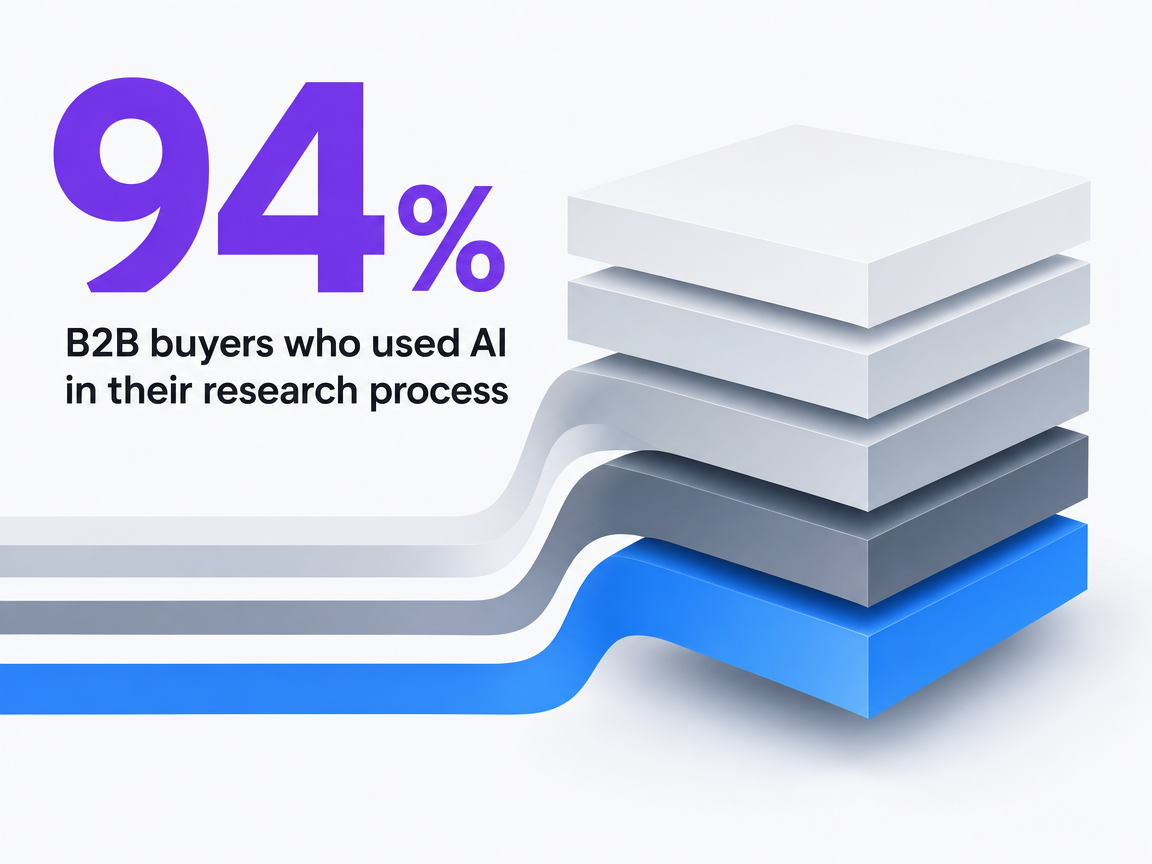 B2B buyers who used AI in their research process
B2B buyers who used AI in their research process
Layer one: technical accessibility as the ranking and retrieval floor
Every downstream layer depends on whether Google's crawlers and the retrieval systems feeding AI answer engines can actually read, parse, and cache the site. When that floor cracks, expert content goes uncited, authority signals get attributed to a competitor's page, and conversion tests run against traffic that never should have been lost in the first place.
The short list of technical checks that determine retrieval eligibility hasn't changed as dramatically as the headlines suggest, but the failure modes have. Rendering budget matters more because AI systems often ingest the raw HTML rather than waiting for client-side hydration. Structured data matters more because it disambiguates entities, authors, locations, and services for models that stitch answers from multiple sources. Canonicalization matters more because near-duplicate location pages, common in dental groups and home services franchises, dilute the strongest version of a service page across dozens of near-identical URLs.
A defensible technical baseline covers seven things:
- Server-rendered or pre-rendered HTML for every indexable route
- A clean XML sitemap that matches the canonical set
- Sub-2.5-second Largest Contentful Paint on primary templates
- Schema markup for Organization, LocalBusiness, Service, FAQPage, and Person where authors are named
- Correct hreflang or geo-targeting for multi-market operators
- HTTPS with valid certificates across every subdomain
- Log-file evidence that Googlebot and major AI crawlers reach priority URLs within the crawl window
Forrester's 2026 buyer research notes that AI-mediated research often influences decisions without ever registering in publisher analytics 2. That reality raises the stakes on retrievability specifically: a page that renders slowly, blocks a user agent, or hides its primary claims behind JavaScript may still rank for a human click, but it can quietly disappear from the answers where the buyer is actually forming a shortlist.
Treat technical accessibility as a monitored uptime metric rather than a quarterly audit. Route crawl errors, schema validation failures, and Core Web Vitals regressions into the same alerting channel that watches conversion drops. Fix them on the same clock.
Layer two: expert content that answers the query and the follow-up
Once a page can be retrieved, the next question is whether it deserves to be quoted. Expert content is the layer where most SEO programs quietly underperform, because ranking-era instincts still push teams toward keyword-matched articles that answer the initial query and stop there. Buyers and models both keep asking.
The useful mental model is a query tree. A dental group's page on "clear aligners cost" is the trunk. The branches are the follow-ups a real patient asks in the next thirty seconds: how it compares to braces, what insurance typically covers, how long treatment takes for mild versus moderate cases, what happens if a tray is lost, and who at the practice actually supervises the case. A page that answers only the trunk gets skimmed. A page that resolves the branches gets cited, linked, and re-surfaced inside AI answers that stitch together multiple sub-questions into a single response.
Forrester's analysis of shifting research behavior argues for content that is structured and authoritative enough to be understood by both human buyers and AI systems, and mapped across the full decision journey rather than a single top-of-funnel query 2. That framing has direct production consequences. Every priority page needs a named author with verifiable credentials, a last-reviewed date, explicit scope (who this is for, who it is not for), primary claims stated in plain declarative sentences, and structured markup that identifies the entity, the service, and the location.
Depth is not word count. A 900-word page that resolves seven real follow-up questions with specificity outperforms a 2,400-word page that repeats the trunk in five variations. Behavioral health networks writing about intensive outpatient programs, home services franchises writing about tankless water heater replacement, and legal groups writing about wrongful termination timelines all share the same failure pattern: the trunk is over-written and the branches are missing.
Build the query tree before the outline. Pull the follow-ups from call recordings, chat transcripts, sales objections, and the "people also ask" set, then assign each branch a paragraph, a heading, or its own linked page depending on search volume and intent. Treat the tree as the editorial spec. When an update ships, revise the branches that changed and leave the rest, so the page compounds authority instead of resetting it.
Test Predictable SEO Pipeline Execution in Days
Experience real-time SEO impact by publishing and measuring live content results during your free trial period.
Layer three: authority signals that get cited by humans and models
Retrievable, well-written pages still lose to weaker competitors when the authority layer is thin. Authority is the reason a model chooses one source over three others that say roughly the same thing, and the reason a human buyer clicks the third result instead of the first. It is built deliberately, over quarters, from signals that are legible to both audiences.
Forrester's October 2025 analysis of B2B buyer behavior reports that 95% of surveyed B2B buyers planned to use generative AI in at least one area of a future purchase, and more than half said generative AI helped them consider more or different vendors while saving research time 4. That study measured buyer intent and self-reported research behavior in a B2B context, not consumer discovery, and it changes what authority has to accomplish. A page that will be summarized inside an AI answer needs to signal credibility in structured form, because the model is reconciling claims across sources rather than reading any single page top to bottom.
Four signals do most of the work:
- Named expert bylines with verifiable credentials, linked to Person schema and to off-site profiles a model can cross-reference.
- Third-party validation from publications, associations, and directories that already carry topical weight in the vertical, so a behavioral health network appears in SAMHSA-adjacent contexts and a dental group appears in ADA-adjacent contexts.
- Original data, proprietary benchmarks, or first-party case outcomes that other sources have to cite by name rather than paraphrase.
- Consistent entity information across the web, so Organization, LocalBusiness, and Person records reconcile cleanly when a retrieval system tries to confirm who is making the claim.
Link acquisition still matters, but the useful frame has shifted from domain authority scores to citation surface area. A single link from a state bar association, a hospital system's referring-provider page, or a manufacturer's certified-installer directory does more for authority in a regulated vertical than fifty guest posts on generalist marketing sites. Track earned mentions and unlinked brand references with equal weight, because AI systems often cite entities by name without a hyperlink.
Audit the authority layer quarterly against three questions:
- Which pages have a named author with a defensible credential trail?
- Which claims are original enough that competitors would have to cite the source by name?
- Which third-party surfaces already describe the organization in the terms it wants to be found by?
Where the answer is none, that is the next quarter's roadmap.
Layer four: conversion paths where query specificity outperforms raw volume
Traffic is not the point. Booked consultations, submitted intake forms, and qualified inbound calls are. Once a page is retrievable, useful, and cited, the conversion layer decides whether any of that upstream work compounds into pipeline or evaporates on a landing page that treats every visitor the same.
The most useful sourced benchmark for framing this layer comes from academic work at NYU Stern comparing organic and sponsored search performance using retailer search data. The study reports mean conversion rates of 2.76% for natural search and 5.4% for paid search, with retailer-specific information on the landing page associated with a 29.74% lift in conversion and brand information associated with a 42.93% lift 13. Those figures come from a retail dataset, not legal intake or behavioral health admissions, so the exact percentages should not be pasted onto a dental group's clear-aligner funnel. The pattern is what transfers: when a page names the specific entity the searcher is looking for and states the specific brand context that resolves ambiguity, conversion moves in a measurable direction.
That pattern rewrites the priority list. Head-term pages built for volume convert worse than long-tail pages built for a named intent, because the long-tail visitor has already narrowed the question. A home services franchise ranking for "tankless water heater installation Denver" converts a different visitor than one ranking for "tankless water heaters," and the landing page should reflect that. Local phone number above the fold. Named technicians with credentials. Permit and code specifics for the metro. Same-week scheduling widget wired to the branch's actual calendar, not a generic form that routes to a call center the next business day.
Three design decisions carry disproportionate weight:
- Match the page's primary claim to the exact query intent rather than the broader topic.
- Put entity and location information where both humans and retrieval systems can find it in the first viewport.
- Instrument every conversion action to the CRM with source, query, and page recorded on the record itself, so the attribution layer has something to work with.
A behavioral health network running admissions inquiries against a generic contact form loses the ability to see which pages produced admits versus which produced tire-kickers, and the conversion optimization program stalls at the guessing stage.
Test specificity, not volume. A page that draws 200 visits and books 14 intakes outperforms a page that draws 2,000 visits and books 9. The conversion layer is where the earlier investments in accessibility, expertise, and authority either convert into revenue or reveal that the funnel is wired to the wrong destination.
Layer five: attribution that survives AI-mediated, zero-click journeys
Attribution is where most organic programs lose the executive argument. When a buyer reads an AI summary that quotes the site, checks a review profile, sees the brand named in a peer's Slack thread, and finally arrives through a direct-load or branded search two weeks later, the analytics package credits "direct" or "organic branded" and the SEO investment looks flat. Forrester expected AI-powered search to drive 20% of organic B2B traffic by the end of 2025 and characterized that traffic as potentially higher quality, with lower bounce rates and higher engagement 3. That forecast is a directional planning input, not a universal benchmark, and it applies to B2B research behavior rather than every service vertical. The point that transfers is that a growing share of the journey now happens outside the click stream the reporting stack was built to measure.
The fix is to widen the measurement surface and tie it to CRM outcomes rather than session counts. Four instrumented signals do most of the work:
- Share of visibility inside AI answers for a defined query set, sampled on a fixed cadence across the model surfaces the target buyer actually uses.
- Branded search and direct-load volume trended against content publication and PR pickups, because rising branded demand is often the earliest visible proof that upstream authority work is landing.
- Assisted-conversion paths in the CRM that capture the first, middle, and last touch on every closed deal, including phone calls tagged with the source page.
- Qualified pipeline influenced, defined as opportunities that touched an indexed page or an AI citation at any point in the buying window, reported next to the sourced-pipeline number rather than replacing it.
Instrument the CRM before renegotiating the KPIs. Every intake form, chat handoff, and inbound call needs source, landing page, query where available, and first-touch timestamp written to the opportunity record. Without that spine, influenced-pipeline reporting becomes an argument about definitions rather than a defensible number in a quarterly review.
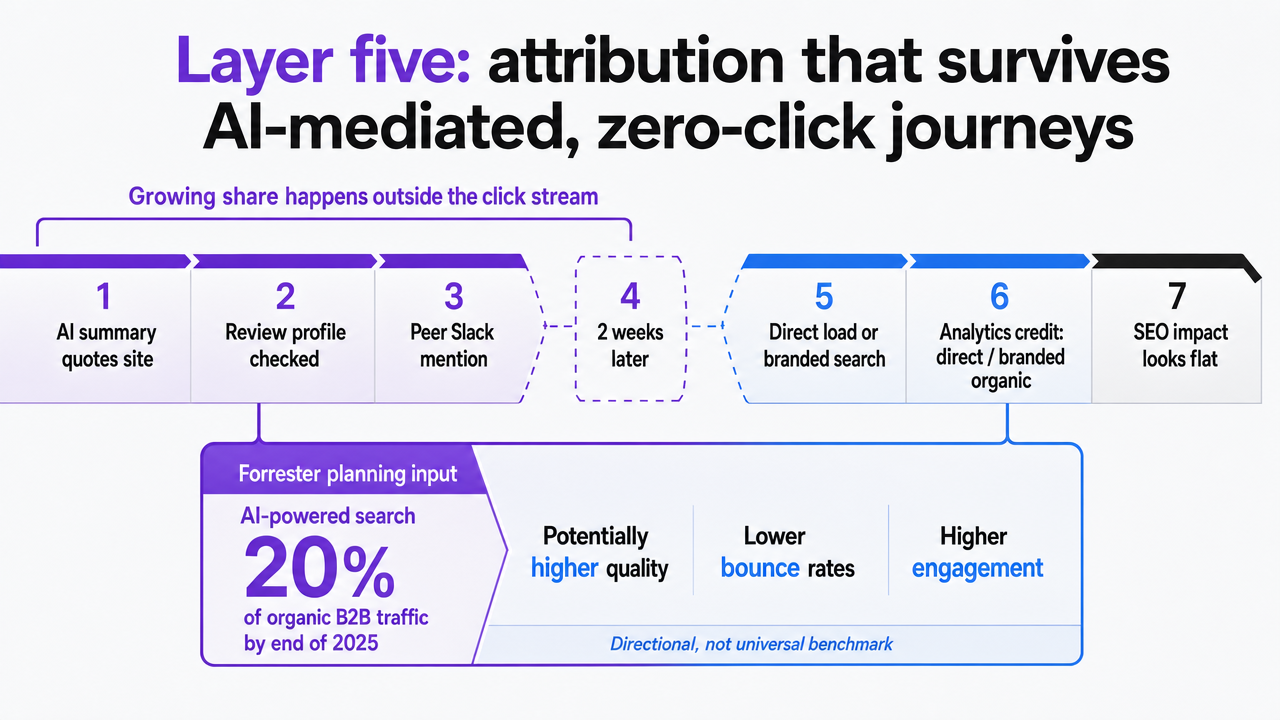 Support the cited Forrester statistics on AI's role in B2B buyer research and its share of organic traffic, directly relevant to the attribution challenge
See How Leading Teams Engineer SEO for Consistent Pipeline Gains
Connect with experts to benchmark your current SEO execution, identify measurable gaps, and explore automated workflows proven to drive sustained pipeline growth—without increasing headcount or vendor complexity.
Governance for AI-assisted production in YMYL and regulated verticals
Scope shift: the guidance above applies to any VP running organic as a pipeline channel. This section narrows to teams in legal, healthcare, behavioral health, dental, and senior living, where a wrong sentence on a service page is a regulatory event, not a conversion-rate footnote. AI-assisted production accelerates output in these verticals, but it also concentrates risk into a single review checkpoint that has to hold.
The governance spine has three parts: provenance, human review, and lifecycle. NIST's Generative AI Profile recommends documenting training-data sources, tracing the origin of generated content, and monitoring outputs for errors and bias as part of an organizational risk-management program 5. The broader AI Risk Management Framework treats human oversight, accuracy, and monitoring as controls that sit alongside privacy and security rather than replacing them 11. Applied to SEO production, that translates to a per-asset record showing which model produced which draft, which sources were consulted, which claims were changed in human review, and who signed off before publish. The record is boring until an enforcement letter or a plaintiff's discovery request makes it the most important file the marketing team owns.
Human review has to be substantive, not ceremonial. For healthcare pages, HHS advises checking claims against credible sources and qualified professionals and not sharing information when accuracy is uncertain 8. Education pages should state that general information does not replace professional medical advice, diagnosis, or treatment and route readers to qualified professionals for individual questions 9. A behavioral health network publishing on medication-assisted treatment needs a licensed clinician, not a content editor, approving the clinical claims before the page ships.
Reviews and testimonials sit in a separate compliance lane. The FTC's final rule on consumer reviews and testimonials, effective October 21, 2024, prohibits fake reviews, deceptive testimonials, review suppression, and undisclosed material connections 12. The commission's broader endorsement guidance requires that testimonials be truthful and that compensated or otherwise material relationships be disclosed 10, 6. For a dental group syndicating patient quotes to location pages or a law firm featuring case outcomes, the operational rule is that review acquisition, moderation, and display workflows get legal sign-off before automation, not after.
Lifecycle closes the loop. HHS recommends annual review of live content with explicit ownership, review dates, and revision or archiving of material that is outdated or no longer maintained 7. Annual is a floor. Pricing, service scope, provider rosters, insurance participation, and regulatory citations move faster than that, and the content calendar should reflect it. Every YMYL page carries an owner, a last-reviewed date, a next-review date, and a trigger list that forces an off-cycle review when a specific fact changes.
The practical build is a governed pipeline where AI drafts, a named human expert reviews and signs, a compliance reviewer signs where required, and the provenance record writes itself into the CMS at publish. That is the version of AI-assisted production that survives audit, discovery, and the next FTC rulemaking without slowing the team below agency-equivalent output.
If you run multiple locations: coordination overhead per published asset
Scope shift: this section is for VPs running SEO across multi-location or portfolio operations—dental groups with 40 practices, behavioral health networks with 12 facilities, home services franchises with 60 territories, senior living operators with regional brands. The single-location math from earlier sections still applies, but a different variable dominates the P&L: coordination overhead per published asset.
The traditional stack fragments the work. A content agency drafts. An SEO agency briefs and optimizes. A backlink vendor pitches. A review-management tool routes local reputation. A PPC agency runs paid. A reporting analyst reconciles what happened. Every asset touches four to six external parties before it ships, and each handoff adds a briefing cycle, a status call, and a review round. The cost that quietly kills the program is not any single retainer—it is the internal FTE hours a small team spends coordinating them.
The table below compares the traditional multi-vendor model against a unified approval-workflow model on variables an operator can measure directly, without invented dollar figures.
| Coordination variable per published asset | Traditional multi-vendor stack | Unified approval workflow ||---|---|---|| External parties touching one asset | 4–6 (content, SEO, links, reviews, PPC, reporting) | 1 platform, 1 internal approver || Briefing cycles before draft | 2–3 (kickoff, revision brief, alignment) | 1 (signal → ranked recommendation) || Internal FTE hours per asset for briefing and status | 4–8 hours | 0.5–1.5 hours || Review rounds before publish | 3–5 (agency, in-house, legal, brand) | 1–2 (expert review, compliance where required) || Time from signal to published asset | 3–6 weeks | 3–10 days || Attribution reconciliation | Manual, monthly, across tools | Written to CRM at publish |
The multiplier is what matters. A 40-location dental group publishing 12 assets per location per year is publishing 480 assets. At 6 internal FTE hours of coordination per asset, that is 2,880 hours—roughly 1.4 full-time employees whose job is meetings about work rather than the work itself. Compress coordination to 1 hour per asset and the same team ships the same volume with the equivalent of one FTE returned to strategy, quality review, or expansion into a new market.
The operational takeaway: before adding another vendor to close a capability gap, measure the coordination hours the current stack already consumes. That number usually justifies consolidation on its own.
An approval-first operating model that ships at agency scale without agency headcount
The five-layer system only produces predictable pipeline if it can be executed on a weekly cadence. Most in-house teams stall not because they lack tactical knowledge, but because the operating model requires more hands than the org chart has, and adding vendors reintroduces the coordination overhead the earlier section already priced out.
An approval-first model compresses the loop to five stages:
- Signal
- Ranked recommendation
- Human approval
- Automated execution
- KPI feedback written back to the CRM
Signals come from live business data—qualified calls, form completions, ranking movement, crawl errors, review velocity, branded search trend. Recommendations arrive already ranked by expected pipeline impact, with the reasoning attached, so the VP or channel lead approves or edits rather than briefs from scratch. Execution runs against the approved spec, and outcomes flow back into the signal layer within days rather than the monthly reporting cycle a traditional stack allows.
Two constraints make the model defensible. Nothing publishes without a named human approver, which preserves the governance spine the YMYL and FTC guidance already requires. And every approved asset carries provenance, source citations, and the reasoning that produced it, so a quarterly board review or a compliance audit reconstructs the decision trail without a scramble. Platforms built on this pattern, including Vectoron, are how a five-person marketing team ships the volume a multi-vendor stack produces without absorbing its coordination cost.
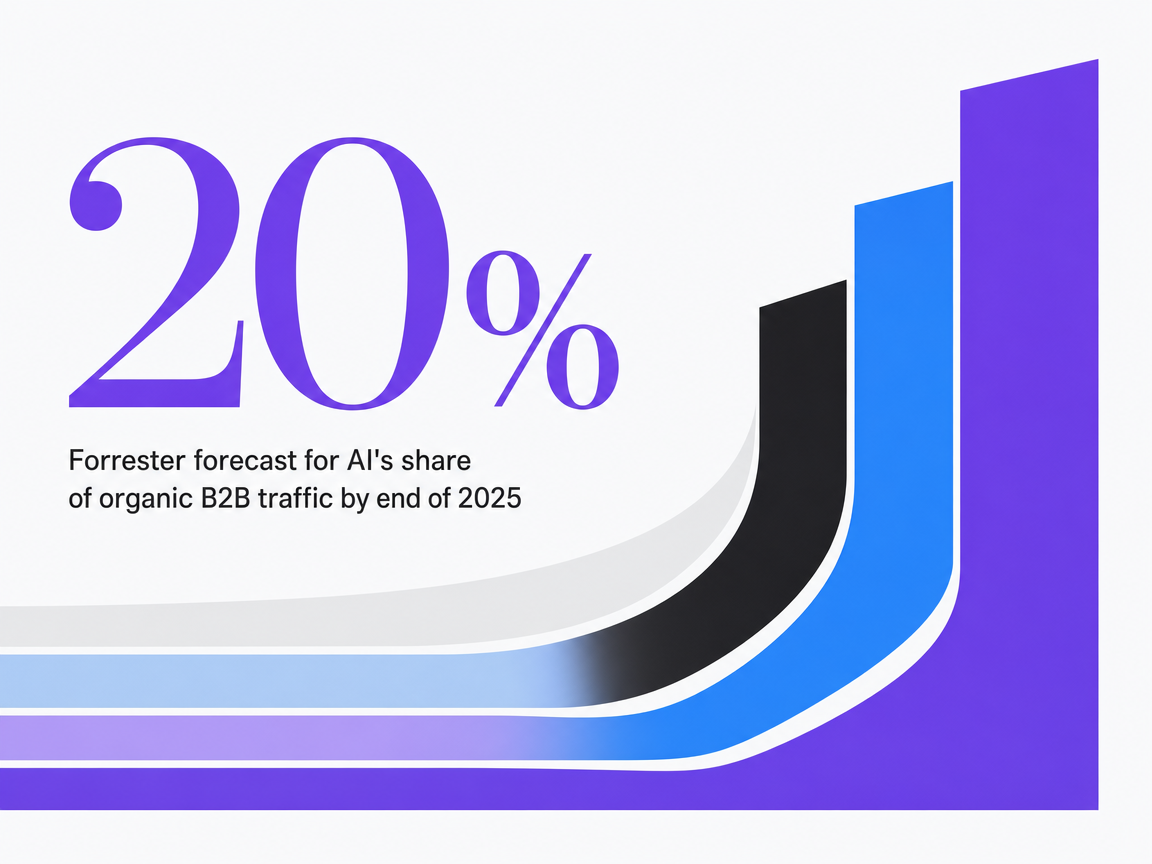 Forrester forecast for AI's share of organic B2B traffic by end of 2025
Forrester forecast for AI's share of organic B2B traffic by end of 2025
Frequently Asked Questions
References
- 1.B2B Buyers Make Zero-Click Number One.
- 2.Search Is Changing — Is Your Content Strategy Ready?.
- 3.Will Zero-Click Search Kill My B2B Website?.
- 4.Impact And Opportunity For AI-Powered Search In B2B Marketing.
- 5.Artificial Intelligence Risk Management Framework: Generative Artificial Intelligence Profile.
- 6.The Consumer Reviews and Testimonials Rule: Questions and Answers.
- 7.HHS Website Content Lifecycle Management and Archive Guidance.
- 8.A Community Toolkit for Addressing Health Misinformation.
- 9.Website Disclaimers.
- 10.Endorsements, Influencers, and Reviews.
- 11.AI Risk Management Framework.
- 12.16 CFR Part 465: Trade Regulation Rule on the Use of Consumer Reviews and Testimonials.
- 13.Comparing Performance Metrics in Organic Search with Sponsored Search Advertising.