
Key Takeaways
- Intent mapping produces a documented brief naming the query cluster, decision stage, conversion event, internal expert, and compliance flags — briefs missing any field should not enter the production queue.
- A consistent technical gate covering sitemaps, robots.txt, canonicals, status codes, metadata, and accessibility checks runs before publish, preventing the double-ship cycle that burns specialist hours 6, 7.
- Content assets require a named subject-matter reviewer and documented evidence before drafting, which prevents generic output and satisfies FTC substantiation obligations on health-adjacent claims 10.
- External authority now depends on earned citations and legitimate review solicitation, since the FTC's 2024 rule prohibits fake, incentivized-without-disclosure, and AI-fabricated reviews 1, 11.
- First-party measurement must tie organic sessions to qualified pipeline, with tracking configurations for healthcare clients reviewed against HHS guidance and the NIST Privacy Framework 3, 5.
- A single approval-gate matrix mapping vertical to regulatory regime lets one reviewer clear or flag assets against a fixed checklist rather than triggering a second draft cycle.
Ranking Improvement Is a Production Problem, Not a Tactics Problem
Heads of SEO running a book of 5 to 50 clients rarely lose ground because they misjudged a title tag or picked the wrong internal anchor. They lose ground because the production line stalls. Briefs sit in queues, legal sends a redline back on week three, a compliance question routes to the wrong reviewer, and the calendar slips another sprint. The tactics are known. The throughput is the problem.
A 2025 scoping review reframes SEO as a multi-stage visibility process spanning metadata, technical interoperability, persistent identifiers, external aggregators, and search-engine mechanisms — not a single ranking event 9. That definition matters operationally: each stage is a separate handoff, and every handoff is a place where an agency either compounds output or burns specialist hours.
The frame this guide uses treats ranking improvement as a governed production line with five named layers — intent, technical, content, authority, measurement — and one approval gate that clears FTC, HIPAA, ADA, and privacy exposure before publish rather than after. The metric that actually governs agency scale is coordination cost per approved deliverable: how many specialist hours, approval cycles, and revision rounds each shipped asset consumes. Sections 2 through 6 build the system layer by layer, then examine where AI-assisted execution changes the math.
The Five-Layer Production System
Layer 1: Intent Mapping Before Keyword Selection
Keyword lists are downstream artifacts. The upstream input is a documented understanding of what the searcher is trying to accomplish, what they need to see to convert, and which stage of the visibility process the agency is actually influencing. A 2025 scoping review defines SEO as a systematic, multi-stage process spanning metadata, technical interoperability, persistent identifiers, directories, and external aggregators — not a single ranking decision made by one algorithm 9. Intent mapping is the layer that decides which of those stages a given asset is built to serve.
For a personal injury firm, a query like "soft tissue settlement amounts" and a query like "car accident lawyer near me" belong to different pipelines. The first feeds evergreen educational assets that build topical depth and earn citations. The second feeds location pages tied to call tracking, review surfaces, and directory presence. Treating both as ranking targets on a single spreadsheet collapses that distinction and produces content that ranks for neither.
The operational deliverable at this layer is an intent brief, not a keyword list. Each brief names:
- the primary query cluster,
- the searcher's decision stage,
- the conversion event the page is accountable for,
- the internal expert who will supply evidence, and
- the compliance flags that will apply at the approval gate.
Briefs that leave any of those five fields blank should not enter the production queue. Specialists who inherit a complete brief spend their hours on evidence and structure rather than on reconstructing what the page is supposed to do.
Layer 2: Technical Accessibility as a Delivery Requirement
The technical gate is the cheapest place to prevent revenue loss and the most common place agencies skip in the interest of throughput. Government discoverability guidance from digital.gov names the operational baseline in plain terms: XML sitemaps, robots.txt, HTML page titles, meta descriptions, domain verification, and routine status code review 6. None of that is novel. The failure mode at agency scale is that it is inconsistently applied across a book of 30 clients running on six different CMS platforms.
A defensible technical gate produces the same artifact for every client, regardless of stack:
- a sitemap submitted and last-modified date verified,
- robots.txt reviewed against the current staging and production trees,
- canonical tags audited against duplicate parameter URLs,
- a status code sweep flagging 4xx and 5xx patterns, and
- titles and meta descriptions written to the intent brief rather than pulled from a template.
The check runs before content publishes, not quarterly.
Accessibility belongs in the same gate, not in a separate deliverable. The Department of Justice has been explicit that inaccessible websites can prevent people with disabilities from accessing goods, services, and information available online, and that the Americans with Disabilities Act can apply to websites functioning as places of public accommodation 7. Alt text, heading hierarchy, form labels, color contrast, and keyboard navigation are not cosmetic. They determine whether a page can be crawled, understood by assistive technology, and defended if a demand letter arrives.
Agencies that fold accessibility checks into the technical gate ship content once. Agencies that treat accessibility as a remediation project ship the same page twice — once for launch and once after a complaint — and pay specialist hours both times.
Layer 3: Evidence-Backed Content With Named Reviewers
The content layer breaks under agency load when writers are asked to source expertise from search results. At 5 to 50 clients, that model produces indistinguishable articles across competitors in the same vertical, which is exactly the pattern Google's helpful content signals were built to demote. The fix is not more words. It is a named subject-matter reviewer attached to every asset before drafting begins.
Each content brief should identify the internal expert whose experience, credentials, or case data will ground the piece: the managing partner for a legal explainer, the clinical director for a behavioral health topic, the operations lead for a home services pricing page. The reviewer's job is not to rewrite. It is to supply the two or three specifics that only a practitioner would know — a jurisdiction quirk, a treatment protocol variation, a common misdiagnosis, a seasonal repair pattern — and to sign off that the evidence is accurate before the compliance reviewer looks at it.
For health-adjacent verticals, this layer carries substantive weight. The FTC's Health Products Compliance Guidance requires competent and reliable scientific evidence for health-related claims and expects marketers to possess substantiation before dissemination 10. That obligation extends to organic content whenever a page implies a treatment outcome, a recovery timeline, or a symptom-to-service pathway. An article that says a program "helps clients achieve lasting sobriety" is making a claim the agency must be able to defend on request.
The production consequence is straightforward: assets without a named reviewer and a documented evidence source should not enter drafting. That single rule collapses the two most expensive failure modes at agency scale — generic content that does not rank and claim-laden content that triggers legal escalation after publication. It also gives editors a defensible reason to send a brief back at the first gate rather than the third.
Layer 4: External Authority Without Manufactured Reviews
External signals still move rankings, but the compliant surface area has narrowed. The FTC's final rule on consumer reviews and testimonials, effective October 21, 2024, prohibits the sale, purchase, creation, and dissemination of fake or false reviews, including AI-generated reviews that misrepresent a nonexistent person or someone without actual experience 1. It also addresses incentivized reviews, insider reviews without disclosure, and the suppression of negative reviews 2. Any review-generation workflow built before that date should be rewritten, not audited.
The FTC's Endorsement Guides add the second constraint. Testimonials must reflect honest opinions and experience, material connections must be disclosed, and a "results may vary" disclaimer does not cure a testimonial that implies typical performance the advertiser cannot substantiate 11. For legal, medical, dental, and financial verticals, that means outcome-based testimonials carry the same evidentiary burden as claims made in the body copy.
What still works at scale: earning citations and mentions from sources the target audience already reads. That includes:
- trade publications,
- state bar and licensing directories,
- condition-specific patient advocacy organizations,
- local news coverage of legitimate community involvement, and
- expert commentary contributed by the named reviewer from Layer 3.
These are slower to produce than a link exchange but survive both search quality updates and regulatory review.
Review acquisition remains legitimate when the agency solicits from actual customers, does not condition the ask on a positive rating, does not gate negative feedback from public surfaces, and does not edit or fabricate substance. Documenting that workflow — who was asked, when, and how — is the artifact that matters if enforcement questions ever arrive.
Layer 5: First-Party Measurement Tied to Qualified Pipeline
Rankings and sessions are diagnostic, not terminal. The metric that renews retainers is qualified pipeline: booked consultations, scheduled service calls, intake-qualified leads, and revenue attributed to organic entry points. Building measurement at this layer means instrumenting the events that map to those outcomes and configuring analytics so the client's operations team and the agency see the same numbers.
For healthcare, dental, and behavioral health clients, that instrumentation runs directly into HIPAA constraints. HHS guidance is explicit that covered entities must configure tracking technologies so that uses and disclosures of protected health information comply with the Privacy Rule and protect electronic protected health information under the Security Rule 3. That affects pixel deployment on appointment pages, form field capture, call recording routed through analytics, and any third-party tag that transmits URLs identifying a condition or treatment. Agencies serving these verticals need a documented tracking configuration signed off by the client's privacy counsel, not a copy-pasted GTM container.
The NIST Privacy Framework provides a structured way to review analytics, call intelligence, lead forms, CRM integrations, and personalization practices before implementation 5. Running new measurement configurations through that lens — even for non-healthcare clients — surfaces the exposures that create rework later: consent scope, retention windows, cross-tool data sharing, and unintended profile creation.
The measurement artifact each client should receive monthly is not a rankings report. It is a pipeline report showing organic sessions to qualified events to booked outcomes, with cost per qualified lead calculated against the retainer. That report is what makes the four upstream layers legible to the person signing the invoice.
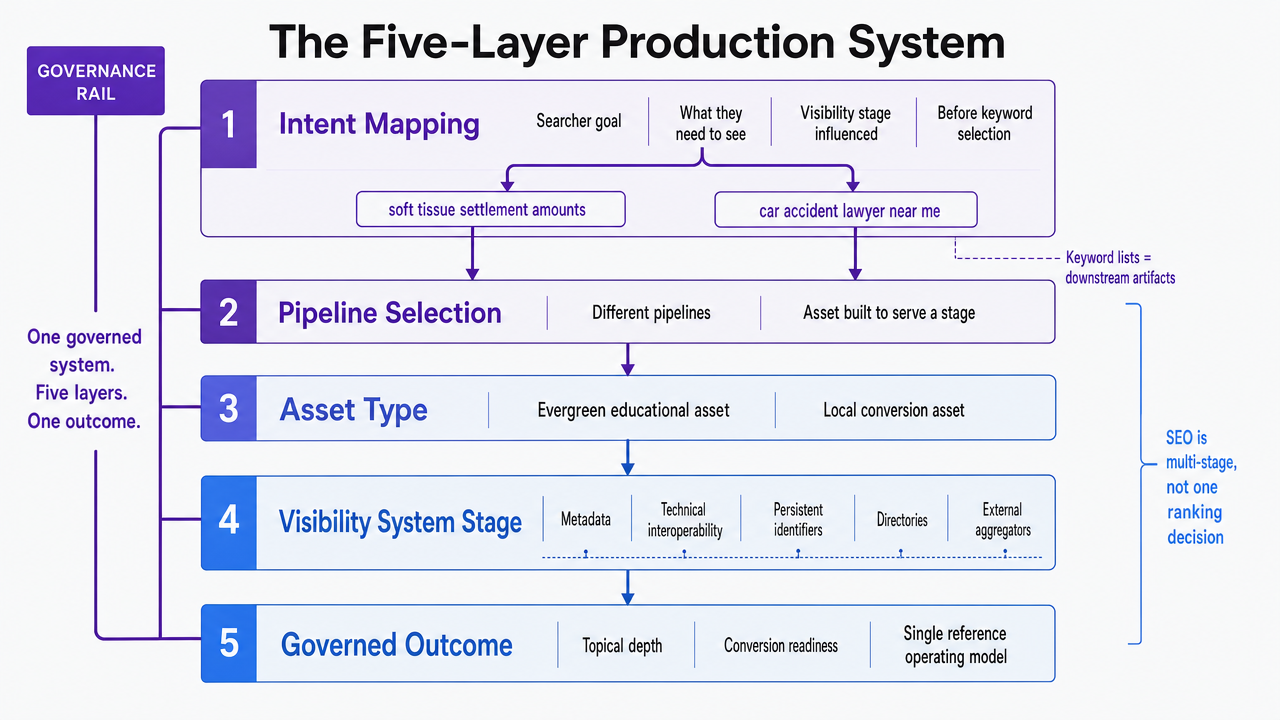 Visualize the five sequential production layers described in Sections 2.1 through 2.5 as a governed pipeline, giving readers a single reference for the operating model the rest of the article builds on
Test Real-World SEO Improvements in One Week
Experience measurable SEO ranking gains using live content and analytics during your free trial period.
The Approval Gate: Compliance Review Before Publish
Vertical-Specific Obligations in One Matrix
Every agency serving more than one regulated vertical eventually rediscovers the same lesson: compliance exposure does not map neatly to job titles. A single article can trigger FTC substantiation review, HIPAA tracking questions, ADA accessibility scrutiny, and privacy-risk questions in one draft. Consolidating those obligations into one matrix — rather than scattering them across specialist checklists — is what makes the approval gate operate at the speed of publishing rather than the speed of legal.
The matrix that governs pre-publish review should have vertical on one axis and regulatory regime on the other. Healthcare, dental, and behavioral health clients trigger HHS tracking guidance on any page that transmits URLs, form fields, or pixel events tied to a condition or treatment 3, plus FTC Health Products Compliance Guidance whenever content implies a treatment outcome, recovery timeline, or symptom-to-service pathway 10. Legal, financial, and any client publishing customer statements sit under the FTC Endorsement Guides for testimonial handling 11and the Consumer Reviews and Testimonials Rule for review-generation workflows 1. Senior living and home services clients typically carry both endorsement obligations and — when they publish outcome or safety claims — substantiation obligations.
Public-sector clients and organizations contracted by state or local governments carry the WCAG 2.1 Level AA obligation established by the DOJ web rule, with compliance dates of April 26, 2026 for entities serving populations of 50,000 or more and April 26, 2027 for smaller public entities and special districts under the revised timeline 4, 8. Every client, regardless of vertical, benefits from running new analytics, form, CRM, and personalization configurations through the NIST Privacy Framework as a structured pre-implementation review 5. The matrix's job is to make sure no reviewer at the approval gate has to guess which regimes apply to the asset in front of them — the vertical determines the row, and the row determines the checks.
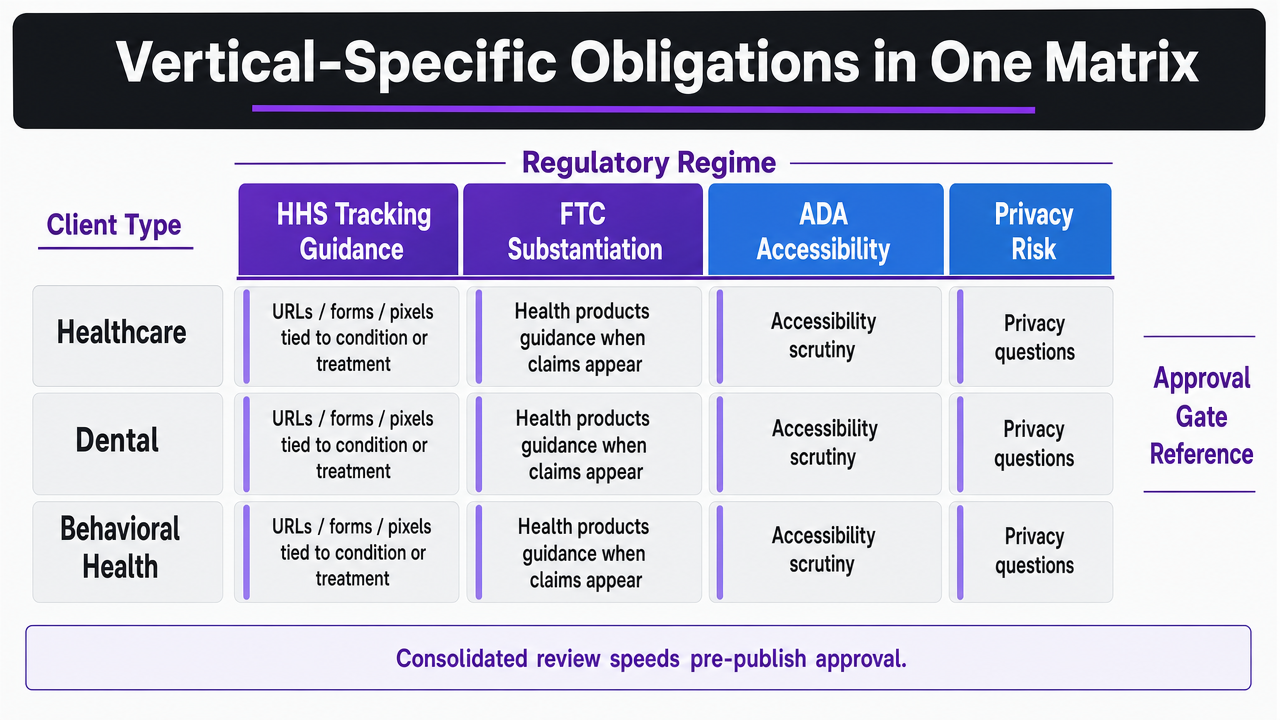 Render the compliance-by-vertical matrix described in Section 3.1 as a reference grid so readers can see which regulatory regimes apply to each client type at the approval gate
What the Reviewer Actually Checks
The reviewer at the approval gate is not re-editing the piece. The reviewer is running a fixed checklist and either clearing the asset or routing a specific flag back to the responsible specialist. Anything else turns compliance review into a second draft cycle and doubles the coordination cost the system was built to prevent.
The checklist has six items:
- Claims: every factual assertion — statistic, outcome, timeline, comparison — has a documented source in the brief, and health-adjacent claims meet the FTC's competent and reliable scientific evidence standard before dissemination 10.
- Testimonials and endorsements: any customer statement reflects an honest opinion, material connections are disclosed, and outcome claims that imply typical results carry the required substantiation rather than a boilerplate disclaimer 11.
- Reviews and reputation content: nothing on the page originated from a purchased, incentivized-without-disclosure, insider-without-disclosure, or fabricated source, and negative reviews are not suppressed from public surfaces 1.
- Tracking and measurement: for healthcare, dental, and behavioral health clients, pixel deployment, form field capture, and analytics events on the page have been configured against HHS tracking guidance and signed off by the client's privacy counsel 3.
- Accessibility: heading hierarchy, alt text, form labels, color contrast, and keyboard navigation meet the technical standard applicable to the client.
- Disclosures: affiliate relationships, sponsored content, and material connections appear in a location a reasonable reader will see before the endorsement.
A clean pass moves the asset to publish. A flag returns to the specialist named in the brief with the specific item and the source citation attached. Reviewers who deviate from the checklist create the exact rework cycle the gate was designed to eliminate.
Coordination Cost per Approved Deliverable
The metric that governs agency margin is not cost per word or cost per hour. It is coordination cost per approved deliverable: the total specialist, editor, reviewer, and account-management time consumed between an intent brief entering the queue and a compliant asset publishing. Agencies that track billable hours per client without tracking this figure usually discover — during a margin review — that a handful of assets consumed disproportionate coordination time and pulled the retainer underwater.
Four variables drive the number:
Specialist hours per brief : Cover research, drafting, and technical implementation.
Approval cycles per asset : Count each round trip between the specialist, the editor, the compliance reviewer, and the client contact.
Revision rounds : Capture rework triggered by unclear briefs, missing evidence, or reviewer flags.
Compliance review hours : Account for the checklist pass at the approval gate described in Section 3.2, plus any escalation to client-side counsel for HIPAA tracking configurations 3or FTC substantiation questions on health-adjacent claims 10.
The table below expresses the calculation with reader-supplied variables rather than invented benchmarks. Populate the rate columns with the agency's blended figures and the cycle columns with the actual counts from the last quarter's production log.
| Input | Traditional briefing-cycle workflow | Approval-first workflow |
|---|---|---|
| Specialist hours per brief | [specialist hours] | [specialist hours] |
| Approval cycles per asset | [cycle count] | [cycle count] |
| Revision rounds per asset | [revision count] | [revision count] |
| Compliance review hours | [reviewer hours] | [reviewer hours] |
| Blended cost per hour | [agency rate] | [agency rate] |
| Coordination cost per approved deliverable | = sum of hours × rate | = sum of hours × rate |
Two patterns show up when agencies run the calculation honestly. First, approval cycles compound faster than specialist hours: a fourth round trip on a single asset can double the coordination cost even when the drafting hours held steady. Second, the assets that trigger the most cycles are the ones that entered production without a named reviewer, a documented evidence source, or a completed intent brief — the failure modes Sections 2.1 and 2.3 exist to prevent. Compressing coordination cost is less about writing faster and more about refusing to admit incomplete briefs into the queue.
See How Top Agencies Streamline SEO Execution—Without Expanding Headcount
Connect with our specialists to benchmark your current SEO processes and discover workflow automations proven to reduce content cycle times by over 40% for multi-client portfolios.
If You Manage a Multi-Location or Multi-Brand Book
The five-layer system holds, but the coordination math shifts when a single client spans 40 dental practices, 12 rehab facilities, or a franchise network of 200 home service locations. At that scale, the risk is not per-asset quality — it is per-location drift. Location pages copy each other, reviewer sign-off gets delegated to the nearest office manager, and one branch quietly runs a review-generation campaign the parent brand has already retired.
Three controls contain the drift:
- A single source of truth for claims and testimonials at the brand level, not the location level. The FTC's Consumer Reviews and Testimonials Rule applies uniformly across every location a brand operates, and enforcement risk sits with the parent when a franchisee posts fabricated or incentivized reviews under the shared name 1. A location manager should be able to solicit reviews from actual customers, but the workflow, disclosure language, and suppression rules live in one document the compliance reviewer audits.
- A location-page template that separates true local variables — address, hours, staff, licensed services, jurisdiction-specific disclosures — from brand-level content that never varies. Templates prevent the two failure modes at scale: near-duplicate pages that dilute topical authority, and rogue local edits that introduce unsubstantiated claims a compliance reviewer never sees.
- A measurement rollup that reports qualified pipeline by location and by cohort, so underperforming markets surface before the quarterly review rather than during it. The coordination cost per approved deliverable from Section 4 gets multiplied by location count; the agencies that scale profitably are the ones that centralized approvals without centralizing every keystroke.
Where AI-Assisted Execution Changes the Unit Economics
AI assistance compresses the two variables that dominate coordination cost: specialist hours per brief and revision rounds triggered by incomplete inputs. Draft generation, technical audits against the digital.gov checklist 6, and first-pass evidence retrieval for the named reviewer in Section 2.3 are the tasks where minutes replace hours. What AI does not compress — and should not be asked to compress — is the approval gate itself. FTC substantiation for health-adjacent claims 10, endorsement handling 11, and HIPAA tracking configuration 3still require a human reviewer signing off against the Section 3.2 checklist.
The unit-economics shift shows up in one place: approval cycles per asset. When the specialist submits a complete brief with evidence, disclosures, and tracking configuration attached on the first pass, the reviewer clears or flags in one cycle rather than three. That is where agency margin recovers. Platforms like Vectoron are built around this approval-first pattern — AI executes drafting and technical checks, humans retain sign-off, and every recommendation carries its reasoning into the review. Teams evaluating that model should test it on a small cohort first, measure coordination cost per approved deliverable against their current baseline, and expand only where the numbers hold.
Frequently Asked Questions
References
- 1.Federal Trade Commission Announces Final Rule Banning Fake Reviews and Testimonials.
- 2.The Consumer Reviews and Testimonials Rule: Questions and Answers.
- 3.Use of Online Tracking Technologies by HIPAA Covered Entities and Business Associates.
- 4.Accessibility of Web Content and Mobile Apps Provided by State and Local Governments.
- 5.Privacy Framework.
- 6.Optimize your content.
- 7.Guidance on Web Accessibility and the ADA.
- 8.Fact Sheet: New Rule on the Accessibility of Web Content and Mobile Apps Provided by State and Local Governments.
- 9.Visibility, Discoverability, Findability, Search Engine Optimization and Academic SEO in Digital Repositories: A Scoping Review.
- 10.Health Products Compliance Guidance.
- 11.Guides Concerning the Use of Endorsements and Testimonials in Advertising.