
Key Takeaways
- Flat rankings usually respond better to tightening what already exists than to commissioning more articles, since a small set of documented signals does most of the ranking work 1.
- Six named levers, each tied to a Search Central document, make ranking work standardizable across a portfolio: helpful content, internal linking, canonicals, Core Web Vitals, structured data, and page-experience hygiene.
- Pruning, merging, and rewriting weak pages before commissioning new ones concentrates internal signals on URLs Google is already evaluating and cuts wasted production hours 3.
- Score every draft against Google's people-first criteria as a production checklist, since roughly 16,000 external quality raters train the systems that approximate those guidelines 4.
- Audit for orphan pages, ensure money pages carry at least three inbound internal links from relevant parents, and replace generic anchors with descriptive phrasing 11.
- Consolidate duplicate URLs with rel=canonical, matching sitemap and internal link choices, and add 301s before commissioning new pages on the same topics 10.
- Treat LCP under 2.5s, INP under 200ms, and CLS under 0.1 as a template-level prerequisite so new production never inherits old performance debt 5.
- Extend page-experience checks to mobile parity, HTTPS coverage, intrusive interstitials, and main-content clarity, since Google evaluates these alongside speed 6.
Why Ranking Gains Now Come From Fewer Levers, Not More Hires
The default response to flat rankings is to commission more articles. That reflex has quietly become the most expensive line item on an agency's SEO delivery sheet, and it rarely moves the results it is meant to defend. Google's own documentation points in a different direction: a small set of technical and editorial signals do most of the ranking work, and each of them can be standardized across a book of accounts without adding senior specialists.
The Search Central library treats SEO as a discipline of helping search engines understand a site and helping users find it, built on readable structure, unique content, and people-first usefulness 1. That framing rewards teams who tighten what already exists rather than teams who publish faster. Its companion guidance on helpful, reliable, people-first content is explicit that ranking systems favor material created for people, not content produced to influence rankings 3.
Read together, these documents shift the delivery question from "how many pages this month" to "which levers deliver the highest ranking impact per specialist hour, and can a junior operator run them under senior approval." The rest of this playbook works through those levers in order: helpful-content alignment, crawlable internal linking, canonical consolidation, Core Web Vitals thresholds, structured data eligibility, and broader page-experience hygiene. Each is documented by Google, each is repeatable, and none of them require another headcount requisition to execute across twenty or forty client sites.
The Six Google-Documented Levers That Move Rankings Per Specialist Hour
Ranking work compounds fastest when a delivery team stops treating SEO as an open-ended discipline and starts treating it as six named levers, each anchored to a specific Google document. That constraint is what makes the work standardizable across a portfolio: a junior operator can execute against a checklist tied to Search Central, and a senior specialist only needs to review outputs against the same source of truth.
The six levers, ranked by how much ranking movement they tend to produce per specialist hour:
- Helpful content alignment. Rewrite or retire pages against Google's people-first content guidance, which prioritizes reliable information created for readers over material engineered for rankings 3.
- Crawlable internal linking. Ensure every page worth ranking has at least one internal link pointing to it, the baseline Google states directly in its link best practices 11.
- Canonical consolidation. Collapse duplicate URLs into a single representative page, since Google treats the canonical as the main source it uses to evaluate content and quality 10.
- Core Web Vitals thresholds. Hit documented performance targets for loading, interactivity, and visual stability as a portfolio-wide floor 5.
- Structured data eligibility. Add supported markup so pages qualify for richer search appearances without additional content production 7.
- Page-experience hygiene. Clean up mobile parity, intrusive interstitials, and main-content clarity as adjacent ranking signals documented alongside Core Web Vitals 6.
Each lever maps to a specific Search Central page, which means production work can be templated, reviewed, and audited against Google's own language. The Starter Guide frames the whole discipline as helping search engines understand a site and helping users find it 1; the six levers are how that framing becomes billable, repeatable work. The rest of the playbook develops each lever in the order it typically pays back, starting with the editorial cleanup that reduces the need for new production in the first place.
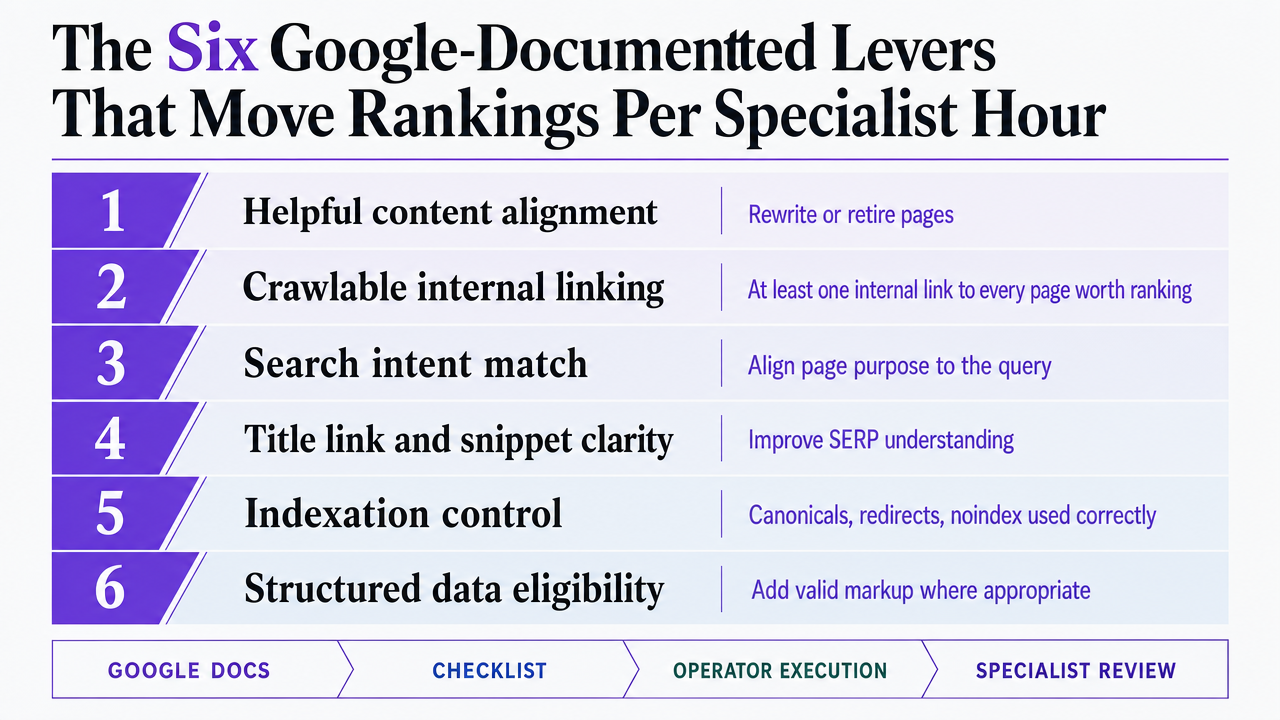 Visualize the six named Google-documented SEO levers as a ranked framework, matching the ordered list in this section
Prune and Strengthen Before Commissioning New Pages
Before a single new brief goes into production, the highest-yielding move is usually to cut. Most client sites carry a long tail of thin, redundant, or drifted pages that dilute topical authority and split internal signals across near-duplicates. Google's guidance on helpful, reliable, people-first content is direct on this point: ranking systems prioritize material created for people, not content produced to manipulate rankings 3. A page that no longer earns that description is a liability, not a placeholder.
The workflow a junior operator can run under senior approval has three steps:
- First, pull every indexable URL and segment by last twelve months of clicks, impressions, and internal links pointing in.
- Second, mark each low-performing page for one of three actions: retire and 301 to the strongest sibling, merge into a stronger page that already ranks, or rewrite against the current query intent.
- Third, route the merge and rewrite queue back to a senior specialist for approval before anything ships.
This sequence often outperforms a net-new content sprint on the same specialist hours. Consolidating two mediocre pages into one stronger page concentrates internal links and query coverage on a URL Google is already evaluating, which aligns with the Starter Guide's framing of SEO as helping search engines understand a site through readable structure and unique content 1. Retirement candidates typically include old campaign landing pages, duplicate location pages, and legacy blog posts that answer questions the brand no longer serves.
The operational rule is straightforward: no new page enters the editorial calendar until the pruning queue for that client has been triaged. That single constraint tends to reduce production volume by a meaningful share while lifting the pages that remain.
Align Content With Google's Helpful-Content Signals
Pruning clears the shelf. The next lever fills what remains with pages that match how Google's ranking systems describe quality: reliable information created for people, not material engineered to influence rankings 3. That standard is more specific than it sounds, and it gives a delivery team a concrete rubric to apply across a portfolio.
Three questions decide whether a page qualifies:
- Does it answer the query a searcher actually typed, or does it answer an adjacent one the writer preferred?
- Does it demonstrate direct familiarity with the subject through specifics a generalist could not fake?
- Is the primary purpose to help the reader finish a task, rather than to rank for a phrase?
Pages that fail any of these get routed back to the rewrite queue before publication.
Google operationalizes this quality read through roughly 16,000 external quality raters who review sample search results against its published guidelines 4. Rater scores do not directly influence rankings, but they train the systems that do, which means the guidelines function as the closest public description of what Google's algorithms are trying to approximate. Treating the helpful-content criteria as a production checklist, rather than a philosophical statement, is what makes this lever standardizable: a junior editor can score drafts against it, and a senior specialist only reviews the edge cases.
Test AI-driven SEO execution on real projects
Experience measurable ranking improvements by publishing actual content during your full-access trial.
Fix Internal Linking as a Portfolio Audit Standard
Internal linking is the cheapest ranking lever a delivery team owns, and it is the one most often left to whatever the CMS defaulted to at launch. Google's link best practices set a floor that doubles as a portfolio audit rule: every page worth ranking should have a link from at least one other page on the site 11. Any URL that fails that test is effectively invisible to the crawler and to the ranking systems evaluating topical hierarchy.
The audit a junior operator can run each quarter has three passes:
- First, crawl the site and flag orphan URLs, meaning indexable pages with zero internal inbound links.
- Second, list money pages, meaning the URLs the client actually wants to rank, and count inbound internal links to each; anything with fewer than three from relevant parents gets queued for linking work.
- Third, review anchor text on existing links for descriptive, crawlable phrasing rather than generic "learn more" strings, which aligns with Google's guidance on making links crawlable and meaningful 11.
Standardized across twenty client sites, this audit tends to surface hundreds of easy wins per portfolio without commissioning a single new page. Senior specialists review the money-page linking plan; the rest ships under approval.
Consolidate Duplicates With Canonicalization
Duplicate URLs are the hidden tax on portfolio ranking work. Faceted navigation, tracking parameters, printer-friendly variants, HTTP/HTTPS mismatches, and legacy location pages all create near-identical URLs that split signals across copies of the same content. Google resolves this by selecting a representative URL through canonicalization, and it treats that canonical as the main source it uses to evaluate content and quality 10. Every duplicate left unconsolidated is a page competing with itself for the same query.
The consolidation queue a junior operator can run has four checkpoints:
- First, crawl for URL variants that return the same or substantially similar content and group them by intended canonical.
- Second, set a
rel="canonical"link element on each duplicate pointing to the chosen representative, and mirror that choice in the XML sitemap and internal links. - Third, add 301 redirects where variants exist only as artifacts of old campaigns or platform migrations.
- Fourth, spot-check Search Console's Page Indexing report to confirm Google is honoring the declared canonical rather than selecting a different URL.
The operator rule is blunt: consolidate duplicate URLs before commissioning new pages. A single canonical carrying the internal links, backlinks, and query coverage that were previously scattered across four variants tends to move rankings faster than any net-new brief on the same topic.
Hit Core Web Vitals Thresholds as Standardizable Benchmarks
Performance work is where technical SEO stops being subjective. Google publishes exact thresholds for its three Core Web Vitals: Largest Contentful Paint under 2.5 seconds, Interaction to Next Paint under 200 milliseconds, and Cumulative Layout Shift under 0.1 5. Those numbers double as a portfolio benchmark card. A junior operator does not need to debate whether a page is fast enough; the page either clears the threshold on mobile field data or it enters the remediation queue.
The standardized workflow has four checkpoints:
- First, pull the Core Web Vitals report in Search Console for every client property and segment URLs by which vital is failing.
- Second, group failures by template rather than by page, because most Vitals problems trace to a shared header, hero image, embedded widget, or third-party script that repeats across dozens of URLs.
- Third, assign each template group to one of three fixes: image and font optimization for LCP, main-thread cleanup and input handler audits for INP, and reserved dimensions on media and ad slots for CLS.
- Fourth, route the remediation plan to a senior specialist for approval before development touches production.
Treating templates as the unit of work is what makes performance a headcount-neutral lever. A single fix to the article template can lift LCP across every post on a publisher client. A single reserved-height rule on the ad container can drop CLS across a location-page directory. Google's page-experience framing supports this template-first read, since it evaluates whether pages have good Core Web Vitals as one component of overall usefulness in Search 6.
The operator rule: no page ships in the editorial calendar on a template that has not cleared the three thresholds on mobile field data. That constraint moves speed work from a quarterly project to a standing prerequisite, and it prevents new production from inheriting old performance debt.
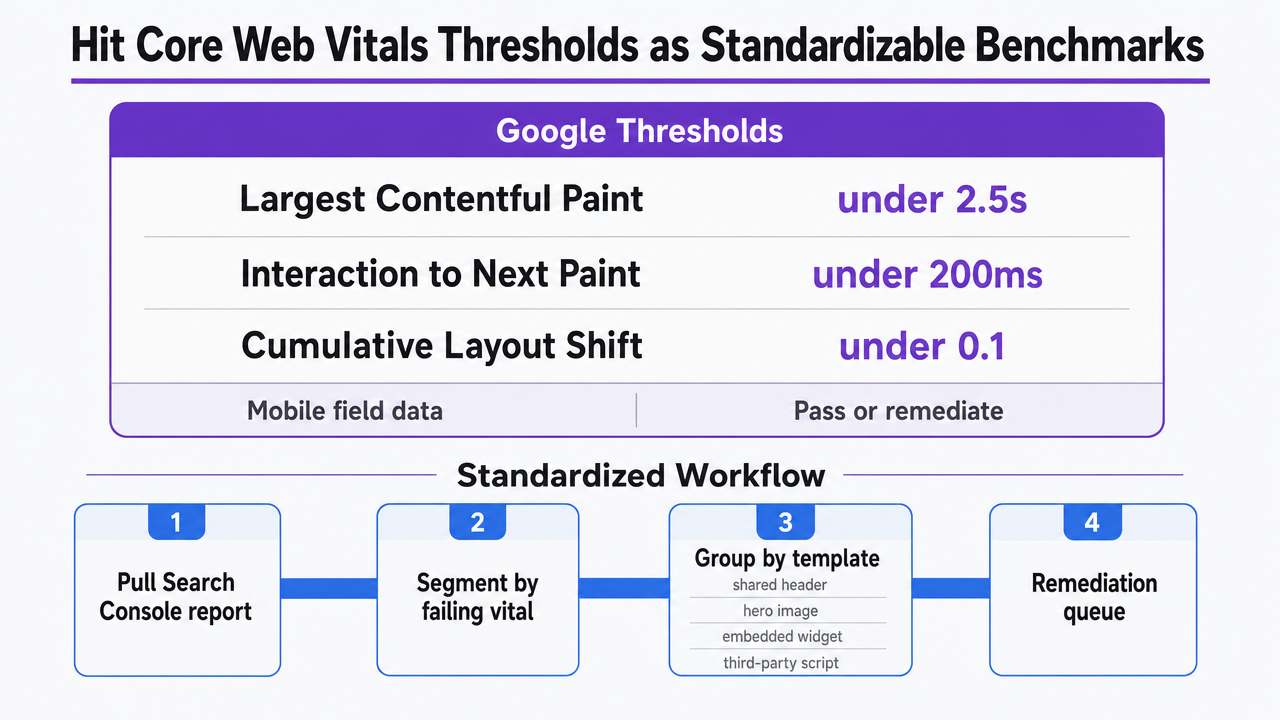 Display the three exact Core Web Vitals thresholds cited by Google as a benchmark card that supports the section's operator rule
Extend Page-Experience Hygiene Beyond Speed
Speed clears the loudest failures, but Google's page-experience framework treats performance as one input among several. The same document asks whether pages display well on mobile devices, whether the connection is secure, and whether the main content is easy to distinguish from ads, navigation, and other page furniture 6. Each of those questions is a checklist item a junior operator can audit without touching a line of copy.
Four hygiene checks belong in the standing portfolio review:
- Mobile parity: the mobile template must render the same primary content, headings, and internal links as the desktop version, since mobile is the version Google evaluates.
- HTTPS coverage: every URL, including legacy subdomains and old campaign paths, resolves over a valid certificate.
- Intrusive interstitials: full-screen overlays that block main content on entry get rebuilt as inline or dismissible elements.
- Main-content clarity: the primary answer to the query sits above the fold on mobile, with ads, related-content modules, and navigation clearly separated from it.
None of these fixes require a new brief or a new hire. They are template-level cleanup that ships once and protects every page on that template.
Scale SEO Performance Across Clients—Without Expanding Your Team
Connect with experts to see how leading agencies are automating SEO execution at scale, maintaining oversight and content quality, while reducing resource overhead.
Prioritize Structured Data by Search-Appearance Return
Structured data is the lever that changes how a page looks in Search without changing what it says. Google frames it as an eligibility mechanism: adding supported markup can enable richer search appearances, called rich results, that pull recipe ratings, event dates, product prices, FAQ accordions, and similar elements into the SERP itself 7. For an agency running a book of accounts, that means presentation gains without commissioning new copy.
Prioritization matters because implementation time is finite. Google publishes a full catalog of supported markup types and uses that markup to understand page content and show richer appearances 8. A pragmatic ranking of what to ship first, by search-appearance return per implementation hour:
- Product and Review markup on ecommerce and service pages
- LocalBusiness on every location page
- Article on editorial content
- FAQ where genuine Q&A exists on the page
- HowTo for procedural content
- Organization on the root domain for entity clarity
Each maps directly to a supported type in the gallery and templates cleanly across similar pages on a client site.
Eligibility fails silently when the markup itself is malformed or the page is blocked. Google's structured-data policy is explicit that supported formats are JSON-LD, Microdata, and RDFa, and that structured-data pages should not be blocked with robots.txt or noindex 9. The operator rule is to ship JSON-LD as the default format, validate every template against the Rich Results Test before deployment, and audit robots directives on any URL carrying markup. Malformed schema does not just fail to trigger rich results; it consumes senior review time that should be spent on the next lever.
If You Manage Multiple Client Accounts: Portfolio Economics of Standardized Levers
The rest of this playbook has treated the six levers as work done on a single site. For Heads of SEO running a book of ten, twenty, or forty accounts, the economics change. The question stops being "which lever moves this client" and becomes "which lever, standardized once, can be executed by junior operators and AI-assisted tooling across the whole portfolio under senior approval." That reframe is what makes ranking work scale without another specialist hire.
The table below is an operator planning model, not sourced market data. It sketches how specialist hours per client per month tend to redistribute when the six Google-documented levers move from ad-hoc senior work to standardized playbooks. Hour ranges are illustrative variables for portfolio planning; a delivery lead should calibrate them against their own account mix and tooling stack.
| Lever | Traditional delivery (senior specialist hrs/client/mo) | Standardized playbook (junior + AI-assisted, senior approval only) | Portfolio effect at 20 clients |
|---|---|---|---|
| Helpful content alignment 3 | 6–10 | 2–4 junior + 0.5 senior review | ~80–130 senior hrs freed/mo |
| Crawlable internal linking 11 | 3–5 | 1–2 junior + 0.25 senior review | ~50–80 senior hrs freed/mo |
| Canonical consolidation 10 | 2–4 | 0.5–1 junior + 0.25 senior review | ~30–60 senior hrs freed/mo |
| Core Web Vitals thresholds 5 | 4–8 | 1–2 junior + 0.5 senior review | ~60–110 senior hrs freed/mo |
| Structured data eligibility 7 | 2–4 | 0.5–1 junior + 0.25 senior review | ~30–60 senior hrs freed/mo |
| Page-experience hygiene 1 | 2–3 | 0.5–1 junior + 0.25 senior review | ~25–40 senior hrs freed/mo |
Operator planning model. Hour ranges are illustrative variables for portfolio calibration, not benchmarks.
Two patterns tend to hold across delivery teams that run this model. First, the reclaimed senior hours are worth more than the raw count suggests, because they shift from execution to review and strategy, which is where margin and retention actually live. Second, the standardization only holds if every playbook maps to a single Search Central source of truth. When juniors and AI tooling execute against Google's own language, senior review becomes a quality gate rather than a rewrite.
Governance: Approval-First AI Execution Without Autonomous Publishing
Standardized playbooks only scale safely when the automation layer sitting on top of them cannot ship anything without a human signing off. That constraint is what separates a governed AI execution model from the failure mode most agencies fear: junior operators and generative tooling pushing malformed schema, drifted rewrites, or off-brand internal links into client production at portfolio speed.
The workflow that holds up in delivery has four steps. A signal, whether it is a crawl report, a Search Console alert, or a Core Web Vitals regression, generates a ranked recommendation tied to the specific lever it maps to. The recommendation carries its strategic reasoning and the Search Central source it references, so a senior specialist reviewing the queue is checking work against Google's own language rather than a black-box output 2. Only after approval does the change execute against the client site, and every executed change writes back to a measurement log for the next review cycle.
Two governance rules keep this loop honest. Structured data ships as JSON-LD validated before deployment, since malformed markup that reaches production wastes the senior review time the model is designed to protect 9. And no automated rewrite touches a page whose canonical status is unresolved, because publishing over a duplicate compounds the consolidation problem rather than fixing it 10. Platforms like Vectoron are built around this approval-first pattern for exactly that reason.
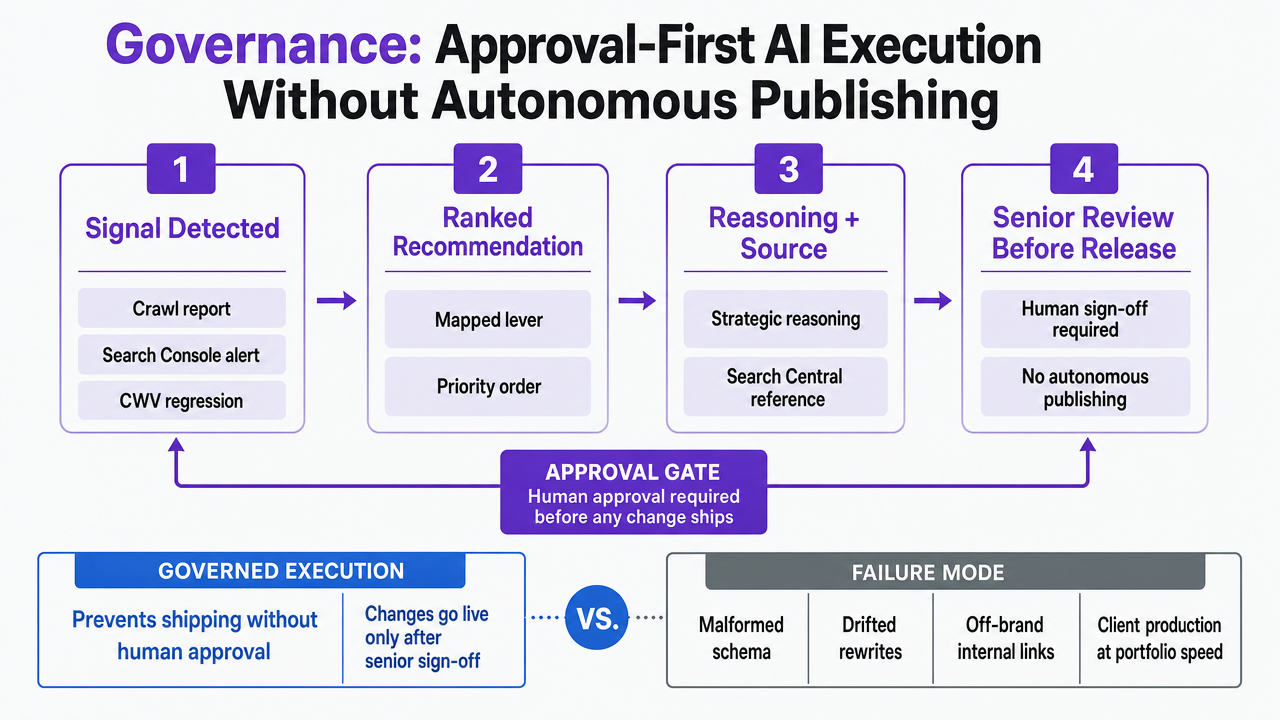 Visualize the four-step approval-first governance workflow described in the section
Frequently Asked Questions
References
- 1.Search Engine Optimization (SEO) Starter Guide.
- 2.Google Search Essentials (formerly Webmaster Guidelines).
- 3.Creating Helpful, Reliable, People-First Content.
- 4.Search Quality Rater Guidelines: An Overview - Google.
- 5.Understanding Core Web Vitals and Google search results.
- 6.Understanding page experience in Google Search results.
- 7.Introduction to structured data markup in Google Search.
- 8.Structured Data Markup that Google Search Supports.
- 9.Completeness.
- 10.What is URL Canonicalization.
- 11.SEO Link Best Practices for Google.