
Key Takeaways
- AI Overviews appear on 42% of queries and cut outbound clicks by 38%, making citation inside the panel more valuable than a traditional top-three ranking 11.
- Google confirms no separate AIO tactics exist, so agency advantage comes from executing SEO fundamentals faster and more consistently across every client URL 1, 2.
- Filter keywords through a trigger rubric—informational, non-branded, three-to-five words, low CPC, low-to-medium difficulty—before spending production budget on pages unlikely to be cited 10.
- Structure pages around a self-contained 40-to-60-word answer block below a query-phrased H2, so AI synthesis can extract a clean, quotable response.
- Maintain entity hygiene by aligning schema, NAP, GBP fields, and service definitions from a single master data source, since inconsistencies weaken citation candidacy 7, 14.
- Govern production with defined stages, approvers, and service-level targets so briefing overhead does not consume margin on high-volume client portfolios 1, 2.
- For multi-location clients, use fixed templates with mandatory unique fields—address, hours, staff, local FAQs—to avoid duplication while preserving entity consistency 12.
- Publish named authors with role-appropriate credentials and verifiable proof points, since trust anchors E-E-A-T and drives citation eligibility on YMYL queries 6, 13.
Why AI Overview citations became a delivery problem, not a content problem
The commercial pressure on organic search is now measurable. A randomized field experiment found that AI Overviews (AIOs) appeared on 42% of queries, and removing them raised outbound clicks from 0.38 to 0.61 per search. This represents a 38% drop in outbound organic clicks on triggered queries, with the zero-click rate climbing from 54% to 72% 11. User satisfaction remained largely unchanged when AIOs were removed, indicating that the traffic loss is a distribution shift rather than a quality improvement for the reader 11.
For agencies managing numerous client accounts, this shift alters the economics of every retainer. While rankings still exist, a top-three organic link on a triggered query now competes with a synthesized answer positioned above it. The most advantageous position is often within the AIO itself, as a linked citation 3. The focus shifts from "can this page rank?" to "can this page be included in the summary and cited by name?"
This reframing challenges many agency delivery models. Earning a citation relies on fundamental SEO principles: crawlable pages, matching structured data, clear answers, and strong entity signals 1. The difficulty lies in producing this output consistently across hundreds of client URLs, month after month, without the overhead of briefing and handoffs eroding profit margins. Agencies that approach AIO optimization as merely a new content tactic are likely to struggle. Those that view it as a production and governance issue—involving query selection, answer architecture, entity hygiene, and approval throughput—are the ones successfully appearing in the citation panel.
What Google actually says (and what that means for agency roadmaps)
Google's public stance on AI Overview optimization is straightforward: no separate optimization is required. The Search Central documentation explicitly states that AI features utilize the same indexing and ranking systems as standard Search. It emphasizes that existing SEO fundamentals—crawlability, internal link discoverability, page experience, and quality textual content supported by structured data—remain the primary priorities 1. The generative AI optimization guide reiterates this point, advocating for clear information architecture and schema that accurately reflects on-page content, rather than AI-specific tricks 2.
This guidance may seem anticlimactic until an agency's roadmap needs to incorporate it. If Google isn't demanding new tactics, the competitive advantage isn't tactical; it's operational. Agencies gaining citation share are those executing the same fundamentals more quickly, more consistently, and across a greater number of URLs than their competitors.
Two key implications arise. First, agencies should resist client pressure to create a separate "AI Overview service line" that simply re-packages existing SEO deliverables at a premium. The core work remains the same; what changes is the need for increased throughput, enhanced answer clarity, and consistent entity representation across the entire site footprint. Second, every AIO snapshot includes outbound links to source pages 3. Therefore, the roadmap's objective is to be the page that is selected and named as a trusted answer within the panel. This shifts the deliverable from "rank on page one" to "be the trusted answer inside the panel," which is a problem of content structuring and trust, not a new algorithm to exploit.
Test AI-powered content workflows on live projects
Experience measurable efficiency gains by publishing real SEO content for clients during your trial period.
The four-layer AI Overview readiness stack
Layer 1: Query selection against AI Overview triggers
Not every client keyword warrants AIO-optimization budget. Trigger patterns are now stable enough to filter keyword lists before content drafting begins. The most reliable pattern involves informational intent, non-branded queries, typically three to five words long, with low volume, low CPC, and low-to-medium difficulty 10. These are the queries where synthesis is beneficial to the searcher and where Google is most inclined to display an AIO panel with citations.
This filtering process changes what enters the production queue. For example, a dental client's "emergency dentist [city]" query is high-intent transactional and rarely triggers an AIO. However, queries like "How long does a root canal take" or "is a cracked tooth an emergency" are informational, non-branded, and concise—fitting the exact profile of a triggered query. Agencies that push every keyword through the same content workflow waste resources on pages that will never be cited. Separating keywords into a trigger-likely queue and a conventional-SERP queue is the initial operational decision.
Scoring for the trigger-likely queue is straightforward: intent type, branding, query length, search volume, difficulty, and CPC. These six criteria can be tracked in a spreadsheet or dashboard. A senior team member can score a 500-keyword list in an afternoon once the rubric is established. The crucial aspect is that the rubric exists and is applied consistently across all clients, ensuring that the answer-first content architecture (Layer 2) is applied to pages with genuine citation potential.
Two secondary filters are also helpful. First, check if an AIO currently displays for the query; if so, the citation slots are visible and testable. Second, verify if the client's site already ranks in the top ten organically. Strong organic performance and brand authority correlate with citation eligibility 10. Therefore, the trigger-likely queue should be sorted by existing ranking strength. Queries where the client ranks 4–10 on a triggered SERP offer the quickest wins, as the ranking signal is already present, and the content primarily needs restructuring to be pulled into the panel.
Layer 2: Answer-first content architecture
Once a query is in the trigger-likely queue, the page structure must facilitate easy extraction of the answer. Multi-location playbooks consistently recommend short, direct answers to common questions, consistent service definitions, and structured content that AI summaries can readily pull 9. This is not merely a copywriting technique; it's a templating decision applied across the entire client portfolio.
An effective pattern involves a 40-to-60-word answer block placed at the top of the relevant page section. This block should be a complete sentence capable of standing alone if quoted verbatim. Below it, supporting details—numbered steps, exceptions, and context for human readers—are provided. On a service page, an H2 phrased as the query itself should be followed by this answer block above the fold. This approach differs from simply reheating the classic "featured snippet" pattern. While similar, AIO synthesis draws fragments from multiple pages, so the answer block must be self-contained enough to be quoted out of context.
Two structural details are critical for production at scale. First, the visible on-page answer must align with the schema. Google's structured data guidance explicitly states that schema should reflect the actual content on the page 14. Using FAQPage schema where questions do not appear as visible text is a common agency shortcut that erodes trust signals. Second, each answer block should incorporate a first-hand experience marker where appropriate for the vertical—such as a specific procedure name, a state statute, a treatment protocol, or a service radius. Generic answers are often outranked by specific ones for the same query.
The production implication is the creation of a page-type inventory. For most service clients, this inventory is small: a service page template, a location page template, a condition or FAQ hub template, and a long-form guide template. Each template is assigned a canonical answer-block pattern. Writers then fill these templates rather than reinventing the structure for each page. This method allows the same architectural decision to propagate across numerous clients without requiring a briefing meeting for every URL.
Layer 3: Entity and schema hygiene
Answer-ready content only earns a citation if Google is confident about the source. This confidence stems from consistent entity signals—the same name, address, phone number, service definitions, and branding appearing uniformly across the site, schema, Google Business Profile, and third-party citations 7. Inconsistencies degrade the entity, making it a weaker candidate for citation.
Three checks should be part of every monthly QA pass. The LocalBusiness or Organization schema on each page must precisely match the visible NAP (Name, Address, Phone) and service list on that page, adhering to Google's guidance that structured data must reflect on-page content 14. The site name declared in schema and the brand name Google displays in search results must align with the client's actual brand; mismatches here weaken the brand's appearance in AI-generated experiences 13. Furthermore, service definitions on the site must correspond with those on the GBP and any specialty pages, as inconsistent service language fragments the entity across different platforms 8.
At a portfolio scale, schema hygiene is not a per-page task but a per-template task. For instance, the LocalBusiness block for a dental client's location pages can be a single JSON-LD template, with location-specific variables populated from a master data source. When the template is correct, 50 pages are correct. If the template drifts, 50 pages drift together, which is easier to detect than 50 pages drifting independently.
The recommended audit cadence includes a quarterly full crawl to verify schema-versus-visible-text matches, a monthly comparison of GBP fields against the master NAP source, and a rolling review of LLM citations for the client's top local queries to identify which competitor entities are being cited and why 8. This last check often reveals missing specialty pages or thin service definitions more quickly than traditional rank reports.
Layer 4: Governed approval workflow
The first three layers define what to produce. The fourth determines an agency's capacity to produce it at the volume required by a client portfolio. This is where many delivery models falter—not due to writing quality, but because of the numerous individuals, meetings, and email exchanges involved between a keyword entering the queue and a page publishing with correct schema.
A governed workflow streamlines this process into defined stages with clear ownership: query scored against the trigger rubric, answer block drafted using the page-type template, schema generated from the master data source, human review, and publication. Each stage has an approver and a service-level target. The goal is not to eliminate human judgment; Google's guidance emphasizes that quality content and matching structured data remain priorities, both requiring editorial oversight 1, 2. Instead, the aim is to remove the briefing-and-handoff overhead between critical judgment points.
Two design choices distinguish governed workflows from standard project management. First, template and rubric decisions are made once during client onboarding, rather than being renegotiated for each deliverable. Second, execution is automated between approvals—including schema generation, internal linking, and publishing—so human time on each page is focused on the answer block and review, not on formatting and coordination.
Measurable outputs include cycle time from keyword to publish, revisions per page, and pages shipped per FTE per month. Agencies that industrialize these four layers do not need to hire an "AI Overview specialist." They require a page-type inventory, a query rubric, a schema template library, and an approval workflow that prevents these artifacts from being bypassed under deadline pressure.
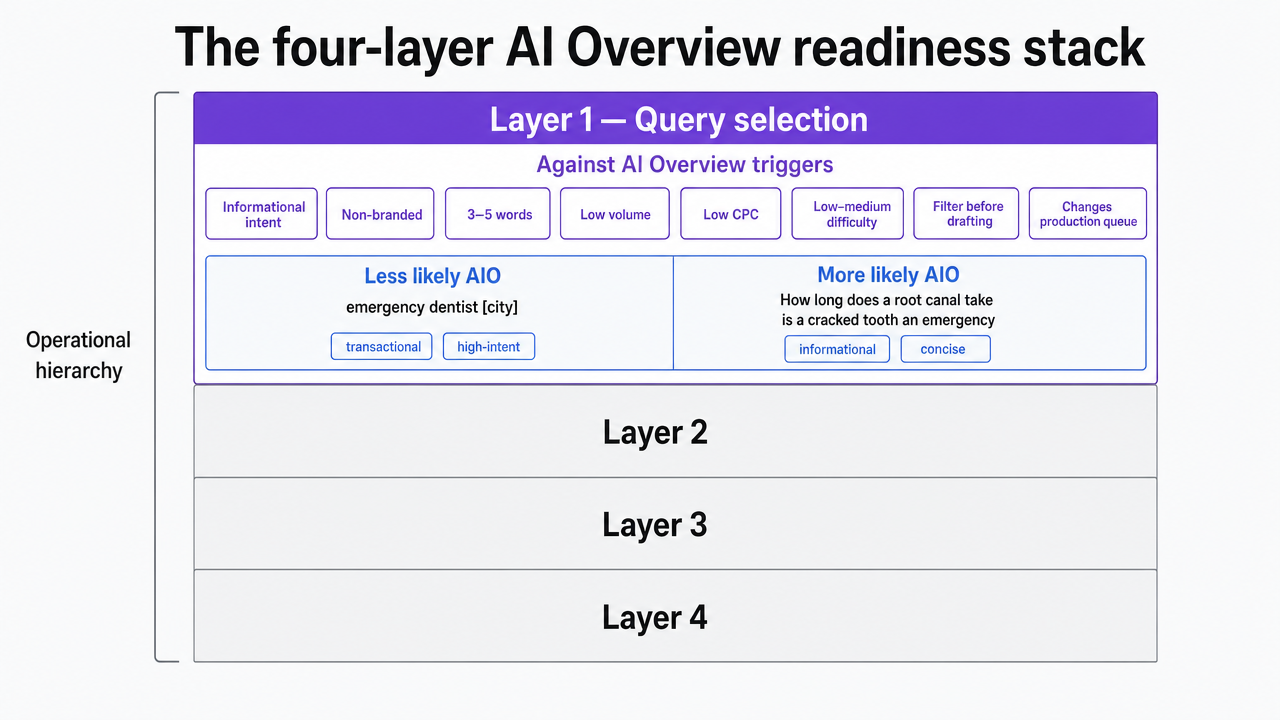 Visualize the four-layer readiness framework introduced in this section as a stacked process diagram, reinforcing the operational hierarchy from query selection to governed workflow
If you manage multi-location clients: the location-page problem
Master NAP repositories and GBP as entity anchor
For multi-location operators—such as a 40-office dental service organization, a regional home services franchisor, or a behavioral health group with 22 clinics—every hygiene failure becomes a compounding problem. A single misaligned suite number doesn't just affect one page; it fragments the entity across dozens of surfaces simultaneously.
The Google Business Profile (GBP) now functions as the entity anchor Google uses to understand a multi-location brand. Every downstream signal—LocalBusiness schema, citations, and on-page NAP (Name, Address, Phone Number)—must align with it 7. If the GBP for the Cleveland office lists "Suite 210," the location page lists "Ste. 210," and a Yelp citation lists "#210," the entity graph becomes unclear. This makes the page a weaker citation candidate for local queries that would otherwise trigger an AI Overview.
The operational solution is a single master data repository that feeds all surfaces. This repository should contain one canonical row per location, with fields for legal name, DBA, street, suite format, phone, hours, service list, and geo-coordinates. The GBP, the LocalBusiness JSON-LD block, the on-page NAP module, and the citation submission tool should all draw from this single source. Changes are made in one place, and audits become a comparison against the master data, rather than a manual crawl.
AI can also accelerate the audit process itself—reconciling GBP fields, review corpuses, and citation snapshots against the master data to identify inconsistencies more quickly than a manual sweep 8. This offers significant leverage for agencies managing clients with 25 or more locations.
Templated but unique: the 50-location content problem
Every enterprise multi-location guide addresses the same challenge: location pages must be templated for volume production, yet unique enough to avoid duplicate content penalties that can harm visibility across the entire footprint 12. An imbalance in either direction can prevent pages from earning citations for local informational queries that trigger AI Overviews.
A workable pattern involves a fixed template with mandatory unique fields. The template dictates the H1 structure, answer-block position, schema shape, internal linking pattern, and CTA placement. The unique fields—address, hours, parking notes, staff bios, service radius, insurance accepted, city-specific FAQ, three location-specific photos, and one paragraph of neighborhood or service-area context—are non-negotiable for each page. Enterprise guidance explicitly states that each page requires a unique address, hours, CTAs, and brand-voice-preserving copy, with dynamic templating used only to prevent duplication, not to substitute for uniqueness 12.
Service definitions require their own discipline. The same service offered in Cleveland and Columbus must use identical core language, as inconsistent service definitions fragment the entity in the same way inconsistent NAP does 8. Variability should come from local proof—such as patient volumes, procedure counts, or licensed clinicians on staff—not from rephrasing the service itself.
Short, direct answers to city-specific common questions should be included on every location page, as this is the format AI summaries can cleanly extract from local pages 9. For example, "How much does Invisalign cost in Cleveland" should have a 45-word answer block on the Cleveland page, rather than linking to a national pricing hub.
Delivery model economics for AI-ready location pages
The economics of producing 50 AI-ready location pages and maintaining them monthly significantly impact retainer margins. Three delivery models are common in agency portfolios, each with different profiles for cost, cycle time, and consistency risk. The table below compares them based on factors that predict citation eligibility and account profitability. Cost per page is presented as a variable range due to differing agency cost structures; the qualitative ratings reflect the templating-versus-uniqueness trade-off highlighted in enterprise multi-location guidance 12and the NAP consistency requirement central to entity-anchor discussions 7.
| Dimension | Freelance/in-house writer + SEO briefing | Offshore content mill + agency QA | AI-assisted production + human approval |
|---|---|---|---|
| Cost per location page | Highest variable range | Lowest variable range | Low-to-medium variable range |
| Briefing cycle time | 5–10 business days per batch | 3–7 business days per batch | Same day, once templates are set |
| Revision rounds per page | 2–3 | 3–5 | 1–2 |
| Entity/schema consistency risk 7 | Medium | High | Low (schema generated from master data source) |
| Uniqueness at scale 12 | High per page, Low across footprint | Low | High, when unique-field discipline is enforced |
| Strategic oversight retained | High | Low | High (approval-gated) |
| Best fit | Under 15 locations | Rarely defensible for AIO work | 25+ locations with monthly refresh |
Two observations from the table are crucial for planning. Offshore content mills often fail on entity consistency because they treat each page as an isolated writing task, rather than a component of a governed data model—a failure mode explicitly warned against in enterprise guidance 12. While freelance and in-house workflows maintain quality, they often exceed the cost ceiling that most 50-location retainers can absorb monthly. The AI-assisted approval workflow, however, maintains the master data source as the single source of truth for schema and NAP fields. This is a structural requirement for a multi-location entity to withstand AI Overview scrutiny 7. Human decision-making is then focused on the answer block and review, rather than repeatedly formatting a JSON-LD template.
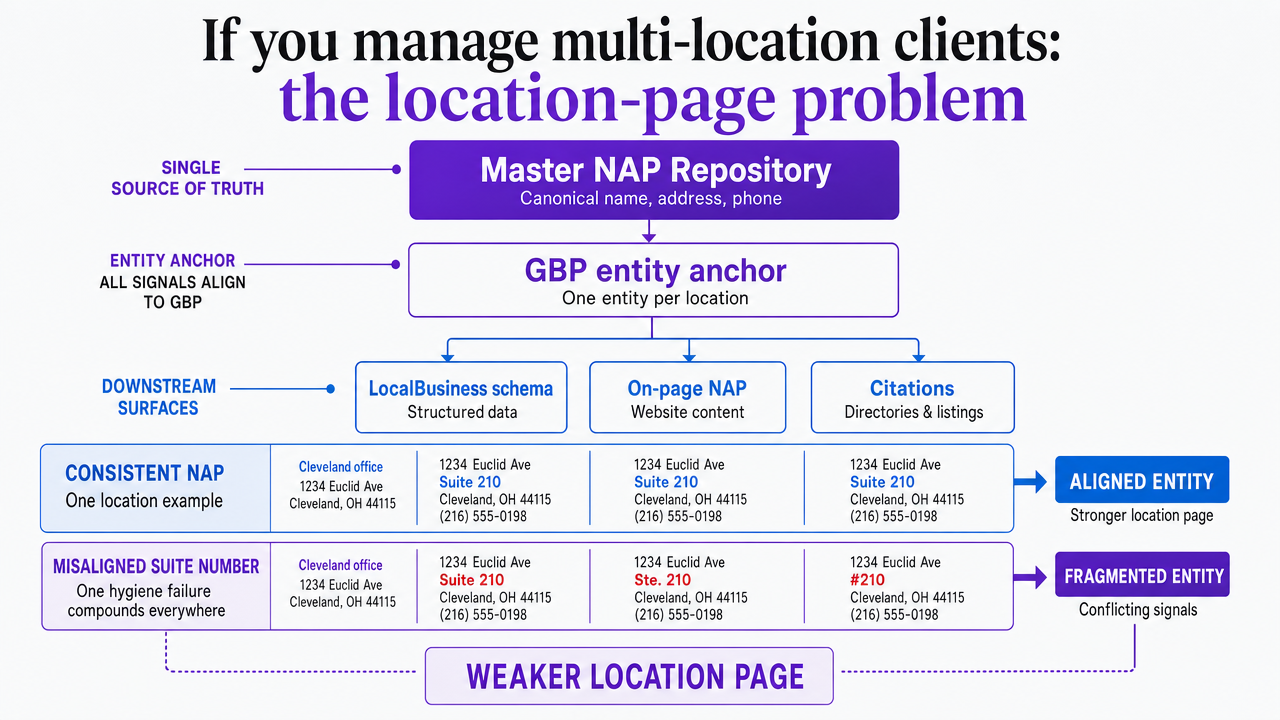 Illustrate the master NAP repository as a single source of truth feeding downstream surfaces (GBP, schema, on-page NAP, citations), matching the article's governance model for multi-location entity consistency
See How Leading Agencies Are Scaling AI Overview Optimization—Without Expanding Teams
Request a walkthrough of unified workflows and measurable outcomes from AI-powered content delivery designed for agencies managing multi-client SEO at scale.
E-E-A-T, author signals, and trust at portfolio scale
Trust is the paramount element in Google's quality framework. The Search Quality Rater Guidelines update that incorporated Experience into E-E-A-T positioned trust as the foundation, with experience, expertise, and authoritativeness contributing to it rather than existing as separate equals 6. For AI Overview citation eligibility, this hierarchy is significant: synthesis draws from pages Google already deems trustworthy on a given topic. This trust assessment relies on visible signals indicating who authored the answer and whether they possess first-hand experience.
At a portfolio scale, author signals cannot be managed on a page-by-page basis. Agencies overseeing 40 or more client sites require a bylining standard integrated into every content template. Each service-page answer block and each condition or FAQ hub should include a named author, a role appropriate to the vertical (e.g., attorney, licensed clinician, board-certified specialist, master plumber), and a link to a comprehensive author profile detailing credentials, licensure, and specific experience. Generic "Content Team" bylines often fail the experience test for YMYL (Your Money or Your Life) queries, which is where AI Overview panels are frequently displayed.
Two supporting signals reinforce the byline. The site name declared in schema and the brand displayed in search results must match the entity a reader would recognize, as inconsistent site naming weakens brand representation in AI-generated experiences 13. Additionally, on-page proof—such as specific procedure names, jurisdiction references, licensure numbers, or dated case results—must be verifiable. This specificity distinguishes an experienced source from a synthesized one for the same query.
Measuring citation share and reporting to clients without the 38% panic
Reporting is the point where the delivery model is tested by the client. A retainer holder who reads a headline about AI Overviews reducing organic clicks will expect an answer during the Quarterly Business Review (QBR). This answer cannot be a defensive slide about traffic loss; it must be a measurement framework that prioritizes citation share as the primary KPI, with organic sessions as a supporting metric.
Three metrics are essential for the report. Citation share is the count of triggered queries in the client's tracked keyword set where the client's domain appears as a linked source within the AI Overview panel, divided by the total triggered queries in that set. Trigger rate is the proportion of tracked queries displaying an AIO, which fluctuates as Google adjusts display thresholds. Answer-block coverage is an internal audit metric: the percentage of trigger-likely pages containing a compliant 40-to-60-word answer block with matching schema 14. The first two metrics describe outcomes, while the third reflects production discipline and predicts the first two.
Organic sessions should remain on the report, but their framing needs to change. Sessions on trigger-likely queries are expected to decrease. Sessions on branded, transactional, and long-tail queries—where AIOs appear less frequently—represent the retention story. Reporting both prevents clients from misinterpreting a natural distribution shift as an agency failure.
Frequently Asked Questions
References
- 1.AI Features and Your Website | Google Search Central | Documentation | Google for Developers.
- 2.Google's Guide to Optimizing for Generative AI Features on Google Search.
- 3.AI Overviews and AI Mode in Search - Google Search.
- 4.Google AI Overviews - Search anything, effortlessly.
- 5.An overview of SGE.
- 6.E-E-A-T – "Experience" Added To Revised Search Quality Raters Guidelines.
- 7.The Complete Guide To Local SEO For Multiple Locations.
- 8.Multi-Location SEO: How To Win Google & AI.
- 9.The Real Playbook for Multi-Location Local SEO in 2026.
- 10.AI Overviews optimization guide: Ranking in Google’s generative results.
- 11.Study Confirms Google AI Overviews Cut Organic Clicks 38%.
- 12.Enterprise Multi-Location SEO: Scale Local Search Success.
- 13.Site names in Search results.
- 14.Introduction to structured data.