
Key Takeaways
- Google confirms no special technical requirements exist for AI Overviews beyond standard indexing eligibility, so pages already competing as top web results are what enter the citation pool 1, 8.
- Agency SEO leads face a throughput problem, not a tactics problem — the bottleneck is how many evidence-dense pages a pod can ship across a portfolio each week.
- Citation density belongs in the brief and QA stages as a production standard, with primary-source quotes, scoped statistics, and at least one citation in the first 200 words.
- Schema hygiene scales when Article properties like author, datePublished, dateModified, headline, and image live in the template and validate against staged URLs before publish 4, 1.
- Topical coverage expands by adding pages that resolve distinct query intents, not by re-slicing existing ones, which keeps portfolios clear of doorway and scaled content abuse enforcement 5.
- An approval-gated loop keeps the strategist as the judgment layer while removing coordination work, so capacity scales with packages reviewed per day rather than pages personally shepherded.
- Modeling per-strategist output requires isolating accounts held, pages per account, review minutes per page, and schema QA minutes — the loop changes where those minutes go, not the eligibility bar 1, 4.
- Compliance controls belong in the pipeline once — distinct query intent per brief, primary-source citations in visible text, and editorial oversight on third-party content — rather than repeated across every page 5, 2.
What Google Actually Requires for AI Overview Eligibility
Google's Search Central documentation is unusually direct on this point: "There are no additional technical requirements" to appear inside AI Overviews or AI Mode beyond standard indexing eligibility 1. The same crawlability, internal linking, page experience, and content-quality signals that qualify a page for regular search results are what make it eligible to be cited in an overview. There is no AI-Overview schema type. There is no GEO markup. There is no separate submission path.
Google's own PDF on AI Overviews reinforces the framing: overviews are assembled from information backed by top web results and include supporting links to those sources 8. In practice, that means the eligibility question is not "how do we optimize for AI Overviews" but "is this page already the kind of page Google would surface as a top result on the underlying query." If the answer is no, tactical GEO changes will not fix it.
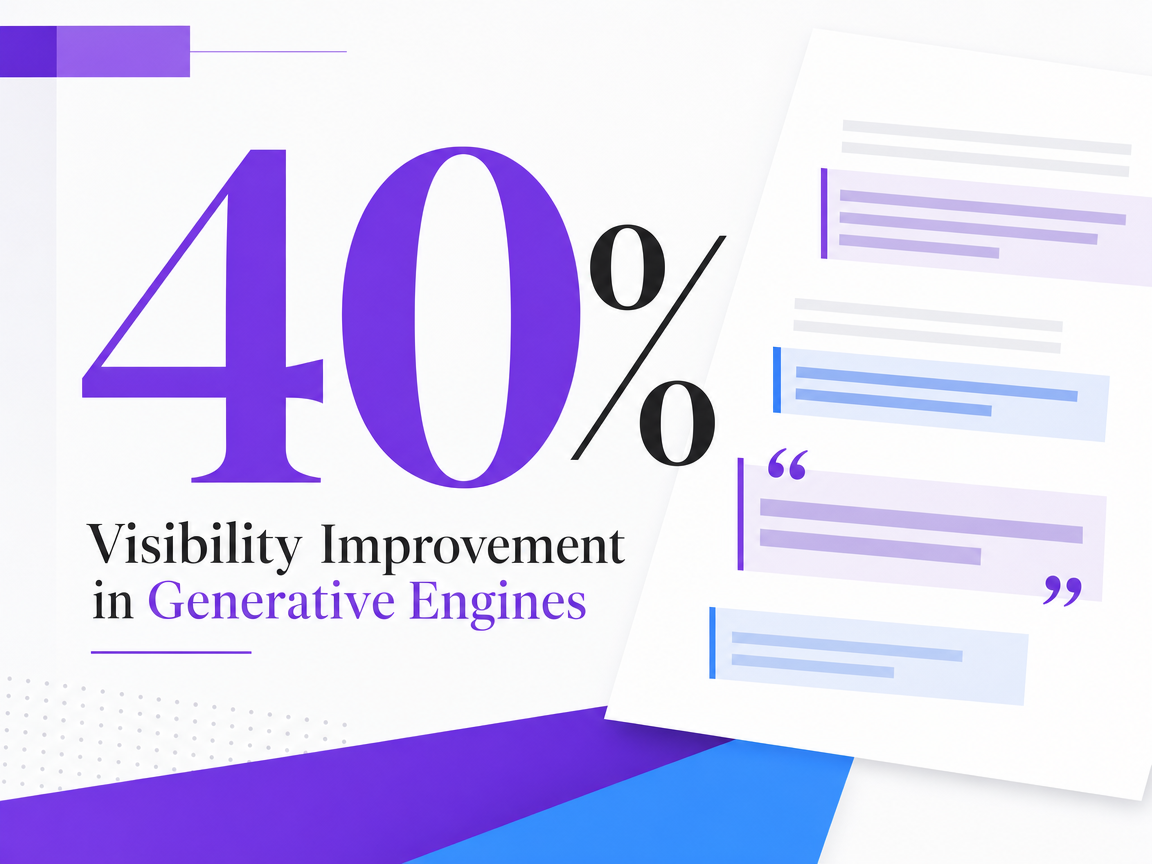
That boundary matters because a parallel industry has grown up selling AI-Overview-specific tactics. Some of it rests on real research. The GEO academic paper, for instance, reported visibility gains of up to 40% in generative engines when pages added citations, quotations, and statistics 7. But that study measured multiple generative engines in a controlled academic setting, not Google's AI Overviews specifically, and a subsequent critical survey of the GEO literature has documented cross-engine inconsistencies and countervailing findings 10. Treating those results as Google-confirmed ranking signals overstates what the evidence supports.
The operational read for agency SEO leaders is straightforward. Build eligibility on what Google has confirmed. Test GEO tactics as directional experiments, not as the foundation. The pages that get cited are the pages that were already competing to be top results — well-structured, evidence-dense, and indexable — not the pages carrying a special badge that competitors missed.
 Visibility Improvement in Generative Engines
Visibility Improvement in Generative Engines
Why Throughput Is the Real Constraint for Agency SEO Pods
The eligibility bar Google describes is not the hard part 1. The hard part is shipping evidence-dense, schema-clean, policy-compliant pages across 40, 80, or 120 client accounts every month without adding a strategist for every ten new sites. That is a throughput problem, not a tactics problem.
A traditional agency pod distributes the work across four roles:
- a strategist scopes topics and briefs,
- a writer drafts,
- an editor tightens, and
- a schema QA layer validates markup before publish.
Each handoff adds queue time. Each queue adds days between a brief being approved and a page going live. Multiply that by a portfolio, and the bottleneck is not idea generation — it is the number of pages a pod can move from brief to indexed URL per week.
AI Overviews compress the tolerance for slow pipelines. Google's own framing is that overviews assemble from top web results and their supporting links 8, which means pages that never reach top-result quality never enter the citation pool. Agencies that cannot ship consistently across every client account end up with a few flagship sites cited and the rest of the portfolio invisible. The response is not to hire more writers or buy more GEO tools. The response is to reduce the human minutes required per published page while keeping the strategist as the approval gate on quality, evidence, and schema.
Citation Density as a Production Discipline
The single most portable finding from the GEO research base is that pages carrying visible citations, direct quotations, and numeric statistics gained up to 40% more visibility in generative engines than pages that relied on keyword-tuned prose alone 7. That study measured multiple generative engines in a controlled academic setup — it did not measure Google's AI Overviews specifically, and a follow-on critical survey has documented that GEO tactics do not always transfer across engines or query types 10. Treat the 40% as a directional signal for how generative systems weight evidence, not as a Google-confirmed lift.
The operational takeaway holds even with that caveat. Pages that quote a named source, attribute a number to a specific study, and link to the underlying document read more like the kind of top-web-result content Google says its overviews draw from 8. Pages that assert without attribution read like commodity content.
At agency throughput, citation density has to be a production standard, not an editorial preference. That means the brief itself specifies a minimum count of primary-source citations per 1,000 words, the writer works from a research packet with pre-approved sources, and the editor rejects drafts that assert numbers without attribution. Retrofitting citations after the fact is where pods lose hours.
Three production rules travel well across client verticals.
- Quote the primary source, not a secondary write-up of it.
- Keep the scope of every statistic in the same sentence as the number — who was studied, when, and on what engine or population.
- Require at least one citation in the first 200 words so the page signals evidence early.
None of these require new tools. They require the strategist to enforce them at the brief and QA stages, not the writer to remember them mid-draft.
Schema Hygiene That Matches What Google Says It Uses
Google's structured-data documentation makes two things clear at the same time. Structured data helps Search understand what a page is about and qualifies it for rich results, and structured data must match the visible text on the page 1, 3. Nothing in that guidance singles out AI Overviews as a separate use case. The same markup that powers rich results is the markup Google says it uses to interpret pages, and interpretation is what determines whether a page reads as a credible top result on the underlying query.
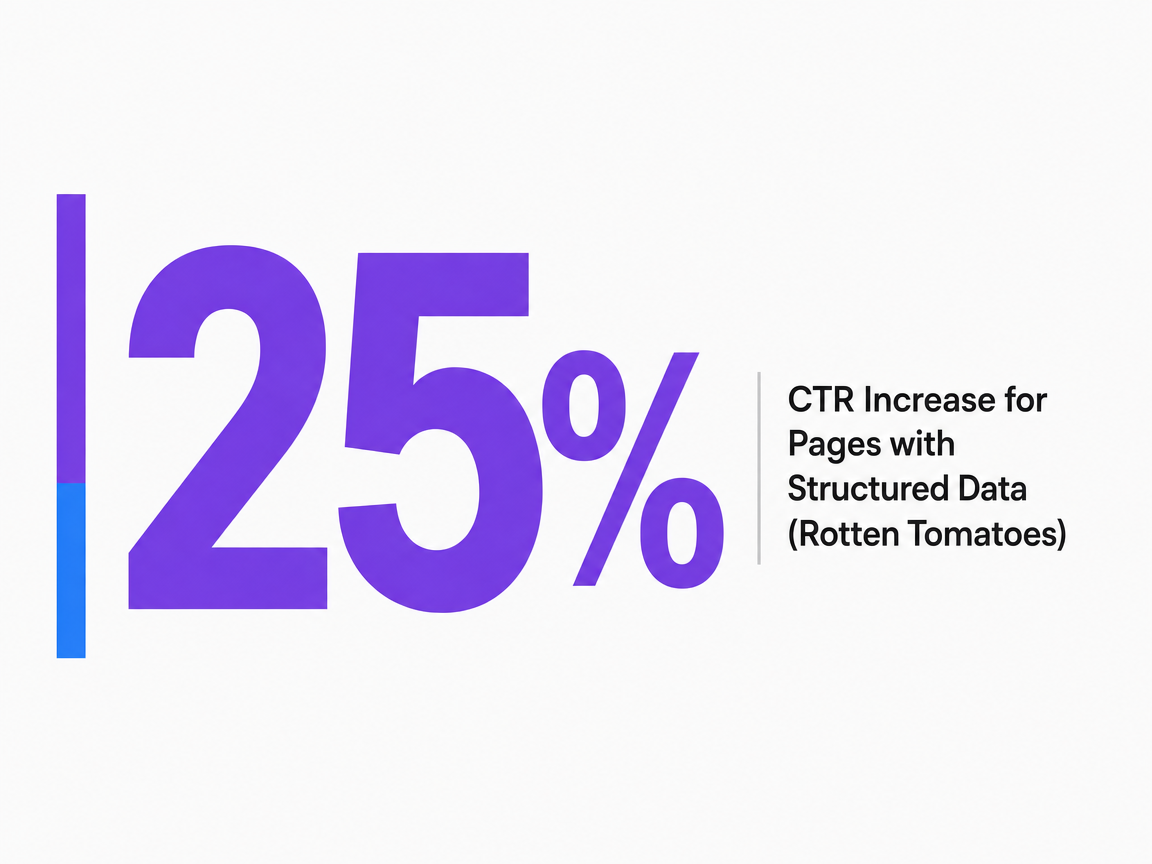
The CTR case data Google publishes on structured data is the most cited evidence for the practice. Rotten Tomatoes reported a 25% higher click-through rate on pages carrying structured data, and Nestlé reported that pages returning rich results had an 82% higher CTR than pages that did not 3. Those are Google-published rich-result CTR examples, not AI Overview inclusion metrics — the distinction matters because agency leaders are often sold schema as an AI Overview lever, and Google has not framed it that way. The value is interpretation and rich-result eligibility, both of which raise the odds a page competes in the top-results pool that overviews are assembled from 8.
At portfolio scale, the failure mode is not missing schema — it is mismatched or drifting schema. Article markup that names an author the page does not credit, a datePublished that never updates when the piece is revised, or a headline field that no longer matches the H1 will fail validation and, more importantly, contradict the visible-text-match rule Google states explicitly 1. For Article, NewsArticle, and BlogPosting pages, Google recommends author, datePublished, dateModified, headline, and image as the core properties 4. Standardizing those five fields across every client template, and treating dateModified as a required update on any material edit, removes the most common source of drift.
The production discipline that scales is treating schema as a publish-blocker, not a post-publish cleanup task. The strategist approves the visible content and the markup in the same review pass. Validation runs against the staged URL before the page ships. Templates carry the required Article properties by default so writers never touch the JSON-LD directly. Done that way, schema hygiene stops consuming strategist minutes per page and becomes a property of the pipeline itself.
Test AI-driven SEO workflows on live campaigns
Experience hands-on optimization and track real results in AI Overviews before making any commitment.
Topical Coverage Without Doorway Behavior
Depth wins citations. Breadth without depth wins enforcement risk. That is the tension every agency SEO lead runs into the moment topical coverage becomes a production quota rather than a strategy — and Google's spam policy names the failure mode directly, listing doorway abuse and scaled content abuse among the behaviors it acts against 5.
The eligibility argument for topical coverage is straightforward. AI Overviews assemble from pages Google already reads as top web results on the underlying query 8. A client site that covers a topic in one thin page rarely reads as authoritative on the query cluster around it. A site that covers the parent topic, the adjacent subtopics, and the specific long-tail questions with distinct, evidence-dense pages reads as a subject-matter source. That is a coverage argument, not a page-count argument.
The doorway line is where agencies get in trouble at scale. Producing twenty near-duplicate pages targeting minor query variants — one per city, one per synonym, one per modifier — is the pattern Google's policy identifies as doorway behavior and, when generated in bulk, as scaled content abuse 5. The test is not whether AI was used to draft the pages. Google has stated separately that appropriate use of AI is not itself a policy violation 9. The test is whether each page carries distinct, useful information a reader could not get from the others on the site.
At portfolio scale, the operational rule is one page per answerable question, with the strategist enforcing that no two briefs in a client's queue resolve the same query intent. Coverage expands by adding new questions, not by re-slicing existing ones.
The Approval-Gated Production Loop
The point of the production loop is to keep the strategist as the quality gate while removing every step where the strategist is doing work a template, a research packet, or a validator could do instead. Google's guidance is that pages become eligible for AI Overviews through the same fundamentals that qualify them for top web results — indexing, crawlability, structured data that matches the visible page, and content that reads as backed by evidence 1, 8. None of that requires the strategist to write the draft. It requires the strategist to approve what ships.
The loop has six stages, and each one has a specific handoff rule:
- Brief carries the target query, the mandatory primary sources, the minimum citation count, and the schema template the page will use.
- Draft is produced against that brief, whether by a writer or with AI assistance — Google has stated that appropriate use of AI is not itself a policy issue 9, but the same guidance is explicit that content generated without adding value can trigger scaled content abuse enforcement 2.
- Schema is applied from the template, not hand-authored per page, so the required Article properties — author, datePublished, dateModified, headline, image — are present by default 4.
- Human approval is the strategist's single review pass on visible content, evidence density, and markup together.
- Publish runs validation against the staged URL as a blocker.
- Measure feeds inclusion and rich-result data back into the brief queue.
What changes when the loop is built this way is the shape of strategist time. In a traditional pod, the strategist spends most of the week briefing, chasing drafts, and reconciling schema mismatches after publish. In an approval-gated loop, the strategist spends the week approving or rejecting completed page packages — draft plus schema plus citations, reviewed together — and the number of accounts one strategist can hold expands with the number of packages they can review per day, not the number of pages they can personally shepherd. The strategist stays the judgment layer. The pipeline absorbs the coordination cost.
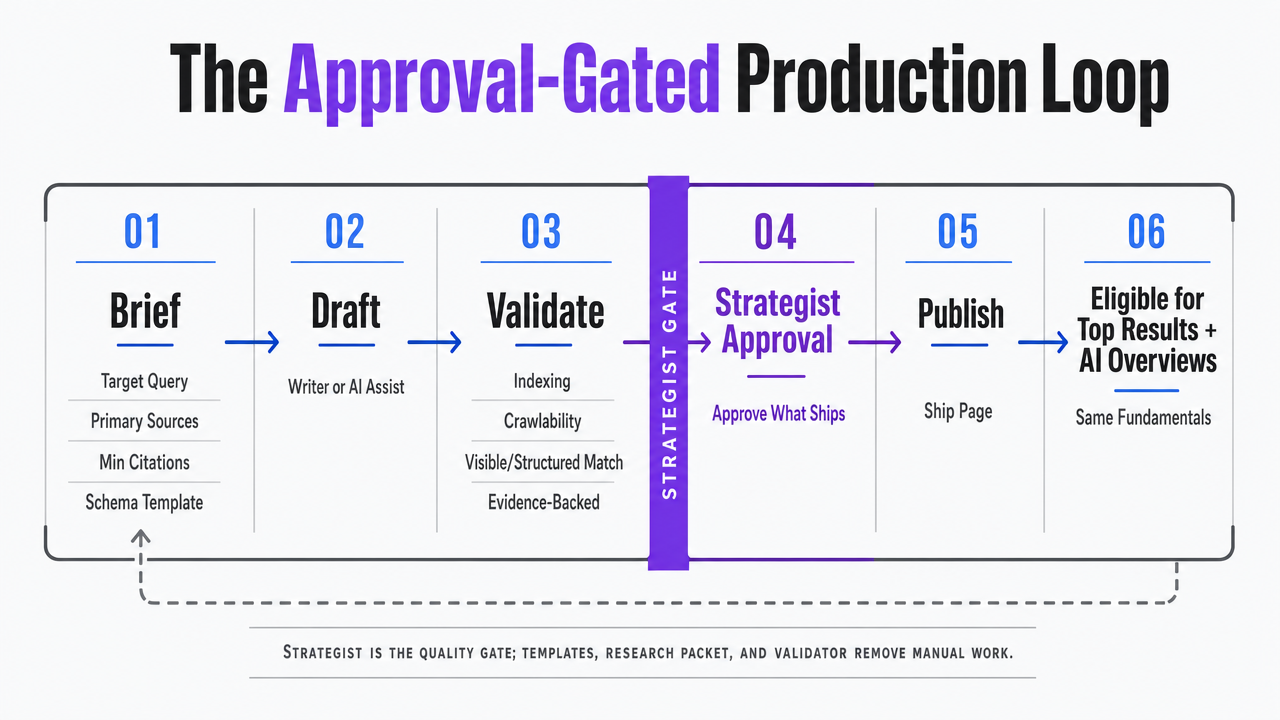 Visualize the six-stage approval-gated production loop described in the section as a horizontal process flow, making the strategist's single approval gate visible
Per-Strategist Output Under Two Operating Models
The point of this section is not to assert what an agency should save. It is to give SEO leads a worksheet that isolates the variables that actually determine per-strategist throughput, so a portfolio plan can be modeled against real inputs rather than vendor promises.
Four variables do most of the work:
- Accounts held per strategist.
- Pages shipped per account per month.
- Strategist review minutes per page under the current handoff structure.
- Schema QA minutes per page.
Everything else — writer capacity, editor availability, tooling cost — flows downstream of those four. The comparison below holds the output target constant and shows where the minutes go under each model. Numbers in the table are variables to populate, not benchmarks to accept.
| Input | Traditional Pod (strategist + writer + editor + schema QA) | Approval-Gated Loop (strategist reviews completed packages) |
|---|---|---|
| Accounts per strategist | A₁ | A₂ |
| Pages per account per month | P | P |
| Strategist minutes per page (brief + chase + reconcile) | M₁ | — |
| Strategist minutes per page (single approval pass on draft + citations + schema) | — | M₂ |
| Schema QA minutes per page | Q₁ (post-publish cleanup common) | Q₂ (template-default; validator-gated) |
| Monthly strategist minutes consumed | A₁ × P × (M₁ + Q₁) | A₂ × P × M₂ |
Two mechanics change the math. First, schema stops consuming per-page strategist minutes when the Article properties Google recommends — author, datePublished, dateModified, headline, image — are carried by the template and validated against the staged URL before publish 4. Second, the strategist's review collapses into a single pass on the completed package instead of separate touches on brief, draft, and post-publish schema reconciliation. Neither mechanic changes the eligibility bar Google describes 1. Both change how many accounts the same strategist can hold at that bar.
Agency leads should populate the table with their own A, P, M, and Q values before deciding whether the loop is worth building. The output is a capacity plan, not a savings claim.
See How Leading Agencies Secure Top Visibility in AI Overviews—Without Expanding Teams
Request a data-driven walkthrough of scalable workflows that consistently place clients in AI-generated search results—while maintaining strategic oversight and resource efficiency.
One Compliance Section, Not Ten Scattered Warnings
Spam-policy risk is easier to manage when it lives in one place in the operating plan rather than scattered across every brief as a footnote. Google's enforcement categories that matter for agency-scale content production are named in a single policy document: scaled content abuse, site reputation abuse, doorway abuse, and machine-generated traffic 5. Reading that policy end-to-end once, and mapping each named behavior to a specific pipeline control, does more for portfolio safety than repeating warnings inside individual page briefs.
The boundary Google draws is intent- and quality-based, not tool-based. Appropriate use of AI or automation is not itself against the guidelines 9, and the current generative-AI guidance repeats that framing while naming the failure mode directly: using generative AI tools to generate many pages without adding value for users may violate the scaled content abuse policy 2. The March 2024 update sharpened enforcement against very low-value, third-party content produced primarily for ranking purposes 6. None of those statements disqualify AI-assisted production. All of them disqualify volume without value.
Three pipeline controls convert that policy into operational safety:
- Every brief resolves a distinct query intent that no other page in the client's queue is resolving, which addresses the doorway line directly 5.
- Every draft carries primary-source citations and named studies in the visible text, which is the value-add test the generative-AI guidance describes 2.
- No client site publishes third-party content on behalf of an outside party without editorial oversight, which is the site reputation abuse line 5.
Those three checks run at approval, not at post-publish audit.
The operational payoff is that the strategist stops re-litigating compliance on every page. The controls live in the pipeline. The approval gate confirms them once, and the portfolio scales without the policy risk scaling with it.
If You Manage Multi-Location or Franchise Portfolios
The scope shifts here. Multi-location brands, DSOs, home-services franchises, and senior-living operators run a different problem than single-site clients: dozens or hundreds of location pages competing on near-identical query intent, separated only by geography. That structure is where doorway abuse enforcement lives, and Google's policy names the pattern explicitly 5.
The operational line is that each location page has to earn its own evidence. A location page that repeats the parent brand's service copy with the city name swapped in fails the value-add test the generative-AI guidance describes 2. A location page that carries the actual practitioner names, the specific services offered at that address, local case data, and location-specific FAQs reads as a distinct source. Same Article schema template, same required properties 4, different visible evidence per URL.
At franchise scale, the approval gate moves up one level. The strategist approves the location-page template and the evidence requirements once, then reviews packages against that standard rather than rewriting each location from scratch. Portfolio coverage expands by adding real locations with real evidence, not by cloning pages across ZIP codes.
Measuring Inclusion When the Data Is Thin
Search Console does not yet report AI Overview inclusion as a discrete surface, and Google's own guidance on AI features does not promise it will 1. That leaves agency SEO leads measuring a citation event they cannot directly query. The workable response is to instrument what is measurable and stop pretending the rest is precise.
Three signals carry most of the weight:
- Tracked query-level appearance checks on the client's priority query set, run on a fixed cadence from a neutral environment, and logged as a binary cited/not-cited per URL.
- Rich-result impressions and CTR from Search Console on the same URLs, since Google frames overviews as assembled from top web results and their supporting links 8.
- Referral behavior from AI surfaces where it is attributable, treated as directional rather than complete.
The reporting rule that holds up is to report inclusion rate as a portfolio metric across the tracked query set, not as a per-page win. Individual citations churn. Portfolio inclusion rate moves with the pipeline quality the strategist actually controls, which is the number the approval-gated loop is built to lift.
 CTR Increase for Pages with Structured Data (Rotten Tomatoes)
CTR Increase for Pages with Structured Data (Rotten Tomatoes)
Frequently Asked Questions
References
- 1.AI Features and Your Website | Google Search Central.
- 2.Google Search's Guidance on Generative AI Content on Your Website.
- 3.Introduction to structured data markup in Google Search.
- 4.Learn About Article Schema Markup | Google Search Central.
- 5.Spam Policies for Google Web Search.
- 6.New ways we're tackling spammy, low-quality content on Search.
- 7.GEO: GENERATIVE ENGINE OPTIMIZATION.
- 8.AI Overviews and AI Mode in Search - Google Search.
- 9.Google Search's guidance about AI-generated content.
- 10.A Critical Survey of Generative Engine Optimization (2023– ...).