
Key Takeaways
- Write client contracts around first-party pipeline metrics like qualified calls or booked appointments, defined by source system and attribution window, so quality disputes reference shared definitions rather than lagging ranking proxies 1.
- Encode canonicalization, mobile parity, structured data, and Core Web Vitals thresholds into shared templates so technical quality ships as a default instead of being rediscovered in monthly audits 5, 6, 8.
- Enforce a mandatory human editorial review layer with vertical-familiar editors working from a people-first checklist, because heavy optimization patterns can undercut how expert readers perceive credibility on YMYL pages 2, 4.
- Run weekly render diffs, monthly pipeline reviews, and quarterly editorial audits with named owners and pre-agreed thresholds, so template regressions and content drift surface before clients notice them 2, 8.
- Govern AI-assisted drafting using the NIST AI Risk Management Framework's Govern, Map, Measure, and Manage functions, with source verification on every YMYL draft and versioned prompt templates reviewed quarterly 12.
- Recalculate strategist capacity quarterly using H, A, and Q variables rather than treating the account ceiling as fixed, since new content types or hiring gaps collapse the ratio before retention numbers reveal it.
- Refuse a separate AI Overviews optimization track; eligibility follows from indexing, extractable text, accurate structured data, and mobile page experience already governed by the production system 3, 7, 11.
- For multi-location portfolios, force genuinely distinct first-party content into every location page and generate sitemaps programmatically, because a declared canonical is a signal Google can override 9, 10.
Why Individual Heroics Stop Working at 30 Accounts
The math of agency SEO breaks somewhere between the 15th and 30th account. A senior strategist who can hold four clients in working memory, run a monthly technical sweep, brief writers, and personally edit YMYL drafts starts missing meta descriptions, then canonicals, then whole content calendars. Retention drops before rankings do, because clients feel the attention loss two quarters before it shows up in Search Console.
The reflex response is to hire more specialists or buy more workflow software. Neither addresses the actual failure mode: delivery quality depends on which strategist owns the account, not on a system the agency can point to. When the senior person is on PTO, the account regresses. When they leave, the account churns.
Google's own guidance frames the work as principle-based rather than formulaic. Search Essentials describes crawlability, helpful content, descriptive page elements, and appropriate indexing controls as the substrate of visibility 1. Page experience is explicitly a collection of signals, not a single ranking switch 11. Principles do not scale through memorization. They scale through templates, review gates, and documented criteria that any qualified strategist on the team can apply the same way.
The rest of this piece treats predictable client outcomes as an output of four fixed layers: outcome contracts tied to first-party pipeline data, a technical baseline enforced by templates, an editorial standard that survives volume, and a review loop that catches drift before the client does. Volume is a byproduct. Governance is the product.
The Four-Layer Production System
Outcome Contracts Tied to First-Party Pipeline Data
Ranking reports are a lagging proxy for the outcome the client actually pays for. A law firm cares about qualified consultations booked, not position three for a head term. A DSO cares about new-patient appointments per location. A senior living operator cares about tour requests attributable to organic sessions. Contracts written around keyword positions invite disputes the agency cannot win, because ranking movement and pipeline movement decouple regularly.
The fix is to write the contract around two or three first-party metrics the client already trusts. Qualified calls from organic sessions, form completions with a lead-quality flag, booked appointments sourced through a tagged landing path. These come from the client's CRM, call-tracking platform, or booking system, not from a third-party rank tracker. Google's own framing supports this move: Search Essentials treats visibility as a byproduct of helpful content and crawlable pages rather than a guaranteed output of any single tactic 1.
Outcome contracts also change the internal review conversation. When strategists open a monthly account review with pipeline deltas rather than average position graphs, drift becomes visible earlier. A 12% drop in qualified organic calls surfaces before a client emails to ask why traffic feels flat.
Two rules keep these contracts defensible. Define the metric, the source system, and the attribution window in the statement of work, so quarterly disputes reference the same definitions the agency wrote in month one. Publish the metric on a dashboard the client can open without a strategist present. Contracts that hide the number invite mistrust; contracts that expose the number force both sides to improve the same thing.
A Technical Baseline Enforced by Templates, Not Audits
Monthly audits are how quality slips at scale. An audit finds problems after they ship. A template prevents them from shipping. Agencies running 30 or more accounts should stop paying strategists to rediscover the same crawl, render, and metadata failures across client sites and start paying engineers once to encode the fix into a shared component library.
The template stack has to answer a fixed set of questions before any client site goes live:
- Does the mobile rendering contain the same primary content, metadata, structured data, and internal links as desktop, with no lazy-loaded core content that requires user interaction 5?
- Does every client-rendered route return a stable HTML canonical, and does the rendered DOM expose the same links a crawler needs to reach adjacent pages 8?
- Does structured data on every template correspond to visible page content, with no hidden or misleading fields 7?
- Is the sitemap generated programmatically, restricted to canonical URLs, and submitted through the Search Console API rather than hand-maintained per client 9?
Performance sits on the same baseline. Templates should be measured against the Web Vitals thresholds for the 75th percentile of real users:
- Largest Contentful Paint within 2.5 seconds
- Interaction to Next Paint at or below 200 milliseconds
- Cumulative Layout Shift at or below 0.1 6
These numbers are not aspirational targets to be hit later. They are release criteria. A template that fails any of the three at the 75th percentile in field data does not get promoted to a client account; it goes back to engineering.
Page experience remains a collection of signals rather than a single switch, so templates also encode secure delivery, an absence of intrusive interstitials, and clear separation of main content from surrounding elements 11. Encoding these decisions once removes them from the strategist's daily surface area. The strategist stops auditing and starts owning outcomes.
The operational payoff is measurable. When the technical baseline lives in the template, onboarding a new account collapses from a multi-week audit-and-remediate cycle to a template deployment plus content migration. Canonicalization rules, hreflang patterns, structured data shapes, and internal linking conventions ship as defaults rather than tickets. Regression risk drops because every client inherits the same fix when the template updates.
An Editorial Standard That Survives Scale
The instinct at scale is to ship more optimized content faster. Google's people-first guidance pushes in the opposite direction: originality, demonstrated expertise, completeness, first-hand experience, and a clear reason the page exists 2. These are editorial judgments, not template fields, and they do not survive a production line that treats writers as interchangeable throughput.
The counterintuitive evidence sharpens the point. A 2023 study of health-related webpages evaluated by 61 laypeople and experts found that non-optimized pages received higher expertise ratings than their optimized counterparts, suggesting that visible SEO signals can undercut how readers perceive credibility 4. Scope matters: the sample is small, the vertical is health, and the measure is human perception rather than ranking behavior. The finding does not generalize to every industry or query type. It does, however, put a specific operational constraint on YMYL production: heavy-handed optimization patterns can make expert content read as less expert to actual experts, which is the audience most YMYL clients recruit patients, clients, or residents from.
The operational takeaway is a mandatory human editorial review layer, staffed by editors with subject familiarity in the vertical, applied to every YMYL draft regardless of who or what produced the first version. The review checks four things:
- whether the page reflects first-hand experience or verifiable source material,
- whether claims are attributed to authorities the vertical recognizes,
- whether the writing reads like an operator rather than a marketer, and
- whether optimization patterns like keyword-dense subheads or over-formatted answer blocks distort the voice.
Scaling this without adding headcount per account requires editors to work against a checklist rather than intuition. The checklist mirrors the helpful-content evaluation questions 2:
- Would a reader feel they got the answer?
- Does the page demonstrate someone actually did the work?
- Is the byline attributable to a person with real credentials?
- Would the client's own subject-matter expert sign it?
A draft that fails any of these does not ship, regardless of how well it scored in a content brief tool.
Editorial standards enforced at scale are what keep the technical baseline from producing polished-looking pages that erode the client's authority in their own market.
A Review Loop That Catches Drift Before Clients Do
Drift is what kills accounts that looked healthy last quarter. A template update breaks structured data on a subset of location pages. A CMS migration silently strips canonical tags from paginated archives. A writer swaps in a new intro pattern that reads like ad copy. None of these show up in a monthly rank report; all of them show up in a churn call three months later.
A review loop built for scale runs on three cadences, each with a fixed owner and a fixed artifact:
- Weekly, an automated crawl compares the live rendered DOM of a sampled set of URLs per account against the template's expected output, flagging canonical mismatches, missing structured data fields, and render failures on JavaScript routes 8. The artifact is a diff report a strategist reviews in under 20 minutes per account.
- Monthly, a pipeline review compares the first-party metrics named in the outcome contract against the prior 90 days, filtered by landing template and geography. The artifact is a one-page delta with two flagged threshold breaches maximum, so the strategist prioritizes rather than triages.
- Quarterly, an editorial audit pulls a random sample of shipped content per account and re-scores it against the people-first checklist 2. The artifact is a scorecard the editorial lead reviews with the strategist, and any failures trigger a rewrite queue rather than a note in a project management tool.
The loop only works if the artifacts are short, the owners are named, and the thresholds are pre-agreed. Long reports get skimmed. Ambiguous ownership means no one acts. Threshold breaches without pre-agreed responses turn every drift signal into a meeting.
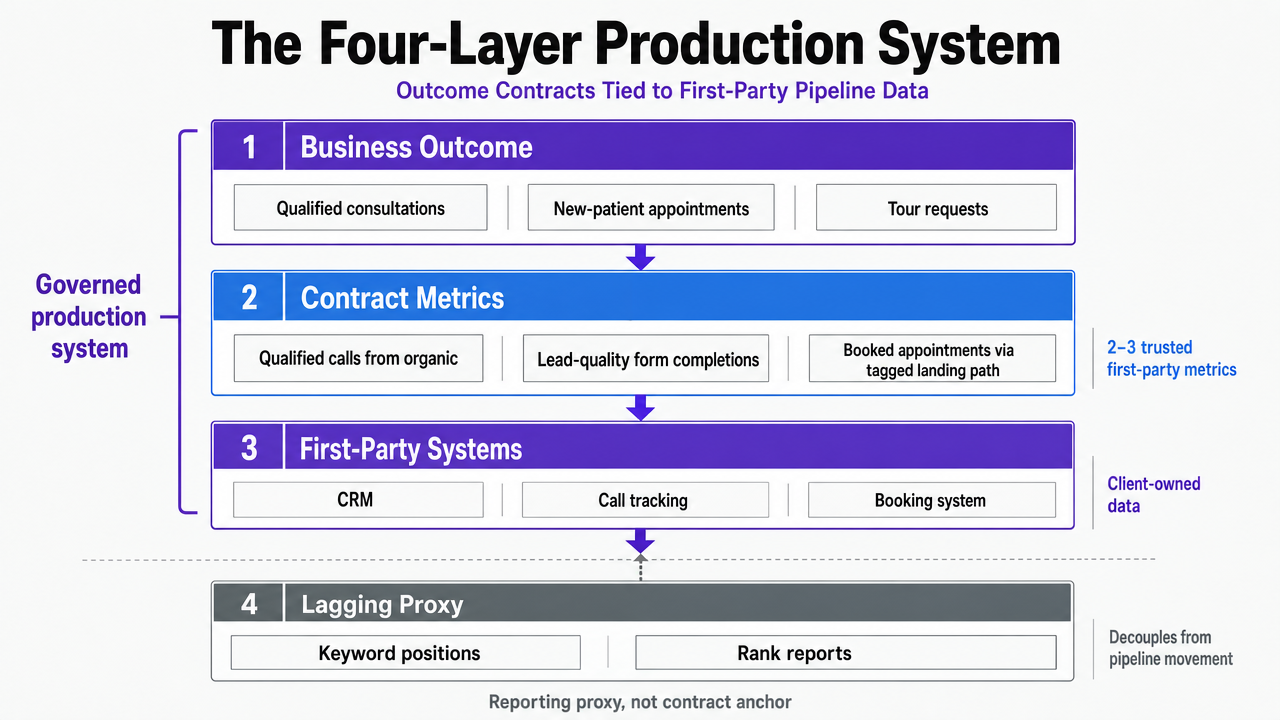 Visualize the four-layer governed production system that structures the entire article's operating model, giving readers an anchor diagram for the sections that follow
Governance for AI-Assisted Production
AI-assisted drafting collapses production time, and that speed is precisely what makes ungoverned use dangerous for a client book. A hallucinated citation in a legal explainer or a fabricated dosage reference in a behavioral health page does not stop at one client's site; it becomes a portfolio-wide liability the moment the same prompt template ships across 40 accounts. Governance has to sit above the tools, not inside them.
The NIST AI Risk Management Framework provides a defensible spine for that governance layer, and its July 2024 Generative AI Profile addresses the failure modes specific to generative systems 12. The framework organizes controls into four functions that map cleanly onto agency production:
Govern : Sets the policy layer: written criteria for which content types may use AI drafting, which require licensed human authorship, and who signs off before publication.
Map : Identifies where AI touches the pipeline and what could go wrong at each touchpoint: source hallucination, biased phrasing, privacy exposure through prompt logs, or structured data that misrepresents visible content 7.
Measure : Defines the monitoring KPIs: factual accuracy rate on sampled drafts, editorial rejection rate by writer or model, and downstream indicators like manual action reports and quality-related traffic drops.
Manage : Specifies the response protocol when a threshold breaches, including rollback, client notification, and root-cause review.
Two agency-specific controls translate the framework into daily practice:
- Every AI-assisted draft on a YMYL account carries a source verification pass before it reaches the editor.
- Every prompt template used across more than one client is versioned, reviewed quarterly, and retired when the underlying model changes.
Governance is what lets an agency use AI at scale without exporting model risk to its clients.
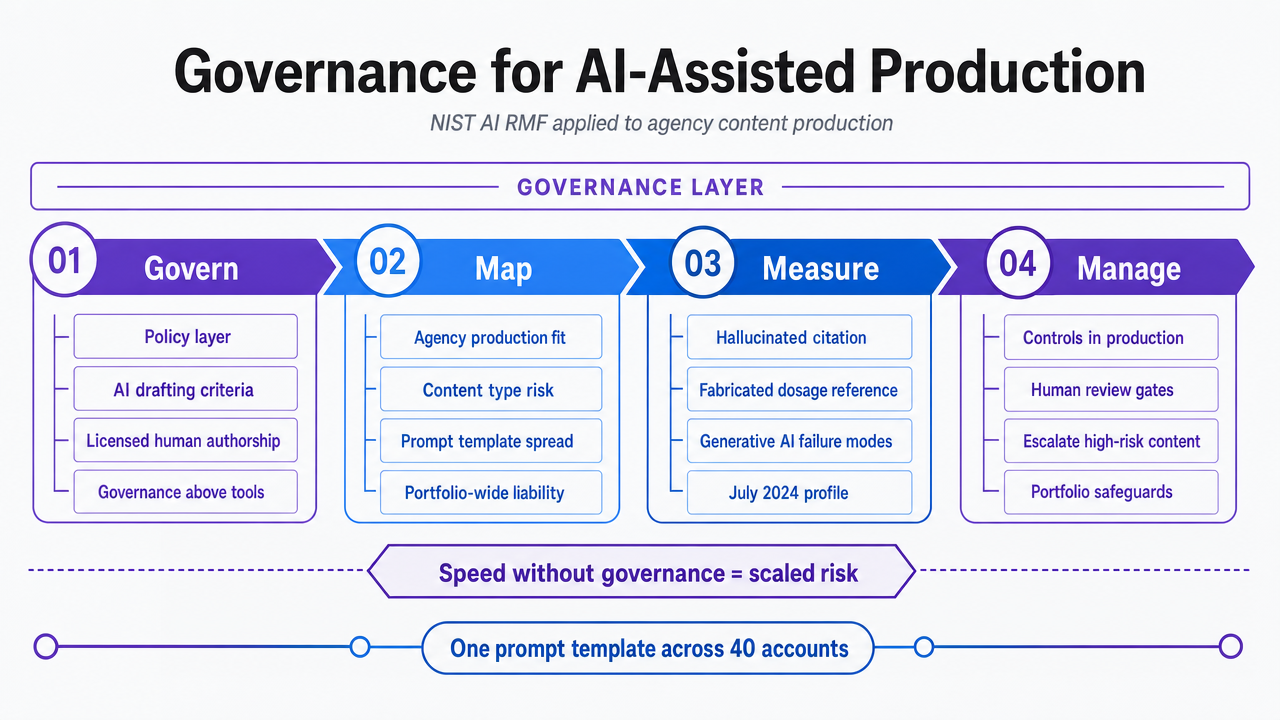 Visualize the NIST AI Risk Management Framework's four functions (Govern, Map, Measure, Manage) as applied to agency AI-assisted content production, directly supporting the section's operational guidance
Test real-time SEO execution across multiple clients
Experience measurable workflow efficiency and publish live SEO content at scale during your free trial.
Capacity Planning and Consolidation Economics
Capacity math at the portfolio level, not the account level, is what tells an agency whether it can absorb another 20 clients without a quality collapse. The relevant variables are consistent across delivery models:
H : The productive hours a senior strategist has in a month after meetings and internal work.
A : The number of accounts assigned to that strategist.
Q : The QA hours per deliverable required to hold the editorial and technical standard.
The ratio H divided by (A times monthly deliverables times Q) is the honest capacity number. When it drops below one, quality slips before anyone admits it.
Three delivery models produce very different values for that ratio. The comparison below uses explicit variables rather than industry-wide averages, because agency cost structures diverge too much for a single benchmark to be useful.
| Delivery Model | Accounts per Senior Strategist | Hours per Account per Month | QA Coverage | Onboarding Time |
|---|---|---|---|---|
| Traditional pod (specialist per discipline) | 4–6 | H / A, high per-account load | Ad hoc, owner-dependent | 4–8 weeks of audit and remediation |
| Generalist strategist plus freelancers | 8–12 | Reduced, but Q rises as freelancer variance grows | Sampled, inconsistent | 2–4 weeks, variable |
| Governed production system (templated baseline plus AI-assisted drafting plus human editorial review) | 15–25 | Lower fixed Q per deliverable because template QA is pre-paid | Systematic, tied to release criteria 6, 7 | 1–2 weeks, template deployment plus migration 9 |
The governed model shifts cost from recurring per-account labor to one-time template engineering and standing editorial review. Onboarding compresses because canonicalization rules, structured data shapes, mobile parity checks, and sitemap generation ship as defaults rather than tickets 5, 10. Strategist time redirects from audit rediscovery to outcome analysis and client-facing judgment, which is the work that actually protects retention.
The planning discipline is to recalculate the ratio quarterly with real numbers. When H drops because of hiring gaps or when Q rises because a new content type entered the mix, the strategist load ceiling moves down, not up. Agencies that treat the ceiling as fixed are the ones that discover it broke in a churn call.
Where AI Overviews Fit (and Where They Do Not)
The generative-search anxiety cycle has produced a small industry of GEO tactics, dedicated AI markup schemas, and consulting decks arguing that AI Overviews demand a parallel optimization track. Google's own documentation says otherwise. Pages appear as supporting links in AI Overviews and AI Mode when they are indexed and eligible for ordinary Search snippets, and the guidance states plainly that there are no additional requirements or special optimizations necessary 3.
That is a directive to agency heads, not a reassurance. It means the levers that already govern portfolio delivery are the same levers that govern AI Overview eligibility:
- crawlability,
- textual content that a renderer can extract,
- internal links that expose adjacent pages,
- accurate structured data that matches what a reader sees, and
- page-experience signals that hold up on mobile 3, 7, 11.
Agencies that have industrialized the technical baseline and editorial standard already qualify. Agencies that have not will not close the gap by adding an AI-specific worksheet.
The operational takeaway is to refuse the separate track. AI Overview performance belongs in the same monthly pipeline review as organic sessions, filtered by landing template rather than tracked in a sidecar report. When a client asks about GEO, the honest answer is that the work is already scoped, and diverting budget to speculative markup is a tax on the fundamentals that actually move visibility.
See How Leading Agencies Standardize SEO Delivery—Without Expanding Teams
Request a walkthrough of AI-powered workflows that let agency teams coordinate, approve, and execute scalable SEO strategies for multiple clients—maintaining quality and oversight at every step.
Portfolio Considerations for Multi-Location and Franchise Books
The system changes shape when the account is not a single brand but a network of 40 dental locations, 120 franchise territories, or 25 senior living communities under one parent. The strategist is no longer optimizing a site; they are governing a template that renders hundreds of near-duplicate pages, each with its own local intent, NAP data, and service mix.
Canonicalization is the first place multi-location work goes wrong. Location pages that share 80% of their copy across geographies invite Google to consolidate signals onto a single URL the agency did not choose, and a declared canonical is a signal rather than a command 10. The template response is to force meaningful differentiation into the first-party content zones on every location page: staff bios, local case examples, community references, service hours, and photography that a crawler can verify is unique per URL. Faceted URLs, tracking parameters, and session variants get canonicalized or excluded from the sitemap, which should be generated programmatically per brand and submitted through the Search Console API rather than maintained by hand across the portfolio 9.
Structured data multiplies the same way. LocalBusiness, Physician, Dentist, or LodgingBusiness markup has to correspond to what a reader actually sees on each location page, with no fields carried over from a master template that no longer match the local reality 7. A quarterly diff between rendered content and emitted markup catches the drift that CMS updates introduce silently. On JavaScript-rendered location finders, the same render-parity check applies: crawlers must reach individual location URLs through HTML links, not through client-side routing that only resolves on user interaction 8. Portfolio scale rewards the agency that treats every location page as an instance of one governed template, not as 400 accounts in a trench coat.
A 90-Day Path to a Governed Delivery Model
The transition from hero-dependent delivery to a governed system does not require pausing client work. It requires sequencing the four layers so each one becomes a default before the next lands on top of it.
- Days 1–30: Rewrite outcome contracts and instrument the pipeline. Pick the three accounts with the most defensible first-party data and rewrite their statements of work around qualified calls, form completions with a lead-quality flag, or booked appointments. Publish a shared dashboard per account. This is the layer that changes the internal review conversation before any engineering ships 1.
- Days 31–60: Ship the technical baseline as a template. Engineering encodes canonicalization rules, mobile parity, HTML canonicals on JavaScript routes, programmatic sitemap generation, and structured data that matches visible content 5, 7, 8, 9, 10. Release criteria are the Web Vitals thresholds at the 75th percentile 6. New accounts onboard onto the template; existing accounts migrate on a scheduled cadence rather than a fire drill.
- Days 61–90: Stand up the editorial standard and the review loop. Hire or assign vertical-familiar editors, publish the people-first checklist 2, and codify the weekly render diff, monthly pipeline review, and quarterly editorial audit with named owners. Layer the NIST-aligned governance controls on top for AI-assisted drafts 12. By day 90, quality no longer depends on which strategist owns the account.
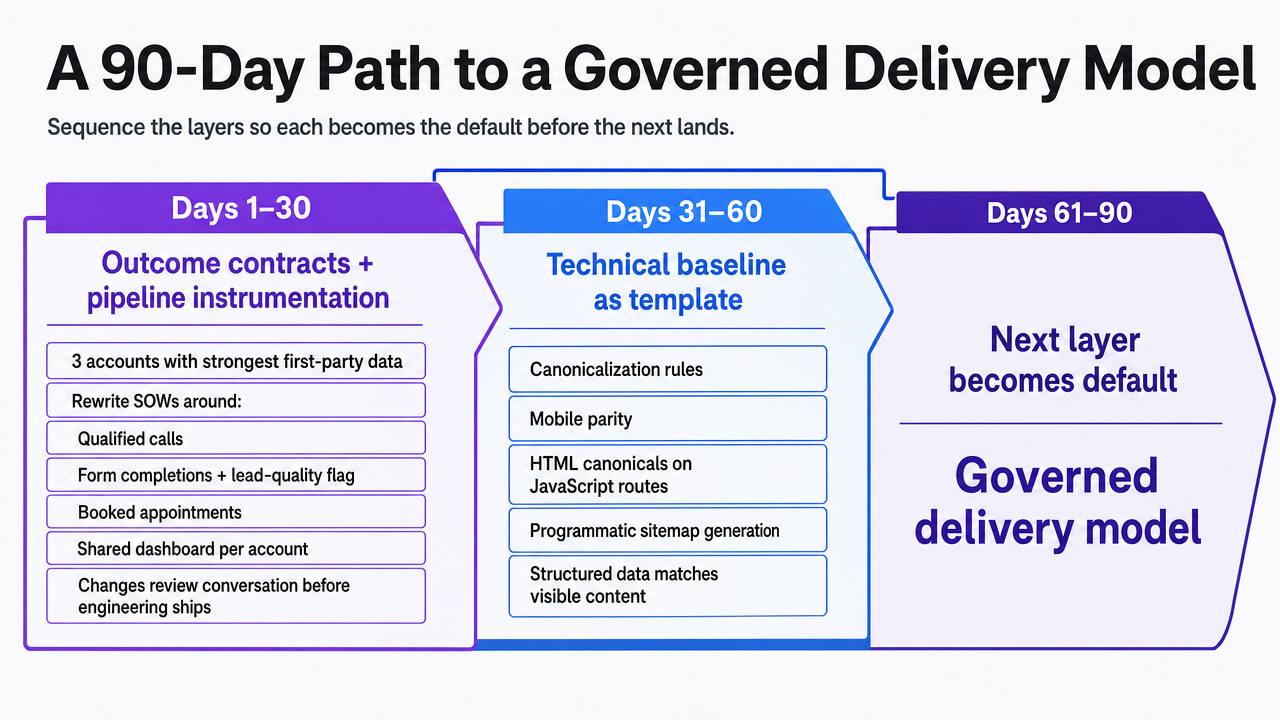 Visualize the three-phase 90-day implementation roadmap described in the section, giving readers a scannable timeline of the sequenced rollout
Frequently Asked Questions
References
- 1.Google Search Essentials (formerly Webmaster Guidelines).
- 2.Creating Helpful, Reliable, People-First Content.
- 3.AI Features and Your Website.
- 4.Does Search Engine Optimization come along with high-quality content? A comparison between optimized and non-optimized health-related web pages.
- 5.Mobile-first Indexing Best Practices.
- 6.Web Vitals.
- 7.General Structured Data Guidelines.
- 8.Understand JavaScript SEO Basics.
- 9.How to create a sitemap.
- 10.What is URL Canonicalization.
- 11.Understanding page experience in Google Search results.
- 12.AI Risk Management Framework.