
Key Takeaways
- Build a standards library first: codified title tag, metadata, and internal linking templates let non-specialists produce compliant pages without routing every decision through a senior reviewer.
- Run an intake queue with four required fields—target query, page type, pipeline stage, and internal owner—so low-value ad hoc requests fail before consuming production capacity.
- Govern AI-assisted production by mapping the NIST AI RMF's Govern, Map, Measure, and Manage functions 4onto policy, intake classification, QA scoring, and post-publish monitoring for defensible throughput.
- Schedule maintenance in tiers—quarterly for high-value commercial pages, semi-annual for mid-tier, annual for the full catalog 1—so audits feed the intake queue instead of becoming cleanup emergencies.
- For multi-location operators, consolidate vendors and briefing cycles into one governed workflow against a shared standards library, since each codified rule pays back across every market.
- Report organic contribution as sessions, leads, qualified opportunities, and closed pipeline by cluster, treating rankings as a leading indicator rather than the headline metric finance evaluates.
- In the first 90 days, sequence the build: standards library and CMS enforcement, then intake queue and AI governance policy, then source tags, cluster mapping, and the first tiered audit.
The staffing trap in organic search
Most marketing leaders inherit the same organic growth playbook: hire another SEO specialist, retain an agency for content production, layer a technical consultant on top, and hope the handoffs hold. Two quarters later, the pipeline math rarely improves. Briefing cycles multiply. Approval queues stretch. The cost per published page climbs while output stalls.
The assumption underneath that playbook is that SEO scales with headcount. It does not. Federal agencies, university medical centers, and multi-brand regulated organizations publish tens of thousands of pages against strict compliance rules with central teams that are smaller, not larger, than most in-house marketing groups. The U.S. Department of Energy runs its search program off a codified standards document rather than a bench of specialists 9. Digital.gov treats page titles, meta descriptions, robots.txt, and XML sitemaps as repeatable publishing tasks any content owner can execute 2.
The gap between those operations and a typical in-house team is not talent. It is the operating model. Organic growth stalls when the work lives inside individual specialists instead of inside standards, queues, and approval gates. The VP's job is to build that system, not to keep staffing the old one. Everything that follows is a blueprint for doing that with the team already on payroll.
Why lean SEO is a systems design problem
Organic search rewards consistency at scale. A single page ranks because a thousand adjacent decisions—title construction, internal link targets, canonical rules, metadata hygiene, refresh cadence—were made the same way, in the same voice, against the same standard. Specialists deliver that consistency through experience. Systems deliver it through codified rules that anyone on the team can apply without re-litigating each decision.
That distinction is what separates a growing organic channel from a stalled one. When the work lives in a person, throughput caps at whatever that person can review this week. When the work lives in a documented standard, throughput caps at whatever the approval queue can process. Digital.gov's optimization guidance treats HTML page titles, meta descriptions, robots.txt, and XML sitemaps as accessibility and discoverability tasks any content owner can execute against a checklist, not as specialist judgment calls 2. The Department of Energy operationalizes the same principle across a federal footprint by writing the rules down instead of adding reviewers 9.
The implication for the VP running a team of three to eight is direct. Growing organic contribution without adding headcount means shifting effort from producing individual pages to producing the standards, queues, and approval gates that produce pages. The remaining sections work through that build: a standards library, an intake and prioritization queue, a governance layer for AI-assisted production, and a measurement loop tied to pipeline.
Build the standards library before hiring another specialist
Codify title tags and metadata into templates non-specialists can apply
Title tags are the highest-leverage piece of on-page real estate a small team controls, and they are also the easiest to standardize. The University of Rochester Medical Center's title-tag guide reduces the entire discipline to four enforceable rules:
- the primary keyword sits within the first 70 characters,
- total length stays under 120 characters,
- every page carries a unique title, and
- phrases are ordered from most specific to least specific 10.
Those four rules fit on an index card. They also produce consistent output whether a senior strategist or a junior content coordinator drafts the tag.
The operational shift for the VP is to stop treating title construction as a judgment call and start treating it as a form field. A template that prompts the writer for the specific service, the geographic or product qualifier, and the brand designation—in that order—will generate compliant tags across hundreds of service pages without a specialist reviewing each one. The same logic extends to meta descriptions, H1 headings, and image alt text. Each element gets a documented rule, a character budget, and an example.
Codification does two things at once. It removes the bottleneck of specialist review from routine pages, and it creates an audit surface: any page that deviates from the template is flagged automatically rather than discovered months later during a manual crawl. Non-specialists apply the standard. The specialist's time moves to the pages where judgment actually matters.
The federal publishing checklist: robots.txt, sitemaps, titles, meta
Digital.gov's optimization guidance treats HTML page titles, meta descriptions, robots.txt configuration, and XML sitemap maintenance as accessibility and discoverability tasks that belong inside the publishing workflow, not inside a specialist queue 2. That framing is the model to import. Every page that ships passes through the same four gates:
- a unique title tag that conforms to the template,
- a meta description within the character budget,
- inclusion in the correct sitemap section, and
- a robots directive that matches the page's intended indexation status.
Encoding those gates as a pre-publish checklist eliminates the two failure modes that consume the most cleanup time on lean teams:
- Orphaned or non-indexable pages that sit in the CMS for months before anyone notices they never entered the index.
- Duplicate or truncated metadata generated by CMS defaults.
Both are prevented by making the checklist a hard requirement of the publish action, not a suggestion attached to a style guide.
A small team can enforce this without new tooling. The checklist lives inside the CMS as required fields, the sitemap regenerates on publish, and a weekly crawl reports any drift. The Department of Energy runs the equivalent process across a federal footprint with a written standards page rather than a bench of reviewers 9. In-house teams can operate the same way.
Content clarity and internal linking as enforceable rules
Clarity and internal linking are usually treated as editorial preferences. They should be treated as rules with pass/fail criteria. The Department of Energy standard tells its writers to produce content that is clear, concise, unique, and authoritative, and it names internal linking, keyword placement in headings and first paragraphs, and captions and alt text as required elements of every page 9. None of that requires a senior SEO to execute. It requires a rubric.
A workable internal linking rule for a lean team has three parts:
- every new page links out to at least three related pages within the same topical cluster,
- every new page receives at least two inbound internal links from existing high-authority pages, and
- anchor text describes the destination rather than the source.
That rule can be checked programmatically before publish. It can also be checked in quarterly audits without a specialist reading each page.
Content clarity submits to the same treatment. A reading-level ceiling, a maximum sentence length for the opening paragraph, and a required H2 structure covering the page's primary question turn subjective judgments into a rubric a content coordinator can apply. The specialist's role narrows to writing the rubric and reviewing the exceptions.
Test full-scale SEO execution with real content
Experience measurable organic impact using your own site and workflows—no commitment required.
Intake, prioritization, and the approval queue
Standards solve the production problem. They do not solve the demand problem. A lean team that publishes anything a stakeholder asks for will still burn its capacity on low-value pages regardless of how tight the templates are. The intake queue is where that leakage stops.
A workable intake form has four required fields:
- the target query and its estimated commercial intent,
- the page type it maps to in the standards library,
- the pipeline stage it supports, and
- the internal owner who will approve the brief.
Requests that cannot fill those fields do not enter the queue. That single rule eliminates the majority of ad hoc requests without a conversation, because most drive-by asks fail the pipeline-stage field.
Prioritization runs on two axes: expected pipeline contribution and production cost against the standards library. A service page that fits an existing template and targets a high-intent query clears the queue first. A thought-leadership piece that requires custom research and maps to no existing template waits, or gets refused. The VP owns the scoring rubric; the queue owner runs it weekly.
Approval gates sit at three points: brief sign-off before drafting, editorial sign-off before publish-check, and the standards checklist before the page ships. Each gate has a named owner and a service-level target measured in business days, not calendar weeks. Missed SLAs surface in the same weekly review that reorders the queue.
Governing AI-assisted production so throughput is auditable
Map the NIST AI RMF functions onto marketing workflow stages
AI-assisted drafting collapses the marginal cost of a page. It does not collapse the marginal risk. Without a governance layer, throughput gains show up alongside factual drift, inconsistent voice, and pages that no one on the team can defend when a stakeholder asks how they were produced. The NIST AI Risk Management Framework is the reference model for closing that gap. It is a voluntary framework for managing AI risks and improving trustworthy AI, organized around four functions: Govern, Map, Measure, and Manage 4.
Each function maps cleanly onto a stage of the marketing workflow:
Govern : Sits at the policy layer: the written rules for what AI can draft, what requires human authorship, what data it can be prompted with, and who owns exceptions.
Map : Sits at intake: every request entering the queue is classified by risk level, page type, and the amount of AI assistance permitted before it moves to production.
Measure : Sits at production QA: each drafted page is scored against a rubric before it clears the approval gate.
Manage : Sits at monitoring: post-publish, the team tracks factual corrections, ranking volatility, and any content that gets pulled or rewritten, and feeds that signal back into the Govern layer.
The payoff is auditability. When a page ships, the team can trace which policy governed it, which risk classification it received, which QA scores it passed, and which monitoring signals have hit it since publish. That is the difference between AI-assisted throughput and AI-assisted exposure.
A multi-dimensional QA rubric, not a single quality score
Most in-house QA rubrics collapse to a single number: an editor rates a draft one through five and it either clears or goes back. That model breaks under AI-assisted throughput because the failure modes are not one-dimensional. A page can read well and still misstate a service line. It can be technically accurate and still carry the tonal bias of the model's training data. NIST treats trustworthiness as multi-dimensional, not reducible to a single metric, and names reliability, safety, transparency, accountability, privacy, and fairness as distinct characteristics that can conflict with one another in the same artifact 7.
The operational translation is a rubric with separate pass/fail lines for each dimension the team actually cares about:
- Reliability checks factual claims against a named source.
- Transparency checks that citations and data attributions resolve.
- Bias checks that the draft does not over-index on a single demographic frame or competitor comparison.
- Privacy checks that no client, patient, or matter detail entered the prompt or the output.
Each line is scored independently, and a single failure blocks publish regardless of the other scores.
That structure gives the editor a defensible rejection and gives the production system a specific signal about which control needs tightening.
Provenance, labeling, and the audit trail for AI-assisted pages
Provenance is the record of how a page was produced: which model drafted which sections, which prompts were used, which sources were cited, which human approved which version. NIST's synthetic content report frames this as an emerging operational requirement, noting that digital content transparency can help record and reveal provenance, label AI-generated content, and reduce harms from synthetic content 3. For a marketing team, the practical translation is a metadata layer attached to every AI-assisted page that captures those fields at publish time.
That record does three jobs. It lets the team reconstruct the production path when a page is challenged, internally or by a regulator. It supports selective refresh cycles by flagging which pages were drafted under which policy version, so a rule change triggers a targeted re-audit rather than a full recrawl. And it separates the pages that need human-authorship disclosure from those that do not, based on the risk classification assigned at intake. The audit trail is the artifact that makes governed throughput defensible.
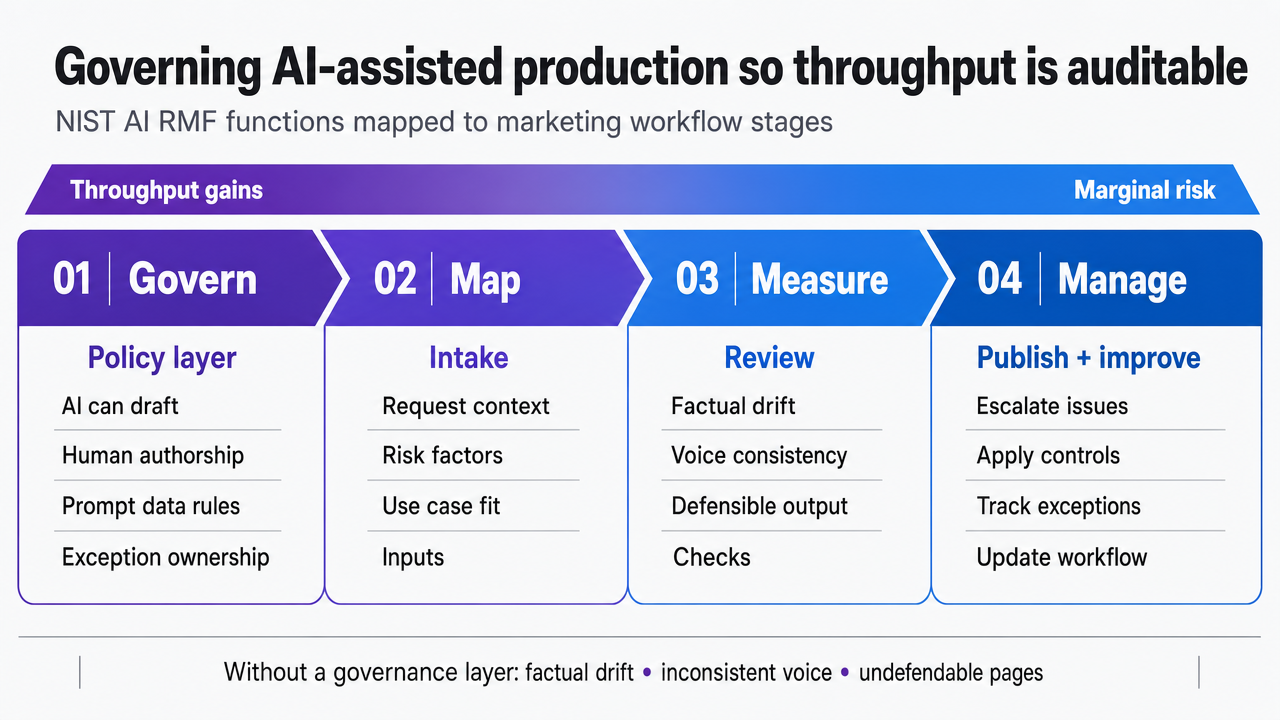 Visualize how the four NIST AI RMF functions map onto the marketing workflow stages described in the section, giving readers a scannable operating model
Maintenance as a scheduled function, not a cleanup project
Most in-house teams treat content maintenance as a project that surfaces when rankings drop, a stakeholder complains, or a migration forces a crawl. That reactive posture is what turns a two-hour refresh into a two-quarter cleanup. Digital.gov's content guidance recommends that agencies conduct content audits at least once a year, and treats removing outdated pages as part of the publishing process rather than a special initiative 1. The operating shift for the VP is to put audits on the calendar the same way payroll is on the calendar.
A workable cadence has three tiers:
- High-value commercial pages get a quarterly review against the standards library: title tag compliance, metadata length, internal links intact, primary claims still accurate.
- Mid-tier informational pages get a semi-annual review.
- The full catalog gets an annual audit that flags pages for refresh, consolidation, or removal based on traffic, conversions, and factual currency.
Each tier has a named owner, a fixed date, and a scored output that feeds the intake queue. Pages that fail the audit re-enter production as prioritized work, not as emergencies. Maintenance stops competing with new production because it never accumulates.
See How Enterprise Teams Automate SEO Execution—Without Adding Headcount
Request a walkthrough of unified AI workflows that let in-house teams coordinate SEO, content, and technical improvements—validated by analytics and routed for approval—without expanding internal resources or managing multiple vendors.
If you manage multiple locations: consolidating the operating model
For operators running content across dozens of location pages and multiple service verticals, the economics of the standards-based model change in the operator's favor. The single-brand VP builds standards to keep a lean team from drowning. The portfolio operator builds standards to stop paying an agency, a technical consultant, and two freelancers to redo the same title-tag decision two hundred times per market.
The consolidation opportunity is not a headcount cut. It is the collapse of vendor coordination, briefing cycles, and approval touchpoints into a single governed workflow that runs against a shared standards library. The comparison below uses variables rather than invented dollar figures, because the operator's actual numbers depend on portfolio size and current vendor mix.
| Operating dimension | Traditional agency + in-house model | Standards-based, AI-assisted governed model ||---|---|---|| Vendor relationships per market | 2–4 (agency, technical SEO, content, local listings) | 1 (internal standards owner) || Briefing cycles per new page | 1 per vendor, sequential | 1 intake form, template-matched || Approval touchpoints per page | 4–6 across vendors and internal reviewers | 3 fixed gates (brief, editorial, standards checklist) || Time-to-publish per location page | Weeks, gated by vendor SLAs | Days, gated by internal approval SLA || Audit cadence across the portfolio | Ad hoc, triggered by ranking drops | At least annual, tiered by page value 1|
The rows compress because the same standards library governs every market. A title-tag template written once applies to two hundred service pages. A quarterly audit rubric written once runs against the full portfolio. The operator's leverage is that each codified rule pays back across every location, which is the same leverage the Department of Energy uses to run search across a federal footprint without a large central team.
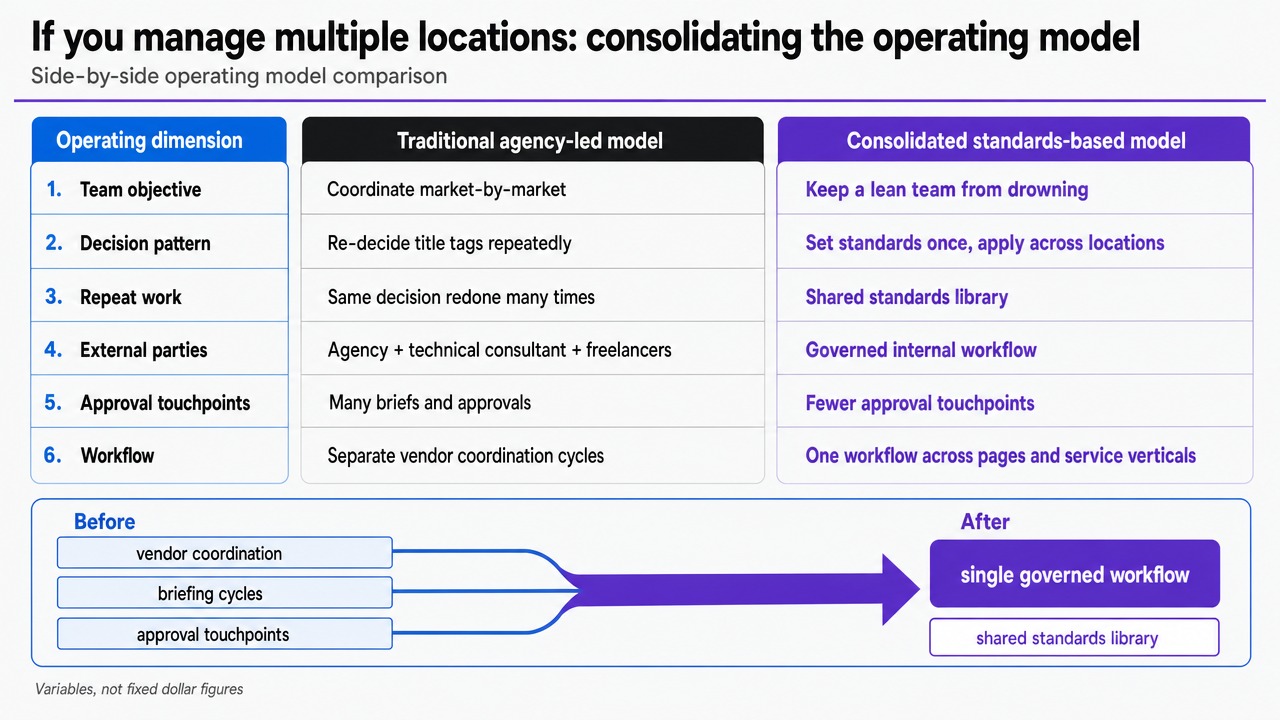 Render the comparison table from the section as a scannable side-by-side operating model comparison so multi-location operators can absorb the consolidation logic quickly
Measuring the organic channel against pipeline, not rankings
Ranking reports are diagnostic. They are not the metric the CEO is asking about. A lean team that reports keyword positions and traffic totals will lose the budget argument every time the pipeline forecast tightens, because neither number resolves into qualified opportunities. The measurement loop that protects the operating model reports organic contribution the same way paid channels report it: sessions attributed to a source, converted to leads by page and query cluster, converted to qualified opportunities by sales, and converted to closed pipeline by segment.
Three instrument points make that loop work:
- Every landing page carries a source tag that survives the form submission and lands in the CRM.
- Every query cluster maps to a page type in the standards library, so conversion rates roll up by cluster rather than by individual URL.
- Every quarterly review compares cost-per-opportunity from organic against the other channels the VP owns, using the same denominator finance uses for paid media.
Rankings still get tracked, but as a leading indicator of the pipeline number rather than the number itself. When organic opportunity volume drops, the ranking data explains which clusters moved. When it holds, the ranking data is background.
What the VP actually builds in the first 90 days
The build sequence matters more than the tool selection.
- Days 1 through 30 produce the standards library: title tag template, metadata rules, internal linking rubric, and the pre-publish checklist encoded as required CMS fields. One person owns the document. Two page types get templated first—whichever service pages carry the most pipeline weight.
- Days 31 through 60 stand up the intake queue and the three approval gates. The queue owner runs a weekly triage against the scoring rubric. The AI governance policy gets written in the same window, mapped to the Govern, Map, Measure, Manage functions of the NIST framework 4, with a QA rubric that scores reliability, transparency, bias, and privacy independently rather than collapsing them into one number.
- Days 61 through 90 close the measurement loop. Source tags land in the CRM, query clusters map to page types, and the first tiered audit runs against the highest-value commercial pages.
By day 90, the operating model produces pages against standards, routes them through governed approval, and reports contribution in the language the CEO already uses for paid channels.
Frequently Asked Questions
References
- 1.An introduction to content | Digital.gov.
- 2.Optimize your content | Digital.gov.
- 3.Reducing Risks Posed by Synthetic Content.
- 4.AI Risk Management Framework.
- 5.AI Risk Management Framework, Appendix A: Descriptions of AI Actor Tasks.
- 6.AI Risk Management Framework, Chapter 6: AI RMF Profiles.
- 7.AI Risk Management Framework, Chapter 3: AI Risks and Trustworthiness.
- 8.AI RMF Playbook.
- 9.Search Engine Optimization Best Practices.
- 10.Guidelines for Improved Search Engine Rankings.