
Key Takeaways
- Scaling SEO content across clients fails when governance is missing, not when writers are slow; tiered review, versioned templates, and logged approvals turn AI drafting into throughput rather than liability 8, 9.
- Tier 1 Standard content covers low-risk verticals like home services and general B2B, relying on locked templates, junior or AI drafts, and sampled senior review to keep reviewer minutes per asset minimal 8.
- Tier 2 Regulated content for health, legal, and financial clients requires per-asset substantiation gates before drafting and before publish, because the FTC treats implied outcome claims as equivalent to express ones 3, 2.
- Tier 3 YMYL-Critical content demands a named, credentialed human reviewer contributing expressive judgment on every asset, both to meet FTC health substantiation and to preserve copyright interest under Copyright Office guidance 1, 9.
- Vertical-to-regulator mapping, not revenue, forces tier assignment: dental, legal, and healthcare typically land in Tier 2, while behavioral health and senior living clinical pages almost always require Tier 3 1, 4, 6.
- A versioned template layer standardizes the 80% that repeats, including the HIPAA Notice of Privacy Practices slot and WCAG 2.1 AA components, so compliance becomes a build-time constraint rather than a post-publish fix 4, 5.
- AI-assisted drafting works only inside four approval gates—outline, edit, pre-publish, and audit—each logging substantiation source, reviewer identity, and AI-assist disclosure to address generative risks and authorship documentation 8, 9.
- Review and testimonial blocks must pull from verified sources with attribution and reviewer logs, because the FTC's 2024 rule against fake and AI-generated reviews carries civil penalty authority across every vertical 6, 7.
The Scaling Constraint Is Governance, Not Writing
Agencies managing SEO content across numerous client sites often struggle not due to slow writers, but because senior judgment is misapplied to the majority of assets. For instance, a treatment page for a behavioral health client and a service page for a plumber might follow the same brief and editorial process, despite the former carrying significant civil penalty exposure under FTC health advertising rules 1.
Effective scaling of content production requires treating it as a governed pipeline. Governance involves tiered review depth calibrated to legal risk, a template layer for repeating structures and disclosures, and logged human approval at defined stages. With these layers, AI-assisted drafting enhances throughput. Without them, AI-assisted drafting can increase liability, given the specific risks of generative output identified by NIST 8 and copyright exposure clarified by the U.S. Copyright Office 9.
This approach reframes the challenge of "how to write content for SEO" at portfolio scale. It's not primarily a drafting issue, but a production line problem involving three tiers, five federal regulators, and a reviewer-hour budget that dictates profit margins. The following sections detail this architecture.
A Three-Tier Production Model for Portfolio Content
Tier 1 Standard: Template-Led Production for Low-Risk Verticals
Tier 1 encompasses content where the primary risk is a ranking miss, not a civil penalty. This includes sectors like home services, general B2B, e-commerce (outside health and finance), most SaaS, and local service pages for non-regulated trades. The main cost driver here is template consistency, not writer skill.
Standard-tier assets should adhere to a fixed page architecture: H1 pattern, intent-matched introduction, standardized section blocks, schema slots, internal link anchors, and a locked disclosures footer. Junior writers or AI-assisted drafts populate variables within this structure. Senior review is conducted via spot-checks, with the Head of SEO determining the sampling rate based on error tolerance, rather than line-by-line review of every asset.
Maintaining integrity in this tier at portfolio scale relies on two rules. First, templates must be versioned, and changes should tag all affected downstream assets for rebuild eligibility. Second, AI-assisted drafts still require human editor review before publication, as NIST's generative AI profile highlights hallucination and misattribution as risks, even in low-stakes content 8. The economic viability of Tier 1 comes from minimizing reviewer minutes per asset, not eliminating review entirely.
Tier 2 Regulated: Substantiation Gates for Health, Legal, and Financial Content
Tier 2 covers content where specific claims can trigger regulatory scrutiny. This includes general healthcare service pages, dental and DSO treatment pages, legal practice-area pages, financial services explainers, insurance content, and most senior living marketing pages. The key distinction from Tier 1 is the obligation to substantiate every outcome, comparison, and success-rate statement.
The FTC's Health Products Compliance Guidance, updated in December 2022, mandates that health benefit and safety claims be supported by "competent and reliable scientific evidence." It also requires marketers to consider both express and implied messages consumers derive from content 3. This focus on implied messages is crucial for SEO teams; a page might avoid direct medical claims but still convey implied ones through testimonials, before-and-after presentations, or comparison tables. The FTC's broader Health Claims guidance treats these implied messages as equivalent to express claims 2.
Tier 2 production integrates two additional gates into the standard workflow. Before drafting, a reviewer must log the substantiation source for every outcome-related claim proposed in the outline; otherwise, the claim is removed. Before publication, a second reviewer verifies that the source still supports the language in the final asset. Both gates require logging the reviewer's name, date, and source citation. Legal and financial content follows a similar structure, substituting state bar advertising rules and consumer finance guidance for FTC health standards.
The implication for volume is clear: Tier 2 assets demand more reviewer minutes than Tier 1 and cannot be sampled. Every asset undergoes these gates because the risk is claim-specific, not portfolio-wide.
Tier 3 YMYL-Critical: Named-Author Review for Behavioral Health, Senior Living, and Medical Claims
Tier 3 is a highly specialized category for content where a reader acting on the information could face direct clinical, financial, or safety harm. This includes behavioral health treatment pages detailing modalities and outcomes, addiction recovery landing pages, senior living pages discussing memory care or medication management, medical device pages, and any content addressing symptoms, diagnosis, or treatment selection.
Two characteristics differentiate Tier 3 from Tier 2. First, every asset must have a named human author or clinical reviewer credentialed in the relevant field, with credentials displayed on the page and documented in the workflow log. Second, substantiation is not merely cited internally but often presented to the reader through linked evidence, methodology notes, or a reviewer-signed statement. The FTC's substantiation standard for health content applies rigorously here, and its distinction between express and implied claims makes implied outcome language particularly risky in areas where efficacy varies by population 1, 2.
Operationally, Tier 3 limits the use of AI-assisted drafting shortcuts. While AI can generate structure, source summaries, and initial language, the named clinical reviewer must contribute the expressive judgment: deciding which claims to make, what qualifiers to add, which populations to specify. This human contribution also helps preserve copyright interest in the final asset, as AI-only output is not protectable, and the U.S. Copyright Office requires disclosure of AI-generated material along with a description of human input 9. Tier 3 assets incur the highest reviewer minutes and yield the lowest volume per client, but they offer significant ranking advantages and client retention, justifying the model.
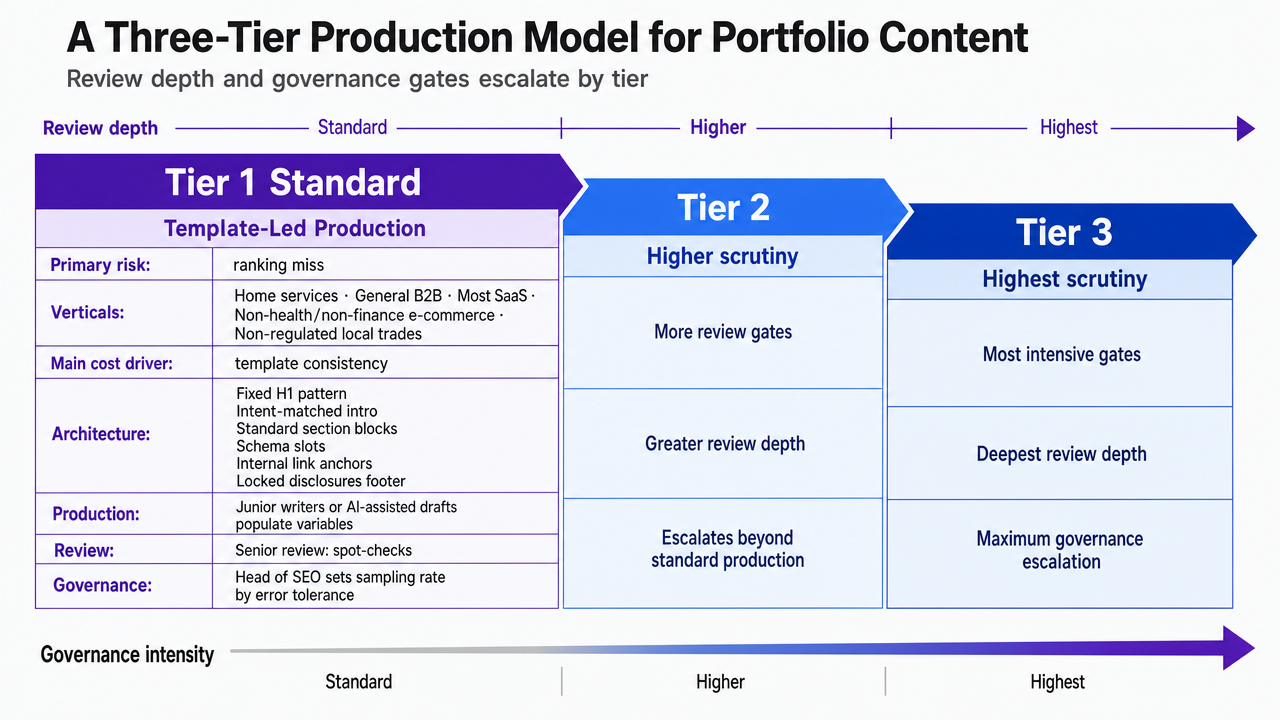 Visualize the three-tier governance model that structures the entire article, showing how review depth and gates escalate by tier
Mapping Verticals to Tiers and the Regulations That Force the Assignment
Tier assignment is not arbitrary but determined by the federal regulators overseeing a client's claims, disclosures, and site infrastructure. To ensure tier decisions withstand client audits, a Head of SEO must map each vertical to the specific guidance that dictates review depth, then implement this mapping as portfolio policy.
Dental groups and DSOs typically fall into Tier 2, shifting to Tier 3 when treatment pages describe clinical outcomes, sedation protocols, or implant success rates. The FTC's Health Products Compliance Guidance governs the substantiation standard for these outcome claims, including implied ones conveyed through before-and-after content or comparison framing 1. HIPAA's requirement to prominently display a Notice of Privacy Practices (NPP) applies to any site describing customer services, affecting the site template rather than just a dedicated privacy page 4.
Behavioral health and senior living are almost always Tier 3. Modalities, memory care descriptions, and medication-management language carry direct clinical risk, and the FTC's express-and-implied claim standard applies to all outcome-related statements 2. HIPAA NPP posting is required if the operator is a covered entity 4.
Legal practice-area pages are Tier 2. State bar advertising rules govern substantive review, and the FTC's 2024 rule banning fake and AI-generated reviews applies to any testimonial or attorney-review content produced or syndicated by the agency 6. Healthcare systems and health insurance sites are subject to the full FTC health regulations plus HIPAA NPP obligations, placing most content in Tier 2 and clinical pages in Tier 3 1, 4.
Home services are generally Tier 1, with two notable exceptions. Testimonial and review content across all verticals falls under the FTC's 2024 rule, requiring Tier 2 treatment even for Tier 1 sites 6. Accessibility is also a growing concern: the DOJ adopted WCAG 2.1 Level AA as the technical standard for state and local government web content in 2024, suggesting agencies serving quasi-public clients or healthcare operators should adopt this standard proactively 5.
Test AI-driven SEO content workflows risk-free
Publish real SEO content and measure efficiency gains across multiple client campaigns—no commitment required.
Template Layer: Standardizing the 80% That Repeats
Page Architecture, Variables, and the HIPAA NPP Slot
The template layer is crucial for portfolio margin. A well-designed page template locks down elements that repeat across all clients in a vertical, exposing only fields that vary by location, service, or reviewer. Elements like H1 patterns, schema blocks, and disclosure footers are managed as a single, versioned artifact.
For healthcare, dental, senior living, and behavioral health clients, the template must include a required slot for the Notice of Privacy Practices (NPP). HHS guidance mandates that covered entities "prominently post" the NPP on any website providing information about customer services or benefits 4. This is a global site requirement, not limited to a privacy page, so the NPP link should be in persistent template chrome (e.g., footer or header utility area), not a per-page decision.
Variables, such as location name, service description, reviewer credentials, jurisdiction-specific disclaimers, and state-specific claim qualifiers for Tier 2 content, are filled within this fixed structure. Junior writers and AI-assisted drafts populate these variables but do not alter the core architecture. When the FTC updates substantiation guidelines or HHS clarifies NPP language, the change is applied once to the template and cascades across all clients in that vertical.
Accessibility as a Template Decision, Not a Post-Publish Fix
Accessibility is often an afterthought, bolted on post-build, unless enforced by the template. The DOJ's 2024 rule adopts WCAG 2.1 Level AA as the technical standard for state and local government web content and mobile apps, with compliance deadlines of three to four years from April 24, 2024 5. While this rule doesn't directly cover most private agency clients, healthcare systems, senior living operators, and quasi-public entities should adopt this standard now.
The template layer is where this decision is upheld. Heading hierarchy, contrast ratios, alt-text requirements for image variables, keyboard-navigable interactive elements, and captioned media components are defined within the template. When these constraints are enforced at the component level, a junior writer or AI-assisted draft cannot publish an inaccessible page without failing validation.
Retrofitting accessibility across a portfolio post-publication is inefficient. A template that enforces WCAG 2.1 AA on core components transforms compliance into a build-time constraint. Alt text and semantic structure become required fields, not editorial afterthoughts, benefiting ranking, screen-reader users, and regulatory compliance simultaneously.
AI-Assisted Drafting Inside a Governed Workflow
Where Human Approval Gates Sit in the Pipeline
AI-assisted drafting at portfolio scale is ineffective if it operates outside the review layer. Its throughput is maximized when integrated into a defined gate structure with logged artifacts at each stage. This structure transforms generative output from a liability into a valuable production input.
Most agency pipelines involve four key gates:
- Before drafting, the assigned reviewer approves the outline, target claim set, and substantiation source for all outcome-related statements.
- Between draft and edit, an editor confirms the AI-assisted draft aligns with the approved outline and flags any language deviating from sourced claims.
- Before publication, a senior reviewer signs off on Tier 2 and Tier 3 assets, verifying that cited sources support the final language and that implied outcome claims include proper qualifiers.
- After publication, a scheduled audit samples assets against current regulatory guidance and template versions.
Each gate logs three artifacts: the substantiation source, reviewer name and timestamp, and an AI-assist disclosure indicating machine-drafted and human-authored sections. NIST's generative AI profile identifies hallucination, misattribution, and confabulation as risks of generative systems 8; these logged artifacts demonstrate the application of human judgment to mitigate these risks. The U.S. Copyright Office requires disclosure of AI-generated material and description of human contributions for work registration 9, so the same log serves both compliance and copyright functions.
Authorship, Copyright, and Reviewer Contribution
AI-only output is not copyrightable. The U.S. Copyright Office's 2025 report confirmed that protection applies only when a human author contributes sufficient expressive elements, a standard not met by prompts alone 10. For agencies producing content at scale, this has three operational implications often overlooked in contracts and workflows.
First, the reviewer's contribution must be substantive, not merely cosmetic. Expressive judgment, such as selecting claims, adding qualifiers, specifying populations, and making structural decisions, is what the Copyright Office seeks. Simple grammar corrections do not establish authorship.
Second, this contribution must be documented. Registration guidance requires applicants to disclose AI-generated material and describe human-authored contributions 9. The workflow log, already used for compliance gates, contains the reviewer's name, timestamps, and AI-assist disclosure, making it suitable for copyright registration if pursued.
Third, client contracts should explicitly address ownership. If a client assumes ownership of all agency deliverables, but the asset is largely AI-generated with minimal human expression, both parties may be operating under a misunderstanding of copyright interest.
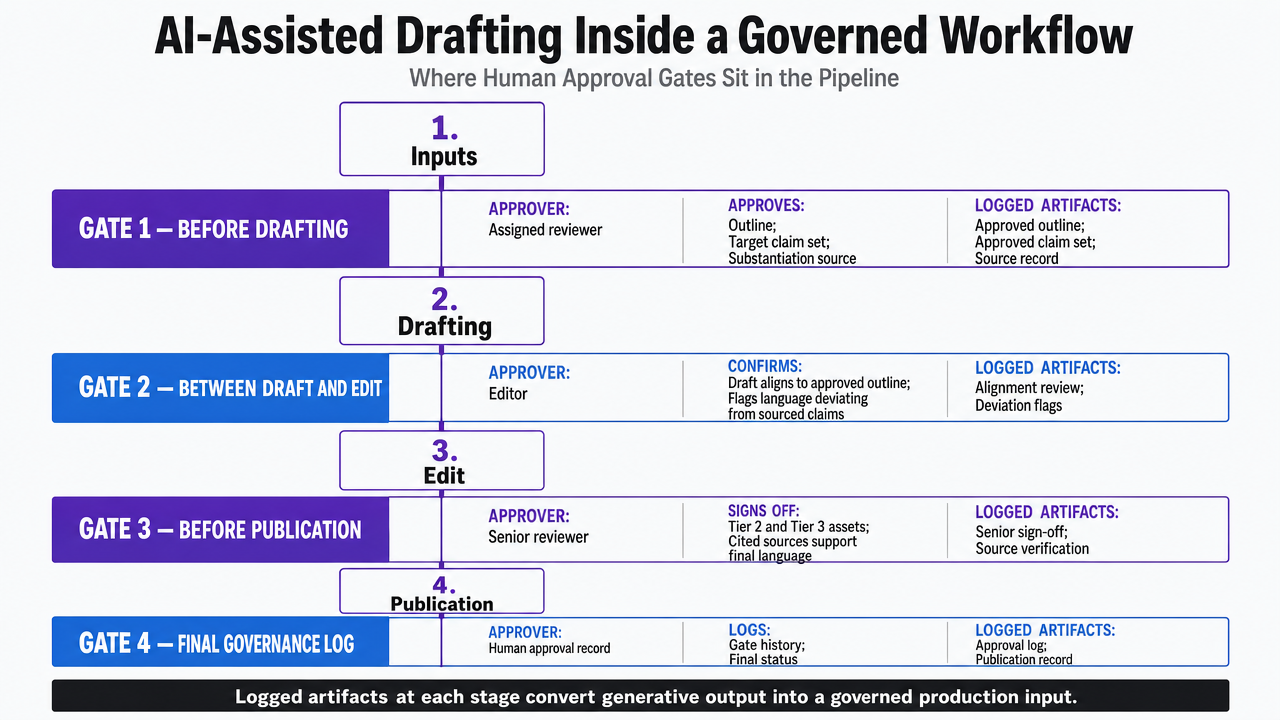 Diagram the four human approval gates in the AI-assisted content pipeline described in the section, including the artifacts logged at each gate
Reviews, Testimonials, and the Reputation Content Trap
Review and testimonial content presents significant enforcement exposure in scaled production. The FTC's August 2024 final rule prohibits fake and AI-generated reviews, bans their purchase or sale, and grants civil penalty authority against knowing violators 6. This rule applies across all client verticals, as reputation content is prevalent on most agency-managed sites.
Three practices carry high risk in scaled workflows:
- Repurposing testimonials across multiple location pages without verifying the customer relationship for each instance.
- Generating illustrative review-style copy with AI to fill template slots.
- Syndicating third-party review excerpts without the disclosures required by FTC endorsement guidance 7.
Any of these can elevate a Tier 1 home services account to an enforcement issue.
The operational solution lies in the template layer. Review blocks should pull from a verified source, include required attribution and date fields, and route through the same reviewer log used for substantiation gates in Tier 2.
Automate High-Quality SEO Content Production Across Every Client
See how leading agencies use AI-powered workflows to scale SEO content creation with measurable quality controls and full strategic oversight—without increasing headcount or risking content consistency.
If You Manage Multi-Location Clients: Local Content as a Variable Problem
For portfolio teams managing content for franchise systems, DSOs, senior living operators, home services rollups, and multi-office law firms, the unit of production shifts from individual pages to location records that expand into pages.
Multi-location content fails at scale when writers treat each location as a unique rewrite. This approach is economically unsustainable, leads to quality inconsistencies, and results in location pages that appear as paraphrased copies, a pattern demoted by helpful-content systems. The solution is to define variables instead of rewriting. For example, a dental group page for Cleveland and one for Columbus share the same architecture, schema, substantiation posture, and locked disclosures footer. Only a defined set of variables changes: address, hours, provider roster, credential list, jurisdictional qualifiers, and state-specific claim language flagged during Tier 2 template build.
Two portfolio rules ensure consistency. First, review depth follows the tier, not the number of locations. A 40-location behavioral health operator still requires Tier 3 substantiation and named-reviewer gates for every location page, as mandated by FTC health guidance 1, 2. Second, template-layer obligations cascade uniformly. The HIPAA Notice of Privacy Practices posting requirement applies to every location subdomain or path operated by a covered entity, not just the corporate root 4. When the template enforces both, the same governance layer supports both single-location and 200-location clients without separate workflows.
Operator Economics: Modeling Reviewer Hours Against Portfolio Throughput
The tier model's effectiveness depends on its financial viability. Key variables include reviewer minutes per asset, assets per client per month, and the blended cost of reviewers at each gate. Other factors, such as drafting speed and AI-assist ratio, operate within this budget.
Using variables rather than fixed figures, let:
R : the fully loaded hourly cost of a senior reviewer
J : the equivalent for a junior editor
N : the assets per client per month
C : the number of clients in that tier
Monthly reviewer cost per client is calculated as (minutes per asset / 60) × hourly rate × N. Portfolio cost is this figure multiplied by C. The tier assignment determines the minutes, and the gates dictate which rate applies.
| Tier | Senior reviewer minutes per asset | Junior/AI-assisted draft minutes per asset | Approval gates required | Required substantiation artifacts |
|---|---|---|---|---|
| Standard | Sampled at portfolio-defined rate | Full drafting and edit pass | Editor pre-publish; scheduled sample audit | AI-assist disclosure log 8 |
| Regulated | Per-asset review at pre-draft and pre-publish gates | Full drafting and edit pass with claim-by-claim source check | Outline sign-off; pre-publish senior sign-off; audit | Substantiation source per outcome claim 1, 2; reviewer log; AI-assist disclosure |
| YMYL-Critical | Named clinical or credentialed reviewer on every asset | Drafting supports, does not replace, reviewer expression | All Regulated gates plus named-author sign-off | Substantiation source; reviewer credential; human authorship description for copyright 9, 10 |
The financial implications are clear. Standard-tier margin is increased by raising N per client while keeping sample-audit minutes constant. Regulated-tier margin comes from template reuse that reduces pre-draft outline time, not from cutting the pre-publish gate. YMYL-Critical margin is not volume-driven but stems from client retention and ranking durability, making reviewer hours in this tier a client-retention investment rather than a production cost.
What the Head of SEO Should Change This Quarter
To transition a portfolio from a writing team to a production line, three key actions are recommended this quarter:
- Audit every client account and assign a tier (Standard, Regulated, or YMYL-Critical) based on the vertical-to-regulator map, not volume or revenue. Legacy health, senior living, and behavioral health content created before the FTC's December 2022 guidance likely contains implied claims that no longer meet substantiation standards 3.
- Version templates. Lock the HIPAA NPP slot, review blocks, and WCAG 2.1 AA components at the architectural level to prevent non-compliant downstream drafts 4, 5.
- Establish a reviewer log. Every Tier 2 and Tier 3 asset should have the substantiation source, reviewer name, and AI-assist disclosure recorded at each gate. This log serves both NIST-aligned governance and the Copyright Office's authorship documentation requirements 8, 9.
Governed AI content production platforms like Vectoron are designed with this log-first architecture.
Frequently Asked Questions
References
- 1.Health Products Compliance Guidance.
- 2.Health Claims | Federal Trade Commission.
- 3.FTC Announces New Business Guidance for Marketers and Sellers of Health Products.
- 4.Notice of Privacy Practices for Protected Health Information.
- 5.Fact Sheet: New Rule on the Accessibility of Web Content and Mobile Apps.
- 6.Federal Trade Commission Announces Final Rule Banning Fake Reviews and Testimonials.
- 7.Endorsements, Influencers, and Reviews.
- 8.AI Risk Management Framework | NIST.
- 9.Copyright Registration Guidance: Works Containing Material Generated by Artificial Intelligence.
- 10.NewsNet Issue 1060 | U.S. Copyright Office.