
Key Takeaways
- Report SEO performance at the qualified-call layer rather than rankings, since that is where search work stays visibly responsible for revenue the client's CFO can defend.
- Delivery model decides margin: specialist pods cap on headcount, blended pods leak hours to senior rewrites, and AI-assisted production only scales when senior approval hours per deliverable hold steady.
- Consolidate FTC review and substantiation rules 2, 3, HIPAA tracking and marketing rules 6, 10, and ADA accessibility guidance 5into one governance layer applied across every client.
- Next quarter, rewrite dashboards to the qualified-call layer, publish a technical baseline, wire approval gates into production, and run the delivery economics worksheet against the lowest-margin accounts.
Why Agency SEO Now Lives or Dies on Revenue Attribution
The pressure on agency SEO leaders has shifted. Clients no longer accept a monthly deck that opens with keyword position deltas and closes with a domain authority chart. They want to see the line between organic search and money in the bank — booked consultations, qualified calls, signed matters, scheduled procedures, dispatched trucks. When that line is missing, retention erodes long before rankings do.
This changes what it means to improve SEO at the agency level. The work is no longer a tactical stack of on-page fixes and link building. It is an operating model that has to survive audit by a client CFO who reads pipeline reports, not SERP screenshots. Every deliverable has to trace back to a revenue event the client already measures.
Three forces are converging on Heads of SEO at the same time. Client procurement teams want attribution down to the dollar. Regulated verticals — law, healthcare, behavioral health, dental groups, home services, senior living — bring FTC, HIPAA, and ADA exposure that punishes sloppy execution. And the delivery cost math has to hold across a book of 15 to 80 accounts without adding a specialist for every new logo. Agencies that answer all three at once keep the roster. The rest churn quietly.
The Revenue-Mapped KPI Hierarchy That Replaces Ranking Reports
Ranking reports die at the CFO's desk. A revenue-mapped hierarchy survives because it climbs the funnel one measurable layer at a time, and each layer answers a question the client already asks in board meetings.
Five layers make up the chain:
- Impressions confirm the site is indexed and eligible.
- Qualified sessions — filtered by intent, geography, and page type — confirm the traffic matches the service line the client actually sells.
- Form fills and qualified calls confirm that intent converted into a first-party signal the client's intake team can act on.
- Booked consultations confirm that signal survived intake friction, scheduling gaps, and disqualification.
- Closed revenue confirms the entire chain produced money.
The qualified-call layer is where agencies gain or lose renewals. Impressions and sessions are too far from money for a client CFO to defend at budget review. Booked consultations and closed revenue depend on the client's intake staff, sales process, and operational capacity — variables the agency does not control and cannot be held to. Qualified calls sit at the exact seam where SEO work is still visibly responsible for the outcome and the client can still see cash implications one step downstream. Report at that layer, and the conversation shifts from "what's our position on this keyword" to "what did search produce for the pipeline this month."
Two operational consequences follow. First, call intelligence has to be wired into every engagement, not treated as an upsell. Second, qualification rules — what counts as a qualified call for this client, this service line, this geography — need to be written into the scope of work before month one, because retroactive definitions look like agencies moving goalposts.
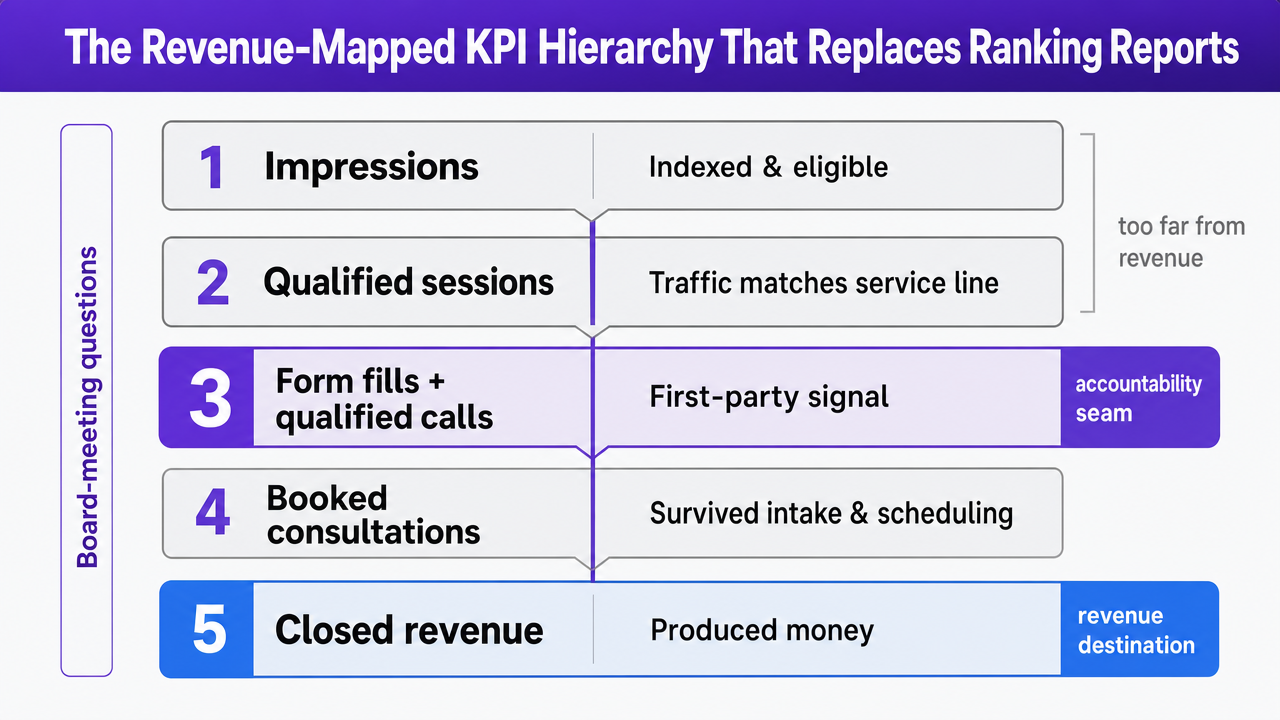 Visualize the five-layer KPI hierarchy the section explicitly enumerates, highlighting the qualified-call layer as the accountability seam
Designing the Delivery Model: Specialist Pod, Blended Pod, or AI-Assisted Production
Delivery model is the lever most agency leaders underweight. Reporting frameworks and tactic libraries look identical across competing agencies; what actually separates margin outcomes is how the work gets produced, who touches it, and where senior judgment enters the chain. Three staffing patterns dominate the market right now, and each produces a different cost-per-approved-deliverable at the same client price point.
The Three Staffing Models and What They Actually Produce
The specialist pod is the traditional agency configuration: a dedicated strategist, technical SEO, content lead, and account manager assigned to a client or a small group of clients. Output quality is high because the same senior brains touch strategy, brief, draft, and QA. The ceiling is headcount. Every new logo either stretches an existing pod past capacity or triggers a hire, and hires in regulated verticals — where the content lead needs to understand HIPAA marketing rules 10 or FTC substantiation for health claims 7 — take months to season.
The blended pod keeps a senior strategist onshore and pushes production hours to offshore writers, freelancers, or a rotating bench. Cost per deliverable drops. So does consistency. The senior strategist spends an increasing share of the week rewriting drafts that missed the client's voice, catching claims that would not survive FTC review 3, or reconciling briefs against a technical audit the freelancer never read. Margin looks good on the spreadsheet and worse in the retention numbers.
The AI-assisted production model with a human approval layer compresses the junior production hours — outline drafting, first-pass copy, schema generation, meta writing, internal link candidates, image alt text — while holding senior strategist review hours constant or slightly higher per deliverable. The strategist stops writing first drafts and starts approving, correcting, and rejecting them. Output volume rises. Judgment stays where clients pay for it.
Delivery Economics Worksheet: Filling In Your Own Numbers
The table below is a planning worksheet, not a sourced benchmark. Agency cost structures vary too widely — geography, vertical mix, seniority blend, benefits load — for any published average to survive contact with a specific P&L. The point is the shape of the math, not the numbers. Populate each cell with figures from the agency's own timesheets and payroll data, then compare cost per approved deliverable across the three columns.
| Input | Specialist Pod | Blended Pod | AI-Assisted + Human Approval |
|---|---|---|---|
| FTE hours per client per month | |||
| Blended hourly rate (loaded) | $ | $ | $ |
| Monthly production capacity (briefs / pages) | |||
| Senior-strategist review & approval hours retained | |||
| Rework hours per deliverable | |||
| Cost per approved deliverable | $ | $ | $ |
Two variables tend to surprise operators when they run the exercise honestly. Rework hours in the blended pod are usually higher than the timesheet captures, because senior rewrites often get logged as "strategy" rather than "production." And senior review hours in the AI-assisted column should not drop toward zero — that is the failure mode that produces compliance incidents. The correct pattern is junior production hours compressing while senior approval hours hold steady or rise slightly per deliverable, which is where the cost-per-approved-deliverable gap opens up in favor of the third column.
Run the worksheet against a single mid-sized engagement first. The columns that look closest on price often diverge sharply on throughput, and throughput is what determines whether the agency can absorb the next fifteen accounts without a hiring cycle.
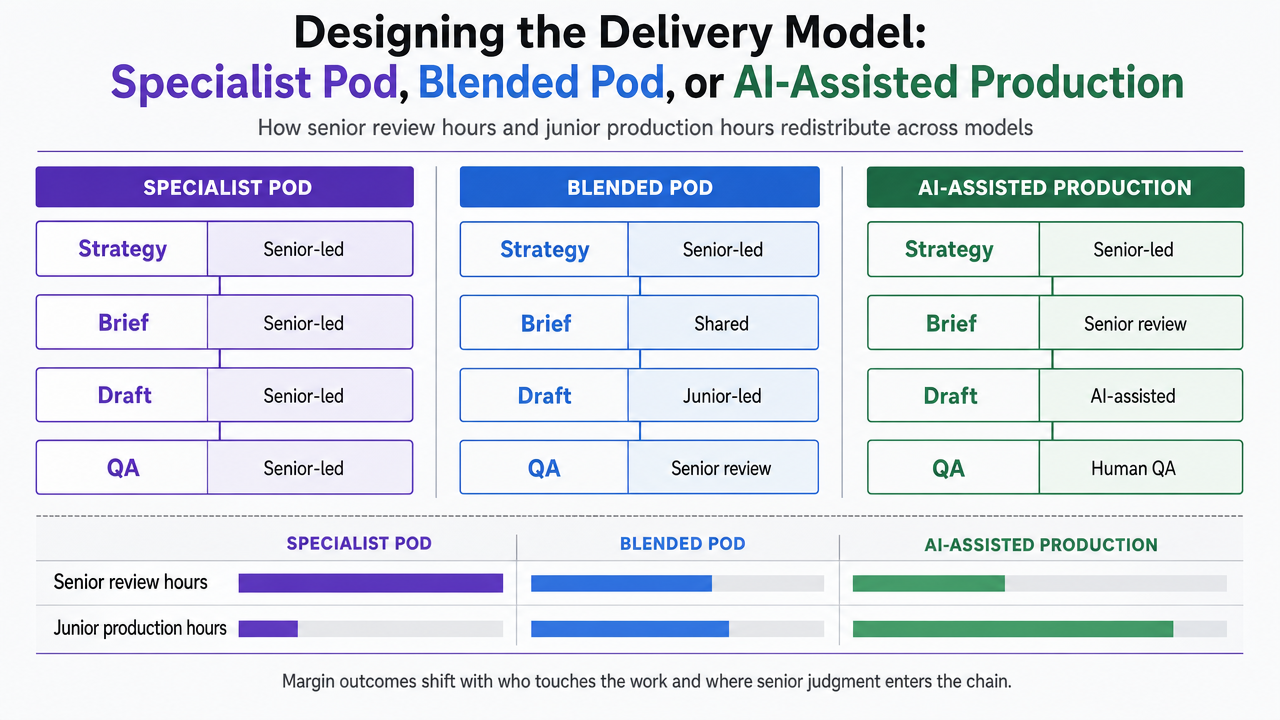 Visualize the three staffing models side-by-side as a comparison framework the article explicitly describes, helping readers grasp how senior review hours and junior production hours redistribute across each model
Technical Discoverability as an Agency-Wide Standard, Not a Per-Client Rediscovery
Every agency that scales past twenty accounts hits the same wall: technical SEO gets re-solved from scratch on every engagement. A new client lands, a strategist opens Screaming Frog, and three weeks disappear into crawl budget triage, canonical cleanup, and schema decisions that the last five engagements also worked through. The knowledge sits in the strategist's head, not the agency's system.
The fix is a standardized technical baseline every client site is measured against on intake and re-measured on a fixed cadence. Each of the following gets a pass/fail rule and a remediation playbook the production team executes without waiting for senior direction:
- Crawlability
- Indexation
- Core Web Vitals thresholds
- Structured data coverage for the client's service types
- Internal link depth to money pages
- Log-file sampling for wasted crawl
- hreflang for multi-location rollups
Two operational shifts follow. Audits become templated diffs against the standard, not bespoke research projects, which cuts onboarding time roughly in half for most vertical templates. And technical debt becomes visible portfolio-wide, so the Head of SEO can rank fixes by revenue exposure across the book rather than by whichever client emailed last. Discoverability stops being a per-client rediscovery and starts being an agency asset that compounds.
Trial Advanced SEO Workflows With Full Oversight
Test real-time content approvals and automated execution on live client projects before making any commitment.
Content That Maps to Booked Consultations, Not Search Volume
Search volume is a vanity input. A keyword can pull 12,000 monthly searches and produce zero booked consultations for a personal injury firm because the intent is research, not retention. The content programs that move client revenue start from the opposite direction: list the service lines that actually generate margin for the client, then work backward to the queries a buyer runs the week they are ready to call.
That inversion changes what gets briefed. Bottom-funnel service pages, comparison queries between provider types, cost and insurance questions, geographic modifiers tied to actual service areas, and post-diagnosis or post-incident queries take priority over broad awareness topics. Awareness content still has a role, but only where the internal link path to a conversion page is short and the topic is a documented precursor to a booking — not because a keyword tool flagged it as an opportunity.
Two production disciplines make the mapping hold. Every brief names the specific service line and conversion page it feeds, so the writer produces copy that supports a booking rather than a scroll. And every published page gets a 90-day check against qualified-call data, not sessions — pages that draw traffic without producing calls either get rewritten for buyer-stage intent or demoted in the internal link graph. Content that cannot earn a call loses its promotion.
Local and Entity Signals Where the Qualified Call Actually Originates
Most qualified calls for local service clients start on a map pack result, not an organic blue link. That single fact reorganizes where the agency spends its optimization hours. Google Business Profile completeness, category selection, service-area accuracy, review velocity, and photo freshness move the needle on call volume faster than another 800-word blog post on a mid-funnel topic.
Entity signals do the quieter work behind the map result. Consistent NAP data across authoritative directories, a clean organization schema on the site, sameAs links to the client's verified profiles, and structured data for each service and location tell search engines the business is one identifiable entity operating in specific places. Multi-location clients — DSO groups, home services franchises, senior living portfolios — need location pages that render distinct addresses, hours, staff, and service inventories rather than templated copies with a swapped city name.
Two production rules keep the local layer honest. Review-generation workflows stay inside the FTC's Consumer Reviews and Testimonials Rule 2 — no incentives that go undisclosed, no gating of negative feedback, no employee reviews posted as customers. And every location page gets tagged in the call-tracking system so the qualified-call layer of the KPI hierarchy can attribute volume back to the specific profile and page that produced it.
The Compliance Stack: One Governance Layer Across Every Client
Compliance in regulated-vertical SEO is not a footnote at the end of a brief. It is the governance layer that decides which review-generation workflows are safe to run, which analytics tags can fire on which pages, which health claims can appear in a service description, and which conversion patterns cross from persuasive into deceptive. Agencies that treat these rules as one integrated stack — rather than four separate warnings scattered across four different playbooks — remove a category of risk that competitors keep re-discovering the hard way.
The stack has four layers:
- FTC rules on reviews, endorsements, and advertising substantiation
- HIPAA rules on online tracking and marketing communications
- ADA web accessibility guidance
- The boundary between persuasive and deceptive conversion design
Each layer maps to specific production controls the Head of SEO can wire into templates, briefs, QA checklists, and approval gates.
FTC Reviews, Endorsements, and Substantiation
The FTC's Consumer Reviews and Testimonials Rule prohibits fake reviews, manipulated review systems, undisclosed incentives, and deceptive testimonials 2. The 2023 update to the Endorsement Guides expanded that scope to cover employee reviews posted as customers, suppression of negative feedback, fake negative reviews of competitors, and inadequate disclosure quality 9. For agencies running review-generation programs across dozens of local clients, that changes what counts as a safe workflow.
Three production controls follow. Incentive language in review requests gets audited before deployment. Suppression logic — anything that routes low-star feedback away from public posting — gets removed from the workflow, not softened. And every case study, testimonial, or service claim on a client site needs documented substantiation on file, because advertising must be truthful and backed by evidence 3.
HIPAA Online Tracking and Marketing Rules for Healthcare and Behavioral Health Clients
This subsection narrows to healthcare and behavioral-health portfolios, where the analytics stack most agencies deploy by default is often non-compliant on day one. HHS OCR's bulletin on online tracking technologies requires HIPAA-covered entities and business associates to configure analytics, call tracking, remarketing pixels, and session-recording tools so that uses and disclosures of information tied to protected health information comply with the Privacy Rule and Security Rule 6. Standard GA4 tagging on an authenticated patient portal, or a remarketing pixel on a behavioral-health intake form, can create a disclosure event before the client's compliance team ever sees the build.
HIPAA's marketing definition compounds the exposure. Communications encouraging a recipient to purchase or use a product or service generally require authorization when they involve protected health information, subject to specific exceptions 10. That reshapes testimonials, remarketing audiences built from form-fill data, and any call-intelligence integration that stores identifiable caller information alongside condition or service-line context. The agency needs a documented tracking review per client, signed by the client's privacy officer, before any tag deploys.
ADA Accessibility and Ethical Conversion Design
The Department of Justice's web accessibility guidance applies to businesses open to the public and describes concrete steps for making sites usable by people with disabilities 5. Accessibility should not be reduced to a ranking tactic — the legal obligation stands independent of SEO — but the operational overlap is real. Keyboard-navigable forms, labeled inputs, sufficient contrast, and screen-reader-compatible navigation increase conversion on the same pages that qualified-call attribution depends on.
Conversion design sits next to accessibility in the same governance layer because the FTC's dark patterns report flags deceptive urgency, disguised ads, obscured terms, and manipulated data-sharing choices as regulatory risk 8. The line between persuasive and deceptive is where senior review earns its hours. Consolidating FTC review rules 2, advertising and health-claim substantiation 3, HIPAA tracking and marketing rules 6, and ADA accessibility 5 into one governance layer is what lets the agency scale delivery without scaling regulatory exposure alongside it.
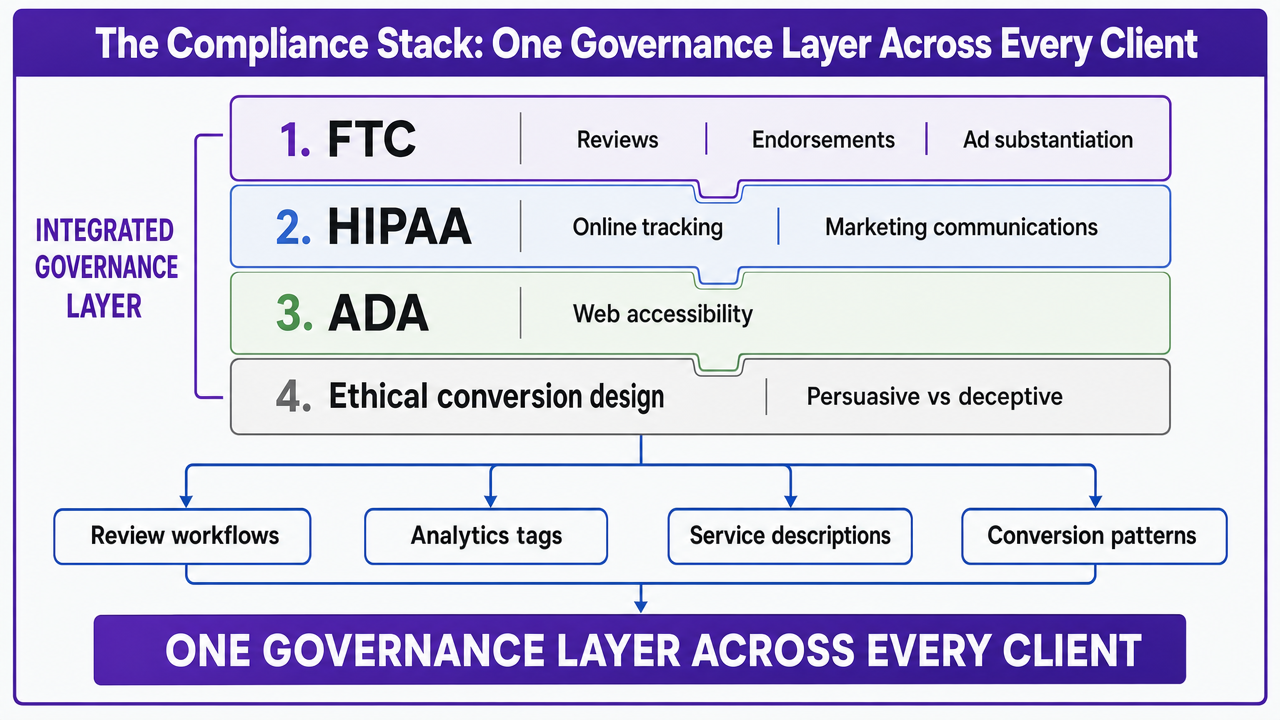 Visualize the four-layer compliance governance stack the section explicitly describes (FTC, HIPAA, ADA, and ethical conversion design) as an integrated framework rather than scattered controls
The Human Approval Layer That Makes AI-Assisted Production Safe to Scale
AI-assisted production without a formal approval layer is how agencies discover, in public, that a service page for a behavioral-health client claimed a treatment outcome the clinician cannot substantiate 7. The technology compresses production time. The approval layer is what keeps that compression from producing a compliance incident.
Approval works when it is wired into the workflow at four specific gates, not bolted on as a final read:
- Content briefs get senior sign-off before drafting begins, so the writer — human or AI — is not free-associating on service lines the client does not sell.
- First-pass drafts route to a strategist who owns claim substantiation, with FTC advertising rules 3 and, for health and behavioral-health work, the health-claims standard 7 embedded in the QA checklist.
- Technical fixes and schema changes route to a technical lead before they hit the client's production environment.
- Review responses and local profile edits route through a reputation reviewer who checks language against the FTC's endorsement and testimonial rules 2.
The failure mode is predictable. Senior review hours drift toward zero as production volume rises, and the agency mistakes throughput for capacity. The correct pattern holds strategist review hours steady per deliverable while junior production hours compress — that is what turns AI-assisted production into a scalable capability rather than a liability with faster output.
See How High-Volume SEO Execution Drives Measurable Client Revenue Gains
Request a walkthrough of automated workflows that enable agencies to scale SEO deliverables, maintain approval control, and connect content performance to client revenue metrics—without expanding your team.
If You Manage a Regulated-Vertical Portfolio: Adjusting the Operating Model
This section narrows to Heads of SEO whose book of business tilts toward law firms, healthcare practices, behavioral-health providers, dental groups, senior living communities, or home services with licensing exposure. The operating model described in earlier sections still holds. What changes is the sequencing and where senior hours land.
Three adjustments matter more than the rest:
- Privacy governance moves upstream of production, not alongside it. The NIST Privacy Framework works as a portfolio-wide backbone for analytics decisions, call-intelligence data handling, vendor reviews, retention rules, and access controls — one governance model applied to every client rather than a bespoke privacy conversation on each onboarding 1.
- Subject-matter review gets a named owner per vertical. A behavioral-health service page needs a clinician-approved substantiation trail for any objective health claim before it publishes 7, and that reviewer sits inside the approval workflow, not outside it.
- Call-intelligence configuration becomes a per-client build rather than an agency default. For HIPAA-covered clients, tag deployment, form capture, and remarketing audience construction each require a documented review that the client's privacy officer signs before anything fires 6, 10.
The portfolio-level payoff is quieter than a ranking win but more durable. Standardizing the governance backbone once and applying it across every regulated account is what lets the agency add the next ten logos without adding a compliance headcount for each.
Wiring Attribution Into the Client Contract From Day One
Attribution disputes almost always trace back to the statement of work. Definitions that were never written down at signing become the terms both sides fight over in month seven, when the client's CFO asks why the qualified-call count on the agency dashboard does not match the intake team's booking log.
Four contract elements close that gap before it opens:
- The definition of a qualified call — service line, geography, duration threshold, disqualification reasons — gets written into the scope, not left to interpretation.
- The list of first-party signals the agency is responsible for producing is separated from the downstream events the client's intake, sales, or clinical staff control, so nobody argues about closed revenue when the intake team missed the callback window.
- The analytics and call-intelligence stack is named specifically, with configuration decisions for regulated clients routed through the client's privacy officer under a documented review before any tag fires 6, 10.
- Reporting cadence, dashboard access, and the escalation path for attribution disputes are set at kickoff.
Contracts written this way turn attribution from a monthly argument into a quarterly business review the client's finance team can actually reconcile.
What to Build Next Quarter
The operating model in this article does not install in a weekend. It installs in one quarter of focused build work, sequenced so each layer supports the next.
Four builds carry the weight:
- Rewrite the standard client dashboard to report at the qualified-call layer, not the ranking layer.
- Publish the technical baseline and vertical audit templates so onboarding stops re-solving the same problems.
- Consolidate FTC, HIPAA, and ADA controls into one governance layer with named approval gates 2, 6, 5.
- Run the delivery economics worksheet against the three lowest-margin accounts to see where AI-assisted production with a human approval layer changes the math.
Agencies that want the approval-first production layer built rather than assembled can evaluate Vectoron on a two-week trial.
Frequently Asked Questions
References
- 1.Using Privacy Framework 1.1.
- 2.The Consumer Reviews and Testimonials Rule: Questions and Answers.
- 3.Advertising FAQ's: A Guide for Small Business.
- 4.Endorsements, Influencers, and Reviews - Federal Trade Commission.
- 5.Guidance on Web Accessibility and the ADA.
- 6.Use of Online Tracking Technologies by HIPAA Covered Entities and Business Associates.
- 7.Health Claims | Federal Trade Commission.
- 8.FTC Report Shows Rise in Sophisticated Dark Patterns Designed to Trick and Trap Consumers.
- 9.Federal Trade Commission Announces Updated Advertising Guides to Combat Deceptive Reviews and Endorsements.
- 10.Marketing.