
Key Takeaways
- Revenue SEO reorients reporting from rankings and sessions to qualified calls, booked appointments, revenue per indexed page, and CAC payback at the URL level.
- A closed-loop operating model runs on four control points: signals from live business data, ranked priorities, a human approval gate, and execution with KPI feedback.
- Performance, accessibility, and credibility function as revenue levers, since mobile speed affects conversion 1, unlabeled forms block bookings 4, and clinician-reviewed content earns durable rankings in regulated topics.
- Multi-location operators should consolidate signals, priorities, approval, and execution into one governed loop rather than stacking vendors, keeping human sign-off for Consumer Reviews Rule 9and HIPAA tracking exposure 10.
The Measurement Gap That Separates Ranked Pages From Booked Revenue
Most SEO programs report easily measurable metrics like keyword positions, organic sessions, bounce rate, and time on page. However, they often fail to report on what truly matters to finance teams: qualified calls, booked appointments, closed revenue, and the payback period on content investment. This discrepancy often leads to SEO budget cuts.
This disconnect stems from an operating-model choice. Teams viewing SEO as a traffic function optimize for visibility metrics, losing track of the user journey between a session and a booking. In contrast, teams treating SEO as a revenue function instrument the entire path, from initial impression to signed contract. This data then informs decisions on which pages warrant further investment and which should be retired.
Performance monitoring is crucial here. The U.S. Web Design System notes that studies consistently show performance improvements boost conversion rates, particularly for mobile traffic sensitive to variable network conditions 1. This indicates that every page in the organic funnel also serves as a conversion surface, necessitating measurement that tracks the user all the way to the desired outcome.
The following sections detail how to build this measurement stack and the governance required for it.
Revenue Per Indexed Page: The Metric Most SEO Programs Skip
What Revenue SEO Measures vs. What SEO Dashboards Report
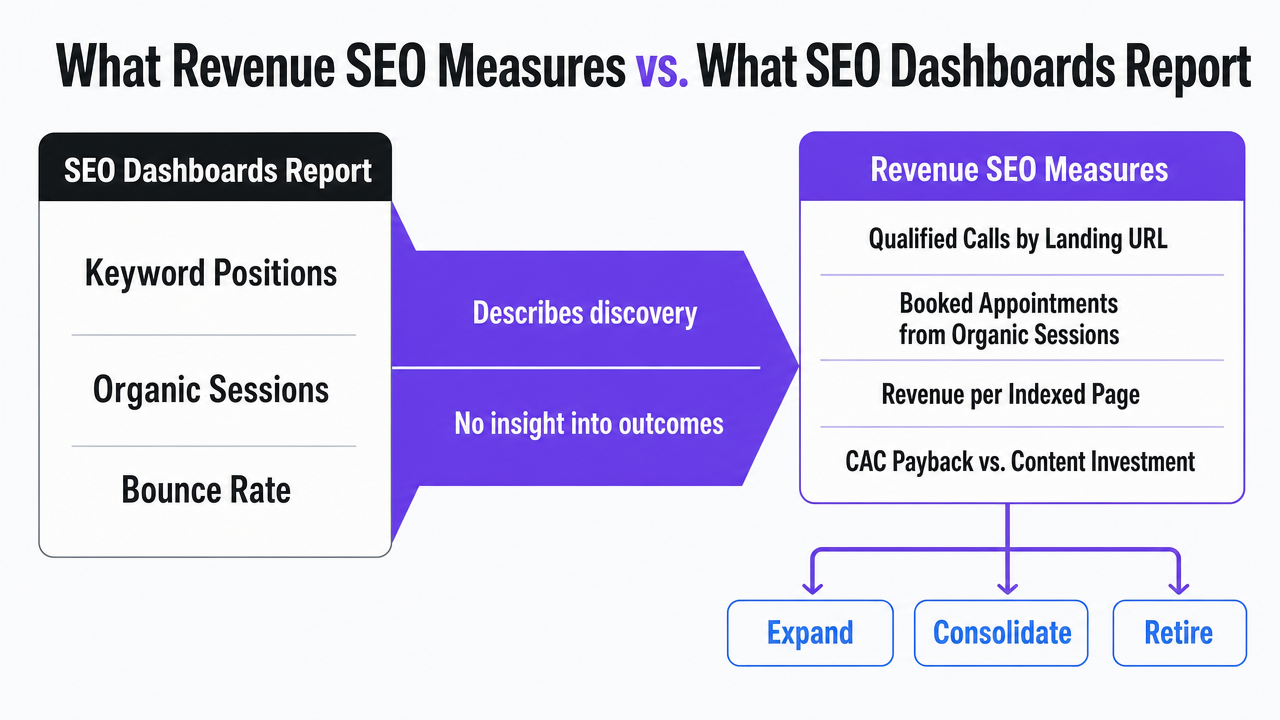
Standard SEO dashboards typically report keyword positions, organic sessions, and engagement proxies like bounce rate. These metrics describe discovery but offer no insight into whether a visitor completed a call, filled out a consultation form, or booked an appointment.
Revenue SEO reorients this reporting. Instead of ranking pages by SERP position, it ranks them by their actual output:
- Qualified calls attributed to the landing URL
- Booked appointments sourced from organic sessions
- Revenue per indexed page over a rolling window
- Customer acquisition cost payback measured against content investment
These four metrics dictate which pages are expanded, consolidated, or retired.
What SEO dashboards report vs. what revenue SEO measures. Conventional reporting stacks rankings, sessions, and bounce rate. Revenue reporting stacks qualified calls, booked appointments, revenue per indexed page, and CAC payback — the metrics that decide which URLs earn more investment.
The link between these two approaches is page performance. The U.S. Web Design System highlights that performance improvements consistently enhance conversion rates across various applications, with mobile traffic being particularly susceptible to fluctuating network conditions 1. This emphasizes that every indexed URL is a conversion surface, requiring a measurement stack that spans from the first impression to the booked outcome. Otherwise, the dashboard only reflects half of the funnel.
 Contrast the metrics conventional SEO dashboards report against the metrics a revenue SEO program measures, directly supporting the section's core argument
Instrumenting the Funnel: Calls, Forms, and Booked Appointments
Effective instrumentation is critical for revenue SEO. A common failure occurs when analytics counts a form submission, the CRM counts a lead, and the scheduler counts an appointment, but no single system can connect an organic session on a specific URL to a booked slot days later. This leads to seemingly healthy dashboards while pipeline remains stagnant.
A functional instrumentation stack addresses four key handoffs:
- Every conversion surface—appointment forms, consultation requests, chat openers, and tracked phone numbers—must carry the landing page, source, and session identifier through to the CRM record.
- Call tracking needs to route by page and intent, not just by campaign, ensuring distinct numbers for different page types.
- The CRM must relay qualification and booking status back to analytics, beyond just lead creation.
- Revenue attribution must resolve at the URL level on a rolling window, as the page that generated the initial call may not be the one that closed the deal.
For HIPAA-regulated entities, the mechanics of tracking change, but the measurement goals remain. HHS OCR guidance on tracking technologies mandates that pixels, session replay, and similar tools on authenticated pages must be configured to ensure protected health information is used and disclosed in compliance with the Privacy Rule and protected under the Security Rule 10. This means instrumentation design and compliance design are integrated, not sequential, projects.
A Closed-Loop Operating Model: Signals, Priorities, Approval, Execution
The Four Control Points of a Revenue SEO Program
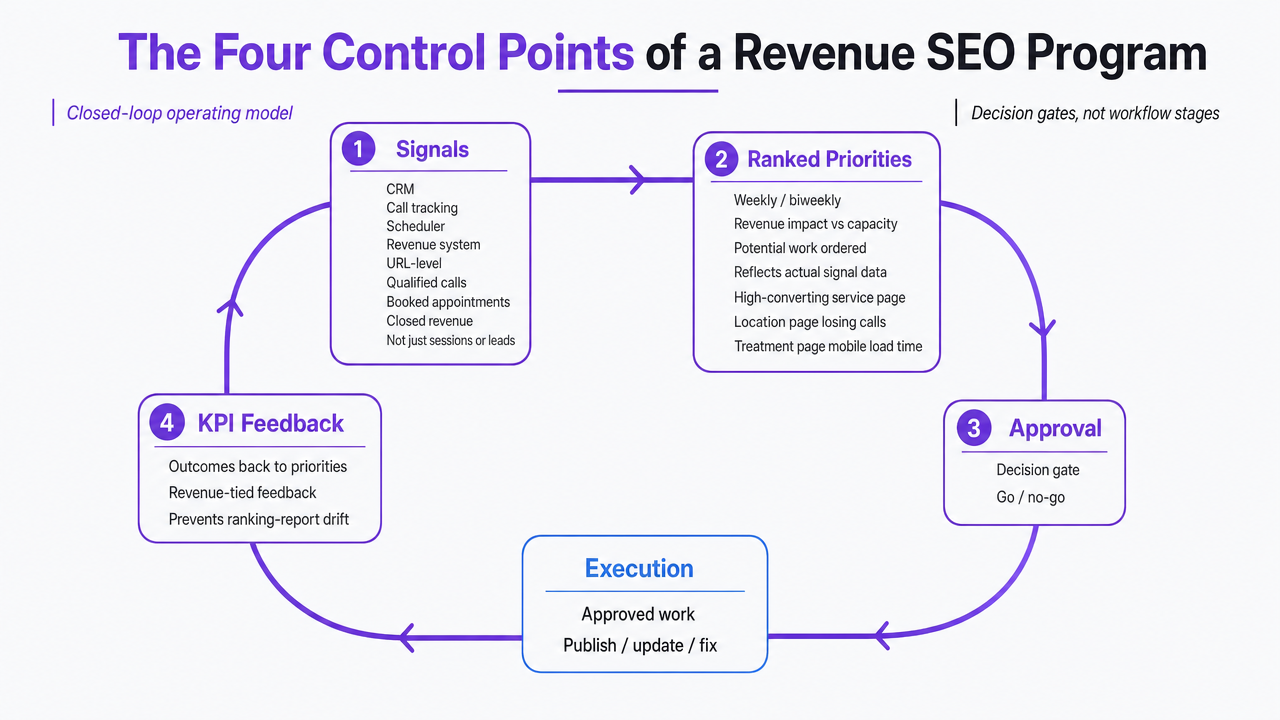
A revenue SEO program operates on four control points, each serving as a decision gate rather than a workflow stage. If any of these points are missing or disconnected, the program tends to revert to focusing on ranking reports.
- The first control point is signals: live business data from the CRM, call tracking, scheduler, and revenue system, resolved at the URL level. This includes qualified calls, booked appointments, and closed revenue tied to the generating page, not just sessions or leads.
- The second is ranked priorities: a weekly or biweekly list that orders potential work by expected revenue impact versus capacity. This list reflects actual signal data, highlighting, for example, a service page converting at four times the site average, a location page losing calls to a competitor, or a treatment page where mobile load time correlates with form abandonment.
- The third control point is the approval gate. Every priority—whether a new page, a consolidation, a schema change, or a tracking update—requires human sign-off before implementation. This gate serves two purposes: mitigating compliance exposure in regulated verticals and addressing the fact that automated prioritization can be inaccurate enough to degrade the asset base if unsupervised.
- The fourth is execution with KPI feedback. Approved work is built and published, and its performance data flows back into the signals layer within the same measurement window. This closes the loop, ensuring the next priority list reflects the outcomes of the previous release.
The closed-loop operating model. Signals (qualified calls, booked appointments, closed revenue per URL) feed ranked priorities. Priorities route through a human approval gate before execution. KPI feedback returns to the signals layer, where performance data continues to inform which pages earn more investment — a pattern consistent with performance monitoring guidance that treats speed and reliability as ongoing operational metrics rather than one-time projects 1.
 Visualize the closed-loop operating model (signals → priorities → approval → execution → KPI feedback) described in the section
Killing Unprofitable Pages and Doubling Down on Converting Ones
Many content libraries contain numerous pages that rank and attract sessions but generate no revenue. These pages were often created to target keywords rather than to produce bookings. Revenue SEO views such pages as liabilities. Pages that consume crawl budget, dilute topical authority, and distract internal links without contributing to the pipeline are consolidated, redirected, or removed on a scheduled basis.
The decision-making process is systematic. Over a rolling ninety-day window, each indexed URL is scored based on three inputs: qualified calls or form conversions attributed to the page, revenue per session, and maintenance cost (updates, compliance review, internal link upkeep). Pages falling below a set threshold on all three are added to a "kill list." Pages above the median for conversion but below for traffic are moved to an "expansion list" for deeper content, better internal links, and supporting assets. Pages above the median for both conversion and traffic receive technical and performance investment first, as incremental improvements on high-converting pages yield greater revenue per hour than creating new pages from scratch.
The secondary effect is significant. When the "kill list" is implemented, the remaining pages benefit from a cleaner internal link graph and a more focused topical footprint. The expansion list then operates within a smaller, higher-quality asset base, which is why aggressive pruning often leads to new pages indexing and ranking faster in subsequent quarters.
Test Data-Driven SEO Execution in Real Time
Evaluate impact on SEO performance by publishing real site content during your trial, with full analytics access.
Conversion-Grade Pages: Performance, Accessibility, and Credibility as Revenue Levers
Performance and Mobile Variability on the Path to Conversion
A page that ranks well on a desktop and loads quickly on a fiber connection often differs significantly from what a prospective customer experiences. The real page typically loads on a mid-tier Android phone over a congested LTE connection, often indoors, one-handed, and while the user is comparing competitors. Performance degradation in such real-world conditions is where organic sessions frequently fail to convert.
The U.S. Web Design System emphasizes performance as an ongoing operational metric for digital services. It notes that studies consistently show performance improvements boost conversion rates, and mobile traffic is particularly affected by rapidly changing network conditions 1. While avoiding a universal lift number due to audience, task, device, and offer variability, the directional insight is clear: speed is a revenue driver for every page in the organic funnel, not merely a technical achievement for the engineering team.
Operationally, this means pages generating the most qualified calls receive dedicated performance budgets, real-user monitoring for mobile field data, and regression alerts tied to deployments, rather than just a quarterly Lighthouse audit of the homepage.
Accessibility as a Revenue Capture Mechanism, Not a Legal Footnote
Accessibility is often treated as a legal obligation managed by another department within most SEO programs, a perspective that can lead to lost revenue. Department of Justice guidance under the Americans with Disabilities Act clarifies that inaccessible websites create barriers for people with disabilities and outlines when the ADA requires public-facing web content to be accessible, along with practical steps to address these barriers 4. This guidance, issued in March 2022, remains a key federal reference for accessibility requirements.
The conversion impact is direct:
- An appointment form with unlabeled inputs will not function with a screen reader.
- A location selector relying on hover states will not work on a touch device or with keyboard navigation.
- A phone number rendered as an image is invisible to assistive technology and cannot be tapped on mobile.
In each instance, a prospective customer who arrived from organic search with intent to book is unable to complete the transaction. This lost booking never enters the CRM, so the attribution model fails to register the loss.
Teams that prioritize accessibility for conversion surfaces—forms, scheduler widgets, click-to-call elements, chat openers—can recover demand they are already paying to generate. Accessibility audits should align with deployment cadences, as a design system change on a converting template can silently disrupt assistive-technology paths between releases.
Credibility in Regulated Verticals: Why Source Quality Changes Rankings and Trust
This section focuses on operators in healthcare, behavioral health, and similar regulated verticals, where the credibility bar is significantly higher than for general commercial content, and errors carry substantial risks beyond a simple bounce.
A meta-analysis of systematic reviews on online health information quality concluded that quality is frequently suboptimal, and the internet does not consistently provide high-quality health information for laypeople 2. While quality varied, this finding underscores why editorial controls for medical content must exceed those for generic service pages. A separate study comparing traditional search engines and AI chatbots for health information found Google to be the most reliable source of high-quality, readable health information among evaluated platforms, though comparative results depend on prompts, queries, evaluation criteria, and model versions 3. Strategically, organic search remains where credibility is built, and pages that achieve durable rankings in regulated topics are those with clinician review, cited evidence, clear authorship, and transparent dates.
Credibility also feeds into the measurement loop. Pages that accurately answer questions generate more qualified calls per session than those that obscure answers with marketing language. Consequently, revenue per indexed page tends to increase in parallel with editorial rigor on regulated topics.
Compliance as a Conversion Lever: FTC, ADA, and HIPAA in One Governance Pass
Substantiation and Disclosure on Service and Landing Pages
Compliance review often occurs late in the content creation process, after a page is drafted, designed, and queued for publishing. By this point, claims are integral to the conversion argument, and legal edits either gut the page or introduce workarounds that subtly weaken it. Integrating substantiation early in the brief dictates which claims are written in the first place.
Federal Trade Commission guidance for small businesses clearly states that internet advertising claims must be truthful and substantiated, and disclosures must be clear and conspicuous enough for consumers to notice and understand them 5. The companion "Rules of the Road" publication provides operational details for SEO teams regarding landing pages: testimonials must reflect typical experiences unless otherwise qualified, cannot make unsubstantiated claims, and disclaimers do not rectify fundamentally unsupported claims 8. Broader online marketing guidance emphasizes that material details should be disclosed upfront, within the same visual frame as the claim, rather than hidden in a footer 6.
For service or treatment pages, the practical rule is that every outcome claim, timeframe, pricing range, success metric, or comparative statement requires a named source in the page brief before copy is written. If a source does not exist, the claim should not be published.
Review and Testimonial Governance After the 2024 Consumer Reviews Rule
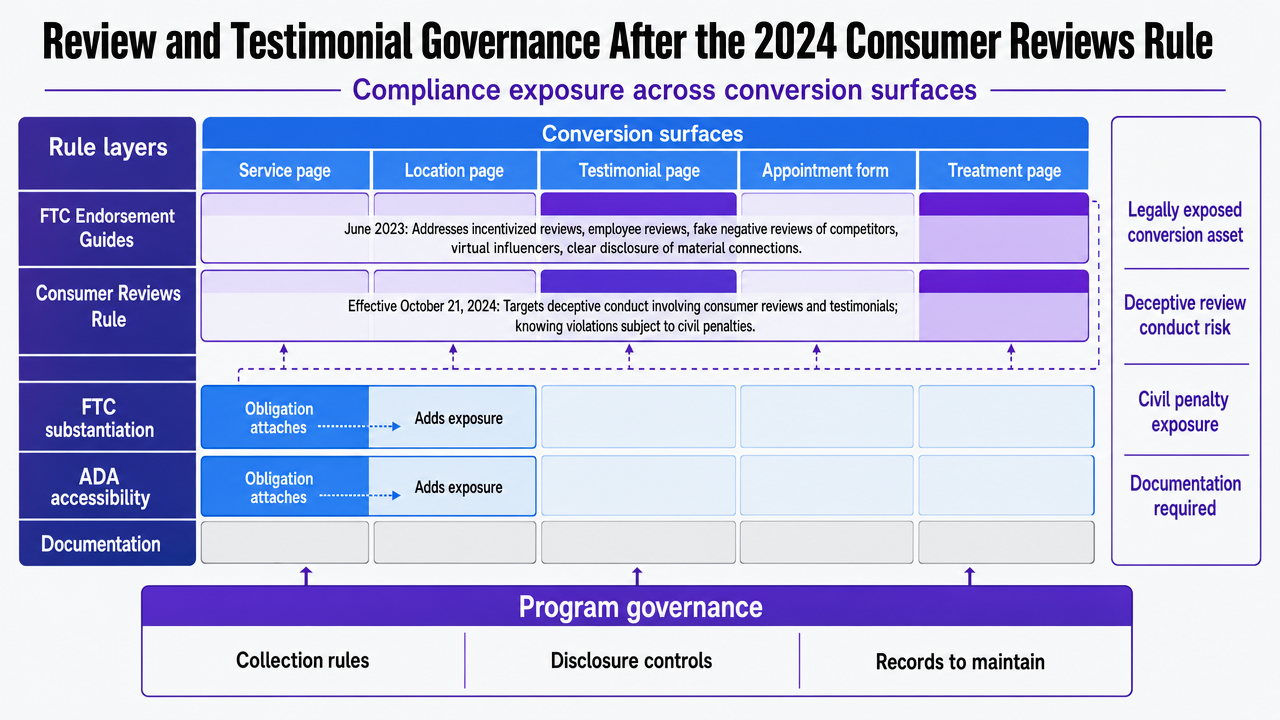
Review content is a highly effective conversion asset on organic landing pages, but it is now also one of the most legally exposed. The FTC's updated Endorsement Guides, announced in June 2023, address incentivized reviews, employee reviews, fake negative reviews of competitors, virtual influencers, and the clear disclosure of material connections 7. The Consumer Reviews and Testimonials Rule, effective October 21, 2024, targets deceptive conduct involving consumer reviews and testimonials, with knowing violations subject to civil penalties 9. Together, these regulations redefine what a review program can do and the documentation it must maintain.
Compliance exposure matrix by page type. Service pages carry FTC substantiation obligations 8and ADA accessibility obligations 4. Location pages add local accuracy and review governance under the 2024 Consumer Reviews Rule 9. Testimonial pages carry the full weight of the updated Endorsement Guides and the Reviews Rule, including material-connection disclosures 7, 9. Appointment forms carry ADA accessibility obligations 4and, for HIPAA-regulated entities, tracking-technology obligations 10. Treatment pages add substantiation on clinical claims 8and HIPAA considerations when authenticated or sensitive interactions are involved 10.
Operationally, this translates into three required artifacts for the review workflow:
- An audit trail detailing how each published review was solicited and whether any incentive was exchanged
- A consistent disclosure pattern for material connections
- A documented policy for handling negative reviews to prevent default suppression
Review widgets, location-page carousels, and case-study pages all draw from this same governed pool.
 Map compliance obligations across page types (service, location, testimonial, appointment form, treatment) so readers can see which regulations attach to which conversion surfaces
HIPAA Tracking: When Measurement Itself Becomes the Risk
This section specifically addresses HIPAA-regulated operators, including health systems, behavioral health networks, dental groups handling PHI, and their business associates who build their websites.
HHS OCR guidance on tracking technologies covers cookies, pixels, session replay, fingerprinting, and similar tools on healthcare websites and apps. Covered entities and business associates must configure tracking on authenticated pages to ensure protected health information is used and disclosed in compliance with the Privacy Rule and protected under the Security Rule 10. Whether a particular unauthenticated page interaction involves PHI depends on the specific facts and data flow, which is why the guidance avoids a blanket rule and emphasizes analysis of individual implementations.
The revenue consequence is direct. A tag manager pushing form-field values from an appointment page to a third-party analytics endpoint can transform a measurement decision into a reportable incident. Teams that treat the tracking plan as a compliance artifact—reviewed alongside the page brief, with a documented data map and signed business associate agreements where required—can maintain their attribution model without exposing the organization to regulatory risk.
See How Leading Teams Build Predictable SEO Pipeline—Without Adding Headcount
Request a data-backed assessment of your current SEO execution process and learn how enterprise teams accelerate revenue impact through AI-powered workflow automation.
If You Manage Multiple Locations: The Hidden Cost of Fragmented SEO Execution
Where Multi-Location Operators Diverge: Local Accuracy, Review Governance, Form Tracking
This section is for operators managing SEO across multiple locations, such as DSO groups, multi-market law firms, behavioral health networks, regional home services brands, and senior living portfolios.
The differences from single-site SEO are distinct:
- Local accuracy becomes a per-location data integrity challenge: name, address, hours, insurance acceptance, provider rosters, and service availability must match across the website, location pages, Google Business Profile, and third-party directories. A change-control process is essential to prevent discrepancies before a prospective customer encounters a disconnected number.
- Review governance scales nonlinearly; while a single location can manage reviews informally, twenty locations generating reviews across multiple platforms require a documented solicitation workflow, consistent disclosure patterns for material connections, and a published policy for handling negative reviews—all obligations tightened by the Consumer Reviews and Testimonials Rule effective October 21, 2024 9.
- Form tracking also fragments. Each location often routes to a different scheduler, phone system, or intake queue, and the attribution model must accurately link organic sessions to the correct destination without leaking PHI to third-party endpoints if the operator is HIPAA-regulated 10.
The Vendor and Coordination Sprawl Table
The hidden cost of multi-location SEO is rarely the retainer itself, but rather the coordination tax—the hours a VP, director, or operations lead spends briefing, reviewing, reconciling, and chasing status across various vendors or contractors, each responsible for a segment of the program. The table below uses variables instead of specific dollar figures, as actual costs vary by vertical, number of locations, and vendor mix.
| Execution slice | Typical owner in fragmented model | Hidden coordination cost |
|---|---|---|
| Content production | Agency or freelance pool | Briefs, revisions, compliance review per page × locations |
| Technical SEO | Separate specialist or dev shop | Change requests queued behind product roadmap |
| Local listings and GBP | Local SEO vendor | Per-location data reconciliation, suspension recovery |
| Reviews and reputation | Separate platform plus manual workflow | Solicitation audit trail, disclosure consistency 9 |
| Backlinks | Outreach contractor | Approval of each placement against brand and compliance |
| Analytics and attribution | In-house or BI vendor | CRM-to-URL reconciliation, HIPAA tracking review 10 |
| Internal coordination | VP, director, ops lead | Weekly status, cross-vendor conflict resolution, QA |
When actual hours are applied to this table, two patterns emerge. The approval surface area expands faster than the number of locations, as each vendor requires its own review loop. Additionally, the component most critical for revenue attribution—connecting a page to a booked appointment—is typically not fully owned by any single vendor.
Scaling Execution Without Adding Headcount or Stacking Vendors
The structural solution to the fragmentation problem is not to add another vendor or a second content agency. Instead, it involves consolidating the four control points—signals, ranked priorities, approval, and execution—into a single governed loop that one owner can supervise across all locations without expanding the team.
Operationally, this means the system that reads signals is the same system that generates the priority list, routes each item through human approval, ships the approved work, and feeds results back. The approval gate remains human due to compliance exposure under the Consumer Reviews Rule 9, HIPAA tracking obligations on authenticated pages 10, and the inherent inaccuracies of automated prioritization that can degrade asset quality if unsupervised. What changes is the scope of governance for the VP—one approval queue instead of six vendor review loops, one data map instead of seven reconciliation spreadsheets.
Vectoron is built on this model, offering specialist AI strategists for content, SEO, backlinks, PPC, social, and call intelligence. These specialists are coordinated through a Command Center that routes every recommendation for sign-off before execution. The next operational decision then becomes which converting pages receive the first approval cycle.
Frequently Asked Questions
References
- 1.Why track performance | U.S. Web Design System.
- 2.Can Patients Trust Online Health Information? A Meta-Analysis of Systematic Reviews on the Quality of Health Information on the Internet.
- 3.The Reliability Gap: How Traditional Search Engines and AI Chatbots Compare in Health Information.
- 4.Justice Department Issues Web Accessibility Guidance Under the Americans with Disabilities Act.
- 5.Advertising FAQ's: A Guide for Small Business.
- 6.Online Advertising and Marketing.
- 7.Federal Trade Commission Announces Updated Advertising Guides to Combat Deceptive Reviews and Endorsements.
- 8.Advertising and Marketing on the Internet: Rules of the Road.
- 9.The Consumer Reviews and Testimonials Rule: Questions and Answers.
- 10.Use of Online Tracking Technologies by HIPAA Covered Entities and Business Associates.