
Key Takeaways
- Organic programs win pipeline by installing preference before the first sales call, since 68% of B2B buyers enter with a front-runner who wins 80% of the time 6.
- Treat SEO as four jobs with distinct owners and KPIs: discoverability across classic and AI surfaces, trust through substantiation, conversion of qualified visits, and attribution beyond last click.
- Consolidate FTC substantiation, WCAG 2.1 AA accessibility, and HIPAA tracking rules into one pre-publish checklist owned by one approver, turning compliance into a conversion lever rather than a blocker 2, 8, 9.
- Replace sessions and rankings with qualified organic opportunities, assisted pipeline tagged in the CRM, AI-answer citation accuracy, and a discovery-call field capturing where prospects first heard of the brand.
Where organic pipeline is actually won in 2026
Organic pipeline is no longer decided on the search results page. It is decided in the research that happens before a buyer ever opens a tab on a vendor's site. Forrester's 2025 Buyers' Journey work found that 68% of B2B buyers enter the process with a front-runner already in mind, and that front-runner wins the deal 80% of the time; across all buyers, the preferred vendor wins 55% of purchases overall 6. The implication for a VP of Marketing is unambiguous: the SEO program's primary job is to install preference, not to maximize sessions.
That reframe collides with how most organic programs are still measured. Keyword rankings, traffic trendlines, and domain authority scores describe surface area, not pipeline. They were useful proxies when buyers clicked through to a site to form an opinion. Now a growing share of that opinion-forming happens inside AI answer surfaces, in peer conversations, and in third-party comparison content the vendor does not control.
Three forces have reshaped what "improving SEO" actually means. Buyers arrive pre-decided more often than marketing dashboards suggest. AI-mediated research compresses the consideration stage and often hides the referring source entirely. And in regulated verticals, substantiation and accessibility now function as ranking and conversion variables, not legal afterthoughts. The sections that follow treat SEO as a four-job operating system built around those forces, with KPIs a CRO or CEO can defend in a QBR.
The four-job operating model for pipeline SEO
Treating SEO as a single discipline hides where it actually breaks. A more useful frame separates the work into four jobs, each with its own owner, its own evidence, and its own KPI. The jobs are discoverability, trust, conversion, and attribution. They operate in sequence from a buyer's first unprompted question to a closed deal, and a weakness in any one of them caps the output of the others.
Discoverability covers presence in classic search results and in AI answer surfaces, measured by share of voice on category questions and by appearances in generative responses rather than by raw sessions. Trust covers the substantiation and credibility signals that let a reader, a reviewer, and an algorithm accept a claim: expert authorship, cited evidence, review integrity under FTC rules 2, and accessibility that keeps the site usable for the full audience 8. Conversion covers whether a qualified visit becomes a qualified call, booking, or sales conversation. Attribution covers how influence is credited when much of the research is zero-click and happens inside third-party surfaces 5. The sections ahead work through each job with the metrics and operational decisions a VP can defend.
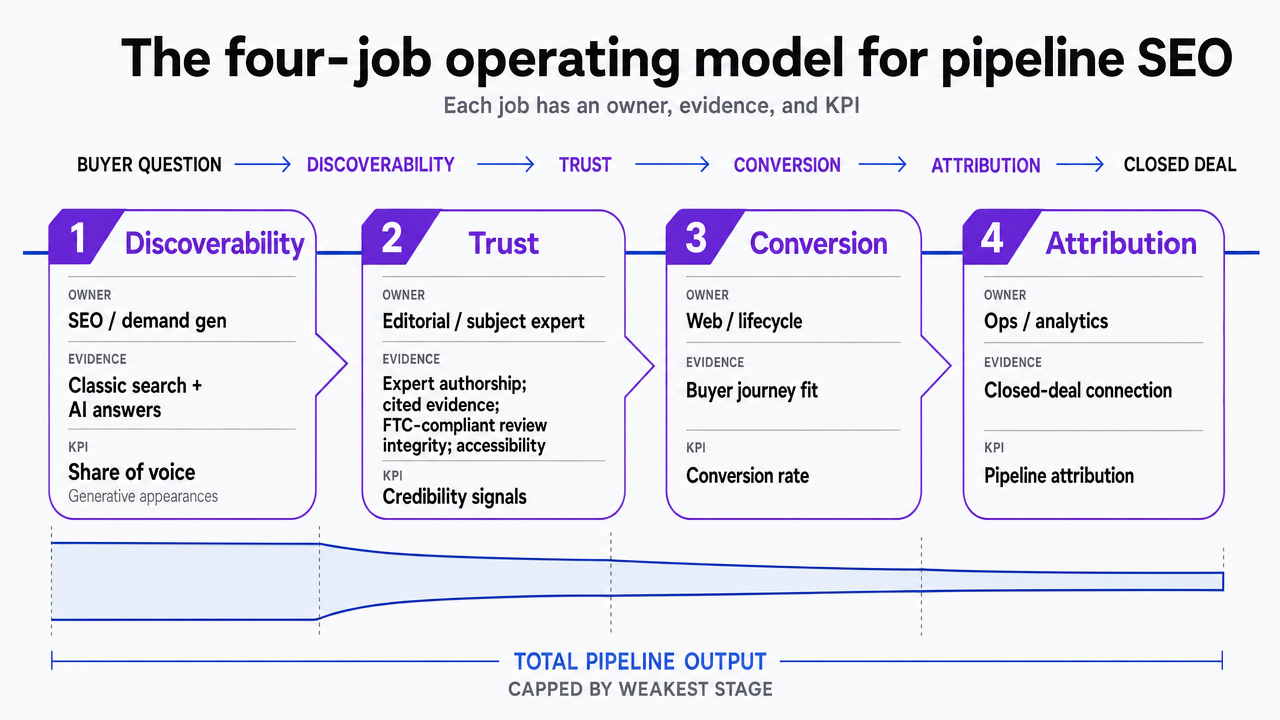 Visualize the four sequential jobs (discoverability, trust, conversion, attribution) with their owners, evidence sources, and KPIs as described in the section
Discoverability: ranking in classic search and AI answer surfaces
Why pre-form preference beats session volume
The highest-leverage SEO work installs a preference the buyer carries into the first sales conversation. Forrester's 2025 Buyers' Journey research, which measured B2B buyers across purchase types, found that 68% entered the process with a front-runner already in mind, that front-runner was selected 80% of the time, and the preferred vendor won 55% of purchases overall 6. The sample reflects B2B purchasing specifically, so the magnitudes will not translate cleanly to a walk-in consumer category, but the directional lesson holds anywhere a buyer researches before contacting a provider: the organic program's primary output is a position in the consideration set, not a session count.
That reframe changes what a VP of Marketing actually optimizes. A page that ranks third on a comparison query and names the brand accurately inside an AI answer can shape preference even when the click never lands on the owned site. A page that ranks first for a generic head term and converts at 0.3% can look like a win in a dashboard and contribute almost nothing to pipeline. The question worth asking in a QBR is not "did sessions grow" but "did the share of qualified buyers who already know the brand grow."
Three practical shifts follow. Category-defining content should be built around the questions buyers actually ask in-market, not the keywords with the fattest search volume. Branded search growth, direct-traffic growth to decision-stage pages, and sales-reported "heard of you already" rates become leading indicators of organic health. And comparison, alternative, and evaluation pages get prioritized ahead of top-of-funnel explainers, because those are the surfaces where the front-runner position is actually assigned.
Optimizing for generative and conversational search
AI answer surfaces reward content that resolves a full buyer question in one place, with named entities, cited evidence, and structure a model can parse. Forrester's survey of B2B buyers found that 95% planned to use generative AI in at least one area of a future purchase, and more than half said that use led them to consider more or different vendors while saving research time 4. The number describes stated intent among surveyed B2B buyers, not verified traffic from AI surfaces, but the operational signal is clear: assistants are expanding the consideration set, not narrowing it to incumbents.
Winning that expansion requires content built for extraction rather than for scroll depth. Pages that answer a specific buyer question in the opening paragraph, define the entities and categories in plain terms, and attribute claims to identifiable sources are easier for a generative system to quote accurately. Comparison tables with consistent column structure, FAQ blocks that mirror real buyer phrasing, and clear authorship with credentials give an AI system the context it needs to represent the brand correctly when the user never clicks through.
Classic SEO fundamentals still carry weight here. A page that is slow, inaccessible, or missing structured data is harder for both a traditional crawler and an answer engine to use. The practical adjustment is to measure a second layer alongside rankings: how often the brand is named in generative answers for category and comparison queries, whether those citations are accurate, and whether the surrounding context positions the brand as a credible option. Those metrics tell a VP whether discoverability work is actually feeding preference, or just producing pages no one reads.
Test Data-Driven SEO Execution in Real Time
Measure the impact of live SEO improvements on your pipeline before making any commitment.
Trust and substantiation as a ranking and conversion lever
E-E-A-T, expert review, and the YMYL quality gap
In regulated and consequential categories, substantiation is a competitive edge, not a legal cost center. A 2021 audit of Google results for "supplements for cancer" scored pages against an objective health-information quality index and found that only about 26% of results earned the top quality scores of 10 to 12. The correlation between quality score and ranking position was effectively zero, with Spearman's ρ of 0.034 and p of 0.67 10. The study examined one query over one period, so the specific percentages should not be generalized to every YMYL topic. The directional read still matters: ranking well and being trustworthy are not the same thing, which leaves a durable opening for operators willing to invest in expert review.
The practical build is less exotic than most E-E-A-T discourse suggests. Named authors with verifiable credentials, a visible medical, legal, or clinical reviewer on YMYL pages, citations to primary sources, and dates for last review give both human readers and ranking systems reason to accept a claim. Pages that explain how a conclusion was reached, acknowledge limits, and link to the underlying evidence tend to outperform pages that assert the same conclusion without scaffolding.
For a VP overseeing content in healthcare, legal, financial, or senior-living categories, the operational decision is who signs off before publish. A standing review panel with named experts, documented review dates, and a short list of claim categories that always require substantiation turns E-E-A-T from a vague signal into a shippable workflow. That workflow is also what makes the next job, compliance, executable at scale rather than reactive.
Consolidating FTC, ADA, and HIPAA requirements into one workflow
Most marketing teams treat FTC, ADA, and HIPAA as three separate anxieties handled by three separate people on three different timelines. That fragmentation is where organic programs quietly lose conversions and expose the business. Collapsing all three into one pre-publish checklist, run by one owner, turns compliance into a conversion lever instead of a late-stage blocker.
Start with the FTC layer, which touches the surfaces SEO depends on most. Reviews, testimonials, endorsements, influencer content, comparison pages, and third-party rankings must be authentic, disclosed where a material connection exists, and free of fabricated or incentivized feedback 2. Landing pages, service claims, before-and-after content, and AI-generated marketing assets must be truthful and substantiated, with heightened evidence expectations for health, safety, and performance claims 3. A single reviewer who checks every new landing page for a claim-to-evidence match catches the issues that quietly suppress conversion when a prospect notices the gap.
The ADA layer belongs in the same gate. The Department of Justice points to WCAG and Section 508 as the technical standards organizations can use to assess accessibility, and the 2024 Title II rule adopts WCAG 2.1 Level AA for state and local governments on a defined timeline 1, 8. Private operators outside Title II's direct scope still benefit from using WCAG 2.1 AA as the internal bar, because an inaccessible contact form, booking widget, or service page loses qualified pipeline that never shows up in a conversion report as a lost lead.
HIPAA closes the loop for any operator in healthcare, behavioral health, dental, or senior living. HHS has stated that HIPAA obligations apply when tracking technologies, analytics, pixels, forms, call intelligence, or remarketing tags collect or disclose protected health information, and that regulated entities must have appropriate business associate agreements with vendors where required 9. The operational consequence is specific: an analytics or ad-tech configuration that would normally support conversion optimization can become a reportable incident on a healthcare site if PHI reaches a vendor without the right agreement in place. One pre-publish checklist that covers substantiation, accessibility conformance, and tracking configuration prevents three separate teams from making the same site slower, less credible, or legally exposed one change at a time.
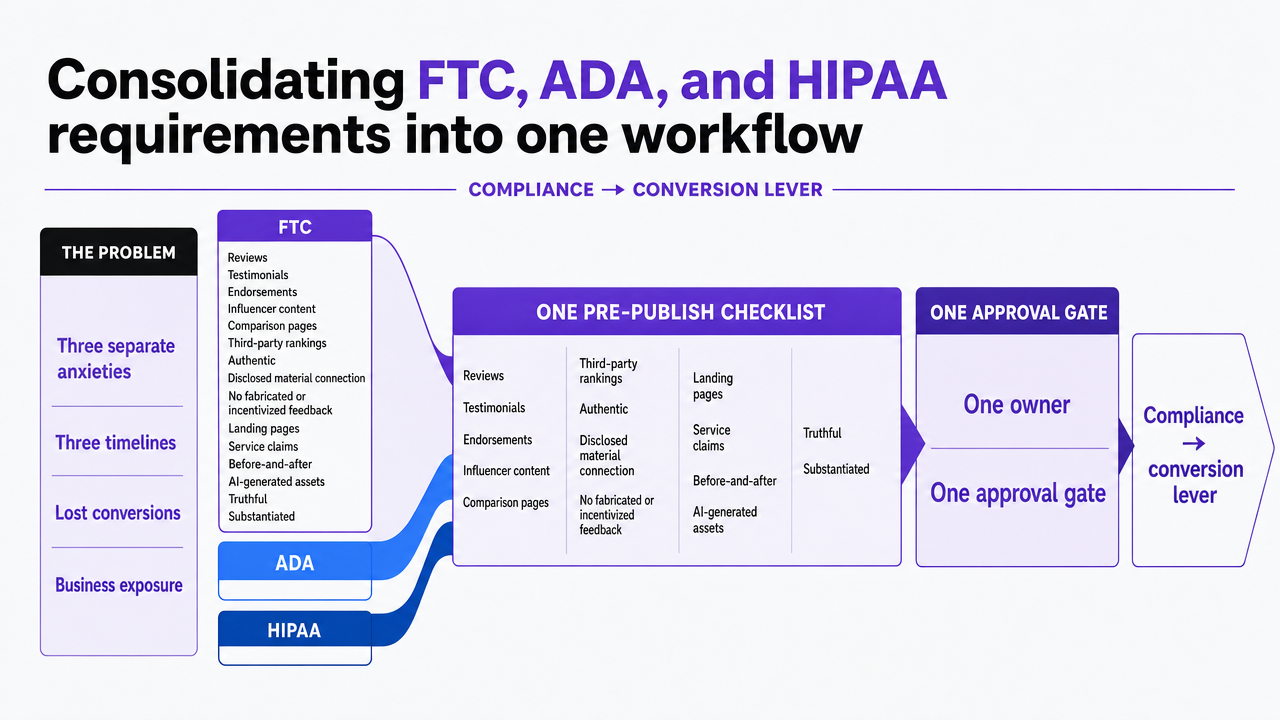 Visualize the unified pre-publish checklist consolidating three regulatory layers into one approval gate as described in this section
Conversion quality: turning qualified visits into qualified pipeline
A page that ranks well, loads fast, and earns trust still fails the pipeline test if the visitor who matches the ideal customer profile cannot complete the action that matters. Conversion quality is the job that translates a qualified visit into a qualified call, booking, demo, or sales conversation, and it is where most organic programs quietly leak the gains made upstream.
The first adjustment is to stop treating conversion rate as a single number. A 4% form-submission rate on a comparison page that produces mostly student researchers is worse than a 1.2% rate on the same page producing in-market buyers with budget. The metric worth tracking is qualified conversion rate: submissions, calls, or bookings that a sales team actually accepts as pipeline, divided by sessions from the target segment. That requires closed-loop data between the site, the CRM, and the call-handling layer so disqualified contacts are subtracted from the numerator rather than celebrated.
The second adjustment is to design decision-stage pages for the buyer who already has a front-runner in mind. Comparison pages, pricing-context pages, implementation and onboarding detail, and named-customer evidence do more work at this stage than another explainer. Scannable structure, specific numbers, and a single primary action per page outperform dense walls of copy with competing CTAs.
The third adjustment is removing friction that disproportionately filters out qualified buyers. Forms that demand phone number, company size, and use case before showing pricing push serious evaluators toward a competitor whose page answered the same question in one scroll. Inaccessible booking widgets, broken mobile layouts, and call paths that route to voicemail after hours all suppress the conversions the SEO program worked to earn 8. A monthly audit that walks the top ten organic landing pages on a screen reader, a mid-tier Android phone, and a cold call during off-hours surfaces most of the leaks before they show up as a missed quarter.
Attribution beyond last click: measuring assisted and zero-click pipeline
Last-click attribution was built for a buying journey that no longer exists. When a prospect reads three comparison pages inside an AI assistant, watches a product walkthrough on a peer-review site, and types the brand name directly into a browser two weeks later, the resulting direct-traffic conversion credits none of the organic work that produced it. Forrester's 2025 Buyers' Journey Survey, which measured self-reported source influence among B2B buyers, found that 94% used AI during their research and that twice as many named generative AI or conversational search as a more meaningful source than any other input 5. The survey captures stated preference rather than observed click paths, but the operational problem it describes is real: a growing share of pipeline influence happens on surfaces the marketing team cannot instrument directly.
The behavior is not confined to software buying. A 2025 cross-sectional study of 297 participants searching for health information in the prior year found that 98% used search engines, 68.4% used health-related websites, and 21.2% used LLM-based chatbots 7. The sample is small and self-reported, so the specific percentages should be read as a pattern rather than a benchmark, but the pattern is what matters for attribution design: a single prospect routinely touches three or four surfaces before contacting a provider, and the final touch is often a branded search that looks like free traffic in the dashboard.
A workable measurement stack adds three layers on top of last-click reporting:
- The first is assisted-pipeline tracking in the CRM: tag every closed-won opportunity with every known organic touch, and report the share of pipeline that had at least one organic interaction regardless of which channel closed it.
- The second is AI-answer visibility: a monthly audit of how often, and how accurately, the brand appears in generative responses to the top 25 category and comparison queries.
- The third is sales-conversation signal: a one-field addition to the discovery call template asking where the prospect first heard of the company and what they read before the call.
None of these replace revenue reporting; together they explain the share of revenue that last-click underprices, and give a VP the evidence to defend organic investment in a QBR without overclaiming direct causation.
See How Leading Brands Systematize SEO for Consistent Pipeline Growth
Request a walkthrough of unified, AI-driven workflows that coordinate content, SEO, and conversion tracking—enabling enterprise teams to scale organic impact without adding headcount or managing multiple vendors.
If you manage multiple locations: coordination economics without added headcount
The reader scope shifts here. Everything above applies whether the organic program covers one site or fifty. This section is written for the operator running SEO across a portfolio: a DSO with 40 practices, a behavioral health group with 12 clinics, a law firm with 8 offices, a home-services brand with regional franchisees. The constraint is the same across those categories. Headcount is fixed, locations are not, and every location multiplies the number of pages, reviews, local listings, call paths, and compliance checks that need to stay coordinated.
The hidden cost in multi-location SEO is rarely the work itself. It is the coordination overhead between the vendors doing the work. A typical portfolio runs a content agency, a technical SEO agency, a PPC agency, a review-management tool, a call-tracking vendor, and a local-listings service. Each one has its own reporting cadence, its own approval queue, and its own definition of a win. The marketing lead becomes a full-time translator between them, and the four-job model from earlier sections, discoverability, trust, conversion, and attribution, fragments across six dashboards that do not reconcile.
The variables that actually drive the economics are plain enough to model without invented dollar figures. Multiply the number of locations by the number of vendors by the number of approval cycles per month, and the result is the number of briefing conversations the in-house team has to run before any work ships. A 20-location operator with five vendors and a weekly approval rhythm is running 400 briefing touches a month before counting revisions. Each touch is a point where a claim can drift out of FTC substantiation 3, a tracking tag can be added to a form that handles PHI without the right agreement 9, or a local landing page can go live with an inaccessible booking widget 8.
A unified approval workflow collapses the coordination layer without expanding the team. The practical test is whether every recommendation across channels arrives in one queue with the reasoning attached, every decision routes through one approver, and every approved change is executed and measured against the same pipeline KPIs the earlier sections defined. That is the operating model Vectoron was built around, and it is how portfolio operators compound organic gains across locations instead of relitigating them in each vendor status call.
A 90-day sequence to re-architect the organic program
Re-architecting an organic program in one quarter is realistic if the work is sequenced by dependency rather than by channel. The four jobs defined earlier, discoverability, trust, conversion, and attribution, do not improve in parallel. Trust gates discoverability in regulated categories, conversion depends on both, and attribution only becomes useful once the first three produce enough signal to measure.
- Days 1 to 30 belong to diagnosis and the trust layer. Audit the top 50 organic landing pages for named authorship, reviewer credentials, substantiation of performance and outcome claims, and review-content authenticity against FTC guidance 2, 3. Run the same pages through a WCAG 2.1 AA conformance check and fix the issues that block contact, booking, or form completion 8. For any site handling protected health information, inventory every tracking tag, pixel, call-intelligence script, and remarketing integration against HHS guidance and confirm business associate agreements where required 9. Nothing new ships until the pre-publish checklist that combines these three layers is live and owned by one approver.
- Days 31 to 60 rebuild discoverability on top of that cleaned foundation. Prioritize comparison, alternative, and decision-stage pages ahead of top-of-funnel explainers. Rewrite the opening paragraph of each priority page to answer the specific buyer question outright, with named entities and attributed evidence a generative system can quote accurately. Add structured data, consistent comparison tables, and FAQ blocks that mirror actual buyer phrasing.
- Days 61 to 90 install the measurement stack. Tag assisted pipeline in the CRM, start a monthly audit of brand mentions and citation accuracy in AI answers for the top 25 category queries, and add a single discovery-call field capturing where the prospect first heard of the company. By day 90, the program reports qualified organic opportunities and preferred-vendor rate alongside sessions, which is the scoreboard a VP can defend in the next QBR.
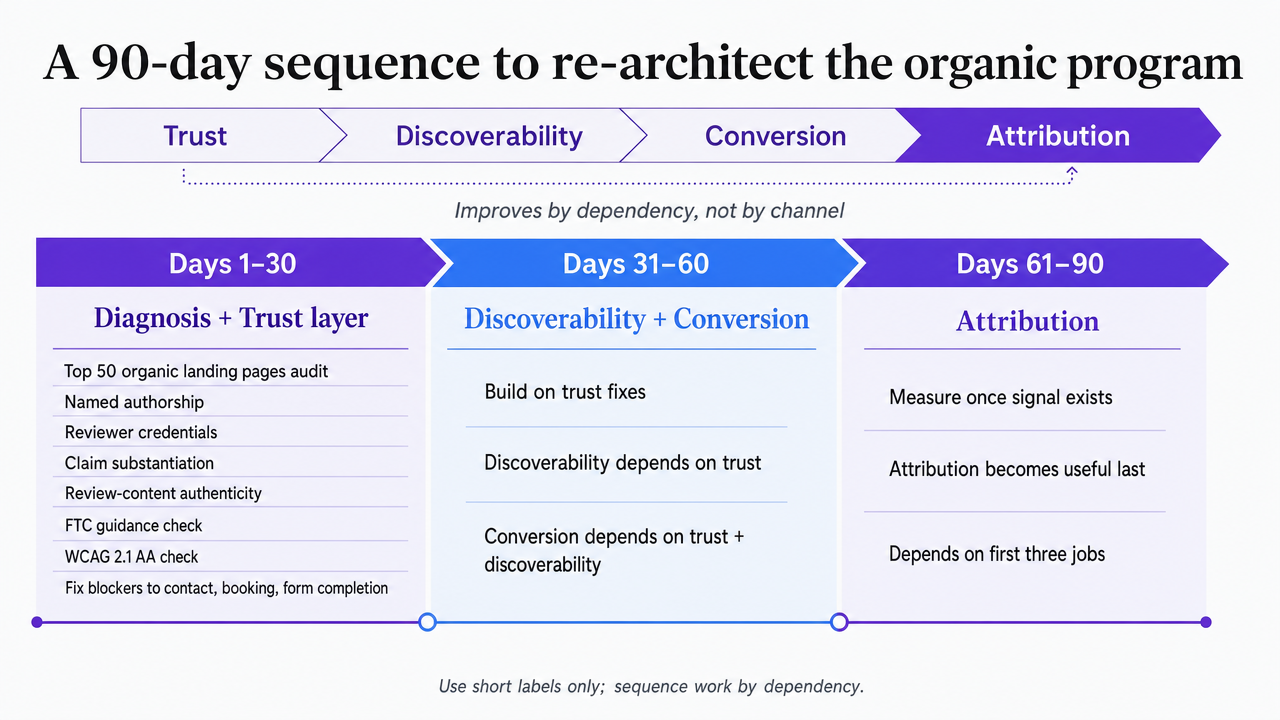 Visualize the three sequential 30-day phases described in the section with their specific deliverables
Frequently Asked Questions
References
- 1.Fact Sheet: New Rule on the Accessibility of Web Content and Mobile Apps Provided by State and Local Governments.
- 2.Endorsements, Influencers, and Reviews - Federal Trade Commission.
- 3.Advertising and Marketing on the Internet: Rules of the Road.
- 4.From Keywords To Context: Impact And Opportunity For AI-Powered Search In B2B Marketing.
- 5.B2B Buyers Make Zero-Click Number One.
- 6.B2B Buyer Vendor Preferences Are Durable Across All Purchase Types.
- 7.Online Health Information–Seeking in the Era of Large Language Models: A Cross-Sectional Study.
- 8.Guidance on Web Accessibility and the ADA.
- 9.Use of Online Tracking Technologies by HIPAA Covered Entities and Business Associates.
- 10.Using the Google™ Search Engine for Health Information.