
Key Takeaways
- Treat SEO as an organic revenue system with five connected layers: technical discoverability, first-party expertise, high-intent content, conversion design, and closed-loop measurement, each governed by a human approval gate.
- AI Overviews compress clicks without changing the fundamentals, so demote sessions and rankings to diagnostics and elevate branded demand, qualified conversions, assisted pipeline, and closed revenue as the primary scoreboard.
- In regulated verticals, substantiation logs for claims and endorsements, HIPAA-scoped tracking configurations, and NIST-aligned AI review turn content operations into something defensible in a board review or regulator inquiry 2, 3, 9.
- Focus the next two quarters on instrumentation and governance first, then commercial-intent production and conversion tests scored on sales-accepted opportunities rather than form-fill rate.
What 'Increase SEO' Now Means for Revenue Teams
For a VP of Marketing carrying a pipeline number, "increase SEO" no longer describes a ranking exercise. It describes the job of building a governed organic revenue system that produces qualified conversations, defensible claims, and attributable pipeline in a search environment where AI-generated summaries compress clicks and Google's own guidance says the fundamentals of crawlability, original expertise, internal linking, page experience, and accurate structured data still decide what surfaces.
That reframing matters because the reporting line has changed. CEOs and CROs no longer accept session growth as proof of impact when a summary answers the query before the click. They want qualified leads, booked appointments, sales-accepted opportunities, and revenue traceable to organic entry points. Rankings become an input, not the outcome.
The operating problem is harder than the tactical one. Content volume expectations have risen, review standards for regulated verticals have tightened, and measurement now has to reconcile compressed clicks with brand demand and assisted pipeline. Legal, behavioral health, dental, home services, senior living, and healthcare marketers face an added layer: every conversion mechanism, from analytics pixels to call tracking to lead forms, sits inside a compliance perimeter that FTC and HHS have been actively enforcing 2, 3.
The teams pulling ahead treat the discipline as five connected layers with a human approval gate: technical discoverability, first-party expertise, high-intent content, conversion design, and closed-loop measurement. The rest of this analysis walks through that model and how a small in-house team can install it without adding headcount.
The Organic Revenue System Replacing the Ranking Playbook
Five Layers That Actually Move Pipeline
The organic revenue system has five working layers, and each one carries a distinct job that the others cannot compensate for.
Technical discoverability is the base. Crawlability, indexation, internal linking, page experience, and accurate structured data decide whether anything downstream gets a chance to compete. This layer is unglamorous and cheap to neglect, which is why it quietly erodes.
First-party expertise is the second layer. Original research, named authors with real credentials, primary data from the business, and citations to authoritative sources produce the signals that distinguish a page from summarized commodity content. In regulated verticals, this layer also carries the substantiation burden that FTC guidance places on health and outcome claims 3.
High-intent content is the third. The pages that generate pipeline map to commercial and problem-aware queries, not top-of-funnel definitions. A single service page that ranks for a bottom-funnel term often out-earns a dozen educational posts.
Conversion design is the fourth. Forms, calls, chat, and booking flows either translate a visitor into a qualified conversation or waste the acquisition cost of the click. Lift here has to come from clarity and intent-matching rather than pressure tactics that regulators are actively cataloging.
Closed-loop measurement is the fifth. Without a connection from organic entry point to CRM stage to revenue, the first four layers cannot be defended in a budget review. In healthcare and adjacent verticals, that measurement layer sits inside a HIPAA perimeter that constrains how pixels, call tracking, and lead forms are configured 2.
Remove any one layer and the system stops producing pipeline predictably.
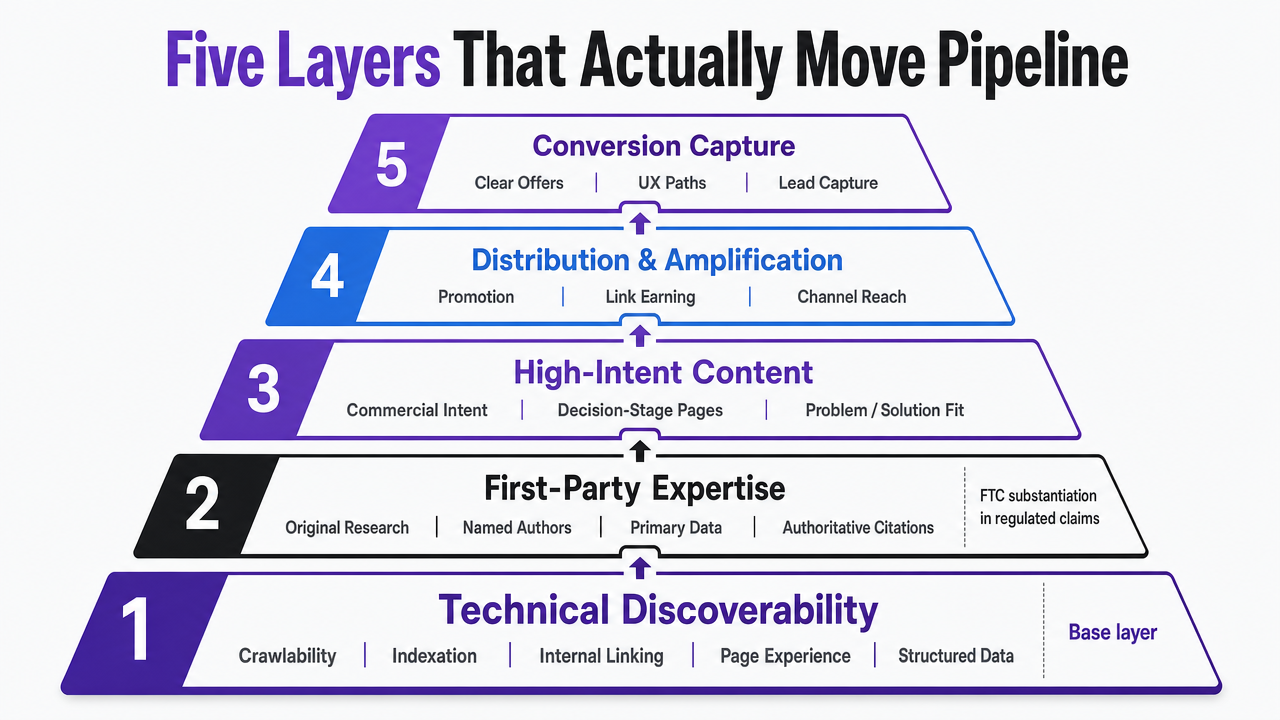 Visualize the five connected layers of the organic revenue system described in this section as a stacked framework
Why AI Overviews Change the Scoreboard, Not the Fundamentals
Generative summaries have not introduced a separate optimization discipline. The same crawlability, original expertise, internal linking, page experience, and structured data that shaped classic ranking still determine what an AI answer surfaces, cites, or ignores. What has changed is the click economy behind those rankings.
When a summary answers the query in-panel, informational pages lose sessions even when their positions hold. That produces a specific reporting failure: session and impression trends decouple from pipeline. A VP who reports SEO in sessions will look like they are losing while qualified conversations from organic entries stay flat or grow.
The corrective is on the measurement side, not the tactical side. Programs pulling ahead track branded search demand, direct-and-organic assisted conversions, form and call quality by entry URL, and closed revenue attributed to organic first-touch or last-touch. Rankings and impressions remain diagnostic, not terminal.
Content priorities shift accordingly. Definitional and encyclopedic pages are the most exposed to summary compression, so investment moves toward commercial-intent pages, comparison pages, service pages with local proof, and expert-authored analysis that a summary is more likely to cite than replace. Educational content still earns its keep, but as an entry to a conversion path rather than a session-count target.
The fundamentals are stable. The scoreboard is what a marketing team has to rebuild, and the rebuild has to happen before the next board review, not after a year of session declines has already framed the narrative.
First-Party Expertise as a Ranking and Trust Asset
Generative summaries prefer to cite pages that read like primary sources. That preference reshapes what a content team should actually produce: original research pulled from the business's own operational data, named authors with verifiable credentials, direct quotes from practitioners, and inline citations to authoritative primary sources. Pages built this way get referenced by AI answers rather than replaced by them, and they perform in classic rankings because they carry the signals Google has always rewarded.
The trust argument runs parallel to the ranking argument, and it is where most content programs underinvest. AHRQ, drawing on survey evidence, reports that roughly half of people looking up health information online check the source of the information and its date only occasionally, hardly ever, or never 1. The scope matters: the finding measured self-reported behavior among health-information seekers, not general web users, and it describes verification habits rather than belief. Even so, the operating implication is the same across regulated verticals. If half the audience will not verify a source, the burden shifts to the publisher to make provenance visible without being asked.
That translates into concrete production standards. Every page carries a byline tied to a real person with a credential line, a role, and a link to a public profile. Every page displays a published date and a last-reviewed date, with the reviewer named when the topic is clinical, legal, or financial. Every substantive claim points to a primary source rather than a secondary aggregator. Statistics are scoped in the sentence where they appear so a skimming reader can judge weight without leaving the page.
For a small in-house team, the harder question is how to produce this volume of first-party material without either hiring specialists for every topic or accepting generic AI drafts. The workable answer is a production model where subject-matter experts are interviewed and cited rather than expected to write, primary data is extracted from CRM and call systems on a schedule, and every draft is reviewed against a substantiation checklist before publication. That is a governance model, and it belongs in the next section.
 Health-info seekers who rarely check source/date
Health-info seekers who rarely check source/date
Test AI-Driven SEO Pipeline Execution Today
Experience measurable SEO impact with live campaign results during your free trial—no delays, no commitments.
Governance: One Section for Claims, Endorsements, and AI Oversight
Substantiating Outcomes and Endorsements
The claims on a service page, a testimonial block, or a case study are the same claims that would appear in a paid ad, and regulators treat them that way. FTC guidance on health advertising is direct: companies must support their claims with solid proof, and the level of proof depends on the claim, the product, and what a reasonable consumer would take away from it 3. Outcome language on a dental implant page, a residential treatment page, or a home services warranty page cannot rest on a marketing writer's phrasing choices. It has to be tied to evidence a compliance reviewer could produce on request.
Reviews and endorsements carry a parallel standard. The FTC says endorsements must reflect the endorser's honest opinion and cannot be used to make a claim the marketer itself could not legally make, and material connections between the endorser and the brand should be disclosed clearly 4, 10. That governs testimonial pages, employee-written case studies, referral incentives, influencer content, and any AI-assisted summary of customer feedback.
A workable substantiation workflow has three artifacts per published page:
- a claims log that lists every outcome or performance statement with a source,
- an endorsement log that captures consent, material connections, and the verbatim source of each testimonial, and
- a review date stamped on the page itself.
The workflow catches the failure modes regulators have already been enforcing against, including composite testimonials presented as individual experiences and outcome claims that a compliance team cannot trace back to primary data.
AI-Assisted Content Under NIST-Aligned Review
AI drafting is now standard inside in-house content teams, which raises a governance question the tactic-level SEO literature mostly avoids: who is responsible for what a generative system publishes, and how is that responsibility documented. NIST released its Generative AI Profile, NIST AI 600-1, on July 26, 2024, organized around 12 identified risks and more than 200 recommended actions covering provenance, human oversight, information integrity, privacy, security, and review 9. NIST's companion report on synthetic content examines authentication, provenance tracking, labeling, detection, and auditing of systems that produce or manage generated material 7. Neither document is binding on marketing teams. Both are the reference standard a regulator, a health-system legal team, or an enterprise procurement reviewer will use to evaluate an AI content operation.
The enforcement backdrop makes the framework practical rather than theoretical. In January 2025 the FTC required a $1 million payment from an online marketer and prohibited unsupported claims that its AI product could make websites WCAG-compliant 6. The lesson for a marketing operation is not that AI content is disallowed. It is that capability claims, compliance claims, and performance claims produced or amplified by AI need the same substantiation as any other advertising claim.
The operating pattern is an approval-first loop:
- a signal from live business data produces a ranked recommendation,
- a named human reviewer approves or rejects it with rationale captured,
- execution follows only after approval, and
- the KPI impact is attributed back to the decision.
Every step is logged, which is what turns AI-assisted production into something a VP can defend in a board review or a regulator inquiry.
Conversion Design That Earns Lift Without Manipulation
The conversion layer is where organic acquisition either becomes pipeline or becomes a line item that cannot be defended. The temptation, especially when session counts are down, is to squeeze more out of existing traffic with pressure tactics: forced continuity, obscured pricing, prechecked consent, countdown timers on evergreen offers, or friction engineered into cancellation and opt-out paths. The FTC, working with the International Consumer Protection and Enforcement Network and the Global Privacy Enforcement Network, reviewed 642 subscription websites and apps in January and February 2024 and reported that nearly 76% used at least one possible dark pattern and nearly 67% used multiple possible dark patterns 8. The review flagged possible dark patterns, not adjudicated violations, and it focused on subscription flows rather than lead-generation forms. The base rate still matters: manipulation-adjacent design is now the default backdrop regulators are cataloging, which raises the reputational and enforcement risk of any lift that comes from it.
Durable conversion lift comes from a narrower set of moves:
- Match the page to the query intent so a visitor who searched a commercial term lands on a page that answers commercial questions, not a gated whitepaper.
- Show price ranges or price mechanics where the vertical allows it, because obscured pricing is one of the categories the same review flagged.
- Cut required form fields to the ones the sales or intake team actually uses in the first call, and route the rest into progressive profiling after the conversation starts.
- Give visitors a real choice of contact modality: form, phone, chat, and self-scheduled appointment, each instrumented so the team can see which one qualified leads prefer for which service.
Two design decisions carry disproportionate weight for regulated verticals. First, testimonials and outcome copy on the conversion page have to match the substantiation and endorsement standards already governing the rest of the site, because a service page is where a reasonable consumer forms the takeaway that triggers a claim 3. Second, consent language on forms and call widgets should be plain, unchecked by default, and specific about what the visitor is agreeing to receive. That is a conversion decision as much as a compliance decision: clarity converts, and it survives audit.
The test discipline changes as well. A/B tests optimized to form-fill rate alone will select for whichever variant most efficiently manipulates the click. Tests scored against downstream qualification, appointment show rate, or sales-accepted opportunities select for variants that bring the right visitor into the right conversation. That is the lift that shows up in a pipeline review and does not have to be walked back later.
Closed-Loop Measurement When Clicks Are Compressed
From Sessions to Qualified Pipeline
A measurement stack built for session growth will misread the current environment. When a generative summary answers the query before the click, informational pages hold their positions but bleed traffic, and a dashboard that peaks at sessions will report a decline that has no bearing on pipeline. The fix is to move the primary scoreboard downstream and demote sessions to a diagnostic.
The working reporting stack for a VP has four tiers:
- Brand demand, tracked through branded search volume and direct-navigation trends, captures the demand that AI answers create without a click.
- Qualified conversions, defined by the sales or intake team rather than the marketing team, count the form fills, calls, and self-scheduled appointments that survive first-touch qualification.
- Assisted pipeline, pulled from multi-touch attribution or a simpler first-and-last-touch model, credits organic entries that contributed to opportunities closed elsewhere.
- Closed revenue, tied to organic first-touch or last-touch by CRM stage, is the number that gets defended in a budget review.
Rankings, impressions, and sessions still belong in the diagnostic layer. They explain why a downstream number moved, but they no longer are the number. Reframing the report this way, before a year of session declines shapes the CEO's narrative, is the difference between defending the SEO budget and losing it.
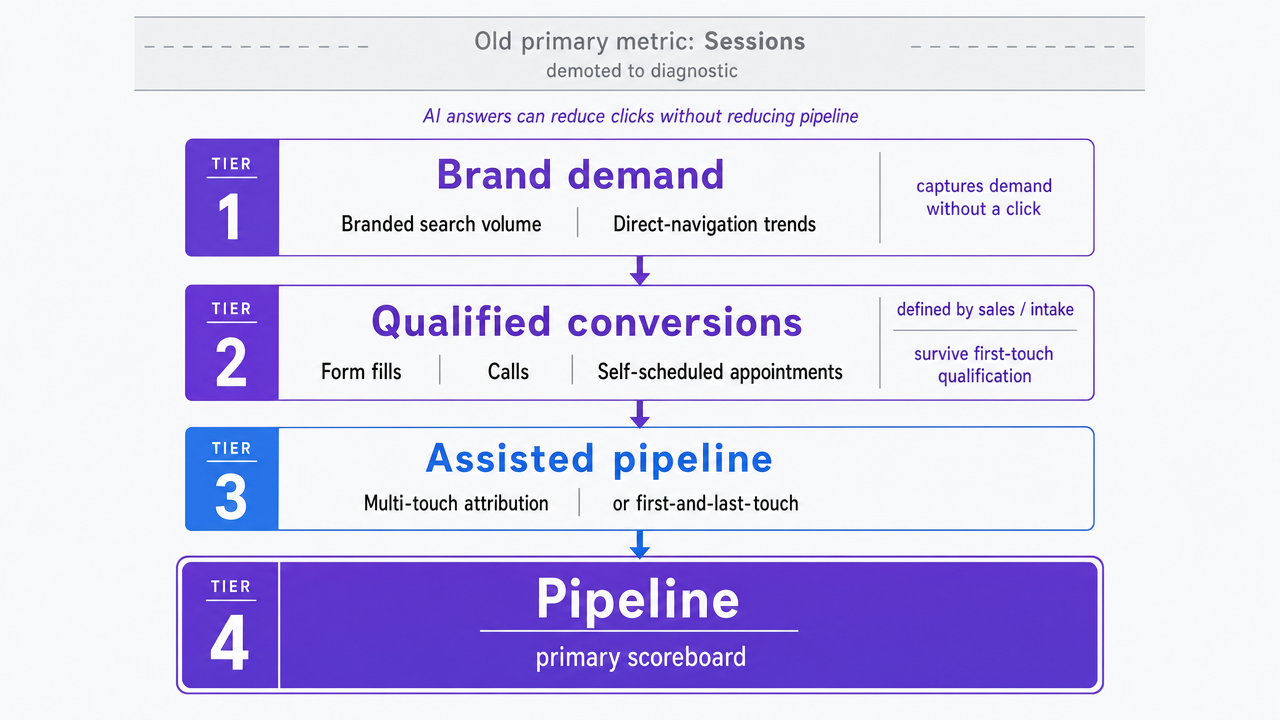 Show the four-tier reporting stack that replaces session-based measurement, directly matching the prose
Compliant Tracking in Regulated Verticals
The measurement stack a healthcare, behavioral health, dental, or senior-living operator installs has to sit inside a HIPAA perimeter that HHS OCR has been actively clarifying. OCR's guidance on tracking technologies states that regulated entities must configure pixels, analytics scripts, session replay, call tracking, and form telemetry so that protected health information is used and disclosed only as permitted by the Privacy Rule, and that ePHI is protected under the Security Rule 2. Whether a given interaction produces PHI depends on user status, page context, and the data disclosed, so a fact-specific review by legal and security precedes any tracking rollout.
A parallel line runs through HHS marketing guidance. When SEO activity feeds retargeting, CRM enrichment, lookalike audiences, or third-party ad platforms, the communication can cross into marketing that requires written patient authorization, with limited exceptions 5. That determines what can be piped from the measurement stack into paid channels without additional consent.
The operating pattern is a two-layer stack: authenticated-page tracking configured under a business associate agreement with named vendors, and unauthenticated marketing-page tracking scoped to non-PHI events. Call intelligence sits in the same perimeter, with recording and transcription vendors under BAAs and consent captured before qualification data enters the CRM.
See How Leading Teams Accelerate Pipeline with Data-Driven SEO Execution
Request a workflow demo focused on predictable SEO gains and streamlined approvals—purpose-built for teams managing complex, multi-channel campaigns at scale.
If You Operate Multiple Locations: Consolidation Economics
The scope shifts here from a single-brand VP running one site to operators carrying a portfolio: multi-location dental groups, DSOs, behavioral health networks, senior living portfolios, home services franchise systems, and regional legal or medical groups. The economic question changes with the scope. A single-brand team can absorb three or four point vendors. A 40-location operator cannot, because coordination cost scales faster than content output does.
The typical vendor stack for a multi-location operator covers six functions, and each one usually sits with a different provider or internal owner:
- Content production runs through a writing agency or freelance bench.
- Technical SEO sits with a specialist consultancy or an in-house engineer.
- Local and entity management runs through a listings tool and a separate agency for GBP optimization.
- Backlinks come from a link-building vendor.
- Analytics and call intelligence involve a tracking vendor plus a call-analytics platform, both of which need HIPAA-aligned configuration in healthcare-adjacent verticals 2.
- Reporting is stitched together by an analyst or a BI contractor.
The table below compares the three operating models a multi-location VP is realistically choosing between. Dollar variables are used because ranges depend on location count, vertical, content volume, and whether the operator carries HIPAA obligations. Operators should populate the variables with their own quotes.
| SEO Function | Traditional Agency Stack | In-House Build | Unified Approval-First Workflow ||---|---|---|---|| Content Production | 1–2 vendors, retainer $A/mo | 2–3 FTEs, loaded cost $L1 | Single workflow, subscription $S || Technical SEO | 1 vendor, retainer $B/mo | 0.5–1 FTE, loaded cost $L2 | Included in $S || Local / Entity Management | 1 vendor + 1 tool, $C/mo | 1 FTE + tool, $L3 | Included in $S || Backlinks | 1 vendor, retainer $D/mo | 0.5 FTE, loaded cost $L4 | Included in $S || Analytics & Call Intelligence | 2 vendors, $E/mo (BAA required) | 1 FTE + platforms, $L5 | Included in $S, BAA scoped || Reporting | 1 analyst or vendor, $F/mo | 1 FTE, loaded cost $L6 | Included in $S || Coordination Overhead | 6 contracts, 6 review cycles | 5–7 FTEs, internal meetings | 1 contract, 1 approval queue |
The line that decides the model is coordination overhead, not sticker price. Six vendors produce six briefing cycles, six status calls, six reporting formats, and six versions of the substantiation record a compliance reviewer or a regulator would ask for. An in-house build removes vendor coordination but replaces it with hiring cost, ramp time, and the risk of losing a specialist mid-quarter. A unified approval-first workflow collapses the six functions into one queue where a named human approves each recommendation before execution, which is also the artifact the FTC and NIST-aligned governance work implies a marketing operation should be able to produce on demand 6, 9. For a portfolio operator, that consolidation is what makes the organic revenue system defensible at the scale the P&L actually runs at.
Installing the Operating Model in the Next Two Quarters
A two-quarter install plan keeps the work scoped to what a small in-house team can actually execute.
- Quarter one is instrumentation and governance. The measurement stack moves to qualified conversions and closed revenue as primary KPIs, with rankings and sessions demoted to diagnostics. Tracking on authenticated pages gets a HIPAA review where the vertical requires it 2, and a claims log plus an endorsement log gets attached to every service and testimonial page 3, 4. An approval-first production loop is documented against the NIST Generative AI Profile so AI-assisted drafts carry a named reviewer and a captured rationale 9.
- Quarter two is production and conversion. First-party expertise pages ship on a weekly cadence, high-intent commercial pages get rewritten against downstream qualification data, and conversion tests are scored on sales-accepted opportunities rather than form-fill rate. Vendor consolidation, where the portfolio scale justifies it, collapses six coordination queues into one.
The artifact a VP walks into the next board review with is a single dashboard that ties organic entries to revenue, backed by a substantiation record any regulator or CEO could request without warning.
Frequently Asked Questions
References
- 1.Internet Access for Health Information and Advice.
- 2.Use of Online Tracking Technologies by HIPAA Covered Entities and Business Associates.
- 3.Health Claims.
- 4.FTC’s Endorsement Guides: What People Are Asking.
- 5.Marketing.
- 6.FTC Order Requires Online Marketer to Pay $1 Million for Deceptive Claims Its AI Product Could Make Websites Compliant with Accessibility Guidelines.
- 7.Reducing Risks Posed by Synthetic Content: An Overview of Technical Approaches to Digital Content.
- 8.FTC, ICPEN, GPEN Announce Results of Review of Use of Dark Patterns Affecting Subscription Services and Privacy.
- 9.AI Risk Management Framework.
- 10.Endorsements, Influencers, and Reviews - Federal Trade Commission.