
Key Takeaways
- A keyword cluster tool decides page boundaries, specialist assignments, internal-link flow, and attribution scope, so treating the grouping export as the finished product forfeits every downstream editorial decision.
- Cluster quality is testable with intent precision and query recall borrowed from information retrieval, with page-boundary coherence determining whether a validated cluster ships as one URL or several 2, 1.
- Embeddings handle harvesting, deduplication, and first-pass grouping, but intent validation, page-boundary calls, and the quality gate against Google's helpful-content and spam guidance stay with a human reviewer 5, 7.
- Agencies scaling across client books should govern the workflow with approval gates, report performance as cluster rollups in Search Console against the seed query set, and resist modifier-based expansion without SERP evidence 9, 8.
Why Clustering Became the Agency Production Layer
Agency SEO leaders stopped treating keyword clusters as planning artifacts the moment client books outgrew specialist capacity. A cluster now decides how many pages get briefed, which specialist owns them, how editors defend quality under Google's scaled-content-abuse policy, and how performance rolls up to a client dashboard 7. The grouping export is the smallest part of the job.
The shift is measurable at the operations layer. Google's own guidance has moved against publishing a separate page for every query variation, which quietly invalidates the cluster-expansion playbooks many agencies ran from 2018 through 2022 8. At the same time, ranking continues to work largely at the page level, meaning a strong pillar does not automatically lift its supporting pages and each cluster asset has to earn its position on its own signals 10.
That combination forces a production discipline. Clusters have to be tight enough to pass editorial quality review 5, broad enough to capture the relevant query universe, and governed enough that an AI-assisted draft does not drift into pages that contain keywords but make little sense to readers 7. The agencies absorbing more clients without more specialists treat the keyword cluster tool as the operating layer where intent, page boundaries, internal links, and QA all converge, then flow into Search Console attribution 9. The sections that follow unpack that layer, starting with what a cluster tool is actually deciding on an agency's behalf.
What a Keyword Cluster Tool Actually Decides
A keyword cluster tool makes nine production decisions before a draft is ever assigned. Each one quietly sets the ceiling on how much the output can be trusted at scale.
The pipeline runs from harvest to attribution. Terms are collected from search data, competitor crawls, and client inputs. The tool groups them by semantic proximity, then an operator (or a second system) validates intent against live SERPs because semantic similarity and search intent are not the same signal. From that validation comes the page-boundary decision: whether a cluster becomes one consolidated resource or several supporting pages. Brief standardization follows, locking down the H1, the questions the page must answer, the format conventions, and the entity coverage. An internal-link map then ties the cluster into existing site architecture so each new page is reachable through descriptive anchors from other findable pages 6. Drafting happens inside that structure, not before it. A quality gate checks each page against audience fit, first-hand expertise, completeness, and whether a reader can finish the task the title promised 5. Publishing is the handoff, not the endpoint. Attribution closes the loop in Search Console, where impressions, clicks, and query coverage per cluster expose which groups are earning placement and which are stalling 9.
Framed this way, the tool is not grouping keywords. It is deciding editorial scope, specialist assignment, URL structure, link equity flow, and what gets measured. Agencies that treat the export as the finished product inherit every downstream decision by default, usually without noticing until a client asks why forty new pages produced flat impressions. The sections that follow make each decision legible, starting with how to measure cluster quality in metrics borrowed from information retrieval rather than guessed from a dashboard.
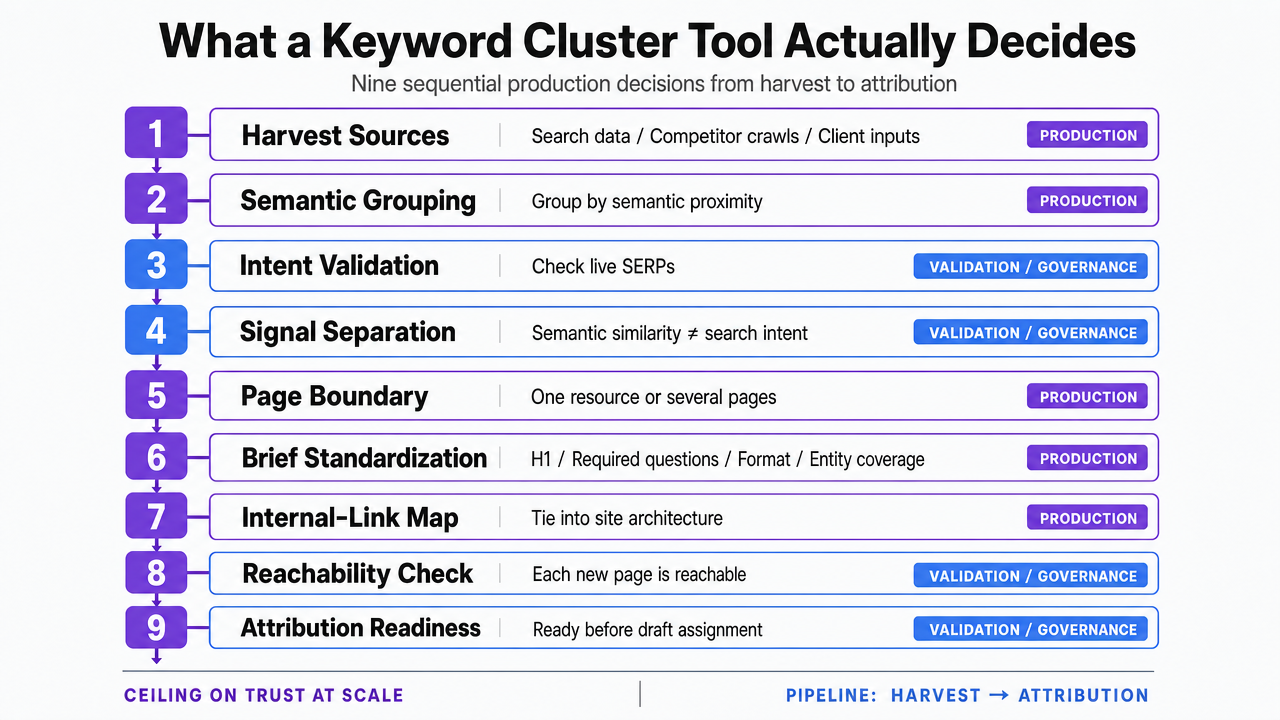 Visualize the nine sequential production decisions a keyword cluster tool makes, as explicitly enumerated in the section's pipeline description from harvest to attribution
A Cluster QA Scorecard Borrowed From Information Retrieval
Cluster quality is testable, not a matter of taste. Information retrieval has spent decades defining what it means for a system to group things correctly, and the vocabulary ports cleanly to keyword clustering. Two measures do most of the work: precision and recall. A third dimension, page-boundary coherence, converts those measures into a publishing decision an agency can defend to a client and to Google's quality systems 5.
Agencies that run clustering without a scorecard end up arguing about clusters in Slack. Agencies that run clustering with one argue about thresholds, which is a cheaper argument.
Intent Precision and Query Recall as Operating Metrics
Precision, in NIST's retrieval vocabulary, is the proportion of retrieved items that are relevant 2. Translated to a keyword cluster, intent precision is the share of terms inside the cluster that genuinely share one search intent. A cluster of forty queries where thirty-four map to the same job-to-be-done scores 0.85. The remaining six are either noise, a sibling cluster that leaked across the boundary, or evidence that the grouping algorithm optimized for lexical similarity instead of SERP convergence.
Recall is the inverse pressure. It is the proportion of relevant items retrieved from the full relevant set 1. For clustering, query recall asks how much of the addressable query universe for that intent the cluster actually captured. A tight, high-precision cluster that misses half the relevant long-tail queries will underperform in Search Console because it never earns impressions for the variations users actually type.
The two measures trade off. At varying cutoffs, precision and recall tend to move inversely 2. Loosen the similarity threshold to pull in more queries and precision drops; tighten it and recall collapses. A cluster QA scorecard should log both, per cluster, with a target band rather than a single number. Mature agencies set floors (intent precision at or above 0.80, query recall at or above 0.70 against a defined seed set) and treat anything outside the band as a review ticket, not a publishable brief.
Page-Boundary Coherence and the One-Page-Per-Query Trap
Precision and recall say whether a cluster is internally consistent and externally complete. Page-boundary coherence says whether that cluster should become one URL or several. The test is practical: can a single page satisfy every query in the cluster without the writer context-switching mid-draft? If yes, consolidate. If the brief keeps forking into different formats, different reader states, or different conversion asks, the cluster contains more than one page.
The failure mode on the other side is louder. Splitting a coherent cluster into a page per query variation to chase long-tail coverage is exactly the pattern Google flags as scaled-content abuse when the pages add no user value 7. The company's generative-search guidance makes the same point in planning language: creating separate content for every possible variation to manipulate rankings undermines the resource users actually need 8. Boundary decisions are where cluster QA stops being analytics and starts being editorial policy.
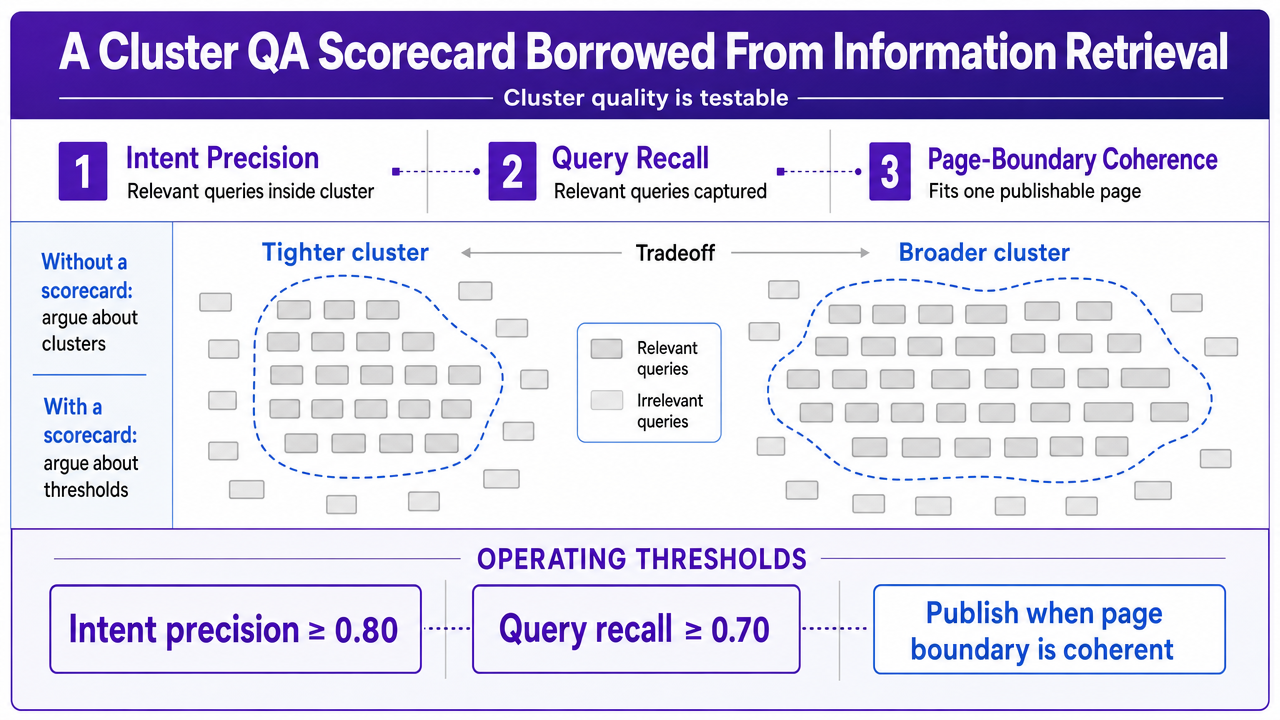 Illustrate the precision/recall tradeoff and the agency's operating thresholds (intent precision ≥ 0.80, query recall ≥ 0.70) cited in the section text
Test AI-driven keyword clustering on real campaigns
Experience advanced keyword clustering and publish optimized content live before making a commitment.
Where Embeddings Help and Where Human Judgment Is Non-Negotiable
Embedding-based clustering is a real technical advance, and it is routinely oversold. The distinction matters for any agency choosing which parts of the workflow to automate.
The strongest peer-reviewed evidence comes from an EMNLP Industry study that paired BERT embeddings with dimensionality reduction, density-based clustering, and class-based TF-IDF labeling, then put the output in front of human evaluators. The evaluators judged the resulting topics coherent on an industry dataset 12. That result holds up as a technical finding: contextual embeddings can group related terms into human-interpretable topics with less manual seeding than older frequency-based methods required. For a keyword cluster tool, this is why modern grouping feels qualitatively better than the 2018-era string-similarity approach.
Semantic coherence is not search intent. A cluster can score well on embedding similarity and still mix two or three distinct jobs-to-be-done, because embeddings capture topical relatedness, not what a user is trying to accomplish on the SERP. Queries about pricing, comparison, and implementation can sit close in vector space and still demand different page formats, different conversion asks, and different evidence standards. The EMNLP work itself relied on human evaluation to confirm coherence, which is the quiet admission inside every honest embeddings paper: the model proposes, a human disposes 12.
That split defines the automation line. Embeddings do the volume work: harvesting, deduplication, first-pass grouping, and surfacing adjacent terms a specialist would otherwise miss. Humans do the judgment work: validating intent against live SERPs, deciding whether a coherent cluster is one page or three, and signing off on briefs against the audience-fit and expertise questions Google's quality guidance actually asks 5. Agencies that invert this split, letting the model draft page boundaries and letting humans tidy outputs, inherit the exact failure pattern Google's spam policy names: pages that contain keywords but make little sense to readers 7.
The operational rule is cleaner than the debate suggests. Automate grouping and candidate generation. Gate every page-boundary decision and every brief through a human reviewer whose job is intent validation, not copy editing.
From Cluster to Site Architecture: Pillars, Supporting Pages, and Internal Links
A validated cluster is a URL plan in waiting. The translation from cluster to architecture is where most agencies lose the compounding benefit of clustering, because the grouping export does not specify directory structure, pillar scope, supporting-page count, or the anchor text that connects them. Those decisions have to be made deliberately, against guidance Google has published for exactly this purpose.
Directory organization carries architectural meaning. Google states that using directories to group similar topics can help it understand how URLs relate to one another 4. For a keyword cluster tool's output, that translates into a simple rule: clusters sharing a parent intent live under the same directory, and the pillar sits at the directory root. A cluster that spans two parent intents is a signal the grouping is wrong, not a signal to invent a third directory.
Pillar and supporting pages have to be reachable, not just published. Google's developer guidance is explicit that every page should be reachable through a link from another findable page, and that sitemaps help Google understand page relationships 6. The practical consequence for cluster programs is an internal-link map produced before drafting, not after. Each supporting page links up to the pillar with a descriptive anchor drawn from its own intent, each sibling links across to the two or three closest adjacent intents, and the pillar links down to every supporting page using varied, intent-specific anchors rather than repeated exact-match phrases.
Pillar authority does not transfer automatically. Google's ranking-systems guide notes that ranking works largely at the page level, with multiple signals evaluated per URL 10. A strong pillar can earn impressions, but each supporting page still has to satisfy its own query set to hold a position. Agencies that treat supporting pages as link-equity recipients rather than standalone resources end up with directories that look complete and perform unevenly, which Search Console will expose cluster by cluster.
The Scaled-Content-Abuse Line Every Cluster Workflow Has to Respect
Google's spam policy names the exact failure a volume-first cluster workflow produces. Scaled content abuse covers generating many pages primarily to manipulate rankings rather than help users, including using generative AI to produce pages without adding user value and publishing pages that contain keywords but make little sense to readers 7. There is no page-count threshold in the policy. The test is intent and usefulness, which means an agency can cross the line at ten pages or stay inside it at ten thousand.
The planning guidance is more specific. Google explicitly warns against creating separate content for every possible search variation when the motivation is ranking manipulation rather than user need 8. That single sentence invalidates the long-tail expansion tactic many clustering tools still default to: taking a validated cluster, splitting it by modifier (city, year, synonym, question form), and shipping a page for each variant. The grouping algorithm does not know the difference between a legitimate page-boundary split and a scaled-abuse pattern. The reviewer has to.
Three operational rules keep the workflow inside the line.
- Every page in a cluster has to answer a question a reader would actually ask, documented in the brief before drafting.
- AI-assisted drafts flow through the same quality gate as human drafts, measured against audience fit, first-hand expertise, and whether the reader can finish the task the title promised 5.
- Modifier-based expansion requires evidence of distinct intent on the SERP, not just a different word in the query.
Clusters that fail any of the three collapse back into fewer, denser pages rather than shipping as separate URLs.
See How Enterprise Teams Orchestrate Scalable Content With AI-Powered Keyword Clustering
Connect with specialists to evaluate how automated keyword clustering streamlines large-scale content planning, improves topic coverage, and enables approval-first workflows for agencies managing complex SEO programs.
Running Clustering Across a Client Portfolio
For agencies running clustering across a client book rather than a single site, the unit of analysis changes. The question stops being whether a cluster is well-formed and becomes how many clusters a given specialist can own per week without the quality floor dropping. Portfolio operations expose weaknesses in a clustering workflow that a single-site view hides: inconsistent brief templates between account managers, intent-validation decisions made differently on Tuesday than on Thursday, and internal-link maps that exist as a spreadsheet on one account and as tribal knowledge on another.
The two subsections below separate the two problems. The first names the capacity math that forces the question. The second compares how hours actually distribute across cluster stages when the workflow is governed versus when it is not.
If You Manage Multiple Client Accounts: The Specialist-Hours Problem
Agency capacity does not scale linearly with client count. A specialist who comfortably runs eight clusters per month for three clients does not run twenty-four for nine. Context-switching costs, inconsistent client data inputs, and non-standardized brief templates compound, and the per-cluster hour cost rises as the book grows.
The constraint is specialist judgment, not keystrokes. Harvesting terms and running first-pass grouping take minutes at any volume. SERP intent validation, page-boundary decisions, and quality-gate review against audience-fit and expertise criteria are the hours that resist automation 5. Those are also the hours that determine whether a cluster ships as a defensible resource or as pages that contain keywords but drift from reader need, which is the pattern Google's spam policy names 7.
Agencies that model this honestly track specialist hours per cluster stage, per client, and set a ceiling on cluster volume per specialist that holds the quality-gate hours constant. When the ceiling binds, the choice is to add headcount, cut cluster volume, or move the automatable stages out of specialist time. The third option is what governance makes possible.
Governed vs Ungoverned Cluster Workflow: Hours per Cluster
The hours shift when the workflow is governed. Stanford's 2025 AI Index reports that organizational AI use rose from 55% in 2023 to 78% in 2024, and generative-AI use in at least one business function rose from 33% to 71% over the same window 3. Those figures measure adoption across all business functions in surveyed organizations, not SEO productivity specifically, and adoption is not evidence of effectiveness. They do mark the point at which agencies have to decide whether AI-assisted clustering runs as an unmanaged shortcut inside specialist workflows or as a governed stage with explicit approval gates.
The distribution of hours per cluster differs sharply between the two models. The variables below are ranges an agency can calibrate against its own time tracking rather than invented benchmarks.
| Cluster stage | Ungoverned workflow (specialist hours per cluster) | Governed AI-assisted workflow (specialist hours per cluster) |
|---|---|---|
| Manual keyword grouping and deduplication | H1_u | H1_g (near zero; AI first pass) |
| SERP intent validation | H2_u | H2_g (specialist retained) |
| Brief creation and standardization | H3_u | H3_g (template-driven, specialist edits) |
| Internal-link mapping | H4_u | H4_g (AI proposes, specialist signs off) |
| Quality gate against Google helpful-content and spam guidance 5, 7 | H5_u | H5_g (specialist retained; non-negotiable) |
Two stages collapse under governance: first-pass grouping and internal-link proposal are the volume work embeddings handle well. Three stages hold. Intent validation, brief sign-off, and the quality gate stay with the specialist because each requires judgment the model does not have: whether a SERP has actually converged on one intent, whether a brief passes the audience-fit and expertise questions Google's guidance asks, and whether the resulting pages add value a reader can finish on 5. Agencies that cut hours from the first two stages and add them back to the third one tend to raise cluster throughput without raising scaled-content-abuse exposure. Agencies that cut hours from all five stages at once produce the exact failure Google's spam policy was written to catch 7.
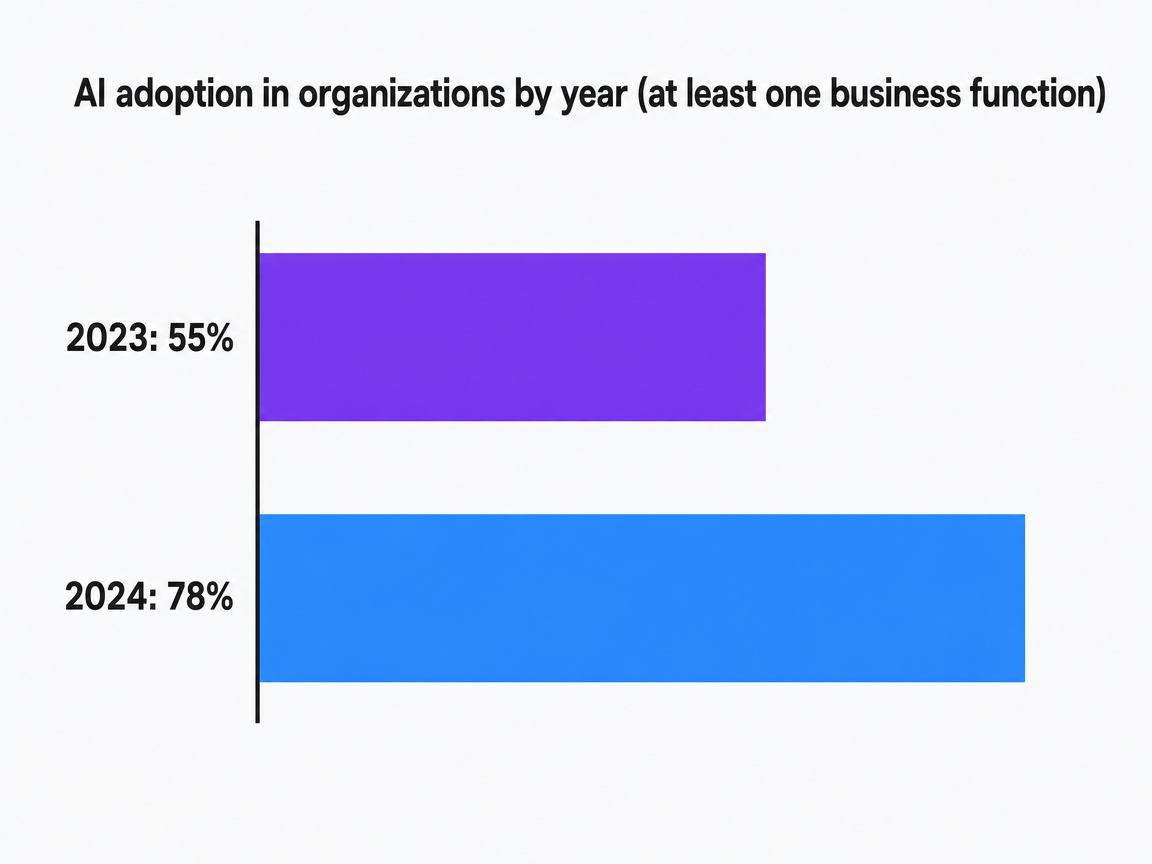 AI adoption in organizations by year (at least one business function)
From Stanford's 2025 AI Index, showing a year-over-year increase in organizational AI use.
Measuring Cluster-Level Performance in Search Console
Cluster programs stall at the measurement layer more often than at the production layer. Agencies ship the pages, then report on them one URL at a time, which hides the question the client is actually asking: did the cluster earn placement across the query universe it was built for?
Search Console answers that question when the performance report is read at the cluster level rather than the page level. The report breaks traffic down by queries, pages, and countries, and shows trends for impressions, clicks, and related metrics 9. For a cluster, the useful rollup is a filtered view that aggregates every URL in the cluster and every query the cluster was designed to capture, then compares impressions and query coverage against the seed set used in the recall calculation. A cluster earning impressions on 70% of its seed queries after ninety days is converging. One earning impressions on 20% has an intent-validation problem, not a content-volume problem.
Three diagnostics belong in every client report:
- Query coverage per cluster against the seed set exposes recall gaps the grouping tool missed.
- Impression trend by cluster, not by page, shows whether the cluster is maturing or stuck, since ranking works largely at the page level and pillar strength does not transfer automatically to supporting URLs 10.
- Click-through rate per cluster against SERP position isolates whether weak performance is a ranking problem or a title-and-snippet problem.
Search Console reports search performance, not revenue, so cluster-level impressions and clicks have to be joined to analytics and CRM data before the number means anything to a client paying for pipeline.
A Build-or-Buy Decision for the Clustering Layer
The build-or-buy question for a keyword cluster tool is really a question about which stage of the pipeline is the bottleneck. Off-the-shelf SaaS tools solve the harvesting and first-pass grouping stages well, and that is roughly where their value ends. Intent validation against live SERPs, page-boundary decisions, brief standardization across clients, internal-link mapping, and the quality gate against Google's helpful-content and spam guidance are not features a vendor ships; they are governance an agency has to install 5, 7.
Three variables decide the call.
- The first is client volume: below roughly fifteen accounts, a SaaS tool plus specialist judgment usually clears the throughput requirement. Above that, the un-automated stages consume specialist hours faster than the book can absorb.
- The second is brief consistency. Agencies with templated briefs and documented intent-validation rules can bolt a SaaS tool onto an existing workflow. Agencies without them will pave over the inconsistency and ship it faster.
- The third is attribution. If cluster-level performance cannot be rolled up in Search Console against the seed query set used for recall, the tool is producing pages, not evidence 9.
The pragmatic answer for most mid-to-large agencies is neither pure build nor pure buy. It is a bought grouping layer wrapped in a built governance layer: approval gates, brief templates, link-map review, and quality sign-off that stay with the specialist. Platforms like Vectoron are designed around that split, with AI handling the volume stages and human approval holding the three stages that defend the work.
Frequently Asked Questions
References
- 1.1 Common Evaluation Measures.
- 2.The 34th Text REtrieval Conference.
- 3.Economy | The 2025 AI Index Report | Stanford HAI.
- 4.Search Engine Optimization (SEO) Starter Guide.
- 5.Creating helpful, reliable, people-first content.
- 6.SEO Guide for Web Developers.
- 7.Spam Policies.
- 8.Google's Guide to Optimizing for Generative AI Features on Google Search.
- 9.How To Use Search Console.
- 10.A Guide to Google Search Ranking Systems.
- 11.Understanding page experience in Google Search results.
- 12.Topic Modeling by Clustering Language Model Embeddings: Human Validation on an Industry Dataset.