
Key Takeaways
- Treat clusters as the atomic unit of planning: one cluster, one brief, one primary URL with supporting pages covering distinct subintents and an explicit internal-link map.
- Combine intent classification, embedding distance, and audience-language segmentation as the signal stack, since lexical overlap alone misses paraphrase and forces near-duplicate pages downstream.
- Geometric scores like Silhouette confirm vector separation but not editorial fit; require human sign-off on SERP evidence, vocabulary, and commercial value before a cluster becomes a brief 5.
- Report at the cluster level using subintent coverage, share of voice across the full term set, cannibalization rate, and AI Overview inclusion rather than isolated keyword rankings.
Clustering as the Connective Tissue of Scaled SEO Delivery
Keyword clustering is often taught as a spreadsheet task: dump a keyword export, run a similarity script, color-code the rows. That framing produces near-duplicate pages, cannibalized rankings, and the exact pattern Google now calls out under scaled content abuse when generative tools are involved 12. For an agency running delivery across a portfolio of clients, clusters have to do more work than that. They are the connective tissue between keyword research, editorial briefs, internal-link maps, and the KPIs reported back to the client.
Treating clusters as the atomic unit of planning changes what junior strategists ship, what senior review actually catches, and what shows up on the monthly report. One cluster, one brief, one page, one measurable share of voice across a defined subintent set. That is the shift.
The operational context supports the urgency. The 2025 CMI B2B benchmark reports that only about one-third of B2B marketers say they have a scalable content-creation model, while 81% are already using generative AI tools in production 15. Adoption is running ahead of the operating layer that keeps output coherent. Clustering, done as a production discipline rather than an algorithm choice, is that operating layer. The rest of this article treats it in four parts: signal, structure, governance, and measurement.
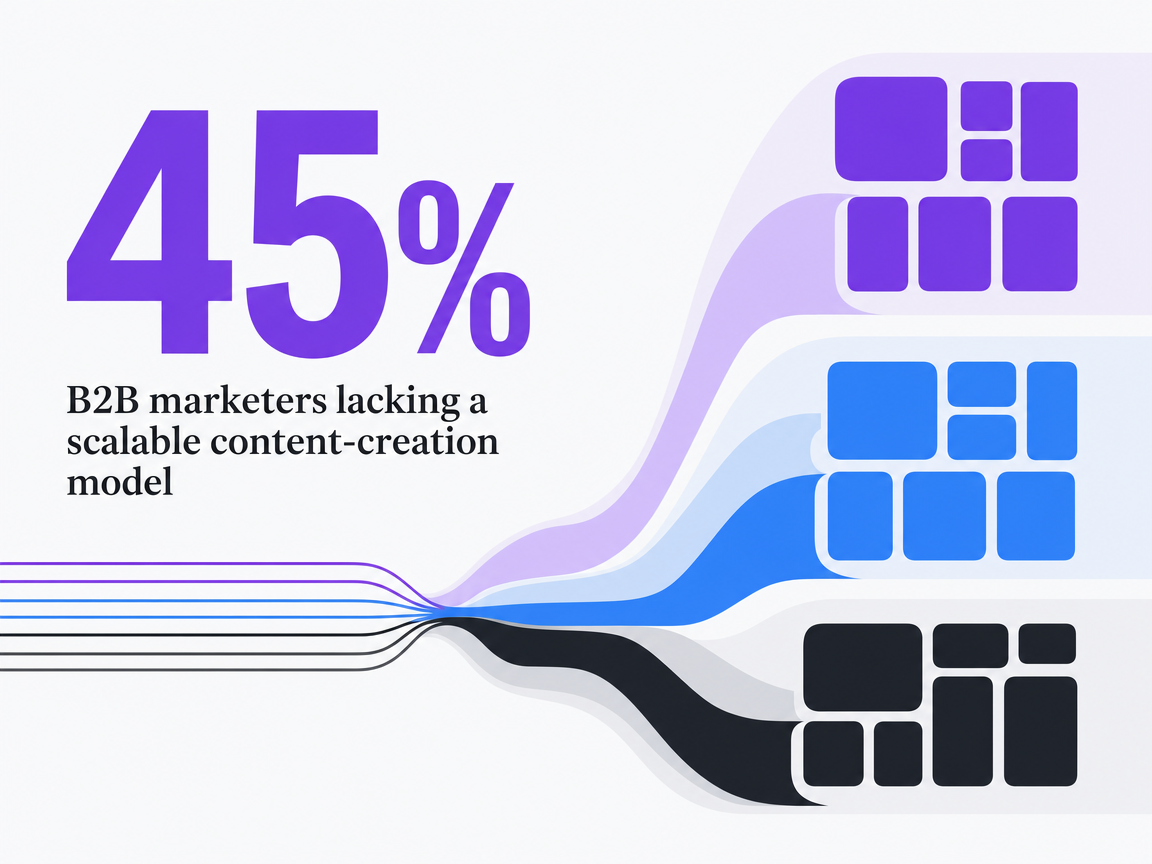 B2B marketers lacking a scalable content-creation model
B2B marketers lacking a scalable content-creation model
The Four Layers of a Clustering System
Signal: What You Actually Cluster On
The first design decision in a clustering system is not the algorithm. It is what dimension the algorithm is grouping on. Lexical similarity, semantic embedding distance, SERP overlap, and intent classification each produce different clusters from the same keyword export, and each carries a different failure mode downstream.
Lexical grouping is fast and transparent but blind to paraphrase. Two queries that share no tokens can express the same intent, and two that share most tokens can diverge sharply once search behavior is examined. Peer-reviewed work on query-intent detection shows that intent classifiers built on Google-result features outperform pure lexical matching, and that extracted keywords from those results help classify the intent of new queries 1. The scope limit matters: intent labels drift by market, device, location, and time, so any intent-based cluster needs periodic revalidation rather than a one-time build.
Semantic embeddings widen the net further. Language-model embeddings capture paraphrase and conversational phrasing that lexical methods miss, which is why current retrieval systems increasingly rely on them 3. The trade-off is transparency. Embedding-space neighborhoods are less inspectable than token overlap, which pushes more weight onto downstream QA.
Google's own SEO starter guidance points in a compatible direction: users search for the same topic using different vocabulary depending on their expertise and familiarity with it 19. A practical signal stack for agency work combines three layers:
- an intent classifier as the primary axis,
- embedding distance for paraphrase coverage, and
- audience-language segmentation (expert vs. novice, research vs. transactional) as the editorial cut that turns a mathematical cluster into a publishable brief.
Structure: From Clusters to Pages, Hubs, and Links
A cluster is not a page until three decisions have been made: which single primary URL will hold it, what supporting URLs sit around it, and how those URLs link to each other. Skip any of the three and clusters revert to a spreadsheet.
The primary URL carries the dominant intent for the cluster and the highest-volume query variants that share it. Supporting URLs cover distinct subintents that a single page cannot answer without becoming incoherent. The distinction matters because research on search-result diversification shows that coverage of subintents, not raw keyword count on a page, is what determines whether the resulting content answers the underlying information need 2. A cluster brief should therefore specify subintent coverage explicitly, not just a keyword list.
Internal linking is where the architecture becomes visible to crawlers. Google states that every page a site cares about should have a link from at least one other page, and that descriptive anchor text helps both users and Google understand context 8. For clusters, that translates into two link types: hub-to-spoke links from the primary URL to each supporting URL, and contextual links between spokes that share a subintent boundary. Google further recommends a logical site structure and relevant links from other pages to important pages, while avoiding repetitive linking patterns 9. The output of a clustering pass, then, is not a keyword map. It is a page inventory, a subintent-coverage checklist per page, and an internal-link graph that an editor can review before any drafting begins.
A Working Methodology: Classify, Embed, Cluster, Threshold
The most reusable technical workflow in the current literature comes from e-commerce page planning, but its shape transfers cleanly to services and B2B. The published approach follows four steps, in that order, each doing one job 4:
- Classifies queries first by a business taxonomy,
- then embeds the queries as vectors,
- then applies bottom-up agglomerative clustering using cosine distance,
- then cuts the dendrogram at a similarity threshold tuned to the desired granularity.
Classification comes first because it prevents the clustering algorithm from grouping across categories that a strategist would never merge editorially. For a legal client, that means separating practice areas before any distance math runs. For a home-services portfolio, it means separating service lines and geographic modifiers before embedding. The taxonomy is a hard partition; clustering happens inside each partition, not across the whole export.
Embedding turns each query into a vector using a language model, which captures paraphrase and conversational phrasing that token overlap misses 3. Agglomerative clustering then builds a hierarchy by repeatedly merging the closest pairs under cosine distance. The threshold decision is where operator judgment enters: a tighter cut produces more, smaller clusters (higher precision, more pages, more risk of near-duplicates), while a looser cut produces fewer, broader clusters (higher recall per page, more risk of incoherent briefs).
Before any cluster leaves this pipeline for a brief, it should pass an internal quality check. Scikit-learn's clustering documentation is explicit about the standard tool: the Silhouette Coefficient is bounded between minus one and plus one, with values near zero indicating overlapping clusters and higher values indicating dense, well-separated clusters 5. That is a geometric signal. It says the vectors sit tidily in space. It does not say the cluster represents one publishable intent for one commercially useful page, and the same documentation is direct about that limit 5. Editorial fit is a separate axis, evaluated by a human against SERP evidence, audience vocabulary, and the client's commercial priorities. The next section develops that distinction. For the pipeline itself, the operational discipline is to log the threshold used, the Silhouette score per cluster, and the taxonomy branch, so that when a brief is challenged in review the strategist can reproduce the decision rather than defend a black box.
Geometric Quality Is Not Editorial Quality
A Silhouette score of 0.7 says the vectors in a cluster sit close to their neighbors and far from the next cluster. It does not say the terms inside that cluster describe a single publishable intent, share a commercial value, or belong on one page a strategist would actually plan. Scikit-learn's own documentation makes the distinction plain: internal metrics measure geometric separation when ground-truth labels are unavailable, not fitness for a downstream task 5. The comparison example that pits homogeneity, completeness, V-measure, adjusted Rand index, and Silhouette against each other on the same text corpus shows the metrics can disagree, and none of them read a SERP or a client's revenue model 6.
The editorial axis asks four questions the math cannot:
- Does the cluster resolve to one dominant intent, or two intents forced together by embedding proximity?
- Do the SERPs for the top-volume terms in the cluster show substantially the same result set, or do they diverge in ways that signal Google reads them as different jobs?
- Does the audience vocabulary inside the cluster hold together, or does it mix expert and novice phrasings that a single page will handle awkwardly 19?
- And does the cluster point at a page the client can commercially justify, or at a topic with no downstream conversion path?
Run both checks. Log the Silhouette score for reproducibility, then require a human sign-off on the four editorial questions before the cluster becomes a brief. Geometry filters the obvious failures cheaply; editorial review catches the ones that would ship as near-duplicates.
Deploy live keyword clusters on real campaigns
Test keyword clustering in your workflow and measure impact with actual published content during your trial.
Precision and Recall as Cluster QA Vocabulary
Silhouette scores describe the shape of a cluster. Precision and recall describe whether the cluster is right. NIST's TREC evaluation framework defines precision as relevant items retrieved divided by total items retrieved, and recall as relevant items retrieved divided by relevant items in the collection 7. Both translate directly into cluster QA when the "relevance set" is the list of queries a strategist judges to belong on one page for one intent.
Precision asks the containment question. Of the terms assigned to this cluster, how many actually belong on the target page? A precision failure looks like a cluster that pulls in adjacent-but-distinct intents, which then produces a brief that reads as two pages stitched together. Recall asks the coverage question. Of the query variants that share this intent, how many did the pipeline capture? A recall failure looks like a page that ranks for its head term but misses the paraphrases, expert vocabulary, and conversational forms that a real audience uses 19.
Both scores require a defensible relevance set. Without SERP evidence or a labeled sample, precision and recall become guesses 7. The practical discipline is to sample twenty to fifty clusters per pipeline run, label them by hand against SERP overlap, and track the two numbers over time as the QA baseline.
Merge, Split, or Canonicalize: A Decision Rule for Overlap
Two clusters that share half their terms are not automatically two pages. They are a governance decision waiting to be made. Google's own canonicalization guidance describes the underlying reality: search systems cluster duplicate or very similar pages and select one representative URL, and duplicates are generally crawled less often than the canonical 10. When a clustering pipeline produces overlapping candidates, the choice is not whether Google will consolidate them. It is whether the strategist consolidates first, with intent, or lets the algorithm pick.
Three branches cover the practical cases:
- Merge when two candidate clusters resolve to the same dominant intent under SERP inspection and the audience vocabulary is compatible; combine the term sets, pick one primary URL, and route the brief accordingly.
- Split when the SERPs for the top-volume terms in each candidate diverge meaningfully, or when the audience language shifts between expert and novice phrasings that one page cannot serve without becoming incoherent 19.
- Canonicalize when two pages already exist, serve substantially the same intent, and cannot be easily merged for editorial or historical reasons.
The canonicalization mechanics matter here. Google characterizes redirects and rel=canonical as strong canonicalization signals, while sitemap inclusion is a weaker one 11. A 301 redirect is the right move when the losing URL has no independent value; rel=canonical is the right move when the losing URL still serves a purpose for users but should not compete in search. Sitemap-only signals are insufficient for closing an overlap.
Bake the rule into the QA gate. Before any new cluster brief is approved, the strategist checks whether an existing page already claims the intent. If yes, the decision is merge or canonicalize, not publish. That single gate prevents most cannibalization at source.
Governing AI-Assisted Execution Without Tripping Spam Policy
The governance question is not whether to use AI in a clustering workflow. It is where to put the human decision so that the output does not read as scaled content abuse. Google's spam policy is explicit that scaled content abuse covers producing many pages primarily to manipulate rankings rather than help users, and it names generative AI as one of the tools that can produce those pages 12. The policy does not prohibit AI assistance. It penalizes volume without value.
The 2025 CMI B2B benchmark frames the operational pressure: 45% of B2B marketers report they lack a scalable content-creation model, while 81% are already using generative AI tools in production 15. The scope note matters here. This is self-reported marketer perception, not a search-engine study, and it does not measure page quality. What it does show is a gap between adoption and the operating layer that keeps output defensible. Governance is what fills the gap.
Google's guidance on generative AI content sets the practical bar: AI-generated content must meet Search Essentials, add value for users, and reflect meaningful review 13. Translated into a clustering pipeline, that means three gates:
- A taxonomy and intent gate that refuses clusters representing artificial permutations of the same intent, which Google's AI-optimization guide warns against directly 14.
- An editorial gate where a strategist signs off on subintent coverage, audience vocabulary, and commercial fit before drafting begins.
- A pre-publish gate that checks whether the resulting page is materially different from existing pages on the site or across client accounts.
The failure pattern to design against is the one Google describes: many pages produced quickly around adjacent keywords, each thin, each without a distinct job. A cluster pipeline that publishes every mathematical grouping will produce exactly that shape. A cluster pipeline that requires human approval at the intent, editorial, and pre-publish gates will not. The AI does the research, drafting, and formatting work. The strategist owns the decisions that determine whether the page should exist.
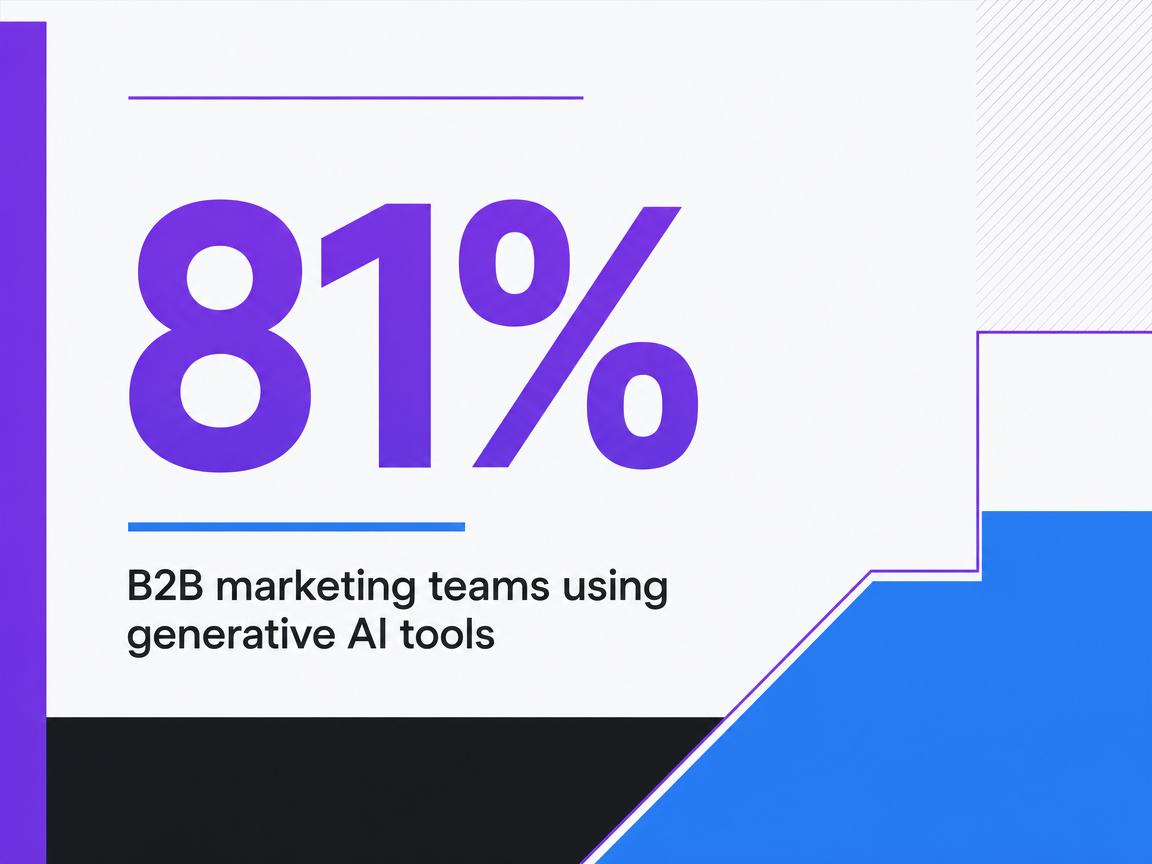 B2B marketing teams using generative AI tools
B2B marketing teams using generative AI tools
Clusters, AI Overviews, and Query Fan-Out
Google now describes AI Overviews and AI Mode as capable of issuing query fan-out, meaning the system runs multiple related searches across subtopics and data sources to assemble a generative response 17. That mechanic rewards a specific content shape: pages that cover a coherent set of subintents deeply, not permutation pages built around every variant of a head term. Google's AI-optimization guide is direct on the failure mode, warning against creating separate pages for every possible query variation when the purpose is ranking manipulation 14.
Clusters, defined as one primary URL plus supporting URLs covering distinct subintents, map cleanly onto fan-out behavior. When the system decomposes a query into related searches, a well-built cluster already has pages waiting at those subintent addresses, linked coherently back to the hub 18. A permutation approach produces the opposite: many thin pages competing for slices of the same intent, none of which reads as the authoritative source.
Two operator implications follow. Eligibility for AI Overview links still depends on ordinary Search technical and indexing requirements, so cluster pages must clear the same crawlability and quality bars as any other page 17. And cluster planning should explicitly enumerate the subintents a reasonable fan-out would probe, then confirm the site answers each one on a distinct, linked URL rather than folding them into a single overstuffed page.
Streamline Keyword Clustering to Scale Content Across Every Client
Connect with experts to see data-driven workflows for automating keyword clustering, accelerating topic coverage, and maintaining oversight—purpose-built for agencies managing complex, multi-site SEO programs.
Cluster-Level Measurement and Reporting
Ranking a single keyword tells the client almost nothing about whether the cluster is doing its job. The unit of measurement has to match the unit of production. If clusters are how pages get planned, briefed, and linked, clusters are how performance should be reported.
Four metrics travel well at the cluster level:
- Subintent coverage tracks how many of the enumerated subintents in the cluster have an indexed, linked page answering them, using the diversification logic that treats coverage of the intent hierarchy as the quality signal rather than raw keyword volume 2.
- Cluster share of voice aggregates rankings across the full term set, not just the head term, which prevents a strong head-term rank from masking recall failures across paraphrases 19.
- Cannibalization rate counts how often two URLs from the same site appear for the same query, the exact signal that canonicalization guidance is designed to resolve 10.
- AI Overview inclusion, where Search Console reports links surfaced in AI features, gives a read on whether the cluster's subintent pages are being pulled into generative responses 18.
The reporting cadence matters as much as the metrics. Monthly cluster reports replace keyword-by-keyword tables and let senior review focus on which clusters are gaining coverage, which are leaking to competitors, and which need a merge or split decision next cycle.
If You Run a Portfolio: Consolidation Economics Across Accounts
The framing shifts here from a single client's site to an agency managing dozens of them at once. What changes is not the clustering method. What changes is how much every unresolved overlap costs when it repeats across accounts, and how much a shared consolidation rule saves when it does not.
Cannibalization is the clearest line item. When two URLs on the same client site compete for the same intent, Google's own systems will cluster them and pick a representative anyway 10. The strategist can either make that call deliberately, using redirects or rel=canonical as the strong signals Google recognizes 11, or absorb the cost of drafting a second page that dilutes the first. Multiply that by the number of clients in the book and the number of overlapping cluster candidates each pipeline run produces, and consolidation stops being a per-account cleanup task. It becomes portfolio hygiene.
The variables that actually move the math are worth naming, since supplied research does not underwrite dollar figures for agency delivery.
| Variable | Before clustering discipline | After clustering discipline |
|---|---|---|
| Pages per client per month | Pbase | Pbase minus merged/canonicalized candidates |
| Hours per brief | Hbase | Hbase minus rework from intent disambiguation |
| Cannibalization rate | Cpre | Cpost after the merge/split/canonicalize gate |
| Reporting cadence | Keyword-level, per account | Cluster-level, standardized across accounts |
Two of these compound at portfolio scale. A standardized cluster-level reporting cadence lets one senior reviewer read across accounts in the time it used to take to read one, since the unit of analysis is the same everywhere. And a shared consolidation gate applied before drafting removes the class of rework that costs the most: pages that ship, underperform, and then require a canonicalization decision after the fact.
The operational context is worth stating with its scope. The 2025 CMI B2B benchmark reports that only about one-third of B2B marketers say they have a scalable content-creation model 15, and the enterprise benchmark finds only 48% of enterprise marketers agree their organization measures content performance effectively 16. Both are self-reported perception surveys, not causal evidence that clustering lifts rankings. They do describe the gap agencies are hired to close. Clusters as the shared unit of planning, production, and reporting are how one delivery team closes it across many books at once.
Where Approval-First AI Execution Fits
The through-line of the four layers is that clustering only scales when a human owns the decisions that determine whether a page should exist, and automation owns everything else. Signal work, embedding math, threshold logs, Silhouette scores, precision and recall sampling, subintent enumeration, internal-link maps, cluster-level reporting: all of it is repeatable pipeline work. Intent disambiguation, merge-split-canonicalize calls, and pre-publish quality sign-off are the judgment calls that keep output on the right side of Google's scaled-content-abuse line 12and its generative-AI guidance 13.
That split is what approval-first AI execution platforms are built to enforce. Vectoron structures the workflow so the pipeline drafts, ranks, and stages the work, and no cluster becomes a brief, and no brief becomes a page, without an explicit strategist sign-off at each gate. The atomic unit stays the cluster. The reviewer stays senior. The output stays defensible.
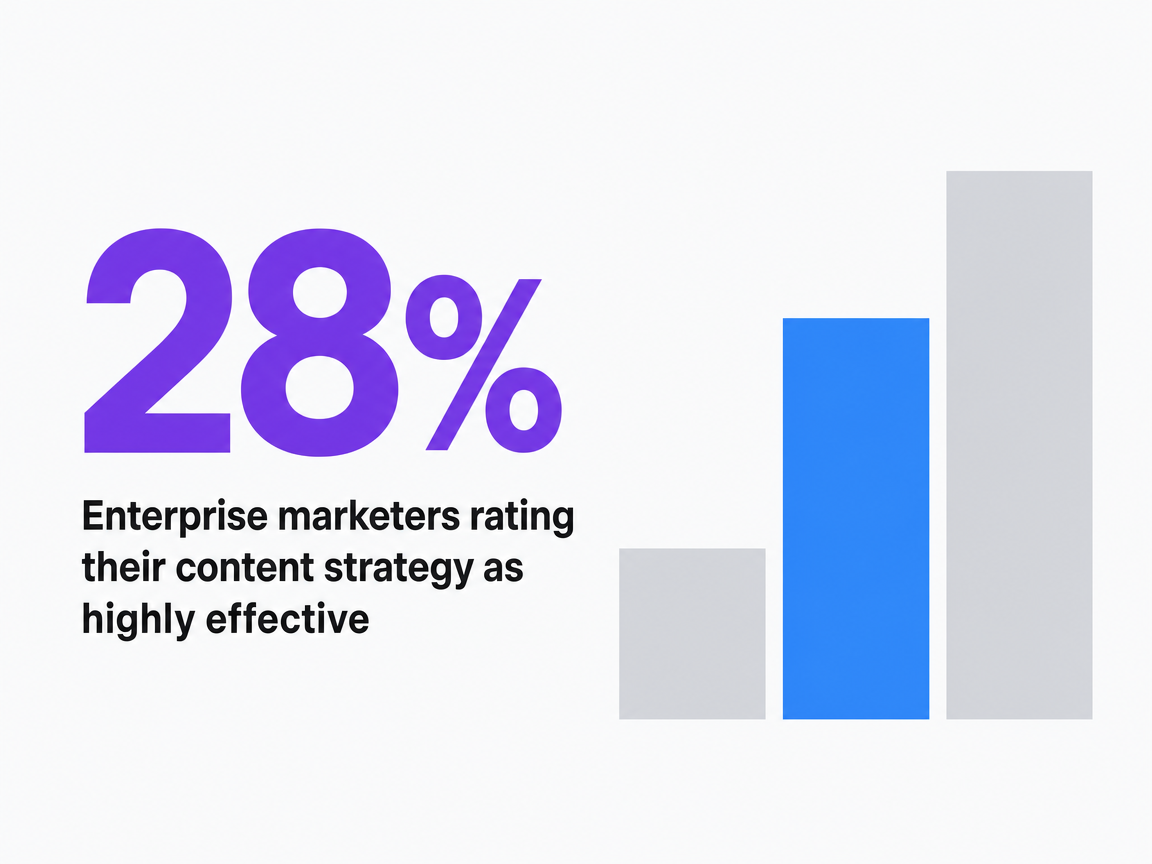 Enterprise marketers rating their content strategy as highly effective
Enterprise marketers rating their content strategy as highly effective
Frequently Asked Questions
References
- 1.Query Intent Detection from the SEO Perspective.
- 2.Low-cost, bottom-up measures for evaluating search result diversification.
- 3.Query Understanding in the Age of Large Language Models.
- 4.Deep Learning Based Page Creation for Improving E-commerce Search Engine Optimization.
- 5.2.3. Clustering — scikit-learn 1.9.1 documentation.
- 6.Clustering text documents using k-means.
- 7.measures.dvi.
- 8.SEO Link Best Practices for Google.
- 9.Learn About What Sitelinks Are.
- 10.What is URL Canonicalization | Google Search Central.
- 11.How to Specify a Canonical with rel="canonical" and Other Methods.
- 12.Spam Policies for Google Web Search.
- 13.Google Search's guidance on using generative AI content.
- 14.Google's Guide to Optimizing for Generative AI Features on Google Search.
- 15.B2B Content Marketing: 2025 Benchmarks & Trends.
- 16.Enterprise Content Marketing Benchmarks, Budgets, and Trends.
- 17.AI Features and Your Website.
- 18.Ringkasan AI dan Situs Anda.
- 19.คู่มือ SEO สำหรับมือใหม่: ข้อมูลเบื้องต้น.