
Key Takeaways
- Keyword clustering earns its place when it governs four decisions: which queries share a URL, which intent the page serves, how depth is specified, and how performance is measured.
- Defensible clusters require four signals in order—lexical overlap as a filter, topic-informed semantic similarity, SERP overlap as arbitration, and intent class as a primary partition 3, 4, 5.
- Consolidation decisions behave like retrieval tradeoffs: broad pages raise recall across a query set, intent-split pages raise precision, and SERP overlap resolves which configuration fits 6.
- Report clusters at the page level filtered to the full query set, tracking distinct query count to catch fan-out coverage, and layer conversion data since retrieval metrics do not equal business outcomes 8, 10.
Clustering as a Planning Discipline, Not a Keyword List
Most agency keyword clustering decks still open with a spreadsheet: thousands of terms, a similarity score, a color-coded grouping, and a recommendation to produce one page per cluster. That artifact is a sorting exercise. It is not a planning discipline, and it does not survive contact with a modern SERP, a cannibalization audit, or a client QBR.
For a Head of SEO running coverage across a client book, clustering earns its place in the production stack only when it governs four decisions the team would otherwise make inconsistently:
- which queries belong on the same URL,
- which intent the URL serves,
- how depth is specified in the brief,
- and how performance will be measured once the page is live.
Treating clustering this way reframes it as the connective layer between research, editorial, and reporting rather than a deliverable in its own right.
The research supports this framing. Semantic similarity models now outperform lexical-only baselines on standard benchmarks when topic information is combined with contextual embeddings 3, 4, intent classification is a distinct dimension that reshapes page format and conversion path 5, and retrieval systems are evaluated against shared test collections with precision and recall rather than anecdote 1, 6. A cluster that cannot be defended on those four axes—meaning, intent, overlap, and measurable relevance—is a keyword list in disguise.
The Four Signals That Define a Defensible Cluster
Lexical Overlap: Useful Floor, Unreliable Ceiling
Lexical overlap is the signal every clustering tool starts with: shared tokens, n-gram matches, stem equivalence, modifier patterns. It is cheap to compute and useful as a first-pass filter for obvious duplicates like divorce lawyer near me and divorce attorney near me.
The ceiling arrives quickly. Lexical scoring cannot separate bankruptcy attorney queries that resolve into Chapter 7 informational pages from those that resolve into business-filing commercial pages, because the surface words are nearly identical. It also over-splits synonyms, missing that assisted living costs and senior living pricing compete for the same SERP real estate. A clustering decision made on lexical signals alone will produce both false merges and false splits in the same run, which is why mature agency programs treat it as a sorting step, not a conclusion.
Semantic Similarity From Topic-Informed Embeddings
Semantic similarity closes the gap that lexical scoring cannot. Modern embedding models represent queries as vectors in a space where meaning, not surface form, drives distance. The strongest results come from models that combine contextual embeddings with topic information: a 2020 ACL study reported that a topic-informed architecture built on BERT outperformed strong neural baselines across several English-language semantic similarity datasets 3. A follow-up EMNLP paper using topic-informed discrete latent variables reported similar gains above neural baselines on multiple benchmarks 4.
For a Head of SEO, the operational translation is direct. Topic-informed embeddings reliably detect that DSO acquisition multiples and dental practice valuation benchmarks belong to the same planning cluster even without shared tokens, and that Chapter 7 and Chapter 13 queries do not, despite overlapping modifiers. Semantic scoring is where false merges from the lexical pass get rejected and where real synonym groups get recovered.
The limit is equally direct. Semantic similarity measures sentence-level meaning, not page-level topical authority or ranking behavior 4. Two queries can be semantically close and still deserve separate pages because the SERPs reward different formats. That is why the next signal exists.
SERP Overlap as Ground Truth for Page Consolidation
SERP overlap is the signal that converts linguistic grouping into a production decision. If two queries return substantially the same top ten URLs, Google has already answered the clustering question: those queries share a result set and almost certainly deserve a single page. If the top ten diverge, the queries belong on separate pages regardless of how semantically close they appear.
Overlap scoring is also the only signal that reflects competitive context. A query cluster that looks coherent in an embedding space can still fracture across local packs, product listings, video carousels, and knowledge panels. SERP overlap exposes those format splits before a brief is written, which saves the team from publishing a page that cannot physically rank in the layout Google serves.
Practical thresholds vary by vertical, but the discipline does not. Agencies that build clusters on overlap use it as the arbitration layer: when lexical and semantic signals disagree, the shared result set decides. This is also the signal that aligns most cleanly with retrieval-grade evaluation, where relevance is judged against observable system behavior rather than against the analyst's expectation of what should rank 1, 6.
Intent Class as a Primary Dimension, Not a Filter
Intent is often applied as a post-hoc filter: cluster first, then label the result informational, commercial, or navigational. That ordering produces clusters that pass semantic and overlap checks but fail in production because the page format cannot serve both intents at once. Treating intent as a primary dimension inverts the sequence. Queries are first partitioned by intent class, then grouped within class by semantic similarity and SERP overlap.
The research supports the inversion. Work on classifying web queries by intent shows that informational, navigational, and commercial queries respond to distinct page formats and conversion paths, and that click logs can substitute for manually annotated training data when scaling intent classification 5. For an agency, that means a single topic—say, HIPAA compliance for behavioral health—may legitimately split into a long explainer, a checklist utility, and a services page, each serving a different intent class even though all three cluster together on meaning.
Intent categories are not clean. The same paper notes that queries can shift intent across a journey or carry multiple plausible interpretations 5. That ambiguity is handled by the validation gate in Section 6, not by pretending intent is a binary label.
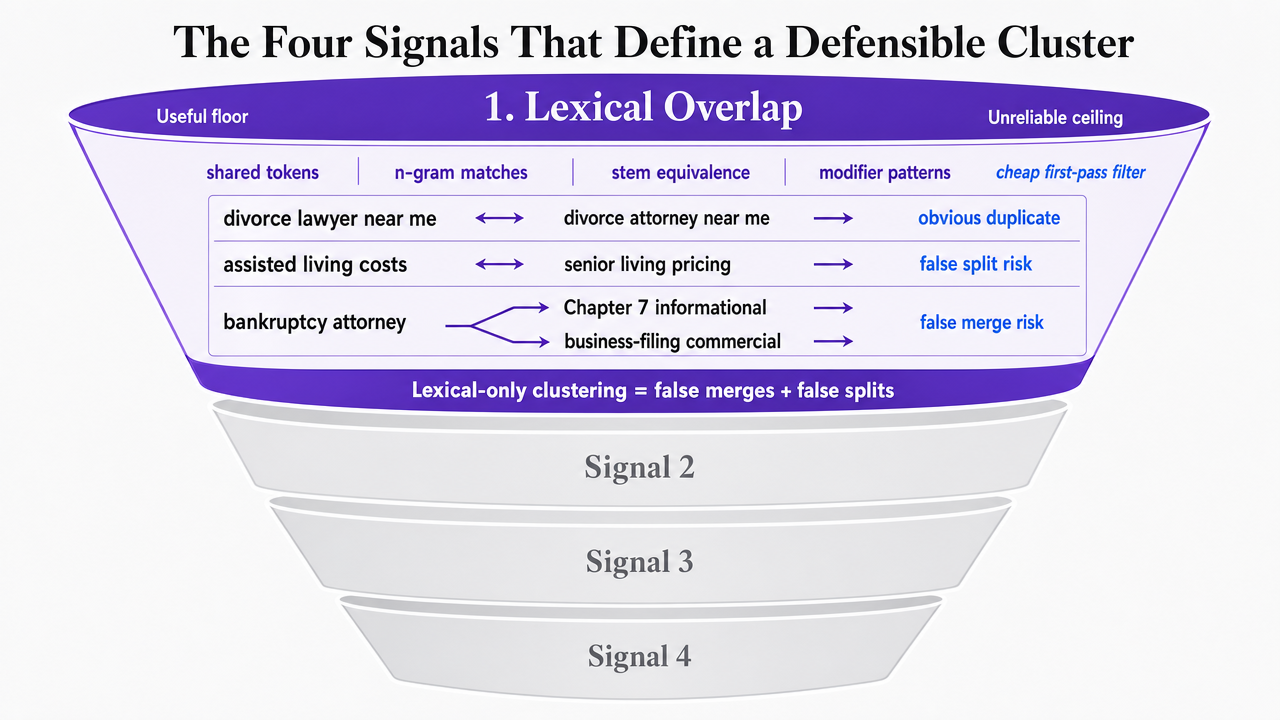 Visualize the four-signal sequence described in the section as a layered filtering framework
Precision and Recall: Testing Consolidation Decisions Like a Retrieval System
Retrieval science has spent four decades formalizing the question every clustering decision implicitly asks: did the right documents surface for the right queries? NIST defines precision as the proportion of retrieved documents that are relevant and recall as the proportion of relevant documents retrieved, measured against shared test collections with repeatable judgments rather than against the analyst's expectations 6. That vocabulary transfers directly to the choice an agency Head of SEO faces every week: should a cluster become one consolidated page, or should it split into multiple intent-specific pages?
Framed as a retrieval problem, the tradeoff clarifies. A single consolidated page covering a broad cluster tends to maximize recall—it has a chance of surfacing for a wider set of queries in the group—but risks lower precision on any individual query, because the page cannot format itself three ways at once. A set of intent-split pages inverts the curve. Each page targets a narrower slice of the query set with higher precision for its intent, at the cost of recall on adjacent queries that would have been caught by a broader page.
The disciplined test is to treat the query cluster as a miniature test collection. The team defines the full query set the cluster is meant to serve, publishes both the consolidated version and the split version on comparable domains or in sequential windows, and measures which configuration retrieves more of the relevant query set at acceptable position. TREC's framing of shared evaluation infrastructure applies: the comparison only means something when the query set, the relevance criteria, and the measurement window are fixed in advance 1, 6.
Two caveats keep the method honest. Precision and recall measure retrieval relevance, not business outcomes; impressions, qualified clicks, and downstream conversion data have to be layered on top for client reporting 6. And no test collection reproduces a client's competitive landscape, local-search conditions, or seasonality perfectly 1. The value is not a universal answer but a repeatable method for deciding consolidation case by case, which is what distinguishes a cluster program a Head of SEO can defend from one that relies on an analyst's intuition about what should rank.
Test Keyword Cluster Strategies on Live Content
Evaluate real-world SEO impact from clustered content—publish and measure results during your free trial period.
Query Fan-Out and Why Topical Depth Beats One-to-One Mapping
AI Overviews and AI Mode change what a single user query actually asks the index. Google's own documentation describes a query fan-out pattern in these features, where one surfaced query triggers multiple related searches across subtopics and data sources before an answer is assembled 8. The implication for cluster planning is direct: the retrieval event is no longer a one-to-one match between a keyword and a page. It is a many-to-one match between a sub-query set and the pages deep enough to satisfy several sub-queries at once.
That dynamic rewards cluster-depth pages and penalizes the keyword-per-page habit that lexical clustering tends to produce. A page built for HIPAA compliance for behavioral health that also covers consent workflows, breach notification timing, business associate agreements, and telehealth-specific exceptions can be cited across several fan-out sub-queries. Four thin pages—one per sub-topic—compete with each other for the same citation slot and typically lose to the deeper source. Topical depth is the fan-out optimization.
Google is explicit that no special markup or feature-specific optimization is required for AI Overviews or AI Mode. The guidance names crawlable content, strong internal linking, textual access to important information, good page experience, and accurate structured data as sufficient 8. For a Head of SEO, that reads as validation of the planning discipline, not a new workstream. Clusters formed on semantic similarity, SERP overlap, and intent class—then written with substantive coverage of the sub-queries a reasonable user would ask next—are already shaped for fan-out retrieval.
The caveat worth tracking is attribution. Search Console currently reports AI-feature interactions within overall web-search performance rather than as a fully separated channel 8. Cluster-level reporting absorbs this gracefully; keyword-level reporting does not.
The Cannibalization and Scaled-Content Boundary
Clustering done badly produces two failure modes that look opposite but share a root cause:
- Cannibalization: multiple pages built for lexically similar queries that compete against each other in the same SERP, splitting authority and confusing canonicalization. See cannibalization.
- Scaled content abuse: dozens or hundreds of thin pages spun from a cluster list to chase every long-tail variant, each page offering little beyond rephrased keywords.
Both come from treating the cluster output as a page-production backlog rather than a planning artifact.
Google's spam policy draws the second line explicitly. It defines scaled content abuse as generating many pages primarily to manipulate search rankings rather than help users, and names generative-AI pages that provide little or no value and pages containing search keywords that make little sense to readers as examples that fall inside the policy regardless of whether automation was involved 9. The policy does not prohibit AI assistance; it prohibits output whose purpose is ranking manipulation rather than reader value.
Agency programs stay on the right side of both failures by using clusters to reduce page count, not expand it. A disciplined cluster run that consolidates ten thin keyword briefs into three substantive pages—each anchored on semantic grouping, SERP overlap, and a defined intent—simultaneously eliminates cannibalization risk and demonstrates the originality, substantial coverage, and primary-focus signals Google's helpful-content guidance asks for 7. The planning discipline is the defense.
A Four-Signal Validation Gate Before a Cluster Enters Production
Clusters generated by any tool should be treated as proposals, not approvals. Before a cluster becomes a brief, a four-signal gate catches the merges and splits that any single signal gets wrong. The gate runs in a fixed order, and a cluster that fails any step returns to the queue for re-partitioning rather than entering production.
- Semantic coherence. The cluster is tested against a topic-informed embedding score, not lexical similarity alone. Topic-informed representations have outperformed strong neural baselines across multiple semantic similarity datasets 3, which is why they catch synonym groups and reject surface-level matches that share words but not meaning 4. A cluster that scores below threshold on topic coherence is almost always carrying two subjects.
- SERP overlap. The top ten URLs for each query in the cluster are compared. Substantial overlap confirms Google is already treating the queries as one result set; divergence confirms the cluster should split, regardless of how coherent it looks in embedding space. This is the arbitration signal when semantic and lexical scores disagree.
- Intent class. Each query is tagged informational, commercial, or navigational before grouping is finalized, following the primary-dimension approach the research supports 5. Clusters that span intent classes are flagged for splitting even when semantic and overlap scores are strong, because no single page format serves two intents without compromising both.
- Business relevance. The cluster is checked against the client's service lines, conversion paths, and the originality and substantial-coverage questions in Google's helpful-content guidance 7. Clusters that pass the first three gates but map to zero commercial outcome become editorial inventory, not production priorities.
Only clusters that clear all four gates enter the brief queue. The sequence matters: semantic coherence filters noise, SERP overlap resolves consolidation, intent class enforces format discipline, and business relevance sets the production order. A cluster program run through this gate produces fewer briefs than a lexical sort would, which is the point.
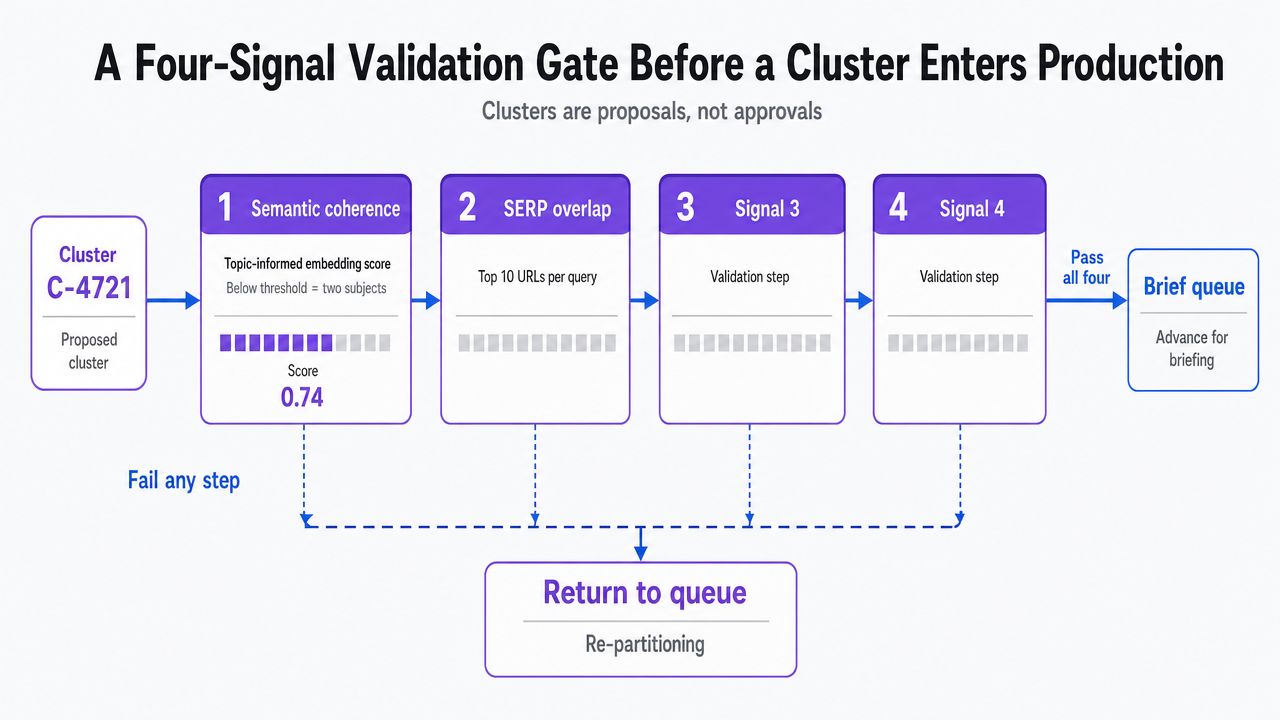 Show the validation gate as a decision workflow where clusters either advance to brief queue or return for re-partitioning
See How Top Agencies Execute Keyword Clustering at Scale
Connect with our specialists to review live examples of AI-driven keyword clustering workflows that boost SEO efficiency and content depth—without increasing your team’s workload.
Cluster Economics Across a Client Portfolio
The economics shift the moment clustering stops being a per-client exercise and becomes a portfolio method. A Head of SEO running fifteen or twenty client books cannot staff a per-keyword production line without expanding the editorial team past what retainers support. Clustering changes the ratio between target queries and finished assets, which is the lever that makes coverage scale without new hires.
The table below compares a keyword-per-page approach to a cluster-per-page approach using variables an agency controls. The ratios are illustrative and will differ by vertical, but the direction holds across client types.
| Variable | Keyword-per-page | Cluster-per-page |
|---|---|---|
| Target queries per client | N | N |
| Pages produced | ~N | ~N / 4 to N / 8 |
| Briefs required | 1 per page | 1 per cluster, deeper spec |
| Internal links to maintain | N×(N-1) surface | Hub-and-spoke, bounded |
| Cannibalization risk surface | High | Low by construction |
| Fan-out coverage per page | Single sub-query | Multiple sub-queries 8 |
Two consequences follow for portfolio planning:
- Brief depth replaces brief count as the throughput constraint. A cluster brief takes longer to write than a keyword brief, but one cluster brief retires four to eight keyword briefs, and the specification work compounds across clients in the same vertical because the signal gates in Section 6 produce reusable cluster shapes.
- The cannibalization audit load drops to near zero on new production. Clusters validated against SERP overlap do not generate competing pages by construction, which removes an ongoing cost line most agencies carry quietly.
The quality bar remains fixed. Google's helpful-content guidance asks whether pages demonstrate original information, substantial coverage, and a primary focus 7, and the spam policy treats volume-first production as scaled content abuse regardless of how the pages were assembled 9. Portfolio economics only improve when clustering reduces page count against the same quality bar. Programs that use clustering to produce more thin pages faster inherit both failure modes at once and lose the economic case along with the ranking case.
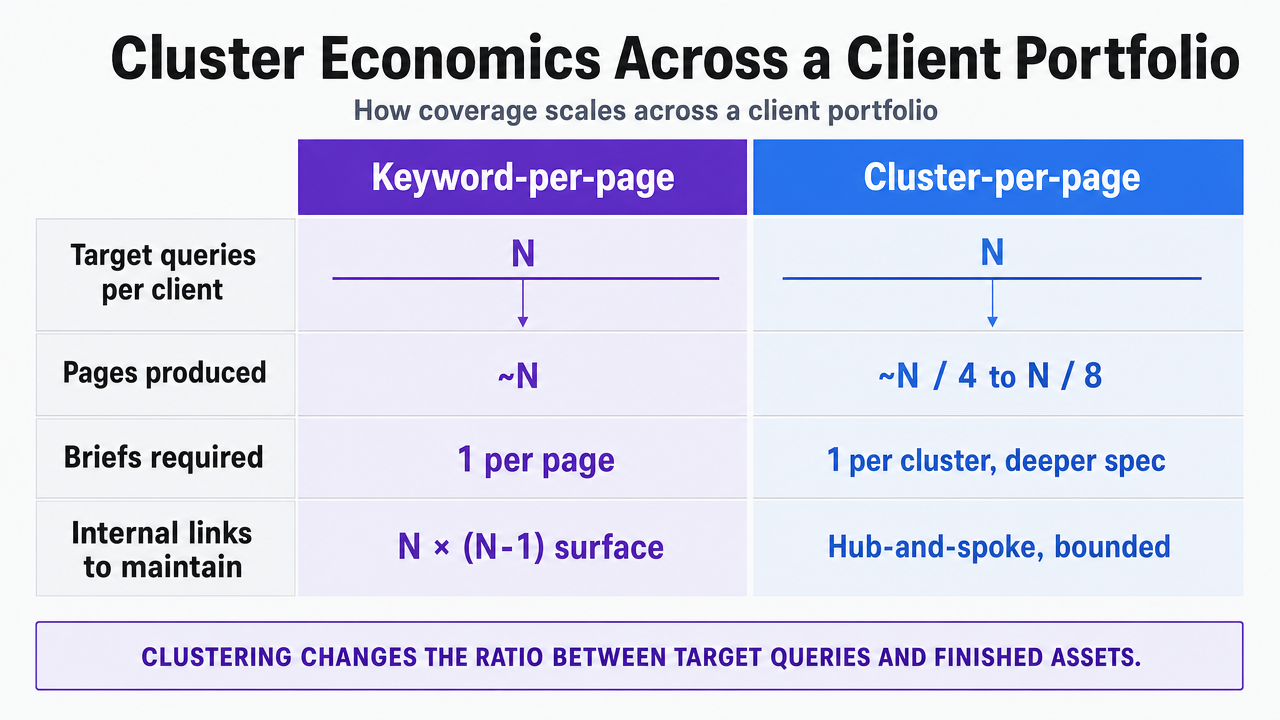 Render the keyword-per-page vs cluster-per-page comparison table from the section as a side-by-side visual comparison
Measuring Clusters in Search Console, Not Keyword by Keyword
Keyword-level reporting is the habit that most undermines a cluster program. A cluster that absorbs eight sub-queries into one page will show eight separate query rows in Search Console, each with a fraction of the impressions and clicks the page actually earned. Reading those rows individually makes the page look weaker than it is, and comparing them against pre-cluster baselines invites the wrong intervention.
Cluster-level measurement reverses the lens. The Performance report breaks traffic down by query, page, and country with impressions, clicks, and trends 10, which means the correct unit of analysis for a cluster is the page row filtered to the full query set the cluster was built to serve. Agencies that report this way pull three numbers per cluster:
- total impressions and clicks on the cluster URL,
- the count of distinct queries the page surfaced for,
- and the average position across that query set.
The second number is the one that catches fan-out coverage expanding over time 8, and it is invisible when reporting runs keyword by keyword.
Two limits shape how the data is used. Search Console samples and delays its data and carries attribution limits that get worse at the query level 10, so cluster rollups should be read on rolling windows rather than day-over-day. And retrieval metrics do not substitute for business outcomes 6—qualified calls, booked consultations, and pipeline from analytics and CRM sit on top of the cluster row, not inside it. A cluster QBR that pairs page-level Search Console rollups with downstream conversion data gives the client a defensible read on whether the consolidation decision paid out, which is the question keyword-row reporting cannot answer.
Where Vectoron Fits in a Cluster-Led Production Model
The planning discipline described across the preceding sections is labor-intensive by design. Topic-informed semantic scoring, SERP overlap arbitration, intent partitioning, and business-relevance checks produce fewer, deeper briefs 7, but each cluster still demands coordinated execution across research, editorial, and reporting roles that most agency retainers were never sized to carry at portfolio scale.
Platforms that run specialist strategists under a human approval workflow absorb the throughput load without changing the quality bar. Vectoron operates in that pattern: cluster proposals, briefs, drafts, and Search Console rollups move through a Command Center where a Head of SEO approves or rejects each artifact before it ships. The four-signal gate stays with the strategist. The production math stops fighting the retainer.
Frequently Asked Questions
References
- 1.The 34th Text Retrieval Conference (TREC 2025).
- 2.Overview of the TREC 2025 Retrieval Augmented Generation (RAG) Track.
- 3.Topic Models and BERT Joining Forces for Semantic Similarity Detection.
- 4.Learning Semantic Textual Similarity via Topic-informed Discrete Latent Variables.
- 5.Using Word-Sense Disambiguation Methods to Classify Web Queries by Intent.
- 6.Overview of TREC 2024 - Text Retrieval Conference.
- 7.Creating Helpful, Reliable, People-First Content.
- 8.AI Features and Your Website | Google Search Central.
- 9.Spam Policies.
- 10.How To Use Search Console.