
Key Takeaways
- Standard gap reports mistake ranking presence for opportunity, ignoring whether queries match satisfiable intent, whether SERPs still send organic clicks, and whether competing pages truly serve the searcher 4.
- Format survivability must precede volume in prioritization, since queries with AI Overviews saw organic CTR fall from around 15% to 8%, with cited-source clicks near 1% 6.
- Score every candidate on four weighted inputs—intent match, format survivability, page-type fit, and revenue relevance—using the four-class taxonomy so page-type decisions stay visible 10.
- Sustain portfolio quality by routing brand, mixed-SERP, and label-conflict queries to senior review, recording SERP evidence per row, and running monthly twenty-query calibrations 8.
Why List-Diff Gap Reports Mislead Agency Portfolios
The default keyword competitive analysis workflow at most agencies involves a two-click export: running a domain-versus-competitors gap report, sorting by search volume, and handing the list to a strategist. This output often appears rigorous due to its quantitative nature, but it frequently isn't. A list-diff report treats ranking presence as a proxy for opportunity, which conflates three distinct questions: whether the query aligns with a searcher goal the client can realistically serve, whether the current SERP still directs clicks to organic results, and whether competing pages genuinely satisfy that goal better than the client's would.
Google's own rater framework bases usefulness on intent-satisfaction, not keyword overlap. The Search Quality Rater Guidelines define usefulness as a function of the user's intent, as interpreted from the query, and how completely the result satisfies it 4. A gap report cannot discern these nuances; it merely observes a ranked URL on a competitor's domain and infers demand.
Two significant portfolio-level issues arise. Firstly, the highest-volume gaps often occur where the SERP format has already absorbed the click, transforming a "top opportunity" into a page that generates impressions but almost no traffic 6. Secondly, junior analysts, working from raw exports, tend to prioritize by volume and difficulty because these are the metrics provided by the tool. Intent match, page-type suitability, and revenue relevance are not standard columns; they necessitate human judgment.
Reframing the analysis around intent-satisfaction within the context of the SERP is crucial for distinguishing a mere gap list from a defensible client recommendation.
Reframing the Gap: Intent-Satisfaction Under SERP Context
Google's Definition of 'Useful' in Rater Guidelines
The Search Quality Rater Guidelines define usefulness as the degree to which a search result satisfies the user's intent, derived from the query 4. Gap reports typically fail to directly observe either of these variables. Instead, they note presence: a competitor's URL ranking for a query where the client's domain does not. Presence, however, does not equate to satisfaction.
This distinction is vital for portfolio management as it redefines what constitutes a sound recommendation. Queries like "best CRM for law firms" and "CRM pricing" may both appear as commercial gaps in a tool export, but they represent different user needs. The first requires a curated comparison from someone knowledgeable about legal workflows, while the second seeks a specific pricing page or a comparison of published tiers. A page that poorly satisfies one intent will also poorly satisfy the other. Therefore, a client's page that cannot satisfy either intent should not be scored identically to one that could satisfy both.
While rater guidance is not the ranking algorithm itself, it offers the clearest public insight into what Google trains evaluators to value 4. Adopting usefulness as intent-satisfaction provides agency teams with a transparent rubric that clients can also understand. This shifts the discussion from "this competitor outranks us on 812 keywords" to "here are 30 queries where current top results fail to meet the searcher's objective, and our client can do it better."
Detecting SERP Drift from User Intent
User intent is dynamic, and so are the search results Google provides. Research into behavioral dynamics from the SERP perspective offers methods to identify when a result set has diverged from the query's underlying intent, using observed user interactions as the primary signal 12. This divergence often highlights the most valuable gap opportunities.
Two recurring patterns emerge in agency portfolios. The first involves a query whose meaning has evolved: a product term the client previously owned editorially now returns integration tutorials because searcher behavior shifted towards implementation. The existing top results were designed for the old intent, leading to high impressions but low task completion. The second pattern occurs when the SERP composition changes—for instance, forums, video results, or an AI Overview absorb the informational layer—leaving the transactional layer inadequately served. Studies on user interaction demonstrate that combining query features with session behavior more reliably identifies these mismatches than relying solely on query text 9.
For gap prioritization, identifying this drift provides the strongest actionable signal for an agency. A competitor ranking with outdated content while user behavior indicates a different need is not a competitive advantage but an opportunity. The analyst's role is to pinpoint queries where the current ranking results no longer fulfill the user's objective, then assess whether the client can create a page that effectively closes that gap. This is a more nuanced task than simply determining "who ranks and who doesn't."
SERP-Format Economics and Prioritization
Volume-weighted gap lists assume a consistent relationship between impressions and clicks, which no longer holds true for queries where AI Overviews appear. A study on click behavior on AI Overview SERPs revealed that the organic click-through rate for traditional results dropped from approximately 15% when no AI Overview was present to about 8% when one was. Furthermore, clicks to sources cited within the Overview itself occurred in only about 1% of visits 6. While these magnitudes are specific to the studied sample and will vary by vertical, query length, and Overview format, directional evidence from a separate working paper on AI Overviews and outbound clicks supports this trend 5.
For portfolio prioritization, this changes the calculation. A query with 12,000 monthly searches where an AI Overview captures the informational layer may yield fewer valuable clicks than a 900-search query with a clear transactional SERP. A standard gap report cannot differentiate this. However, a survivability weighting can.
Practical adjustments are necessary. Queries consistently displaying AI Overviews should be de-prioritized unless the client's page can realistically secure one of the cited slots. Even then, the expected click volume should be modeled against the ~1% cited-source rate rather than traditional CTR curves 6. Queries where the Overview is intermittent, or absent for transactional variations, maintain more traditional economics. Google's newer generative AI performance reports in Search Console provide agencies with direct data on which client pages appear in AI features, the impressions they accumulate, and where clicks actually land 2. This data should inform any gap-scoring rubric from the outset, not as an afterthought.
The guiding principle for analysts is straightforward: every candidate query must undergo a SERP format check before receiving a priority score.
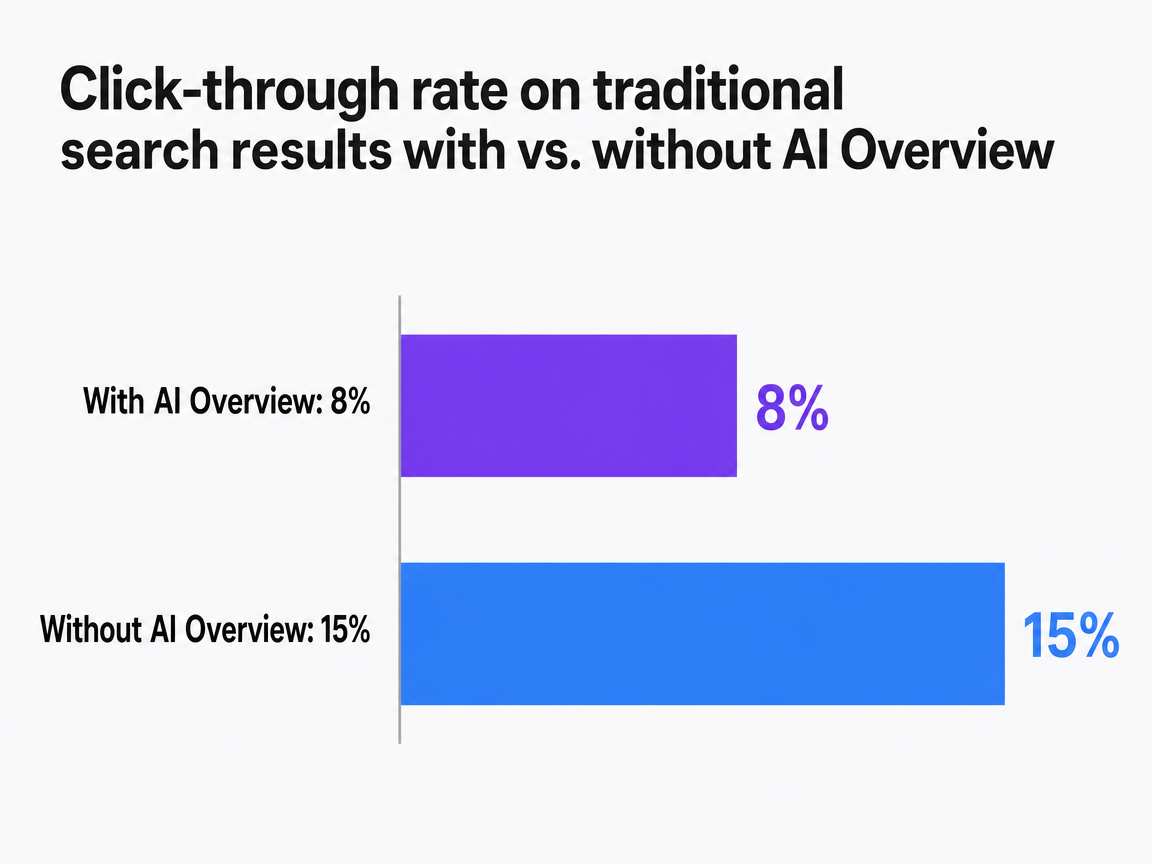 Click-through rate on traditional search results with vs. without AI Overview
Recent research shows that when a Google AI Overview is present, the click-through rate on traditional organic search results drops from 15% to 8%.
Pinpoint High-Intent Keyword Gaps Instantly
Identify, validate, and fill competitive keyword gaps with real data before committing long-term.
Intent-Classification for Junior Analysts
The Three-Class Taxonomy vs. Four-Class Debate
Every gap-scoring rubric requires a consistent vocabulary for intent. The widely adopted taxonomy by Jansen and colleagues includes informational, navigational, and transactional intents 10. Informational queries seek knowledge, navigational queries aim for a specific destination, and transactional queries intend to complete an action, such as locating a website to obtain a product, execute a service, purchase, apply, or download 10. The transactional class, though the smallest share of query volume in their sample, is most closely linked to downstream conversion behavior, thus receiving disproportionate weight in portfolio scoring models 10.
Agency teams often debate whether to subdivide transactional intent into two categories: "commercial investigation" for queries like "best CRM for law firms" and "pure transactional" for queries such as "CRM pricing" or "buy CRM." Jansen's original three-class framework considers both as transactional-adjacent behavior. However, later four-class models elevate commercial investigation to a distinct class because the SERP composition and the page type required to satisfy the query are significantly different 10. Neither taxonomy is inherently incorrect; the key for delegated work is to choose one and apply it consistently.
For portfolio analysis, the four-class taxonomy is recommended. Commercial-investigation queries typically require comparison or review pages, while pure transactional queries demand product, pricing, or booking pages. Combining them forces the analyst to make page-type decisions later, in a less visible step, which can introduce quality inconsistencies.
When Automated Inference Fails: The Need for Human Review
Most keyword tools now provide an intent label for each query. Analysts often accept these labels as definitive to avoid the tedious task of rechecking hundreds of rows. However, research indicates that this shortcut compromises accuracy in specific, predictable areas.
Click-behavior inference is a particular weakness. When researchers attempted to classify navigational queries using only first-result click behavior, the method proved reliable for only a small fraction of queries in their sample 8. This failure is significant because navigational queries, such as brand terms, product-name searches, and "login"-style queries, can inflate opportunity scores if misidentified as informational or transactional. A perceived gap where the client cannot outrank the brand owner is not a genuine opportunity but a distraction.
A three-step classification process, executed sequentially, can counteract this:
- Query-signal pass: modifiers, entity type, and the tool's proposed label are recorded but not automatically accepted.
- SERP-inspection pass: analysts examine the actual page types ranking, the presence of AI Overviews or knowledge panels, and whether top results share a coherent purpose. Combining query features with SERP content enhances intent detection beyond just query text 7.
- Session-behavior check (for ambiguous cases): interaction signals classify search missions more accurately than any single feature and reveal intent gaps that query text obscures 9.
The human-review gate is positioned between step two and step three. Any query with a mixed SERP across page types, a brand or product name, or a discrepancy between the tool's label and SERP evidence is escalated to a senior reviewer before entering the scoring queue. All other queries proceed through the automated lane. This division allows a small senior team to oversee a much larger junior throughput without compromising classification quality due to volume.
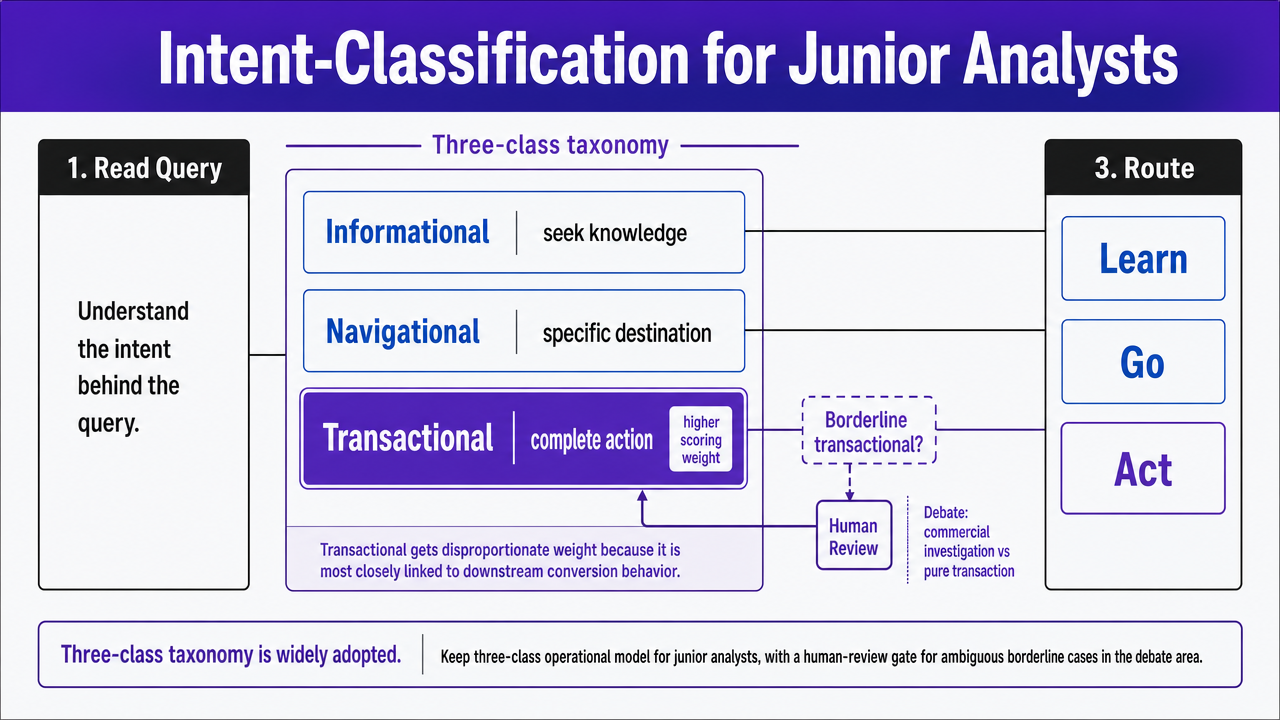 Visualize the three-step classification workflow with the human-review gate, directly supporting the section's explanation of how junior analysts route queries
A Portfolio-Scale Gap Scoring Rubric
Weighted Inputs: Intent Match, Format Survivability, Page-Type Fit, Revenue Relevance
A scoring rubric suitable for delegation across a client portfolio requires four weighted inputs, each defined clearly enough that two analysts scoring the same query will arrive at results within a point of each other. These four critical inputs are intent match, format survivability, page-type fit, and revenue relevance.
Intent match assesses how well the client's proposed page fulfills the objective represented by the query, utilizing the four-class taxonomy previously discussed. A strong alignment between a transactional query and a pricing or booking page receives a high score, while a commercial-investigation query paired with a superficial product page scores low. The foundation for this is Google's definition of usefulness as intent-satisfaction, not merely keyword presence 4.
Format survivability evaluates the remaining click opportunity for a query after accounting for the current SERP composition. Queries consistently displaying AI Overviews receive a low survivability weight because organic CTR on such SERPs is significantly lower than on unaffected ones, and clicks to sources cited within the Overview are rare 6. Queries with traditional ten-blue-link SERPs, or where the AI Overview appears only for informational variants while transactional variants remain untouched, retain more traditional economics.
Page-type fit determines whether the top-ranking results share a coherent page type that the client can realistically produce. If the top five results are all in-depth comparisons written by domain experts, a basic category page will not close the gap, regardless of authority. Combining query features with actual ranking content improves the accuracy of this assessment compared to relying solely on query text 7.
Revenue relevance scores the query's proximity to the client's defined booked-revenue metrics, which are set by the account lead, not the analyst. Transactional queries typically receive a higher default weight because this class is most directly linked to downstream actions 10. However, a high-revenue informational query in a considered-purchase vertical can outweigh a low-margin transactional one.
The four inputs should be weighted to sum to a fixed maximum, with identical weights applied across all clients within a specific vertical. Analysts must also record the SERP-check evidence in the same row as the score, making the rubric auditable at a portfolio scale.
Leveraging Search Console Signals for Scoring
Third-party gap tools reveal competitor rankings but do not show how a client's existing pages perform on queries adjacent to a gap. Search Console, however, provides these crucial signals, which should inform the scoring rubric from the outset, rather than being used merely as a validation step.
Three data feeds are particularly important:
- Firstly, the standard performance report, with its enhanced recency, highlights sudden query movements before third-party crawlers detect them 1. A query with a recent spike in impressions where the client's average position is on page two indicates an active, not hypothetical, gap. Such a query deserves a boost in format-survivability and revenue-relevance scores due to its fresh behavioral data.
- Secondly, the generative AI performance report displays impressions, pages, countries, devices, and dates for the client's visibility within AI features 2. This report answers a question that third-party gap reports cannot: whether the client's pages are already being cited within AI Overviews for queries where they do not rank traditionally. These queries should be scored differently from pure blue-link gaps.
- Thirdly, a query-level impression-to-click ratio for pages ranking in positions four through ten is valuable. A consistent pattern of high impressions with a plummeting CTR often signals a SERP that is drifting out of sync with the ranked results 12. These queries should be routed to the analyst's manual review queue as potential gaps where a competitor's page might better satisfy the intent than the current top results.
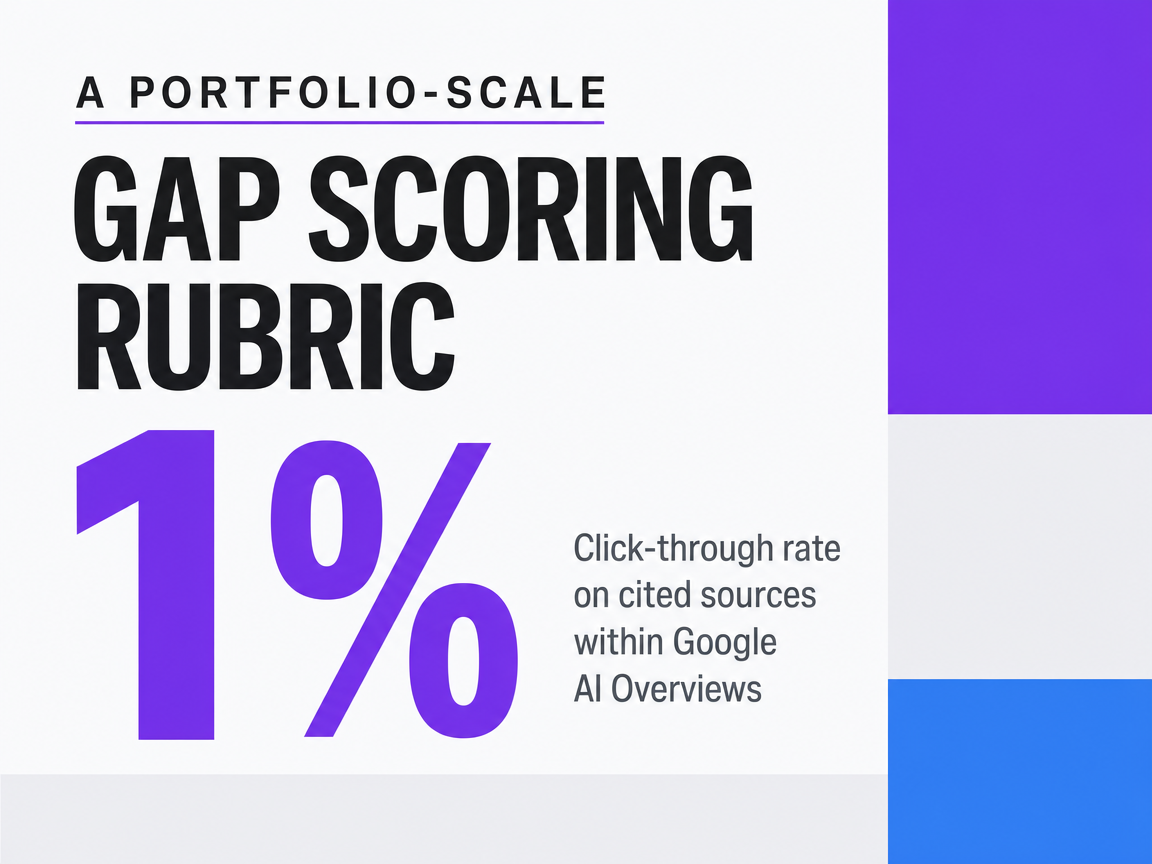 Click-through rate on cited sources within Google AI Overviews
Click-through rate on cited sources within Google AI Overviews
Delegating Work Without Quality Drift
The effectiveness of a scoring rubric depends on its consistent application by analysts. In agency settings, a common failure occurs when a senior strategist develops a framework, trains junior analysts, but within a quarter, scores across accounts diverge due to inconsistent ambiguity resolution. This indicates a failure in delegation, not in the rubric itself.
Three controls help maintain consistency:
- First, a mandatory evidence field on every scored row requires the analyst to record the SERP composition at the time of scoring, the top three ranking page types, and whether an AI Overview was present. This evidence makes the score auditable. A senior reviewer can quickly spot-check twenty rows a week to ensure analysts are consistently applying the format-survivability weight, rather than defaulting to volume-driven scores when the SERP check is inconclusive 6.
- Second, the routing gate established in the classification workflow is crucial. Any query containing a brand or product name, exhibiting a mixed page-type SERP, or showing disagreement with the tool's label is diverted from the automated lane to senior review before scoring 8. This rule prevents most errors stemming from junior judgment.
- Third, regular calibration, not just initial training, is essential. Once a month, two analysts and the account lead independently score the same twenty-query sample and compare their results. Rows where scores differ by more than one point become the focus of the next training session. The core principle of the rubric remains constant across all calibrations: usefulness is defined by intent-satisfaction, not ranking presence 4.
Pinpoint High-Value Keyword Gaps with Competitive Intelligence
Connect with a specialist to see how enterprise teams use continuous keyword gap analysis to surface high-intent opportunities and outpace competitors—without increasing analyst hours.
Analyst Throughput Economics for Multi-Client Portfolios
The focus here shifts from single-account tactics to portfolio-wide operations. An agency managing gap analysis for 10 to 50 client accounts is dealing with an analyst-capacity challenge, not just an SEO problem. The rubric and classification flow described are only beneficial if the monthly hours per client remain predictable as the client roster expands.
The manual baseline workflow in most agencies is similar: a junior analyst pulls a gap export, manually checks intent labels, spot-inspects a subset of SERPs, drafts a prioritized list, and submits it to a strategist for review. Across a portfolio, the hours accumulate significantly during the SERP-inspection phase, as this is where the format-survivability assessment is made, and AI Overview presence must be verified query by query 6. Standardizing the workflow doesn't eliminate this step; it integrates it into a structured process with recorded evidence, making throughput comparisons meaningful rather than aspirational.
| Portfolio size | Manual workflow: analyst-hours per client per month | Standardized rubric workflow: analyst-hours per client per month |
|---|---|---|
| 10 accounts | H | H × (1 − s) |
| 25 accounts | H + drift-review overhead | H × (1 − s), plus fixed senior calibration hours |
| 50 accounts | H + compounding drift-review overhead | H × (1 − s), plus fixed senior calibration hours |
Here, H represents the agency's measured baseline hours per client per month for gap analysis. The savings variable 's' denotes the proportion of the workflow absorbed by the automated lane established in the classification flow, where queries clear the query-signal and SERP-inspection passes without requiring senior review 7. The residual senior calibration hours are fixed, not per-account, because the monthly twenty-query calibration sample from the delegation controls does not scale with the size of the client roster.
Two aspects of this model are crucial for an SEO head. Firstly, the per-account hours under the standardized workflow do not increase with portfolio size, whereas the manual workflow incurs growing drift-review overhead as more accounts generate inconsistent outputs that senior staff must reconcile. Secondly, the senior-hour expenditure remains constant, enabling a small senior team to supervise a larger junior throughput without a decline in classification quality 8. The economic justification for this rubric is not that it accelerates any single gap analysis, but that it makes the tenth, twenty-fifth, and fiftieth analyses as efficient as the first.
From Prioritized Query to People-First Page
A prioritized query serves as a brief, not a finished page. While the scoring rubric guides the team on which gaps to address and why, it doesn't answer the fundamental question of whether the final page will actually earn the click—that is, whether it satisfies the user's need better than existing top results. Google's people-first guidance directly addresses this by emphasizing originality, completeness, and value, and requiring clarity on who created the content, how it was produced, and its purpose 3.
For a delegated workflow, this translates into a comprehensive handoff document rather than just a keyword. Each prioritized query moves into production with four fields already recorded by the scoring analyst: the intent class, the page type observed at the top of the SERP, the format-survivability note, and the revenue-relevance rationale established by the account lead. The writer or subject matter expert then inherits these constraints, eliminating the need for reinterpretation. For example, a commercial-investigation query will not result in a superficial category page, nor will a transactional query lead to a 2,000-word explanatory article.
Completeness is often an underestimated aspect in many agency workflows. If the collective top-ranking results answer eight sub-questions, but the client's draft only addresses five, the intent-satisfaction gap remains open. The usefulness principle from the rater framework also applies at the page level: the result must fully satisfy the intent behind the query 4. This is the benchmark against which the finished page is measured, not merely word count or keyword density.
Frequently Asked Questions
References
- 1.An improved way to view your recent performance data in Search Console.
- 2.Introducing Search Generative AI performance reports in Search Console.
- 3.Creating Helpful, Reliable, People-First Content.
- 4.Search Quality Rater Guidelines: An Overview - Google.
- 5.How Does Generative AI Affect Search? Evidence from Google’s AI Overviews.
- 6.Investigating Click Behaviors On Google Search Result Pages That Produce an AI Overview.
- 7.Impact of query intent and search context on clickthrough behavior in sponsored search.
- 8.Deriving Query Intents from Web Search Engine Queries.
- 9.Detecting the Intent of Web Search Missions from User Interactions.
- 10.Determining the informational, navigational, and transactional intent of Web queries.
- 11.Query Intent Understanding.
- 12.Behavioral Dynamics from the SERP's Perspective.