
Key Takeaways
- Keyword density is the ratio of a target phrase's occurrences to total word count, a descriptive diagnostic rather than a ranking signal Google has ever published or confirmed.
- Google's systems like BERT, RankBrain, neural matching, and passage ranking interpret concepts and context, so exact-match frequency no longer serves as a reliable path to relevance 3.
- Chasing a density percentage creates asymmetric risk: undershooting signals thin coverage, while overshooting can trigger the spam policy's editorial standard against unnatural, out-of-context repetition 1.
- Replace density in briefs and QA with topical completeness and entity coverage, defining primary intent, required sub-topics, and required entities instead of a frequency target.
The question agencies should be asking instead
Heads of SEO managing numerous client sites rarely benefit from debates about the "right" keyword density. A more productive question is what should replace density in content briefs, QA checklists, and client discussions, especially when scaling across junior writers, freelancers, and high content volumes.
Google's own documentation advises against targeting specific percentages. The Spam Policies for Google Web Search define keyword stuffing as repetition that "sounds unnatural" or appears "out of context," warning of potential ranking penalties or removal from results without specifying a safe threshold 1. Similarly, the SEO Starter Guide encourages writers to consider user vocabulary and write naturally, emphasizing useful content over individual optimization tactics 2. Neither document provides a measurable metric for agencies to apply with a word counter.
This lack of clear, measurable guidance creates an operational problem. When a brief mandates "2% density on the primary keyword," writers often resort to stuffing the phrase, risking spam policy violations, or padding content with filler that fails to address the topic adequately. Both scenarios lead to poor rankings, stagnant conversions, and client dissatisfaction.
This article proposes a straightforward reframe: keyword density is a descriptive diagnostic, not a production target. Agencies should focus on building briefs around topical completeness and entity coverage, and conducting QA based on signals that align with how Google's current ranking systems interpret pages 3.
What keyword density actually measures
Keyword density is a simple ratio: the number of times a target keyword or phrase appears on a page divided by the total word count, expressed as a percentage. For example, a 1,000-word page using "keyword density" eight times has a density of 0.8%. This is merely a word-counter output, not a ranking signal Google has ever published or confirmed.
This metric only describes surface frequency. It cannot differentiate between an exact-match phrase in a prominent heading and the same phrase hidden in a footer. Nor can it determine if the surrounding content genuinely answers the query implied by the keyword. It treats "dental implants cost" repeated in a pricing table the same as if it were scattered in unrelated paragraphs about office hours.
For agency operators, density serves one honest purpose: as a descriptive diagnostic. It can confirm that a page mentions its subject or flag a draft that has strayed so far from its topic that the primary phrase is barely present. However, it is not a target for content briefs and does not measure what Google's ranking systems are designed to interpret 3.
Why density ever worked, and when it stopped
From term frequency to learned relevance
Keyword density is not an SEO invention but a simplified descendant of term frequency, a concept studied in information retrieval since the 1960s. Its past correlation with ranking stemmed from early search engines' limited ability to assess document relevance. Counting term occurrences was a reasonable proxy when few other signals were available.
Salton and Buckley highlighted the limitations of this proxy decades ago, arguing that "term frequency factors alone cannot ensure acceptable retrieval performance." They noted that terms become discriminative only when they are frequent in a specific document but rare across a broader collection 10.
This insight led to TF-IDF, which weighted rare terms more heavily, foreshadowing later efforts to move beyond raw counts. Even in 1988, research indicated that density alone was insufficient.
The shift accelerated with Google's deployment of BERT in 2019. Google announced that this contextual language model would enhance Search's understanding of "the full context of a word by looking at the words that come before and after it," impacting approximately 1 in 10 English searches in the US at launch 9. For agencies, the key takeaway is that exact-match frequency became less critical as the engine began interpreting passages more like human readers.
This evolution continued within Google's ranking stack. The helpful content system, introduced in 2022, was integrated into core ranking systems in March 2024, directly incorporating page-level usefulness signals into query evaluation 3. While density still exists as a metric, it ceased to be the most direct path to achieving what the search engine truly measures.
What Google's current systems reward
Google's own ranking systems guide outlines categories of systems that interpret pages today, none of which rely on a density threshold:
- RankBrain helps Google understand conceptual relationships between words, returning relevant content "even if it doesn't contain all the exact words used in a search" 3.
- Neural matching extends this logic to concepts within pages and queries.
- Passage ranking allows Google to surface specific sections of long pages for narrow queries, even if the broader page isn't primarily about that topic.
Each of these systems diminishes the importance of a page's keyword count for ranking.
Term weighting still occurs within the retrieval stack, but these weights are learned, not externally imposed. Google Research's TW-BERT paper describes a method for learning weights for individual query n-grams and integrating them with scoring functions like BM25, showing improvements over strong term-weighting baselines 11. This weighting is an internal property of the engine's query processing, not a directive for content creators. An agency writer cannot "hit" a learned weight by repeating a phrase a fixed number of times.
Google's spam policy reinforces this by defining keyword stuffing as repetition that "sounds unnatural" or appears "out of context," warning that violations can lead to lower rankings or removal 1. This policy sets an unstated upper limit, consistent with how ranking systems reward query-answering passages and penalize content that appears to be counting keywords.
For a Head of SEO managing writers across multiple client sites, the operative framing is clear: density is a measurement an engine could take about a draft, but it is not a lever around which drafts should be constructed.
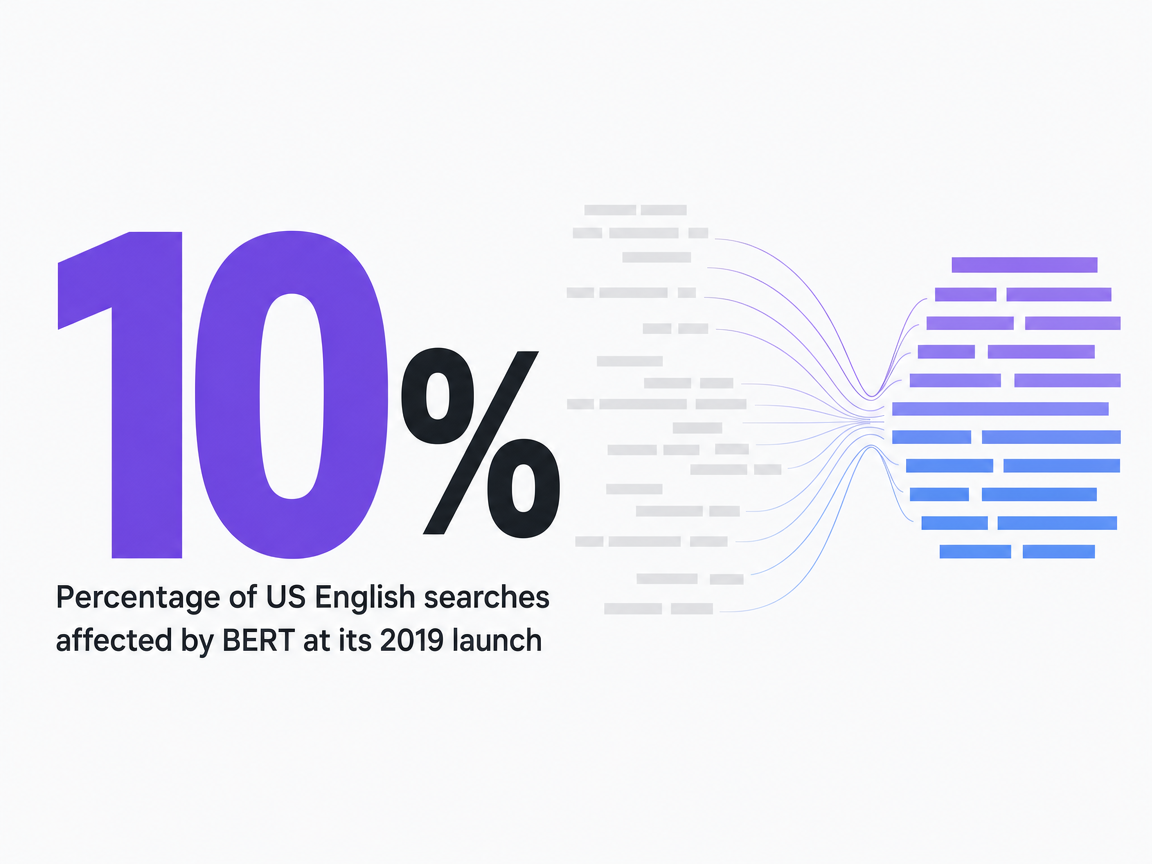 Percentage of US English searches affected by BERT at its 2019 launch
Percentage of US English searches affected by BERT at its 2019 launch
Test data-driven SEO execution in real time
Experience measurable SEO impact by publishing live content and tracking real keyword performance during your free trial.
The spam-policy risk of chasing a target percentage
A density target in a brief often leads writers to achieve the number through repetition rather than comprehensive topic coverage. Google's Spam Policies for Google Web Search explicitly describe keyword stuffing as manipulating rankings by filling a page with keywords or numbers, specifically highlighting repetition that "sounds unnatural" or appears "out of context" 1. The policy defines the violation in editorial terms, not as a numerical threshold that a QA tool could flag pre-publication.
The operational consequences are asymmetrical. A page that falls short of a density target typically ranks poorly due to issues like thin topical coverage or weak intent match, unrelated to the number itself. Conversely, a page that overshoots to meet a target risks triggering the spam policy, potentially leading to lower rankings or removal from results 1. There is no published safe harbor between these two outcomes.
This is not a new standard. Google's archived guidance from Matt Cutts, predating BERT, made the same point: excessive keyword density involves repeating a phrase so often that it annoys users. He advised publishers to prioritize user experience over chasing specific density values 6. While the vocabulary has evolved, the enforcement logic remains consistent.
For a Head of SEO standardizing briefs for junior writers and freelancers, the practical implication is to eliminate the percentage from the brief entirely. A target number incentivizes writers to hit it, and the most reliable way to achieve an inflated number is through behavior that the spam policy aims to prevent.
Replacing density in the brief: topical completeness and entity coverage
When a brief removes the density target, it must replace it with actionable instructions for writers. Topical completeness and entity coverage are two such instructions that are effective across junior staff, freelancers, and specialist writers. Both focus on what the page needs to contain, rather than how often a phrase should appear.
Topical completeness means the content addresses all questions a reader with the query might have, including implied follow-up questions. For a service page on "dental implant cost," this would include price ranges, factors influencing cost, financing options, insurance coverage, procedure stages, and recovery timelines. The SEO Starter Guide frames this as understanding user vocabulary, including differences between novice and expert language, and writing naturally to cover it 2. A brief can operationalize this by listing required sub-questions and sub-topics, derived from SERP analysis, People Also Ask sections, and client intake data (e.g., common sales team questions).
Entity coverage is the complementary instruction. It directs the writer to name specific people, places, products, procedures, conditions, standards, and brands expected in content on the subject. Entities provide neural matching and RankBrain with the concept-level signals they are designed to interpret, enabling Google to return relevant content "even if it doesn't contain all the exact words used in a search" 3. For example, a brief for a behavioral health intake page would specify therapy modalities, accreditations, insurance carriers, and clinician credentials. A home services page brief would list equipment, permit requirements, and service-area municipalities. The writer's goal becomes comprehensive entity coverage, not a specific count.
Practically, this translates to a brief with three fixed fields:
- Primary query and intent
- Required sub-topics
- Required entities
None of these fields demand a frequency. All three are defensible to clients questioning density reports, as each maps to documented Google systems rather than folk rules targeted by spam policies 1.
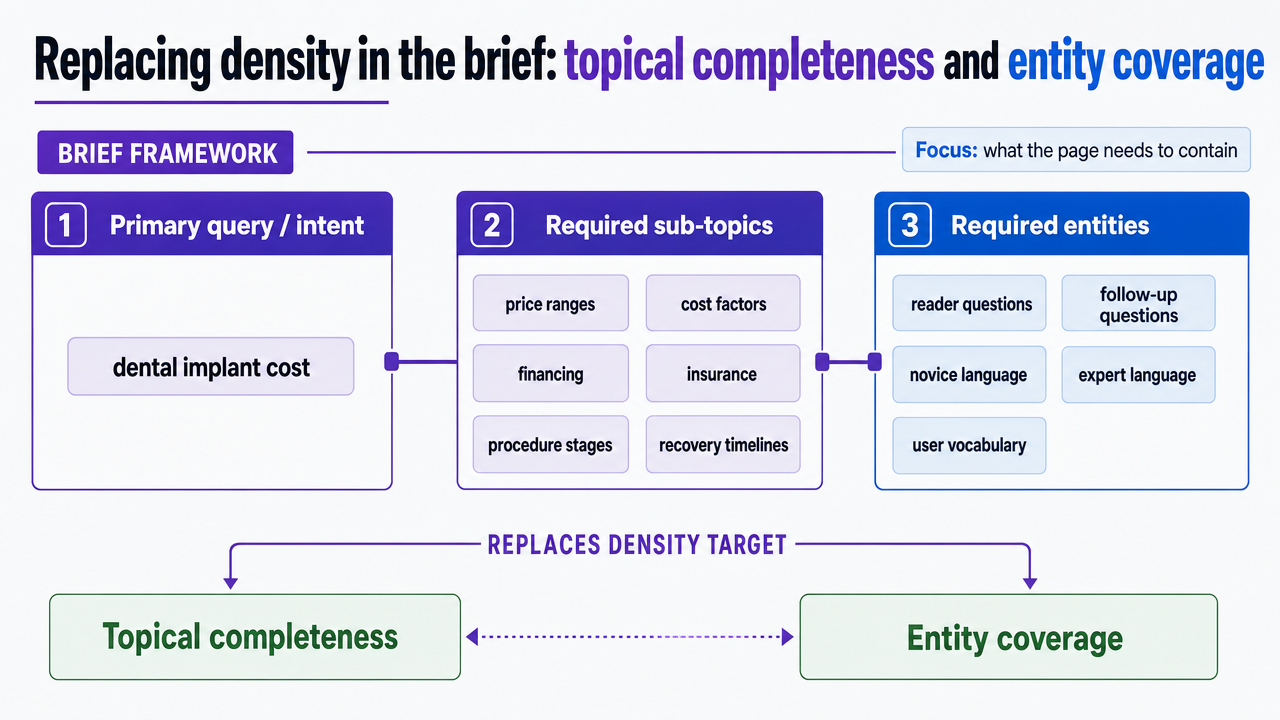 Visualize the three-field brief framework (primary query/intent, required sub-topics, required entities) that replaces density targets, directly supporting the section's operating model
Replacing density in QA: a comparison for operators running 20+ client sites
QA at an agency scale requires identifying issues quickly, ideally within ten minutes per URL, across dozens of pages weekly. A density-based checklist meets the speed requirement but fails on all other fronts. It flags whether a phrase appears frequently enough to seem optimized, which does not align with Google's ranking systems or its spam policy.
The following comparison contrasts density-based QA with topical-completeness QA across critical dimensions for a Head of SEO standardizing reviewer workflows for numerous client accounts.
| Dimension | Density-based QA | Topical-completeness QA ||---|---|---|| What gets measured | Keyword frequency as a percentage of total words | Coverage of required sub-topics, named entities, and query intent || Primary failure mode at scale | Writers hit the number through repetition, producing passages flagged by the spam policy for unnatural, out-of-context repetition 1 | Writers ship drafts that miss sub-topics, caught by a reviewer checking the brief's entity and sub-question list || Alignment with Google's ranking systems | Weak; neural matching, RankBrain, and passage ranking interpret concepts and relevant passages rather than exact-match counts 3 | Direct; the checklist asks whether the page supplies the concepts and passages those systems are built to surface 3 || Defensibility to a client | Low; no Google documentation names a target percentage, and the spam policy frames stuffing in editorial rather than numerical terms 1 | High; each checklist item maps to a documented system or to the Starter Guide's instruction to cover user vocabulary and write naturally 2 || Reviewer time per URL | Fast, but produces false confidence when the number looks clean on a thin page | Comparable once the brief carries the sub-topic and entity list; reviewer checks presence against the brief rather than reading cold || Scales across junior reviewers | Yes, but scales the wrong behavior | Yes, because the brief defines the pass criteria rather than relying on reviewer judgment |
The operational shift is to remove density from the pass/fail criteria, retaining it, if at all, as a descriptive readout to confirm the primary subject's presence. Pass/fail criteria should instead focus on sub-topic coverage, entity coverage, intent match for the primary query, and the absence of unnatural repetition as per the spam policy's editorial standard 1. Reviewers should fail a URL if a required entity is missing or a sub-question is unanswered, not if a percentage falls outside an arbitrary range Google does not endorse.
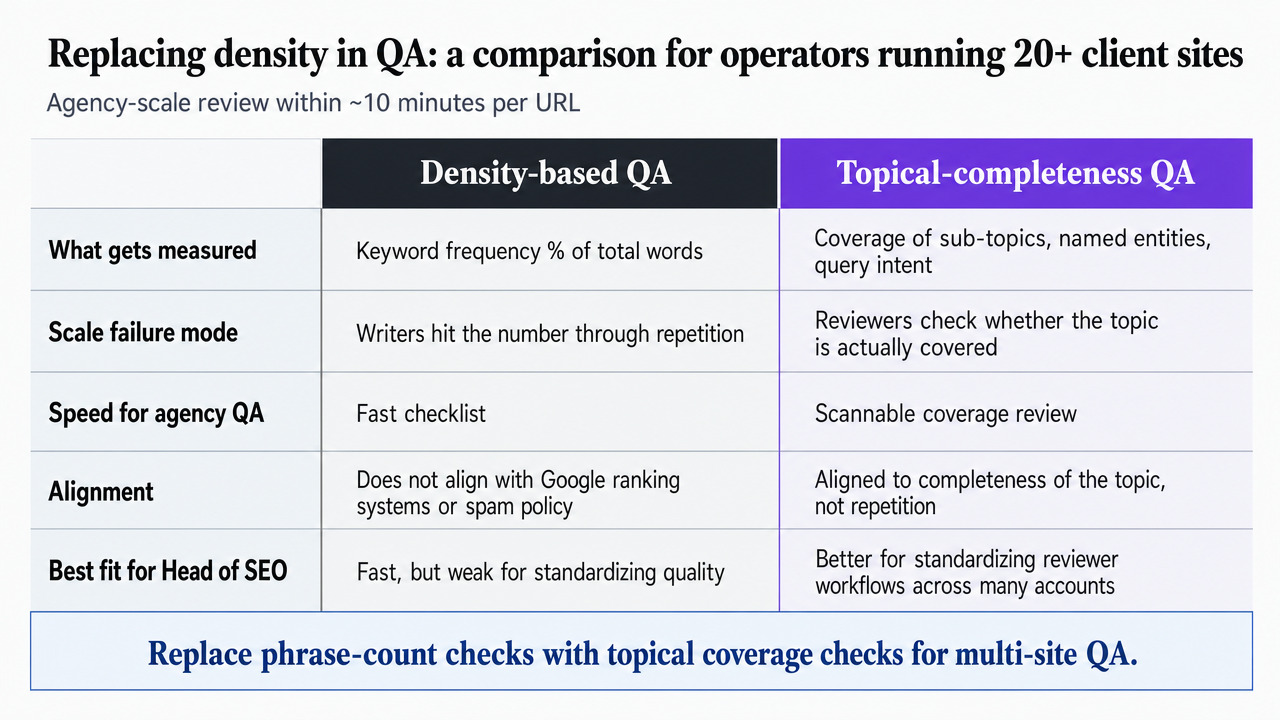 Convert the dense comparison table in this section into a scannable side-by-side comparison infographic contrasting density-based QA versus topical-completeness QA
Get Data-Driven Insights on Keyword Density Benchmarks Across Competitive SERPs
Request a personalized analysis of your site's keyword usage patterns versus industry leaders, complete with actionable recommendations to optimize content performance at scale—without adding manual review cycles.
Density and AI Overviews: what changes, what doesn't
Clients frequently ask if keyword density matters differently now that generative results appear above traditional search listings. Google's guidance indicates it does not. The AI Features and Your Website documentation states "no additional requirements" or special optimizations are needed for AI Overviews or AI Mode beyond foundational SEO practices. The operative list includes technical accessibility, indexability, textual content, internal links, page experience, and helpful, reliable, people-first content 4. Keyword frequency is notably absent from this list.
Google's May 2025 guidance for AI search reiterates this position, advising creators to focus on "unique, non-commodity content" that users find helpful and satisfying. It frames AI experiences as rooted in existing ranking and quality systems, not as a separate retrieval environment with distinct optimization rules 7. Since a density target was not a published Google ranking input before AI Overviews, the 2025 guidance does not introduce one.
What does change marginally is the premium on passage-level clarity. AI Overviews construct answers from passages surfaced by the ranking stack, utilizing the same neural matching, passage ranking, and RankBrain systems documented in the ranking systems guide 3. Pages that answer specific sub-questions in self-contained passages provide these systems with clear content to extract. Pages that obscure answers with repetition introduce noise.
For agencies updating briefs in response to client inquiries about AI results, the operational answer is precise. Maintain the sub-question and entity structure previously described, and strengthen the requirement that each sub-question is answered in a standalone passage. Do not add a density target for AI Overviews, as Google's documentation does not endorse one, and the spam policy governing stuffing applies equally to AI-era content 1.
The scaled-production trap when density targets get replaced with volume targets
When an agency removes density targets from briefs, the next pressure point often becomes output volume. Clients request more pages, service-area variants, and comparison posts, leading production teams to swap one countable target for another. This shifts the failure mode from stuffed paragraphs to a library of near-duplicate URLs that meet monthly quotas without offering new value.
Google's spam policy directly addresses this. The current Spam Policies for Google Web Search cover scaled content abuse, including large quantities of unoriginal pages created primarily to manipulate rankings. This standard applies regardless of whether the content was human-written, template-assembled, or AI-generated 1. The policy prioritizes whether the page offers something a reader wouldn't already find elsewhere, not the production method.
Google's guidance on AI-generated content reinforces this. A February 2023 post states that "the use of AI does not give your content any special gains. It's just content," emphasizing that systems reward originality, usefulness, and broader E-E-A-T signals over production speed 8. Volume is no more a ranking input than density was.
For a Head of SEO, the operational control is to apply the same topical-completeness and entity-coverage criteria to every new page before it enters the production queue. A page that cannot answer a distinct sub-question with a distinct entity set should not be commissioned. This rule ensures quality without reintroducing a numerical target that the spam policy was designed to counteract.
A diagnostic use for density that still earns its place
Density retains one legitimate role in an agency workflow: as a post-hoc diagnostic to confirm a draft's subject matter. A reviewer observing a density figure of 0.1% on a 1,200-word service page gains useful insight: the primary subject has nearly vanished from the copy. In this case, the number is diagnostic, not prescriptive. It flags a drift problem that the brief should have prevented.
This narrow use aligns with how exact-match frequency lost its primacy as a relevance proxy. Google's BERT launch announcement highlighted that the contextual language model would help Search interpret "the full context of a word by looking at the words that come before and after it," impacting approximately 1 in 10 English searches in the US at its 2019 rollout 9. This figure represents a launch-era snapshot, not a steady-state measure of today's engine. The relevant implication for a reviewer is directional: since the systems reading the page interpret passages, a density readout cannot tell a reviewer if the page answers the query, only if the subject is present at all.
The operational rule is to treat density as a flag, not a score. Reviewers should use it solely to identify drafts where the primary subject is missing. Pass/fail criteria should continue to be based on sub-topic coverage, entity presence, and intent match.
Frequently Asked Questions
References
- 1.Spam Policies for Google Web Search.
- 2.Search Engine Optimization (SEO) Starter Guide.
- 3.A Guide to Google Search Ranking Systems.
- 4.AI Features and Your Website.
- 5.Meta Tags and Attributes that Google Supports.
- 6.Webmaster-Videos mit Matt Cutts - jetzt auf deutsch.
- 7.Top ways to ensure your content performs well in Google’s AI experiences on Search.
- 8.Google Search’s guidance about AI-generated content.
- 9.Understanding searches better than ever before.
- 10.TERM-WEIGHTING APPROACHES IN AUTOMATIC TEXT RETRIEVAL.
- 11.End-to-End Query Term Weighting.