
Key Takeaways
- Volume-sorted gap lists produce noise; ranking competitor-owned queries by intent class, monetizable click surface, and authority fit turns discovery into revenue triage a CFO can audit.
- Task-related queries convert against most business models, while content, social, and aggregation queries rarely justify pipeline-scored production budgets and should be sequenced accordingly.
- AI Overviews cut organic click rates from roughly 15% to 8% on affected SERPs, so high-Overview queries should route to citation and AI Mode optimization rather than blue-link production 4.
- Reconcile competitor gap lists against Search Console API pulls and generative AI performance reports to score real opportunities, and present the portfolio to finance as click-equivalent forecasts with payback windows 8, 9.
Why most gap analyses surface noise instead of pipeline
A standard keyword gap report lists thousands of queries a competitor ranks for and the target domain does not. Sorted by search volume, the top of that list looks like opportunity. In practice, most of it is noise: informational queries that convert at near-zero rates, terms owned by domains with authority the target cannot match, and rankings that no longer produce clicks because an AI Overview satisfies the query on the results page itself.
The failure mode is treating gap analysis as discovery rather than triage. Volume-weighted lists ignore three variables that determine whether a ranking becomes revenue: what the searcher actually wants, whether a click still leaves the SERP, and whether the acquiring domain has the authority profile to hold the position once it earns it. Marketing science research on keyword selection has documented this for years, showing that popularity, competition, specificity, content relevance, and online authority jointly determine outcomes, not any single dimension 5.
The consequence for a VP defending an organic budget is direct. A gap portfolio ranked by volume produces a content plan that looks defensible on a slide and underperforms on pipeline. A gap portfolio ranked by intent class, monetizable click surface, and authority fit produces fewer targets, higher conversion density, and a forecast a CFO can audit. The rest of this article builds that second model.
Reframing gap analysis as revenue triage, not keyword discovery
Discovery is not the scarce input in modern SEO. Any competent crawler will produce a spreadsheet of ten thousand queries a competitor ranks for and the target domain does not. The scarce input is judgment about which of those queries can be converted into pipeline at a defensible cost per acquisition, and which should be removed from the list before a content team spends a dollar producing against them.
That reframing changes the unit of analysis. Instead of asking "which keywords are we missing," the operative question becomes "which competitor rankings represent a monetizable claim we can actually take." A monetizable claim requires three conditions to hold simultaneously:
- the query maps to an intent class that converts against the business model,
- a click still exits the SERP at meaningful frequency, and
- the acquiring domain has enough authority to hold the position long enough to earn back production cost.
Any query missing one of those conditions is noise, regardless of its monthly volume.
Google's own quality framework reinforces the point. Raters evaluate pages against both Page Quality and Needs Met, and single queries can carry multiple meanings that a single page cannot resolve 6. A gap list that ignores intent structure is a list of pages a team will produce and Google will not reward. Marketing science research documents the same principle from a different angle: keyword-level characteristics carry a stronger and statistically significant effect on organic outcomes than on paid, which means organic gap decisions deserve more granular scoring than SEM decisions typically receive 2. Triage, not discovery, is where the return sits.
The three quantitative filters that separate real gaps from vanity gaps
Filter one: intent class over search volume
Search volume is a scale variable. Intent class is a conversion variable. Ranking a gap portfolio by the first tells a team how large the potential audience is; ranking it by the second tells a team how much of that audience will do something the business can monetize. The two rankings rarely produce the same top ten.
Academic work on query classification distinguishes four broad intent buckets that behave differently downstream 10:
- content-related queries where the searcher wants to read or watch something,
- task-related queries where the searcher wants to do or buy something,
- social queries oriented toward community and reputation signals, and
- aggregation-based queries where the searcher wants a comparison or list.
Task-related queries convert against most service-business models. Content-related queries build authority and email capture but rarely close pipeline in a single session. Social and aggregation queries usually feed brand consideration, not direct acquisition.
A defensible gap analysis tags every competitor-owned query with one of those four labels before any volume weighting is applied. The tagging exercise routinely cuts a raw gap list by fifty to seventy percent, because most volume in most verticals concentrates in content-related queries that competitors rank for without converting either. Google's own quality framework reinforces the separation: raters assess Needs Met against the specific intent behind a query, and the same string of words can carry more than one meaning that a single page cannot resolve 6.
The operational rule is straightforward. Task-related gaps get scored first and produced first. Aggregation gaps get scored second when the domain can credibly host comparison content. Content-related gaps enter the queue only after the task-related backlog is funded. Social gaps rarely justify production spend against a pipeline metric and belong in a separate brand budget.
Filter two: monetizable click surface after AI Overviews
A ranking that no longer produces a click is not a gap worth closing. It is a citation opportunity at best and a production sinkhole at worst. The second filter discounts every remaining query by the probability that a click still exits the results page.
The most rigorous public measurement of that discount comes from Pew Research, which analyzed browsing data from 900 U.S. adults across 68,879 Google searches conducted in March 2025. On visits where an AI summary appeared at the top of the results, users clicked a traditional organic or paid result 8% of the time. On visits without an AI summary, that click rate was 15%. Links inside the AI summary itself were clicked in only 1% of visits 4. The scope matters: this is U.S. desktop and mobile Google behavior in a specific window, not a universal traffic constant, and the exact multiplier will vary by vertical, device mix, and query type.
Even with that caveat, the directional implication is severe. A query with 10,000 monthly searches and consistent AI Overview presence carries roughly the click potential of a query with 5,300 searches and no AI Overview. Two gaps that look equivalent on a volume-sorted spreadsheet are not equivalent in pipeline terms once the SERP composition is factored in.
Applying the filter requires classifying each gap query by AI Overview presence and stability. Overview presence is not binary; it fluctuates by query wording, location, and account signals, and it changes as Google iterates on triggering logic. The workable approach is to sample each candidate cluster over a fourteen to twenty-eight day window, record the percentage of samples where an Overview appeared, and apply that percentage as a click discount against the volume input. Queries with Overview presence above roughly sixty percent get flagged for a different treatment path: optimized for citation inside the Overview and for AI Mode visibility rather than for classic blue-link click capture. The Pew work on broader search behavior in AI-mediated interfaces supports the same shift, showing that verification and follow-up queries increasingly attach to AI-generated results 11.
Filter three: authority fit between the gap and the acquiring domain
The third filter asks a question most gap analyses skip: can the acquiring domain actually hold this ranking once it earns it, and hold it long enough for the page to pay back production cost? Authority fit answers that question by matching query characteristics to the domain's competitive position rather than treating every gap as equally addressable.
Marketing science research on keyword selection has documented a specific asymmetry: high-authority sites benefit more from broader, higher-competition keywords, while low-authority sites benefit more from specific, narrower keywords 5. The same paper notes that firms often rely on crude heuristics such as minimum traffic thresholds and competitor counts, which ignore the interaction between domain authority and query breadth. A low-authority domain chasing a broad head term inherited from a competitor's gap list is committing production capital to a page that will land on page three and stay there.
The operational translation is a query-breadth score paired with a domain-authority score. Broad, high-competition queries route to the domains with the topical authority and link profile to compete for them. Specific, mid-tail and long-tail queries route to domains that need to build coverage before broader terms become defensible. This is not a permanent assignment; as authority grows, the addressable band widens, and the gap portfolio should be re-scored quarterly.
Google's SEO baseline reinforces the same discipline from the content side. Pages produced against gap targets have to be helpful, unique, up-to-date, and people-first to earn and hold position 3. Authority fit is what determines whether that production standard is enough to win the ranking; content quality is what determines whether the ranking is worth defending once it lands.
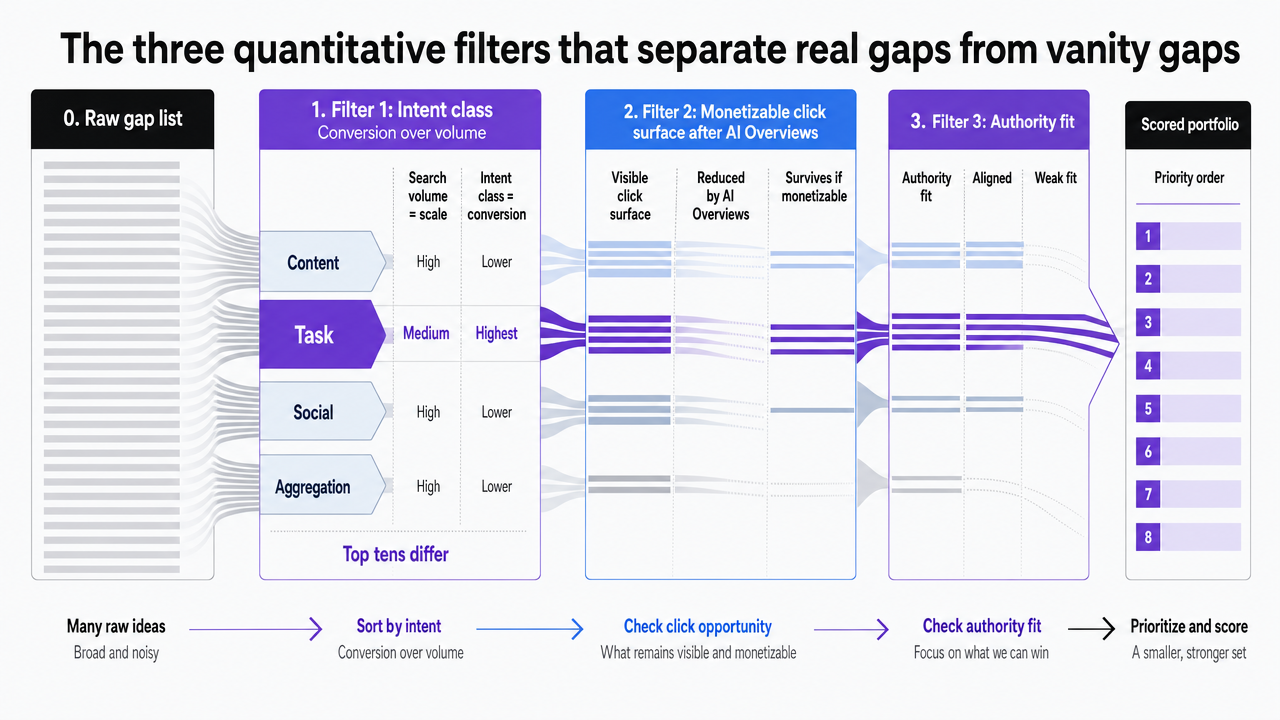 Visualize the three sequential filters (intent class, monetizable click surface after AI Overviews, authority fit) that the section defines as the scoring framework, showing how a raw gap list narrows into a scored portfolio
Close Keyword Gaps With Live Content Execution
Benchmark and publish content to outperform competitors' keyword portfolios in your first week—no delays or barriers.
Scoring the portfolio: turning three filters into a defensible priority score
The three filters produce a portfolio, not a ranking. Turning that portfolio into a defensible investment plan requires a composite score a CFO can audit. The workable formula multiplies four inputs per query:
- raw monthly volume,
- an intent-class weight,
- a click-surface coefficient, and
- an authority-fit coefficient.
The output is a priority score in click-equivalent units, which maps cleanly to a production cost per expected click and, downstream, to a cost per acquisition once conversion rates are attached.
Intent-class weights sit between zero and one. Task-related queries carry the highest weight because they convert against service-business models most directly. Aggregation queries carry a mid-range weight, content-related queries a lower weight, and social queries a near-zero weight for pipeline-scored budgets. Click-surface coefficients derive from the sampled AI Overview presence rate: a query with sixty percent Overview presence loses roughly forty percent of its click potential before any further discount. Authority-fit coefficients penalize broad head terms on low-authority domains and specific long-tail terms on high-authority domains, matching the asymmetry documented in the marketing science literature 5.
The counterweight a VP will face from a CFO is that paid search often shows better per-conversion economics in head-to-head measurement. The Ghose and Yang study of a single retailer's search behavior reported mean click-through rates of 6.6% for paid and 2.77% for organic, with mean profit per paid search 3.1 times higher than per organic listing 1. That result is a single-firm context, not a universal constant, and the same authors' companion work found that keyword-level characteristics carry a stronger effect on organic conversion, order value, and profit than on paid 2. The reconciliation is straightforward: paid search buys immediate slots at a variable cost that recurs on every click, while a captured organic gap produces clicks at a fixed production cost amortized across months or years of ranking. The composite score answers the CFO's real question, which is not whether organic outperforms paid on a per-click basis but which specific gaps produce enough click-equivalent value to earn back production cost inside a defensible payback window.
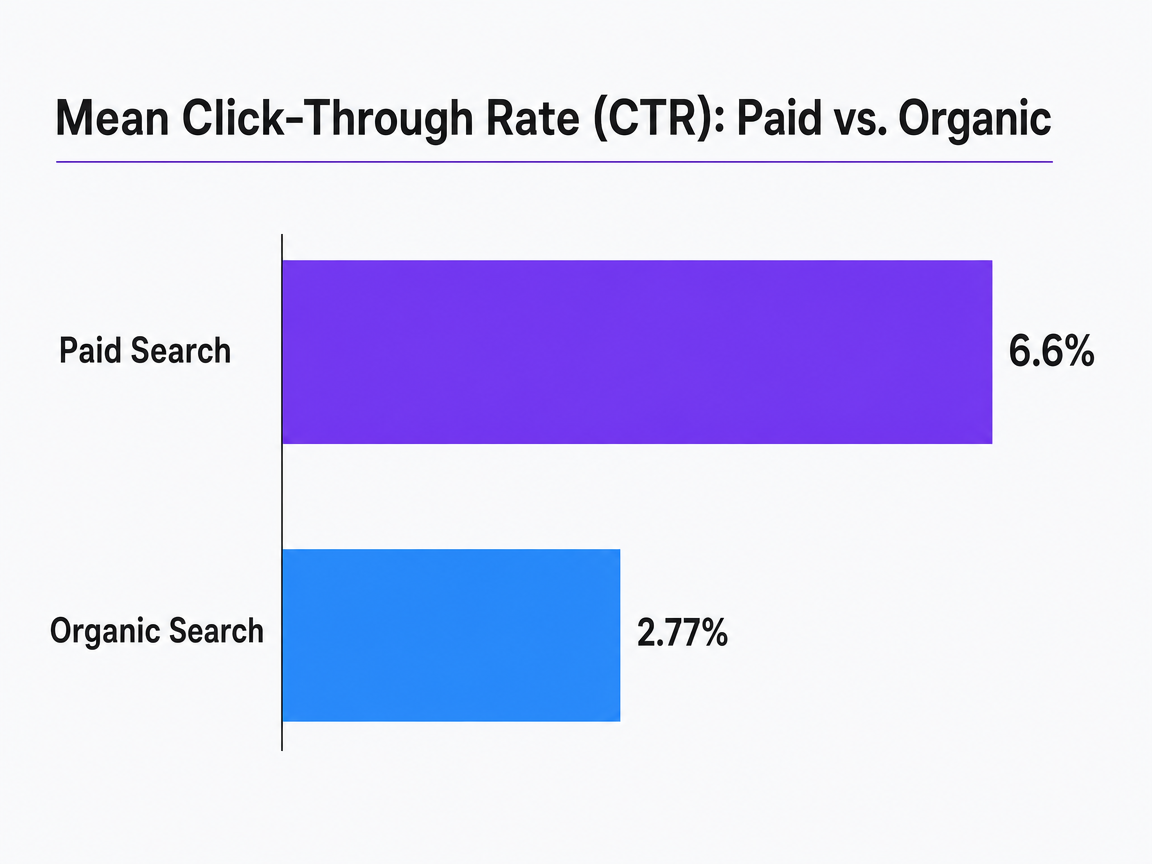 Mean Click-Through Rate (CTR): Paid vs. Organic
Compares the mean CTR for paid and organic search listings from an academic study. Useful for a bar chart.
Instrumenting the workflow inside Search Console and the API
Third-party crawlers surface competitor rankings, but the ground truth for a target domain's own position lives in Search Console. That data is what a defensible gap workflow reconciles against, because it is the only source that reports actual impressions, clicks, and average position for queries the domain already ranks on. Any gap portfolio built without it is scoring competitors' positions against an unverified picture of the target's own footprint.
The Search Console Insights report added in June 2025 exposes top and trending queries directly, and Google explicitly flags trending-up queries as a source of new content ideas 7. For a mid-sized domain that view is often enough to catch emerging demand before a monthly crawler refresh detects it. What Insights does not do is scale. Manual export caps, sixteen-month history windows, and the row-limit ceiling on aggregated queries all bite once a portfolio crosses a few thousand ranking terms.
The Search Console API removes those constraints. The Search Analytics endpoint exposes the same query, page, device, and country dimensions available in the Performance report, but returns them programmatically for pipeline ingestion 8. A workable instrumentation pattern pulls daily query-level data into a warehouse, joins it against the third-party gap list on the query string, and flags competitor-owned terms where the target domain already earns impressions but no clicks. Those are the highest-yield gaps in most portfolios: intent is proven, indexation exists, and the remaining work is position improvement rather than net-new content production.
Tracking visibility in AI Overviews and AI Mode
A gap portfolio scored only against classic blue-link rankings misses the fastest-changing surface in search. Google's generative AI performance reports, announced in June 2026 and rolled out to a subset of properties for testing, now expose impressions, pages, countries, devices, and dates for URLs appearing in AI Overviews and AI Mode 9. That instrumentation closes a measurement gap that previously forced teams to infer AI-surface visibility from third-party scraping.
The operational use is specific. Queries flagged in filter two as high-Overview-presence should be paired with their AI-surface impression data before any production decision. A query where the target domain already earns AI Overview impressions but no traditional clicks is a citation position worth defending through structured content, entity clarity, and factual density. A query where a competitor's URL appears inside the Overview and the target's does not is a different kind of gap: the ranking exists conceptually, but the acquiring domain is absent from the surface that satisfies the intent. Both cases route to different production briefs than a standard organic gap, and both belong in a separate line of the portfolio score. Pew's broader work on AI-mediated search shows users increasingly verify information after an AI answer appears, which means citation visibility inside these surfaces carries downstream click value that a first-touch attribution model will undercount 11.
Pinpoint Untapped Revenue by Closing Your Keyword Gaps
Request a strategic audit that quantifies lost pipeline from keyword gaps, benchmarks your share of voice, and outlines actionable opportunities to capture competitor-owned demand.
If you manage multiple locations: consolidating gap analysis across a portfolio
Why per-location gap workflows break at scale
The audience shifts here. Everything above assumes a single domain or a tightly scoped subdomain set. Multi-location operators, whether a dental support organization with sixty practices, a home services franchise with two hundred territories, or a senior living portfolio with fifty communities, face a different math problem: gap analysis has to reconcile against N localized SERPs simultaneously, and the query set at each location overlaps only partially with the corporate footprint.
Running per-location workflows manually collapses on three fronts:
- Query volume multiplies: a two-hundred-location operator scoring a thousand candidate gaps per market is grading two hundred thousand query-location pairs each cycle, and most third-party crawlers price aggressively above single-domain seat tiers.
- Data reconciliation multiplies with it, because the Search Console property structure that works cleanly for one domain fragments into dozens of location subfolders or subdomains that each require separate API pulls and query joins 8.
- Prioritization judgment does not scale linearly at all: a corporate analyst who can defend a hundred-query portfolio for one market cannot defend twenty thousand queries across two hundred markets without either delegating decisions to junior staff or reducing every scoring dimension to volume.
The workable answer is centralized scoring against localized data, not localized scoring against local judgment.
Cost structure comparison: agency retainers, in-house analyst, platform-based execution
Three execution models compete for the multi-location gap-analysis budget. Each carries a different cost curve as location count grows, and each shifts where marginal analyst hours actually go.
Per-location agency retainers scale linearly with N. Each market gets a dedicated account team that pulls its own Search Console data, runs its own crawler exports, and produces its own gap portfolio. The model preserves local nuance but multiplies coordination overhead, and cross-market pattern recognition (for example, the same task-related gap appearing in eighty percent of markets) usually gets lost between account teams. A centralized in-house analyst inverts that trade-off: one FTE, or a small team, running a unified scoring model against consolidated Search Console API pulls 8. Cost stays roughly flat as locations are added, but analyst capacity becomes the ceiling once query-location pairs cross a threshold that varies by vertical and portfolio complexity. Platform-based execution with human approval sits between the two: automated ingestion, scoring, and production drafts routed through a single approval queue, with analyst hours redirected from data plumbing to judgment calls on the ranked output.
| Model | Cost curve as N grows | Analyst hours consumed by | Cross-market pattern capture |
|---|---|---|---|
| Per-location agency retainer | Linear with N | Vendor coordination, briefs | Weak; siloed by account team |
| Centralized in-house analyst | Flat until capacity ceiling | Data pulls, reconciliation, scoring | Strong on scoring, weak on production throughput |
| Platform-based execution with approval | Sub-linear with N | Approval decisions on ranked output | Strong; unified scoring model |
The defensible framing for a CFO is not price per location. It is query-coverage breadth per analyst hour, held against the intent-weighted priority score from section four. Whichever model produces the most scored, approved, and produced task-related gap coverage per FTE hour wins the allocation, regardless of headline retainer cost.
Presenting the gap portfolio to a CFO
A CFO does not fund a keyword list. A CFO funds a portfolio with a payback window, a defensible discount rate, and a set of assumptions that survive audit. The final deliverable of a gap analysis is not the spreadsheet of scored queries; it is a one-page investment case that translates those scores into click-equivalent forecasts, production cost per gap cluster, and expected pipeline contribution across a twelve to eighteen month horizon.
Three inputs carry the weight in that conversation. The intent-class weight and click-surface coefficient developed earlier convert raw volume into an expected click forecast that already discounts AI Overview cannibalization 4. The authority-fit coefficient sets a realistic ranking probability rather than assuming every scored gap lands on page one 5. Production cost per cluster, held against the target's own conversion rate to opportunity from Search Console query data, produces a cost per expected pipeline dollar that maps to the same P&L math a CFO already uses for paid channels 8.
The framing that lands is portfolio, not project. A gap portfolio behaves like a book of positions: some clusters compound quarterly, others amortize over years, and a defensible allocation funds task-related gaps first, aggregation gaps second, and content-related gaps only against a documented authority-building thesis. That is the case Vectoron was built to run end to end.
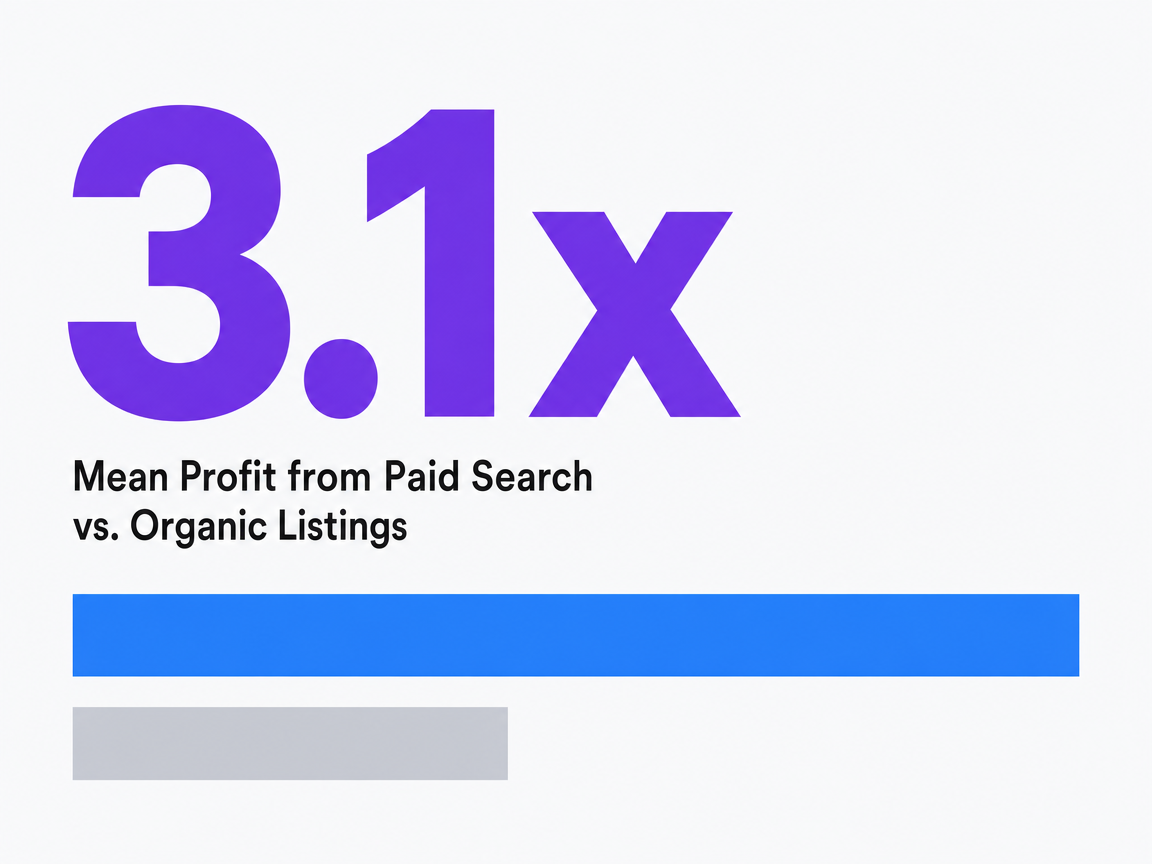 Mean Profit from Paid Search vs. Organic Listings
Mean Profit from Paid Search vs. Organic Listings
Frequently Asked Questions
References
- 1.Analyzing the Relationship Between Organic and Sponsored Search Advertising.
- 2.Comparing Performance Metrics in Organic Search with Sponsored Search Advertising.
- 3.Search Engine Optimization (SEO) Starter Guide.
- 4.Google users are less likely to click on links when an AI summary appears in the results.
- 5.Keyword Selection Strategies in Search Engine Optimization: How Relevant Is Relevance?.
- 6.Search Quality Rater Guidelines: An Overview.
- 7.The new Search Console Insights report is here.
- 8.Query your Google Search analytics data | Search Console API.
- 9.Introducing Search Generative AI performance reports in Search Console.
- 10.Can We Predict User Intents from Queries?.
- 11.The State of Online Search in the Age of AI.