
Key Takeaways
- Tag every gap as awareness, consideration, or capture before ranking, because forcing different demand types into one template loses both rankings and pipeline 7, 8.
- Sort the roadmap by expected pipeline contribution per page rather than search volume, since a channel with 51% of traffic but 41% of MQLs shows intent-matching decides outcomes 16.
- Design each page around the searcher's true job and attach a demand-appropriate conversion event mapped to a CRM field, or the page ships as a publishing artifact 13, 1.
- Lock a four-metric KPI contract before production: sourced pipeline, influenced pipeline, organic SQL contribution rate, and organic CAC payback, reported from the CRM under two attribution models 19, 10.
Why Keyword Gaps Stall Before They Reach Revenue
Most keyword gap analyses die inside a spreadsheet. A competitive scan surfaces a few hundred missing terms, the list gets sorted by volume and difficulty, a handful of briefs enter production, and six months later nobody can point to the pipeline the exercise created. The discovery step is not the problem. The problem is that the output was never designed to survive a CRM query or a finance review.
The economic stakes are large enough that the disconnect shows up on the P&L. Organic search drove a median 27% of sourced pipeline among B2B SaaS companies in 2024, according to a Starr Conspiracy benchmark built on HubSpot's State of Marketing 2024 survey of 1,200 B2B marketers 14. A separate 2024 Starr Conspiracy campaign benchmark puts organic search at 51% of B2B website traffic and 41% of marketing-qualified leads 16. When a channel of that weight is managed as a list of missing terms rather than a pipeline lever, the miss is not a rounding error.
The stall has a consistent shape. Gaps get treated as uniform capture-intent opportunities, so awareness and consideration queries are either ignored or forced into product pages that never rank. Prioritization defaults to search volume, which correlates weakly with deal value. Pages ship without a defined conversion event, so Search Console reports impressions while Salesforce reports nothing. And the KPI conversation stays at sessions and rankings, which finance treats as vanity.
The teams converting gap analysis into attributable pipeline run a different workflow. They classify each gap by demand type, prioritize by expected pipeline contribution, produce pages that match the query's actual purpose, and measure results against a fixed KPI contract that separates organic-sourced from organic-influenced pipeline. The rest of this guide walks through those four decisions in order.
The Four-Decision Workflow That Ties Gaps to Pipeline
Classify Demand Before Prioritizing Terms
Every gap list contains three different jobs pretending to be one. Some queries reflect buyers who do not yet know a category exists. Others come from evaluators building a shortlist. A smaller set comes from buyers ready to compare vendors and price. Treating those as a single pool distorts every downstream decision, from brief length to conversion event to what counts as a win.
Forrester's demand spectrum sorts these situations into distinct marketing approaches rather than a single funnel 7. The related demand-type work names three core B2B demand types and the tactics each requires 8. Applied to a keyword gap list, the exercise is mechanical: tag each missing term as awareness, consideration, or capture, and note what the buyer is actually trying to accomplish at that moment. A term like "how to reduce SDR ramp time" is not the same asset as "outbound sequencing software pricing," and forcing both into a product page loses both.
Skipping the awareness and consideration tiers is the more common failure. Gartner's 2026 research, based on a survey of 645 B2B buyers fielded in August and September 2025, found that buyers used an average of seven information sources during their purchase, 45% used generative AI as part of that research, and 69% still turned to sales reps to validate AI-generated insights 6. Seven sources means the vendor that only shows up at the pricing page has already been narrowed out by the time capture-intent queries fire. Coverage at the earlier tiers is what puts a brand into that reference set.
The output of this decision is a tagged gap list, not a ranked one. Ranking comes next, and the demand-type tag is what makes the ranking honest. A high-volume awareness term with no plausible path to opportunity should compete against other awareness terms, not against a capture-intent query with a smaller audience and a much shorter distance to pipeline.
Prioritize by Pipeline Math, Not Volume
Volume-first prioritization treats a 12,000-search awareness query as automatically better than a 300-search capture query. Pipeline math often reverses that ordering. The right sort key is expected pipeline contribution per page, calculated with the variables the team already has: monthly search volume, a realistic click-through assumption for the ranking position the page can plausibly reach, an on-page conversion rate to a defined next step, and the historical rate at which that next step becomes an opportunity and then a closed deal.
The Cometly keyword workflow describes the connective tissue: link the analytics platform to the CRM, extract competitor keyword portfolios, cross-reference gaps, filter by volume and difficulty, and then prioritize by business relevance rather than volume alone 15. Business relevance is the phrase that does the work. For a term to earn a slot on the roadmap, the team should be able to state, in one sentence, which pipeline stage it feeds and roughly how much revenue a mid-ranking outcome would generate.
Two ratios anchor the calculation without inventing numbers. Organic search contributes a reported 51% of B2B website traffic and 41% of marketing-qualified leads in the Starr Conspiracy 2024 campaign ROI benchmark 16. The gap between those two figures is instructive: organic pulls more traffic than it pulls qualified leads, which means intent-matching and page quality are where prioritization decisions get lost. A gap that will produce sessions but not MQLs is not a priority; a smaller gap that produces MQLs at a higher rate is.
The practical output of this step is a scored gap list where each row carries the demand-type tag from the previous decision, a projected pipeline range, and the conversion event the page will be measured against. Anything that cannot carry all three fields drops off the roadmap. That is the discipline that separates a keyword plan from a content backlog.
Produce Pages That Match True Query Purpose
A page that matches the query in title but not in purpose will underperform on both rankings and pipeline. Google's Search Quality Rater Guidelines instruct raters to assess the true purpose of the page before rating anything else and to rate deceptive or purpose-mismatched pages lowest 13. That framing translates directly to production: before writing, the team names the specific job the searcher is trying to complete, then designs the page around completing it.
For an awareness query, that job might be understanding whether a category applies to the reader's situation. For a consideration query, it might be comparing two approaches with enough specificity to eliminate one. For a capture query, it might be verifying that a vendor handles a particular integration, contract term, or vertical. Each of those pages has a different structure, a different depth, and a different conversion event. Forcing them into a shared template is what produces the traffic-without-MQLs pattern in the previous step.
Google's SEO Starter Guide reinforces the same point in production terms: the guidance is to build helpful, people-first content that search engines can understand, with titles, snippets, and structure that reflect what the page actually does 1. That is a specification, not a style note. A comparison page needs a comparison table. A pricing-adjacent page needs pricing signals or a defensible reason they are absent. A definitional awareness page needs a clear definition in the first block, not a 400-word runway.
The measurable output of this decision is a per-page conversion event tied to the demand tag: a newsletter or resource download for awareness, a solution guide or assessment for consideration, and a demo or pricing request for capture. Each event should map to a CRM field that will later carry the attribution weight. Without that mapping, the page is a publishing artifact, not a pipeline asset.
Measure With a KPI Contract, Not a Traffic Dashboard
The last decision is the one most gap programs never make explicit: what four numbers will this program be judged on, and where do they live. The Starr Conspiracy's SEO ROI measurement procedures prescribe a tight KPI set: organic-sourced pipeline dollars, organic-influenced pipeline dollars, organic SQL contribution rate, and organic CAC payback period 19. Four metrics, reported on a fixed cadence, with the CRM as the source of record rather than the analytics platform.
The mechanics behind those numbers are not exotic, but they require a decision before the first page ships. Google's Attribution Playbook recommends comparing attribution models, reviewing multi-channel funnel paths, and acting when a keyword or page receives more credit under a non-last-click model than under last-click 10. The companion data-driven attribution guide argues that channel-only thinking misses business impact and that top-performing organizations tend to use advanced attribution rather than defaulting to last-touch 9. In practice, the gap program should be reported under two models side by side: last-touch for sourced pipeline, and a multi-touch or data-driven model for influenced pipeline. Both numbers matter, and reporting only one is what triggers the CFO objection.
The IAB's guide to marketing mix modeling and multi-touch attribution adds the higher-altitude check. MMM is defined as a statistical analysis of aggregate sales, marketing, and business-driver data that can feed MTA with control variables for factors outside the addressable data set 12. For most in-house teams, MMM is not a monthly report; it is a semi-annual validation that the attributed pipeline numbers align with what a top-down model produces. When the two views disagree, the gap program's credibility is what gets protected by having both.
The output of this decision is a one-page KPI contract, signed off before production begins, that defines the four metrics, their CRM sources, the attribution models in use, and the reporting cadence. Every page produced under the program inherits that contract.
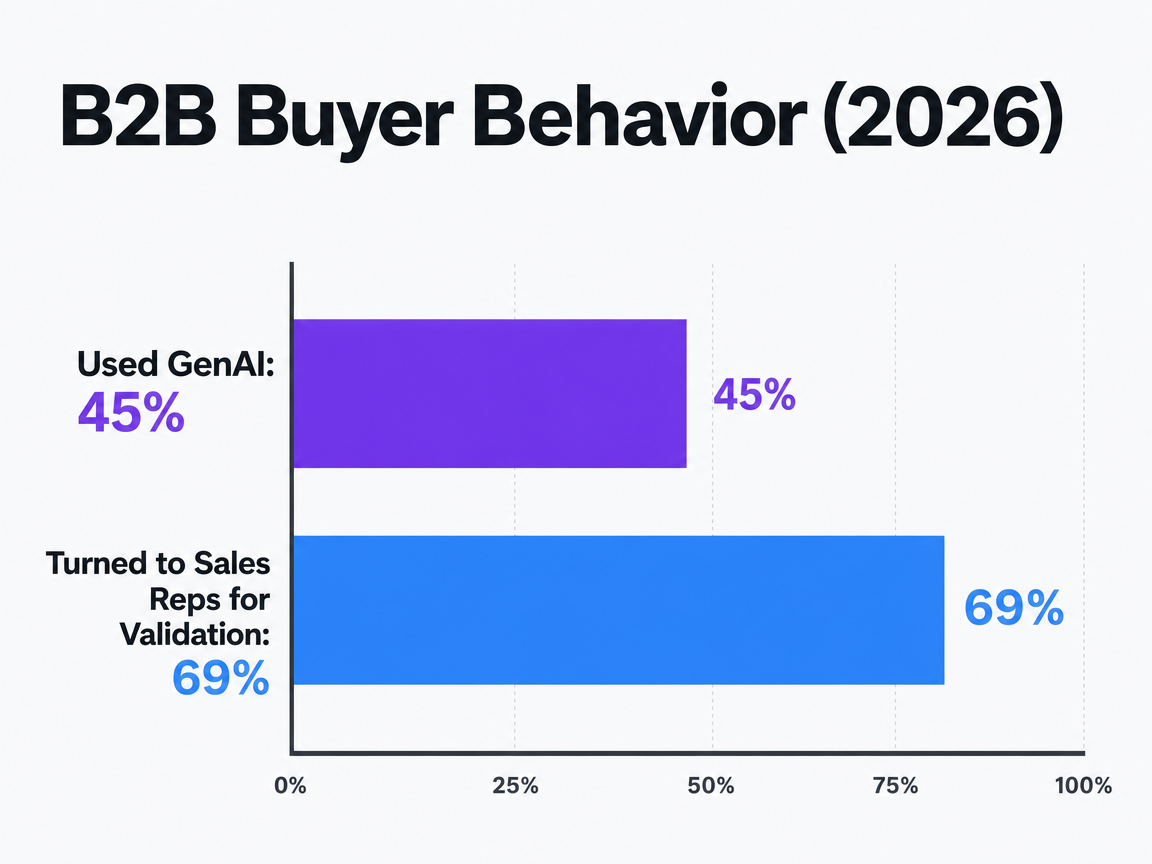
Gartner's 2026 research shows B2B buyers use a mix of digital tools (GenAI) and human interaction (sales reps) during their purchase process.
Identify and Close Critical Keyword Gaps Now
Test-drive real-time keyword gap analysis and publish content that targets missed pipeline opportunities immediately.
Sourced vs. Influenced Pipeline: The Definitions That Survive a CFO Review
The single sentence that determines whether a keyword gap program keeps its budget is the one that defines what counts as pipeline. Sourced pipeline is the deal where marketing created the initial lead through a direct activity: the first-touch record on the opportunity points to an organic session on a page the program produced 17. Influenced pipeline is broader. It includes any deal where an organic touch appears anywhere in the opportunity's touch history, regardless of what created the lead. The two numbers answer different questions, and reporting one without the other is what invites the CFO's red pen.
The mapping to CRM is where most programs quietly fail. Sourced pipeline needs a first-touch campaign field on the lead or contact that survives conversion to opportunity, populated from the UTM or landing page that produced the form fill. Influenced pipeline needs a multi-touch campaign influence object on the opportunity itself, populated from every organic session tied to a known contact on the account. Salesforce's Campaign Influence object handles the second job; the first requires a custom first-touch field because standard lead source fields overwrite too easily.
Attribution model choice is what makes the two numbers defensible. Report sourced pipeline under a last-non-direct or first-touch model, and report influenced pipeline under a data-driven or position-based model, in line with Google's guidance to compare models and act when a keyword receives more credit under a non-last-click view 10. When the two figures diverge sharply, the divergence is the finding: it usually means the program is producing consideration-stage assets that assist deals without originating them, which is a case for keeping the budget, not cutting it.
The Execution Bottleneck: Why Discovery Outruns Delivery
Gap discovery is cheap. Delivery is where programs die. A modern SEO tool can produce a competitive gap list in an afternoon, but the pages that would close those gaps sit in a brief queue for weeks and ship without the CRM plumbing that would make them measurable. The constraint is not creativity or research budget. It is throughput and attribution.
The Content Marketing Institute's 2025 B2B survey, based on 1,062 respondents, quantifies the squeeze: 58% of B2B marketers called their strategy only moderately effective, 54% cited a lack of resources, and 56% said they struggle to attribute ROI to content efforts 4. The 2026 follow-up shows the outcome ceiling those constraints produce: 63% of marketers said content helped generate demand or leads, but only 49% said it helped generate sales or revenue 5. The fourteen-point gap between demand and revenue is the execution bottleneck showing up in the P&L. Pages get published, leads get generated, and the connection to closed-won never gets built.
Two operational moves compress that gap. The first is separating discovery cadence from production cadence. A weekly gap review that adds twenty terms to a backlog no one can staff is a morale problem, not a strategy. Cap the active roadmap at what production can ship with the KPI contract intact, and let the rest of the gap list wait. The second is treating the CRM integration as a launch requirement, not a follow-up project. If a page ships without a first-touch field, a campaign influence record, and a defined conversion event, it counts as a draft, not a release.
Governed AI-assisted production is the honest response to the resource constraint. It does not remove the judgment calls, it removes the wait states between them.
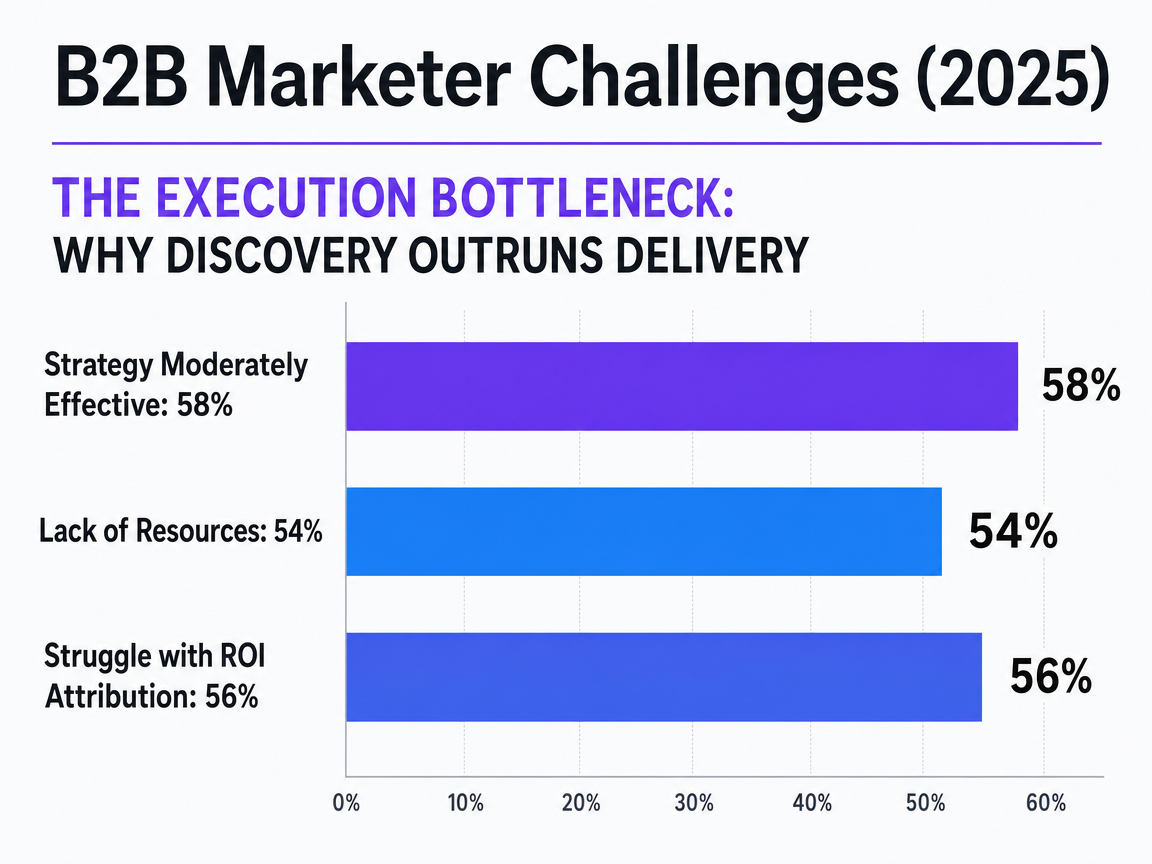 B2B Marketer Challenges (2025)
From CMI's 2025 B2B survey, this shows key challenges marketers face, including strategy effectiveness, resource constraints, and measuring ROI.
See How Leading Teams Turn Keyword Gaps Into Predictable Pipeline
Request a walkthrough of actionable workflows that connect gap analysis to bottom-line metrics—purpose-built for agencies and enterprise brands seeking scalable, multi-channel execution without extra headcount.
If You Manage Multiple Locations: Compounding Gap Economics Across a Portfolio
The next few paragraphs shift audience. Single-brand VPs can skip to the governance section; the math below is aimed at operators running keyword programs across a portfolio of locations: dental DSOs, home services franchises, senior living groups, and multi-office professional services firms.
A keyword gap program compounds unusually well across a portfolio because the discovery and page architecture work is largely fixed, while the pipeline output scales with location count. One well-structured comparison page or service-area template, once it ranks, reproduces across every location that inherits it. That is why the organic-led rebalance now underway in B2B SaaS pipeline strategy, which frames organic search and content as a durable substitute for paid acquisition rather than a supplement to it 18, reads even stronger for portfolio operators than for single-brand teams.
The economics can be expressed as a formula that operators plug their own inputs into, without inventing dollar figures:
Portfolio Pipeline Impact = Locations × Monthly Organic Sessions per Location × Session-to-MQL Rate × MQL-to-Opportunity Rate × Average Deal Size × Organic Sourced Share
| Variable | Source or Input | Notes |
|---|---|---|
| Locations | Operator input | Count only locations that inherit the shared page architecture. |
| Monthly Organic Sessions per Location | GA4, per-location view | Use trailing 90-day median, not peak. |
| Session-to-MQL Rate | CRM, per-location | Applied to organic sessions only. |
| MQL-to-Opportunity Rate | CRM historical | Segment by demand type where possible. |
| Average Deal Size | Finance | Use closed-won median, not list price. |
| Organic Sourced Share | Benchmark: 27% median for B2B SaaS 14; 41% of MQLs from organic search 16 | Adjust downward for verticals with heavier referral or paid mix. |
Two ratios anchor the sanity check. Organic search drives 41% of MQLs in the 2024 B2B campaign benchmark 16, and organic-sourced pipeline runs at a median 27% share among B2B SaaS operators 14. For portfolio operators outside SaaS, those figures are directional, not prescriptive; the point is that a single ranked page multiplies by the number of locations feeding from it, which is why one hour of gap-classification work at the portfolio level tends to outperform the same hour spent on any single location.
The governance implication is that the gap roadmap belongs at the portfolio level, and the CRM plumbing described earlier has to carry a location dimension on every organic touch. Without that field, the formula produces a portfolio number that no regional operator can defend inside their own P&L.
A Governance Model for Continuous Gap-to-Pipeline Conversion
Gap programs decay without governance. New competitors publish, SERPs reshuffle, buyer language shifts, and the roadmap that produced results in Q1 no longer matches the queries buyers are running in Q3. The teams that hold pipeline contribution steady treat governance as a scheduled loop rather than a project that ends when the first batch of pages ships.
Three cadences carry the load. A weekly discovery review uses Search Console Insights to surface trending pages and queries, which Google positions as a source for new content ideas and refresh candidates 3, paired with Google Trends checks on rising interest for terms already on the roadmap 2. A monthly production review closes out pages against their KPI contract: sourced pipeline, influenced pipeline, organic SQL contribution rate, and organic CAC payback, reported from the CRM rather than the analytics tool 19. A quarterly strategic review compares attribution model outputs against a higher-altitude view, using marketing mix modeling as the validation layer that Google's CMO handbook describes for KPI-level questions 11.
Two governance rules keep the loop honest. First, no page enters production without a named owner, a demand-type tag, and a conversion event mapped to a CRM field. Second, any page that has been live for two full quarters without contributing to sourced or influenced pipeline gets reviewed for intent mismatch, decommissioning, or a rewrite against a different demand type. The organic-led rebalance now reshaping B2B SaaS pipeline strategy 18 rewards programs that retire assets as deliberately as they publish them.
Governed AI-assisted execution is what makes this cadence survivable on a lean team. Platforms like Vectoron structure the discovery, prioritization, production, and measurement loop around human approval at each decision point, which is the operating model this workflow requires.
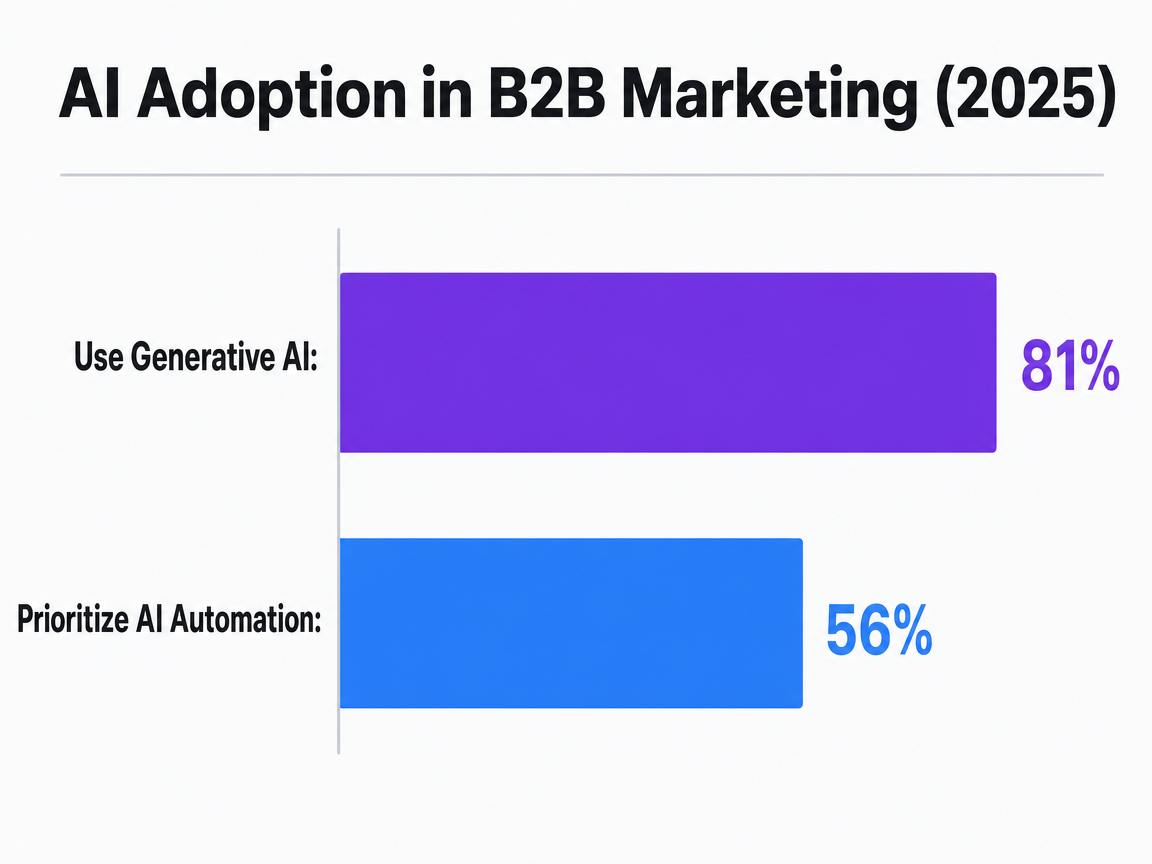 AI Adoption in B2B Marketing (2025)
From CMI's 2025 survey, this shows the percentage of B2B marketers using GenAI and prioritizing AI automation.
Frequently Asked Questions
References
- 1.Search Engine Optimization (SEO) Starter Guide.
- 2.Get started with Google Trends.
- 3.The new Search Console Insights report is here.
- 4.B2B Content Marketing: 2025 Benchmarks & Trends.
- 5.B2B Content and Marketing Trends: Insights for 2026.
- 6.Gartner Survey Finds 69% of B2B Buyers Turn to Sales Reps ....
- 7.An Introduction To The Demand Spectrum.
- 8.How To Identify B2B Demand Types.
- 9.The Definitive Guide to Data-Driven Attribution.
- 10.Attribution Playbook.
- 11.Marketing Mix Modelling - A CMOs handbook.
- 12.The Essential Guide to Marketing Mix Modeling and Multi-Touch Attribution.
- 13.Search Quality Rater Guidelines: An Overview.
- 14.B2B SEO + Content Engine Benchmarks 2024 | The Starr Conspiracy.
- 15.Keyword Report: Complete Guide For Actionable Insights.
- 16.B2B Campaign ROI Benchmarks: 2024.
- 17.B2B Marketing ROI Benchmarks: 2024 KPIs | The Starr Conspiracy.
- 18.Organic vs Paid: What's Really Driving B2B SaaS Pipeline in 2026?.
- 19.B2B SEO ROI Measurement Procedures - The Starr Conspiracy.