
Key Takeaways
- Treat every tracked keyword as a call hypothesis tagged to one of four intent classes, with a target outcome tier that decides whether it earns continued budget.
- Close the measurement loop by reconciling CRM dispositions and call intelligence weekly, then reprioritize the portfolio on outcome contribution over an eight to twelve week window.
- Split the analytics stack so keyword and session data stay first-party, and only hashed identifiers with generic conversion types leave the regulated environment 8.
- Scale senior oversight through approval-first automation: strategists assemble ranked recommendations with disposition evidence and compliance context, and the Head of SEO governs rather than produces.
Treating Each Keyword as a Call Hypothesis
A keyword is a prediction. It predicts who will search, what page will serve them, what problem they will describe out loud, and whether the resulting phone conversation will produce a qualified inquiry, a booked appointment, or a closed matter. Ranking is only the first condition. Everything downstream is where the hypothesis is tested.
Agency SEO leads working in law, behavioral health, dental, home services, senior living, and healthcare already know that CTR and position reports do not reconcile with what the client hears from intake. A page can rank third for a high-volume head term and generate calls that never convert, while a mid-volume modifier produces consultations that close. Treating the keyword list as a portfolio of call hypotheses, each with a specific outcome tier attached, is what separates SEO that defends retention from SEO that invites a quarterly call-volume complaint.
The operating definition this article uses: a keyword earns continued investment when its calls disposition into a target tier at a defensible rate, not when it ranks. The measurement loop that proves or disproves each hypothesis has to be instrumented, governed, and kept inside the lines of HIPAA tracking rules 8, FTC substantiation standards 6, and call-recording consent law 3. The sections that follow assemble that loop, starting with how intent maps to outcome.
The Measurement Loop From Query to Disposition
Mapping Call Outcome Tiers to Query Intent
Query intent predicts call shape before the phone rings. An emergency query ("burst pipe near me," "same-day crown repair," "24 hour detox admission") carries a different outcome distribution than a consultative query ("what happens in a free case evaluation"), a comparison query ("invisalign vs clear correct cost"), or a branded query. Treating these four intent classes as distinct hypothesis buckets is the first move in the measurement loop, because the keyword's job is defined by what kind of call it is supposed to produce.
- Emergency intent tends to concentrate at the top of the funnel: high call volume, short handle time, and a heavy share of qualified inquiries that convert to booked appointments inside the same session.
- Consultative intent produces fewer calls per impression but a higher share of calls that reach a scoped consultation.
- Comparison intent generates mid-length calls dominated by price and credential questions, with a measurable fallout rate before booking.
- Branded intent carries the highest conversion density because it is largely return demand.
The practical use: tag every tracked keyword with one of the four intent classes at the point it enters the portfolio, and attach a target outcome tier to each class. Emergency queries are judged on booked appointments per hundred calls. Consultative queries are judged on scoped consultations. Comparison queries are judged on movement from quote to booking. Branded queries are judged on retention of existing demand. Rankings are a leading indicator, not the scorecard.
Instrumenting Landing Pages and Call Pixels Without Leaking PHI
The measurement loop depends on connecting a specific query to a specific call outcome, and that connection is where most call-driven SEO programs introduce compliance exposure. In healthcare, behavioral health, dental, and senior-living accounts, HHS has stated that regulated entities must configure tracking technologies on authenticated webpages so they use and disclose protected health information only in compliance with the HIPAA Privacy Rule, and must protect ePHI under the HIPAA Security Rule 8. The guidance applies to pixels, tag managers, session replay, form analytics, and dynamic number insertion scripts that feed keyword attribution.
What this means for instrumentation: a page targeting "outpatient depression treatment [city]" cannot pass the combination of IP address, device identifier, and a health-condition URL path to a third-party analytics or ad platform without authorization or a business associate agreement that permits it. The same constraint applies to call pixels that fire a conversion event tagged with the keyword and the service line that implied the health condition.
The workable pattern is to split the stack. Keyword and session data flow into a first-party analytics environment under the regulated entity's control. Call tracking uses dynamic numbers scoped to campaign and keyword, but the conversion event sent to any third-party platform is reduced to a non-PHI signal: a hashed session identifier and a generic conversion type, not the service line, not the symptom, not the identifiers HHS lists under Safe Harbor. Qualified-call classification and outcome tiering happen inside the first-party environment, where the full context is already permitted.
Legal verticals and home services sit outside HIPAA, but the same architectural discipline pays off: when a client later adds a regulated service line, the measurement loop does not need to be rebuilt.
Feeding Dispositions Back Into Keyword Prioritization
Dispositions are what close the loop. Every tracked call needs a classification that maps back to the outcome tier its originating keyword was supposed to produce: qualified inquiry, scoped consultation, booked appointment, closed matter or case or patient, or disqualified. Without that classification arriving on a weekly cadence, the keyword portfolio drifts toward whatever ranks, which is not the same as whatever pays.
Two sources of disposition work in parallel. Intake teams tag calls in the CRM at the point of handoff, using a short controlled vocabulary that matches the outcome tiers. Call intelligence reads recorded conversations, tags qualified inquiries, and flags missed opportunities where a caller matched a target intent but the intake conversation collapsed. The two streams reconcile weekly. Where they disagree, the recorded call is the tiebreaker.
The reprioritization rule is explicit: a keyword earns continued investment when its calls disposition into the target tier at a defensible rate over a rolling window large enough to clear noise, typically eight to twelve weeks for mid-volume terms. A head term that ranks second but produces mostly disqualified calls loses budget to a modifier that ranks sixth and books consultations. Negative intent patterns (price-shopping language on a comparison query that was supposed to produce bookings, out-of-service-area calls on an emergency query) feed back into the page's targeting and the keyword's intent class, not just into keyword removal.
The portfolio is re-ranked on outcome contribution, not volume. That is the entire point of the loop.
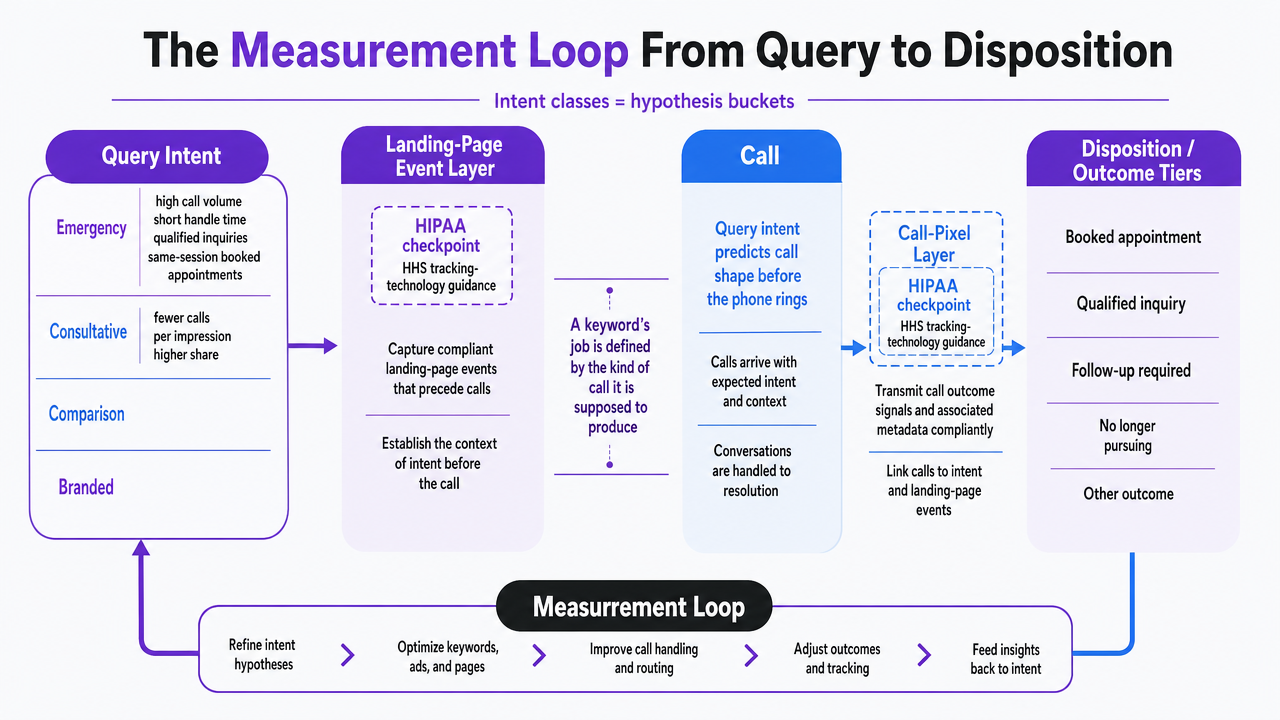 Visualize the keyword-to-call measurement loop with explicit HIPAA compliance checkpoints at the landing-page event layer and the call-pixel layer, matching the section's cited HHS tracking-technology guidance
Local Relevance, Distance, and Prominence by Call Intent
Google's local ranking model weighs three signals: relevance, distance, and prominence. Treating them as a flat checklist is where most call-driven programs lose yield. Each signal dominates a different intent class, which means the keyword's intent tag from the measurement loop also determines which lever moves calls.
Distance dominates emergency intent. A caller searching "24 hour emergency dentist" or "burst pipe repair now" is filtering on who can arrive or answer first, and the pack rarely rewards a technically stronger page located forty minutes further out. The optimization work on emergency keywords is service-area precision, location-page density across the actual response radius, and NAP consistency on the GBP listings that cover each sub-market. Keyword expansion follows the geography, not the other way around: every neighborhood, exit, and adjacent municipality within the response window gets a tracked variant, and the disposition data from the measurement loop confirms which of those variants produce booked calls versus out-of-area fallout.
Relevance dominates consultative intent. A caller searching "what to expect in a free consultation for a workers comp claim" is matching on specificity of the page to the question, and distance tolerance expands considerably when the firm appears to understand the situation. Keyword work here concentrates on long-tail modifiers that mirror the exact language intake teams hear on qualified calls, with page copy that resolves the question before the form or phone number appears. Relevance is also where transcripts earn their keep: the phrases callers actually use, surfaced from call intelligence and reconciled against the controlled vocabulary from the disposition process, become the next round of targeted modifiers.
Prominence dominates comparison and high-consideration branded intent. A caller comparing "invisalign vs clear correct cost" or researching a named practice before calling is weighing review volume, review recency, authoritative citations, and the depth of the entity's footprint across the web. Keyword optimization at this stage is less about new query targets and more about defending the SERP real estate around existing ones with substantiated comparison content, structured review surfaces, and citations that reinforce the entity. The call-side consequence is a shorter, higher-intent conversation that disposition into booked appointments at a rate the comparison intent class is specifically judged on.
Experience data-driven keyword optimization in action now
Test real-world keyword strategies and measure impact with live call qualification data during your free trial.
Landing Page Claims, Testimonials, and Accessible Intake
Substantiating Outcome Language and Review Snippets
Keyword-targeted pages amplify claims. A page built to rank for "best DUI attorney [city]" or "fastest sedation dentist near me" tends to accumulate superlatives, star counts, and outcome language the base service page never carried. Each of those additions is an advertising claim the business has to be able to defend.
The FTC Act prohibits unfair or deceptive advertising, and claims about health, safety, performance, or pricing must be substantiated before dissemination, including on landing pages and in the resulting sales conversation 9. For health-related claims specifically, the FTC generally requires competent and reliable scientific evidence sufficient to support the specific claim made and the implied consumer takeaway 6. A dental page promising "pain-free extractions," a behavioral health page citing recovery percentages, or a senior-living page describing fall-reduction outcomes all sit inside that evidence requirement regardless of how the keyword was researched.
Review snippets and testimonials carry a separate rule. The FTC's 2023 update to the Endorsement Guides addresses procuring, suppressing, boosting, organizing, publishing, upvoting, downvoting, or editing consumer reviews in ways that distort what consumers think about a product or service 5. Pulling only five-star quotes onto a keyword-targeted landing page, filtering by sentiment, or editing reviews for length without disclosure can all fall inside that principle.
The workable editorial pattern is a claims register tied to the page: every outcome statement, statistic, and testimonial on a keyword-targeted page is logged with the evidence that supports it and the date that evidence was last reviewed. Pages are built from the register, not the other way around. When intake teams or call intelligence surface callers quoting a promise the page made, the register is where the claim is revisited.
Accessible Forms as a Qualified Call Lever
Accessibility is a call-volume variable, not just a legal one. The ADA requires businesses open to the public to provide full and equal enjoyment and effective communication, and DOJ guidance identifies labels, keyboard access, and clear instructions as specifically important for accessible forms, alongside text alternatives and captions 1. Callers who cannot complete an inaccessible intake form do not vanish; a share of them pick up the phone, and another share leave.
Three form failures route disproportionate traffic to the phone line in ways that depress qualified-call rates:
- Unlabeled fields and placeholder-only inputs break screen reader flow, which forces users to call for information the page should have captured.
- Keyboard traps inside multi-step forms strand users who do not use a mouse.
- Error messages that announce "invalid" without naming the field or the fix send users back to the top of the page, and often back to the SERP.
Fixing the form pays twice. Users who can complete intake self-serve into booked appointments without consuming phone capacity. Users who still prefer to call arrive with the context the accessible page already surfaced, which shortens handle time and raises the share of calls that disposition into the target outcome tier.
Consolidated Analytics, Consent, and Vertical Compliance
Every call-driven SEO program accumulates the same four governance obligations: how analytics data is de-identified before it leaves the regulated environment, how call recording consent is captured, how marketing communications are scoped, and how outbound follow-up on captured leads is run. Scattering those obligations across every section of a playbook is how they get missed. Consolidating them into a single matrix tied to the vertical is how they get followed.
Analytics governance starts with de-identification. HHS describes two methods for de-identifying protected health information: Expert Determination, which requires a qualified expert to conclude that re-identification risk is very small, and Safe Harbor, which requires removal of specified identifiers 7. NIST frames de-identification more broadly as a balance between useful analysis and protection against linking data to specific individuals, with residual risk that depends on the data, controls, and linkage possibilities 2. Call transcripts, intake notes, and session-level keyword attribution all carry identifiers that have to be stripped or transformed before they inform portfolio decisions outside the covered entity. The practical consequence: the environment where qualified-call tagging happens is not the environment where keyword prioritization reports are shared with the agency team.
Call recording consent is the next layer. Federal law allows interception when one party has given prior consent, provided the interception is not for a criminal or tortious purpose 3. State law frequently requires all-party consent, which means the recording notice at the start of the call is the enforceable control, not an afterthought. Programs that run across multiple states default to the stricter standard.
Marketing scope matters once a captured lead moves into nurture. HHS defines marketing as a communication about a product or service intended to encourage recipients to purchase or use it, and many marketing communications involving protected health information require individual authorization 4. A keyword-driven lead who called about one service line and is later contacted about an adjacent one has crossed into that definition. Outbound follow-up on those leads carries its own layer: the FTC's Telemarketing Sales Rule regulates interstate campaigns to induce purchases and specifies circumstances requiring recorded audio and express written consent 10.
The matrix is the single artifact the Head of SEO maintains per account. Every keyword decision, landing page edit, and attribution change references it, and no later section of the program re-litigates the same obligations.
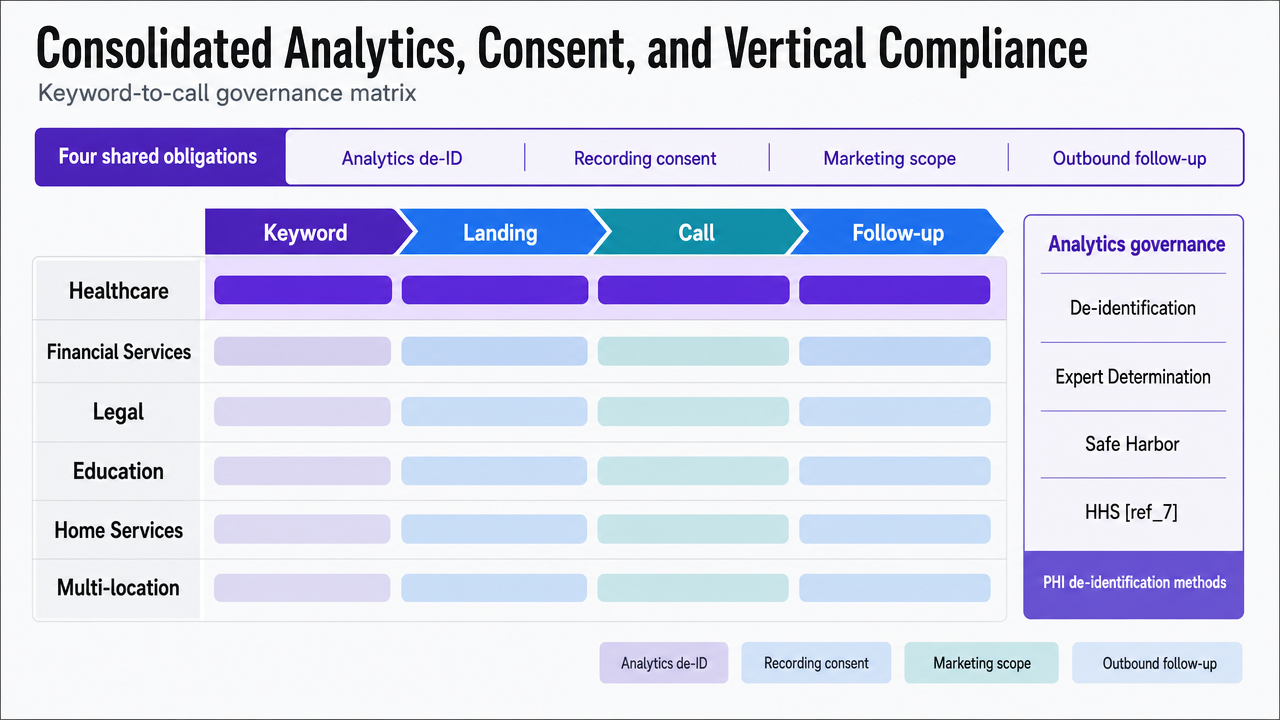 Visualize the vertical compliance matrix referenced in the section, mapping six verticals to the keyword-to-call stages each regulatory obligation constrains, using only the citations present in the surrounding prose
See How Data-Driven Keyword Optimization Fuels Qualified Call Volume
Request a walkthrough of AI-powered workflow automation that connects keyword strategy to measurable call outcomes—without increasing your team’s workload or risking quality control.
If You Govern Keyword Work Across a Portfolio
Approval-First Automation So the Head of SEO Is Not the Bottleneck
The sections above assumed a single client. The economics change when the same Head of SEO owns delivery across twenty, fifty, or more accounts in regulated verticals. At that scale, the governance model has to answer a different question: how do keyword decisions get made quickly without the senior strategist personally reviewing every disposition report, landing-page edit, and claim register entry?
The pattern that holds up is approval-first automation. Account strategists and AI specialists do the production work: pulling disposition data, re-ranking the keyword portfolio against outcome tiers, drafting landing-page revisions, updating the claims register, and queuing attribution changes. The Head of SEO reviews ranked recommendations with the strategic reasoning attached, approves or rejects in batch, and the approved work ships. Nothing publishes without sign-off, and nothing waits on the senior strategist to assemble it from scratch.
Three guardrails make the model defensible across regulated accounts:
- Shared disposition vocabularies prevent one account's "qualified inquiry" from meaning something different than another's.
- The compliance matrix from the vertical obligations section travels with the account, so a dental client's landing-page claim review automatically references FTC substantiation standards without the strategist re-deriving the rule.
- Every recommendation carries the evidence that triggered it: the keyword that lost its outcome tier, the transcript phrases that surfaced a new modifier, the review snippet that failed the claims register.
The Head of SEO becomes the approver of ranked decisions, not the producer of them.
Portfolio Economics of Governed Keyword-to-Call Workflows
Portfolio capacity is the variable the model is built to move. The table below uses ratios and workflow variables rather than invented dollar figures, because agency pricing and client ARPU vary too widely to generalize. The columns describe how a single Head of SEO's time scales across accounts under a manual review model versus a governed workflow with approval-first automation.
| Variable | Manual review model | Governed workflow |
|---|---|---|
| Accounts under direct oversight | Capacity-constrained by review hours | Capacity-constrained by approval decisions |
| Keywords actively tracked per account | Limited by analyst bandwidth to classify intent and disposition | Scales with account complexity, not analyst hours |
| Call dispositions reviewed per week | Sampled; full review infeasible at scale | Full disposition coverage with exceptions surfaced for approval |
| Hours per account per week on senior review | Grows roughly linearly with account count | Grows with recommendation volume, not account count |
| Compliance matrix application | Re-derived per account per edit | Attached to account; referenced on every recommendation |
| Resulting analyst capacity | Senior strategist becomes the bottleneck | Senior strategist governs; production scales |
The leverage point is the recommendation layer. When ranked keyword decisions arrive with the disposition evidence, the compliance context, and the proposed change already assembled, approval time per decision drops to minutes. Account count scales against approval throughput, which the Head of SEO controls, rather than against production throughput, which previously consumed the role. That is how call-driven SEO delivery scales across regulated verticals without adding senior headcount, and it is the operating model platforms like Vectoron are built to support.
Where This Breaks and How to Close the Loop
Three failure modes recur across call-driven SEO programs, and each one breaks the loop in a predictable place.
- The first is a disposition vocabulary that drifts between intake teams and call intelligence. When "qualified" means a scoped consultation to the strategist and "answered the phone" to the front desk, the keyword portfolio reprioritizes against noise. The fix is a single controlled vocabulary enforced at the CRM field level, reconciled weekly against recorded calls.
- The second is attribution rebuilt around a third-party conversion event that quietly carries service-line or symptom context into platforms the regulated entity cannot authorize. The fix is architectural: strip the event to a hashed session identifier and a generic conversion type before it leaves the first-party environment, and keep outcome tiering inside it.
- The third is a claims register that stops being maintained once pages ship. Keyword-targeted pages accumulate superlatives faster than evidence, and the register has to be reviewed on the same cadence as the disposition data, not annually.
Close the loop at those three points and the portfolio starts paying on outcomes rather than rankings.
Frequently Asked Questions
References
- 1.Guidance on Web Accessibility and the ADA.
- 2.IR 8053, De-Identification of Personal Information.
- 3.9-7.000 - Electronic Surveillance.
- 4.Standards for Privacy of Individually Identifiable Health Information.
- 5.Federal Trade Commission Announces Updated Advertising Guides to Combat Deceptive Reviews and Endorsements.
- 6.Health Products Compliance Guidance.
- 7.Guidance Regarding Methods for De-identification of Protected Health Information in Accordance with the HIPAA Privacy Rule.
- 8.Use of Online Tracking Technologies by HIPAA Covered Entities and Business Associates.
- 9.Advertising and Marketing on the Internet: Rules of the Road.
- 10.Complying with the Telemarketing Sales Rule.