
Key Takeaways
- Keyword prioritization should treat intent class, commercial modifiers, SERP composition, and pipeline fit as the primary scoring inputs, with search volume relegated to a tiebreaker role.
- Bottom-of-funnel comparison and alternatives queries converted roughly 20 times better than top-of-funnel terms in B2B lead-gen data, reshaping what qualifies as effective keyword coverage 13.
- Codifying the rubric raises senior strategist capacity from five to seven accounts to fifteen to thirty by replacing bespoke research with a repeatable, defensible prioritization process.
- Search Console's 24-hour view and Insights integration turn impression drift, CTR anomalies, and position stalls into weekly rubric adjustments rather than monthly report surprises 5, 4.
Why Volume-First Keyword Playbooks Quietly Misallocate Client Budget
An analysis of 579,240 leads found that keywords of seven or more words drove 48.95% of revenue, three-to-six word phrases drove 46.29%, and one-to-two word head terms drove just 4.76% 11. This dataset, focused on leads rather than universal traffic, highlights a significant disparity: the shortest, highest-volume queries often prioritized by agencies produce roughly one-twentieth of the revenue attributable to search compared to longer, more specific queries.
Most agency keyword strategies still prioritize these high-volume head terms. These terms often secure tracked ranking slots in client dashboards, anchor content briefs, and feature prominently in pitch decks. Conversely, queries that strongly correlate with booked revenue—longer, modifier-heavy phrases indicating a specific need—are often relegated to a "long-tail" footnote and addressed only if time permits.
This misallocation has tangible costs. When a client's content and internal linking budget is primarily directed towards one-to-two word terms, they are paying for impressions that convert at a significantly lower rate than commercial queries. A follow-on study across 2022 and 2023 revealed that the revenue share of seven-plus word phrases increased from 31.21% to 48.95% year over year, while mid-length terms decreased from 62.71% to 46.29% 12. This trend indicates that buyer language is becoming increasingly specific.
Google's own guidance supports this, suggesting that pages should be designed to address the actual goal behind a query, not just the query string itself 1. A revenue-first approach treats keyword selection as a critical capital allocation decision. The remainder of this article details how to score, prioritize, and justify this allocation across a client portfolio.
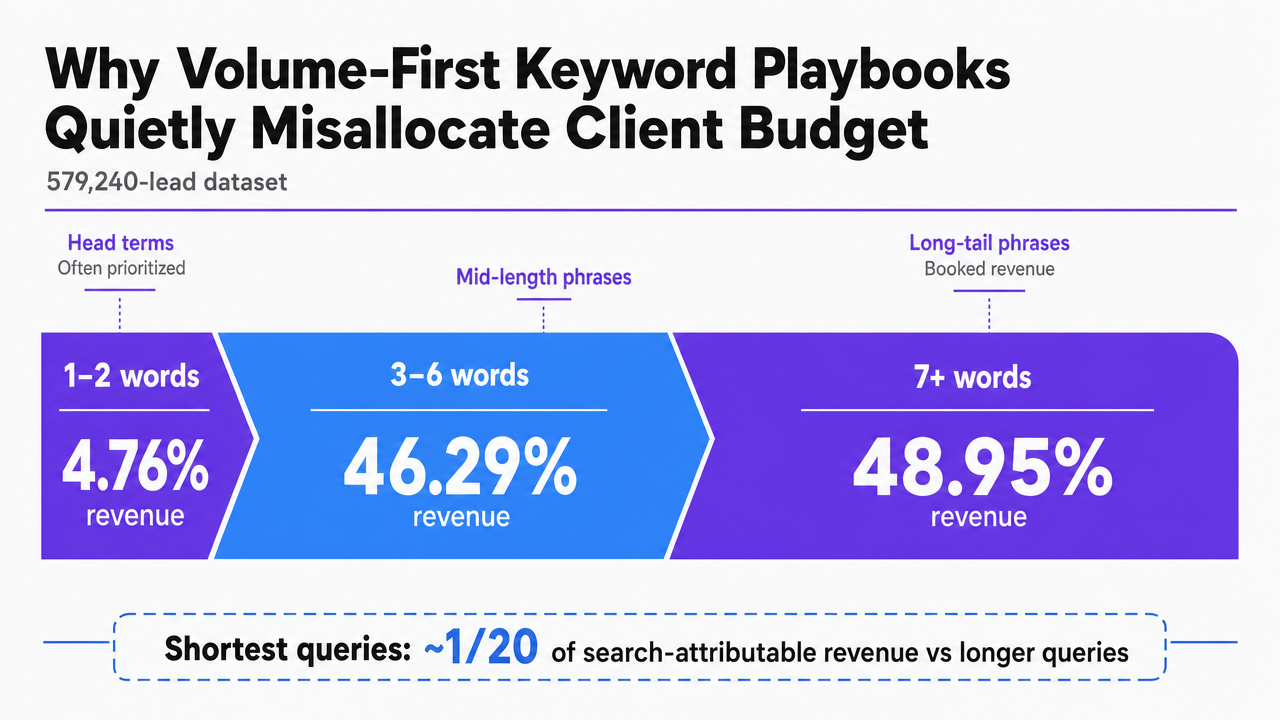 Visualize the revenue share by keyword length from the 579,240-lead dataset cited directly in this section, showing the imbalance between head terms and long-tail phrases
Reclassifying Keywords as Pipeline Assets, Not Ranking Targets
Intent Class Before String Match
A keyword represents a request for a specific outcome, and this outcome determines its potential to generate revenue. Two queries sharing the same head noun can have vastly different commercial implications: a broad category term typically indicates research, while terms with modifiers like pricing, alternatives, or for [use case] signal a closer proximity to a buying decision 14.
Google's "people-first content" guidance emphasizes building pages for the underlying goal of a query, rather than simply optimizing for the query string 1. This perspective implicitly de-emphasizes head-term optimization, as matching a page to a broad noun rarely fulfills the searcher's specific objective.
For agency prioritization, it's crucial to classify every potential keyword by its intent—informational, commercial investigation, transactional, or navigational—before considering search volume. A revenue-first framework uses intent as the primary filter, with volume serving as a tiebreaker within an intent class 10. A high-volume informational term and a low-volume comparison term belong to different budget categories and should be presented as such in client QBRs.
The 20x Conversion Delta Between BOFU and TOFU Queries
A Grow and Convert analysis of B2B lead generation programs provides strong quantitative evidence for intent-based classification, revealing that high-buying-intent keywords converted approximately 20 times better than top-of-funnel, traffic-generating terms. Specifically, comparison and alternatives queries in this dataset achieved an average conversion rate of 6.94% 13. It's important to note that this data pertains to B2B lead-gen conversion, not universal e-commerce, and represents an aggregate across studied programs.
Even within this specific scope, this conversion delta redefines what constitutes effective keyword coverage. A page ranking for an informational term with a 0.3% conversion rate requires roughly twenty times more traffic than a comparison page to generate the same number of qualified leads. Agencies that prioritize broad informational content over comparison, alternatives, and transactional pages effectively incur a 20x "tax" on lead volume, even if it's not visible on the invoice.
The implication for classification is clear: bottom-of-funnel query patterns—such as [category] vs [competitor], best [category] for [job], [product] alternatives, [product] pricing, or [category] near [location]—should be prioritized for any account focused on booked calls, demos, or qualified leads. Informational content retains its value, but primarily as a support system for internal linking, retargeting audiences, and building topical authority around BOFU pages, rather than as a primary deliverable.
Two caveats are essential for client discussions. First, the 6.94% figure is an average for an intent class, not a guarantee for every single query. Second, BOFU conversion advantages are only realized if the landing page is designed to convert; a comparison term directed to a generic blog post will negate this benefit 17.
What the Academic Record Adds to Folk Intent Wisdom
While intent taxonomy is a common topic in SEO, academic research provides a more rigorous foundation. A Springer study on informational, transactional, and navigational intent in search advertising demonstrated that search intention significantly impacts ad ranking, click-through rate, conversion rate, cost-per-click, and cost per conversion 7. This confirms that intent influences every performance metric agencies report on, not just conversion.
Additionally, a Marketing Science Institute paper on consumer click behavior highlighted the importance of query specificity. The study found that less popular keywords correlate with greater searcher effort and a closer proximity to purchase 8. This suggests that popularity, often the default metric in keyword tools, is inversely related to commercial readiness at the query level.
These findings provide agencies with a robust justification for treating intent class and query specificity as primary axes in a scoring rubric, with search volume as a secondary input. The following section outlines such a rubric, incorporating four inputs with explicit weightings, enabling prioritization decisions that can withstand scrutiny from a client CMO focused on head terms.
A Scoring Rubric Agency Leads Can Deploy Across Accounts
Four Inputs: Intent Class, Commercial Modifier, SERP Composition, Pipeline Fit
A practical rubric must be effective across a diverse portfolio. Four consistently applied inputs can generate a defensible score for any candidate keyword without becoming overly complex.
Intent class is the foundational filter. Each candidate keyword is categorized as informational, commercial investigation, transactional, or navigational. Google's people-first content guidance implies this hierarchy: the page must satisfy the user's goal, not just the query string 1. A revenue-first rubric prioritizes commercial investigation and transactional terms, with informational content serving a supportive role.
The commercial modifier is the second input. Modifiers such as pricing, cost, demo, alternatives, vs, best for [use case], and near [location] indicate that the searcher is in an evaluation phase 14. The presence of such a modifier boosts a keyword's score; its absence doesn't disqualify a term but places it in a supporting content tier.
SERP composition is the third input, often overlooked by volume-driven strategies. If the top ten search results are dominated by comparison pages, review sites, and vendor landing pages, Google is signaling commercial intent, regardless of what a keyword tool might suggest. Conversely, if the SERP is filled with definitional posts and how-to guides, the term is informational, even if it contains pricing-related words. A manual review of the first page of results is more valuable than an automated intent label from a tool 10.
Pipeline fit is the fourth input. This assesses whether the query aligns with a service the client offers, at a profitable margin, to their ideal customer profile. A high-scoring keyword that falls outside the client's addressable market is a distraction. Pipeline fit ensures that strategists reject well-optimized terms that would generate leads sales cannot convert 10.
Weighting the Rubric So Prioritization Survives a Client QBR
For a rubric to be effective, its inputs must carry different weights, aligned with the client's key performance indicators. For a lead-generation account, a practical weighting might be 35% for intent class, 25% for SERP composition, 25% for pipeline fit, and 15% for commercial modifier presence. Intent class is weighted highest because academic research strongly supports its impact on conversion rates and cost per conversion 7. SERP composition and pipeline fit share the middle ground as they are easily visualized and explained to a CMO during a QBR—one through a screenshot of current search results, the other by mapping the query to a specific service line.
Search volume is intentionally excluded from the weighted inputs. It only serves as a tiebreaker for keywords that score similarly, and only after intent, modifier, SERP, and fit have established a shortlist. This structured approach allows strategists to defend prioritization decisions when clients question the absence of head terms from the roadmap 15. The justification is a comprehensive score, an input-by-input breakdown, and a SERP screenshot, not simply "low intent."
Where CPC-as-Commercial-Proxy Breaks Down
Cost-per-click (CPC) is often used as a proxy for commercial intent due to its accessibility and perceived market signal. While useful, it is not sufficient. The Iriscale workflow, which popularized CPC-plus-modifier filtering, explicitly states that CPC must be validated against actual conversion and revenue attribution 14.
Three common failure modes exist in agency work:
- First, auctions inflated by a few well-funded bidders can drive up CPC for terms whose organic SERP is still dominated by informational content, leading to a false commercial signal.
- Second, regulated industries like legal, behavioral health, and financial services often have elevated CPCs due to advertising policy restrictions, not necessarily because the query is close to purchase.
- Third, brand-adjacent terms may have high CPCs due to defensive bidding, which doesn't reflect organic conversion potential.
The rubric addresses this by treating CPC as supporting evidence for commercial modifier and SERP composition, rather than as a standalone input. When CPC aligns with a comparison-heavy SERP and a clear modifier, the signal is reinforced. However, if CPC contradicts the SERP, the SERP takes precedence. This ensures prioritization is based on actual searcher behavior and Google's interpretation, not solely on advertiser willingness to pay.
Test Revenue-Driven Keyword Execution at Scale
Experience live, publishable SEO content built for measurable revenue outcomes before committing long-term.
The Long-Tail Economics That Justify the Rubric
The rubric's emphasis on intent and specificity is justified by conversion rates alone. The economic benefits become even clearer when considering the cost side of the equation.
A dissertation on sponsored search advertising quantified the impact of applying long-tail principles to keyword selection: a 430% increase in click-through rate and a 61% reduction in cost-per-click 9. While this study focused on paid search and advertiser performance, not organic SEO outcomes, the underlying principle is relevant. The same query specificity that lowers CPC in an auction reflects a searcher whose need is sufficiently defined to click and act.
For an agency portfolio, this implies a dual compounding effect of specificity. In paid search, budgets allocated to long-tail patterns should see significantly lower blended CPC and higher CTR, freeing up spend for retargeting and BOFU landing pages. In organic search, the same specificity signals that reduce paid auction costs also correlate with less popular queries that are closer to purchase, as supported by the Marketing Science Institute's finding that less popular keywords involve more searcher effort and a closer approach to buying 8.
This combination justifies the rubric's de-emphasis on volume. A head term is expensive to compete for in paid search, highly contested in organic search, and diluted in commercial signal. Conversely, a modifier-rich phrase is more affordable to target, less competitive, and more predictive of a booked outcome. The rubric is not merely a preference; it reflects the inherent economic realities.
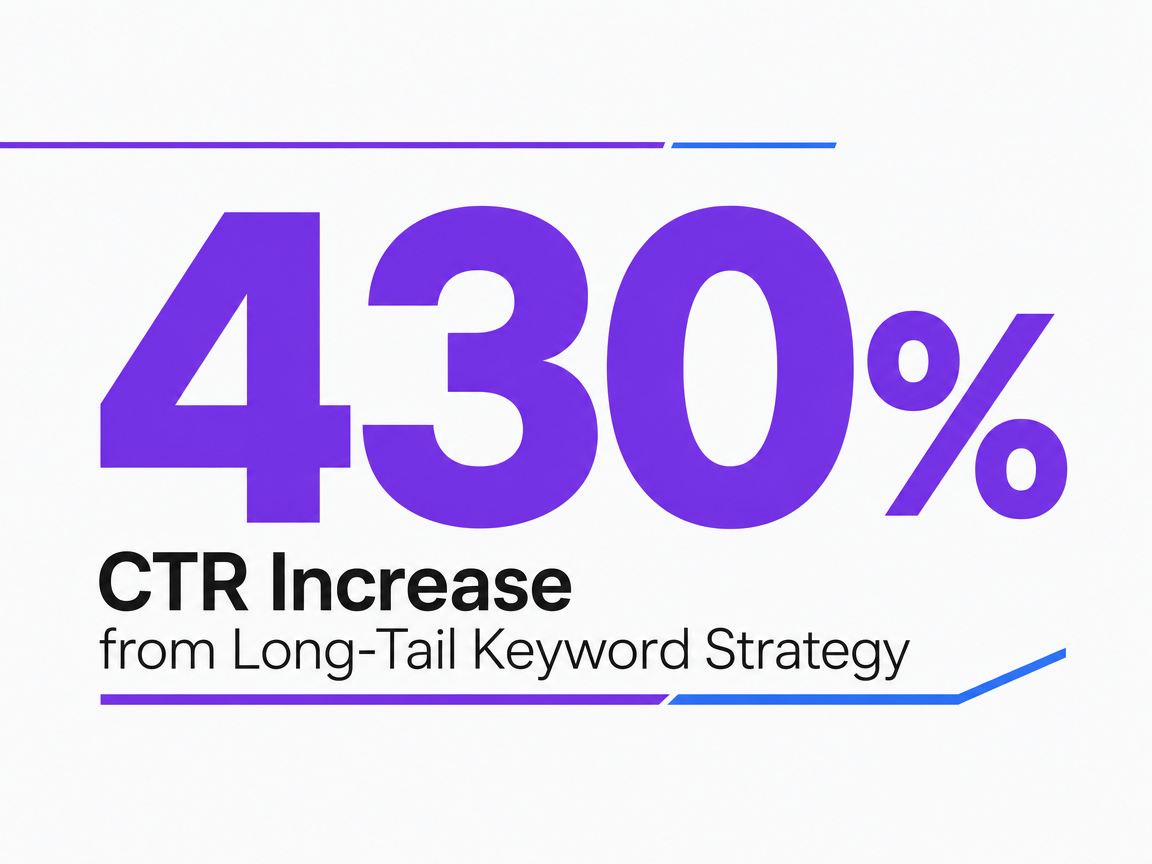 CTR Increase from Long-Tail Keyword Strategy
CTR Increase from Long-Tail Keyword Strategy
Closing the Loop With Search Console as a Near-Real-Time Feedback System
The 24-Hour View as Prioritization Signal
Rubrics lose their effectiveness if they don't adapt to real-world data. The purpose of scoring is to create a prioritization queue that strategists can adjust based on actual query behavior. Search Console's 24-hour view, introduced in late 2024, significantly shortened this revision cycle by providing daily data on clicks, impressions, CTR, and average position, broken down by query, page, country, and device 5.
For agency leads managing multiple accounts, this rapid feedback is invaluable. A comparison page launched on Monday no longer requires waiting until the next month's report to see if it's gaining impressions for its target modifier cluster. If a [category] vs [competitor] query appears within a day at position 18 with a respectable CTR, the term warrants internal linking and further asset development. If the same page only draws impressions for a broader informational variant, the initial classification was likely incorrect, and the rubric score needs adjustment.
The 2025 Search Console Insights integration further enhanced this by incorporating trend comparisons into the same view, allowing strategists to compare clicks and impressions against prior periods without generating separate reports 4. This provides the essential feedback mechanism for managing a portfolio.
Feeding Query Performance Back Into the Rubric
New data is only valuable if it informs future actions. The feedback loop into the rubric utilizes three inputs that strategists can extract from Search Console query reports directly within the tool.
- Impression drift. If a scored page begins attracting impressions for modifiers not initially tagged by the rubric—for example, a pricing page showing up for [category] cost for [industry] variants—the pipeline-fit input is revised upward, and the term is added to the shortlist for a dedicated asset.
- CTR anomaly. A query holding position 6 with a significantly lower CTR than the benchmark for that position suggests a title-tag or SERP-composition mismatch. This feeds back into the SERP composition input and often reveals an incorrect initial intent classification.
- Position stall. A comparison term that reaches position 11 and remains there for three weeks is a candidate for internal link redistribution from informational content, aligning with the pipeline framework that positions BOFU pages as the ultimate destination 10.
Google's guidance supports using observed query behavior as an input signal: pages should be built for the words people actually use 2. The rubric serves as the initial framework, and Search Console acts as the correction mechanism.
See How Data-Driven Keyword Strategies Deliver Measurable Revenue Impact
Request a tailored walkthrough of AI-powered workflows that connect keyword phrase selection directly to pipeline metrics—built for agencies scaling client SEO without expanding headcount.
If You Run a Portfolio: The Agency Economics of Codified Prioritization
This section shifts focus from per-account keyword prioritization to the impact of a codified rubric on the structure of a delivery organization, particularly for a Head of SEO managing fifteen to thirty accounts.
Bespoke keyword strategy incurs a fixed cost per account that scales linearly with headcount. A senior strategist performing intent classification, SERP inspection, and pipeline mapping from scratch for each engagement can spend 10 to 15 hours per account per month on research and prioritization alone, before any content brief is written. This limits a senior strategist's capacity to five to seven accounts before quality declines or deadlines are missed. Codifying the rubric—with defined intent classes, commercial modifiers, SERP composition, pipeline fit, and fixed weightings—transforms much of this work into a repeatable process that a mid-level strategist or an automated system can execute. This frees up senior time for critical judgment calls flagged by the rubric, such as SERP disagreements with CPC, pipeline-fit overrides, and score ties requiring client discussion 10.
The table below illustrates the operational shift, using variables that an agency lead can populate with their own delivery data. Specific dollar figures are omitted as retainer size, strategist loaded cost, and utilization vary widely by agency.
| Variable | Volume-First Workflow | Codified Revenue-First Workflow |
|---|---|---|
| Accounts per senior strategist | 5–7 | 15–30 |
| Senior hours per account per month on keyword research and prioritization | 10–15 | 2–4 (exceptions only) |
| Prioritization defensibility in QBR | Volume rank, tool intent label | Rubric score, SERP screenshot, pipeline mapping |
| Feedback cycle length | Monthly reporting pull | 24-hour Search Console view 5 |
| Primary metric surfaced to client | Rankings, sessions | Booked leads by query cluster 17 |
The "Prioritization defensibility in QBR" row is crucial for protecting the portfolio. When a client CMO questions why a head term isn't on the roadmap, a rubric score with four defined inputs and a SERP screenshot can resolve the discussion quickly. Relying on a volume ranking spreadsheet, however, often prolongs the conversation into subsequent meetings.
The Operating-Model Shift: Approval-First Automation of Classification and Scoring
The rubric is portable, but the bottleneck lies in its manual execution. Classifying intent, inspecting SERPs, mapping pipeline fit, and adjusting scores based on Search Console query drift are knowledge-intensive tasks that don't scale well when confined to a senior strategist's expertise. The true shift in portfolio economics comes from automating the mechanical aspects of the rubric—such as intent tagging based on Google's people-first framework 1, modifier extraction, SERP composition scans, and query-drift alerts from the 24-hour view 5. This creates an automated workflow that generates a scored shortlist for the strategist to approve, override, or reject.
"Approval-first" is the key constraint. Nothing is implemented without sign-off, and every scored recommendation includes the four inputs and their weightings, allowing the strategist to understand the rationale behind each term. This preserves the critical judgment calls the rubric already highlights—SERP disagreements with CPC, pipeline-fit exceptions, and score ties—while eliminating the hours spent generating the initial shortlist 10. A senior strategist managing fifteen to thirty accounts can then focus on overrides and client QBR narratives, rather than manual tagging.
Vectoron's SEO strategist operates on this principle: it produces classification and scoring outputs, routes them through a Command Center for approval, and executes only what the strategist approves. This transforms revenue-first keyword work from a bespoke, time-consuming ritual into a governed, scalable process for the entire portfolio 17.
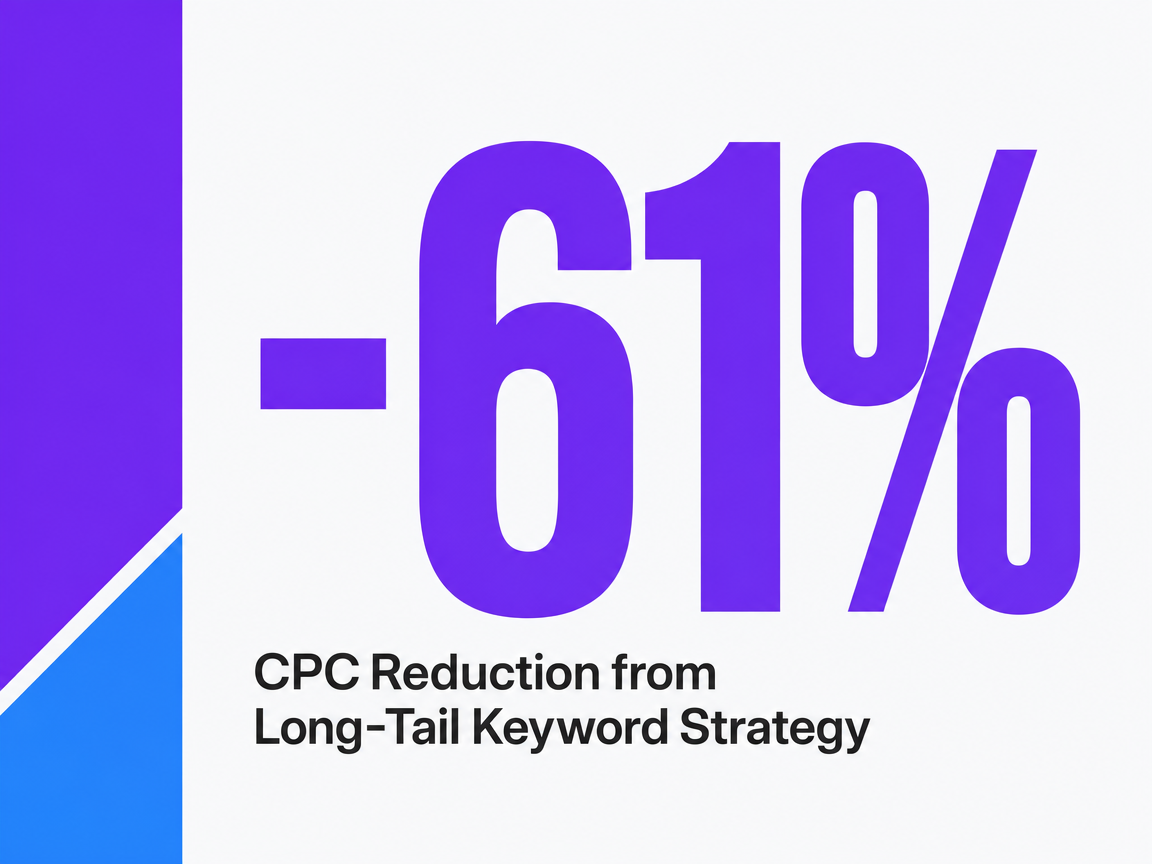 CPC Reduction from Long-Tail Keyword Strategy
CPC Reduction from Long-Tail Keyword Strategy
Frequently Asked Questions
References
- 1.Creating Helpful, Reliable, People-First Content.
- 2.Google Search Essentials (formerly Webmaster Guidelines).
- 3.Search Engine Optimization (SEO) Starter Guide.
- 4.The new Search Console Insights report is here.
- 5.An improved way to view your recent performance data in Search Console.
- 6.Search Quality Rater Guidelines: An Overview - Google.
- 7.Informational, transactional, and navigational need of information: relevance of search intention in search engine advertising.
- 8.Consumer Click Behavior at a Search Engine: The Role of Keyword Popularity.
- 9.The impact of long tail distribution in keyword selection on the effectiveness of sponsored search advertising.
- 10.Pipeline-Focused Keyword Strategy for B2B - 23HubLab.
- 11.Which Keywords Actually Drive Revenue.
- 12.Which Keyword Types Drive Revenue?.
- 13.B2B Lead Generation SEO: How to Get 20x the Conversion Rate.
- 14.Unlock B2B SaaS Growth with Low-Volume Keywords - Iriscale.
- 15.How to Choose SEO Keywords That Drive Revenue.
- 16.7 Revenue-Driving SEO Services That Scaled Companies 312% in 2024.
- 17.Revenue-Focused SEO: 7 Data-Driven Strategies That Convert.
- 18.7 Revenue-Driving SEO Services That Delivered 347% ROI in 2024.