
Key Takeaways
- AccuRanker's two-hour domain refresh with unlimited on-demand updates is the benchmark for volatility analysis across portfolios exceeding 10,000 keywords per client 9.
- Semrush Position Tracking suits agencies consolidating position data, backlinks, keyword research, and competitive intelligence into a single environment rather than chasing best-in-class depth per axis 7.
- seoClarity, BrightEdge, and Conductor deliver enterprise governance — role-based access, workflow controls, and multi-brand rollups that keep reporting coherent across parent brands and regional franchisees 6.
- SEOmonitor differentiates on forecasting, turning keyword positions into predictive traffic and pipeline models that carry more weight in renewal conversations than backward-looking movement charts 6.
- Nozzle and STAT feed warehouse-grade SERP data tagged by device, geography, and feature type into BigQuery or Snowflake alongside GSC pulls for downstream conversion joins 6, 7.
- SE Ranking fits agencies prioritizing collaboration, with white-label reporting and multi-client workspace structure that scales across account teams without a proliferation of exported PDFs 8.
- Similarweb blends rank signals with market intelligence, adding category-level share of voice and competitive traffic context for quarterly reviews focused on category performance 6.
The pipeline problem behind agency rank tracking
Agency SEO leads managing dozens of client domains and tens of thousands of keywords do not lose sleep over which tool draws the prettiest position graph. The recurring failure mode is upstream of the tool: rank data lands in one system, engagement and conversion data in another, briefing lives in a third, and the analyst hours that stitch it all together are the actual line item. Position tracking at agency scale in 2026 is a data pipeline design problem before it is a software selection problem.
That framing changes what a keyword position checker has to do. The canonical source of query-level position and impression data remains Google Search Console, and its value multiplies when it is linked to GA4 so pre-click search behavior can be fused with post-click engagement and conversion in one property 1. Yet the Search Console API imposes hard ceilings — row limits per search type, pagination increments, and dimensions that cannot be combined — that portfolio-scale operators hit within weeks 2. A specialized tracker fills that gap for a specific job. The decision layer that turns rank movement into ranked, approved work is a separate concern entirely.
The rest of this piece slots named tools against those jobs, then examines where the cost of a fragmented stack actually accumulates across a client portfolio.
Why Google Search Console is the non-negotiable baseline
GSC as the canonical position source
Every third-party rank tracker on the market benchmarks itself against Google Search Console for a reason: GSC reports the position and impression data Google actually recorded, not a position a crawler inferred from a datacenter proxy. For portfolio owners running dozens of client domains, that distinction matters when a stakeholder asks why the tracker shows position 4 and GSC shows average position 6.8. The tracker is answering a different question.
GSC also becomes materially more useful once it is linked to GA4. That linkage joins pre-click query and impression data with post-click engagement and conversion in the same property, which is what turns a position report into a revenue attribution conversation 1. For agency SEO leads whose reporting has to survive a quarterly business review, that fusion is the floor, not the ceiling.
Google's dominance is the second reason GSC sits at the base of the stack. Google runs roughly 90.8% of global search across devices as of December 2025 4, so a position source that reports Google's own recorded data covers the overwhelming majority of the visibility surface a client actually cares about.
The API ceiling every agency hits
The GSC UI hides the constraint that portfolio operators run into within weeks of building a real pipeline. The Search Analytics method of the Search Console API exposes a maximum of 50,000 rows of data per day per search type, and results are paginated by incrementing the startRow value by 25,000 per request until the last page is reached 2. For an agency running 10,000 keywords across a single mid-sized client, that ceiling is workable. Across a portfolio of thirty clients with heavy long-tail query distributions, it is not.
The searchAppearance dimension compounds the problem. Search appearance cannot be returned as a column alongside other dimensions in a single query. Analysts have to group all data by search appearance type first, then run a second query filtering by the specific type they want to examine 5. Multi-dimensional feature-level reporting — say, AI Overview appearances by device by country by page — requires stitching multiple filtered queries together and reconciling them in a warehouse.
These constraints are what determine whether an agency needs a supplementary rank tracker, a custom warehouse feed, or both. Teams that treat GSC as a UI product hit the wall and blame the tool. Teams that treat GSC as an API-first data source design their extraction schedule, dimension strategy, and storage layer around the row and pagination limits from day one, and layer specialized trackers on top for the jobs GSC will not do — daily volatility, competitor positions, and SERP feature share of voice.
Generative AI impressions as a new signal
The signal set inside GSC expanded in 2026. Search Console now publishes performance reports for generative AI features, showing how often URLs from a site appeared in AI Overviews, AI Mode, and generative features in Discover, with hourly, daily, weekly, and monthly granularity 3. That release moves generative visibility from a manual SERP-scraping exercise into a first-class dimension inside the same property that already houses classic query data.
The reporting shift forces a definitional question. An impression inside an AI Overview is not the same object as an impression on a classic blue link — the URL may be cited inside a synthesized answer the user never scrolls past. Agency stacks that still equate impressions with visibility will misread the data. The operational adjustment is straightforward: segment GSC impressions by search appearance, track generative surfaces as a distinct series, and reconcile citation-style appearances against downstream engagement in GA4 1. Rank trackers that ignore generative surfaces are now under-reporting the visibility surface that matters most for informational queries.
Track Keyword Movements Across All Clients Instantly
See live keyword rankings and publish actionable reporting during your trial—no delays, no sandbox limitations.
Selection criteria that actually separate agency-grade tools
Feature checklists rarely predict which tracker survives a client portfolio. The criteria that matter are the ones that break at scale, and they fall into five buckets.
Refresh cadence under load. : Daily refresh is table stakes. What separates tools is whether the refresh holds when a portfolio crosses 10,000 keywords per client across multiple locations, and whether on-demand refreshes are metered or unlimited. AccuRanker's two-hour domain refresh with unlimited on-demand updates is the benchmark practitioners cite when volatility analysis is the primary job 9.
SERP feature and generative surface coverage. : A tracker that reports position 3 without noting an AI Overview above the fold is misreporting visibility. Coverage has to include AI Overviews, AI Mode, video, sitelinks, and People Also Ask as distinct series, aligned with the search appearance dimensions GSC now exposes 3, 5.
API depth and warehouse feed. : Portfolio operators need programmatic access, not CSV exports. The question is whether the tracker exposes raw SERP data by device, geography, and feature type in a format that lands cleanly in BigQuery or Snowflake alongside GSC pulls 2.
Segmentation granularity. : Device, country, city, language, tag, and page-group segments are the axes stakeholder reports get sliced on. Missing any one of them creates analyst hours.
Reporting automation and governance. : White-label reports, scheduled delivery, and role-based access decide whether a tool scales across account teams or bottlenecks on one operator 10.
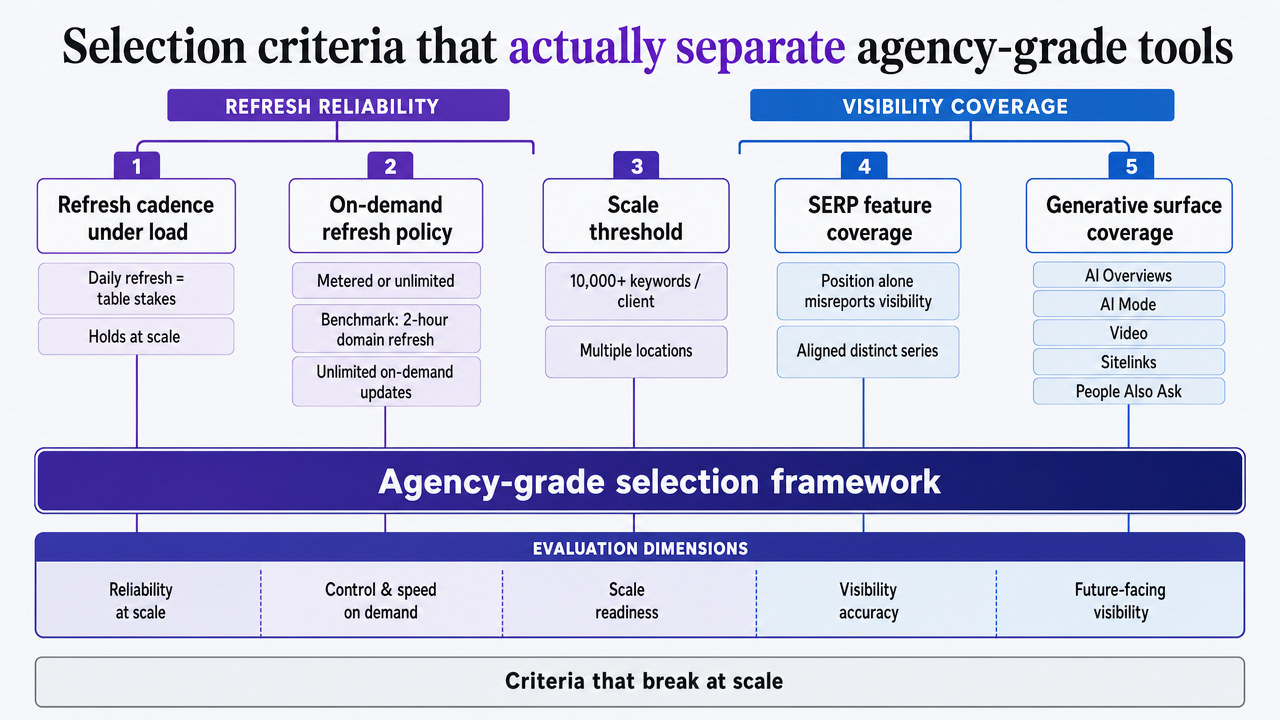 Visualize the five agency-grade selection criteria as a structured framework that supports the section's list of evaluation dimensions
Rank trackers slotted by job-to-be-done
AccuRanker — refresh speed and volatility analysis
AccuRanker earns its slot in an agency stack on one axis: refresh cadence under load. Its two-hour domain refresh with unlimited on-demand updates is the benchmark practitioners point to when managing 10,000+ keywords across multiple clients, and it is the reason volatility-focused teams tolerate higher per-keyword costs 9. Independent practitioner reviews reinforce the positioning, calling it the fastest tracker for live volatility analysis 7.
The job it does well is narrow but important. When an algorithm update lands mid-week, or a client's category page drops six positions overnight, an agency lead needs the next data point in hours, not tomorrow morning. AccuRanker also exposes SERP feature detection and geo-granular tracking that hold up when the same keyword set is replicated across dozens of city-level campaigns for multi-location brands.
Where it stops being the right tool is stakeholder reporting depth and forecasting. Teams that need executive-ready narrative reporting or predictive traffic modeling pair it with something else rather than stretching it into a role it was not built for.
Semrush Position Tracking — multi-channel all-in-one
Semrush Position Tracking earns its slot when the agency's operating model is consolidation rather than specialization. Practitioner reviews describe it as complete all-in-one tracking for multi-channel SEO — unmatched for teams that want position data, backlink signals, keyword research, and competitive intelligence in a single environment 7. That breadth is the point.
For agency SEO leads whose analysts split time across content, technical audits, and paid overlap analysis, one login with acceptable coverage across each surface beats six tools with best-in-class coverage on one axis. Position Tracking supports device, location, and tag segmentation at the granularity most stakeholder reports demand.
The trade-off is refresh cadence and SERP feature depth relative to specialized trackers. Agencies running heavy long-tail portfolios or same-day volatility work will find the update rhythm and API depth thinner than a dedicated tracker delivers.
seoClarity, BrightEdge, and Conductor — portfolio governance
This is the enterprise governance tier. seoClarity, BrightEdge, and Conductor are grouped because the job they do is the same: monitor large keyword portfolios across locations and devices, then add segmentation, governance, and reporting layers designed for multi-brand programs 6. The 2026 enterprise comparison frames their real value as turning raw rankings into stakeholder-ready visibility reporting for multi-site or multi-brand programs 6.
That framing matters for agency Heads of SEO who own portfolios spanning parent brands, sub-brands, and regional franchisees. Role-based access, workflow controls, and multi-property rollups are what keep the reporting layer from fragmenting when one analyst covers eight clients. These platforms also fold in unified AI and search visibility as an emerging differentiator, which aligns with the generative surface tracking now expected of the base stack 6, 3.
The cost is licensing weight and implementation time. These are procurement-cycle purchases, not self-serve signups, and their governance strength assumes the agency already has the operational discipline to use it.
SEOmonitor — forecasting-led reporting
SEOmonitor's slot is forecasting-led reporting. The 2026 enterprise comparison singles it out for forecasting as a discrete differentiator among enterprise trackers, positioning rank data as an input into predictive traffic and opportunity modeling rather than a standalone output 6.
That matters when the reporting conversation shifts from "where did we rank last month" to "what traffic and pipeline should we expect if we hold current positions through Q3." Agency leads pitching retention decks or annual renewals get more mileage from a forecast tied to keyword-level position probabilities than from a bar chart of last month's movement.
SEOmonitor works less well as a raw SERP feature or volatility tool. Teams that need same-day refresh or deep AI Overview segmentation supplement it rather than replace the specialized trackers already in the stack.
Nozzle and STAT — warehouse-grade SERP data
Nozzle and STAT occupy the warehouse-grade SERP data slot. Both are cited in the enterprise tier for depth of raw SERP capture and the ability to feed downstream data infrastructure at portfolio scale 6. Practitioner reviews echo the positioning, grouping Nozzle with the enterprise-grade tools agencies reach for when SERP intelligence depth and scalable reporting are the primary requirements 7.
The job here is not "look at rankings in a dashboard." It is "land structured SERP data in BigQuery or Snowflake next to GSC pulls, tag it by device, geography, and feature type, and join it to conversion data downstream" — the same pipeline logic that the GSC API row and pagination constraints force teams to design around in the first place 2.
Agencies without a data engineer or a warehouse strategy will not extract full value from either. The category rewards teams that have already accepted rank tracking is a data infrastructure problem.
SE Ranking and Similarweb — collaboration and market context
SE Ranking earns its slot on agency collaboration. Zapier's neutral overview flags it as best for agencies with strong collaboration tools, which matters when account teams, analysts, and client stakeholders need shared views without a proliferation of exported PDFs 8. White-label reporting and multi-client workspace structure make it a fit for agencies scaling out account teams.
Similarweb's slot is different. It sits in the enterprise tier as the tracker that blends rank signals with market intelligence, giving portfolio owners category-level share of voice and competitive traffic context alongside position data 6. That combination is useful when a client's quarterly review question is "how are we doing against the category," not "where did we rank last week."
Neither replaces a specialized volatility or forecasting tool. Both extend what the reporting layer can say.
Job-to-be-done comparison at a glance
The matrix below maps each tracker to a single primary job rather than an overall score. Agencies typically run two or three of these in parallel because no single tool covers every axis, and the operating decision is which specialization the portfolio needs most.
| Tool | Primary job | Source ||---|---|---|| AccuRanker | Refresh speed — two-hour domain refresh, unlimited on-demand updates for 10,000+ keyword portfolios | 9|| Semrush Position Tracking | Multi-channel all-in-one position tracking in a consolidated suite | 7|| seoClarity / BrightEdge / Conductor | Enterprise governance and stakeholder-ready reporting for multi-brand programs | 6|| SEOmonitor | Forecasting-led reporting tying position to predicted traffic | 6|| Nozzle / STAT | Warehouse-grade SERP data feeding BigQuery or Snowflake pipelines | 6, 7|| SE Ranking | Agency collaboration and multi-client workspace structure | 8|| Similarweb | Rank data blended with market and competitive intelligence | 6|
Read the matrix as a slot chart, not a leaderboard. The next section examines what the consolidation math looks like when these slots are filled fragmentarily versus as part of a decision-and-execution layer.
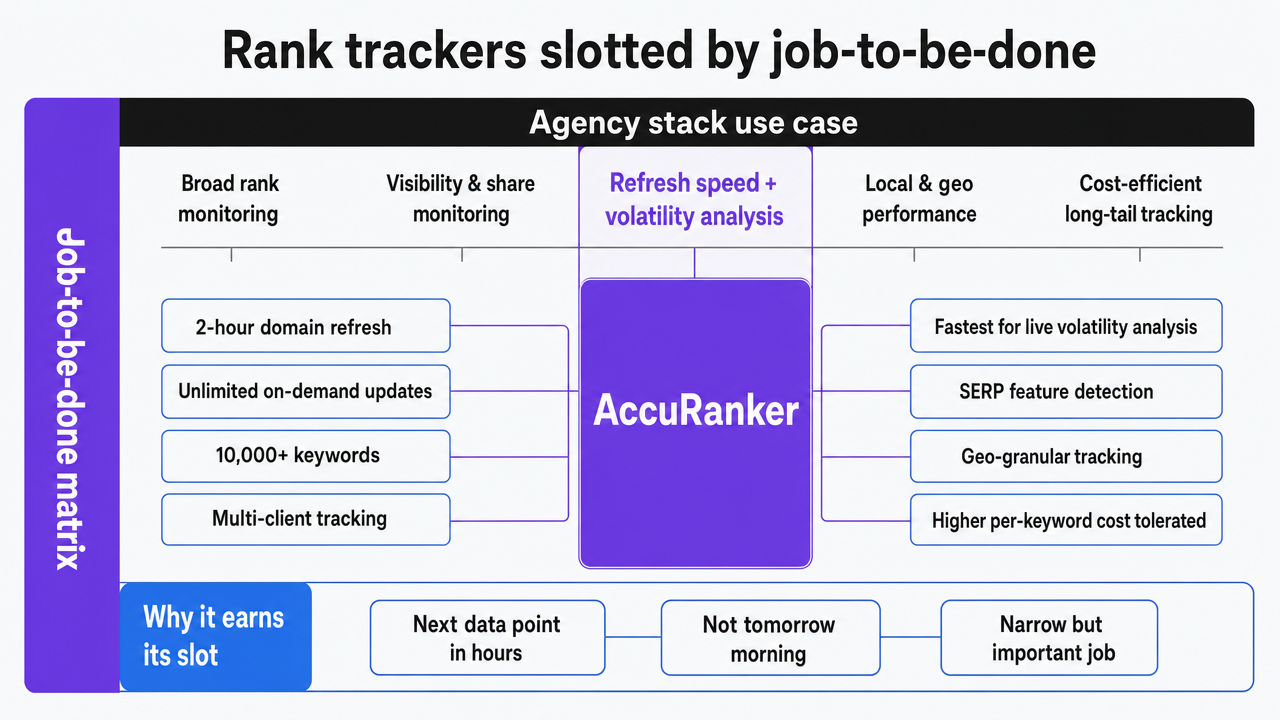 Render the job-to-be-done matrix comparing named rank trackers to the primary specialization each one owns, directly supporting the section's comparison table
See Enterprise-Scale Keyword Rankings Across All Clients—No Extra Headcount Required
Request a walkthrough of automated keyword position tracking designed for agencies managing hundreds of campaigns. Learn how unified reporting and approval-first workflows deliver precise, scalable oversight for multi-location clients.
Consolidation economics across a client portfolio
The license fee on a rank tracker is rarely the line item that decides a portfolio's margin. The cost sits in the reporting-to-decision-to-execution gap — the analyst hours spent reconciling GSC pulls with tracker exports, rebuilding client decks, translating position deltas into briefs, and routing those briefs into production. That gap widens with every additional client.
Three operating models compete for the same portfolio spend. A fragmented stack layers a specialized tracker on top of a separate reporting layer, a separate briefing tool, and analyst hours to stitch them. A partially consolidated model uses an enterprise tracker with built-in reporting, forecasting, and GA4/GSC integration to absorb the reporting layer 6, 10. An execution-layer model routes rank signals into a ranked approval queue that outputs briefs and tracks KPI impact against the same portfolio.
| Stack model | What it covers | Where the cost lives ||---|---|---|| Fragmented | Tracker license + separate reporting layer + separate briefing tool | Analyst hours: ($X/hr × Y hrs/client/month) × clients || Partially consolidated | Enterprise tracker with reporting, forecasting, GA4/GSC integration 6, 10| License weight + residual analyst hours to translate reports into work || Execution-layer consolidated | Rank data feeds a ranked approval queue that outputs approved briefs and production | Platform fee (Vectoron: $599/mo after 2-week trial) + reduced analyst hours per client |
The operational read: enterprise trackers compress the reporting layer but leave the briefing-and-execution translation intact 10. Portfolios that hold analyst hours per client as the fixed variable will find that the tracker license is not the constraint — the translation work is. Model the total against a per-analyst-hour rate and a realistic hours-per-client-per-month figure before renewing anything.
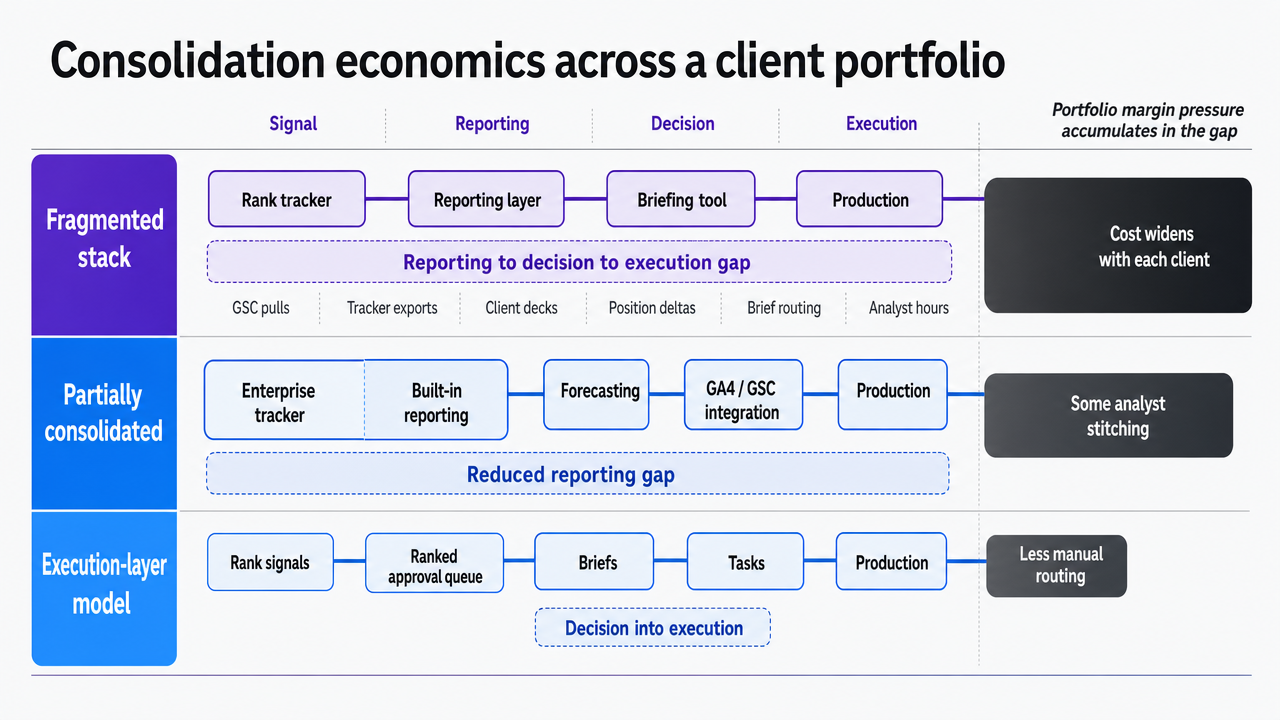 Visualize the three competing stack operating models and where cost accumulates, supporting the section's cited comparison of fragmented, partially consolidated, and execution-layer models
From rank signal to approved work: closing the execution gap
Rank tracking ends where the real work begins. A tracker reports that a client's category page dropped from position 4 to position 11, that an AI Overview now sits above the fold on three head terms, and that share of voice in two priority cities is down eight points week over week. None of that changes what gets shipped next unless someone translates the signal into a ranked brief, routes it for approval, and hands it to production. That translation is the analyst-hour line item enterprise trackers do not absorb.
The execution layer sits between the signal and the shipped asset. It ingests rank movement from whichever tracker owns each job — refresh speed, forecasting, warehouse-grade SERP data — joins it to GSC impressions and GA4 post-click behavior in the same property 1, and adds the generative surface impressions Search Console now exposes as a distinct series 3. Then it ranks the resulting opportunities by expected impact, drafts the brief, and holds it for human approval before production starts.
For agency Heads of SEO evaluating the 2026 stack, the practical decision is where the ranked approval queue lives. Enterprise trackers compress reporting but stop short of briefing and execution. Vectoron positions the decision-and-execution layer on top of the tracking stack rather than replacing it, so the specialized trackers keep doing the jobs they were chosen for while the translation work stops burning analyst hours per client.
Frequently Asked Questions
References
- 1.Linking Google Analytics 4 and Search Console.
- 2.Getting your performance data | Search Console API.
- 3.Introducing Search Generative AI performance reports in Search Console.
- 4.Global market share of search engines.
- 5.Search appearance – Performance data.
- 6.10 Best Rank Trackers for Enterprise SEO (2026).
- 7.15 Best Rank Tracking Software We're Using for 2026.
- 8.The 12 best rank tracker tools.
- 9.6 Best Rank Tracker Tools for Agencies in 2026 (Tested & Approved).
- 10.Enterprise SEO Software | Rank, Monitor & Grow - Click Insights.