
Key Takeaways
- AccuRanker makes daily refresh the default rather than a premium gate, giving agencies fresh volatility data before Monday standups instead of after scheduled crawls catch up.
- SE Ranking scales keyword allowances more linearly than the market, keeping per-keyword unit cost predictable for mid-book agencies expanding client counts without renegotiating tiers.
- Ahrefs Rank Tracker places position data next to backlink and content intelligence, shortening the diagnosis loop when a keyword slips and traffic explanations are needed.
- Semrush Position Tracking surfaces AI Overview presence and sponsored block density alongside organic position, helping account teams defend organic investment against paid attribution in the same room.
- STAT Search Analytics delivers API depth and ZIP-level local pack granularity that survives BI ingestion, fitting enterprise books piping ranked-list data into client warehouses.
- Nightwatch treats white-label PDF generation, scheduled delivery, and dashboard theming as core functionality, recovering analyst hours for agencies delivering monthly branded reports across 50-plus accounts.
- Vectoron shifts the unit of output from a chart to an approved unit of work, routing rank movement into scoped specialist workflows rather than another dashboard 9.
Why Position Data Alone Fails at Agency Scale
Rank tracking earns its keep only when it explains behavior downstream of the SERP. A number-three organic position on a query dominated by an AI Overview, a local pack, and two sponsored placements is not the same asset it was five years ago, and a dashboard that reports it as "green" is quietly misleading the account team. At agency scale, that gap compounds. Across a 100-client book with 500 tracked keywords each, roughly 50,000 position readings refresh on cadence, and any measurement bias in that pipeline propagates into weekly reports, quarterly business reviews, and renewal conversations.
Organic position also cannot be read in isolation from paid visibility. In one academic analysis of paid and organic click behavior, the mean click-through rate was 6.6% from paid searches and 2.77% from organic searches within that study's sample 10. That is a single dataset, not a universal CTR curve, and it should not be extrapolated to every vertical or query class. It does establish a useful directional point for heads of SEO defending organic investment: the same SERP can allocate clicks asymmetrically between channels, and the interaction is not always additive. Rank trackers that surface only organic position leave the account team arguing about a movement from four to two while the sponsored block absorbs demand the client is already paying for.
Position is a coordinate. Retrieval quality, click allocation, and SERP feature real estate are the terrain. Software that treats the coordinate as the whole map will not survive the scale-up from 30 clients to 300.
The Measurement-Quality Case Against Screenshot Reporting
Information-retrieval research has been unusually direct about the limits of raw usage metrics. In a controlled evaluation of eight absolute usage signals, none reliably reflected retrieval quality at the sample sizes tested, while interleaving-based paired comparisons held up under the same conditions 2. That finding is narrower than it sounds, it was conducted on specific query sets with specific click populations, but the operational implication travels. A rank tracker that reports position, visibility score, and estimated traffic as three independent green indicators is asserting a reliability that the underlying signal has not earned.
Clickthrough data has real value as a low-cost feedback layer, and it can produce unbiased comparisons under plausible experimental assumptions 1. The word doing the work in that sentence is assumptions. In a live agency reporting stack, those assumptions rarely hold: query mix drifts, SERP layouts change mid-week, and personalization contaminates aggregate click curves. The lesson is not that click and position data are useless, it is that they need to be interpreted as ranked-list evidence rather than isolated coordinates.
The evaluation traditions that search engines themselves rely on point the same direction. Test collections with graded relevance judgments and metrics like NDCG and ERR were built precisely because a single position number cannot describe how well a ranked list serves an intent 3, 4. Agencies do not need to run TREC-style evaluations to benefit from that thinking. They need to stop shipping weekly reports that treat a keyword moving from position six to position four as a self-evident win when the top of the page is now an AI Overview, a shopping module, and two ads.
At scale, this becomes a margin question, not an academic one. A senior strategist spending Monday morning reconciling screenshot artifacts against client dashboards is time that should be prioritizing which pages get intervention this week. Rank tracker software earns its budget when it treats position as one variable inside a ranked-list evaluation, surfaces SERP feature context alongside it, and lets the account team defend a movement with more than a color-coded cell.
How to Shortlist a Rank Tracker at Agency Scale
Shortlisting starts by rejecting the feature matrix. Most published comparisons rank tools on capabilities that behave identically at 500 keywords and break unpredictably at 50,000. Heads of SEO managing a 100-client book need a shorter set of criteria that map to margin, not to marketing copy.
Five mechanics do most of the work.
- Keyword ceiling economics: the effective cost per tracked keyword at the tier the agency actually operates in, not the entry tier used in vendor screenshots.
- Refresh cadence honesty: whether daily refresh is standard or gated behind an enterprise contract, and what the tool does when a client demands intraday checks during a launch.
- SERP feature coverage: local pack density, AI Overview presence, People Also Ask, shopping modules, and sponsored blocks tracked as first-class fields rather than optional overlays.
- API and export depth: raw ranked-list data extractable into a warehouse without hitting silent row caps, so client BI dashboards and internal prioritization models stay in sync.
- Downstream action: whether a rank movement produces a report or a prioritized unit of work.
For context on why that fifth criterion is drifting up the list, Forrester's 2024 review of U.S. agencies found the category focused on "enhancing productivity and a host of content, media, SEO" use cases as AI moved from pilot to production 7. The shortlist below is organized around those five mechanics, not around tier names.
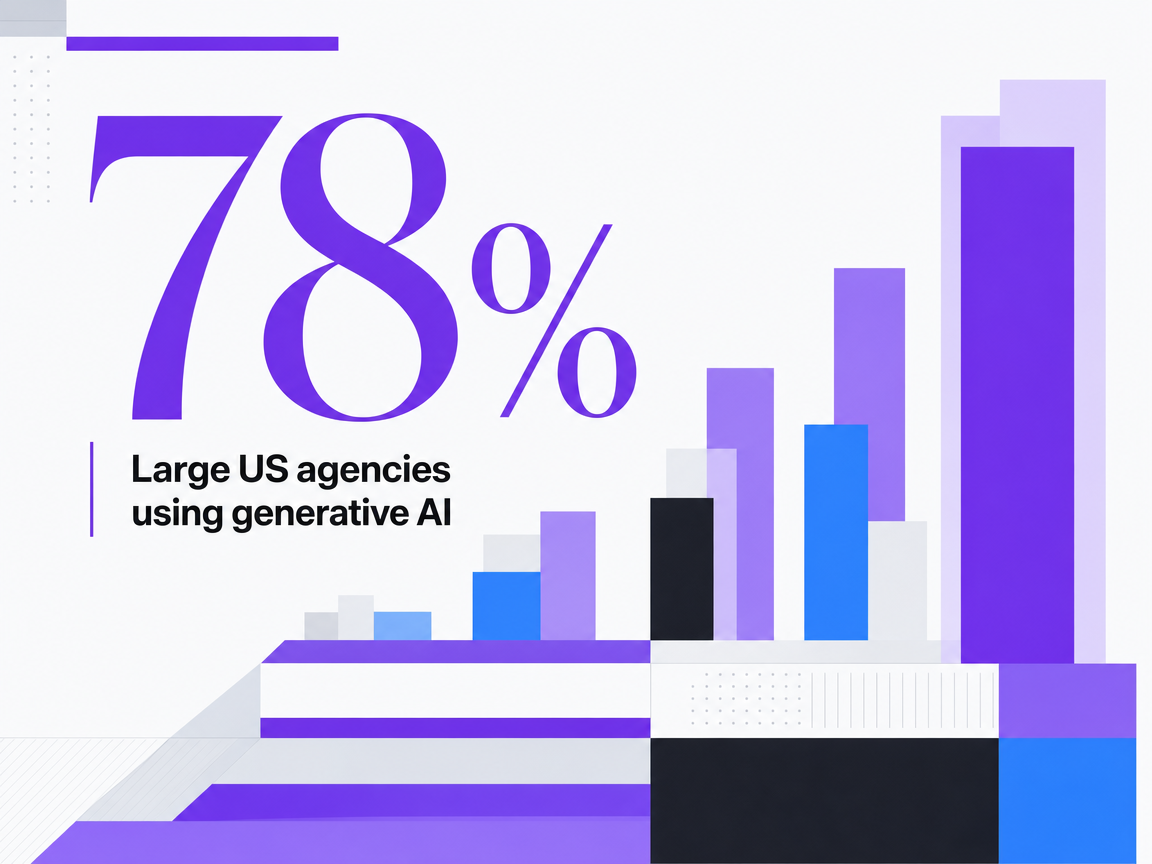 Large US agencies using generative AI
Large US agencies using generative AI
Track Live Keyword Rankings on Real Campaigns
Monitor actual keyword positions and publish content during your free trial to validate impact before committing.
Seven Tools Worth Shortlisting, Grouped by the Bottleneck They Remove
AccuRanker: Daily Refresh Cadence Without Enterprise Gatekeeping
AccuRanker's argument to agency operators is simple: daily refresh is the default, not a premium feature reserved for six-figure contracts. For an agency running launches, migrations, or algorithm-response work across a book of 100 clients, that cadence changes what a Monday standup can act on. A page that dropped Friday afternoon shows up in the ranked list before the account team writes the weekly note, not three days later once a scheduled crawl catches up.
The scale mechanic here is refresh honesty. Weekly or bi-weekly cadences hide volatility that matters during rollouts, and on-demand refreshes billed per query are a soft cap on how often analysts actually pull fresh data. AccuRanker's flat daily model removes that friction and makes SERP feature changes visible on the same clock as position changes.
The tradeoff is scope. It is a focused rank tracker, not a research platform, so agencies pair it with a separate backlink or content stack. For heads of SEO whose margin problem is analyst time spent reconciling stale data against client questions, that focus is the point rather than a limitation.
SE Ranking: Keyword Ceiling Economics for Mid-Book Agencies
SE Ranking wins the shortlist slot when the constraint is keyword volume per dollar. Agencies operating in the 30-to-80 client range typically track between 15,000 and 40,000 keywords in aggregate, and that range sits in an awkward pricing band with most enterprise tools. SE Ranking's published tiers scale keyword allowances more linearly than the market average, and add-on keyword packs are priced transparently rather than routed through sales.
The operator advantage shows up in book expansion. Onboarding a client with 800 tracked terms should not require renegotiating a platform contract or shifting the entire agency to a higher tier for one deal. SE Ranking treats keyword ceilings as a slider, which keeps the per-keyword unit cost predictable as the book grows.
AI Overview tracking, local pack visibility, and white-label reporting are covered in the same tier, though depth is moderate rather than best-in-class. For agencies that need defensible reporting across a mid-size book without paying enterprise rates for enterprise features they will not use, the economics do the arguing.
Ahrefs Rank Tracker: SERP Feature Coverage and Backlink-Adjacent Context
Ahrefs earns its position on the shortlist because rank data lives next to the backlink and content intelligence the same analyst is already querying. When a keyword slips from position three to seven, the same interface shows referring domain movement, competing pages that gained links in the interval, and content gap deltas against ranking peers. That adjacency shortens the diagnosis loop.
SERP feature coverage is broad. AI Overviews, featured snippets, sitelinks, image packs, and video carousels are tracked as first-class fields, so a movement that looks like a loss on paper can be read against the SERP layout that actually shipped. For agencies whose weekly reports have to explain why traffic fell while position held, that context is worth the tier cost.
The limit is refresh cadence and per-keyword economics at very high volumes. Ahrefs is a research-heavy platform, and rank tracking is one workflow inside it rather than the core product. Agencies with 50,000-plus tracked keywords often pair Ahrefs with a dedicated tracker for daily cadence and use Ahrefs for the diagnosis layer.
Semrush Position Tracking: AI Overview Visibility and Paid-Organic Overlap
Semrush is the shortlist entry when the account team has to defend organic investment against paid budget in the same room. Position Tracking surfaces AI Overview presence, featured snippet ownership, and sponsored block density on the same query view, which lets a strategist show where the SERP has changed shape rather than just where the ranking moved.
The paid-organic overlap is the differentiator. A keyword where the client ranks second organically but a competitor holds the top sponsored slot is a different asset than a keyword where the same client owns both. Reading those together matters because the interaction between paid and organic click allocation is not always additive, as the single-study CTR gap between paid and organic in one academic sample illustrated earlier 10. That interpretation is easier when the rank tracker already carries paid visibility fields.
The cost is complexity. Semrush is a broad platform, and rank tracking sits inside a stack that includes content, technical, and competitive modules an agency may not fully use. For heads of SEO whose reporting problem is defending organic spend against paid attribution, that breadth converts into a stronger narrative rather than shelfware.
STAT Search Analytics: Local Pack Density and API Depth for Enterprise Books
STAT is the shortlist entry when the book crosses into enterprise volume and the reporting layer has to feed a client data warehouse rather than a PDF. Its API surfaces ranked-list data, SERP feature detection, and share-of-voice metrics at granularity that survives BI ingestion without silent row caps, which matters when a single client tracks 20,000 keywords across 40 markets.
Local pack coverage is the second scaling mechanic. STAT tracks rankings at ZIP-level granularity, which lets an agency running a multi-location retail or service brand show pack density and organic position side by side for every trade area. That geographic depth is the difference between a defensible local SEO report and a national average that obscures the markets where the client is actually losing.
The tradeoff is procurement. STAT is quote-based, positioned toward enterprise contracts, and the setup work to instrument a full book is nontrivial. Agencies with sub-enterprise books typically feel the friction faster than the value. For heads of SEO whose CFO conversation is about API-fed reporting infrastructure, not seat counts, STAT earns the line item.
Nightwatch: White-Label Reporting Margin at Volume
Nightwatch's shortlist argument is margin per report. The scaling bottleneck it removes is the hidden cost of producing branded client deliverables at volume: PDF generation, scheduled email delivery, custom domains, and dashboard theming that the account team would otherwise assemble by hand or pay a reporting platform to layer on top.
The platform tracks rankings at city and ZIP granularity, covers standard SERP features, and exposes an API sufficient for agency BI use cases. Where it earns the slot is that white-label output is treated as core functionality rather than a premium add-on, which changes the per-client reporting cost for agencies delivering monthly branded packages across 50 or more accounts.
The limit is depth of research context. Nightwatch is built for tracking and reporting, not for content or backlink intelligence, so it pairs with a broader platform rather than replacing one. For agencies whose delivery model is recurring branded reports at volume, the reporting economics recover more analyst hours per month than a marginally better SERP feature panel would.
Vectoron: Rank Movement Inside a Coordinated Execution Loop
The final shortlist entry changes what happens after a rank moves rather than how the movement is displayed. Traditional rank trackers produce a report. A coordinated execution platform routes the same movement as a prioritization signal into an approval queue, where specialist workflows for content, technical fixes, and link acquisition are already scoped. The unit of output shifts from a chart to an approved unit of work.
The research case for that redesign is direct. McKinsey's analysis of agentic AI in growth workflows notes that some Fortune 250 companies have seen campaign creation and execution speed up 15-fold when the workflow itself is redesigned around agents rather than bolted onto legacy handoff steps 9. The gain came from removing briefing cycles and status meetings between rank data and executed work, not from a faster crawler.
For heads of SEO defending delivery margin, the mechanic that matters is approval-queue latency. When a position drop on a commercial page generates a scoped intervention with the strategic reasoning attached, waiting for human sign-off before execution, the account team spends its week approving prioritized work rather than reconciling dashboards. Vectoron is the entry on this shortlist that treats rank tracking as one input into that loop, not the deliverable.
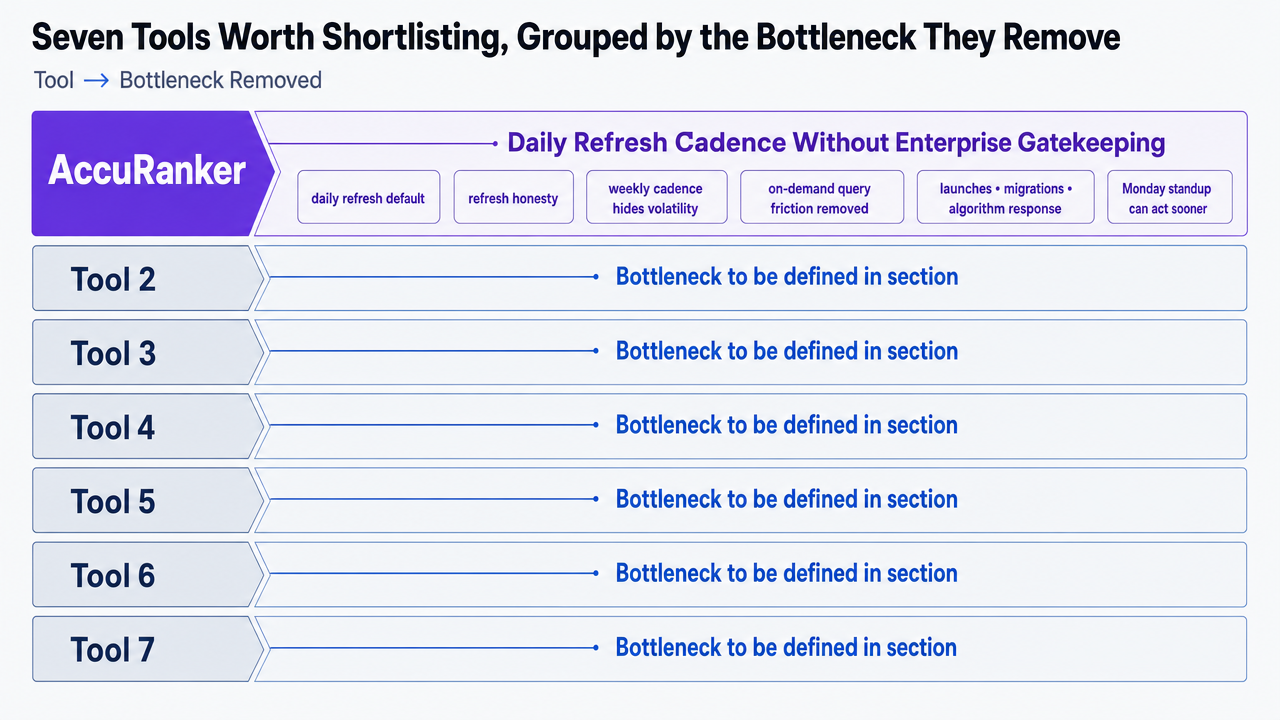 Visualize the seven shortlisted tools mapped to the specific scaling bottleneck each one removes, mirroring the article's organizing frame for this section
Operator Economics: Cost per Tracked Keyword Across a 100-Client Book
The number a head of SEO actually defends to the CFO is not the sticker price of a rank tracker. It is the effective cost per tracked keyword per month at the volume the agency operates at, and the recoverable specialist hours the tool frees up once rank-to-action latency drops. Both variables move independently, and both need to be modeled before a platform contract is renewed.
At a 100-client book tracking roughly 500 keywords each, the working assumption is 50,000 tracked terms with daily or near-daily refresh. Published entry tiers are useful reference points, but agencies rarely sit at them. The table below uses only vendor-published pricing where it exists and marks quote-based tools explicitly rather than inventing a figure.
| Tool | Published entry tier | Refresh cadence at entry | Effective cost per keyword per month at 50k | Scale ceiling note |
|---|---|---|---|---|
| AccuRanker | Published, per-keyword tiers | Daily standard | Published tiered rate, declines with volume | Enterprise pricing at 50k, negotiated |
| SE Ranking | Published tiers with add-on keyword packs | Daily on higher tiers | Published add-on pack rate applies | Daily refresh gated above entry tier |
| Ahrefs Rank Tracker | Bundled inside platform tiers | Weekly standard, daily on higher tiers | Blended rate, not a standalone SKU | Per-keyword economics degrade at very high volumes |
| Semrush Position Tracking | Bundled inside platform tiers | Daily on higher tiers | Blended rate, not a standalone SKU | Keyword caps per project require multi-seat scaling |
| STAT Search Analytics | Quote-based | Daily standard | Quote-based | Positioned for enterprise contracts |
| Nightwatch | Published tiers | Daily standard | Published tiered rate | White-label included at core tier |
| Vectoron | Published subscription | Not sold per keyword | Priced as execution platform, not per-keyword | Rank tracking is one input, not the SKU |
The second variable is harder to price but larger in dollar terms. McKinsey's analysis of generative AI in marketing estimates the productivity impact at 5% to 15% of total marketing spending, a directional forecast rather than a measured outcome 6. Applied to an agency's specialist payroll, that range translates into a variable formula worth modeling: recoverable specialist hours per week equal the number of SEO specialists times weekly hours times the share of time currently spent reconciling rank data into prioritized work, multiplied by the automation coverage of the chosen platform. A ten-specialist team spending 20% of the week on that reconciliation is 80 hours of weekly capacity sitting inside the reporting layer. Even a partial recovery moves margin more than the difference between two vendor tiers.
The operational read is straightforward. Cost per tracked keyword is the line the CFO asks about. Recoverable specialist hours is the line that decides whether the book can grow from 100 clients to 140 without a hire.
Scale SEO Impact with Unified Keyword Tracking and Automated Reporting
Connect with our team to see how centralized rank tracking and automated insights can streamline large-scale SEO management across all your client accounts.
If You Manage Multi-Location Portfolios: Local Pack and Vertical Nuance
A note on audience scope: this section speaks to heads of SEO running multi-location portfolios, DSOs, behavioral health networks, senior living groups, and similar service brands where a single client can carry 30 to 400 trade areas under one contract. The measurement problem changes shape at that level. National average position becomes actively misleading, because a brand can hold position two nationally while losing the local pack in the twelve markets that produce most of the revenue.
The operational read is that local pack density and ZIP-level ranked-list data have to be first-class fields, not overlays. STAT and Nightwatch earn their shortlist slots here because both instrument geographic granularity that survives BI ingestion, which is the difference between a defensible market-by-market report and a national number the client's regional VP will reject on sight. Semrush and SE Ranking cover local pack tracking at moderate depth and work well for portfolios below roughly 50 locations per client.
Vertical nuance matters for regulated categories. Peer-reviewed work on healthcare SEO notes that search visibility meaningfully influences patient choice of provider and that content quality carries its own weight in medical verticals 11. For agencies serving DSOs or behavioral health networks, rank movement on commercial queries is only defensible when paired with content review that the account team can route for clinical sign-off before publication.
Choosing Between the Seven: A Decision Frame for Heads of SEO
The decision is not which tool has the best feature panel. It is which scaling bottleneck the agency is currently paying to work around, and which platform makes that bottleneck cheaper next quarter.
- Agencies whose Monday standups stall on stale data buy AccuRanker.
- Mid-book operators whose margin gets eaten by tier renegotiations at every onboarding buy SE Ranking.
- Teams whose weekly reports have to explain traffic loss without position loss buy Ahrefs.
- Account leads defending organic spend against paid attribution buy Semrush.
- Enterprise books piping ranked-list data into client warehouses buy STAT.
- Agencies whose delivery model is recurring branded reporting at volume buy Nightwatch.
- Heads of SEO whose real problem is rank-to-action latency, not rank visibility, buy into an execution loop like Vectoron.
Most agencies at 100 clients run two of these, not one: a dedicated tracker for cadence and export depth, and an execution or research layer that turns movement into scoped work. The wrong question is which single vendor wins. The right question is which combination removes the two most expensive hours per specialist per week, and whether the platform contract renewing next quarter still maps to a bottleneck the agency actually has.
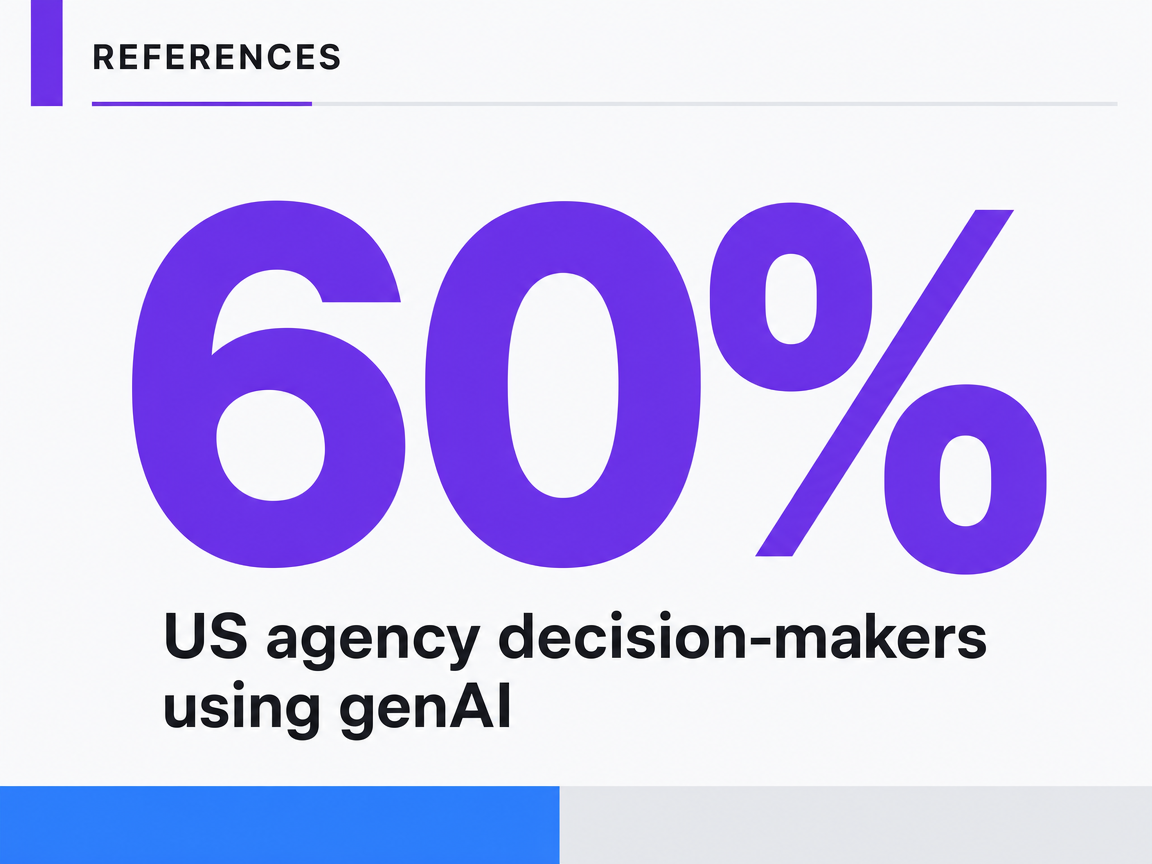 US agency decision-makers using genAI
US agency decision-makers using genAI
Frequently Asked Questions
References
- 1.Evaluating Retrieval Performance using Clickthrough Data.
- 2.How Does Clickthrough Data Reflect Retrieval Quality?.
- 3.Building Better Search Engines by Measuring Search Quality.
- 4.Overview of the TREC 2015 Tasks Track.
- 5.Reinventing marketing workflows with agentic AI.
- 6.Economic potential of generative AI: The next productivity frontier.
- 7.The State Of Generative AI Inside US Agencies, 2024.
- 8.Generative AI Use and Management at Federal Agencies.
- 9.Agents for growth: Turning AI promise into impact.
- 10.Analyzing the Relationship Between Organic and Sponsored Search Results.
- 11.Search engine optimization as a promotional tool for healthcare services.
- 12.Digital Marketing Strategies to Improve Patient Engagement in Healthcare.