
Key Takeaways
- AccuRanker earns a shortlist slot on refresh speed and SERP feature accuracy, giving account managers a fast way to verify ranking drops before client calls 6, 3.
- SE Ranking fits agencies whose bottleneck is reporting throughput, with native white-label, a 50,000 keyword ceiling, API access, and Looker Studio integration at the enterprise tier 7, 4.
- Nightwatch suits portfolios with mixed geographies and non-standard reporting cuts, handling segmentation inside the product rather than pushing it into a downstream BI layer 3, 4.
- ProRankTracker and Advanced Web Ranking compete on client-facing reporting depth and multi-region granularity, staying on shortlists as ranking-first specialists with strong agency reporting surfaces 4, 3.
- Semrush consolidates ranking, content, technical, and AI visibility in one workspace, with an AI Visibility Score that reduces stitching across tools when clients ask about AI Overviews 10, 6.
- Ahrefs and Moz sit in the consolidated tier with different centers of gravity — Moz Enterprise via STAT handles 100,000 keywords for rank monitoring at scale, while Ahrefs pulls agencies toward research consolidation 7.
- BrightEdge, Conductor, and Botify belong on shortlists for enterprise clients, winning on share-of-voice, AI crawler tracking, and log-file analysis rather than on rank tracking itself 10, 6, 7.
- Vectoron is positioned as an execution platform where ranking data feeds an approval-first workflow, targeting agencies whose bottleneck is coordination overhead rather than position accuracy 8, 2.
The agency rank tracking decision has changed shape
Every agency SEO lead already runs a rank tracker. The question in 2026 is not whether to track keyword positions, but how much of the delivery workflow the ranking layer should absorb. The category has quietly split into two: focused rank trackers optimized for SERP coverage and refresh speed, and consolidated visibility platforms that fold ranking into share-of-voice, AI search coverage, and cross-channel reporting.
That split is happening against an expanding market, not a shrinking one. CMSWire's analysis of Scott Brinker's MarTech supergraphic found that SEO technology grew 24% between 2023 and 2025, the highest growth rate of any MarTech category in that window 8. The narrative that generative search would collapse SEO tooling has not played out in the vendor landscape.
What has changed is where the pressure lives. Google's June 2026 rollout of generative AI performance reports in Search Console added a new visibility surface for agencies to explain to clients, with impressions, pages, countries, devices, and dates now broken out for AI Overviews and AI Mode 2. Rank tracking software that stops at blue-link positions leaves a growing share of client visibility unaccounted for.
The tools worth shortlisting sit on both sides of that split. The rest of this article maps them against agency-specific criteria:
- multi-client architecture
- white-label reporting
- AI visibility coverage
- API depth
- the coordination cost of running the stack at 20 or more accounts 4
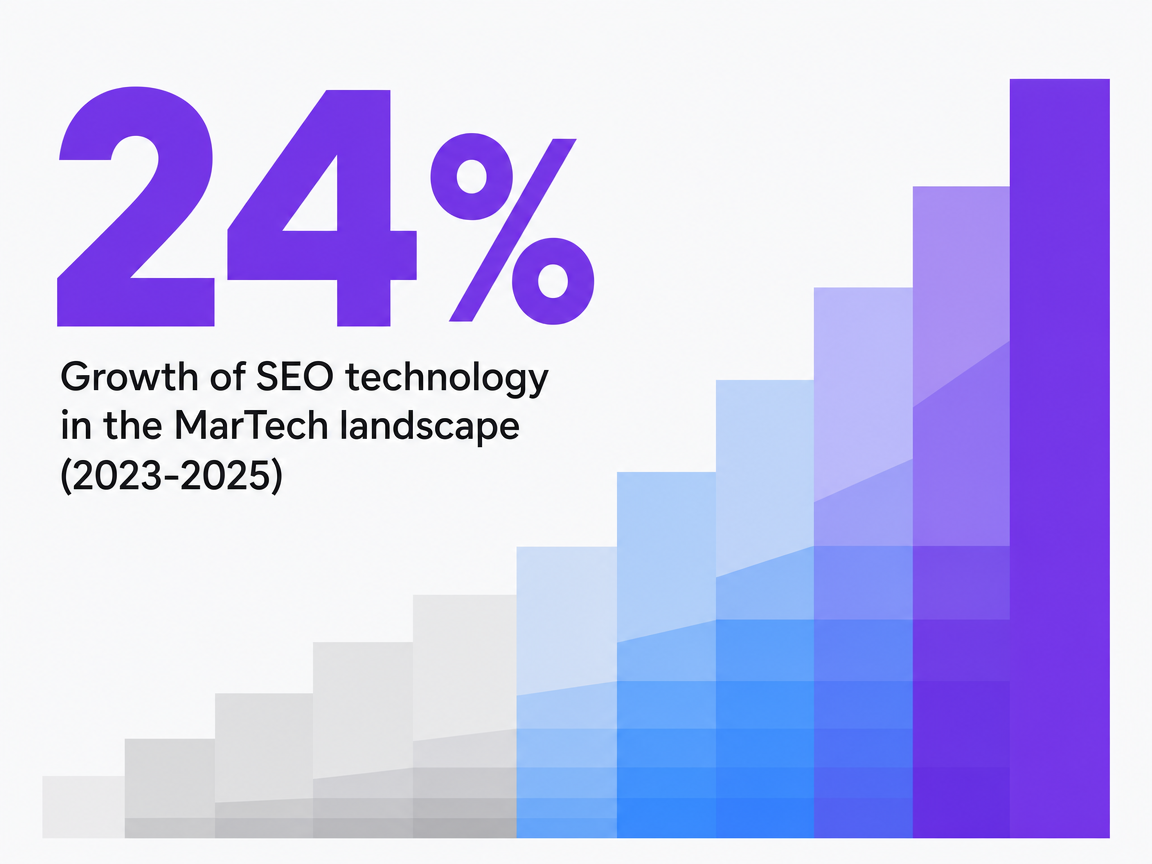 Growth of SEO technology in the MarTech landscape (2023-2025)
Growth of SEO technology in the MarTech landscape (2023-2025)
Two tiers of rank tracking, and where each one fits
The clearest way to read the current market is to separate tools by what they are optimized to do, not by their marketing category. On one side sit focused rank trackers: AccuRanker, Nightwatch, ProRankTracker, and Advanced Web Ranking. On the other sit consolidated visibility platforms: Semrush, Ahrefs, BrightEdge, Conductor, Botify, and seoClarity. Both track keyword positions. The difference is what else the platform is doing while it tracks.
Focused rank trackers compete on refresh speed, SERP feature accuracy, and reporting flexibility. When Konabayev's 2026 enterprise comparison names a single tool for rank tracking speed and accuracy, it names AccuRanker 6. That is the archetype for this tier: a specialist that pulls positions faster, handles larger keyword sets per client cleanly, and exports into whatever reporting layer an agency has already built. Nightwatch, ProRankTracker, and Advanced Web Ranking sit in the same bucket with different strengths in segmentation, local packs, and international coverage 4.
Consolidated visibility platforms treat rank tracking as one input among many. Conductor and Semrush Business, per that same analysis, cover most large-team needs by combining ranking with content workflows, technical audits, share-of-voice, and increasingly AI visibility 6. BrightEdge, Botify, and seoClarity extend the pattern into log-file analysis, share-of-voice dashboards, and AI crawler behavior 10. The tradeoff is real: broader coverage, slower rank refreshes on very large keyword sets, and a heavier seat and contract commitment.
The practical question for an agency SEO lead is which tier the delivery bottleneck actually lives in. If client churn conversations turn on how quickly the team can spot a ranking drop and explain it, a focused tracker earns its seat. If the recurring problem is stitching rank data to content production, technical fixes, and AI visibility inside one client review, the consolidated platform is doing more of the work the team would otherwise coordinate by hand.
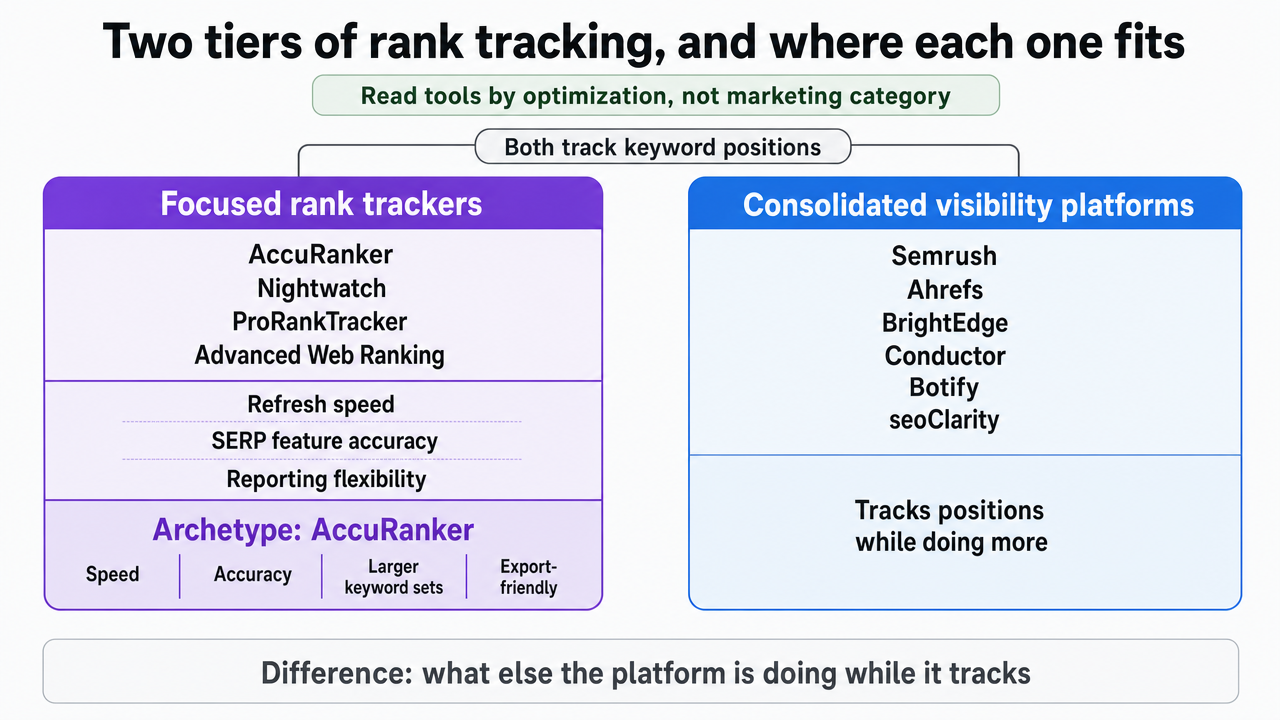 Visualize the article's explicit two-tier framework separating focused rank trackers from consolidated visibility platforms, mapping named tools to each tier
Test Real-Time Keyword Tracking Across All Clients
Experience live keyword rank monitoring and reporting for your client accounts with full publishing capabilities during your trial.
Agency-critical evaluation criteria beyond position accuracy
Multi-client architecture and white-label reporting
Position accuracy is table stakes. What separates agency-fit software from tools built for a single in-house team is how the platform handles thirty or a hundred client workspaces without turning reporting into a manual export job. The consensus criteria across agency-focused reviews land in the same place:
- multi-client support
- white-label reporting
- local and global tracking
- integrations with Google Analytics or Looker Studio 4
The reporting layer is where most agencies feel the friction first. Client-facing dashboards need to render under the agency's brand, on the agency's domain, with permissions that let account managers share views without exposing the underlying workspace. SE Ranking's enterprise tier and Moz's enterprise offering both build white-label reporting and branded reports into the platform rather than treating them as a plugin 7. For a lead managing 40 accounts, the difference between white-label as a native feature and white-label as a workaround is measured in hours per reporting cycle.
API access, Looker Studio, and analytics plumbing
API depth decides whether rank data stays trapped inside a vendor's UI or feeds the reporting layer the agency has already built. Premium API access at the enterprise tier is now standard across the platforms agencies actually shortlist, with Moz Enterprise and SE Ranking Enterprise both exposing API endpoints for historical data and large keyword sets 7.
Looker Studio is the practical test. Agencies that have standardized client reporting on Looker Studio need rank data flowing into the same canvas as GA4, GSC, ad platforms, and call tracking. DesignRush's 2026 agency comparison names Google Analytics and Looker Studio integrations as a baseline evaluation criterion, not an advanced one 4. Tools that require a middleware connector or a paid Zapier bridge to reach Looker Studio add coordination overhead that compounds with every new client onboarded.
AI visibility as a new evaluation axis
The evaluation axis that did not exist eighteen months ago is AI search visibility. Google's June 2026 rollout of generative AI performance reports in Search Console gave agencies a first-party view into impressions, pages, countries, devices, and dates for AI Overviews and AI Mode 2. That data now sits alongside traditional Search results, and clients are asking about it in monthly reviews.
Third-party platforms are stacking on top of that first-party signal:
- Botify's Log File Analyzer tracks AI crawler behavior at the server level
- BrightEdge's DataCube and Copilot layer AI recommendations onto keyword intelligence
- Semrush has introduced an AI Visibility Score alongside prompt research features 10
Each vendor is solving a slightly different piece of the same problem: how to attribute visibility inside generative results that do not always produce a click.
For an agency SEO lead evaluating keyword rank tracking software in 2026, the question is not whether AI visibility is real but which layer of the stack the vendor covers. Search Console reports the impressions. Third-party platforms score the visibility. The client dashboard has to render both without the account manager stitching screenshots together. Software that ignores AI surfaces entirely is quietly under-reporting client performance every month.
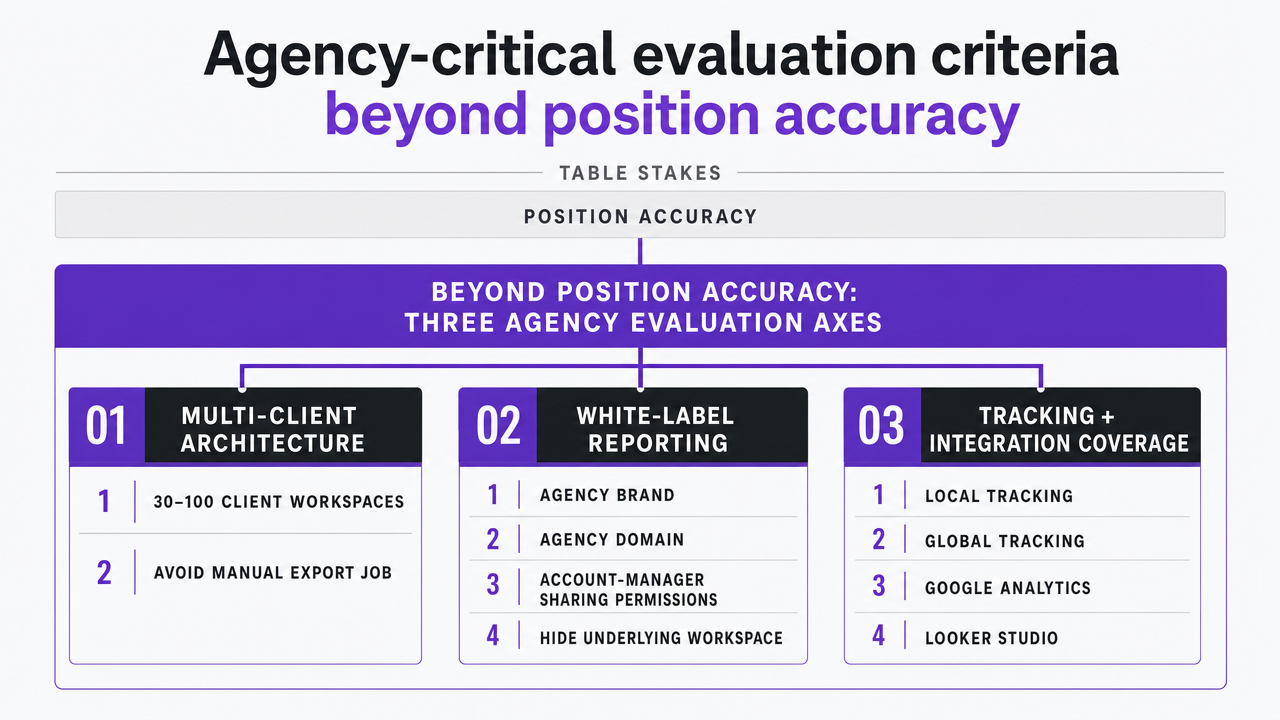 Summarize the three cited evaluation axes agencies use to assess rank tracking software beyond position accuracy
The shortlist: eight tools worth putting in front of an agency SEO lead
AccuRanker — the speed and accuracy specialist
AccuRanker earns its shortlist slot on one job done unusually well: fast, accurate position data at the scale an agency actually operates. Konabayev's 2026 enterprise comparison singles it out as the reference tool for rank tracking speed and accuracy, not as a broader SEO suite 6. Zapier's review lands in the same place, flagging AccuRanker for precise and reliable tracking rather than for content or backlink workflows 3.
For an agency that has already invested in Looker Studio dashboards, Ahrefs for research, and a separate reporting layer, AccuRanker slots in as the ranking data source without asking the team to migrate anything else. On-demand refreshes matter when an account manager needs to verify a position drop before a client call, and SERP feature tracking has kept pace with the surfaces Google keeps adding 3.
The tradeoff is scope. AccuRanker does not attempt to consolidate content briefs, technical audits, or AI visibility scoring inside one workspace. Agencies that want ranking depth without paying for suite features they will not use put it near the top.
SE Ranking — the agency workflow default
SE Ranking shows up on almost every 2026 agency shortlist because it was built around the workflow, not retrofitted for it. Zapier names it as the tool for agencies specifically 3, and DesignRush places it at the top of its six-tool agency comparison for multi-client support and white-label reporting 4.
The feature set reads like an agency ops checklist. White-label reporting ships as a native capability at the enterprise tier, with a 50,000 keyword ceiling, API access, and historical data included rather than bolted on through partner integrations 7. Google Analytics and Looker Studio integrations sit inside the baseline product, which matters when client reporting has already standardized on Looker canvases 4.
Where SE Ranking sits relative to AccuRanker is a portfolio question. Agencies whose primary bottleneck is client-facing reporting throughput tend to consolidate on SE Ranking and accept slower peak refresh speeds. Agencies whose primary bottleneck is diagnostic speed on a specific client's rankings pair AccuRanker with a lighter reporting layer. Both patterns show up in the current market.
Nightwatch — segmentation and custom reporting for niche portfolios
Nightwatch fits agencies whose client portfolios do not look like a uniform mix of local service businesses. Its segmentation engine and custom reporting depth show up consistently across 2026 agency reviews as the reason to shortlist it over more generalist trackers 3, 4.
The practical use case is portfolios with mixed geographies, mixed intent categories, and clients that need reporting cut in non-standard ways. Nightwatch handles that segmentation inside the product rather than pushing it downstream into a BI layer. For agencies that manage international clients or clients with unusually deep local packs, that saves the reporting analyst hours per month.
EWR Digital's 2026 review flags a real tradeoff: Nightwatch, like several traditional platforms, requires add-ons to cover AI visibility tracking natively, and cost climbs as those layers stack up 10. Agencies that shortlist it typically pair it with a first-party Search Console pull for AI Overviews impressions rather than paying for a bundled AI visibility module they do not fully trust yet.
ProRankTracker and Advanced Web Ranking — local, global, and client-facing depth
ProRankTracker and Advanced Web Ranking (AWR) belong in the same conversation because they solve similar problems from different angles. Both appear on DesignRush's six-tool agency shortlist 4and Zapier's twelve-tool comparison 3, and both compete on client-facing reporting depth alongside multi-region tracking.
ProRankTracker's strength is the client-facing layer: white-label dashboards, share links, and scheduled reports that account managers can hand to clients without additional design work 4. For agencies whose reporting bottleneck is the last mile between rank data and a client-ready deliverable, that layer is where the hours accumulate.
Advanced Web Ranking earns its place on the strength of geographic and device granularity. Agencies with clients that need position data across dozens of locales, or that run separate mobile and desktop reporting, use AWR because the segmentation is native rather than assembled through filters 3, 4.
Neither tool tries to become a content or backlink platform. Both are ranking-first specialists with an agency reporting surface, which is why they stay on shortlists even as consolidated platforms expand their own reporting features.
Semrush — consolidated visibility with AI Visibility Score
Semrush is the reference point for consolidated platforms because it now spans ranking, content, technical, and AI visibility inside one workspace. WorldMetrics' 2026 enterprise comparison scores Semrush at 9.3/10 as an enterprise suite 5, and Konabayev names it, alongside Conductor, as the platform that covers most large-team needs in 2026 6.
The recent development that matters for rank tracking specifically is the AI Visibility Score. EWR Digital's 2026 review documents Semrush adding an AI Visibility Score and prompt research features that sit alongside traditional keyword position tracking 10. For agencies that need to answer client questions about AI Overviews performance without stitching third-party tools together, that convergence changes the shortlist math.
The cost profile is the honest counterweight. EWR Digital also notes that Semrush and comparable platforms can become very expensive once AI tracking add-ons are enabled at agency scale 10. Agencies that already have five or more seats and clients asking monthly about AI visibility tend to consolidate here. Agencies whose clients are still reporting purely on blue-link rankings often find the suite premium harder to justify.
Ahrefs and Moz — enterprise-grade rank monitoring inside broader suites
Ahrefs and Moz sit adjacent to Semrush in the consolidated tier, but each brings a different center of gravity to rank monitoring. Both appear on Zapier's tool-by-tool comparison 3and Authencio's eleven-platform enterprise report 7.
Moz Enterprise anchors on STAT Search Analytics for large-scale rank monitoring, with a 100,000 keyword ceiling, branded reports, and premium API access included at the enterprise tier 7. For agencies with clients that need daily tracking across tens of thousands of keywords — retail, publishers, large local portfolios — STAT is often the ranking layer of record even when the rest of the SEO work happens in other tools.
Ahrefs Enterprise plays a different role. Its rank tracker is competent, but the platform's gravitational pull is backlink intelligence and content research 7. Agencies that shortlist Ahrefs are typically consolidating research and rankings rather than treating it as their reporting spine.
The choice between Moz and Ahrefs inside an agency stack usually comes down to which discipline the team optimizes for first. Rank monitoring at scale points toward Moz and STAT. Research-led SEO with rankings as a secondary output points toward Ahrefs.
BrightEdge, Conductor, and Botify — when rank tracking is a byproduct
BrightEdge, Conductor, and Botify belong on the shortlist for agencies serving enterprise clients, and they belong there with a caveat: rank tracking is not why any of these platforms exist. They earn contracts on share-of-voice reporting, AI visibility, and technical scale, with ranking data as one input among many 6, 7, 10.
- BrightEdge leads with DataCube for keyword intelligence and its Copilot layer for AI-driven recommendations, packaged for C-suite dashboards and share-of-voice reporting 10.
- Conductor sits in similar territory as a workflow-heavy enterprise platform that Konabayev groups with Semrush as covering most large-team needs 6.
- Botify differentiates on log-file analysis and, more recently, tracking AI crawler behavior at the server level — a capability that matters for large sites where crawl efficiency and AI bot access directly affect visibility 10.
Agencies that white-label these platforms are typically serving one or two enterprise clients where the client's in-house team already uses the tool. Standing them up across a fifty-account agency portfolio is rare, and Authencio explicitly notes that some of these platforms are overkill for smaller sites 7. Shortlist them for the enterprise slice of the book, not for the whole roster.
Vectoron — ranking data feeding an approval-first execution workflow
Vectoron belongs on this list with the framing stated plainly: it is not a rank tracker competing with AccuRanker on refresh speed or with Semrush on keyword database size. It is an execution platform where ranking data feeds a specialist-strategist workflow that produces the content, technical fixes, and reporting an agency would otherwise coordinate by hand.
The category context makes the positioning coherent. SEO technology grew faster than any other MarTech segment between 2023 and 2025 8, and Google's June 2026 generative AI performance reports added a new visibility surface agencies now have to explain to clients 2. Both trends point toward the same operational question: how much of the delivery loop should sit inside one governed workflow rather than across a stack of connected tools.
Vectoron's answer is approval-first automation. Specialist AI strategists surface ranked recommendations tied to live ranking, content, and channel data, and every recommendation routes to a human for sign-off before execution. For agency leads whose bottleneck is coordination overhead rather than position accuracy, that is the shortlist entry to test against a point-tool stack.
See How Leading Agencies Streamline Keyword Rank Tracking at Scale
Get a walkthrough of unified rank tracking solutions designed for agencies managing hundreds of campaigns—see live reporting, workflow integration, and approval-first automation in action.
If you manage 20 or more client accounts: the consolidation economics
Scope shift: this section is for agency leads running 20 or more active client accounts, where the coordination cost of the tool stack starts to outweigh per-seat license math. Below that threshold, a focused rank tracker plus a reporting layer usually wins on flexibility. Above it, the question becomes how many separate contracts, exports, and reconciliations the ops team is absorbing every month.
Three approaches are worth comparing on the same axes agencies actually feel:
- tracked-keyword ceiling
- white-label reporting
- AI visibility coverage
- API and Looker Studio access
- coordination overhead across the delivery loop
| Approach | Tracked-keyword ceiling | White-label reporting | AI visibility coverage | API / Looker Studio | Coordination overhead |
|---|---|---|---|---|---|
| Point-tool stack (e.g., AccuRanker + separate reporting + AI add-ons) | Depends on stacked seats | Assembled across tools | Requires separate module or first-party GSC pull 2 | Available per tool, stitched in Looker 4 | Highest — multiple vendors, exports, reconciliations |
| Consolidated platform (Moz Enterprise, SE Ranking Enterprise, Semrush) | 100k on Moz Enterprise via STAT; 50k on SE Ranking Enterprise 7 | Native at enterprise tier, branded reports included 7 | Share-of-voice reporting and AI-driven insights bundled 7 | Premium API access and historical data included 7 | Moderate — one contract, one workspace |
| Execution platform (ranking data feeding approval workflow) | Depends on connected data sources | Native, tied to approval workflow | Included in the same governed loop | Included | Lowest — ranking, content, and channel work in one queue |
The pattern most agencies land on above 20 accounts: consolidate the reporting spine on one enterprise platform, keep a focused tracker only where refresh speed materially changes a client conversation, and stop paying for overlapping keyword databases across three vendors.
How to run the shortlist inside your delivery team
A shortlist is only useful if the evaluation runs against the actual delivery bottleneck, not against a feature matrix pulled from vendor sites. The agency leads who pick well tend to start with the same diagnostic: which client conversation the team loses time on every month.
- If that conversation is diagnostic speed on a ranking drop, run AccuRanker against the incumbent on the same 500-keyword client set for two weeks and measure refresh latency and SERP feature accuracy 6.
- If the conversation is reporting throughput, run SE Ranking or ProRankTracker against the current stack on white-label output and Looker Studio integration time 4.
- If the conversation is AI Overviews performance, connect Search Console's generative AI reports first and layer a third-party AI visibility score on top before committing to a suite upgrade 2, 10.
Two rules keep the pilot honest. Score tools on the criteria the delivery team actually feels, not on database size or feature counts that never enter a client review. And put someone from account management on the evaluation, not only SEO ops, because the reporting layer is where the tool either saves hours or quietly costs them.
For agencies whose bottleneck is coordination rather than position accuracy, the evaluation shifts from rank trackers to execution platforms where ranking data feeds one governed workflow. Vectoron is built for that specific case: ranking signals routed through specialist AI strategists, every recommendation approved by a human before execution, and the delivery loop consolidated inside one queue instead of stitched across vendors.
Frequently Asked Questions
References
- 1.12 Best Keyword Rank Tracking Tools for Agencies.
- 2.Introducing Search Generative AI performance reports in Search Console.
- 3.The 12 best rank tracker tools.
- 4.Discover the Top 6 Agency Rank Tracking Tools for 2026.
- 5.Top 10 Best Enterprise SEO Software: 2026 Comparison.
- 6.Best Enterprise SEO Tools in 2026 Compared.
- 7.11 Best Enterprise SEO Platforms 2026: Consolidate & Scale.
- 8.Martech Madness, 15000 Logos Later.
- 9.The State of Martech 2024.
- 10.Best Enterprise SEO Tools & Platforms (2026 Full Review).