
Key Takeaways
- Semrush anchors most agency stacks as a full-platform default with 170 top-three practitioner mentions, but its alerts report change without queuing the next action 4.
- Ahrefs earns its slot on portfolio depth, named the primary link analysis tool by 78% of enterprise-serving agencies, though reporting and workflow triggering remain limited 5.
- Google Search Console provides the ground-truth layer every stack needs, yet query sampling caps and 16-month history windows prevent it from serving as a primary tracker.
- Screaming Frog leads the SEOFOMO survey at 292 top-three mentions and gives rank movement its technical context, but it does not track keywords or trigger action 4.
- AccuRanker fits agencies needing share-of-voice reporting at scale, offering location and device segmentation depth that generalist platforms strain to match on large keyword sets 6.
- Looker Studio is the reporting fabric 38% of agencies already rely on, compressing the hours specialists otherwise spend hand-assembling weekly client rollups 5.
- Vectoron sits above the rank data layer as the workflow and execution slot, routing recommendations through approval rather than competing with Semrush or Ahrefs on database size.
Why rank data alone stopped moving the margin needle
Rank tracking used to be a product category. It is now a feature inside something larger. Market Research Future estimates enterprise SEO platforms grew from $6.94 billion in 2022 and projects the segment reaching $35.67 billion by 2032, with an independent forecast pegging roughly 15% CAGR through 2033 and a ~$15 billion mark by the end of that window 2, 3. Both reports frame keyword tracking as one module inside a broader execution stack that also covers research, audits, backlinks, and content optimization 1.
For an agency Head of SEO, that platformization matters more than any single tool's SERP database. Delivery margin does not improve when a specialist checks positions faster. It improves when rank movement automatically triggers a brief, a content update, a technical fix, or an executive-facing narrative — without a human copying data between tabs.
Enterprise rank trackers now compete on share-of-voice reporting, AI search visibility, segmentation by location and device, and API access into BI systems, precisely because raw position data has been commoditized 6. Agencies that still evaluate keyword ranking software on database size and update frequency are optimizing for a decision the market already made.
The seven tools in this analysis are scored on what actually expands per-specialist capacity: how much of the loop between a ranking change and a client-visible outcome the software absorbs.
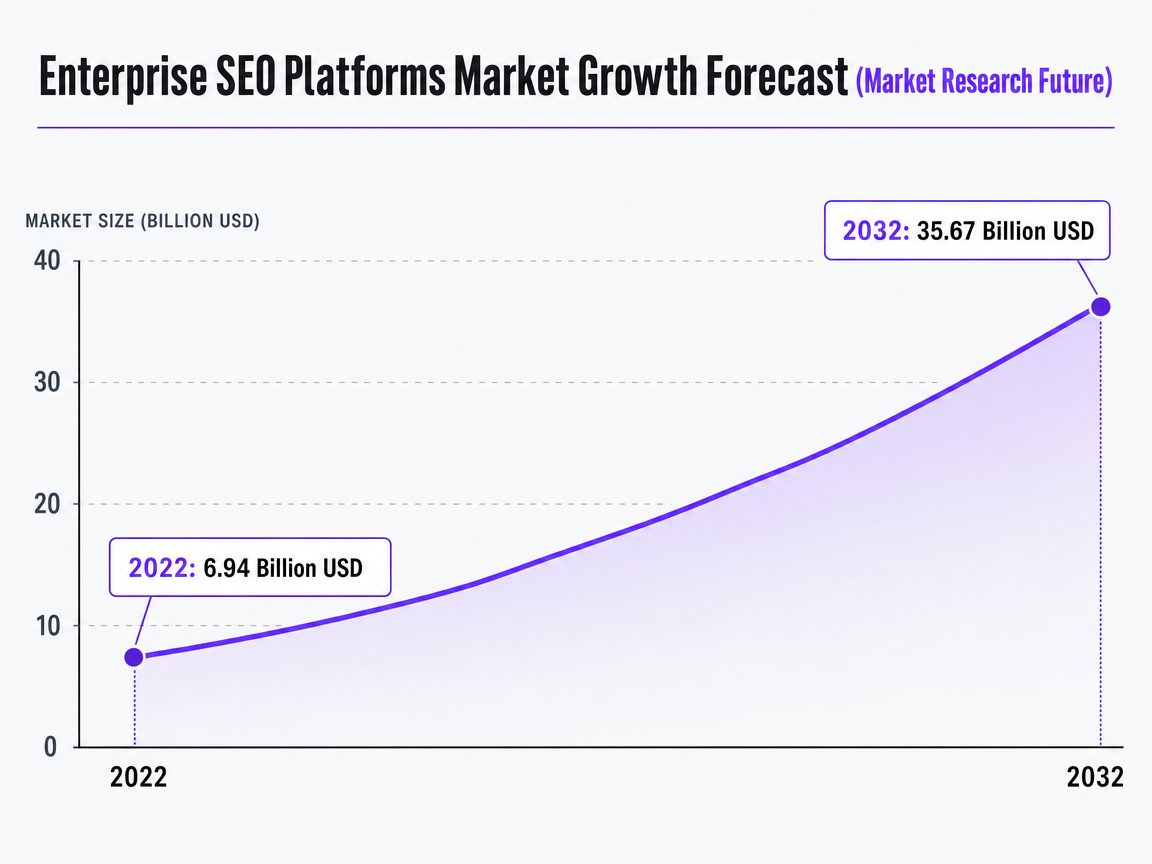 Enterprise SEO Platforms Market Growth Forecast (Market Research Future)
Projects the market growing from $6.94 billion in 2022 to $35.67 billion by 2032.
The scoring rubric: three vectors that decide agency throughput
Keyword portfolio ceiling
Portfolio ceiling is the practical cap on how many keywords a tool can track across how many locations, devices, and languages before cost, latency, or interface friction forces a specialist to cut corners. Enterprise rank trackers now compete on segmentation by location and device, AI search visibility, and API access for downstream systems, not on refresh speed alone 6. For an agency running a 40-client portfolio at, say, 500 tracked terms per client, the ceiling shows up as which markets get monitored weekly and which quietly drop to monthly.
A tool scores well here when it can hold the full portfolio without the specialist rationing coverage.
Reporting automation depth
Reporting automation depth measures how much of the rank-to-client-narrative chain the tool absorbs. Raw position exports are not the bottleneck. Share-of-voice curves, segmented rollups, and stakeholder-ready visibility summaries are — and those are precisely the capabilities enterprise rank trackers now use as differentiators 6. Adoption patterns confirm the direction: 38% of agencies already push SEO reporting into Looker Studio dashboards, and 84% of enterprise-level teams operate three or more premium SEO tools daily, which means reporting has to cross platforms cleanly 5.
A tool scores well when a weekly executive rollup regenerates without a specialist rebuilding it from scratch.
Workflow and AI execution layer
The third vector is what separates a data source from a throughput multiplier: whether the tool triggers work, not just displays it. A ranking drop should open a brief, queue a technical fix, or route a content update for approval — without a human copying URLs into a spreadsheet. Cross-industry research finds that process automation contributes the largest share of AI-driven operational efficiency gains, ahead of analytics and personalization 10. Marketing-specific analyses point the same direction, with 81% of marketers now embedding AI inside their SEO workflow rather than treating it as a side tool 5.
A tool scores well when rank movement translates into queued, approvable action items instead of another dashboard tab.
Why these seven tools made the shortlist
The shortlist reflects where practitioner usage actually concentrates. In the SEOFOMO auditing survey of working SEOs, four tools dominated top-three mentions:
- Screaming Frog with 292
- Google Search Console with 205
- Semrush with 170
- Ahrefs with 143
well ahead of the long tail 4. Those four form the empirical core of any credible agency stack analysis, which is why each earns a slot here.
AccuRanker is included because share-of-voice reporting and location-segmented visibility are now table stakes for enterprise rank trackers, and it is one of the few tools built specifically around that job 6. Looker Studio is included because it is where 38% of agencies already assemble client-facing SEO dashboards, making it the de facto reporting fabric between platforms 5. The seventh slot covers the workflow and execution layer — the piece the first six do not fill.
The throughput ceiling: what caps accounts per specialist
Ask a Head of SEO what caps their delivery capacity and the answer is rarely keyword coverage. It is the copy-paste layer between the rank tracker and everything downstream: the brief, the ticket, the client email, the executive summary. That layer is where specialist hours quietly disappear on a 40-client portfolio.
The evidence for automating that layer is unusually consistent. Nucleus Research measured a 20% average productivity lift among marketing departments implementing automation for the first time 8. McKinsey's benchmarks, cited in a broader synthesis, put the generative-AI productivity uplift at 5–15% of total marketing spend, with integrated systems deploying campaigns 35% faster than traditional agency setups 14. A peer-reviewed 2025 study across industries found that process automation contributes the largest share of AI-driven operational efficiency gains, ahead of analytics or personalization 10.
Single-agency case data is more dramatic and worth reading with scope caveats. One SEO agency that unified semantic core building, on-page work, and monitoring inside an AI-powered workflow reported a 10x productivity boost, with specialists shifting from handling 1–2 sites per day to managing 10 or more 12. A separate go-to-market automation implementation logged a 340% improvement in content production speed and 180% growth in organic traffic within six months 13. Both are single-implementation results, not industry benchmarks — but they mark the ceiling of what workflow automation, not better rank data, can do to accounts-per-specialist math.
The takeaway for stack decisions is direct: if a candidate tool only shortens the time to see a ranking change, it does not lift the ceiling. The ceiling moves when the tool shortens the time from ranking change to approved, executed action.
Test Real-Time Keyword Tracking on Live Campaigns
Experience measurable rank tracking accuracy and workflow efficiency before making a long-term commitment.
Per-specialist capacity by delivery model
The math of agency delivery lives in the accounts-per-specialist column, not the tool-license column. Below is a compact view of how that column moves as the delivery model changes, anchored to evidence points already introduced.
| Delivery model | Typical accounts per SEO specialist | Primary constraint | Evidence anchor |
|---|---|---|---|
| Manual or spreadsheet rank tracking | 1–2 sites/day of active work | Copy-paste between SERP checks, briefs, and client updates | Baseline in AI-workflow case study 12 |
| Single premium platform (Semrush or Ahrefs) | Modest lift over baseline; ~20% productivity gain typical | Reporting narrative still hand-assembled | Nucleus Research 20% first-time automation lift 9 |
| Multi-tool stack (3+ premium platforms) | Higher coverage, diminishing returns on capacity | Cross-platform reconciliation; 84% of enterprise teams operate here | SEO tool usage data 5 |
| AI-assisted workflow layer over the stack | 10+ sites/day per specialist in the reference case | Approval throughput, not data throughput | Single-agency AI workflow implementation 12 |
The 10+ figure is one agency's implementation result, not an industry benchmark. What travels across cases is the direction: the constraint moves from data collection to approval throughput once workflow automation absorbs the copy-paste layer.
The seven tools, scored on agency throughput
Semrush: the full-platform default
Semrush earns its slot on evidence, not reputation. The SEOFOMO auditing survey placed it third among tools SEO professionals name in their top three, with 170 mentions, behind only Screaming Frog and Google Search Console 4. That practitioner concentration matters for an agency Head of SEO staffing a specialist pod: onboarding time drops when new hires already know the interface.
On the rubric, Semrush scores highest on the full-platform axis. It carries research, tracking, competitor analysis, and audits under one login, which is why category analyses classify it as a "full platform" rather than a layer leader 7. Portfolio ceiling is workable for mid-sized agency stacks, though position tracking projects and keyword limits push high-volume shops toward tiered upgrades or supplementary trackers.
The weak spot is workflow. Alerts and dashboards report what changed; they do not queue the brief, the fix, or the client update. Semrush is the connective tissue of a stack, not the execution layer sitting on top of it.
Ahrefs: the layer-leader for portfolio depth
Ahrefs sits at 143 top-three mentions in the SEOFOMO practitioner data, right behind Semrush 4. Independent tool-usage compilations report that 78% of SEO agencies serving enterprise clients name Ahrefs as their primary link analysis tool, which is the specific job it defends better than any full-platform competitor 5.
On the rubric, Ahrefs scores as a layer leader with unusual depth on the portfolio ceiling vector. Its keyword and backlink indices support large tracked-term counts across markets, and category analyses specifically position it as a "layer leader" strong in research and links rather than an all-in-one suite 7. For an agency running competitive analysis on a 40-client roster, that depth is the argument for keeping it in the stack even when Semrush is already there.
Reporting automation is functional but not stakeholder-ready out of the box; most agencies pipe Ahrefs data into a separate dashboard layer. Workflow triggering is minimal. Ahrefs answers "what is happening in the SERP" faster than most, but it does not shorten the distance to an approved next action.
Google Search Console: the free ground truth every stack needs
Search Console led the SEOFOMO practitioner list with 205 top-three mentions, second only to Screaming Frog 4. That concentration reflects a simple reality: it is the only source reporting Google's own impression, click, and average-position data per query, per page, per country. Every third-party rank tracker triangulates against it.
On the rubric, GSC scores low on portfolio ceiling by design. Query sampling caps and 16-month history windows mean it cannot serve as the primary tracker for a 40-client, multi-market portfolio. What it does is provide the ground-truth layer that keeps agency reporting honest when a third-party tool shows a ranking that Google's own data does not confirm.
Reporting automation is thin natively but strong once the data lands in a warehouse or dashboard layer. Workflow triggering is absent. Every agency stack should include it; no agency stack should rely on it alone.
Screaming Frog: the technical audit backbone that feeds rank context
Screaming Frog topped the SEOFOMO survey at 292 top-three mentions, well ahead of every other tool in the audit category 4. It is not a rank tracker, which is exactly why it belongs in a keyword ranking software analysis: rank movement without technical context is unreadable.
A drop from position 4 to position 12 across a 200-page section reads differently once the crawler shows a canonical change, an indexation shift, or a redirect chain layered underneath. Screaming Frog scores highest on the technical-audit backbone role and integrates cleanly with GSC and Semrush data through custom extraction and API pulls.
Portfolio ceiling scales with the machine running it more than the license itself, which is a rare property in the stack. Reporting automation is limited to what the specialist configures. Workflow triggering is nonexistent. Screaming Frog is the diagnostic layer that gives rank data its meaning, not the layer that acts on it.
AccuRanker: share-of-voice reporting for executive rollups
AccuRanker is included because it is built for the specific job most full platforms treat as a side feature: share-of-voice reporting across large keyword sets, segmented by location and device, with fast refresh cycles. Enterprise rank tracker analyses in 2026 frame that job — market-level share-of-voice, AI search visibility, and segmentation depth — as the differentiating capability set for the category 6.
On the rubric, AccuRanker scores highest on portfolio ceiling among the pure-play trackers here. Agencies running weekly executive rollups across 40 or more accounts get the segmentation depth and refresh cadence that a generalist platform strains to match at the same keyword volume. API access into BI systems is a first-class citizen, which matters when rank data has to land in Looker Studio or a client-facing warehouse.
Reporting automation is strong within its own dashboards and stronger once piped downstream. Workflow triggering is limited. It answers the "what is our visibility trajectory" question at scale, then hands the narrative work back to a human.
Looker Studio: the reporting fabric that ties rank data to client narratives
Looker Studio earns its slot on adoption evidence. Tool usage data reports that 38% of agencies use it as the client-facing SEO dashboard layer sitting on top of their rank and traffic data 5. It is not a keyword ranking tool; it is the fabric that makes rank data legible to a client without a specialist rebuilding a slide deck every Monday.
On the rubric, Looker Studio scores highest on reporting automation depth. Connectors pull from GSC, Semrush, Ahrefs, AccuRanker, GA4, and warehouse tables into a single templated dashboard that regenerates on schedule. Portfolio ceiling is a function of the underlying data sources, not Looker itself.
Workflow triggering is absent by design. Looker reports the state of the world; it does not open a brief or queue a fix. For an agency, its value is compressing the reporting-narrative hours that specialists otherwise spend hand-assembling weekly rollups.
Vectoron: the workflow and execution layer that turns rank data into action
The first six tools answer versions of the same question: what is happening in the SERP, and how do we report it? None of them answer the harder question — what action does the agency take next, and who approves it — without a specialist in the middle copying data between tabs. That gap is the workflow and execution layer.
Vectoron sits in that slot deliberately. It is not a rank tracker competing with Semrush or Ahrefs on database size; it is the layer above the stack that reads ranking movement, technical signals, and performance data, then ranks recommendations and routes them through an approval workflow before executing content, on-page, or reporting work. The direction is consistent with cross-industry evidence that process automation contributes the largest share of AI-driven operational efficiency gains 10, and with marketing-specific data showing integrated AI systems deploy campaigns 35% faster than traditional agency setups 14.
On the rubric, Vectoron scores lowest on portfolio ceiling — it depends on the rank data flowing in from tools that own that job — and highest on workflow and execution.
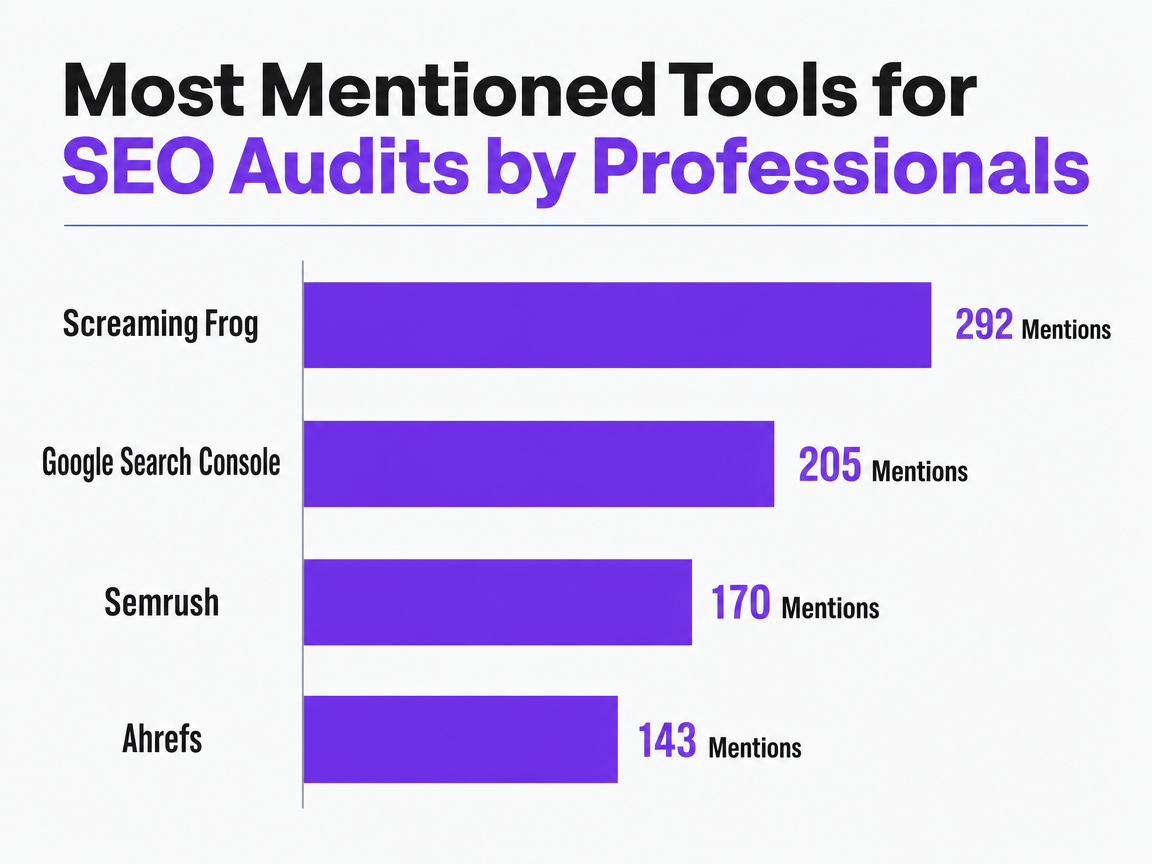 Most Mentioned Tools for SEO Audits by Professionals
Number of times each tool was mentioned by SEO professionals in their top 3 for auditing, showing reliance on core platforms.
If you manage a multi-brand or multi-location portfolio
Scope note: this section is for agencies running multi-brand rosters or multi-location clients — a home services franchisor with 80 locations, a DSO with 45 practices, a senior living group with 30 communities. The single-brand rank-tracking playbook breaks here, and it breaks in predictable ways.
The first break is segmentation. A 30-community senior living client is not one keyword portfolio; it is 30 local portfolios that share brand terms and diverge on everything else. Enterprise rank trackers that lead on location and device segmentation, share-of-voice by market, and API access into BI systems are the ones built for this job 6. A generalist full-platform stack can be forced to cover it, but the specialist hours spent reconciling rollups per market erode the margin the account was supposed to produce.
The second break is reporting cadence. A regional director wants their market's visibility trajectory, not the parent brand's. Weekly rollups have to regenerate per location without a specialist rebuilding 30 versions of the same slide — which is exactly why 38% of agencies already anchor client SEO reporting in Looker Studio and pipe segmented rank data through it 5.
The third break is action routing. A ranking drop in one market should open a brief for that market's page, not a generic parent-brand ticket. That is workflow-layer work, not rank-tracker work.
See How Leading Agencies Streamline Keyword Tracking at Scale
Connect with a platform specialist to review advanced multi-client keyword monitoring, automated reporting, and workflow integration for agency teams managing high-volume SEO delivery.
What these tools do not solve
Every tool in this shortlist reports on the world. None of them changes it without a specialist in the loop. That distinction matters when a Head of SEO is deciding where the next stack dollar goes.
The first unsolved problem is handoff friction. A ranking drop surfaces in AccuRanker, gets cross-checked against Search Console, gets contextualized against a Screaming Frog crawl, and then waits for a human to write the brief, assign the ticket, and email the client. The rank data is fresh; the response cycle is not.
The second is brief-to-publish latency. Semrush and Ahrefs identify the content gap. Neither drafts the piece, routes it for approval, or pushes the on-page update. That gap is where the 340% content production speed improvement documented in one automation case study came from — collapsing the queue between insight and shipped work, not faster keyword data 13.
The third is reporting narrative. Looker Studio regenerates the dashboard; the specialist still writes what it means. Rank tools stop where agency judgment starts.
How to sequence a stack consolidation without breaking client delivery
Stack consolidation goes wrong when it starts with the license renewal calendar instead of the delivery workflow. The safer sequence is to fix the reporting layer first, then the workflow layer, then the tracker layer — because that order lets client-facing outputs stay stable while the plumbing changes underneath.
- Step one: standardize the reporting fabric. Move client rollups into a single dashboard layer so rank sources become interchangeable rather than load-bearing. This is where most agency stacks already land, with Looker Studio serving as the connective layer between GSC, Semrush, Ahrefs, and rank tracker exports 5.
- Step two: automate the copy-paste layer between rank movement and next action. A ranking drop should open a queued brief or ticket for approval, not sit in an alert inbox. Process automation contributes the largest share of AI-driven operational efficiency gains in cross-industry data, ahead of analytics or personalization 10.
- Step three: rationalize the trackers. Once reporting and workflow are stable, cutting or swapping a rank source becomes a data migration, not a delivery risk.
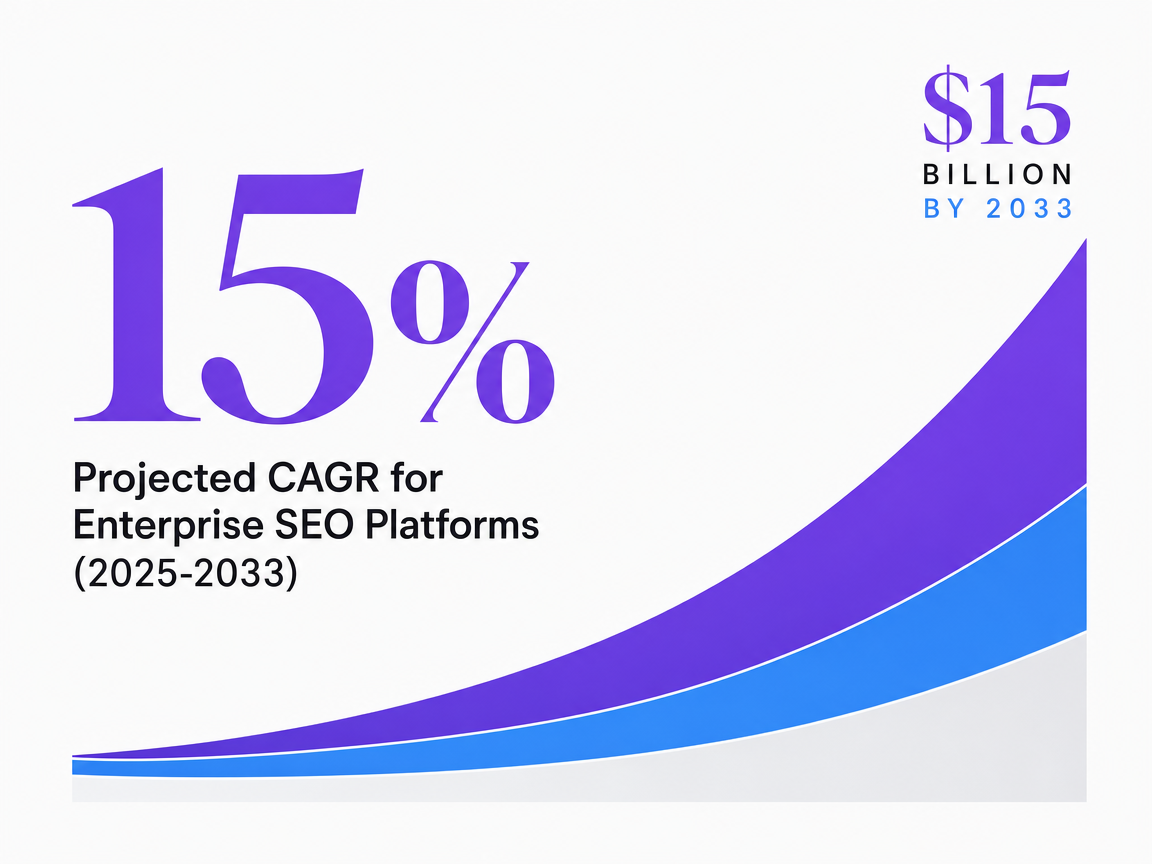 Projected CAGR for Enterprise SEO Platforms (2025-2033)
Projected CAGR for Enterprise SEO Platforms (2025-2033)
Frequently Asked Questions
References
- 1.Enterprise SEO Platforms Market Size Share & Growth.
- 2.Enterprise Seo Platforms Market Share, Size, Trends | 2035.
- 3.Enterprise SEO Platforms Analysis 2025 and Forecasts 2033.
- 4.The SEOFOMO SEO Auditing Survey - 2023 Edition.
- 5.100+ SEO Tools Usage Statistics (2026 Updated) | DWI.
- 6.10 Best Rank Trackers for Enterprise SEO (2026).
- 7.16 Best Enterprise SEO Tools in 2026.
- 8.Marketing automation increases productivity (Nucleus Research PDF copy).
- 9.Marketing automation increases productivity.
- 10.The Impact of Artificial Intelligence on Operational Efficiency in Business Management.
- 11.Exploring the potential of AI to increase productivity in small and medium-sized enterprises.
- 12.SEO Automation Case Study | AI-Powered Workflow for an SEO Agency.
- 13.GTM Workflow Actions: SEO Team Automation & Process Optimization.
- 14.AI marketing assistant benefits for cutting agency costs and scaling output.