
Key Takeaways
- Portfolio keyword strategy works as a five-layer system—intent taxonomy, journey mapping, AI-search hedging, IPV prioritization, and execution templates—stacked so each layer constrains the next.
- Buyer research now splits roughly evenly across digital self-serve, remote, and in-person touchpoints, so clusters need three parallel coverage lanes rather than one linear funnel 2.
- Intent-weighted pipeline value scoring multiplies volume, intent weight, conversion probability, and strategic fit, letting a low-volume transactional query defensibly outrank a high-volume informational term.
- Focus reclaimed analyst hours on the three judgment calls templates cannot make: strategic fit modifiers, SERP-shape interpretation, and cross-cluster narrative choices that stake out topical territory.
Why keyword work has become a portfolio operations problem
The agency Head of SEO running keyword strategy across thirty clients is no longer solving the same problem as the analyst running keyword strategy for one. What used to be a research deliverable—spreadsheets, difficulty scores, cluster maps—has become a governance question about how consistent quality gets produced at volume, across verticals, without the analyst-by-analyst artistry that breaks the moment a strategist leaves.
Two shifts have pushed keyword work into portfolio operations territory. First, B2B and professional services buyers now research across digital self-serve, remote, and in-person touchpoints in roughly equal measure, meaning each client needs keyword coverage mapped to three parallel journeys rather than one funnel 2. Second, AI-mediated search is siphoning discovery away from classical SERPs, forcing clusters to earn visibility in two ranking systems at once 1. Multiply those requirements by every client on the roster and the old model—one analyst, one keyword brief, one client at a time—stops scaling.
What the agencies growing pipeline fastest have figured out is that keyword strategy needs the same operational discipline applied to media buying or reporting: repeatable inputs, defensible prioritization logic, and human judgment concentrated where it moves outcomes. The rest of this piece lays out a five-layer model for running that discipline across a portfolio without adding headcount.
The five-layer keyword operating model
What the model replaces
Most agencies still run keyword strategy as a series of one-off research engagements: an analyst opens Ahrefs, pulls a seed list, scores difficulty, buckets terms into a spreadsheet, and hands the artifact to a content lead. The output quality tracks the analyst. Move that person to a different account, and the framework moves with them.
That model breaks in three predictable ways at portfolio scale:
- Prioritization drifts toward whatever volume the tool surfaces first, because there is no shared logic for weighing a 90-search-per-month personal injury query against a 2,400-search-per-month informational term.
- Journey coverage gets uneven, since no two analysts map intent the same way.
- AI-search visibility gets treated as a separate project rather than a design constraint on the original cluster.
The operating model replaces the artifact with a system: shared definitions, shared scoring, and shared execution templates that let a Head of SEO govern quality across dozens of accounts instead of auditing spreadsheets one at a time.
The layers, in order of governance value
Five layers, stacked in the order a strategist should build and audit them:
- Intent taxonomy. A fixed set of intent categories every analyst uses to classify queries before anything else happens. Removes the first source of cross-account variance.
- Journey mapping. A rule for distributing keyword coverage across digital self-serve, remote evaluation, and in-person conversion touchpoints, grounded in how B2B and professional services buyers actually split their research time 2.
- AI-search hedging. A cluster design constraint that forces each topic to earn both classical SERP rankings and generative-answer citations, hedged against the fact that AI search is now the primary insight source for a large share of users 1.
- Portfolio prioritization. An intent-weighted pipeline value (IPV) score applied uniformly across accounts, so ninety-search personal injury terms and 2,400-search informational terms get compared on the same axis.
- Execution systematization. Templates and workflows for the repeatable parts of keyword production, with analyst judgment concentrated on the two or three decisions per client that actually move outcomes.
The order matters. Prioritization logic built before intent taxonomy inherits the same inconsistency the model is meant to fix. Each layer constrains the next.
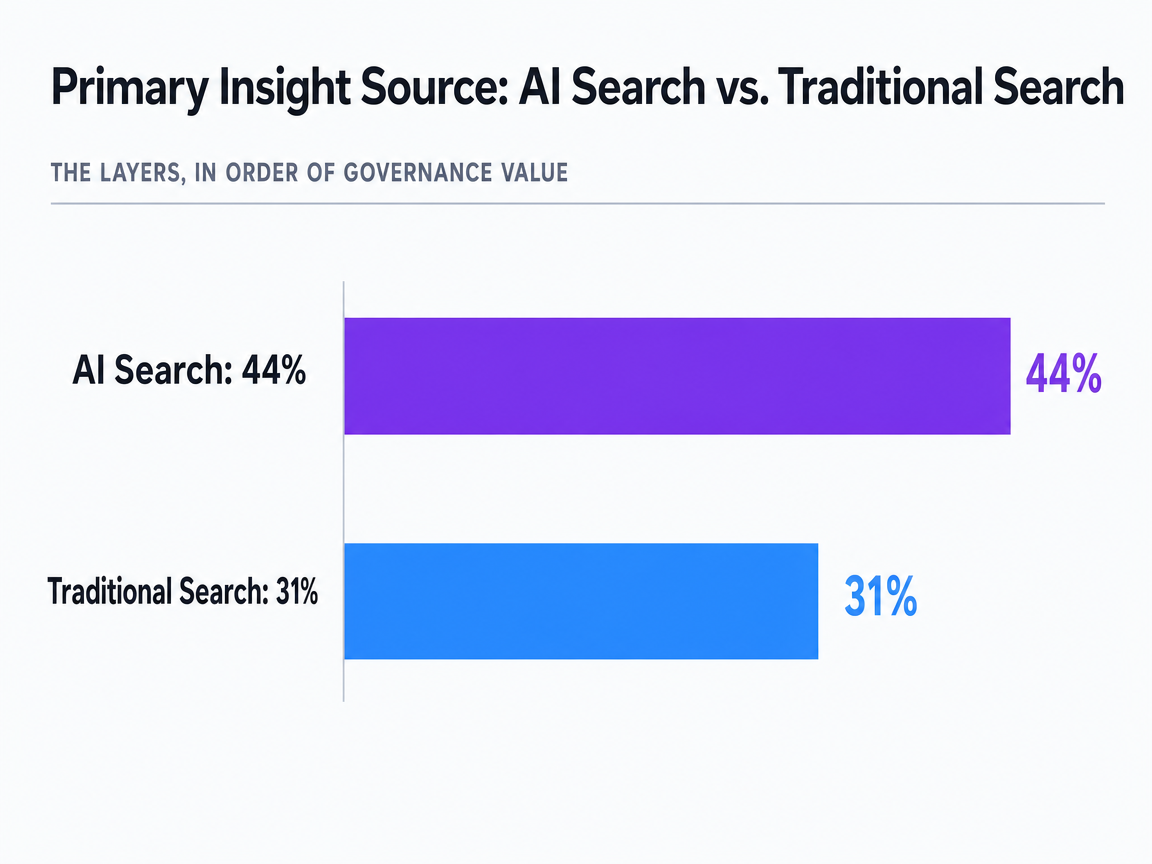 Primary Insight Source: AI Search vs. Traditional Search
Compares the percentage of users who name AI search as their primary source of insight versus those who name traditional search.
Layer one: an intent taxonomy that survives contact with a real SERP
Most agency taxonomies collapse the moment they meet a live results page. An analyst labels a query "informational," the SERP returns three local map packs and a comparison table, and the label stops meaning anything. A taxonomy earns its keep by predicting what the SERP will reward, not by describing what the query looks like on paper.
Four categories cover the ground for high-stakes service verticals without over-fitting.
Problem-recognition : Queries that name a symptom, cost, or situation before the buyer has decided a service is the answer—"tooth pain when biting down," "water in basement after storm."
Solution-comparison : Queries that evaluate alternatives once the category is understood—"invisalign vs braces adults," "partial hospitalization vs iop."
Provider-evaluation : Queries that screen specific firms or practices for fit, credentials, and process—a pattern Forrester's 2024 professional services trust research ties directly to what buyers can verify online before shortlisting 5.
Transactional : Queries that carry booking, quote, or consultation intent and read as ready-to-act language: "free case review motorcycle accident," "emergency dentist open now."
The discipline is refusing to classify a query without also recording what the SERP actually shows: featured snippet, local pack, video carousel, AI overview, organic listings dominated by directories, or a hybrid. That second field is what lets a taxonomy survive contact with the real page. A query classified as provider-evaluation but ranked behind three directory aggregators is a different production problem than one where organic listings still dominate—and the analyst covering forty accounts needs that distinction encoded, not remembered.
Test scalable keyword execution on real campaigns
Experience live keyword strategy deployment and measure pipeline impact before committing long-term.
Layer two: mapping keywords to omnichannel buyer journeys
Journey mapping fails at portfolio scale when analysts treat the funnel as a single vertical line. McKinsey's B2B research complicates that picture: at any given stage of the buying journey, roughly one-third of buyers prefer digital self-serve, one-third remote interactions, and one-third in-person engagement, with the mix holding across research, evaluation, and purchase 2. Coverage on one track leaves two-thirds of intent uncaptured.
Applied to keyword work, the split translates into three parallel coverage lanes per client rather than one linear progression:
- The self-serve lane catches queries where the buyer wants answers without contact—"cost of dental implants without insurance," "steps to file a wrongful death claim," "how long does an AC replacement take." These terms feed long-form comparison content, calculators, and FAQ pages.
- The remote-evaluation lane catches queries that signal the buyer is willing to engage but not yet visit—"virtual consultation partial hospitalization program," "free case review by phone," "video estimate roof replacement." These clusters need landing pages that surface conferencing options, intake forms, and scheduling.
- The in-person conversion lane catches queries oriented around a physical visit—"emergency dentist near me open Sunday," "personal injury attorney office [neighborhood]," "same-day HVAC repair [zip]." Local pack optimization, service-area pages, and hours schema carry these.
A three-lane map also fixes a common portfolio failure: a dental support organization ranking well for informational implant queries but missing every remote-consultation and same-day-visit variant its buyers are also typing. Under a single-funnel model that gap reads as a content depth issue. Under a journey-mapped model it reads as a coverage assignment—two lanes underbuilt, one overbuilt—which is the level of specificity a Head of SEO can hand to a production team without rewriting the brief for every client.
Layer three: hedging clusters against AI-mediated search
The visibility problem has doubled. McKinsey's 2025 consumer research found that 44% of users now name AI-powered search as their primary source of insight, compared with 31% who name traditional search, and roughly half of consumers intentionally seek out AI-powered engines for discovery tasks 1. A keyword cluster designed only for classical SERP ranking is now competing for a shrinking share of decision-stage attention.
Hedging means designing every cluster to earn placement in both systems simultaneously. Classical ranking still rewards page-level topical depth, internal link structure, and query-matched headings. Generative answers reward something adjacent but different: extractable claims, source-worthy phrasing, structured comparisons, and content that reads as a citable authority rather than a landing page. The two overlap enough that a well-built cluster can serve both—but only if the analyst is designing for both from the start, not retrofitting after the fact.
Three cluster-design constraints do most of the work:
- Lead sections with a direct, factually complete answer to the head query in the first hundred words, phrased so an AI system can lift it as a standalone claim without losing meaning. A page on "outpatient vs. inpatient rehab cost" that buries the comparison under three paragraphs of introduction is invisible to generative extraction.
- Structure evaluative content—comparison tables, credential summaries, methodology explanations—in formats that map cleanly to how AI assistants assemble answers, which is the same trust-building content Forrester's 2024 professional services buyer research identifies as central to shortlist decisions 5.
- Treat citations, named sources, and specific data points as ranking assets, not editorial flourishes. Generative systems disproportionately surface pages that read as primary sources.
The portfolio implication: every cluster brief now carries two rank targets, not one, and the analyst covering forty accounts needs both encoded in the template rather than left to interpretation. A cluster that ranks first organically but never gets cited in an AI overview has already lost half the pipeline it was scoped to capture.
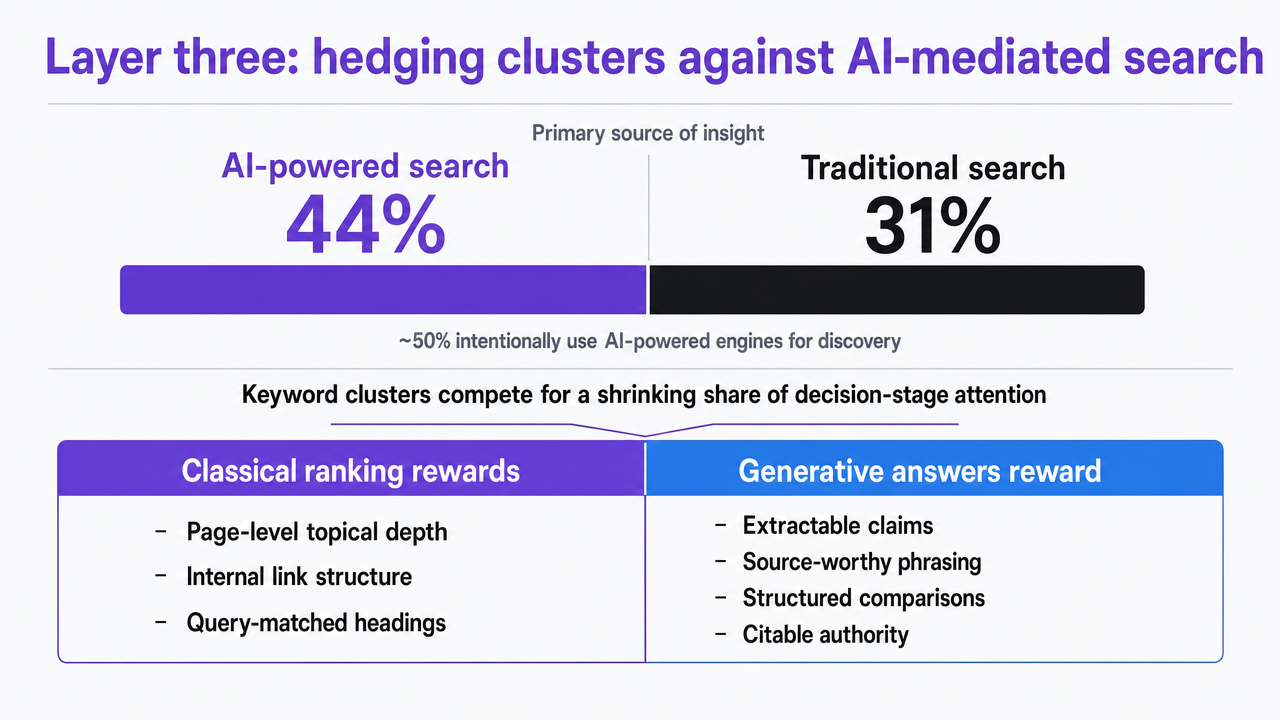 Support the McKinsey citation that 44% of users name AI-powered search as their primary insight source vs. 31% for traditional search, directly cited in the surrounding prose
Layer four: intent-weighted pipeline value (IPV) for portfolio prioritization
Why volume-first prioritization misprices agency work
Volume-first prioritization ranks a 2,400-search-per-month query on "types of personal injury cases" above a 90-search-per-month query on "motorcycle accident lawyer free case review [metro]" every time. The scoring is arithmetically clean and strategically wrong. The first query fills a page with informational traffic that closes at low single-digit rates. The second query fills the same page with prospects who are already screening firms and who, per McKinsey's B2B buyer research, arrive at sales conversations after extensive independent search and value the human touchpoint that follows 3.
The misprice compounds across a portfolio. An analyst working thirty accounts under a volume-first model produces thirty content maps top-loaded with informational terms, because volume is the easiest column to sort by. The Head of SEO auditing those maps sees healthy traffic projections and weak pipeline projections and cannot tell, from the spreadsheet, which clusters are actually funding the retainer. A shared scoring formula that weights intent and conversion probability alongside volume is what turns a keyword map into a pipeline forecast.
The IPV scoring formula and how to weight its inputs
Intent-weighted pipeline value multiplies four inputs: monthly search volume, an intent weight, an estimated conversion probability, and a strategic fit modifier. Each input has a defensible range, and the whole formula sits on a single row of a spreadsheet.
Volume : The tool-reported monthly search count for the head term of the cluster.
Intent weight : A fixed multiplier tied to the taxonomy category from layer one: problem-recognition queries carry a low weight (0.1–0.3), solution-comparison mid (0.4–0.6), provider-evaluation higher (0.7–0.9), transactional highest (1.0–1.5). The provider-evaluation and transactional bands anchor to Forrester's 2024 finding that professional services buyers use digital touchpoints to verify credentials and process before shortlisting, meaning those queries sit closest to signed engagements 5.
Conversion probability : The client's observed close rate from that intent tier, or a category benchmark when historical data is thin.
Strategic fit : A 0.5–1.5 modifier for factors the formula cannot see: geographic priority, service-line margin, capacity to serve.
Multiply the four, and a 90-search transactional query in a priority metro can score above a 2,400-search informational term without argument.
The point is not precision. The point is that every analyst on the team scores every cluster the same way, and the Head of SEO can audit prioritization by looking at one column instead of thirty maps.
Applying IPV across high-stakes verticals
The scoring behaves differently across verticals because the underlying buyer economics differ, and the formula makes those differences legible.
- For a personal injury firm targeting motorcycle accident queries in three metros, IPV consistently pushes transactional and provider-evaluation clusters to the top: "motorcycle accident attorney [metro] free consultation" outscores "what to do after a motorcycle accident" by a wide margin once the transactional weight and metro-specific fit modifier are applied.
- For a dental support organization running implant consultation campaigns across a multi-state footprint, the top-scoring clusters are usually solution-comparison and provider-evaluation queries—"all-on-4 vs traditional implants cost," "[city] implant dentist consultation"—because those are the queries where healthcare consumers, 83% of whom start with general search engines, actually shortlist providers 10.
- For a home services operator running emergency HVAC, transactional queries with time and location modifiers dominate the score sheet: "same-day AC repair [zip]," "emergency furnace replacement [neighborhood]."
What changes across verticals is the mix, not the method. A Head of SEO reviewing a QBR for a legal client and a QBR for a DSO can defend both prioritization sheets with the same formula, which is what makes the model portfolio-governable rather than analyst-dependent.
Scale Client Keyword Strategies Without Expanding Your SEO Team
Connect with our team to see data-driven frameworks for automating keyword research, mapping, and performance monitoring—purpose-built for agencies managing high volumes of client campaigns.
Layer five: systematizing execution without flattening judgment
What to templatize and what to leave analyst-driven
Systematization fails when it either templatizes everything (and produces interchangeable keyword maps that no client would pay a retainer for) or templatizes nothing (and keeps the agency dependent on whichever analyst happens to know the account). The workable line runs through the middle: templatize the mechanical inputs, keep judgment concentrated on the two or three decisions per client that actually move outcomes.
The mechanical inputs are the parts that repeat across every account regardless of vertical. Seed term expansion, synonym and modifier permutations, SERP feature capture, difficulty and volume pulls, taxonomy tagging against the four intent categories, and IPV scoring math all belong in templates. So does the initial cluster grouping—semantic proximity is a solved problem, and no client is paying premium rates for an analyst to hand-bucket 800 seed terms.
What stays analyst-driven is narrower and higher-leverage:
- The strategic fit modifier in the IPV formula (which requires knowing the client's capacity, margin, and geographic priorities).
- The SERP-shape interpretation that decides whether a provider-evaluation cluster is worth pursuing when three directory aggregators own the first page.
- The cross-cluster narrative choices that determine which topical territory the client actually stakes out.
Those three calls are where a Head of SEO's judgment compounds across a portfolio. Everything upstream of them is production work that a system should handle.
Borrowing rigor from systematic literature search methodology
The most useful methodological template for portfolio keyword work comes from outside marketing. Health sciences librarians building systematic literature searches follow a documented protocol: structured term selection, exhaustive synonym expansion, iterative refinement, and an explicit trade-off between sensitivity (catching every relevant result) and specificity (excluding noise) 6. The protocol produces search strategies that another librarian can reproduce and audit without the original author present.
Applied to keyword production, the same rigor closes the reproducibility gap that breaks most agency workflows. Every cluster brief documents its seed terms, its synonym and modifier expansions, its inclusion and exclusion rules, and its sensitivity-specificity target—broad discovery clusters run high sensitivity, transactional clusters run high specificity. A Head of SEO auditing thirty accounts can then trace any keyword decision back to the rule that produced it, rather than to an analyst's memory.
If you manage a portfolio: the analyst-hour math
The audience for this section narrows. Individual-account strategists can skip ahead; what follows is for the Head of SEO defending analyst utilization across a book of ten to fifty clients, where the difference between a systematized keyword workflow and an artisanal one shows up as billable-hour math on a spreadsheet.
The variables are portable.
H : The fully-loaded hourly cost of a senior keyword analyst.
K : The number of keyword clusters produced per client per quarter.
T : The analyst hours consumed per cluster under the traditional model (seed expansion, tool pulls, taxonomy tagging, SERP capture, scoring, cluster grouping, brief writing).
T' : The analyst hours consumed per cluster once the mechanical inputs are templatized and only the three high-leverage decisions from layer five stay analyst-driven.
C : The number of clients in the portfolio.
Quarterly analyst cost under the traditional model is H × T × K × C. Under the systematized model it is H × T' × K × C, where T' is typically a fraction of T because the eight to ten mechanical steps compress into templated runs. The delta is H × (T − T') × K × C—the reclaimed hours per quarter, before any headcount decision.
What the formula makes visible is where those reclaimed hours should go. Not into more clusters per client, which pads output without moving pipeline. Into the strategic-fit modifier calls, the SERP-shape interpretations, and the cross-cluster narrative choices that a template cannot make. That is the arithmetic behind scaling delivery without hiring: the same analyst governs more accounts because the mechanical work no longer scales linearly with the client count.
Where Vectoron fits into systematized keyword governance
The five-layer model describes what governance looks like. The harder question is what runs it. A Head of SEO who wants shared taxonomy tagging, IPV scoring, and dual-rank cluster briefs applied consistently across forty accounts needs the mechanical work to execute against templates while the strategic-fit and SERP-shape calls stay in human hands.
Vectoron's specialist strategists are built around that split: templated production of the repeatable inputs, approval-first routing of every strategic decision to the analyst who owns the account. The reclaimed hours from the layer-five math go where the formula said they should—into the two or three judgment calls per client that a template cannot make.
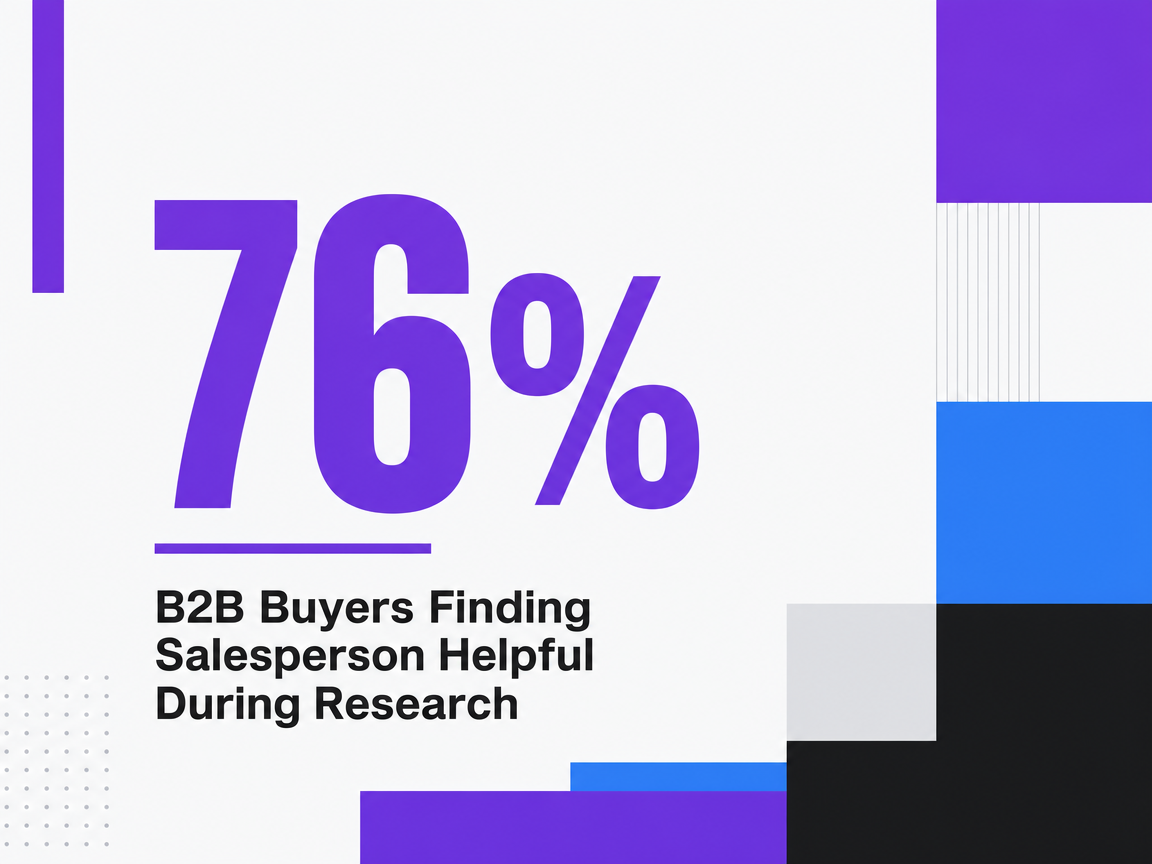 B2B Buyers Finding Salesperson Helpful During Research
B2B Buyers Finding Salesperson Helpful During Research
Frequently Asked Questions
References
- 1.New front door to the internet: Winning in the age of AI search.
- 2.Five fundamental truths: How B2B winners keep growing.
- 3.When B2B buyers want to go digital and when they don’t.
- 4.2023 Buyer Insights: Professional Services Industry.
- 5.The State Of Global Business Buyer Trust In 2024: Professional Services.
- 6.A systematic approach to searching: an efficient and complete method to develop literature searches.
- 7.Clinician Search Behaviors May Be Influenced by Search Engine Design.
- 8.How to Research Keywords for SEO.
- 9.The New B2B Growth Equation.
- 10.Online Health Information Seeking Behavior: A Systematic Review.
- 11.Determinants of Consumer eHealth Information Seeking Behavior.
- 12.Online health information seeking behavior, healthcare access, and health care.
- 13.The consumers' social media use in choosing physicians, dentists and hospitals.