
Key Takeaways
- A keyword string and the job behind it are separate; Google's raters score pages on Needs Met against inferred intent, not on term frequency or lexical overlap 2.
- Split the classic taxonomy into five signals—informational, navigational, commercial investigation, transactional, and local—because each predicts a different SERP feature, content format, and success metric.
- Treat classification as a hypothesis validated on the live SERP and confirmed with 60- and 90-day behavioral checks, since query classification is highly error-prone in practice 4.
- Match KPIs to the intent class: assisted conversions for informational, precision-at-1 for navigational, mid-funnel actions for commercial investigation, and direct conversion for transactional 7.
The Query String Is Not the Job
A keyword is a label. The job behind it is what a searcher is trying to complete when they type those words into a box. Those two things are not the same, and treating them as interchangeable is what breaks most keyword strategies before the first brief is written.
Consider the phrase "personal injury lawyer." One searcher wants to know what a personal injury lawyer does. Another wants the firm they saw on a billboard last week. A third has just been in a car accident and needs a consultation today. The string is identical. The jobs are not, and the content required to satisfy each one differs in format, depth, and trust signals.
Google's own guidance is explicit that pages are judged on whether they meet the person's need, not whether they contain the query, and that standard rises sharply for topics that affect health, finances, or safety 1. The Search Quality Rater framework operationalizes this through Needs Met ratings, which score how well a result satisfies the likely intent behind the query rather than lexical overlap 2.
For a VP of Marketing running a lean team against a pipeline number, the practical consequence is direct. A content roadmap built on keyword volume will produce assets that rank for terms nobody at the company can convert. A roadmap built on intent classification produces fewer assets that each answer a specific job and route to a specific next action.
How Modern Retrieval Learned to Read Intent Instead of Strings
For most of the 2000s, ranking systems leaned heavily on lexical overlap: does the page contain the query terms, and how often, and where. That model rewarded exact-match keyword pages and punished pages that answered the same question in different words. It also broke down on the long tail, where a query might have been typed only a handful of times and had almost no historical click data to learn from.
Neural retrieval changed the mechanics. Microsoft's GEN Encoder, presented at SIGIR 2019, framed the problem differently: instead of matching strings, it learned a distributed representation of what a query means by studying which results different users clicked on for related queries. The authors describe it as a model that
"learns a distributed representation space for user intent in search"
using co-click data and paraphrase multi-task learning 5. The reported result on their evaluation set was a roughly 50% reduction in the sparsity of unseen, long-tail queries compared to prior baselines 5. Two things about that number matter for a marketing leader. The scope is a research corpus of click logs, not the live Bing or Google ranker, so the specific figure describes what the model achieved in that experiment. And the supervision signal is co-click data, which inherits whatever bias the existing ranker had at the time it collected those clicks. The authors flag that limitation directly 5.
The strategic point survives the caveats. Once a retrieval system can place "personal injury attorney near me," "car accident lawyer consultation," and "who to call after a crash" into the same semantic neighborhood, a page that satisfies the underlying job outranks a page that repeats the exact phrase. Google's public framing reinforces this. Its Search Quality Rater documentation instructs raters to score results on Needs Met against the likely intent, not on term frequency 2, 3.
For content planning, the implication is that the unit of work is a job to be answered, not a keyword to be inserted.
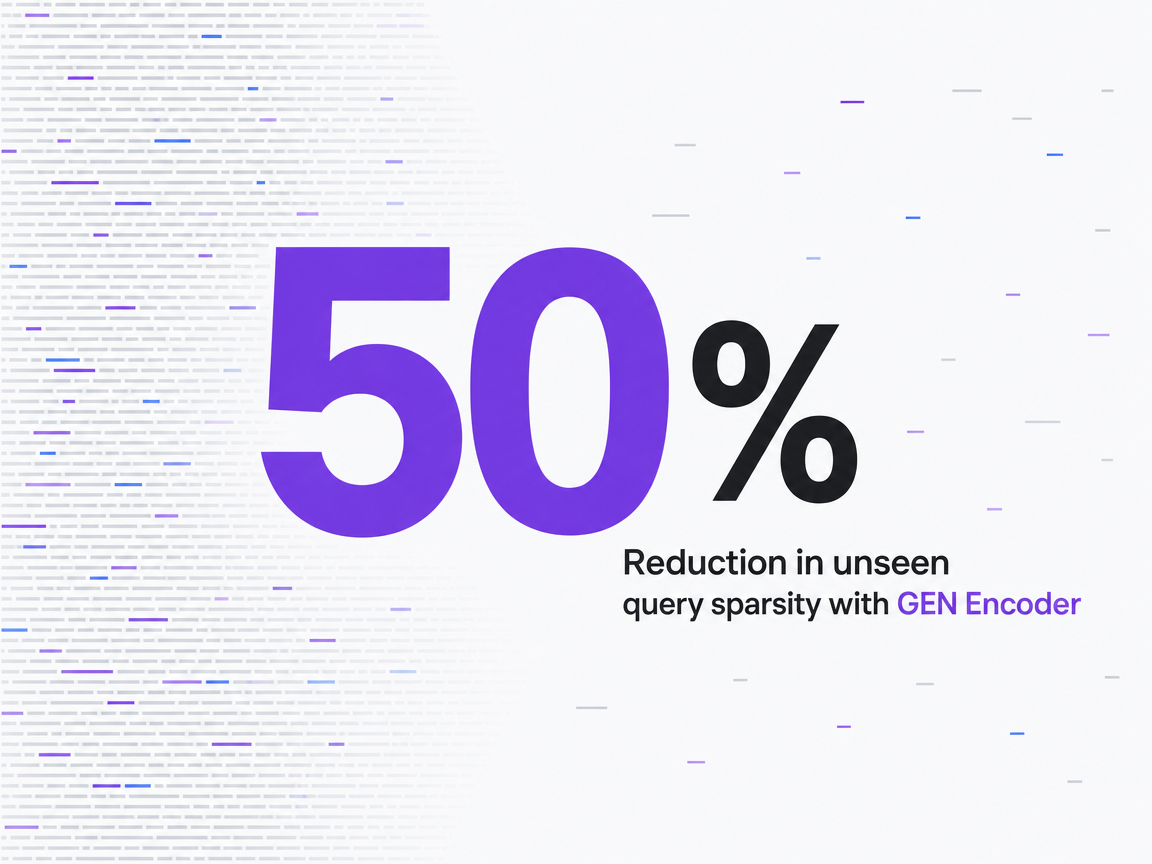 Reduction in unseen query sparsity with GEN Encoder
Reduction in unseen query sparsity with GEN Encoder
A Five-Signal Model for Classifying Intent
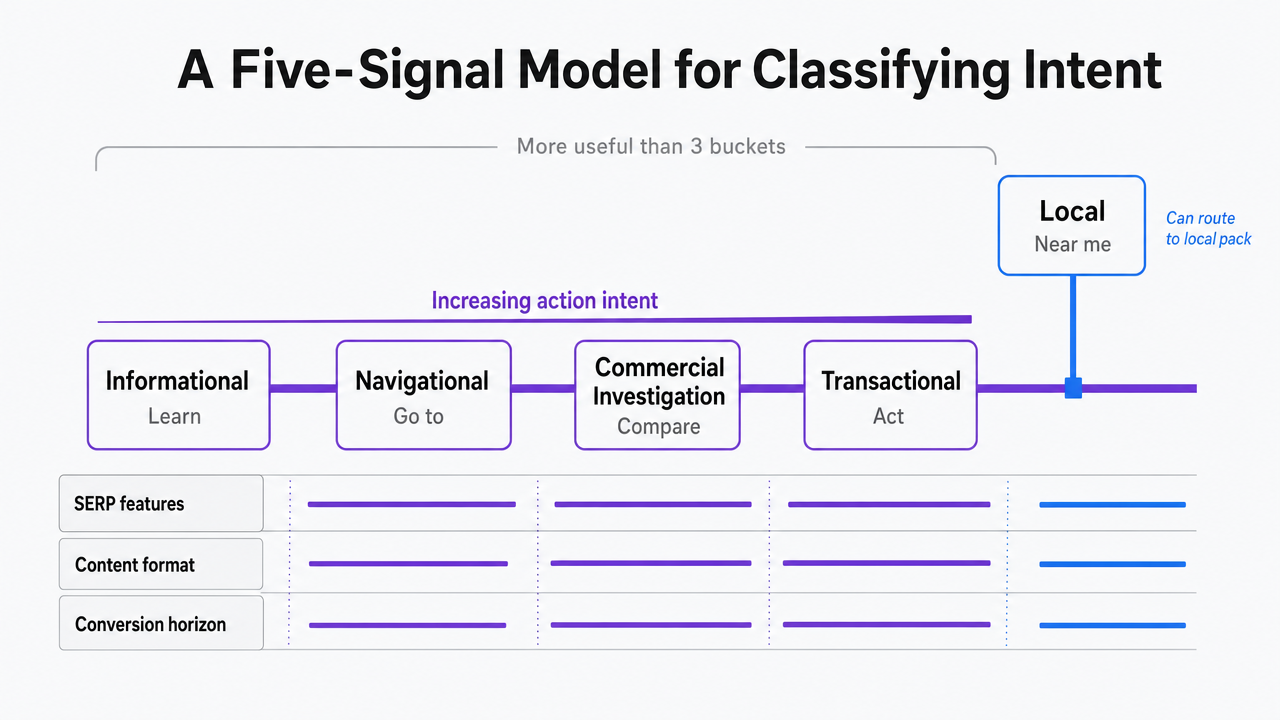
The classic taxonomy of informational, navigational, and transactional queries, introduced by Broder and formalized by Jansen and colleagues, remains the academic anchor for intent research 8, 9. It is a useful starting point and a poor stopping point. A three-bucket model treats "best CRM for dental practices" and "CRM software" as the same class, even though the first carries commercial evaluation cues and the second does not. It also ignores geographic modifiers that route a query to a local pack rather than an organic list.
A more useful classification for content planning splits the taxonomy into five signals:
- Informational
- Navigational
- Commercial investigation
- Transactional
- Local
Each signal predicts a different SERP feature set, a different content format, and a different conversion horizon. The classification is not a stricter taxonomy; it is a decision aid that maps directly to editorial choices a marketing team has to make anyway.
Beyond the Three-Bucket Taxonomy
Informational queries locate content on a topic to address a knowledge need, and transactional queries precede a web action such as a purchase, download, or reservation 9, 7. Between those two sits commercial investigation: queries where the searcher is comparing options before a transaction. "Best," "vs," "pricing," and "reviews" are the lexical tells, but the underlying job is evaluation, not information gathering. The SERP for these queries is dominated by comparison content, review sites, and vendor pages that pass an evaluation checklist.
Local intent is the fifth signal and often overrides the other four. A query with "near me," a city name, or an implicit service radius triggers map results and location-verified organic listings. For multi-location operators, a query that looks informational on the surface routes almost entirely through local ranking factors once a geographic modifier is present.
Where Underspecified Queries Break the Model
Short queries fracture the model. The CMU background paper on intent classification notes that intent categories overlap and blur for underspecified queries, which is why classification schemes need richer context signals to resolve them 8. "Invisalign" could be informational (what is it), commercial (which provider), transactional (book a consult), or local (nearest office). The query string does not settle the question.
The 2012 SearchStudies paper found that non-expert users and crowdsourced raters often disagreed on query classification, and it concluded that query classification is highly error-prone, particularly for commercial queries 4. Two implications follow. First, no single classifier, human or machine, produces clean labels on ambiguous head terms. Second, a content strategy that treats intent as deterministic will misroute assets. The workflow needs to hypothesize intent, ship against the dominant signal on the live SERP, and validate with behavior after publish.
 Visualize the five intent signals introduced in this section as a framework diagram, giving readers a scannable reference for the classification model the section defines
Test intent-driven keyword execution risk-free now
Experience real-time impact from publishing content mapped to high-intent keywords during your trial.
Mapping Intent Classes to Content Format and Metric
Once a query has been classified, the editorial choices should follow from the classification, not from house style. Each intent class predicts a different SERP experience, which predicts a different content format, which predicts a different success metric. Holding a comparison article accountable to same-session conversions is the same category error as holding a location page accountable to time on page.
The mapping below is grounded in the Broder/Jansen taxonomy, with format and metric choices derived from the Stanford IR chapter's observation that different query types demand different evaluation approaches and that informational queries frequently require the searcher to consult multiple pages before acting 7, 9.
| Intent class | Dominant SERP feature | Recommended content format | Primary success metric |
|---|---|---|---|
| Informational | Featured snippet, People Also Ask, long-form organic | Explainer, guide, glossary, structured Q&A | Assisted conversions and organic entrances into the funnel |
| Navigational | Sitelinks, brand pack, knowledge panel | Branded landing page or contact page | Precision at 1: does the searcher reach the intended page |
| Transactional | Shopping, product listings, booking widgets | Service page, pricing page, booking flow | Direct conversion rate on entry session |
| Commercial investigation | Comparison sites, review roundups, vendor pages | Comparison article, alternatives page, buyer's guide | Demo requests, quote submissions, cart adds |
| Local | Map pack, location-verified organic | Location page with service radius, reviews, hours | Direction requests, calls, appointment bookings |
Intent classes mapped to SERP experience, content format, and success metric, adapted from the Broder/Jansen taxonomy 7, 9.
Two entries in this table warrant attention because they are where most content programs misallocate effort. Informational content is measured on assisted conversions rather than direct ones because the Stanford IR chapter notes that informational searchers typically consult multiple pages before completing a task, which means a last-click model will systematically undercount the value of the top-of-funnel asset that started the journey 7. Commercial investigation content, meanwhile, is the class most likely to be misclassified as informational and then written as a neutral explainer. The lexical tells (best, vs, pricing, reviews) point at an evaluation job, and the metric that matters is a mid-funnel action, not a pageview.
Navigational queries deserve a shorter comment. Stanford's evaluation guidance treats precision at 1 as the sensible metric because there is exactly one right answer: the page the searcher was already trying to reach 7. A branded query that lands on a blog post instead of the contact page is a failure regardless of session duration.
The operational payoff of this map is that editorial briefs stop asking writers to "target the keyword" and start specifying which of these five jobs the page has to do. That single change tightens what gets shipped, and it tightens what gets measured after publish.
The Attribution Problem for Informational Content
Informational content carries a measurement problem that undercuts its budget every planning cycle. A searcher who reads a guide on "how to negotiate a personal injury settlement" rarely converts on that session. They come back through a branded search two weeks later, or they call the firm after seeing a retargeting ad, or they forward the guide to a family member who becomes the actual client. A last-click attribution model credits the branded search or the retargeting ad, not the guide that started the sequence.
The Stanford IR chapter is direct about why this happens: informational queries typically require the searcher to consult several pages before completing the underlying task 7. That behavior is a feature of the intent class, not a failure of the content. Applying a same-session conversion metric to a piece of content whose job is to educate produces the same result every time. The asset looks unproductive, gets deprioritized, and the top of the funnel narrows.
Two adjustments correct the reporting without inventing new data:
- Informational assets should be measured on assisted conversions and organic entrances into the funnel, not on direct conversions from the entry session.
- The reporting window should extend past the standard 30-day lookback for informational classes, because the Stanford IR observation implies a multi-page, multi-session path is the norm rather than the exception 7.
The practical takeaway for a VP defending a content budget: the metric assigned to a piece of informational content should match the job the intent class actually performs, not the job the CFO wishes it performed.
YMYL Verticals: Where Intent Match Is Not Optional
Legal, health, dental, senior living, and financial services share a category label in Google's evaluation framework: Your Money or Your Life. Content in these verticals can affect a reader's health, safety, or financial well-being, and the standards raters apply are correspondingly higher. Google's Helpful Content guidance states that trust is the most important element of E-E-A-T and that strong E-E-A-T signals matter more for YMYL topics than for lower-stakes categories 1. The 2023 Search Quality Rater Guidelines update reinforced this framing by tightening how Needs Met is scored against the likely intent behind a query 2.
The operational consequence for a marketing team in one of these verticals is that intent match and trust signals are not separable line items. A page that ranks a car-accident guide has to satisfy both the informational job the searcher came to complete and the E-E-A-T bar Google's raters apply to legal content. Author credentials, citations to primary sources, and a clear disclosure of who produced the content are not stylistic additions. They are what qualifies the page to compete at all.
Health search behavior sharpens the point. A systematic review of online health information seeking found that perceived reliability, accessible formats, and trustworthy sources are the primary facilitators of engagement, while low health literacy, poor source quality, and exposure to misinformation are the primary barriers 6, 10. A patient searching "is a root canal painful" is not looking for a service page. They are looking for a specific job to be resolved by an authoritative explanation, and if the top result reads like a marketing pitch, the behavioral signals will move the ranker off that page.
The practical rule for YMYL content roadmaps: every intent-matched brief has to specify the author or reviewer credential, the primary sources being cited, and the disclosures required by the vertical's regulatory context. Miss any of those, and the page fails the Needs Met test regardless of how well it maps to the query.
See How Intent-Based Keyword Strategies Drive Predictable Pipeline
Request a walkthrough of AI-driven workflows that surface, prioritize, and execute high-intent keywords—enabling your team to scale conversion-focused content without additional headcount or vendor management.
A SERP-Validation Workflow for Ambiguous Queries
Intent classification looks clean on a whiteboard and falls apart on real queries. The 2012 SearchStudies analysis compared manual labeling, click-through data, and user surveys as classification methods and concluded that query classification is highly error-prone, with non-expert users and crowdsourced raters frequently disagreeing on the same terms 4. The paper also found that navigational intent was easier to infer from click-through data than commercial intent, which is the class most content programs need to classify correctly to route budget 4. A workflow that pretends intent is deterministic will misroute assets on exactly the queries where the stakes are highest.
A validation loop replaces the pretense with a repeatable four-step check:
- Pull the live top ten results for the target query.
- Catalog the dominant SERP features and the format of the ranking pages: are they comparison articles, service pages, guides, or map results?
- Form an intent hypothesis from what the ranker has already rewarded, not from what the query string appears to suggest.
- Write the brief against the dominant format and set a post-publish behavioral check at 60 and 90 days: entrance keywords, scroll depth, and downstream actions on the pages the searcher visits next.
The behavioral check closes the loop the classifier cannot close on its own. If a page written as a commercial comparison ranks and holds, but the downstream action rate stays flat, the dominant intent was probably informational and the brief needs a revision rather than a rewrite. If the page never ranks, the SERP hypothesis was wrong and the format has to change before the copy does.
Two guardrails keep this workflow honest:
- The SERP snapshot has to be taken from the target geography and device profile, because local and mobile SERPs diverge sharply from desktop results on the same query.
- The hypothesis has to be logged in the brief itself, so the post-publish check has something specific to falsify.
Google's rater framework judges pages on Needs Met against inferred intent 2, and the validation loop is what lets a marketing team hold its own work to the same standard the ranker already does.
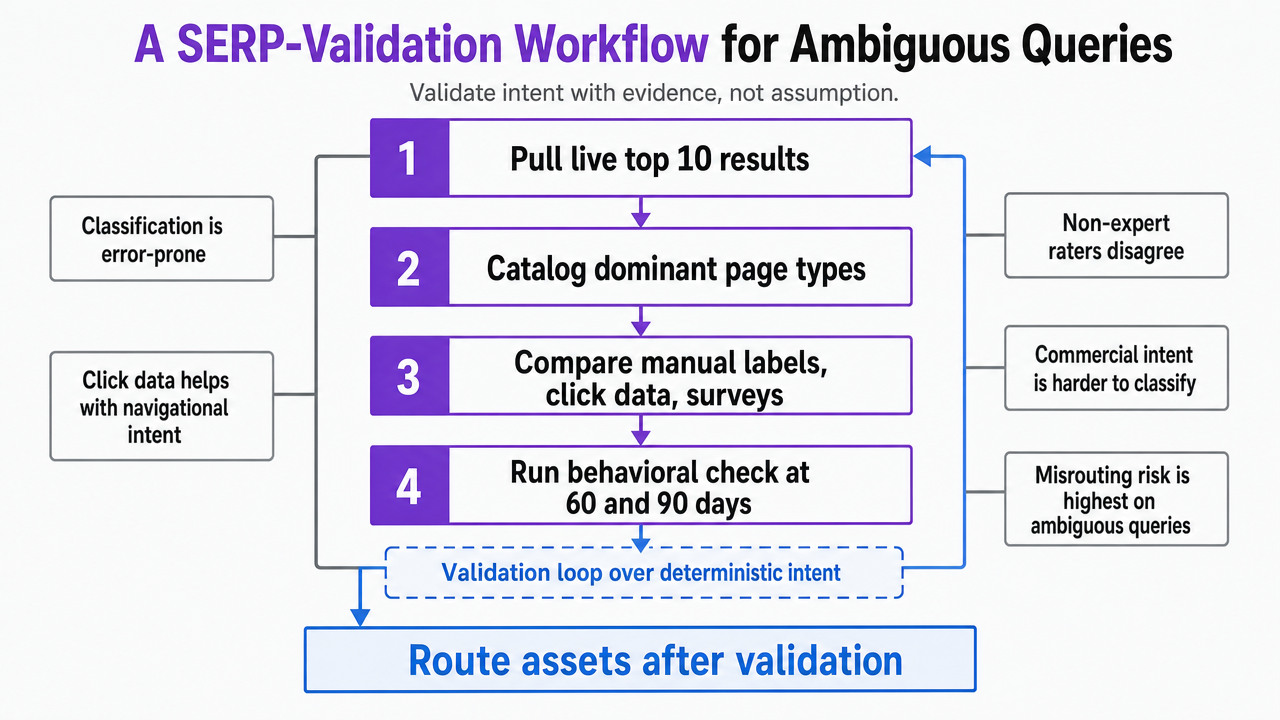 Diagram the four-step validation loop described in the section so readers can execute the workflow, including the 60- and 90-day behavioral check
If You Manage Multiple Locations: How Intent-Classified Libraries Compound
The reader scope shifts here. This section addresses operators running content across many locations: dental service organizations, home services franchises, senior living portfolios, multi-market law firms, and health systems with distributed clinics. The economics of intent classification look different when the same job has to be answered in 40 markets instead of one.
The compounding effect is a function of how intent-matched content templatizes. An informational pillar on "what to expect at a first dental visit" answers the same job in every market. The intent classification, the SERP hypothesis, the format decision, and the E-E-A-T signals are geography-independent. What changes across locations is the local overlay: provider credentials, hours, service radius, and reviews. A commercial-investigation asset like "clear aligners vs traditional braces" behaves the same way. The evaluation job is identical in Denver and Dallas. The location-specific variant carries the same body, different proof.
Local intent is the exception. Queries with "near me" or a city modifier route through map results and location-verified organic listings, which means each market needs its own location page held to precision-at-1 style expectations 7. That is the layer that does not templatize. Everything above it does.
The operator math is a set of variables, not a fixed dollar figure. Cost per brief times number of locations, times republish rate per year, minus the intent-match rate on the first pass, gives the true cost of a per-market briefing model. An intent-classified library inverts the ratio: one brief, N local overlays, one post-publish behavioral check per intent class rather than per market. The 2012 SearchStudies finding that classification is error-prone 4 argues for spending the classification budget once, on a shared library, rather than re-litigating intent in every market brief.
The practical takeaway for portfolio operators: intent classification is a library-level investment, not a per-location cost, and the return scales with the number of markets served.
Reporting Intent-Matched Content to a CFO
A CFO reads a content report the same way they read a media buy: dollars in, qualified pipeline out, on a defensible timeline. The intent framework changes what belongs in each row of that report. The unit of measurement is no longer keywords ranked or posts published. It is intent classes covered, matched to the KPI that intent class actually produces.
A defensible one-page report has four columns:
- The first names the intent class of each asset or cohort of assets.
- The second names the KPI that class is being held to: assisted conversions and organic entrances for informational, precision-at-1 arrivals for navigational, demo or quote requests for commercial investigation, direct conversion for transactional, and calls or direction requests for local.
- The third names the reporting window, which is longer for informational than for transactional because informational searchers typically consult multiple pages before completing the underlying task 7.
- The fourth names the SERP-validation status: intent hypothesis confirmed, revised, or pending the 60- and 90-day behavioral check.
Two things this report does not do. It does not credit informational assets on same-session conversions, and it does not treat classification as settled, because independent research finds query classification is highly error-prone in practice 4. Framed this way, an intent-matched content program reports like an investment portfolio with distinct return profiles, not like a single line item waiting to be cut.
Frequently Asked Questions
References
- 1.Creating Helpful, Reliable, People-First Content.
- 2.Search Quality Raters Guidelines update.
- 3.Search Quality Rater Guidelines: An Overview - Google Search.
- 4.Deriving Query Intents from Web Search Engine Queries.
- 5.Generic Intent Representation in Web Search.
- 6.Online Health Information Seeking Behavior: A Systematic Review.
- 7.User query needs.
- 8.Background.
- 9.Determining the informational, navigational, and transactional intent of web queries.
- 10.Online Health Information Seeking Behavior: A Systematic Review.