
Key Takeaways
- Treat each keyword as a specific question from a named buying-group role at one of Forrester's three decision gates: problem worth solving, category fit, or vendor selection 13.
- Build a keyword-to-decision-gate matrix with roles as rows and gates as columns, then start by filling coverage gaps with lower-competition, page-level terms tied to real buyer questions.
- Run research as a continuous loop—monthly refinement from Search Console and Trends, quarterly matrix review against deal transcripts—rather than an annual spreadsheet exercise 9.
- Avoid ranking by domain assumptions, TOFU/MOFU/BOFU labels, or keyword-stuffed pages; pages rank individually 15and must show expertise, authoritativeness, and trustworthiness 11.
Why keyword programs stall at the pipeline layer
Most keyword programs produce impressions, not pipeline. The gap rarely comes from poor term selection. It comes from treating keywords as a traffic input rather than a record of how a buying group is actually deciding. McKinsey's 2024 B2B Pulse survey found the average B2B customer now uses ten interaction channels in a single buying journey, up from five in 2016 8. This doubling of touchpoints means the surface area a keyword program has to cover has also doubled. A homepage and three service pages cannot answer queries that fan out across ten touchpoints, multiple personas, and looping evaluation stages.
The stall pattern is consistent: a team builds a keyword list from search volume and internal assumptions, publishes pages for high-volume terms, and reports rankings and sessions. Organic sessions climb, but qualified pipeline remains flat. The diagnosis is almost always the same: the list was optimized for what the marketing team could produce, not for the questions a five-person buying committee is actually typing between board meetings, vendor calls, and internal reviews.
Forrester's research on buyer-journey maps identifies this misalignment, noting that many maps—and the keyword programs built on them—fail because they are constructed from internal assumptions rather than observed buyer behavior 6. The following sections reframe keyword work as a governance problem: defining which decision gates the program covers, who owns the mapping, and how research operates as a continuous loop instead of an annual spreadsheet.
What a keyword actually represents in a B2B buying group
A keyword is a shorthand for a question a specific person is asking at a specific moment in a purchase—not a topic, not a page title, and not a volume metric. Google defines keyword research as identifying the exact words and phrases an audience uses to search for information a business offers 9. This framing forces the analyst to think about the sender of the query, not just the receiver of the traffic.
Inside a B2B buying group, the sender is rarely one person. Forrester describes the prospective customer as a portfolio of buyer personas, each playing different roles in the collective advance toward a decision 3. For example, a DSO evaluating patient-communication software involves an operations lead assessing workflow risk, a clinical director considering chairside disruption, a CFO modeling per-location cost, and an IT owner checking integration. Each role generates a different query pattern for the same underlying purchase. Treating these queries as a single cluster—"patient communication software"—flattens four distinct information needs into one page that satisfies none of them well.
The practical consequence is that keyword lists built solely on search volume will systematically over-serve the most vocal persona (often the end-user researcher) and under-serve the persona who ultimately signs the contract. A robust keyword list should resemble a matrix: identifying which role is asking, their evaluation state, and what specific artifact—comparison, methodology, pricing logic, integration detail—answers their query. Forrester's guidance is clear: journey maps, and the keyword programs built from them, must represent the buyer's view of the purchasing process, not the seller's internal stages 4. Every term in a functional keyword file should be traceable to a named role and a specific question.
Mapping keywords to Forrester's decision gates
The three phases and why generic funnel labels miss them
Forrester's B2B Buying Decision Process Framework outlines three common phases and the decision gates buyers pass through during a purchase 13. These phases are not the familiar top-of-funnel, middle-of-funnel, bottom-of-funnel labels often inherited from lead-scoring templates. Instead, they describe what the buying group is trying to resolve: whether a problem is worth solving, which category of solution fits, and which specific vendor earns the contract. A decision gate sits between each phase, representing an internal moment where the group needs sufficient evidence to move forward or restart.
Generic funnel labels fail because they describe the seller's pipeline stage, not the buyer's evaluation state. A query like "HIPAA-compliant patient intake software" is often categorized as "middle-funnel" due to the solution term. However, a compliance officer typing this phrase might be at the earliest problem-definition gate, trying to confirm if such a category even exists. Assigning it to a mid-funnel comparison page misinterprets intent and provides the buyer with the wrong artifact.
Forrester explicitly states that buyer-journey maps must represent the buyer's perspective of the purchasing process, not the seller's internal stages 4. For keyword work, this means the operative question is never "what stage of our funnel does this term belong to?" but rather "which decision gate is this person trying to clear, and what evidence do they need to clear it?" This reframe dictates which pages are built, which internal experts are quoted, and which artifacts—methodology explainers, integration matrices, category comparisons—actually earn the ranking.
Building the keyword-to-decision-gate matrix
The working artifact is a matrix, not a list. Rows represent buying-group roles—operations lead, clinical or practice director, finance owner, IT or compliance owner, end-user researcher. Columns represent the three Forrester decision gates: problem worth solving, category fit, vendor selection 13. Each cell contains the specific questions that role asks at that gate, the queries those questions produce, and the artifact that answers them.
Comprehensive coverage across the matrix is crucial because most of the buying group never speaks to a sales representative before forming an opinion. Forrester's research on self-directed B2B behavior found that 68% of buyers prefer to research independently online, 62% can finalize a vendor list based solely on digital content, and 60% prefer not to interact with a sales rep as their primary source of information 14. A keyword program that only serves the economic buyer's late-stage queries—such as pricing pages or competitor comparisons—leaves the other four roles to form the shortlist without the seller's input.
Consider a senior living operator evaluating occupancy-marketing platforms. The executive director might type "why is move-in velocity slowing" at the problem gate. The regional VP searches "digital marketing options for senior living communities" at the category gate. The CFO searches specific vendor names paired with "pricing model" or "per-community cost" at the selection gate. This illustrates three roles, three gates, and three distinct artifacts—each requiring its own keyword cluster and dedicated page.
The matrix also prevents duplication. If two cells share a query, the program must decide: consolidate onto one page with clearer role-based sections, or split into two artifacts with distinct angles. Forrester views the journey map as a guide rather than an exhaustive prescription 5, and the same applies to the matrix. Its purpose is to highlight coverage gaps and provide the keyword file maintainer with a unified view of which decision gates the program effectively serves.
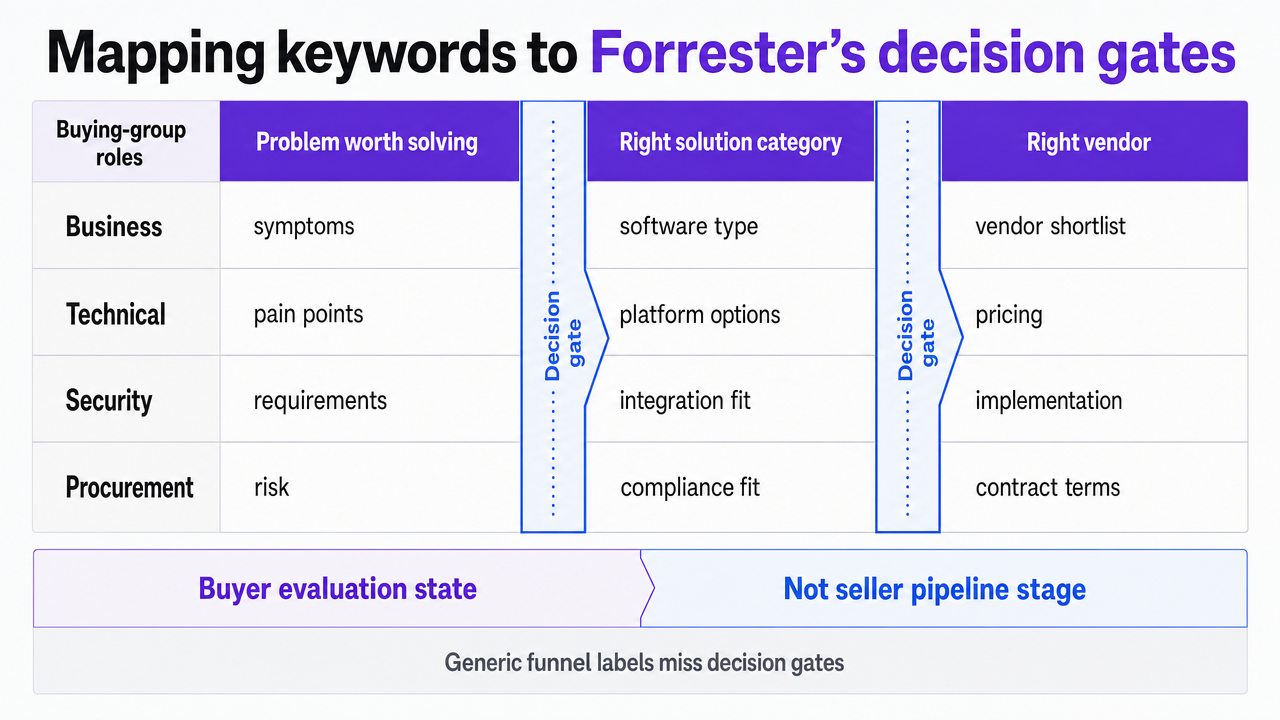 Visualize the keyword-to-decision-gate matrix that anchors this section, showing buying-group roles crossed with Forrester's three decision phases
Test real keyword strategies in your pipeline now
Validate how targeted keywords impact organic traffic and conversions using live content during your trial period.
Running keyword research as a continuous loop, not a spreadsheet
Most in-house programs treat keyword research as a discrete project: a quarter of tool exports, a shared spreadsheet, a launch, then silence until the next planning cycle. This cadence is ineffective as search behavior shifts rapidly. Google's guidance frames keyword research as an ongoing practice, pointing to Trends and Search Console as live signal sources for surfacing rising terms and emerging queries in near real time 9. A static spreadsheet cannot capture this dynamic information.
Michigan State University's SEO workflow provides a clear operational structure for a continuous loop. Keyword research occurs in three phases:
- Brainstorming generates seed terms linked to named buyer roles and their questions at each decision gate.
- Research and refine converts these seeds into vetted queries with volume, competition, and intent annotations from Trends, Search Console, and keyword tools.
- Organize groups the vetted queries into clusters mapped to specific pages, each with an owner, a target artifact, and a measurement plan.
Each phase produces a distinct artifact 1.
Running this sequence as a loop—monthly for refinement, quarterly for reorganization, and continuously for brainstorming from live Search Console data—closes the gap between what buyers are actually typing and what the site is answering. Forrester's guidance reinforces this discipline: the journey map is a guide, not an exhaustive list of actions 5. The same logic applies to the underlying keyword file. A term that generated qualified pipeline in Q1 may lose intent by Q3 as a category matures, a competitor shifts positioning, or a regulatory change reshapes the query set.
The operational key is treating three inputs as standing feeds rather than one-time pulls:
- Search Console query data reveals existing pages earning impressions for terms the program never targeted, providing free signal that validates a cluster or exposes a gap.
- Google Trends surfaces rising terms before competitors consolidate around them 9.
- Sales-call transcripts and support tickets reveal the exact phrasing buyers use before they know the category name, which often differs from keyword tool rankings.
A VP auditing the program should be able to articulate who reviews each of these three feeds and how often the keyword file is updated as a result.
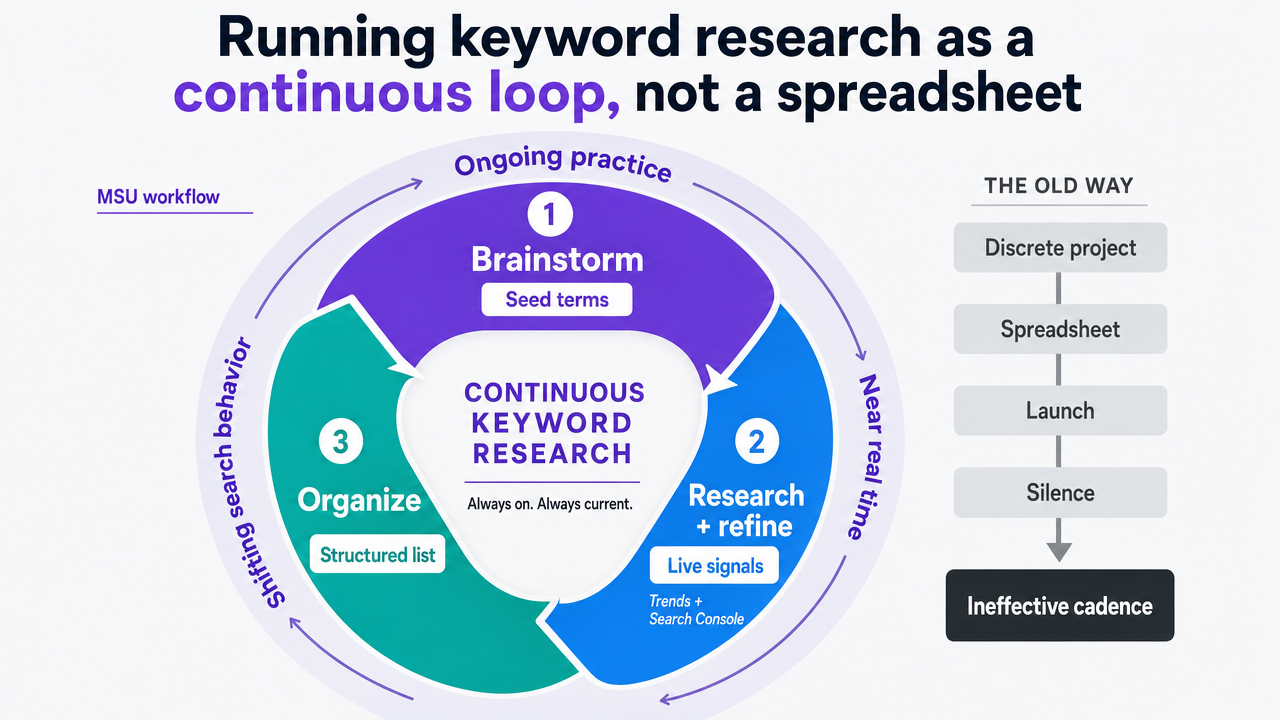 Show the three-phase continuous research workflow (brainstorm, research and refine, organize) with the cadence layered on top, directly supporting the MSU-cited workflow described in this section
Page-level targeting versus site-level topical authority
A common mistake in growth-stage marketing teams is treating the domain as the unit of ranking. It is not. The University of Georgia Extension states that entire websites do not rank for keywords—pages do, and most sites earn more traffic to pages other than the homepage. Therefore, each page should be optimized for its own uniquely valuable keywords 15. This distinction changes where a VP directs optimization efforts.
Page-level targeting is the tactical layer. Each page should address one primary query cluster tied to a specific decision gate and buying-group role, with a matching title, URL structure, and body content. Google's SEO Starter Guide emphasizes unique, user-focused content with descriptive titles and URLs that serve the business, rather than forced keyword insertion 10. For example, a DSO's page on "HIPAA-compliant patient intake workflow" should answer that exact query for the compliance owner at the problem gate. A separate page on "patient intake software pricing per location" should answer the CFO's query at the selection gate. These are two distinct pages, two clusters, and two ranking assets.
Site-level topical authority is the compounding layer that page-level work builds over time. It emerges when a site accumulates enough related pages—each targeting a distinct cluster within the same category—that search engines begin treating the domain as a credible source on that category. UGA's guidance suggests targeting highly specific, lower-competition terms first, as these pages rank sooner and build the internal link and evidence structure that supports higher-competition queries later 15. A senior living operator publishing twelve pages on distinct occupancy-marketing questions will outrank a competitor with one broad "senior living marketing" page, even with lower per-page volume.
The VP-level decision is where to allocate the next unit of effort. If the site has fewer than one page per cell in the keyword-to-decision-gate matrix, the focus should be page-level: filling coverage gaps. When the matrix is populated but individual pages are shallow, the focus shifts to depth—stronger evidence, expert-authored sections, and artifacts that demonstrate expertise, authoritativeness, and trustworthiness, as described in Google's rater guidelines 11. Optimizing the homepage for a category term rarely resolves either problem.
Governance: the operating model that separates programs that scale
Programs that successfully convert keyword work into pipeline share one structural feature: clear ownership of the map. Forrester's guidance on operationalizing buyer-journey programs directly calls for a designated journey owner and shared metrics that balance short- and long-term objectives 7. Without this role, keyword decisions often default to the loudest opinion in content meetings—usually the person closest to the next launch, not the person closest to the buyer.
The journey owner is not a copywriter or an SEO analyst. This role operates above both, maintaining the keyword-to-decision-gate matrix as a single source of truth and arbitrating when demand generation, product marketing, and sales enablement desire the same page to serve different goals. If a paid team wants a category term ranked for a lead-gen offer and the organic team wants the same term for a problem-gate explainer, the journey owner decides based on where the gap in the matrix actually lies.
Shared metrics complete the second half of the work. Forrester warns against silos and advocates for common measures across teams involved in the journey 7. In practice, this means the keyword program reports on the same pipeline outcomes as paid and sales—qualified opportunities influenced, decision-gate coverage, and content-assisted vendor-list inclusion—not just rankings and sessions. A VP who only sees impressions and clicks cannot determine if the program is moving buyers through gates or merely accumulating traffic for terms the buying group has already resolved.
The third governance layer is cadence. The refinement step of the keyword workflow runs monthly, leveraging Search Console and Trends data. The matrix itself is reviewed quarterly against closed-won and closed-lost deal transcripts, which reveal the phrasing buyers actually used before a category name existed. Annual replans are for budget, not for keyword files. Forrester's caution applies here: the journey map is a guide, not an exhaustive list of actions 5, and the keyword file underneath it requires the same treatment—versioned, dated, and expected to change.
A VP auditing an existing program can assess governance with three questions:
- Who is the named owner of the keyword-to-decision-gate matrix?
- What pipeline metric does the keyword program share with sales and paid?
- When was the matrix last edited based on live buyer language, not tool output?
Programs unable to answer these questions are not keyword programs; they are content calendars with search volume attached.
See How Leading Teams Build Predictable Organic Pipeline with Data-Driven Keyword Execution
Connect with Vectoron's experts to benchmark your current keyword strategy, identify gaps in your organic funnel, and explore AI-powered solutions for scaling pipeline—without adding headcount or vendor complexity.
If you manage multiple locations: sizing the query surface
This section addresses VPs managing multiple locations—DSO regional groups, home services franchises, senior living portfolios, and multi-office law firms. At this scale, the keyword problem transforms from a list into a query surface: the total addressable set of buyer questions the program must cover across every location, service line, and decision gate in the matrix.
The math compounds rapidly. The University of Georgia Extension's point that pages rank, not sites, means each location needs its own optimized page set rather than a shared corporate page listing locations 15. A 40-location DSO offering six service lines with three decision-gate clusters per service produces a working query surface in the four-digit range before local-modifier variants are even counted. This is the execution problem a VP is truly sizing.
A variable-based view clarifies the scope:
L : Locations
S : Service pages per location
K : Keyword clusters per service
G : Decision gates covered per cluster
L × S × K × G : Total addressable query surface
Brand-level and location-level work serve different purposes. Brand-level pages carry category authority and problem-gate content applicable across the portfolio—methodology, compliance posture, clinical or operational philosophy. Location-level pages carry selection-gate content with local specificity: named providers, service availability, and queries a buyer types once they have chosen the category and are selecting between nearby options. Forrester's guidance that maps represent the buyer's view of purchasing, not internal stages 4, applies with extra force here. A senior living prospect searching "memory care in [metro]" is not asking a brand question. Answering it with a corporate page routes the query to the wrong artifact.
Quality signals and why keyword-stuffed pages fail the ranker
Keyword targeting is only effective when the underlying page earns the ranking. Google's rater guidelines describe high-quality information as content that demonstrates expertise, authoritativeness, and trustworthiness. These guidelines exist to ensure Search returns results from reliable sources, not pages engineered solely around term frequency 11. A page that repeats "HIPAA-compliant patient intake software" fourteen times without a named clinical or compliance author, without evidence of workflow, and without artifacts a compliance owner would recognize, does not meet this standard.
Google's SEO Starter Guide reinforces this from another angle. The guidance is to produce unique, user-focused content with descriptive titles and URLs that serve the business, rather than forced keyword insertion 10. A URL like /patient-intake-software-hipaa-compliant-dental-practice appears to be built for the ranker, not the reader. The compliance officer clicking through desires a methodology, a named author, a change log, and evidence that the vendor has considered the same edge cases they have.
The operational takeaway is that quality multiplies the effectiveness of every cell in the keyword-to-decision-gate matrix. A well-targeted page with thin evidence will lose to a competitor's page that answers the same query with expert-authored depth. Before adding a new cluster to the file, the program should confirm it can staff the artifact with a genuine subject-matter voice—clinical, legal, operational, or financial—capable of answering the questions a buyer would ask in person.
A 90-day audit for the VP inheriting an existing program
A VP inheriting an existing keyword program does not need a complete rebuild in week one. A more efficient approach is a structured audit to identify which decision gates the program actually covers and which are generating pipeline. Ninety days is sufficient to conduct this without disrupting ongoing work.
- Days 1–30 focus on inventory. Pull every ranking page, tag it to a buying-group role and a Forrester decision gate 13, and mark empty, thin, or duplicated cells in the matrix. Cross-reference Search Console query data against the file to find pages already earning impressions for terms not deliberately targeted 9. This exercise often reveals more coverage gaps than a fresh keyword tool export.
- Days 31–60 test governance. Identify the current owner of the matrix, the pipeline metric the program shares with sales and paid, and when the file was last edited based on live buyer language 7. If these answers are unclear, appoint an owner and establish the monthly refinement cadence before commissioning new content.
- Days 61–90 rebuild depth where it drives pipeline. Prioritize the two or three cells with the highest gate-clearing value and staff them with named subject-matter voices capable of meeting Google's quality bar for expertise, authoritativeness, and trustworthiness 11. All other efforts should wait.
Frequently Asked Questions
References
- 1.SEO Strategy and Keyword Research.
- 2.Creating Journey Maps To Enable Buying Decisions.
- 3.B2B Buyer Journey Map Basics.
- 4.What’s The Difference Between The B2B Buyer’s Journey Map And B2B Revenue Waterfalls?.
- 5.Why a Buyer’s Journey Map Is Not a Program Plan.
- 6.Why Most B2B Buyer’s Journey Maps Miss The Mark.
- 7.Five Ways To Plan For B2B Journey Mapping Success.
- 8.Five fundamental truths: How B2B winners keep growing.
- 9.Get started with Google Trends | Google Search Central.
- 10.Search Engine Optimization (SEO) Starter Guide.
- 11.An overview of our rater guidelines for Search.
- 12.Search Engine Use 2012.
- 13.The Forrester B2B Buying Decision Process Framework.
- 14.The Ways And Means Of B2B Buyer Journey Maps: We're Going ....
- 15.How to research keywords for SEO.