
Key Takeaways
- Start seeding keywords from sales calls, support tickets, and converting product copy, then reduce phrases to noun-verb roots so expansion tools work against language buyers actually use.
- Expand seeds through Autocomplete, People Also Ask, and Related Searches to capture live phrasing, sub-intents, and adjacent clusters that spreadsheet-only lists routinely miss.
- Validate the candidate pool in Keyword Planner for volume ranges and Google Trends for direction, seasonality, and regional variation before committing to a brief.
- Classify intent by reading SERP features directly, since Featured Snippets, Knowledge Panels, review carousels, and Shopping ads signal informational, navigational, commercial, or transactional purpose more transparently than vendor tags 5.
- Prioritize Search Console queries sitting in positions 8 to 20 with high impressions, because closing those near-win gaps often outperforms chasing higher-volume net-new terms 2.
Why Free Keyword Research Outperforms Tool-Dependent Workflows
Search demand continues to grow. PwC's 2023 global consumer survey found that 54% of shoppers rank search engines as their top pre-purchase information source, surpassing social platforms, retailer sites, and word of mouth 1. This highlights the importance for content teams to build a strong keyword pipeline to capture a channel used by over half of buyers before they make a purchase.
The common belief that pipeline quality correlates with tool expenditure is often mistaken. While expensive subscriptions offer aggregated volume estimates and proprietary difficulty scores, they don't provide the two crucial signals for ranking: first-party query data from a brand's own Search Console and live user language directly from the SERP. Both of these are free and frequently underutilized.
Successful managers view free keyword research as a strategic discipline. They analyze Search Console for queries already generating impressions in positions 8 through 20. They interpret People Also Ask and Autocomplete as indicators of actual phrasing. They validate demand using Keyword Planner and Trends before committing to a content brief. Google's own Search Essentials supports this approach, advising publishers to
"use words that people would use to look for your content"
and to integrate them into titles and headings for people-first content 3.
The primary challenge isn't access to data, but establishing a repeatable workflow that converts these free signals into ranked, intent-classified briefs at a consistent production pace. The following section outlines this workflow in five stages.
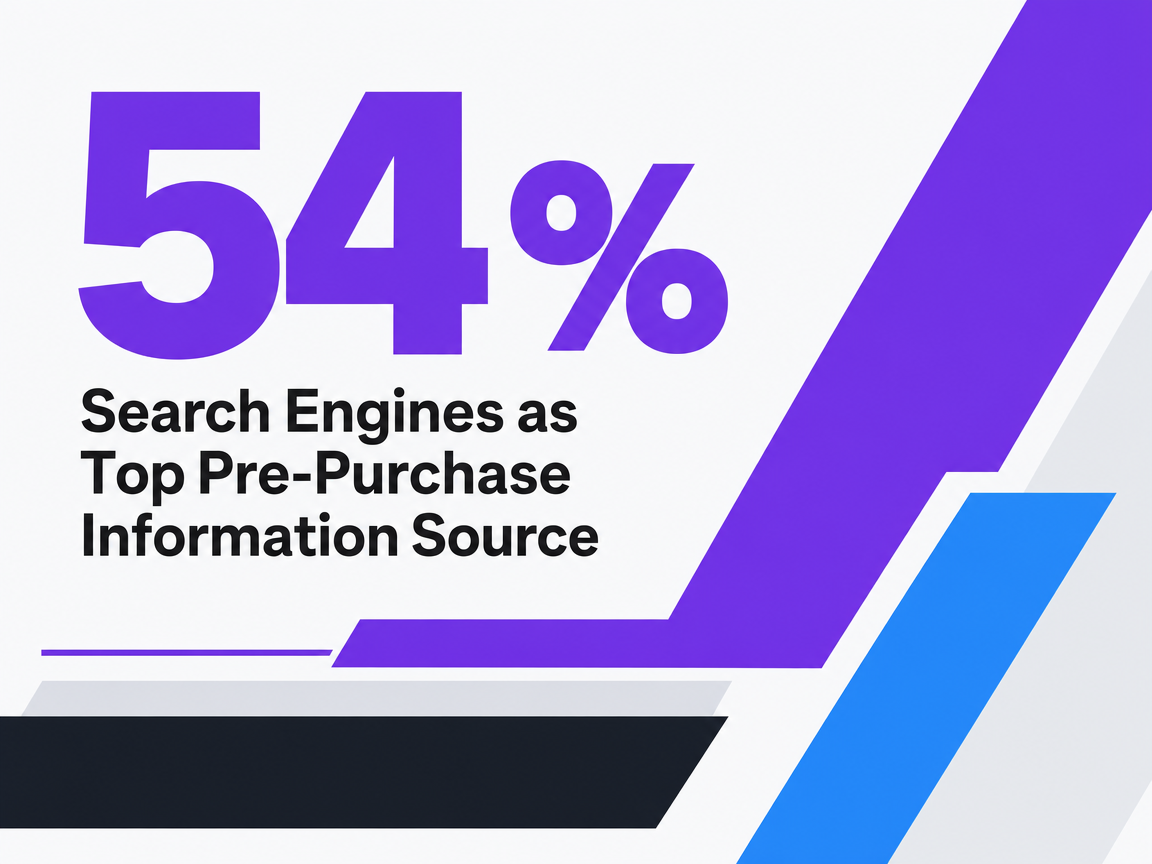 Search Engines as Top Pre-Purchase Information Source
Search Engines as Top Pre-Purchase Information Source
The Five-Stage Free Keyword Workflow
Stage One: Seed From First-Party Language
Keyword seeding begins internally, not with external tools. The most reliable seed terms originate from three internal sources:
- sales call transcripts
- customer support tickets
- existing product page copy that demonstrates conversion
These sources provide the exact phrasing prospects use before engaging with a search engine, and they directly align with commercial and transactional intent.
For each topic cluster, a content team should extract 20 to 30 recurring phrases from these sources, then simplify them to their core noun-verb structure. For example, "How much does invisible aligner treatment cost near me" becomes "invisible aligner cost." This reduction is important because expansion tools are more effective with concise roots rather than full questions.
Secondary seeds can be derived from competitor page titles and H1s on the top five ranking pages for the cluster's main query. This process isn't about imitation, but about confirming that the language identified in sales calls also achieves high rankings. When internal and competitor language align, the seed is validated. Divergences, however, indicate a research finding that warrants further investigation.
Google's Search Essentials sets the standard: use language that users would employ to find content, placing it in prominent locations to serve people-first pages 3. Seeds that don't meet this criterion, including industry jargon, internal product names, or acronyms not searched by buyers, are discarded before further workflow investment.
Stage Two: Expand With Autocomplete, People Also Ask, and Related Searches
Expansion transforms a concise seed list into a candidate pool of 40 to 80 phrases per topic. Google Autocomplete, the People Also Ask module, and the Related Searches block at the bottom of the results page are key. Each surface offers a distinct view of live user language, and failing to differentiate them is a common error.
Autocomplete reveals how searches begin. Typing a seed followed by each letter of the alphabet, a technique documented by lenoretech as producing 8 to 12 new branches per prefix, quickly generates an inventory of real prefix and suffix patterns 8. For instance, "invisible aligner cost" can branch into "invisible aligner cost with insurance," "invisible aligner cost per month," and "invisible aligner cost vs braces," each indicating a unique sub-intent.
People Also Ask (PAA) surfaces questions users click when a headline answer is insufficient. These questions directly inform H2s and FAQ blocks. Clicking a PAA question expands the module with additional questions, extending the pool without requiring new searches.
Related Searches operates at a broader cluster level. While Autocomplete focuses on a single seed, Related Searches suggests adjacent clusters suitable for the editorial calendar. A team researching aligner costs might discover "aligner refinements," "aligner attachments," and "aligner vs retainer" as related clusters, each capable of supporting its own brief.
The searchterms guide emphasizes a generate-then-validate sequence: first mine SERPs and platforms, then push viable candidates into Google's tools for volume signals 7. Bypassing the SERP mining step often leads to keyword lists that appear robust in a spreadsheet but underperform in practice.
Stage Three: Validate Demand in Keyword Planner and Trends
Validation refines the candidate pool into a shortlist. Google Keyword Planner and Google Trends work in tandem, each addressing a unique aspect of demand.
Keyword Planner provides first-party volume ranges and forecast data directly from Google's ad inventory. Zapier's 2026 tool review notes it's completely free, with more detailed data available to accounts running active Google Ads campaigns 10. Accounts without active ad spend see banded ranges, which are sufficient for prioritization but not for precise revenue forecasting. Content teams should input their full candidate pool into the "Get search volume and forecasts" workflow, export the results, and remove any terms with a 0 to 10 volume range, unless it's a high-intent commercial phrase where even 5 monthly searches are valuable.
Google Trends addresses a crucial question Keyword Planner overlooks: is demand for this term rising, stable, or seasonal? A term with 500 monthly searches declining by 40% over two years presents a different opportunity than one with 200 searches increasing by 60%. Trends also highlights regional variations, which is vital for multi-location service brands where a phrase popular in one city might be dormant in another.
Candidates that pass both checks—demonstrating real volume in Planner and stable or rising interest in Trends—proceed to intent classification. Those that fail are filed for review rather than deleted, as seasonal terms often re-emerge, and volume estimates are updated quarterly.
Stage Four: Classify Intent From SERP Features, Not Guesswork
Intent classification is where free workflows often surpass paid alternatives. While paid tools assign an intent tag via an opaque model, the SERP itself communicates intent through the features Google displays. Directly interpreting these features yields more accurate classification than relying on a vendor's label.
A four-part rubric guides most commercial content decisions:
- Informational queries typically display Featured Snippets, People Also Ask modules, and video carousels. Top organic results are usually guides, definitions, and how-to articles from publishers. Content briefs for these terms should aim for the snippet format and answer the core question within the first 60 words.
- Navigational queries feature Sitelinks, Knowledge Panels, and a dominant brand result. These are generally not worth pursuing unless the searcher's target is the brand in question.
- Commercial queries show a mix of comparison content, review sites, and "best of" listicles, alongside product results. Shopping ads may appear but are not dominant. Briefs for these terms should compare options and include decision criteria, rather than just describing a single product.
- Transactional queries prominently display Shopping ads, local packs for service businesses, and product or booking pages as top organic results. Informational content rarely ranks here; a service brand needs a page that facilitates user action.
Research on query sampling supports using these signals as valid proxies for user intention in content strategy development 5. A 2023 paper on search behavior also notes that query length and specificity vary with task type and user expertise, explaining why a single seed can generate branches spanning two or three intent categories, each requiring its own brief 6.
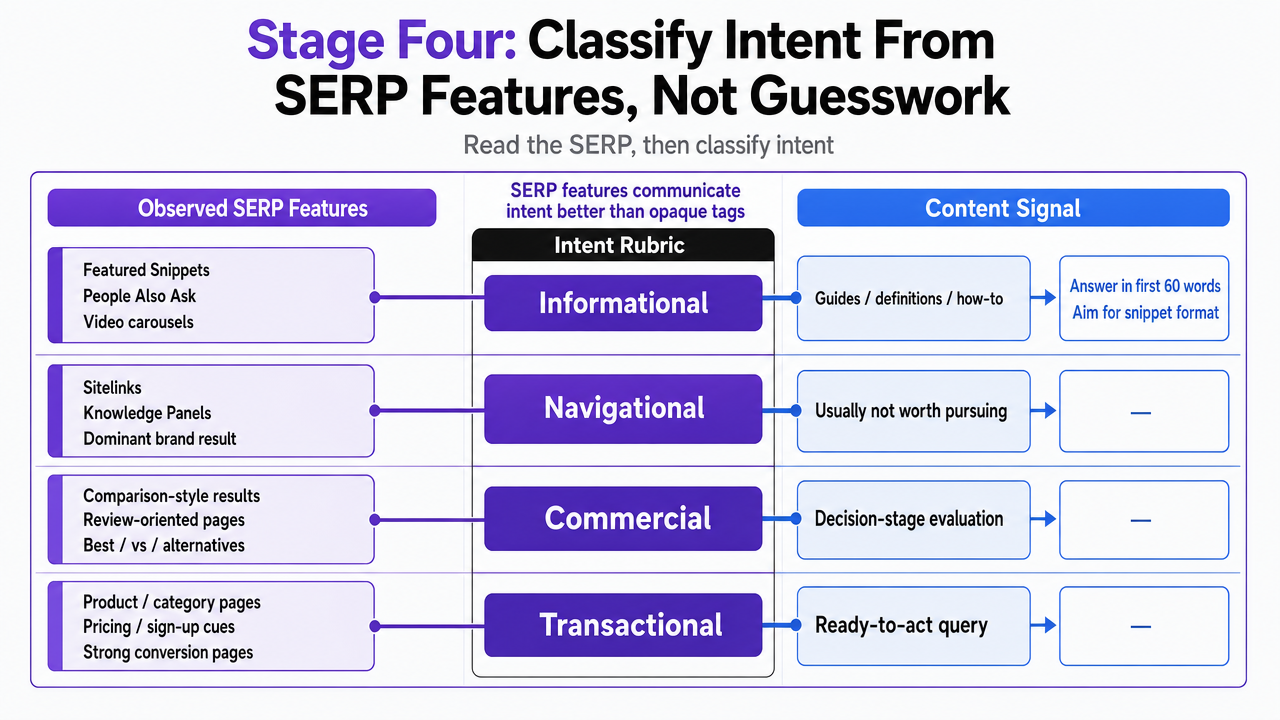 Support the four-part intent rubric by showing how specific SERP features map to informational, navigational, commercial, and transactional intent, which is the core framework of this section
Stage Five: Prioritize Using Search Console Near-Wins
Prioritization is where many free workflows miss significant opportunities. Search Console's Performance report reveals queries for which a site already receives impressions. Queries in positions 8 through 20 with high impressions and low click-through rates (CTR) represent the highest-leverage targets. Moving a query from position 12 to position 5 often involves expanding an existing page, adding an FAQ block that answers a PAA question, or refining a title tag, rather than creating a new page.
The filtering sequence is straightforward:
- Open Performance.
- Set the date range to the last 3 months.
- Filter Position to greater than 7.9 and less than 20.1.
- Sort Impressions descending.
- Remove anything with fewer than 100 impressions.
The remaining rows constitute the "near-win" band. Nuformsocial's 2025 guide suggests a cadence of 5 to 10 new long-tail keywords per week, clustered and mapped to briefs, which is a realistic output for a single content manager balancing near-win optimization with new research 9.
Prioritizing near-wins over higher-volume net-new terms has an additional benefit. Columbia's individual-level click study of a major search engine found that less popular keywords generate more clicks per search and a higher share of sponsored clicks compared to more popular keywords 2. A volume-first prioritization approach can therefore systematically undervalue terms that effectively convert attention into action.
A near-win entering the workflow doesn't require re-seeding. It has already passed demand validation, Google is already displaying it to users, and the site is close to the click threshold. The brief's purpose is to close a performance gap, not to build a page from scratch.
 Free keyword research tools highlighted in Zapier review
Free keyword research tools highlighted in Zapier review
Reading User Language on Q&A and Forum Platforms
Platforms like Reddit, Quora, and niche forums function as unfiltered focus groups. Users articulate questions in their own words, describe problems before knowing product categories, and reveal objections not found in Keyword Planner exports. For content teams relying on free signals, these platforms bridge the gap between what people search on Google and their underlying motivations.
The nuformsocial guide includes forums alongside Search Console and Trends in a free workflow because forum threads expose phrasing that precedes the search query 9. A prospect who eventually searches "invisible aligner cost with insurance" might have started three months earlier on Reddit asking about PPO coverage for adult orthodontic treatment. Both phrasings are valuable for the brief, but only the forum captures the underlying concern that influences headline clicks.
The query sampler research supports treating these platform-sourced phrases as valid indicators of real user intent for content strategy, especially when they overlap with terms from Autocomplete and People Also Ask 5. Convergence across multiple surfaces is a strong signal. A phrase appearing in a Reddit thread, a PAA question, and a Search Console impression report must be addressed in the brief's initial 200 words.
Operational cadence is important here. Content teams should scan two or three relevant subreddits and one Quora topic per cluster, identify the top ten questions by engagement, and add them to the candidate pool before intent classification. This scan takes less than fifteen minutes and yields phrasing that no keyword tool can generate.
Test AI-driven keyword research on live content
Validate your keyword strategy by publishing real articles using full platform capabilities during your free trial.
A Free-Tool Stack, Ranked by Job to Be Done
The five free tools integral to this workflow are not interchangeable; each addresses a specific research question. Understanding their roles clarifies where a manager should focus their time when a brief needs development.
- Google Keyword Planner handles demand validation. Zapier's 2026 review notes it's free, with richer data for accounts running active Google Ads campaigns 10. Accounts without ad spend see banded volume ranges, which are sufficient to narrow a candidate pool from 80 to 20 phrases.
- Google Search Console facilitates first-party discovery. It's the only tool in this stack that reports queries a specific site already receives impressions for, making it indispensable for identifying near-win opportunities and measuring whether published content captures target terms.
- Google Trends provides insights into direction and seasonality. While Planner reports current volume, Trends shows whether that volume is increasing, stable, or seasonal, and if it's concentrated in specific regions. Multi-location service brands use regional views to decide if a popular phrase in one metro warrants a page in another.
- Autocomplete and People Also Ask are crucial for language discovery. Neither provides volume data, but both reveal phrasing users actually type and questions they click. These surfaces populate the candidate pool that Planner then validates.
- Bing Keyword Planner offers cross-checking capabilities. Its volume estimates are derived from a different index and often surface terms that Google's Planner might group within a broader range. This is useful for obtaining a second opinion on marginal candidates before they are added to or removed from the shortlist.
Managers who follow this stack in order—language first, demand second, direction third, first-party fourth, cross-check fifth—can produce intent-classified briefs without needing a paid subscription.
On-Page Placement That Preserves Free-Research Gains
A prioritized keyword list is ineffective if the target terms are buried where search engines cannot easily find them. Free research yields results only when the target phrase is placed in locations that crawlers prioritize and users scan first.
Google's Search Essentials explicitly states: use words people would use to find content, and place them in prominent locations like titles and headings 3. The SEO Guide for Web Developers extends this to metadata, instructing publishers to give every page a descriptive title and meta description, and to ensure visual content is expressed in text form for Google to read 4. Terms embedded only in image files, CSS-generated content, or plugin-rendered widgets will not be indexed.
Four key placements carry most of the weight for a near-win brief:
- the title tag
- the H1
- the first 100 words of body copy
- at least one H2 that mirrors a People Also Ask question
While meta descriptions primarily influence CTR rather than ranking, a description that echoes the query can boost click-through in the position band where near-wins reside. Alt text on supporting images also captures the term in a semantic surface that crawlers index.
A free keyword pipeline that concludes at the spreadsheet stage leaves potential impressions untapped. Disciplined on-page placement is what translates research into ranking improvements.
Scale High-Impact Keyword Research—No Paid Tools Required
Connect with our team to see how leading agencies automate keyword discovery at scale, leveraging AI workflows that accelerate content velocity without compromising data quality or approval controls.
Cadence and Economics: What a Manual Free Workflow Actually Costs in Hours
The free tool stack is free in terms of cost, but not in terms of time. A realistic assessment of manual hours is crucial for a workflow that consistently produces briefs, rather than one that stalls prematurely.
The lenoretech process indicates 30 to 45 minutes per topic once a content manager gains experience with the sequence 8. This covers stages one through four: seeding, expansion via Autocomplete and People Also Ask, validation in Keyword Planner and Trends, and intent classification from SERP features. Stage five, Search Console near-win mining, is conducted as a separate weekly task, as a single session can identify candidates across multiple clusters.
Nuformsocial's 2025 guide suggests a weekly output of 5 to 10 new long-tail keywords, clustered and mapped to briefs 9. At the midpoint of 7 keywords per week, this translates to approximately 28 to 30 per month. Applying the 30 to 45 minute per-topic range results in a monthly research load of 14 to 22 hours for a single content manager, prior to any writing.
| Workflow input | Sourced range |
|---|---|
| Time per topic, stages 1–4 | 30–45 minutes 8 |
| New long-tail keywords per week | 5–10 9 |
| Autocomplete branches per prefix | 8–12 8 |
| Candidate phrases per 5-minute SERP mine | 15–25 8 |
Two factors influence this workload. Team maturity reduces per-topic time towards the 30-minute floor as pattern recognition improves. Conversely, cluster density can expand it: a topic with three distinct intent branches yields three briefs from one research pass, effectively lowering the per-brief cost below the stated range.
The economic consideration isn't merely about saving subscription costs. It's about whether the 14 to 22 monthly hours a manager spends in Search Console, Keyword Planner, and SERP tabs represent the most effective use of their judgment. Research time is judgment time; drafting, briefing, and QA often are not. A pipeline that reserves the manager for high-judgment research and offloads subsequent tasks is where the economic benefits of a free workflow truly compound.
Feeding a Free Keyword Pipeline Into AI-Assisted Production
A free workflow generates a research asset, not a published page. The stages between a ranked keyword list and a live URL—drafting, briefing, internal linking, on-page placement, and QA—are often where content pipelines falter. The 14 to 22 monthly hours a manager dedicates to Search Console, Keyword Planner, and SERP tabs are the most critical, high-judgment hours in the entire operation. The downstream hours are typically less so.
The strategic move is to concentrate human judgment on research and intent classification, then hand the classified brief to an AI-assisted production layer. This layer drafts content based on the SERP feature signals already identified by the manager. A near-win from the position 8 to 20 band enters this layer as a target query, an intent tag, a set of People Also Ask questions to address, and a placement specification for the title, H1, and first-100-words treatment, aligned with Google's Search Essentials 3. The AI produces a draft, which the manager then approves, edits, or rejects.
This handoff enables scaling without increasing headcount. Vectoron's approval-first workflow is specifically designed for this division of labor: the manager makes the keyword decisions, the platform manages the production cycle, and nothing publishes without final sign-off.
Frequently Asked Questions
References
- 1.Global Consumer Insights Pulse Survey June 2023.
- 2.Consumer Click Behavior at a Search Engine.
- 3.Google Search Essentials (formerly Webmaster Guidelines).
- 4.SEO Guide for Web Developers.
- 5.Query sampler: generating query sets for analyzing search engines using keyword research tools.
- 6.Submitted 17 February 2023 (search behavior/keywords-related paper).
- 7.7 Free Ways to Do Keyword Research.
- 8.Free Keyword Research: How to Find Profitable Keywords Without Paid Tools.
- 9.Keyword Research Without Paid Tools: Free Methods.
- 10.The 5 Best Free Keyword Research Tools in 2026.