
Key Takeaways
- Treat every keyword cluster as a CRM object carrying source stamps, landing page groups, and closed-won revenue, so retainer conversations shift from rankings to pipeline contribution 8.
- Report organic-sourced pipeline and organic-influenced pipeline as separate line items; collapsing them hides whether a cluster generates net-new demand or accelerates existing deals 4.
- Attribution lives on the CRM opportunity record, not in GA4 or Search Console, so the source stamp must persist through form submission, lead conversion, and deal creation 7.
- When retainers are under review, redirect production hours toward comparison, pricing, and alternatives clusters that produce visible CRM movement within thirty days, while maintaining reduced top-of-funnel work 11.
The reporting gap that kills agency retainers
Most keyword strategies still live in a spreadsheet, focusing on ranking positions, search volumes, and difficulty scores. This approach fails to answer the critical question for retainer longevity: which keyword clusters produced qualified pipeline, and at what cost per MQL.
The issue isn't analytical; it's architectural. Agencies that successfully defend and expand retainers treat every cluster as a line item in a CRM report, tracking sourced pipeline, influenced pipeline, cost per MQL, and closed-won revenue tagged by cluster and landing page 8. Traffic and rankings become internal diagnostics, while pipeline contribution becomes the primary deliverable.
The main bottleneck isn't keyword selection but the data flow between search intent, content production, CRM source stamping, and weekly reporting. Every organic lead must flow into a CRM where it can be tied to closed revenue 10. If the source field is blank, the cluster's contribution is invisible. Consistent blank source fields over a quarter transform retainer discussions from data-driven conversations into matters of faith.
This article details the reporting schema, attribution decisions, and the three-system stack necessary to transform a keyword strategy from a research deliverable into a pipeline instrument that clients will renew.
Keyword clusters as CRM objects, not research artifacts
A keyword cluster should be treated as a record type, not just a spreadsheet tab. Each cluster needs to carry a source stamp, a landing page group, GA4 conversion events, and a live count of MQLs, SQLs, opportunities, and closed-won revenue within CRM systems like HubSpot or Salesforce 8. Agency reports on organic-sourced MQL volume, cost per MQL, share of inbound MQLs, and pipeline value should originate from the CRM, not a keyword tool.
This shift redefines the purpose of a cluster. Keyword research generates a candidate list, but the CRM phase determines which candidates receive continued production hours. A cluster that ranks well but doesn't contribute to closed-won deals will lose budget. Conversely, a cluster with modest traffic but a clear connection to MQLs via a demo request page will retain its budget.
This reframe requires that the original source and entry page data reside on the same object as the closed-won amount 7. Without this, no cluster can be accurately scored. With it, agency reporting shifts from debating rankings to discussing pipeline contribution, which is the basis for client renewals.
To achieve this, design workflows where every cluster has a naming convention that extends to UTM parameters, hidden form fields, and CRM lead source values. Content briefs must specify the owning cluster, the conversion event, and the lifecycle stage a lead must reach for the cluster to receive credit 3. Content production then becomes a data-capture exercise disguised as content creation.
What a 4x pipeline outcome actually required
A frequently cited outcome in pipeline attribution literature is a documented 4x growth in pipeline attributed to organic search from a single B2B SaaS engagement 5. This number is valuable, but its context is crucial: it represents one company, one reporting cadence, and one attribution model, not an industry benchmark or a universal agency promise.
The legibility of this delta to the client stemmed from disciplined reporting, not just traffic increases. Three operational choices were key:
- Weekly reporting focused on pipeline attributed to organic search, rather than traffic, rankings, or keyword position changes 5. This cadence ensured that every content decision was re-evaluated against CRM movement within seven days. Clusters generating trial signups and SQLs maintained their production hours, while those producing sessions without lifecycle progression were paused.
- UTM-tagged landing pages fed into a CRM account-matching layer 5. Each organic entry point carried structured parameters that persisted in the lead record. When a deal closed, the original organic touch remained on the object, enabling accurate attribution 7.
- A multi-touch model reported organic-sourced pipeline (first touch was organic) and organic-influenced pipeline (organic appeared anywhere in the journey) as distinct line items 5. Combining these numbers would have obscured which clusters initiated relationships versus which ones helped close them.
The key takeaway for agency owners is not the multiplier itself, but the reporting architecture that made the multiplier defensible. Any agency implementing a similar stack—UTM discipline, CRM account matching, weekly cadence, and separate reporting for sourced and influenced pipeline—can produce a verifiable number. Without these elements, a 4x claim is merely a chart, not evidence.
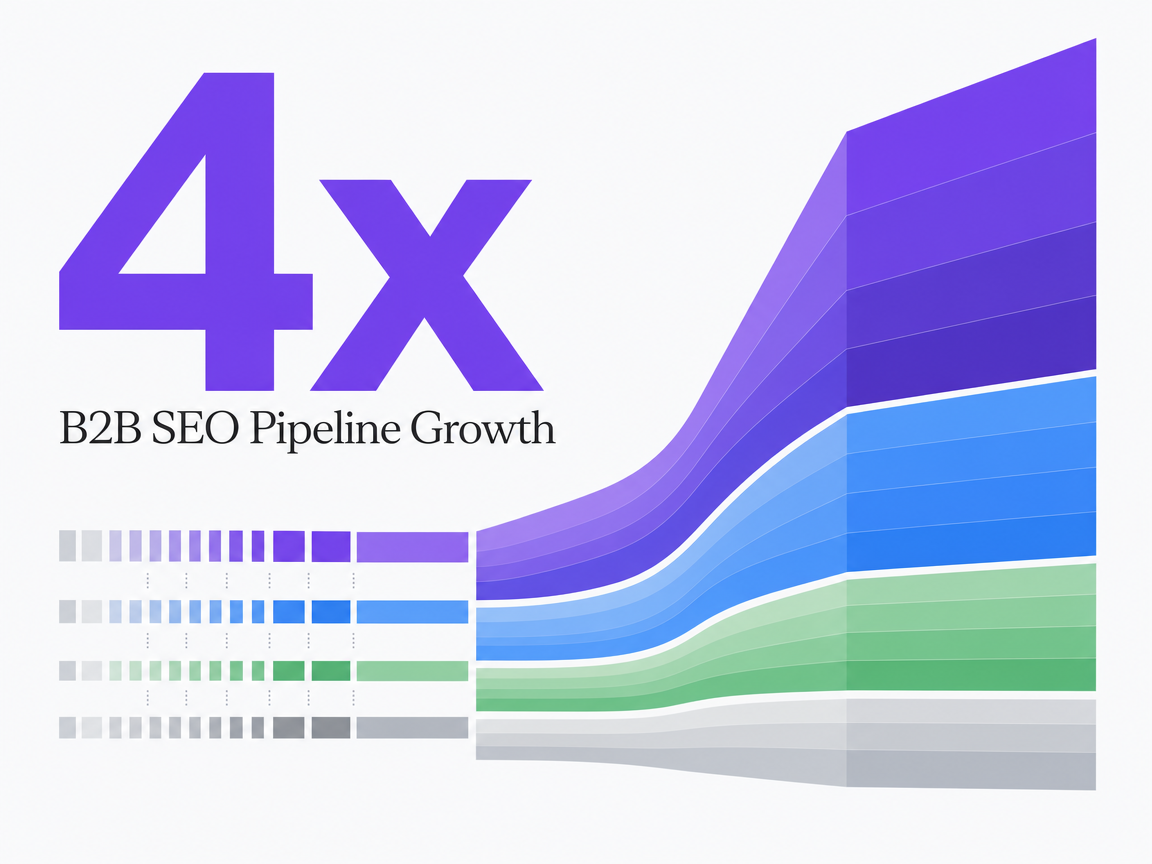
B2B SEO Pipeline Growth
Sourced vs. influenced pipeline: the distinction most reports collapse
Many agency reports present a single "organic pipeline" number, which is often insufficient. This single figure conflates clusters that initiate relationships with those that help close them, and it provides a number that clients may struggle to reconcile with their own CRM data.
A more effective schema separates this into two distinct metrics. Organic-sourced pipeline represents the dollar value of opportunities where the first touch on the lead record was organic search. Organic-influenced pipeline accounts for the dollar value of opportunities where organic appeared at any point in the multi-touch journey, including assisted touches after a paid or direct entry 4. Both are reported separately to provide a complete picture.
Keeping these metrics separate is operationally crucial. Sourced pipeline indicates whether a cluster is generating net-new demand. Influenced pipeline reveals whether a cluster is helping existing deals progress towards closed-won. A comparison of these two line items, cluster by cluster, highlights which content drives acquisition and which supports enablement. Combining them obscures both signals.
Further distinction is valuable in client conversations. Provable organic pipeline refers to deals with a captured organic touch on the CRM record. Influenced pipeline can sometimes extend to branded and direct growth that correlates with organic investment but cannot be tied to a specific session 7. Agencies that report correlated numbers without labeling them as inferred risk losing credibility. Labeling these categories—provable, inferred, and the gap between them—grounds the discussion in reality.
Multi-touch remains the primary lens. Last-touch attribution serves as a diagnostic view, useful for identifying clusters that close deals but insufficient on its own, as it undervalues top-of-funnel content that initiates journeys 4. First-touch provides the counterweight, and together, they define the honest range of a cluster's contribution.
The practical output is a monthly report featuring three columns per cluster: sourced pipeline value, influenced pipeline value, and the ratio between them. Clusters with high sourced and low influenced values are acquisition engines. Those with low sourced and high influenced values are deal accelerators. Clusters excelling in both are core to the retainer and receive the majority of production hours in the subsequent month.
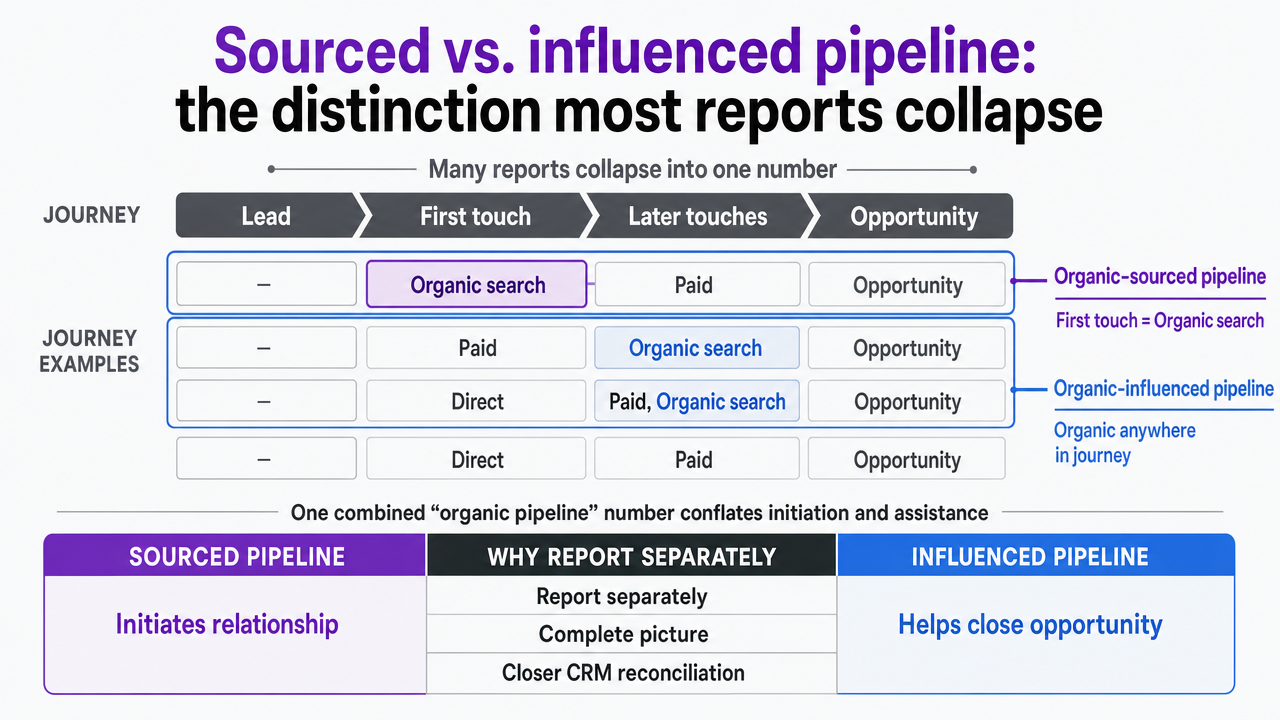 Visualize the operational comparison between sourced pipeline (first-touch organic) and influenced pipeline (organic anywhere in journey) as described in this section, showing how each is defined and interpreted
Test data-driven keyword strategies in real time
Validate your pipeline impact by publishing live campaigns and tracking measurable results during the trial.
Where attribution actually lives: the CRM record
Analytics dashboards are not the definitive system of record. While GA4 tracks sessions and events, and Search Console shows queries and impressions, neither holds the closed-won amount. The critical data point—the closed-won amount—resides on a CRM opportunity object in systems like HubSpot or Salesforce. If the original source and entry page are not linked to this object, no cluster can be credited for the revenue 7.
This is a common failure point for many reporting stacks. Teams often instrument GA4 events, link them to conversion goals, and assume the analytics layer will seamlessly translate into pipeline reports. This assumption is incorrect. Attribution occurs at the CRM record level, meaning the source stamp must persist through every step from form submission to deal creation 7.
The mechanics are straightforward: hidden form fields capture UTM parameters and the entry page upon submission. The form handler then writes these values into lead source, original source, and first-touch landing page fields on the lead object. These fields carry forward when the lead converts to a contact, propagate again when the contact attaches to an opportunity, and finally, the closed-won amount joins them on the same record 8.
Any missed handoff breaks the attribution chain:
- A lead created without a UTM stamp defaults to direct or unknown.
- Merging a contact without preserving the original source overwrites the organic touch.
- An opportunity created from a contact without inheriting source fields severs the chain at the last moment.
Each such gap means revenue generated by a cluster cannot be credited to the agency 10.
The crucial audit is not the keyword tracker, but a quarterly review of the percentage of closed-won opportunities that have a populated original-source field. If this figure is below ninety percent, the pipeline report is based on a partial sample, making the retainer conversation vulnerable when a client questions the numbers.
The minimal viable attribution model
While multi-touch is the ideal primary lens, it's not the appropriate starting point for most agency-client engagements. Many clients begin with CRMs that have incomplete source data, lack self-reported source fields on demo forms, and feature inconsistent lead lifecycles. Attempting to implement a full multi-touch model on such a foundation often results in untrustworthy reports.
A pragmatic compromise is a three-part minimal viable model: first-touch and last-touch fields for every lead in the CRM, combined with a self-reported source field on demo and contact forms 6. First-touch credits the cluster that initiated the relationship, while last-touch credits the cluster that closed it. The self-reported field—a required dropdown asking how the buyer discovered the company—captures branded and dark-social touches that analytics layers cannot detect.
These three fields don't fully resolve attribution; rather, they bracket it. When first-touch, last-touch, and self-reported source all indicate organic, the cluster's credit is defensible. Discrepancies between these fields become valuable data, signaling buyer journeys that crossed channels the CRM couldn't trace 7.
Clients and boards typically accept this model because it links every credited dollar to a closed-won record, even with incomplete touch history 6. Agencies can then expand to weighted multi-touch models once the minimal model consistently produces clean weekly numbers, not before. The sequence is crucial: source hygiene first, model sophistication second.
Mapping keyword clusters to CRM stages
The four-stage keyword-to-revenue path
The traditional awareness-consideration-decision funnel is a marketing concept that doesn't directly map to a CRM. A more practical framework breaks the journey from search term to closed revenue into four operational stages, each with a defined data owner and artifact 13.
- Stage one is keyword tracking. Google Search Console (GSC) manages the query-to-page relationship. The artifact is a live list of clusters showing impressions, clicks, and average position by URL. At this stage, the focus is on confirming the cluster is generating search demand.
- Stage two is landing page mapping. Each cluster corresponds to a specific landing page group, and each page is instrumented with conversion events for qualifying actions. Google Analytics 4 (GA4) owns this layer. The artifact is a page-level table displaying sessions, event completions, and the associated cluster 1.
- Stage three is lead attribution. Upon form submission, the source, entry page, and cluster identifier are stamped onto the lead record. This allows tracking conversion rates and lead quality by keyword cluster, rather than just session counts 13. This is where many reporting stacks fail if the stamp doesn't transfer to the CRM, rendering the cluster invisible.
- Stage four is revenue connection. Closed-won amount, deal cycle length, and customer lifetime value (CLV) are aggregated by cluster on the CRM opportunity object. The output is a single table showing revenue and CLV per cluster 13. This table, not ranking dashboards or traffic curves, is the report clients use for renewal decisions.
Prioritizing high-intent clusters when defending a retainer
Not all clusters warrant equal production time. When a retainer is under review, prioritizing clusters linked to qualified sales calls and demo requests—bottom-of-funnel intent that quickly translates to visible CRM stages—is crucial 11.
The prioritization logic is simple: clusters targeting comparison queries, pricing queries, alternatives queries, and category-plus-solution queries have the highest probability of generating MQLs within the reporting window 12. These clusters make pipeline numbers defensible without abstract discussions about brand lift.
Top-of-funnel clusters still have a role, as B2B buyers use different queries during early research and later evaluation stages, and early queries seed future conversions 14. However, funding top-of-funnel content at the same rate as bottom-of-funnel content when a retainer is at risk is a mistake. When clients question ROI, production hours should shift towards clusters that demonstrate visible CRM movement within 30 days. Top-of-funnel work continues, but with a reduced share until sourced pipeline stabilizes.
The scoring input for this prioritization is the sourced-to-influenced ratio from the previous month's report. Clusters generating sourced pipeline receive the majority of hours. Those producing only influenced pipeline get maintenance hours. Clusters producing neither are paused and documented; a paused cluster with a written justification is a defensible line item, unlike a cluster consuming hours without a pipeline signal.
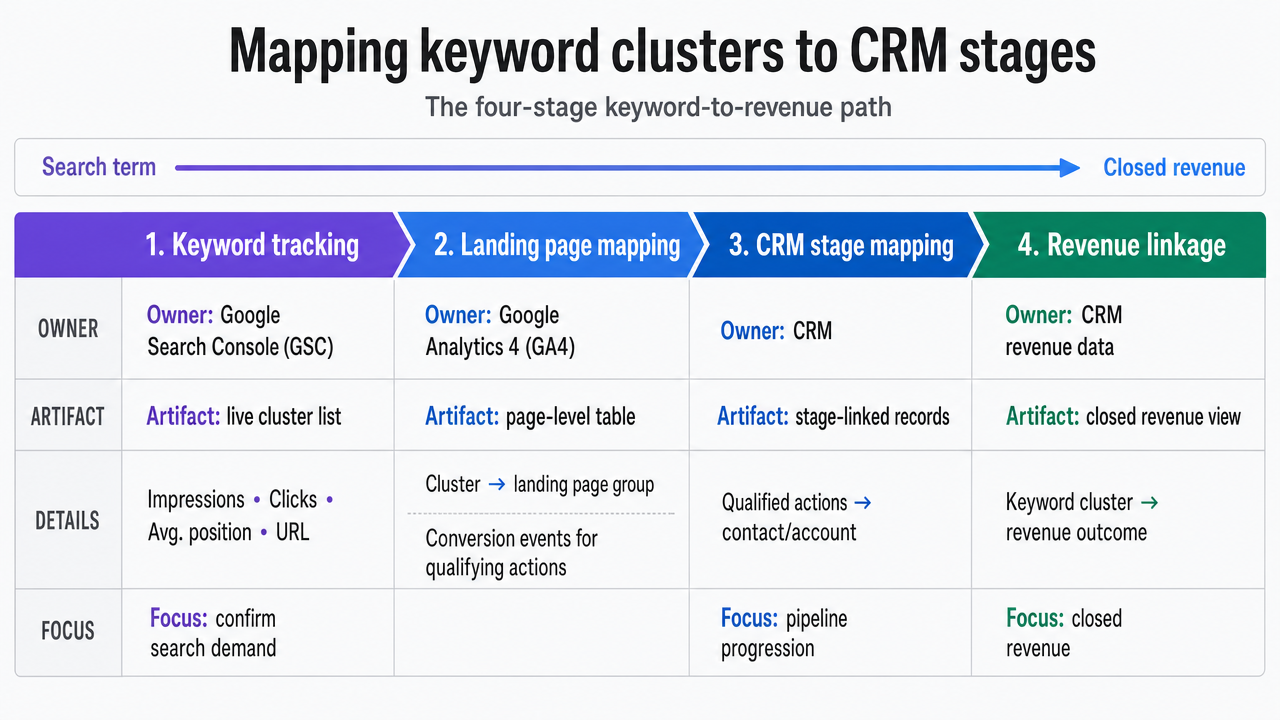 Illustrate the four-stage keyword-to-revenue path described in the section, showing the data owner and artifact for each stage as an operational workflow
See How Data-Driven Keyword Strategies Translate Directly to Qualified Pipeline
Request a walkthrough illustrating how leading agencies connect search intent to measurable pipeline impact—streamlining reporting, reducing manual overhead, and maintaining full client visibility at every stage.
The three-system stack: GSC, GA4, and the CRM
Accurate keyword-to-pipeline reporting necessitates connecting three systems: Google Search Console (GSC), Google Analytics 4 (GA4), and the CRM 8. Each system answers a distinct question, and none can provide a complete report independently.
GSC : Manages the query layer, revealing which search terms generated impressions and clicks for specific URLs. It's the only system that captures the actual search query.
GA4 : Handles on-site behavior, tracking sessions, entry pages, conversion events, and user paths. It's where organic traffic is tagged as a channel before leaving the browser.
CRM : Manages the outcome layer, holding the lead record, opportunity, closed-won amount, and crucially, the source stamp that links revenue back to a landing page and cluster 1.
The integration isn't merely a dashboard; it's a monthly reporting workflow. This process cross-references organic-attributed conversion events from GA4 with CRM records where the first-touch source is organic. It then estimates pipeline contribution using average deal size and close rate per cluster 1. GSC data is incorporated to explain which queries drove the clicks that led to these conversions, completing the loop back to the keyword layer.
The CRM is the system of record. GA4 and GSC serve as inputs. When these systems inevitably disagree due to factors like cookie loss, cross-device gaps, or delayed conversions, the CRM number is what clients ultimately renew against 7.
If you manage multi-location client portfolios: a cluster-to-location reporting schema
This section is for agencies managing multi-location client portfolios, such as dental practices, senior living communities, or regional home services with location-level P&Ls. For these clients, a single organic pipeline number for the parent brand obscures the actual demand distribution.
The reporting schema requires an additional dimension on each cluster record: location. Every organic lead must carry both a cluster identifier and a location identifier. This location data can originate from the landing page (if it's location-specific), form logic (e.g., a ZIP-to-location router), or CRM assignment rules. Both fields must propagate through lead, contact, and opportunity objects. Reports then pivot by cluster and location, rather than just by brand 8.
The variables populated from client data remain consistent across verticals:
- Number of locations
- Average deal value per location
- Organic-sourced MQL volume per cluster per location
- Close rate by cluster per location
- Cost per MQL calculated against the cluster's production hours 8
Organic revenue generated per cluster per location follows the same formula as single-brand reports—MQL volume multiplied by close rate multiplied by average deal value—but applied at the individual location level.
Running these reports reveals two key patterns. First, a cluster that appears average at the brand level often concentrates its pipeline in just a few locations, which should redirect production priorities towards pages serving those specific markets. Second, locations with weak organic-sourced pipeline but strong influenced pipeline usually indicate that brand demand is being generated elsewhere, prompting a shift in the retainer conversation from cluster performance to overall channel mix.
Weekly cadence, margin, and the case for industrializing the loop
Monthly reporting erodes retainers. By the time a monthly deck is delivered, the client has gone thirty days without clear pipeline signals, and the agency has spent that time producing content for clusters that may not be moving CRM stages. Weekly cadence closes this gap. It was also the operational choice that distinguished the documented 4x pipeline growth case from campaigns that generated similar traffic but lacked defensible numbers 5.
The margin challenge is significant. Weekly reporting on sourced pipeline, influenced pipeline, and cost per MQL by cluster demands production hours agencies often don't have unbilled. Manual data extraction from Search Console, GA4, and HubSpot or Salesforce, followed by reconciliation against the cluster taxonomy, can consume a strategist's entire Friday. Across fifteen clients, this reporting layer alone can require a full-time equivalent 1.
There are two responses. The first is to increase retainer fees to cover reporting hours, which many agencies cannot do without losing clients. The second is to industrialize the process: automate data pulls, standardize the cluster-to-CRM schema across all clients, and reserve human strategists for interpretation only. This reduces reporting hours, improves margin, and transforms the keyword strategy from a research artifact into a pipeline instrument that drives client renewals 8. Platforms like Vectoron are designed for this purpose, allowing strategic judgment to remain with the agency while automating the reporting mechanics.
Frequently Asked Questions
References
- 1.B2B SaaS SEO: Connect Rankings to Pipeline.
- 2.B2B SEO Strategy 2026: Generate Leads Through Organic ....
- 3.B2B SEO Strategy: The Framework We Use With Every ....
- 4.SEO Pipeline Attribution: Prove Revenue From Organic.
- 5.B2B SEO Case Study: 4x Pipeline Growth | daydream.
- 6.B2B SEO Content Strategy for Pipeline Generation.
- 7.How to Attribute SEO to Pipeline (B2B SaaS Method) - PipeRocket.
- 8.Key B2b Seo Kpis That....
- 9.B2B SEO checklist: drive pipeline, not just traffic.
- 10.B2B SEO Strategy: How 100+ Clients Drive Pipeline.
- 11.B2B SEO Strategy to Capture Demand and Drive Pipeline.
- 12.B2B Lead Generation SEO Strategies That Actually Drive ....
- 13.Keyword to Revenue: Tracing How Search Terms Turn into Customers.
- 14.Search marketing and the B2B buyer journey.