Key Takeaways
- Scalable lead generation depends less on channel mix and more on coordination, treating SEO, paid, and link acquisition as one operating model with shared targets and measurement.
- Fragmented channel ownership produces keyword cannibalization, landing-page inconsistency, and backlink misalignment, costs that compound as buyers now use an average of ten interaction channels per purchase 4.
- A unified model rests on four layers, strategy, production, distribution, and decisioning, where shared ICP artifacts and a single brief prevent conflicting positioning and double-spend on the same buyer.
- Move measurement from single-model attribution and MQL volume to a portfolio of methods and account-weighted pipeline, then sequence the shift across a 90-day path before consolidating vendors 1.
When SEO and PPC Compete for the Same Buyer
A SaaS marketing organization often runs parallel programs without coordination. For example, an SEO team might publish a guide targeting "workflow automation software," while a paid team bids on the same term in Google Ads, directing traffic to a gated demo page. Simultaneously, a link-building vendor might target a different pillar page that is outdated. This scenario illustrates a common problem: three channels, one buyer, and uncoordinated efforts targeting the same intent.
This fragmented approach is common in B2B SaaS marketing teams with over $10M ARR. Lead generation is typically organized by channel, reflecting how vendors and headcount are structured, rather than focusing on the buyer's journey. This leads to predictable issues: keyword cannibalization, paid landing pages that don't align with organic ranking signals, and backlink campaigns that strengthen deprioritized pages.
The core argument here is that scalable lead generation in the current market is less about channel mix and more about coordination. Organizations that succeed are those treating SEO, paid media, and link acquisition as a single operating model with shared targets, production, and measurement, rather than disparate workstreams that only reconcile during quarterly reviews.
The Coordination Problem Behind Modern Demand
Ten Channels, One Buyer, No Shared Map
Buyer behavior has evolved faster than many marketing organizational structures. McKinsey's B2B Pulse research indicates that B2B buyers now use an average of ten interaction channels in a single purchase journey, a significant increase from five channels in 2016 4. This figure encompasses both digital and human touchpoints, including search, vendor websites, peer reviews, sales conversations, demo environments, and community forums.
This reality of ten channels per buyer often clashes with marketing organizations structured around three to five channel-specific teams. Most SaaS marketing departments above $10M ARR still organize with distinct leads for SEO, paid media, content, lifecycle, and outsourced link building. Each manages a budget and reports on channel-specific KPIs, but none has overall ownership of the buyer's journey.
The result is a lack of a unified view: there's no shared map detailing which channels are active at each stage of the buyer's journey for specific target accounts. Without this, channel owners optimize for their individual metrics—sessions, CPL, referring domains—leading to a disconnected experience for the buyer, even if all interactions share the same brand.
Failure Modes of Fragmented Channel Ownership
Fragmentation manifests not as a dashboard alert, but as a series of small, compounding operational inefficiencies.
A common issue is keyword cannibalization between paid and organic efforts. An SEO team might work to improve a page's ranking for a commercial term, while the paid team, using a separate keyword list, bids on the same term to quickly capture traffic. This results in the company paying for clicks that organic search might soon deliver for free. Both teams operate within their own metrics, but the organization incurs double the cost for the same intent.
Another failure mode is landing-page inconsistency. Paid campaigns frequently iterate on copy based on conversion data, but these insights rarely inform organic content briefs. Consequently, the highest-ranking organic pages may feature messaging that the paid team has long since abandoned. This creates a disjointed experience where buyers arriving via search encounter different value propositions than those arriving through ads.
Finally, backlink misalignment occurs when link vendors, briefed quarterly, build authority for pages that are no longer central to the sales funnel. While domain rating might improve, pipeline growth does not, because the most authoritative pages on the site are not those driving current sales objectives.
Integrated marketing communications frameworks have long identified this organizational pattern, emphasizing the need to align messages across channels by breaking silos and reconciling conflicting stakeholder incentives 6. The cost of ignoring this issue has increased, as buyers now interact with more touchpoints and are more likely to notice inconsistencies.
A Four-Layer Operating Model for Unified Lead Generation
Strategy Layer: Shared ICP, Shared Account and Keyword Targets
The strategy layer is the most cost-effective point for channel coordination. Once decisions move into production calendars and bid sheets, reconciliation becomes significantly more expensive. A unified model establishes four core artifacts that all channels must adhere to:
- a single Ideal Customer Profile (ICP) definition
- a tiered target account list
- a keyword and topic universe categorized by buyer stage
- a value hierarchy that prioritizes accounts by expected contract size rather than just fit score
This "inheritance" means the SEO team selects commercial keywords from the shared universe, focusing on those where organic ranking is economically viable. The paid team cannot bid on terms outside this universe without an exception review, preventing duplicate spending on the same head term. Similarly, the link-building program targets pages relevant to tier-one and tier-two accounts, ensuring authority is built where it matters most.
Forrester's 2023 B2B predictions highlight that companies prioritizing customer needs over internal volume targets outperform competitors, especially as buying behaviors become more fragmented 2. Shared strategy artifacts are crucial for implementing this customer-centric approach beyond high-level presentations.
Production Layer: One Brief, Many Surfaces
Many unification efforts falter at the production stage. Channel teams may agree on a shared strategy but then revert to separate briefs, writers, and review processes. By the time a campaign launches, the paid landing page, organic pillar, and outbound sequence often present conflicting positioning.
A unified production layer consolidates these efforts into a single brief for each target topic or account cluster, from which channel-specific outputs are derived. This brief defines the positioning, proof points, primary and secondary keywords, offer, and disqualifiers. From this single source, the team creates an organic long-form asset, a paid landing page variant, an outbound email sequence, a sales one-pager, and anchor text targets for the link program. While the artifacts vary in length and format, their core argument remains consistent.
This approach embodies integrated marketing communications, which Northwestern's Medill IMC program defines as coordinating messages across various channels to deliver a consistent strategic message. This requires breaking organizational silos and aligning internal stakeholders 6. The single brief serves as an auditable artifact that ensures this alignment.
Distribution Layer: Routing Demand Without Double-Spending
The distribution layer prevents the organization from overspending on the same buyer. In a fragmented model, paid and organic compete on the SERP, retargeting targets accounts already engaged with sales, and link programs build authority for pages not receiving paid traffic. A unified distribution layer treats the SERP, inbox, and off-domain referral graph as a single inventory to be strategically allocated, rather than maximizing three independent channels.
Three key rules guide this layer:
- If an organic page ranks in the top three for a commercial term, paid bids on that term are suppressed or limited to defensive spending, reallocating the budget to terms where organic cannot compete.
- Retargeting and outbound efforts exclude accounts already in an active sales cycle, reducing friction and wasted budget.
- Link acquisition focuses on pages that are critical for paid traffic and sales sequences, ensuring authority builds where it directly impacts the pipeline.
These rules do not require new technology; they require a single owner with cross-channel visibility and the authority to reallocate budget across channels to serve the overall strategy.
Decisioning Layer: Where AI Replaces Coordination Meetings
The decisioning layer enables the first three layers to operate at the speed of buyer behavior. Traditionally, coordination happens in meetings—weekly syncs, monthly QBRs, quarterly offsites—leading to decisions that lag behind data changes. By the time a team agrees to shift budget from a declining keyword cluster, that cluster may have been underperforming for weeks.
AI orchestration transforms coordination from periodic meetings to a continuous signal. This layer ingests data on rank movement, CPC fluctuations, conversion rates by landing page, referring-domain velocity, and account engagement. It then proposes reallocations based on the shared strategy artifacts. Humans approve these proposals, and the system executes across SEO production, paid bidding, and link acquisition without repeatedly re-litigating the strategy.
McKinsey's research on personalization at scale positions AI as the capability that makes coordinated, tailored experiences feasible across channels. It also emphasizes that data governance and privacy guardrails are crucial for ensuring the output is useful rather than intrusive 3. The decisioning layer incorporates these guardrails not as policy documents, but as operational rules for the orchestration system.
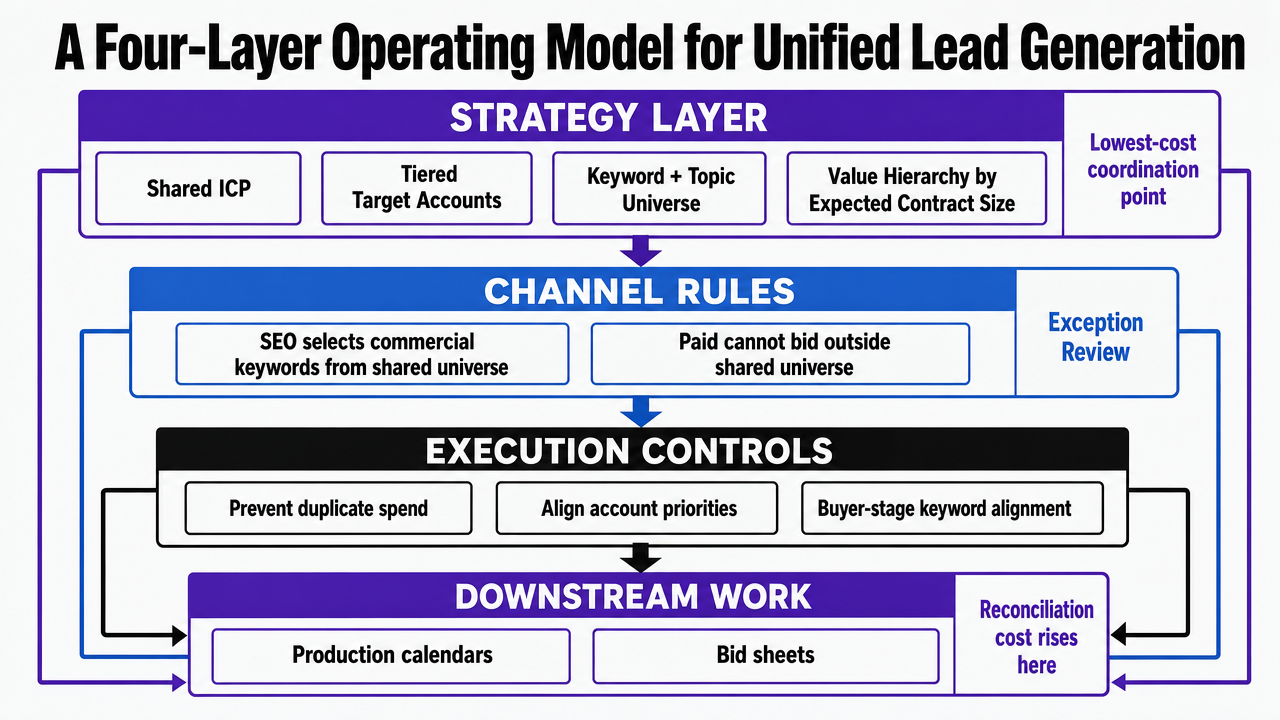 Visualize the four-layer operating model described across the section's subsections, showing how each layer inherits from the one above it
Test Unified Campaign Execution Across All Channels
Experience seamless lead generation by deploying coordinated content, SEO, and paid campaigns during your free trial.
Measurement as a Portfolio, Not a Dashboard
Why Single-Model Attribution Keeps Disappointing VPs
Marketing VPs often inherit or adopt a single attribution model, whether it's first-touch (favoring SEO), last-touch (favoring paid), linear (distributing credit evenly), or time-decay (crediting channels closer to conversion). These models frequently fail to align with pipeline reviews, leading to their eventual replacement.
Forrester states that no single multi-touch attribution model can meet all objectives and audiences. Marketers should instead use multiple models and measurement approaches tailored to specific decisions 1. Attribution is a decision-support tool, not an absolute truth. Relying on a single dashboard as the sole source of truth inevitably leads to recurring disappointment.
The portfolio approach to measurement uses four instruments, each addressing a different question:
- Multi-touch attribution estimates relative channel contribution for tactical reallocations.
- Incrementality tests (e.g., geo holdouts, paid pause tests, audience suppression) determine whether a channel is generating new demand or simply harvesting existing demand.
- Customer research, including win-loss interviews and buyer surveys, captures the channels buyers genuinely remember influencing their decisions, which often differs from click-path data.
- Media-mix signals provide an upper bound on a channel's plausible impact at current spending levels.
No single instrument is perfect, but together they provide a triangulated view that is more resilient to privacy changes, platform reporting shifts, and CFO inquiries about marketing spend efficiency.
From Lead Volume to Account Value
The second shift in measurement, moving from lead volume to account value, is more challenging because it impacts compensation structures. Most B2B SaaS marketing teams still report MQL volume to executives and compensate channel managers based on cost-per-lead. This metric is easily gamed and weakly correlated with closed-won revenue from target accounts.
Forrester's 2023 B2B predictions emphasize that companies aligning strategies and operations with customer needs outperform those optimizing for internal volume targets 2. Practically, this means demoting MQL count to a diagnostic metric and elevating three key measures for executive scorecards:
- pipeline created from tier-one and tier-two target accounts
- pipeline velocity by channel of first touch
- closed-won revenue attributed through the portfolio measurement stack rather than a single model
While changing reporting is straightforward, the more difficult change involves removing incentives for paid managers to chase cheap leads from non-target accounts or for SEO leads to celebrate traffic from segments outside the ICP. When the scorecard rewards account-weighted pipeline, channel teams are incentivized to request tighter, more focused target lists from the strategy layer.
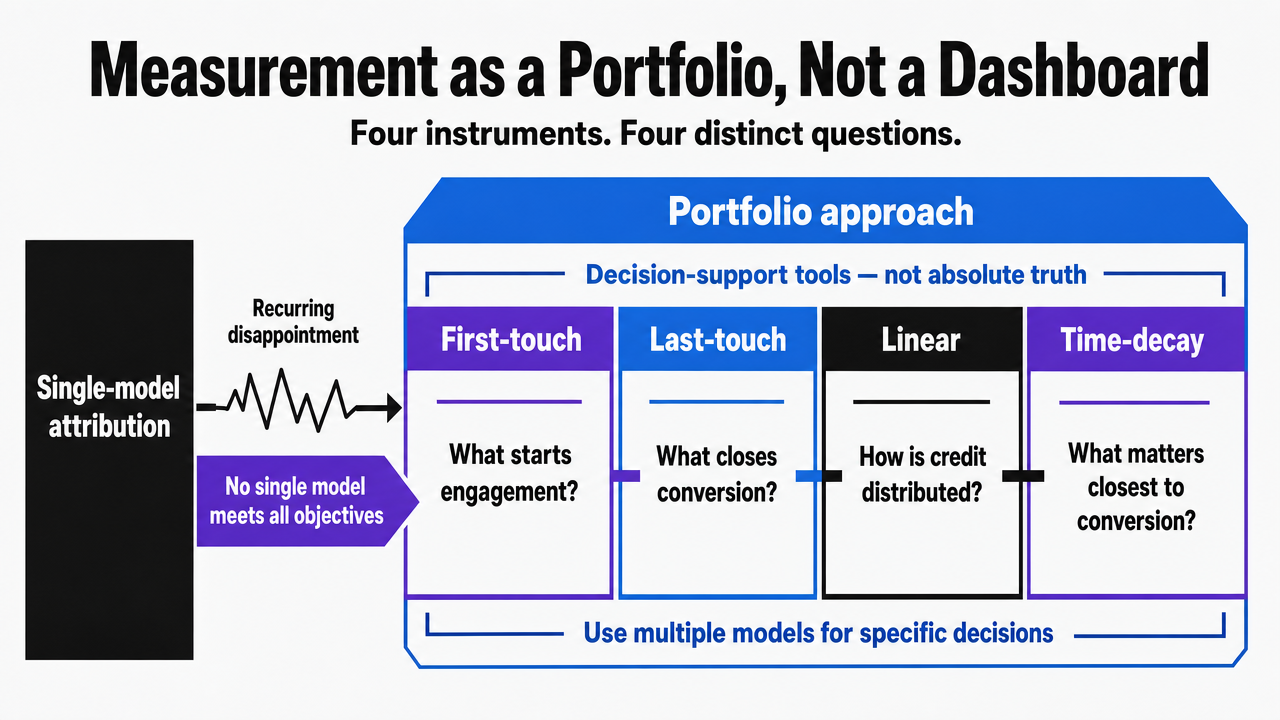 Illustrate the four-instrument measurement portfolio described in the section, showing how each instrument answers a distinct question
Personalization and the Human Handoff at Scale
AI-Driven Personalization Without Creep
Channel-level personalization often involves basic tactics like inserting a first name into an email subject line or rotating a few landing page variants. In contrast, personalization at the operating-model level means the orchestration layer understands an account's industry, pages viewed, past paid campaign interactions, and assigned sales representative. Every subsequent interaction is then rendered within this context. The latter is a practical outcome of integrating shared strategy and decisioning layers.
McKinsey's research on personalized marketing highlights AI and generative AI as key enablers for delivering tailored experiences across channels at scale. However, it also stresses that data governance, consent management, and privacy guardrails determine whether the outcome is perceived as relevant or invasive 3. The distinction between useful and "creepy" personalization lies in what data the system chooses not to use, rather than its technical access capabilities.
In practice, this requires three disciplines:
- Personalization rules must reference behavior and firmographic context explicitly provided by the buyer, not inferred third-party data.
- Variants should remain broad enough that buyers cannot easily deduce the system's knowledge.
- The orchestration layer must log every personalization decision, allowing teams to audit which inputs led to which outputs if a customer inquires.
Where Digital Should Yield to a Human Conversation
While scaling automation across SEO, paid, and link acquisition is tempting, buyer behavior suggests a balanced approach. McKinsey's omnichannel research indicates that companies integrating human contact into digital sales consistently outperform those that don't. Over-reliance on digital channels at the expense of high-value human interactions can lead to customer dissatisfaction, particularly among valuable segments 5.
The unified operating model treats the human handoff as a deliberate transition, not an exception. Three triggers typically warrant routing an account from digital to a human conversation:
- a tier-one target account reaching a defined engagement threshold
- a multi-stakeholder buying committee emerging simultaneously
- any interaction where the buyer's question exceeds the self-service path's capabilities
Below these triggers, automation manages the journey. Above them, a sales representative takes ownership, and the orchestration layer suppresses further marketing communications until the human sales cycle concludes.
See Unified Channel Coordination for Scalable Lead Generation in Action
Request a walkthrough of an AI-driven operating system that synchronizes SEO, PPC, and backlink strategies—designed for agencies and enterprise teams managing complex, multi-location lead generation.
For Multi-Location Operators: Where the Math Changes
Audience shift: the following section addresses marketing leaders running portfolios of locations, practices, or business units rather than a single SaaS P&L. Single-site SaaS readers can skip to the 90-day section.
For operators managing multiple locations, the fragmented marketing model incurs different cost structures. Channel vendors often price per location or per retainer band, and coordination overhead increases with the number of sites, not just the number of decisions. A portfolio that employs separate SEO, paid, content, and link vendors for each location repeatedly pays an integration tax every month, per site.
The following table illustrates how variables change between fragmented per-location and unified account-level models:
| Variable | Fragmented per-location model | Unified account-level model |
|---|---|---|
| Retainer count | One per channel per location band | One per portfolio |
| Per-location multiplier on production | Applied to every brief, page, and campaign | One brief, rendered to N locations |
| Coordination meetings per month | Scales with vendor count × location count | Scales with strategy cycles, not site count |
| Handoff delay between strategy and execution | Days to weeks per vendor | Same business day inside one production engine |
| Measurement reconciliation | Per-vendor reports, manually merged | Single measurement layer across sites |
Healthcare research underscores the operational importance of a unified approach. Studies on omnichannel interaction in healthcare show that integrated journeys across portals, mobile apps, call centers, and physical facilities enhance satisfaction and loyalty when channels share context, but erode trust when they don't 7. Deloitte's digital health work reports that 77% of health system executives are reimagining consumer health journeys towards continuous engagement, a goal unattainable if each location operates with a disconnected stack 8. The 2026 HIMSS recap noted the rollout of voice-first omnichannel AI agent platforms designed to automate high-volume intake and triage across multiple sites, indicating that AI orchestration is becoming a mainstream operating layer for multi-site systems 11.
For portfolio operators, the key takeaway is structural: the planning unit should be the account, not the individual location. Briefs, measurement, and decision-making should occur at the portfolio level, with individual sites inheriting from this overarching strategy.
A 90-Day Path to a Unified Operating Model
Transitioning from separate channel programs to a unified operating model doesn't require a complete re-organization or a new tech stack. Instead, it involves a sequenced 90-day process to rebuild the foundational artifacts that channels inherit.
- Days 1–30: Strategy artifacts. Establish a single ICP definition, a tiered target account list, and a shared keyword and topic universe scored by buyer stage. Discard channel-specific keyword lists. Publish a value hierarchy that ranks accounts by expected contract size, ensuring SEO, paid, and link decisions align with the same priority order 2.
- Days 31–60: Production and distribution rules. Implement a "one brief per topic cluster" approach, where content is rendered into organic, paid, outbound, and link artifacts that maintain consistent positioning 6. Apply three distribution rules: suppress paid bids when organic ranks in the top three for commercial intent, exclude accounts in active sales cycles from retargeting, and concentrate link acquisition on pages critical to pipeline generation.
- Days 61–90: Measurement and decisioning. Set up the portfolio measurement stack: use multi-touch attribution for tactical reallocation, conduct an incrementality test on the largest paid line, and perform win-loss interviews for the last twenty closed-won and closed-lost deals to understand buyer-remembered influence 1. Replace weekly cross-channel syncs with a continuous decisioning layer that proposes reallocations based on the shared strategy and routes exceptions to a single owner. Platforms like Vectoron are designed to manage these production and decisioning layers, streamlining operations without additional account managers between strategy and execution.
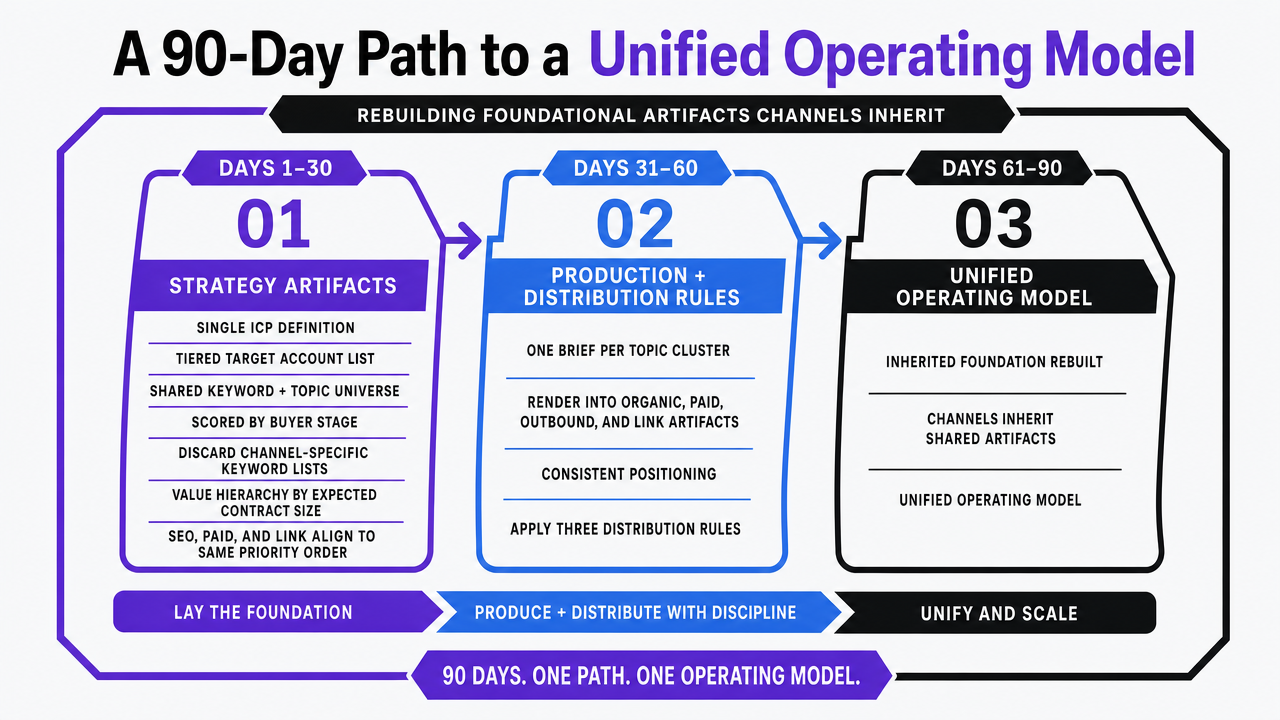 Visualize the three sequential 30-day phases of the implementation roadmap described in the section
Frequently Asked Questions
References
- 1.The Perfect Multitouch Attribution Model Doesn't Exist.
- 2.Predictions 2023: B2B Firms Up Their Focus On Customer Needs.
- 3.The next frontier of personalized marketing.
- 4.Five fundamental truths: How B2B winners keep growing.
- 5.Embracing the B2B omnichannel opportunity.
- 6.What Is Integrated Marketing Communications?.
- 7.An Overview of Omnichannel Interaction in Health Care Services.
- 8.Digital health: Unlocking an "always on" future of care.
- 9.Digital transformation in healthcare.
- 10.HIMSS 2026 Insights: How to Thrive in a Rapidly Changing Field.
- 11.What you missed at this year's HIMSS conference.