
Key Takeaways
- Search-intent content capture works because buyers self-select into commercial queries, so six strong comparison pages outperform sixty thin posts targeting the same terms.
- A structured content engine across articles, video, and case studies hits the documented format floor, with 92% of marketers using articles and 76% using video 4.
- Performance PPC earns its slot when match-type discipline and tight audiences capture click-through rates above 3.75% on high-intent terms 11.
- Account-based motions only justify coordination cost when they target buying groups, with two or more contacts from one account engaging inside a 14-day window.
- Product-led and demo-led acquisition produce the highest-fidelity signal because activation events, not email captures, indicate a prospect did real evaluation work.
- Email nurture compounds prior touches cheaply, but the gap between 36.7% median opens and 50%+ top-quartile opens is a segmentation gap 6.
- Community-led demand covers review platforms and peer conversations at shortlist moments, where the absence of recent activity reads as a negative buying signal.
- Partner and co-marketing programs lower cost per qualified lead through pre-aligned audiences, but collapse without written audience-exchange agreements and a shared offer.
- Hybrid inside-sales motions convert digital traffic through behavior-triggered handoffs, with McKinsey estimating up to 50% more revenue versus single-channel approaches 2.
- Conversion optimization compounds every other play, with McKinsey documenting roughly 60% on-site conversion lift from segmentation and tailored-offer pilots 18.
- AI-orchestrated execution replaces coordination work across the other ten plays, letting one approver and a specialist layer run what traditionally required separate owners 17.
Why the channel list stopped being the differentiator
Two numbers explain why the standard "11 lead generation tactics" listicle has aged poorly. Konica Minolta's buyer journey research reports that 74% of B2B decision-makers complete more than half of their research before contacting a vendor, and that more than 70% now prefer digital self-service or remote interactions over traditional sales calls 7. DemandGen Report data, cited in Entlify's 2025 SaaS lead generation guide, shows that 47% of B2B buyers read three to five content pieces before they will speak to sales 11. Both figures describe buying behavior across surveyed B2B decision-makers, not a single vertical, and both predate any individual play in this article.
That reframes the work. Pipeline rarely stalls because a lean team forgot a channel. It stalls because the channels run as eleven separate workflows, each producing form fills that have no shared definition of intent. Forrester's read on the same data is blunter: buyers have moved to self-service, and most sales and marketing teams have not adjusted their content, processes, or technology to match 8.
The eleven plays below are rated on two axes a Series A–C director can actually defend in a budget review: the buying signal each play produces, and the coordination cost a 2–6 person team pays to run it. Channel coverage is assumed. Orchestration is the variable.
The eleven plays, rated by signal yield and coordination cost
Search-intent content capture
Organic search remains the cheapest place to catch a buyer mid-task. Wynter's 2024 research on SaaS marketing leaders found that B2B buyers actively hunt down information across vendor sites, review platforms, and product content before they engage a salesperson 16. A search-intent capture play maps that hunting behavior to specific URLs: a comparison page for the bottom-funnel query, a category explainer for the middle, a problem-framing piece for the top.
The mechanic is unglamorous. A growth team picks 20–40 commercial-intent keywords where a buyer is comparing options or pricing, then ships a 2,000–2,800 word page per keyword with a buying-group-relevant CTA. The signal produced is high-quality because the visitor self-selected into the task. Entlify's compilation of DemandGen Report data shows 47% of B2B buyers consume three to five content pieces before contacting sales, which means the page has to be one of those three, not the eighth 11.
The failure mode for lean teams is publishing thin pages on too many terms. Six strong comparison pages will outperform sixty generic posts on the same site.
The structured content engine (articles, video, case studies)
Behind every search-intent page sits a production line. The Content Marketing Institute's 2024 B2B research shows that 92% of marketers use short articles or posts, 76% use video, and 75% use case studies or customer stories, with video rated the highest-performing format for goal achievement 4. That distribution describes the floor, not the ceiling — a lean team running fewer than three formats is competing against full portfolios.
A structured engine for a 2–6 person team usually looks like this: one weekly article tied to a search target, one monthly customer story with a quoted dollar or time outcome, and a short-form video clipped from sales or research calls. The buying signal is downstream — page depth, video completion, case study downloads filtered by company size — not the asset itself. Forrester's 2024 demand guidance pushes leaders to measure programs by buying-group engagement rather than asset-level metrics, which collapses the temptation to staff each format separately 9.
The coordination cost shows up in handoffs between writers, designers, and reviewers. Lean teams that hold all three formats in one workflow ship 3x the volume of teams that split production across freelance vendors.
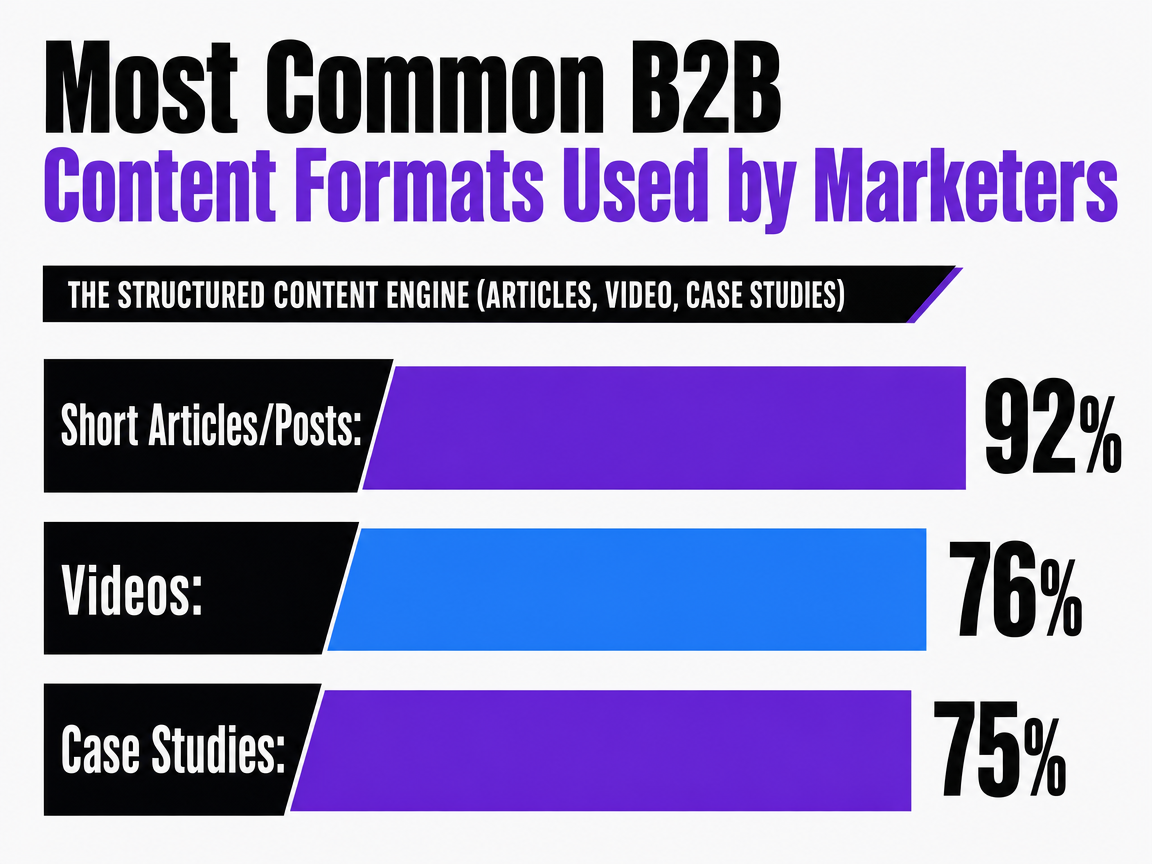 Most Common B2B Content Formats Used by Marketers
Based on Content Marketing Institute's 2024 research, this shows the percentage of B2B marketers using specific content formats. Video was cited as the highest-performing format.
Performance PPC and paid social on high-intent terms
Paid acquisition earns its slot when it buys signals organic cannot reach in time. Entlify's SaaS lead generation analysis reports that optimized paid campaigns observe click-through rates above 3.75% on high-intent terms, well above broad-match averages 11. The play has two halves: branded and competitor search defense on Google, and LinkedIn document ads or single-image ads on narrowly defined job-title audiences.
The mechanic that separates competent execution from money burning is match-type discipline and audience size. A lean team running LinkedIn at a Series B SaaS usually caps audiences at 15,000–40,000 matched members per campaign, then rotates two creative variants every 14 days against the same offer. Search budgets concentrate on the lowest five or six commercial-intent terms instead of spreading across hundreds.
The signal is binary at the click level — someone with a defined job title clicked an offer-specific ad — and the failure mode is retargeting that re-serves the same creative for six weeks. McKinsey's hybrid sales research notes that buyers expect channels to coordinate, not collide 2.
Account-based motions tied to buying-group signals
Account-based programs only earn the coordination cost when they target buying groups, not single contacts. Forrester's planning guidance for 2024 is explicit: demand leaders should rebalance toward programs that create real buying-group signals rather than chase vanity volume, because lead-level scoring misses the four to seven people actually involved in a B2B decision 9.
A lean-team ABM motion is narrower than the enterprise version. A growth director at a Series B picks 80–150 named accounts that match the firmographic ICP, runs LinkedIn audiences against the buying titles inside each one, and pairs that with a low-friction asset — a benchmark report, an interactive assessment, or an industry-specific calculator. The signal worth acting on is multi-contact: two or more people from the same account engaging within 14 days.
Vereigen Media's demand-generation work on SaaS programs frames ABM outreach, webinars, and AI-based lead scoring as a single integrated motion rather than separate channels, which is the only way a small team can execute it without a dedicated ABM hire 12. The failure mode is buying the data and skipping the offer — a target list with no asset produces nothing but cold open rates.
Product-led and demo-led acquisition
Self-service entry points produce the highest-fidelity buying signal in the portfolio: a person did the work to try the product. Vereigen Media's analysis of SaaS demand programs argues that product-led growth and demo-led motions reduce acquisition costs, cut friction, and shorten the sales cycle by giving the buyer agency over the evaluation 12. Roo and Eve's research on self-service buyers describes the same mechanic from the buyer side — people answer their own questions and make decisions with minimal sales involvement when the experience supports it 15.
The play has three operational pieces:
- a frictionless trial or sandbox,
- an in-product activation path tied to one core job, and
- a usage-based qualification rule that fires when a prospect hits a defined threshold.
A lean team treats activation events as the lead — not the email capture that preceded them.
The failure mode is treating PLG as a replacement for sales rather than a qualification layer. Trials without a defined assist trigger convert at a fraction of trials where an inside seller engages once the user crosses the activation line.
Email nurture against documented benchmarks
Email is the cheapest place to compound prior touches, and the benchmark spread reveals how much room most programs leave on the table. Verified.email's 2025–2030 B2B benchmark synthesis reports median open rates of 36.7%–42.35% and median click-through rates of 2%–4%, while top-quartile programs clear 50%+ opens and 10%+ CTR 6. The gap between median and top-quartile is the segmentation gap.
A six-touch nurture for a Series B SaaS list usually carries three behavioral branches:
- a research branch for new subscribers,
- a comparison branch for visitors who hit pricing or competitor pages, and
- a re-engagement branch for accounts that opened then went quiet.
Each branch carries different copy, not different headers on the same template.
The buying signal is sequence-completion plus a second-asset click, not the open. Median opens with no clicks indicate the subject line worked and the offer did not. McKinsey's targeted-marketing case work shows that segmentation and tailored offers produced a 25% lift in email conversions in a comparable retailer program, with the underlying mechanic — segment, tailor, sequence — directly applicable to B2B nurture 18.
Community-led demand and social proof loops
Community is the play most often confused with brand. The function it serves in lead generation is review-platform and peer-conversation coverage at the moments buyers are validating a shortlist. Wynter's SaaS buyer research describes how decision-makers actively hunt across review sites and peer content during evaluation, which means the absence of recent activity reads as a negative signal 16.
The mechanic is concrete: a quarterly cadence of customer reviews on the two platforms the ICP actually uses, a LinkedIn presence anchored on three or four named operators rather than the company page, and a closed Slack or community channel where existing customers answer prospect questions in public-adjacent settings.
The buying signal is referrals from review platforms with intent metadata attached and inbound conversations from named operators' posts. The 2024 LinkedIn B2B benchmark notes that performance marketers are pairing brand activity with paid demand programs for efficient pipeline growth, which is the operating model community work supports 3. The failure mode is paying for review badges without staffing the community responses behind them.
Partner and co-marketing programs
Partner motions consolidate audience access. A single co-hosted webinar with an integration partner can produce more qualified registrations than a quarter of paid social spend, because the partner already owns trust with the target list. Entlify's lead generation guide places partnerships alongside content and SEO as core organic acquisition levers, on the basis that the cost per qualified lead is structurally lower when audiences are pre-aligned 11.
For a lean team, the executable version is one partner-led asset per quarter: a co-authored benchmark report, a joint integration webinar, or a shared customer story. Each partner gets a defined audience exchange and a single attributable CTA.
The buying signal is partner-attributed pipeline tagged at the lead source level, not registration volume. The failure mode is co-marketing as logo-trading — joint blog posts neither side promotes, lists neither side actually has permission to use. Partner programs without a written audience-exchange agreement and a shared offer collapse within two quarters.
Hybrid inside-sales motions on self-service traffic
Hybrid sales — combining digital self-service, remote sellers, and selective in-person engagement — is the model that converts the digital traffic the other plays produce. McKinsey's B2B Pulse-based hybrid sales research estimates that hybrid models can drive up to 50% more revenue than traditional approaches by serving buyers across the channels they actually use, with the figure tied to surveyed B2B organizations comparing hybrid versus single-channel models 2.
The mechanic for a Series A–C SaaS team is a defined handoff between marketing-sourced behavior and inside-sales action. A prospect who hits pricing twice, downloads a comparison asset, and matches the ICP gets a 30-minute remote consult invitation within two business days. Anything below that threshold stays in nurture.
The buying signal is engagement-triggered, not lead-form triggered. Forrester's self-service analysis is direct: buyers complete tasks on their own and many sales teams have not adapted their processes to those task-based signals 8. The failure mode is letting SDRs call every form-fill regardless of behavior, which trains the audience that the form is the cost of getting spammed.
Conversion optimization as a standing program
Conversion optimization belongs in the lead generation portfolio because it compounds every other play. McKinsey's targeted online marketing case work documents a 60% increase in on-site conversions and nearly 30% higher marketing ROI after segmentation and tailored-offer pilots, with the mechanics — testing, audience-specific offers, lifecycle programs — directly transferable to B2B sites 18.
The standing program a lean team can run looks like one structured A/B test per month on a high-traffic page, a quarterly form audit to eliminate fields the sales team does not act on, and a continuous review of paid-landing-page-to-meeting conversion rates by audience segment. Tests run on small samples and inconclusive results count as a finding — most B2B sites do not have the traffic volume to declare a winner inside two weeks.
The buying signal CRO produces is a lift in the conversion rate of every other play already running. The failure mode is testing button colors on pages that get 400 visits a month while the comparison page that drives qualified pipeline goes untouched for a year.
AI-orchestrated execution across the other ten plays
The eleventh play is not a channel. It is the layer that coordinates the other ten. McKinsey's 2025 analysis of B2B sales technology argues that gen AI, combined with external data and integrated with a CRM, can produce a granular view of a market and convert that view into leads qualified by inside sales — expanding pipeline without proportional headcount 17. The framing matters: AI orchestration replaces coordination work, not strategy work.
The operational pattern looks like this. Account-level data from analytics, search console, paid platforms, and CRM flows into a single working model. A specialist layer — content, SEO, conversion, PPC, partner — proposes prioritized actions against that data. A human approval step gates publishing, bidding, and outreach. Execution runs continuously across the ten plays above without per-tactic handoffs.
That description fits a small set of platforms now operating in the category, including Vectoron, which runs strategy, content, SEO, PPC, and backlink work from a single account-level plan rather than per-channel retainers. The category exists because the coordination tax on running eleven plays through a traditional agency or a stack of point tools is the part lean teams cannot scale.
The buying signal AI orchestration produces is portfolio-level: which plays are producing buying-group engagement against which accounts this week, and where to redeploy budget next week. Forrester's demand-leader guidance for 2024 lands in the same place — rebalance toward programs that create real signals and away from volume metrics 9. The failure mode is automating bad workflows. Orchestration improves what the team already runs well; it does not invent strategy where none exists.
Test Automated Lead Generation Workflows in Real-Time
Experience fully automated campaign execution and publish live content with actual lead data during your trial.
Coordination economics: where the eleven plays consolidate
The argument for consolidation is not that any single play above is hard. It is that running eleven of them through separate owners, separate calendars, and separate reporting layers creates a coordination tax that a 2–6 person team pays in missed handoffs rather than in invoices. McKinsey's omnichannel research notes that the more channels a B2B sales organization deploys in a coordinated way, the larger the market share gains — the qualifier is coordination, not channel count 1.
The table below maps each play to the coordination owners a traditional retainer model assumes versus an AI-orchestrated model, alongside the sourced benchmark the play targets. Dollar figures are limited to one published price point; the rest are documented behavior benchmarks.
| Play | Traditional retainer owners | AI-orchestrated owners | Sourced benchmark |
|---|---|---|---|
| Search-intent capture | SEO lead, writer, editor, dev | One approver, one specialist layer | 47% read 3–5 pieces pre-sales 11 |
| Content engine | Strategist, writers, video, design | One approver, one specialist layer | 92% articles, 76% video, 75% case studies 4 |
| Performance PPC | Media buyer, analyst, designer | One approver, bid layer | >3.75% CTR on optimized terms 11 |
| ABM | ABM lead, ops, BDR, content | One approver, signal layer | Buying-group rebalance 9 |
| PLG / demo-led | PM, growth eng, lifecycle | Activation signal layer | Self-service preference 15 |
| Email nurture | Lifecycle marketer, copy, ops | Segmentation layer | 36.7–42.35% open, 2–4% CTR 6 |
| Community | Community lead, social, PR | Cadence + review layer | Buyer hunt-down behavior 16 |
| Partner programs | Partner manager, co-marketing | Asset + audience layer | Organic acquisition lever 11 |
| Hybrid inside sales | SDR manager, ops, enablement | Behavior trigger layer | Up to 50% revenue uplift 2 |
| CRO | CRO lead, dev, designer, analyst | Test queue layer | ~60% on-site lift in pilots 18 |
| AI orchestration | n/a in retainer model | Platform (e.g., Vectoron at $599/mo post-trial) | AI + CRM lead expansion 17 |
The consolidation pattern is consistent: eleven workflows, two effective owners — a human approver and a specialist execution layer. That is the structure lean teams can actually staff.
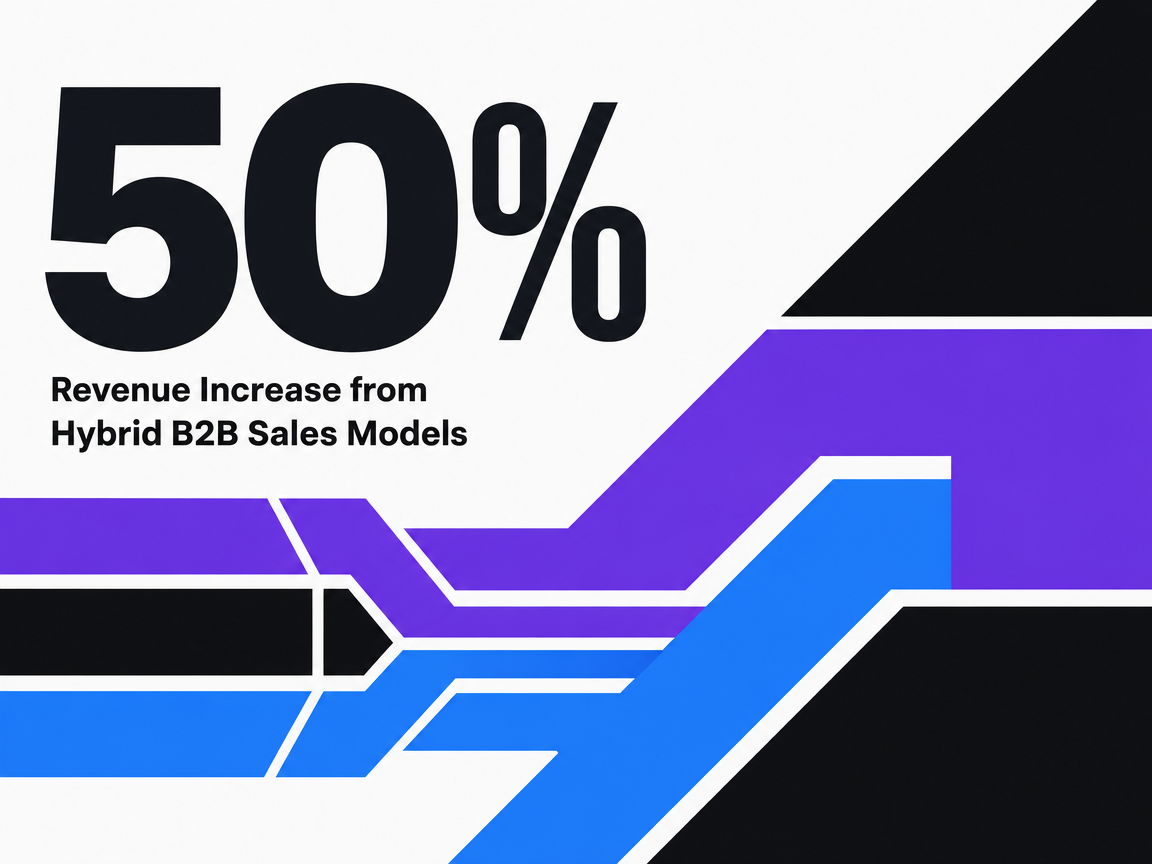 Revenue Increase from Hybrid B2B Sales Models
Revenue Increase from Hybrid B2B Sales Models
Explore Scalable Lead Gen Tactics for High-Performance SaaS Teams
Get a direct walkthrough of automated B2B lead generation workflows proven to reduce CAC and coordination overhead for multi-location and agency-led growth programs.
Portfolio allocation: weighting plays by signal type, not channel count
The macro backdrop matters here. MarketSource's 2024 analysis cites Federal Reserve of New York data, referenced via Forrester, showing net new B2B sales dropped 19–30% in 2023 — a contraction that punishes any portfolio still optimizing for raw lead volume 14. A lean team running eleven plays cannot afford to weight them evenly. The question is which plays produce signals worth a seller's time and which produce only headline metrics.
Three signal categories sort the portfolio cleanly.
- Buying-group signals — two or more contacts from one account engaging within a defined window — come from ABM, hybrid inside-sales triggers, and partner co-marketing. These deserve the heaviest weight because they map to how Forrester says demand leaders should rebalance: away from vanity volume, toward real opportunity creation 9.
- Activation signals — a trial user hitting a usage threshold, a comparison-page visitor returning twice — come from PLG, search-intent capture, and CRO. These compound the buying-group work by pre-qualifying who is worth pursuing.
- Volume signals — opens, downloads, registrations — come from the content engine, email nurture, community, and broad PPC. They remain necessary as the feed-stock for the first two categories but should be measured by downstream conversion to activation or buying-group engagement, not by their own counts.
Weighted that way, the eleven plays stop competing for budget and start feeding each other.
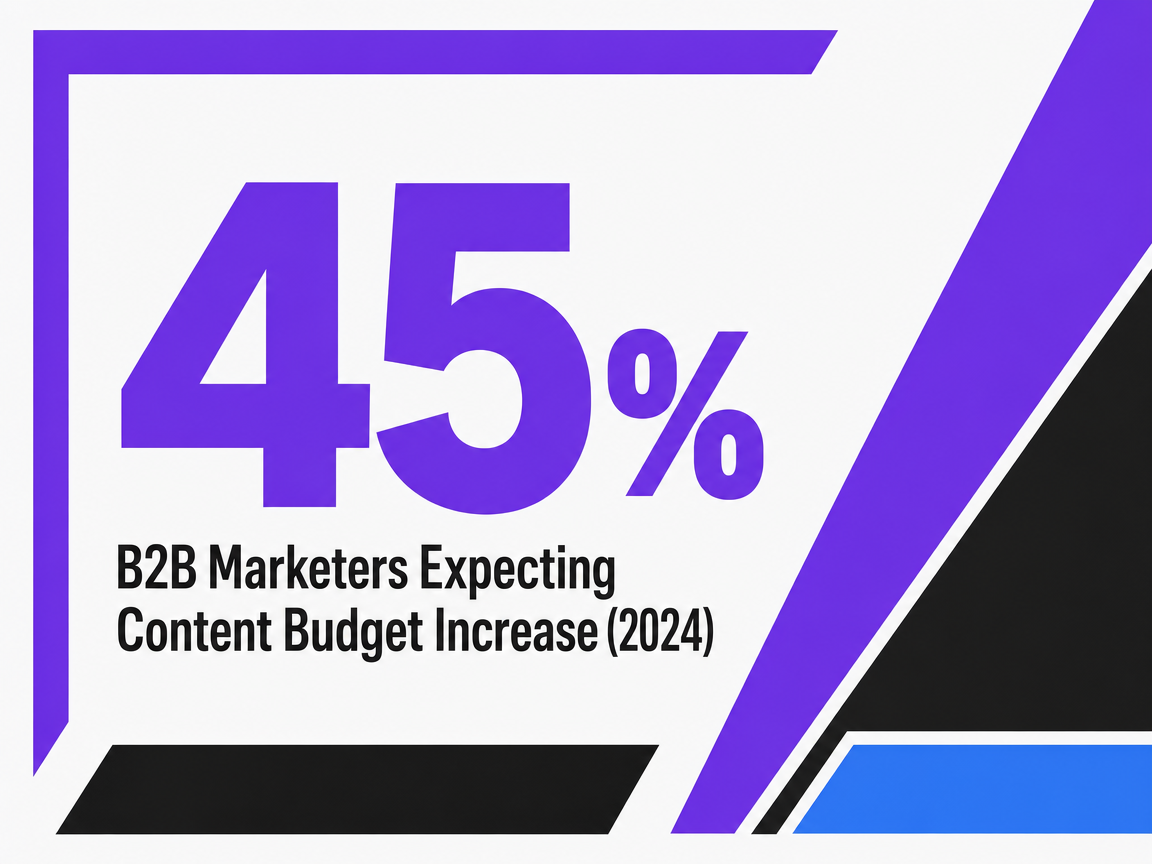 B2B Marketers Expecting Content Budget Increase (2024)
B2B Marketers Expecting Content Budget Increase (2024)
Frequently Asked Questions
References
- 1.The new B2B growth equation.
- 2.The future of B2B sales is hybrid.
- 3.2024 B2B Marketing Benchmark.
- 4.57+ Content Marketing Statistics To Help You Succeed in 2025.
- 5.B2B Content Marketing Benchmarks, Budgets, and Trends: Outlook for 2024.
- 6.B2B Email Marketing Benchmarks & Strategic Forecast 2025–2030.
- 7.Modern B2B Buyers and Buyer Journeys.
- 8.Self-Service Buying Is A Wake-Up Call For B2B Sales.
- 9.Three Tips To Guide B2B Demand Marketing Leaders' Plans For 2024.
- 10.50+ Eye-Opening Demand Generation Statistics for B2B Marketers.
- 11.B2B SaaS Lead Generation: Organic vs. Paid Strategies Guide.
- 12.Top B2B Demand Generation Strategies for SaaS Companies.
- 13.Digital: The Deciding Factor in the New Age of B2B Sales.
- 14.Lead Gen (the Old Way) is Dead! And 7 Other B2B Sales Predictions for 2024.
- 15.The Changing B2B Buyer and the Rise of Self-Service Sales.
- 16.The B2B Buyer Journey Research: How B2B SaaS Marketing Leaders Buy.
- 17.Five ways B2B sales leaders can win with tech and AI.
- 18.Targeted online marketing programs boost customer conversion rates.